Consideration in the OGL 1.0/1.1 #Copyright #OGL #WotC #TTRPG #RPG #DnD #Contract

If you enjoy this post, please retweet it.

So, the Open Gaming License 1.1 (“OGL”) was leaked. Let’s remember that 1) it could be fake; 2) it could be real but modified; and 3) it could have been an intentional leak designed to get feedback in dumbest way possible. We don’t strictly know which of the three it is, though the response of Wizard of the Coast (“WotC”) makes me believe that #1 is not an option. Here’s the response:

Oh, I’m sorry. Wrong media. Here it is.

I think it’s fair to be thinking about the issues this leak raises. I’d just prefer people not assume the sky is falling. Changes could be coming, however unlikely or meaningless they may be. Anyway, with all those caveats above . . . .

A Brief Review

When it comes to consideration, the OGL 1.1 falls into the same structural trap that the OGL 1.0 does. It licenses you “methods, procedures, processes and routines” as well as ” any additional content clearly identified as Open Game Content by the Contributor. . . .” The first part of that grant mirrors language in the Patent Act and patent law practice defining what can be patented. Likewise, these same words are used in the Copyright Act (specifically 17 U.S. Code § 102(b)) and copyright law practice to describe things not copyrightable. So, for a company like WotC that isn’t using the OGL to license patented subject matter (which is pretty much the case for all RPG producers), that first part clearly licenses nothing.

The second part of that grant is meant to reference the System Reference Document (“SRD”), but by its own terms could mean a press conference. A clear statement is a clear statement. However, in WotC’s case, they use the SRD. The content of the SRD is either mechanical (never copyrightable), an inseparable mix of mechanical and creative (and thus not copyrightable), or so simple and trite as to not represent even the “modicum of creativity” necessary to be copyrighted. So, my position has always been that, even with that second part, they’re still giving you nothing.

It’s apparently WotC’s position as well.

Now, with a new OGL on the horizon, maybe they’ll fix that. Maybe the SRD 5.1 (and OneD&D’s SRD) will contain licensable material. Assuming that material (or you’re assuming the material in the current OGL) is creative, does that mean the OGL won’t fail for lack of consideration?

Nope. It still fails, and here’s why.

An Analogy: Renting an Apartment

Recently, I started sharing this analogy on social media, and I think it makes it easier to understand the structural failure of the OGL. Let’s say you sign a lease to rent an apartment. It’s states that your rent is $800 (cheap nowadays), and that it runs from January 1 to December 31. Easy, right? Let’s say it also has a provision stating that you agree to abide by all the Rules & Regulations that appear in a second document. This is hardly rare. I’ve seen them more times than I can remember.

So, why put Rules & Regulations in a separate document? Is it to save space? Clearly not. If the lease is 3 pages long, and the Rules & Regulations are 10 pages long, then combined they’ll be 13 pages. Either way, it’s 13 pages of content, most of which you’re unlikely to read until there’s a dispute, so you’ll just skip ahead to the signature page and sign it. If the concern is organizational, then why not include them an exhibit or appendix? Again, why put them in separate documents that often aren’t even available when you sign the lease?

There’s only one reason: The Rules & Regulations are expected to change as circumstances change.

If the waste disposal company changes their pickup day from Tuesday to Monday, it makes no sense to say that trash can’t be put out until Monday evening after sunset. The Rules & Regulations must adapt. Use of common areas gives rise to the same need for flexibility. If anything in the Rules & Regulations were expected to go unchanged during the term of the lease, they could have been included in the lease.

Well, the OGL is your lease, and the SRD is your Rules & Regulations. The OGL sets the basic terms that can or cannot be revoked (separate discussion), but they reference a separate document where you get the current set of intellectual property that WotC (or any licensor) wants to license to you. There’s no legal or contractual reason to infer that any given licensor using the OGL is restricted from changing the contents of that document, and every reason to believe they can change it whenever they want.

You may think that, in this case, there is a reason to separate the two into different documents that has nothing to do with whether they can be changed. The OGL was intended to be used by other gaming companies with only their intellectual property within it. But that only solidifies that SRDs must be flexible. Also, it doesn’t get around the fact that the “clear statement” of the licensor could have been referenced as a required appendix or exhibit to the license itself rather than a separate document. It could have flat out stated that it was immutable, and absolutely should have said it is “incorporated by reference.” Again, there’s nothing (I’m aware of) in the contract, the law, or the history of interpreting consumer contracts that leads us to infer that the SRD can’t be changed. It’s a separate document (or oral statement!) that otherwise has no need to be separate. If I’m wrong, please point me to an example of a consumer contract with a separate, unsigned document (not merely an appendix, exhibit, schedule, etc.), not necessarily drafted at the time the contract is accepted, and not required to be in writing, that doesn’t expressly demand immutability in that separate document, yet is interpreted to require the separate document to be fixed. (That’s a mouthful, but it’s a lawyers job to interpret such sentences, so they know what I want.)

Aside: One thing that makes the OGL laughable is, carrying this analogy further, the OGL is like the lease and Rules & Regulations, but where the unit you live in, the amount of your rent, and the term of your rent all appear in the Rules & Regulations rather than the lease itself. I hope you see how batshit insane that is, but that’s what we’re dealing with.

This kind of uncertainty of consideration, especially where the licensor has no patents to license, calls the entire structure into question. I find it unlikely that this “contract” survives judicial scrutiny even if the licensee (non-drafter) of the OGL, wants consideration found so that you can enforce it. (Of course, what do you do with interpretation if the licensor is a game designer other than WotC? In that case, neither party drafted the contract, and by the OGL’s own terms, the licensor may not change it [the OGL].) Courts aren’t going to decide for the parties what they think should be included in the SRD with no guidance from the OGL to decide that. All it says is that there must be a “clear statement.” Statements change all the time.

Going back to the lease, your rent and term are set in stone. No matter what they do with the Rules & Regulations, your rent and term can’t be changed. The same is true here. The terms of the OGL aren’t changed by the SRD. You still can use their patents without any apparent restriction (isn’t that odd?), you still can’t use “environments” WotC mentions (that’s crazy), you can still accept the license merely by playing the game even if you’ve never heard of Dungeons & Dragons (“WTF?!”), etc. But again, there’s no reason to believe that the contents of the SRD are set in stone. They’re expected to change, and that also makes sense when considering that WotC has a federal right to control its copyrighted material. WotC hasn’t dedicated their work to the public, but a contrary interpretation could lead to exactly that without a clear statement of intent to do so. Federal copyright law will always override state-based interpretive principles. That is, state contract theories don’t overrule federal law (let alone the Arts & Sciences clause of the U.S. Constitution). I’ll have more to say on that in a future post, because the fact that copyright is involved adds even further strength to this argument.

On a side note, this is why the alleged irrevocability of the OGL is completely irrelevant. The OGL may be irrevocable, but the SRD isn’t (so to speak).

Could Things Have Been Different?

Someone asked me whether a license is even possible. Yes, it is, but not in the way the OGL was intended, and certainly not in the way you’ve all treated it all these years. The OGL 1.1 approaches a real license. It’s a shitty one, but it’s nearly a real license, and I don’t think it would have been received well even if the terms weren’t so onerous. I don’t think the OGL should have ever been (mis)characterized as license. Again, it’s point was to say, “We’re letting you use everything we put in the SRD,” even though most, if not all, of that material is not copyrightable.

What the SRD should have been was instead the exact opposite. It should have been a statement by WotC conceding what they didn’t own, and thus what you were free to use for all time because they had no right to stop you. They should also have said that, in the event they did own anything in the SRD, it’s dedicated to the public domain. If you think it through, that’s how you’re using it, and at least for the overwhelming majority (if not all) of that material, that’s what the SRD discloses. This would also alleviate every single concern I’ve ever stated on the OGL, because the OGL wouldn’t be needed.

Depending on WotC’s eventual statement, I may publish a post I have written that will be quite a serious statement on my part, but either way, I’ll be diving into some heavier copyright theory. Stay tuned.

Either way, can we all agree that WotC screwed up?

Follow me on Twitter @gsllc

Dungeons & Dragons is a trademark of Wizards of the Coast, LLC, who neither contributed to nor endorsed the contents of this post. (Okay, jackasses?)
I’m Famous! Plus OGL 1.1 Termination #Copyright #OGL #WotC #TTRPG #RPG #DnD @JohnduBois @TalesofArcanaRP @SRMacFarland @ChrisHonkala @kilpatds

If you enjoy this post, please retweet it.

Before I say something serious, I’m going to show you something funny.

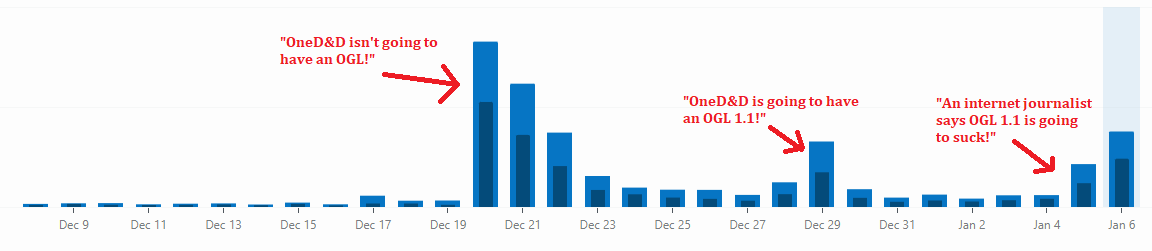
Look at this craziness, most of which are hits to my stat block and OGL posts.

Isn’t Microsoft Paint the best?! Eat your heart out, Nowak!

But wait! It gets … worse? Better? Throughout those posts, if I referenced a legal concept that wasn’t critical to the theme, rather than spell it out for you, I saved space by linking to a discussion of that legal concept on my far less popular legal blog. Here are the hits for that blog over the past few days.

Since writing this post, these numbers have gotten MUCH bigger. Today’s hits are now twice as large as December 29th’s and are approaching December 21st’s.

I don’t want to be famous, so I may have to shut down these blogs. 🙂

Also, I should have tagged John and Tales of Arcana yesterday, so I’m doing so today — with top billing — even though they have nothing to do with this post. So, there you go. If I’m going to be famous, I’m pulling those nerds into it with me.

Something Serious

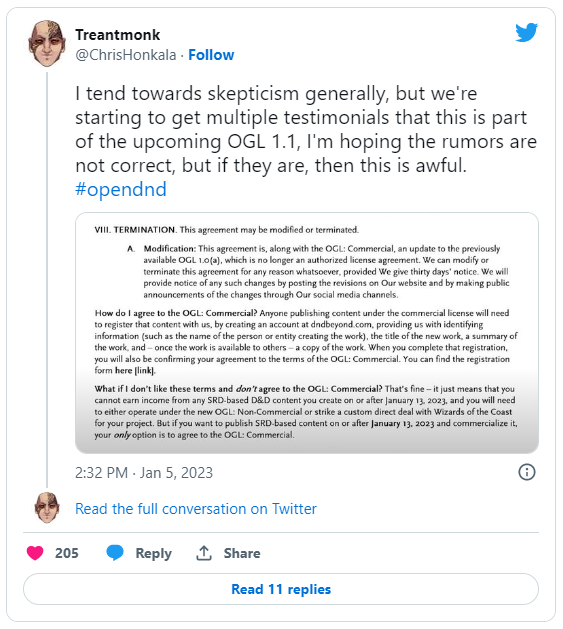
This is a supposed excerpt from the OGL 1.1. I have no idea if it’s real.

Here’s the full-sized image:

But if it is . . .

I Did That Reaction GIF by New York Institute of Technology (NYIT) - Find & Share on GIPHY

. . . you’re welcome. Sort of. It’s clear that my concerns about the OGL are being met, for better or worse, and I know WotC Legal read my posts. This means that there’s a good chance that the OGL 1.1 will be a real license because I pointed out why 1.0 wasn’t. The speculation is that 1.1 will be arduous, but the fake OGL is no less arduous. It simply appears open because WotC is lying to you about what they’ve actually licensed to you (reminder: NOTHING!). They could always have changed their mind and done this. Some people have said to me that WotC could never pull the rug from underneath the community because they’d revolt, but now that they’re telling you the truth, they’re saying (straining the metaphor a bit) that no rug is henceforth standard operating procedure. They’re expressly doing what I told you they always could, and the community is preparing a revolt. Voila!

So, now they’re going to tell you the real story, and it’s clear you don’t like it. Maybe you shouldn’t. Either way, this may not be good for business, and this may not change WotC Legal’s status as . . . well, you know my opinion, but at least you’re going to be protected from deceit (again, assuming this is real and representative of what they’re going to do throughout the OGL 1.1).

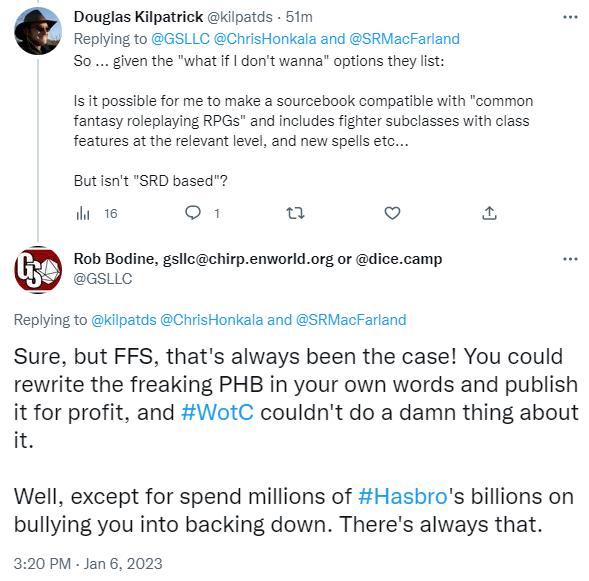
And then there’s this:

Think about it, people, but not too hard, because . . .

The truth hurts.

Follow me on Twitter @gsllc
Follow SRM @SRMacFarland
Follow John @JohnduBois
Follow Matt @TalesofArcanaRP
Follow Chirs @ChrisHonkala
Follow Doug @kilpatds

Dungeons & Dragons is a trademark of Wizards of the Coast, LLC, who neither contributed to nor endorsed the contents of this post. (Okay, jackasses?)

In case the tweets are ever deleted, here are screenshots.

The OGL 1.1 Draft #Copyright #OGL #WotC #TTRPG #RPG #DnD @SRMacFarland

If you enjoy this post, please retweet it.

As you all know, someone got a hold of a snippet of the new OGL 1.1 draft. A few people (publicly and privately) have asked me to weigh in based on my Tome of WotC Criticism. Sorry, but I’m not going to make the same mistake many people did jumping to conclusions about the OGL 1.1, so I’m certainly not going to comment on its text that I haven’t read. I’m also not relying on Gizmodo’s interpretation due to all of humanity’s experience with news media. I will remind you all that the current OGL isn’t a real license. No one has signed it, it’s terms for otherwise accepting it are laughable, and it doesn’t actually license you anything.

Beating a Dead Horse

WotC owns its expression of the game mechanics, but despite their implications, they never license that to you. The OGL (even assuming it’s real) uses terminology appearing in both the Patent Act and Copyright Act, saying “this stuff is what we’re licensing.” Those things are stated to be patentable subject matter in the Patent Act and are expressly excluded from copyrightable subject matter in the Copyright Act. And just to be on the safe side, the OGL says (in case it’s not already obvious, paraphrasing):

If any part of what we’re licensing falls under copyright or trademark [you know, such as the specific expression of game rules!], then we take that out of Open Gaming Content, stick it in Product Identity, and don’t license it to you.

No matter how seriously you take the OGL as a license, there’s simply no way to interpret, “processes, methods, routines, and procedures” as including anything copyrightable, which means nothing copyrightable is being licensed. So, despite the SRD containing WotC’s expression of game rules, and despite WotC’s claim to be allowing you to use that material, WotC is free to pull the rug out at any time and say, “You used out expression!” They never actually license it to you because the SRD is not in any way incorporated into the OGL.

Back on Point

It’s a bit hard to answer your questions or respond to your concerns when they’re all based on so weak a foundation, but here’s something on point. There’s a huge debate going around as to whether the OGL can be revoked. For those that say it can, you’re wrong because there’s nothing to revoke. It isn’t real. For those that say it can’t, you’re referencing language from the FAQ and OGL itself that suggests that. Why do you think that language makes it so clearly irrevocable? The FAQ itself states that “people will just ignore [a revocation] anyway.” How is it that a real license can simply be ignored? Because it’s not a real license. The answer to both groups is the same. You’re both right because you’re both wrong.

While the originally stated intentions were noble, this is, at least for at least the past decade or so, a big sham, and it’ll be very interesting to see whether the OGL 1.1 addresses these fatal shortcomings. Even worse for WotC, here’s an attorney taking the OGL seriously and threatening WotC with a lawsuit if they don’t clarify their position on revocation. To defend against any such lawsuit, or even to respond to the letter, may require WotC to take my OGL post and just read it. They’ll have to admit the OGL is a sham. Funny.

For now, though, I’m in the same holding pattern as you. Until we see the text, we don’t know. If, however, the OGL 1.1 corrects its errors as I’ve identified them, my arrogance level will rise so high that, well, I’d probably qualify for employment with WotC legal.

Hard pass.

Follow me on Twitter @gsllc
Follow SRM @SRMacFarland
Follow John @JohnduBois
Follow Matt @TalesofArcanaRP

Dungeons & Dragons is a trademark of Wizards of the Coast, LLC, who neither contributed to nor endorsed the contents of this post. (Okay, jackasses?)

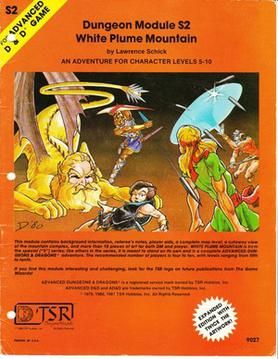
A Fifth (Not Really) Random Memory: White Plume Mountain and My Undergraduate Degree #ADnD #DnD #RPG #TTRPG #1e #physics

If you enjoy this post, please retweet it.

This memory isn’t really random. It has a catalyst.

I registered to run a 1st Edition Dungeons & Dragons game at Winter Fantasy. To prepare for running it, I’m going through my usual routing of creating a Word document placing the encounters in my own words and organizing them in a way that’s more intuitive for me at the table.

I’m sure Wizards of the Coast’s legal department would consider that, and this image, copyright infringement. Jackasses.

Eventually, I came to encounter 22, (spoiler alert!) the frictionless room, which spurred a series of memories from when I was an undergraduate physics major at the University of Maryland. Friction always made things difficult when solving problems related to movement, so unless you were specifically studying differential equations, our problems would assume no friction (as well as assuming every chicken is a sphere). Accordingly, my professors occasionally (and unnecessarily) thought it was necessary to remind us that friction is actually a good thing.

Made better with the right weaponry.

We’re physics majors. We know that friction is important, and life would be impossible without it. Perhaps our professors should have instead just had us play White Plume Mountain as part of the curriculum.

Yeah, I’m pretty clever like that.

Follow me on Twitter @gsllc

Dungeons & Dragons is a trademark of Wizards of the Coast, LLC, who neither contributed to, nor endorsed, the contents of this post. (Okay, jackasses?)
Some Gods to Get Me Through My Vegas Trip #MythologyMonday #MythologyMonandæg #luck #skill #Ebisu #Daikokuten #Lugh

If you enjoy this post, please retweet it.

Today, I fly to Las Vegas for my annual blackjack trip, only this time there will be some major disruptions. I usually go on Columbus Day week, and last year I went in September. This week it was delayed to the Christmas build up week because I had some friends going there. I figured it was about time I do something other than blackjack when I’m there. For example, I’ve always said I was going to see Penn & Teller‘s show at the Rio but never did. Well, I already have tickets for the Friday night show, so that’s finally going to happen (sans Teller, who’s recovering from health issues).

Nevertheless, I’ll still be playing some blackjack. I’m getting there a day before they are so that I’ll have at least one day to game. Overall, I’ll make sure I have two full days to gamble, so it can’t hurt to ask for help from the gods. The luck gods? No, I don’t need them. Blackjack is more a game of skill. I’ve practiced at a local casino over the course of three Sundays and Thanksgiving Day since October 9th. I’ve brought in just over $4,000 in winnings, having started with $800 or less each of those days. (I don’t mind mentioning this because I will be reporting these winnings to the IRS.) At this point, I’ve sharpened my system to so fine a point that it’s like taking candy from babies, only I have no moral qualms with taking this candy from casinos.

That $4,000 pays for my airfare, Penn & Teller, and the resort fee as well as bankrolls my play. As for food, that’s covered through my gambling comps. I’ll be eating at steakhouses all week and won’t have to pay for anything but the tips.

So, with that in mind, here’s a video of Ebisu, the god of luck through hard work . . . sort of. He’s really just a luck god and master fisherman from Japanese mythology, but in Deities & Demigods for 1st Edition Dungeons & Dragons, he was characterized as the god of “luck through hard work.” Considering how rough a childhood Ebisu had, and considering that I’m an RPG nerd, I’m going with that.

But I don’t like fish, so here’s another one. This is a video about Daikokuten, the Japanese god of wealth.

Lugh, the Irish god of skill and law (among other things).

Hey, a divine lawyer? How can I not get behind that?

As for the rest of this week, I’ll be busy, so my posts will be filled with limited content.

Follow me on Twitter @gsllc

Dungeons & Dragons is a trademark of Wizards of the Coast, LLC, who neither contributed to, nor endorsed, the contents of this post. (Okay, jackasses?)

Gwyn ap Nudd #MythologyMonday #MythologyMonandæg #hunt #hunting @MythsExplained

If you enjoy this post, please retweet it.

Yesterday, I posted druid-related memes, so you’d think the next day would be a great day to post a video on druidic folklore. The problems is I’ve already done that. Instead, I’m posting a video on Gwyn ap Nudd (sometimes Gwynn ap Nudd), the Welsh figure associated with the traditional “Wild Hunt” (among other things).

There are several figures from mythology and folklore associated with this tradition, but Gwyn ap Nuddm and his supernatural hounds, the Cŵn Annwn, seem to be the one that provided the closest inspiration for the Celtic “Master of the Hunt” from the 1st Edition Dungeons & Dragons sourcebook, Deities & Demigods. This is why I chose him.

The Master is described . . . .

This is my childhood.

Follow me on Twitter @gsllc
Follow Mythology & Fiction Explained @MythsExplained


Druids #DnD #ADnD #RPG #TTRPG #druid

If you enjoy this post, please retweet it, and please visit my 1st Edition D&D resources page.

Sundays now are lazy days for me. I either post something silly or other people’s work. Usually both. Today, I’m going to change an existing work to make it even more interesting.

I think I can do better with a change to the last line.

I think that makes his smile even more horrifying.

I think this gives me an idea for a couple of spells.

Druids are scary.

Follow me on Twitter @gsllc

Dungeons & Dragons is a trademark of Wizards of the Coast, LLC, who neither contributed to, nor endorsed, the contents of this post. (Okay, jackasses?)

The D&D Blood War and Being a Buzzkill #DnD #RPG #TTRPG #demon #devil #buzzkill

If you enjoy this post, please retweet it.

And now, your moment of buzzkill.

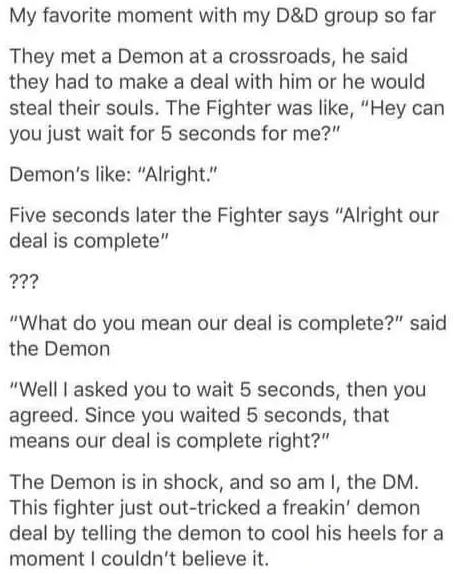
While this was a brilliant way to defeat the encounter, I suspect this is a fake story written by someone with little Dungeons & Dragons experience. In folklore, there’s no distinction between demons and devils; they’re the same thing. However, this is a D&D meme. It mentions the game within its text and claims this is a real encounter. Well, any established player would know that demons don’t “steal souls”; they simply attack and tear you to shreds. They have no concept of negotiation and wouldn’t even have proposed the bargain. Devils are the ones who enter into contracts for your soul, so clearly this is the work of a devil.

Or maybe I’m the devil. Whatever. You know I’m right.

Not that that necessarily matters.

Follow me on Twitter @gsllc

Dungeons & Dragons is a trademark of Wizards of the Coast, LLC, who neither contributed to, nor endorsed, the contents of this post. (Okay, jackasses?)
Cats & Dragons @garius #Caturday #DnD #RPG #TTRP

If you enjoy this post, please retweet it.

We all know that cats are chaotic neutral, which in their case means they can fluctuate between good and evil on a whim (as opposed to being motivated towards achieving cosmic balance). Here’s proof of the evil side (as if you needed any):

Well, what’s a theory without data backing it up?

Yeah, but. . . .

Hmmm . . . . Those were surprisingly easy to find. QED, I guess.

Cats >> dogs.

Follow me on Twitter @gsllc
Follow John Bull @garius

Dungeons & Dragons is a trademark of Wizards of the Coast, LLC, who neither contributed to, nor endorsed, the contents of this post. (Okay, jackasses?)

In case the tweet is ever deleted . . . .


My “Masterplan” for 4th Edition D&D (Get It?) @andy_aiken @Luddite_Vic @flashedarling #4e #DnD #RPG #TTRPG

If you enjoy this post, please retweet it.

I recently discovered Masterplan by Andy Aiken, which is campaign planning, management, and execution software for 4th Edition Dungeons & Dragons (“4e”). You can download it here. Just click on setup.msi and follow the prompts. If you’re not a 4e player, he’s created a similar online only tool for 5th Edition, Dojo, here. But enough about that. This post is about 4e. 🙂

This tool is fantastic, but it’s 4e-based, so adapting it to my 1st Edition game would be too time consuming without much benefit over what I’m doing now. Because I’ll be a player in my upcoming 4e campaign for the foreseeable future, my first step was to create libraries for my my synDCon Dungeon Delves (referred to as “synDClash” for the convention), my divine stat blocks (with corrections) for the Egyptian and Central American pantheons (which occasionally generate interest on my blog), and some other stat blocks I thought were pretty good.

I’ve finished every pre-existing element I planned to input into Masterplan except Monster Manual 3. That’s going to take a while. Because of WordPress restrictions, I can’t upload the library unless I change its extension to an allowed extension. So, for example, I’ve changed Central American Deities.library to Central American Deities.pdf. Likewise, Giant Problems.masterplan was renamed Giant Problems.pdf. You can download everything I’ve done to date using the links below, but you’ll need to change the extension back to .library or .masterplan. Libraries must be placed in your Masterplan/Libraries directory on your hard drive, but projects can go anywhere that’s convenient for you. They aren’t loaded automatically when the software boots up, so the system doesn’t need them to be in a particular place. Adobe Acrobat/Reader can’t read these files, so you won’t be able to view the material until you change that extension and load them into Masterplan. I’ll add more libraries as I create them, so expect hyperlinks to be added to this list. Well, that’s my master plan anyway.

(Now do you get it?)

Libraries (must change extension to .library)

[REMOVED]
Go to my 4th Edition Resources Page for the latest files.

Project Files (must change extension to .masterplan)

[REMOVED]
Go to my 4th Edition Resources Page for the latest files.

synDClash Pre-generated Characters (created by @flashedarling)

[REMOVED]
Go to my 4th Edition Resources Page for the latest files.

Player View

I want to point out a great feature that mimics what I’m doing in my 1st Edition Dungeons & Dragons game with Roll20. You can run your maps and minis online. If your computer has two monitors, you can hide one from the players, but a “player’s view” appears on the other monitor. This obviates the need for a battle map on your table. This isn’t exactly Earth-shattering to a 2022 audience, but this was implemented over a decade before the COVID pandemic accelerated the need for tools of this nature. As such, this doesn’t facilitate remote play over the internet, but as someone who runs my games in person but places maps on a computer screen, this works really well. It’s better than using Roll20 because it’s all self-contained. I can do this on a single computer within a single software application. With Roll20, I have to bring up a second browser, switch to player view, then always bounce back and forth between the two to make sure what’s on my screen matches what’s on the players’ screen. This isn’t a huge burden, but it’s technically a little more difficult. Masterplan makes it trivial. Of course, you may prefer the battle map to either solution for a game like 4e. Players may want to move their own minis around the board, but from the DM’s perspective, moving multiple minis is a lot easier on the screen than on a battle map.

Bug/Defect Report and Wishlist

I’m just getting started with Masterplan, but with what little I’ve done, I’ve already encountered some consistent defects. First off, some of the issues aren’t defects. The system doesn’t properly calculate suggested attack expressions because those depend on how many targets a power targets, but you often enter things like “one or two creatures in the burst” manually, so there’s no way for the system to calculate the proper attack bonus. For the record, an attack against multiple targets’ ACs suffers a -2 penalty in relation to an attack against one creature’s AC (-1 if the monster is a controller). So, you just have to watch your attack expressions.

That said, initiative isn’t even close to correct. According to page 184 of the Dungeon Master’s Guide (“DMG“), a soldier has an initiative bonus equal to its Dex bonus + 1/2 its level (rounded down) +2 because it’s a soldier. For Quetzacloatl, that’s 8 (27 Dex) + 17 (level 34) + 2 = 27, but Masterplan suggests 21. In some cases, Masterplan is off by as many as 9, but I haven’t yet figured out if there’s a pattern.

Defenses are also off. A soldier’s Fortitude should be 12 + level, which in the case of Quetzacoatl should be 12 + 34 = 46. This is exactly what Masterplan recommends. However, Masterplan doesn’t account for how ability scores change the default calculations. Specifically, each defense relies on the higher of two paired ability scores, which are Str and Con for Fortitude. The average ability score for a monster should be 13 + 1/2 level (rounding down), which is 30 at level 34. In the case of Quetzalcoatl, his Str is 36, and his Con is 30. So, take the higher of the two (Str 36), and compare that to the average (30). Accordingly, Quetzalcoatl has a Str 6 higher than average, so you should add half that (3) to his Fortitude, giving him a Fortitude of 46 + 3 = 49. As I said, Masterplan recommends 46, not 49.

I get that small differences in defenses may not matter too much, especially considering that one’s choice of ability scores is often based on flavor considerations or downright arbitrary. However, as the DMG suggests, sometimes you need to give monsters those bumps for game balance. Moreover, the pairing of ability scores facilitates making, for example, a low-intellect character whose Reflex defense can still be competitive due to a solid Dexterity score. Besides, for whatever reason, I’ve included the bumps, so I wish Masterplan factored in that aspect of the games’ rules.

Some of the math is solid. Hit points are good. Skill bonuses are good. Masterplan doesn’t provide damage expressions, so there’s nothing to check there. Also, I’ve created an Excel spreadsheet that performs all the correct calculations and helps me catch the errors, so where there are systemic issues, they’re easily corrected. If you find anything wrong with my calculations, please let me know, but I think I have it right for monsters. Just to make sure, I created and started populating the missing Monster Manual 3 library, started entering creatures, and found my Excel spreadsheet to match the WotC entries perfectly in most cases (exception: Silverback Ape), while the Masterplan recommendations still suffered from the same math errors. NPCs are treated a little differently than monsters (see DMG, page 186), so those aren’t relevant here.

Masterplan gives you the capability to copy an existing monster and paste it. That sounds like it makes things easier, but I find myself ignoring that feature. If the pasted stat block is of a different level or role (i.e., artillery, brute, etc.), when you adjust either, Masterplan will add miscellaneous bonuses to trained skill bonuses to keep them from changing. You’ll have to go through each one and delete the bonus. Moreover, you’ll inevitably have to change most of the attack expressions anyway, so why not do that from scratch? Still, there are some exceptions where it’s easier to make a copy, so YMMV.

To make a change to a part of stat block (e.g., a power), you open a dialog box, make your changes, then hit OK to save it. It returns you to the main stat block but jumps to the top. I’d rather the position of the view not change so that it returns me to where I need to be to continue making changes.

I’ve learned (far too late) that if you’re creating a monster, and you leave the “range” entry blank for a power, the next time you open the software and bring up the monster, whatever you entered in “power details” will be moved to range. To avoid this issue, I’ve started to enter “self,” “melee 1 (see below),” or something similar. You may find yourself having to modify my stat blocks accordingly. This isn’t a fatal flaw. It’s just a bit annoying to see “Range:” before the power details because they’ve been moved into the wrong field.

I’m not permitted to add a trap/hazard to an encounter map even if the trap/hazard has a stat block and is added to the encounter. I’d like to be able to add the trap, but then make it invisible on the “player view” screen.

Notice that the stat block for the sinkhole doesn’t appear in the list to the right of the map. Therefore, it can’t be added.

In the aura dialog box, the tab order for the keywords field is off.

But seriously, this software is amazing. These are nitpicks, and as long as we all help each other identify these problems, we can work with them even if the software is never patched.

Many stat blocks crash the system!!! I did a significant amount of testing, and here’s a strange error I discovered. If your monster (or one that comes with the system) has the word, “hobgoblin” in its name, and if the NPC isn’t of a certain level, the software crashes whether you’re creating the stat block or just trying to view it. A hobgoblin of 5th or 6th level seems to work, and bugbears and goblins aren’t affected. I initially got around the problem by calling my Hobgoblin Warcaster a “Hobo Warcaster” instead. The presence of “hobgoblin” within the powers doesn’t create the problem. I hope Andy has the time and desire to fix this, but I think he moved past this project a long time ago.

Also of note: If the system crashes, you lose all your work since you last opened the program. So, if you’ve made significant changes, exit the library, then exit the software so that it will properly save. You wouldn’t think this was necessary considering that the libraries are separate data files, but it is. Nothing is saved until you exit the program. I’ve lost a good bit of work after unwittingly attempting to open a corrupt stat block entry.

Below is the list of monsters that are confirmed to crash the system. You should expect this list to grow as I continued to plow through the program. I’m replacing them with renamed creatures I built from scratch. “Hobgoblin” is now “Hob Goblin,” “Mezzodemon” is now “Mezzo Demon,” “Nycademon” is now “Nyca Demon,” and “Wereboar” is now “Were Boar.” That seems to solve the problem no matter what else is in the name of the creature.

  • Dungeon Master’s Guide 2: Hobgoblin Legionnaire of Avernus (page 113); Mezzodemon (page 214).
  • Monster Manual: Hobgoblin Grunt (page 138); Hobgoblin Soldier (page 139); Hobgoblins Archer (page 139); Hobgoblin Warcaster (page 140); Hobgoblin Commander (page 140).
  • Dungeon Magazine: Advanced Hobgoblin Warcaster (issue #155); Nycademon Warmaster (issue #174).
  • Monster Manual 2: Firbolg Hounder (page 108), Firbolg Bloodbear (page 109), Wereboar (page 158)
  • Draconomicon — Metallic Dragons: Admaaz Draconian (page 189), Kobaz Draconian (page 192)

I also made changes to the Monster Manual 2 library. I added all the stat blocks that were missing (there were about a dozen IIRC), replaced the malfunctioning one listed above, and categorized all of them. What that last one means is that, for example, Blizzard dragons fall in the section labeled, “Dragon.” There’s a field for that in the database labeled “Category,” but it’s not an indicator of the type of creature. Keywords handle that. Category refers to the section in which the monster is found. Blizzard dragons are in the Dragon section, so Dragon should be its category. An elder brain is not a mind flayer, but it’s written up in the mind flayer section because it’s part of their culture. Thoon hulks are mind flayers, so they have the mind flayer keyword, but they also need to have the mind flayer category. If category is empty, the creature is placed in “Miscellaneous Creatures.” Most of the monsters were missing that piece of data, so I went through each stat block and added the category to the stat block. In other words, the creatures are now better organized and easier to navigate. That process didn’t change the underlying data (other than replacing malfunctioning stat blocks of course).

Complete Rework of the Libraries

I’m just now adding this section almost a week after initial publication of this post. I’m annoyed by the crashing stat blocks, but the other things that bugs me are 1) the “Miscellaneous Creatures” mentioned above; and 2) the fact that some of this data entry was performed before WotC changed how they write the stat blocks. For example, the range entry (e.g., “Melee 1 (one creature)”) didn’t exist until Monster Manual 3. Sometimes, this resulted in strangely expressed stat blocks (e.g., the Solamith from Manual of the Planes, page 123). So, I’m going through all of the libraries and cleaning up the old data. I wouldn’t have expected Andy to do that and am glad he didn’t. I’m glad he spent his time polishing the functionality. Leave data entry to the community (i.e., me). I’ll provide all of the libraries when I’m finished with them. In the meantime, here’s an updated Monster Manual 2 library (also posted above) placing all of the creatures into their appropriate “section,” replacing the corrupted stat blocks, and adding the missing stat blocks. I haven’t yet updated the stat blocks to the new format yet. I won’t do that until I’m finished with Monster Manual 3, though Manual of the Planes is finished, so download that one now. I’ve also provided updates to Draconomicon Metallic Dragons (I replaced the crashing draconian stat blocks) and Underdark (I properly categorized a few stat blocks), and the Forgotten Realms Campaign Guide (I replaced crashing stat blocks, corrected errors, added missing monsters, and updated the terminology to the later format). Again, they have *.pdf extensions, which must be changed to a *.library extensions and placed in the libraries folder.

More Downloads

If you want to complete your 4e downloads with the offline Character Builder, then use one of these three videos for instructions.

I provided three videos because at least one of them didn’t work, and one of them I never tried. I’ve forgotten which is which. However, whatever I installed doesn’t include later material, and it appears there’s a newer version of the CBLoader here. This one may include the missing material, but I have no idea how well it works. Caveat emptor. (It’s free.)

Play what you want.

Follow me on Twitter @gsllc
Follow Luddite Vic @Luddite_Vic
Follow Andy Aiken @andy_aiken
Follow Galen @flashedarling

Dungeons & Dragons is a trademark of Wizards of the Coast, LLC, who neither contributed to nor endorsed the contents of this post. (Okay, jackasses?)