Let's roll some dice, watch some movies, or generally just geek out. New posts at 6:30 pm ET but only if I have something to say. Menu at the top. gsllc@chirp.enworld.org on Mastodon and @gsllc on Twitter.
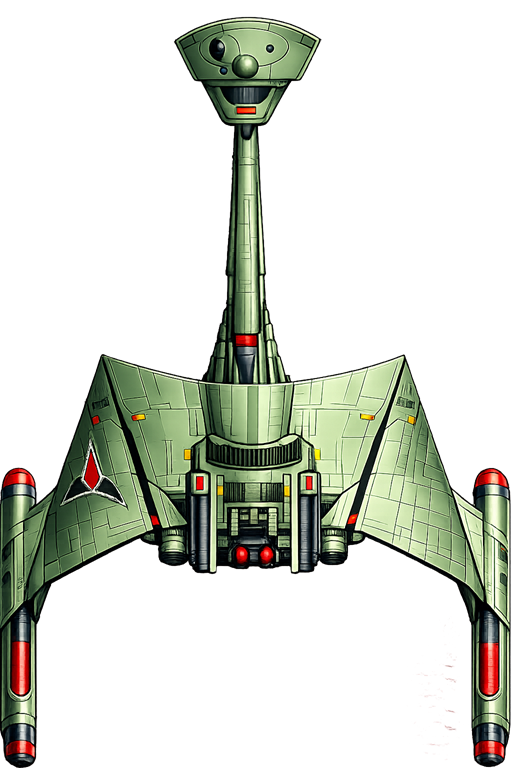
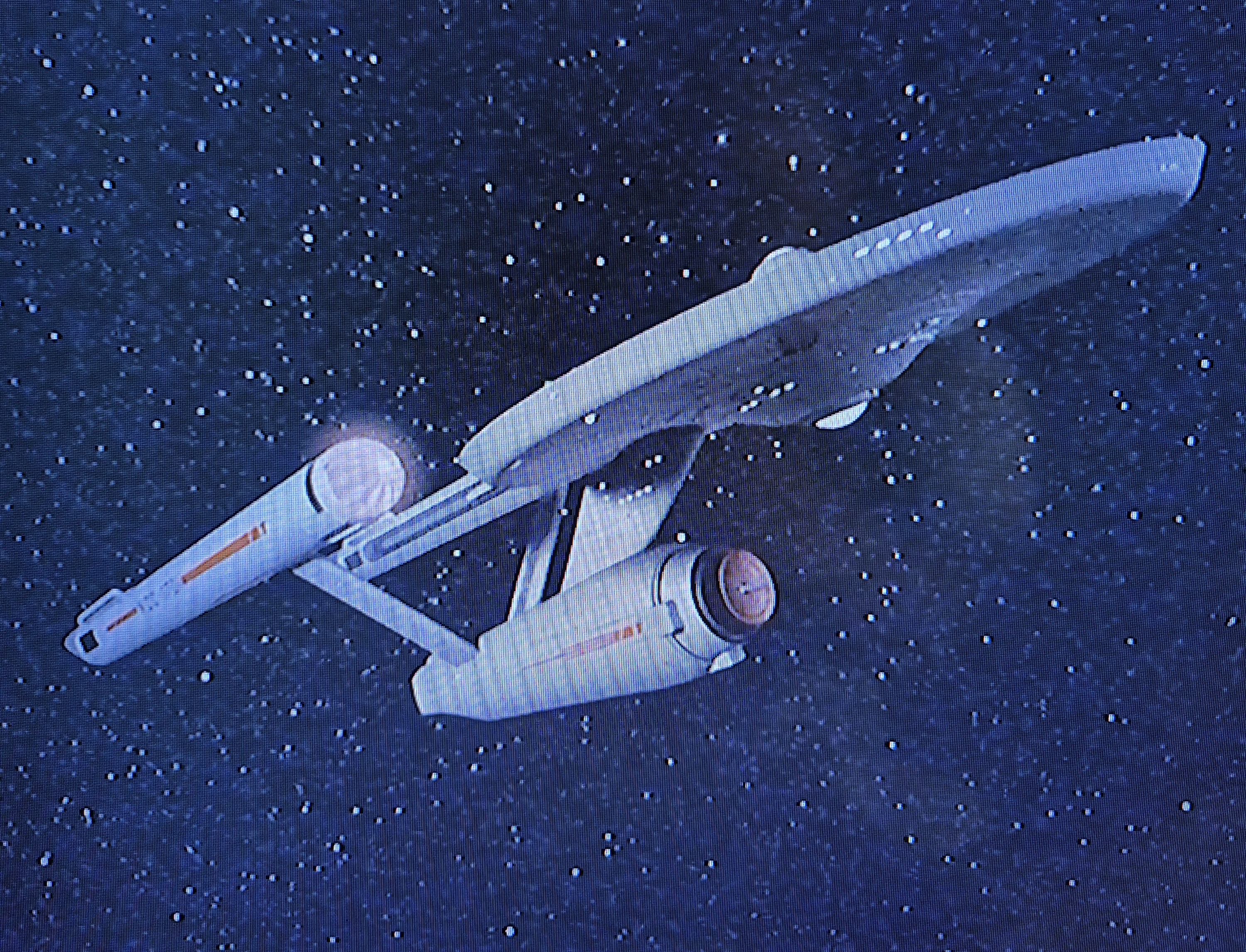
My work on my Bridge application has me contemplating all the ship designs I’ve seen in science fiction and science fantasy, and it reminded me of what my favorite design among them is. Unsurprisingly, it’s from Star Trek.
The Klingon D-7M Cruiser from the TOS movie era and beyond.
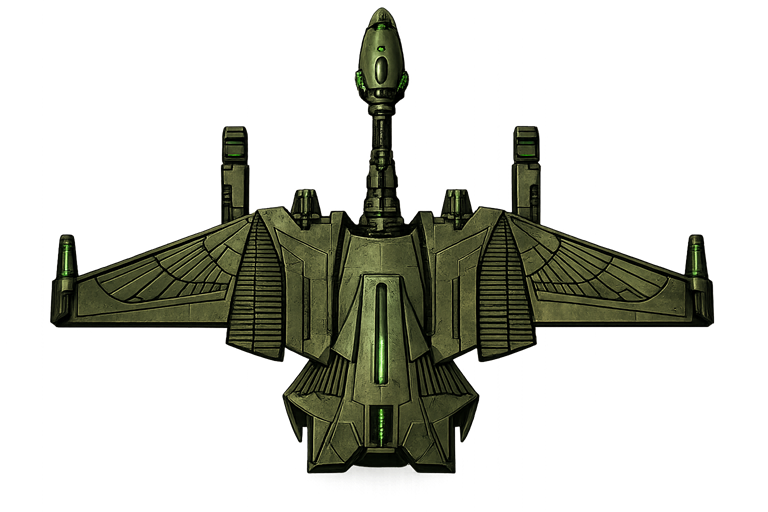
Now, let’s be crystal clear. I’m fully aware that this is 100% subjective. I’m not trying to convince anyone of anything other than to maybe mull it over and form your own opinion. However, I’m going to explain why I like it so much anyway. First, I think it emulates a jet fighter you might pilot. But in this regard, it probably isn’t any better than this ship from the FASA Star Trek RPG.
The Romulan T-10 (Bright One) Destroyer
I’ve always preferred the Romulans to the Klingons as enemies, but this one loses out (as do many other cool designs) to the D-7M for another reason: The backstory (or at least my preferred backstory) to the D-7’s design. I’ve heard a few theories as to why it has a long, thin neck separating the main hull from the bridge. First, it was to keep the poorly insulated ships from irradiating the command bubble. Second, it was to lower the forward profile of the ship when attacking, leaving it’s command center and devastating photon torpedo launcher less vulnerable to being disabled. The third explanation, though, is my favorite, and to my knowledge it comes from the Star Fleet Battles RPG that I played only once. That game positied the notion that the design made it harder to succeed in a mutiny. The thin neck was a natural bottleneck for subordinates trying to take over the command module. Also, it’s interior design had many obstacles built into it, requiring mutineerers to zigzag through the neck before getting to the command module. That gave plenty of time for the captain to detach the command module and blow up the main hull and neck before the mutineers could reach him. What’s more Klingon than that?
But ultimately, I simply like the aesthetic. As I said, this isn’t an argument.
I think Star Wars has had enough designs to come up with some really cool ones, but many are, surprisingly, more functional than creative in design. They’re closer to what I think an actual starship would look like if it were real, or maybe what you’d expect from a rebel alliance that’s repurposing far more available freighters as weapons of war. The FASA Star Trek RPG did a top notch job of expanding the Star Trek universe with some really great designs as well, but they just don’t top the D-7 for me. I should also mention that I haven’t watched a tremendous amount of science fiction and science fantasy, so maybe there’s something out there I’d like better. However, for now, the Klingons win this war. Seems appropriate.
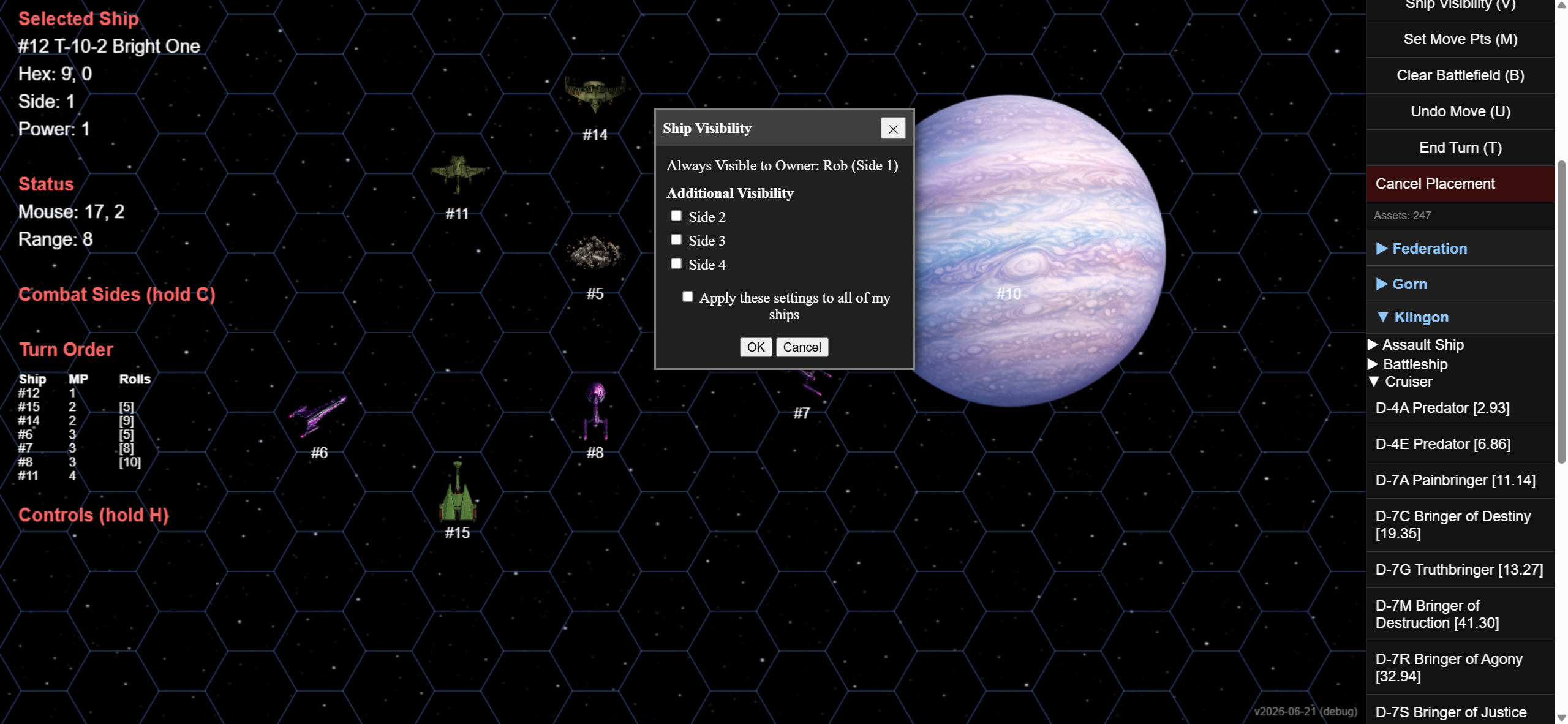
In my last update, I hinted at something new now that the VTT is stable and good enough for production. Well, after quite a bit of work, that something new is at least to the point where I can provide screenshots. Bridge is a web-based app that manages Master Control Panels and Bridge Consoles for the FASA Star Trek RPG (think character sheets but for starships). It’s not even ready for an alpha release, but I’m certainly more than halfway to that. Eventually, it will fully integrate with my VTT, but both apps will remain independent in case you want to use one but not the other. I can appreciate wanting to sit around a real table with pen and paper but using a flat TV for the VTT battle map, but I can also appreciate wanting to use 3D models on a paper battle map while letting Bridge do all the bookkeeping for you.
Before I show you some screenshots, I want to make sure you know how the game is played in a very broad sense. In 2nd edition, starship combat can be played using the Basic game, Advanced game, Graduate game, and Command and Control (“C&C”). In an even broader sense, the game can be played as an RPG or as a board game. While it’s possible to use any game for either an RPG or a board game, the way it usually plays out is that players use (in ascending order of complexity) Basic, Advanced, or Graduate (“B/A/G”) for board games, and C&C for an RPG. In B/A/G, a player runs the entire ship (or multiple ships), so that player handles all ship duties (i.e., power allocation, shields, weapons, etc.). In C&C, the players play characters from the same ship’s crew, so each player takes on one or more roles within that crew. In other words, I might be the captain and run the engineering and science stations; you might man the helm and weapons console; and someone else might man navigation and communications/damage control. If you have enough players, everyone might have one role; otherwise, some are going to have to double up. Also of note, this game was designed for the original series TV show and movies. While there was some support for Next Generation, FASA lost the license before they could really make the rules work with the changes made by that show. My app won’t support TNG rules.
But hey. Enough talk. Here’s what it’s going to look like.
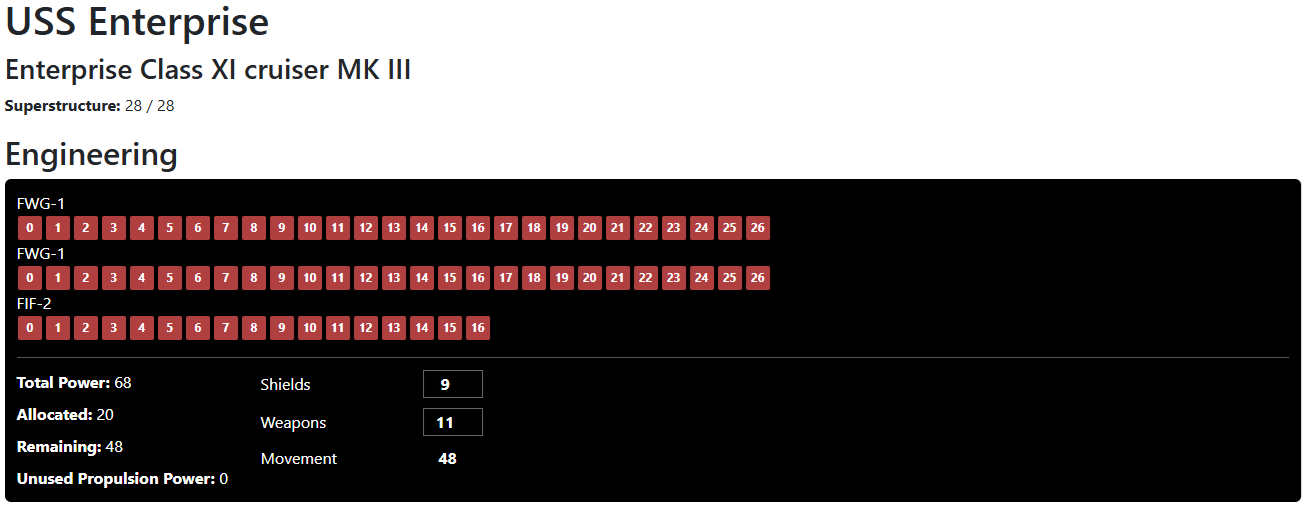
First up is the engineering console for the USS Enterprise (movie refit). If you know the game, you know what this is, but not everyone does, so here’s the basic gist. This tells you how much power your engines produce. As engines get damaged, some of those control panel lamps will go dark And your total power will decrease. In C&C, you assign power to shields, movement, and weapons according to the general request given by the Captain (e.g., “focus on shields!”). In B/A/G, because you control the entire ship, you won’t have to do this. You simply allocate power to individual systems, and when you run out of power, you may need to rethink those allocations. The point is that you can cut out the step of assigning power on the engineering screen. Note: I know the console is a little wide, I’m going to fix that, but not by much. I’m going to add a chat window to all these panels so that you can receive messages from other players or from the system itself.
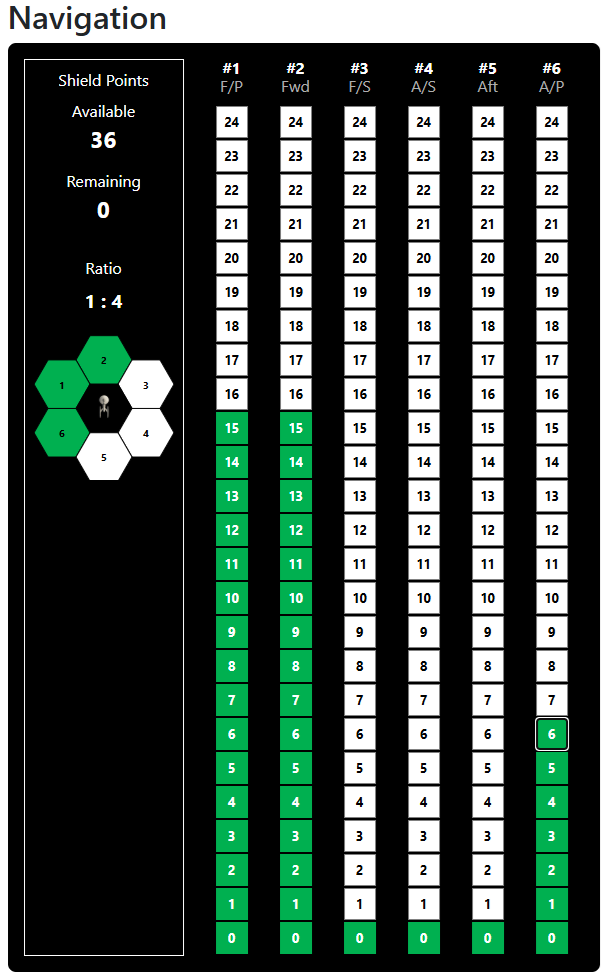
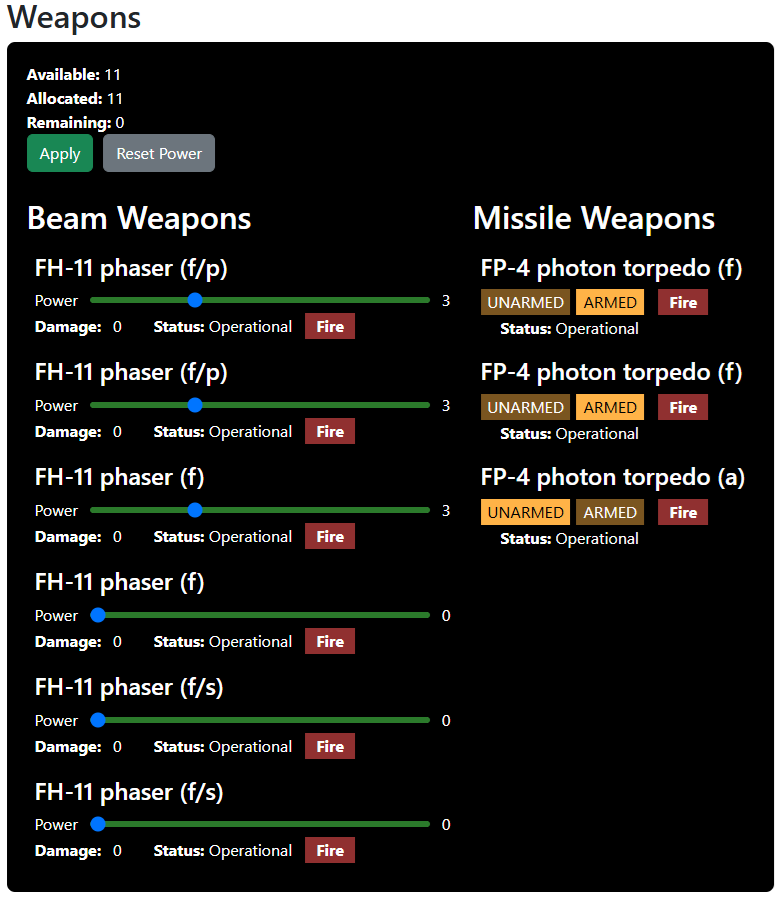
Next up is navigation. In this case, engineering assigned 9 power points to shields, but most shields operate on a favorable power ratio. In this case, those 9 power points resulted in 36 shield points, which I’ve distributed to three shields. If a shield absorbs incoming fire, the higher lamps will light yellow to reflect that. If a shield is damaged, all lamps light red. If a shield is destroyed, it goes black. For those who know the game, there’s an additional state. If a shield temporarily cannot use the power that was allocated to it because the engines (or engineering itself) took a hit, the navigator must choose which shields lose power, and the lamps at the top turn orange. If the engines are repaired during the current turn, those orange lamps will once again turn yellow or, more likely, green due to the repower phase.
Next up, we have the weapons console. Note that this is not the helm. I’ve divided them for two reasons. The in-universe reason is that, in the movies, the weapons console was separate from helm. The in-game reason is that you want to be able to create as much of a sensible division among responsibilities as you can to accommodate the varying number of players that may be at the table. In any event, you can see that I’ve armed two photon torpedoes and energized two phasers.
But Rob! What about the Romulans?!?! Hey, I always favored the Romulans as the enemy. I’ve got it covered.
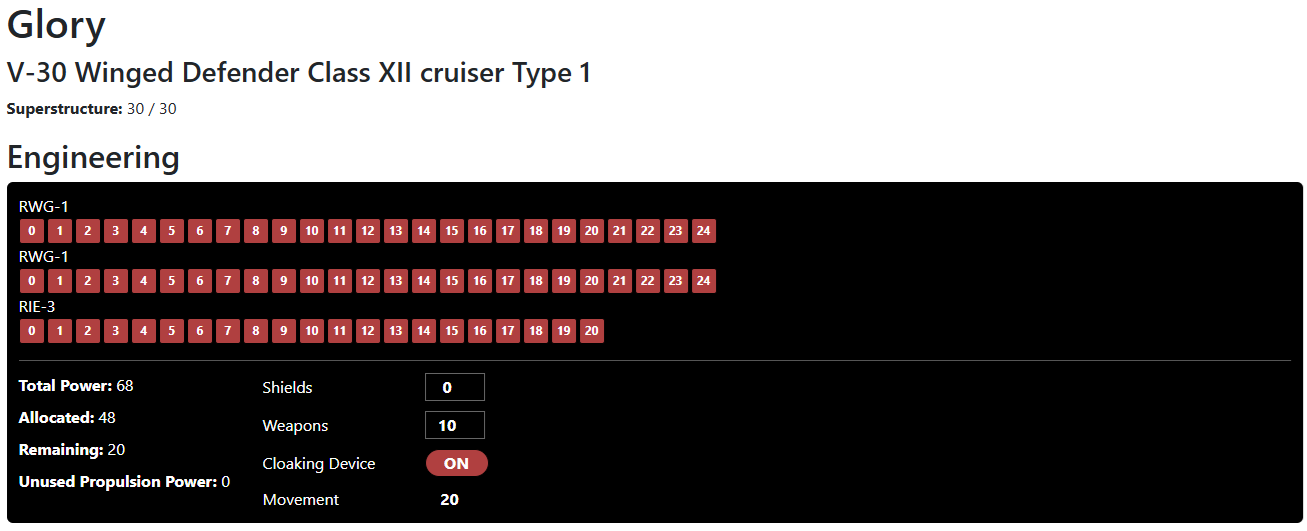
I’m not the best at naming ships.
Here you can see that there’s a new button on Engineering to turn on the cloaking device.
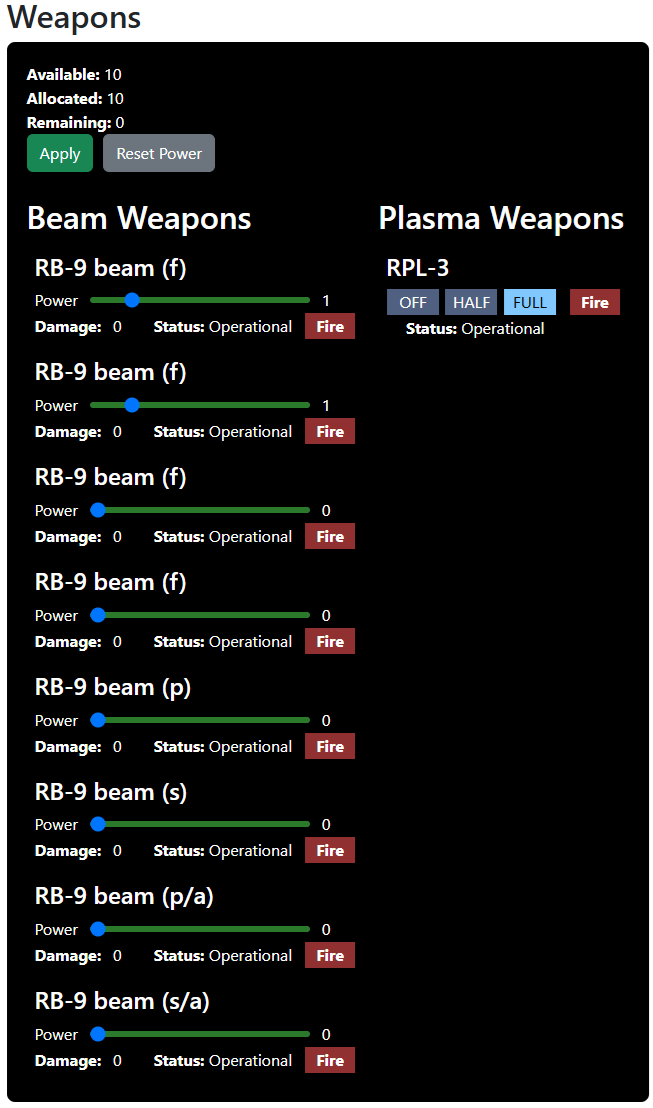
And here you can see that this Romulan ship has a plasma torpedo instead of those lame-ass photon torpedoes. That’ll knock your ship out of whack.
Wait a second. Why’s it crooked? There’s no up in space.
The next console on the list is the damage control panel, but first I have to do some boring architectural work with the turn/phase system. Then I have to tackle the helm and science station, and then my own invention: The captain’s console panel. More coming.
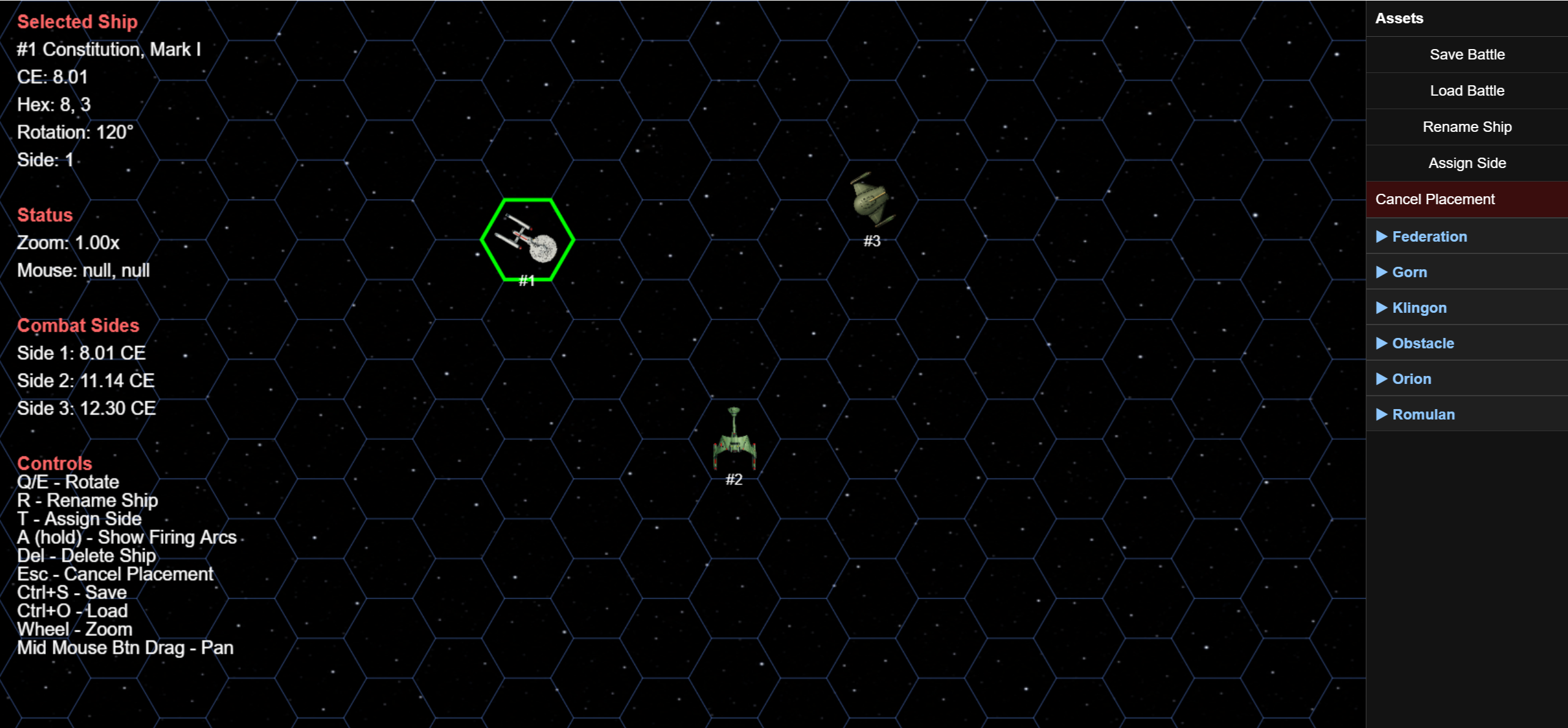
My FASA Star Trek RPG VTT has received major upgrades. You can find it by clicking here.
Among the upgrades: More “obstacles” to put on the map. More importantly, you can create a room so that you can play with people remotely. The rooms have passwords and allow the creator (“administrator”) to lock the rooms so even passwords can’t get you in. The creator must then respond to your requests, clicking ignore if the user is spamming.
Cloaking is now an option, as you can make a ship invisible. Unfortunately, line of sight is not yet implemented, so you have to manually toggle your visibility when retreating behind an obstacle.
There are a few more quirks to resolve, and there are some Klingon ships missing, but I’m focused on a new app to provide master control panels that will interact with the VTT. Once that’s done, I’ll shake out the remaining features for the VTT.
Remember, this app isn’t turning the game into a video game. Even if you’re 100% digital, it’s intended to be played as the pen and paper game was. You’ll need to reference an MCP in order to make use of it. For now, the MCP would have to be pen & paper, but stay tuned.
If you enjoy this post, please retweet it (Twitter/X), boost it (Mastodon), repost it (MeWe), or repost it (BlueSky).
I’ve created a VTT (virtual table-top) for the FASA Start Trek Starship Combat system. This may not appeal to the few of you that still play the game because this is not intended to turn the RPG into a video game. It’s intended to facilitate online play for the RPG. You could certainly use it for the starship combat system alone, which is often used as a board game, but however you play, you’ll need your ship recognition panels. The game does very little along the lines of game mechanics.
The only mechanics it handles are calculation of 1) your fleet’s total combat efficiency, and 2) range to target. The VTT just tells you the range to target is # hexes. Whether or not you have the power points to move to that target hex, or hit an enemy ship located there, is something you need to gather from your character sheet.
My inspiration for creating this is that I’m planning to introduce my gaming groups to the game. One of our group moved across country, so he has to dial in. Using MS Teams, I can give him access to the game board, both visually and in terms of allowing him to take control of the screen and move his ships around. That said, a planned future enhancement will be to implement remote multiplayer rooms, allowing him (or any remote player) to join our game just by entering a game room code. Remember, though; it’s not a video game.
This is in beta test, which means a few things.
I’m seeking honest feedback on the user interface. Does anything bother you, even if just a little? Do you have any preferences? Were the basic instructions on the left side of the screen clear enough to understand? If so, are the shortcut keys intuitive? No nitpicks are too nitpicky.
There are still a few tweeks I need to add in. For example, select a ship and hold the A key, and four firing arcs appear (forward, port, aft, and starboard). Let go of the A key, and they’ll disappear. The problem is that space stations use three firing arcs, not four, but for now they’re showing four. That’s literally the next item on my to-do list, but I’d like to add others.
I have yet to add every ship in the game. The Federation is almost complete, but there’s plenty more Klingon and Romulan ships to add. The Gorn and Orions are complete but only because there aren’t many options for those cultures. I’m considering adding the ships in the fan-created Gorn and Orion ship recognition manuals, but because they’re third party products, that’s low on my list of priorities. That said, there are certainly enough ships right now to actually play a game. The ships it has are the ones you’re most likely to use anyway.
Other items on my to-do list include better interaction with obstacles (e.g., asteroids, planets, stars), alternative panning controls, search function for the list of assets, better movement visualization tools. How these enhancements are implemented will rely heavily on the feedback I receive.
Once I have a full release, I’ll place the code on github, after which I’ll create another VTT to deal with the personal combat system, and then after that convert my MS Access character builder application to a web application.
A few weeks ago, I hosted another 1st Edition Dungeons & Dragons (“1e”) game at my home. The group spent over an hour at the start of the session just reminiscing about the good old days when most of us first met. This was during the era of 4th Edition. Inevitably, the subject of synDCon came up. synDCon was the gaming convention financed primarily by Vic and me. The two of us did almost all the work of running the convention once it began. It was large enough that we had everything represented (see below), yet still maintained the coziness of conventions like Winter Fantasy.
synDCon Was Awesome
I need to put my modesty aside for a bit and say that we pulled off something magical (pun absolutely intended). In our first year, we took advantage of a holiday and put on a four-day convention. We provided tons of organized play: Living Forgotten Realms (4e), Pathfinder Society, and Heroes of Rokugan (Legend of the Five Rings). We also had individual games from less popular RPGs being run here and there, tons of card games (including, of course, Magic the Gathering), tons of board games, and we were the official DC-area convention for Munchkin. We had special events, a LARP, dungeon delves I wrote based on classic 1e adventures, and live music on Saturday night for one of the cons. Our slots were staggered so that slots didn’t start every four hours but rather every two hours. If you wanted to sleep in a bit, you could. You’d just start playing at 11 am instead of 9 am, but there were enough 2-hour slots of other things to do that you could still get three slots of gaming in.
It wasn’t run in a convention center, nor in the basement of a mediocre hotel, but rather in a really nice “hotel and executive meeting center” right across the street from a Metro (subway) stop in Rockville, Maryland. As the county seat for Montgomery County, there were tons of restaurants, et al. in the area, including a gaming store down the street. Of course, we had a gaming store as our in-convention vendor both years, and we generated about 200 attendees both years. Our attendees represented everywhere in the United States east of the Mississippi (e.g., Florida, Georgia, and Ohio), but we gave an award to a guy named Matt for having come the farthest for the con (Alaska).
We had tremendous support from volunteers that helped organize the detail while Vic and I focused on the big picture, and we’re forever indebted to those friends, but I’ll be damned if my feet weren’t atrociously sore by the end of both cons.
Seriously, it was stupendous, and everyone that attended and commented on it said so.
A Slight Diversion Before My Point
I’ve been thinking of doing something other than a Vegas blackjack trip for my fall vacation – I say this every year, so we’ll see if I follow through – and was considering an RPG gaming convention instead. Because I wanted to play 1e, I was initially thinking about GaryCon, but a friend pushed me towards GameholeCon. It was an easy sell because the timing would be better. GaryCon would interfere with Winter Fantasy, but GameholeCon would slide right into the Vegas slot (again, pun absolutely intended). The trouble is that Winter Fantasy and synDCon have spoiled me. I have no intention of going to a convention and paying between $100 and $200 per night for my hotel room if I’m staying at least 2 miles from the convention. That’s ridiculous. It’s like GenCon on a smaller scale. The city is obviously not big enough to handle the convention. So, I decided to look into other options.
There Aren’t Any
Sadly, I went through all my options I could find online, and nothing quite matches the magic of Winter Fantasy or synDCon as far as I can tell. The lists were not complete – Winter Fantasy wasn’t even mentioned (?!) – so maybe there are some other cons out there, but I can’t find them. The cons are at least one of the following: in an inconvenient or excessively crowded location, lack inexpensive parking, or focused on only a few things (usually the shiny new things of the day). Some are also not “cozy,” which I define as between 200 and 350 people. It’s large enough that there can be plenty to do, and you can meet new people, but small enough that you’ll always be able to find your friends and hang out with them. Winter Fantasy doesn’t even satisfy all of these characteristics perfectly – I tried to run 1e but only one ticket for only one slot of three was sold – but it’s as close to perfect as I think practical for a cozy con. It’s also in Ft. Wayne, Indiana. I’m fine going out there, and I will every year they’ll have me, but I find it odd that an area with as big a gaming community as DC doesn’t have something like this.
And this is my point. DC needs a convention like synDCon or Winter Fantasy. Such a con isn’t going to hit the radar scope of the big players (i.e., Wizards of the Coast and Paizo), but it’ll appeal to plenty of players. The DC area is filled with them. Our Gamers’ Syndicate gaming club had over 200 people that identified as members, and we ran game days every single weekend in as many as five gaming stores at a time. While organizing synDCon, I learned of several other groups just as large that had never even heard of us. They were organizing at other stores. This area has an abundance of gamers, and I suspect there are even more here over 10 years later.
Will There Be a synDCon III?
That’s the magic question. I’m happy to organize it, but as we discussed at the game session, my demands are high. First off, I want to do it right or not do it at all. I’m not willing to put together a con in “the basement of the Best Western.” No offense to the chain in general, but that happens to be a hotel we visited that would be the site of a con not worth having. It was downright gross but not unlike venues of cons I’ve attended in the early 2000s. No thanks. Second, having learned from my experiences with the first two, the only way I’d do it is if I had a number of additional owners willing to slap down cashier’s checks for at least $2,000 each (or more depending on how many people commit) and having signed an operating agreement that prevents them from every cashing out that initial investment. That is, I need a sizeable stable of people willing to commit whole-heartedly so that I know I’ll have both the funds and the work ethic necessary to make this doable. Trust me when I say that it’s not enough that someone throw money at me. I need to know that they’re committed to doing the work necessary to pull off a great con. Because it’s been over 10 years, I don’t know what the minimum acceptable number of owners would be, especially without knowing exactly how much each would be willing to contribute up front, but I do know $2,000 is enough to motivate most gamers to stay the course and do what they could not to throw that money away. Any of them willing to drop $2,000 are likely to take it seriously.
Another thing I remember is that no one wanted to be the guy, the “convention coordinator” or CEO who had to make the calls when weird situations arose. While I’m happy to be that guy, I’m not willing to be the one that puts out the feelers (beyond this post, I guess) and see if there’s interest. If I thought my odds were better than 50% of finding such interest, I would, but I don’t think there are enough people willing to make this kind of commitment, so why bother trying? I did my part for king and country, and wound up with a small, overworked group. If this is meant to be, then someone else will have to get the ball rolling. So, while I’m not the one destined to put this together, I strongly suspect there’s a market for it, and my recent thoughts and conversations on the matter sure leave me wishing someone would.
If that’s you, drop me an email when you think you’ve got something real.
Henry, Sr. shouldn’t have slapped Indy. He should have used a baseball bat.
As you know (if you’ve ever read my blog), I’m running 1st Edition Dungeons & Dragons for the first time in 40 years, and I’m in talks with Luddite Vic about organizing a 4th Edition game. Moreover, in the back of my mind, I’m contemplating a FASA Star Trek RPG game. That one may never happen because I’d absolutely have to run that online to find any players, but it’s certainly something I’d like to do in theory.
The point is that all of that material has been sitting on my shelf for years (if not decades) collecting dust, but it’s still as good as it ever was. The potential is always there, and you never know how your circumstances will change. Hell, I even have 3rd Edition Dungeons & Dragonsmaterial on my shelves, and I can’t stand that edition. I’ve played it a couple of times in the past ten years just so I could hang out with some friends, and I’ve written not one, not two, but three posts on unfinished business I have with the edition, so even that has potential value (assuming the DM gets rid of confirmation of critical hits). Two editions of the Gamma World RPG, Star Wars Saga Edition RPG, Dragon Age RPG, Margaret Weiss’s Marvel Superheroes RPG, several board games (Demons!), and some games still in shrink wrap all litter my “man cave,” but I wouldn’t consider my collection huge. If yours is huge, that in my opinion you’re doing things better than I am. You never know what you might need to pull out for company. Hell, I’m even ready to host a night of blackjack or poker.
Where’s a roided-out Barry Bonds when you need him?
Dungeons & Dragons is a trademark of Wizards of the Coast, LLC, who neither contributed to, nor endorsed, the contents of this post. (Okay, jackasses?)
This is a short one. I really love that there’s technology available for people to play long-distance. It allows you to reconnect with friends or make new ones. It also proved very useful in the pandemic. We all know these things, but they just don’t matter to me. I hate online gaming.
Gaming is a social affair. It’s about sitting around a table, eating pizza, drinking Mountain Dew, and rolling a physical set of dice. I’ve done it online, and at times it was better than nothing, but only barely. I’m forced to do it again this weekend, as a player in my new home game will be dialing in from out of state. Our first session was about a month ago, and I don’t want to put this one off any further, but I just don’t like it. On the other hand, I like having online hangouts with friends. Perhaps the difference is that I grew up with a telephone that allowed for (quasi-)hanging out when not in person, but gaming has always in person.
Whatever the reason, it’s just how I feel. I don’t expect you to feel the same way. It’s not an objective truth, so as with all things, YMMV.
And that was your purely destructive post for the day.
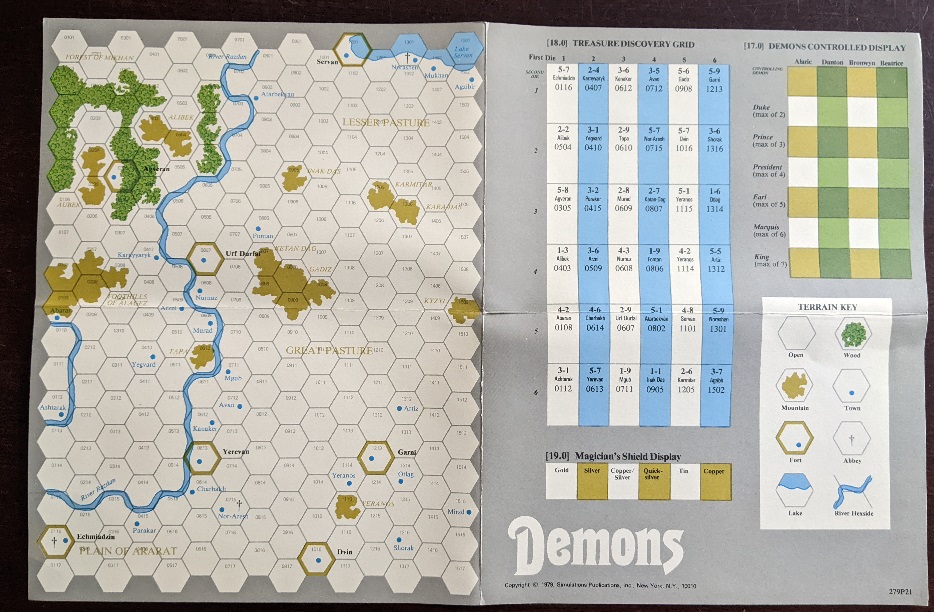
“#RPG” and “#TTRPG” aren’t appropriate hashtags for this post, but screw it. This is about a board game that had great appeal among the 1st Edition D&D folk. Last weekend, I received a copy of a board game purchased on eBay. The game is called Demons.
As you can see, it’s not in mint condition, but considering this was a board game from the 70s that was probably sitting in an attic for decades, this is in remarkably good shape. Going into the purchase I was told that only a single chip was missing, but there are enough blank chips that I could reproduce it if needed.
I bought this game in tandem with the original Dungeon. If, when I mention Dungeon, you think about a box set twice this size with a hard map, then you’re not thinking old school enough. No, the copy I bought with Demons was the one from 1975 (though I purchased it around 1978 or 1979).
Back to Demons. I remember my older brother and uncle ruining this game for me by defacing the instruction manual with rules about how the characters would have to masturbate in a corner if they lost a fight. Juvenile garbage like that. Remember, just a few years later, the Satanic Panic hit me hard. That didn’t occur in a vacuum.
Now, this is clearly a trip down memory lane for me, but let’s not come away from this post without a lesson. Way back when, I was pontificating on how overpriced online sales have become. The reason is that too many of us are willing to pay unreasonable prices in order to relieve simpler times. With a little patience, you can generate that same reward for 1/3 the price. The first copy of Demons I saw on eBay was being sold for $39.99 plus $23.00 shipping. I explained to the guy that I didn’t think it was worth nearly that much, and the insane shipping cost was obviously a way to charge even more for it. I told him to lower the price to $7.00 so that I could pay a total of $30 for it. I thought that was fair. He rejected the offer, and as you can see, the dipshit is still sitting on it.
“30% off”? Seriously, who falls for that bullshit?
I moved on and found this copy for which I paid $26.99 with an extra $5.00 for shipping. He has money; I have my childhood. Everyone wins except the dipshit, and all we needed was just a little patience.
I think I’m going to mail these guys a check for $103.20. The subscriptions are cheaper if you commit for a longer time. At last I’m becoming a crafty consumer.
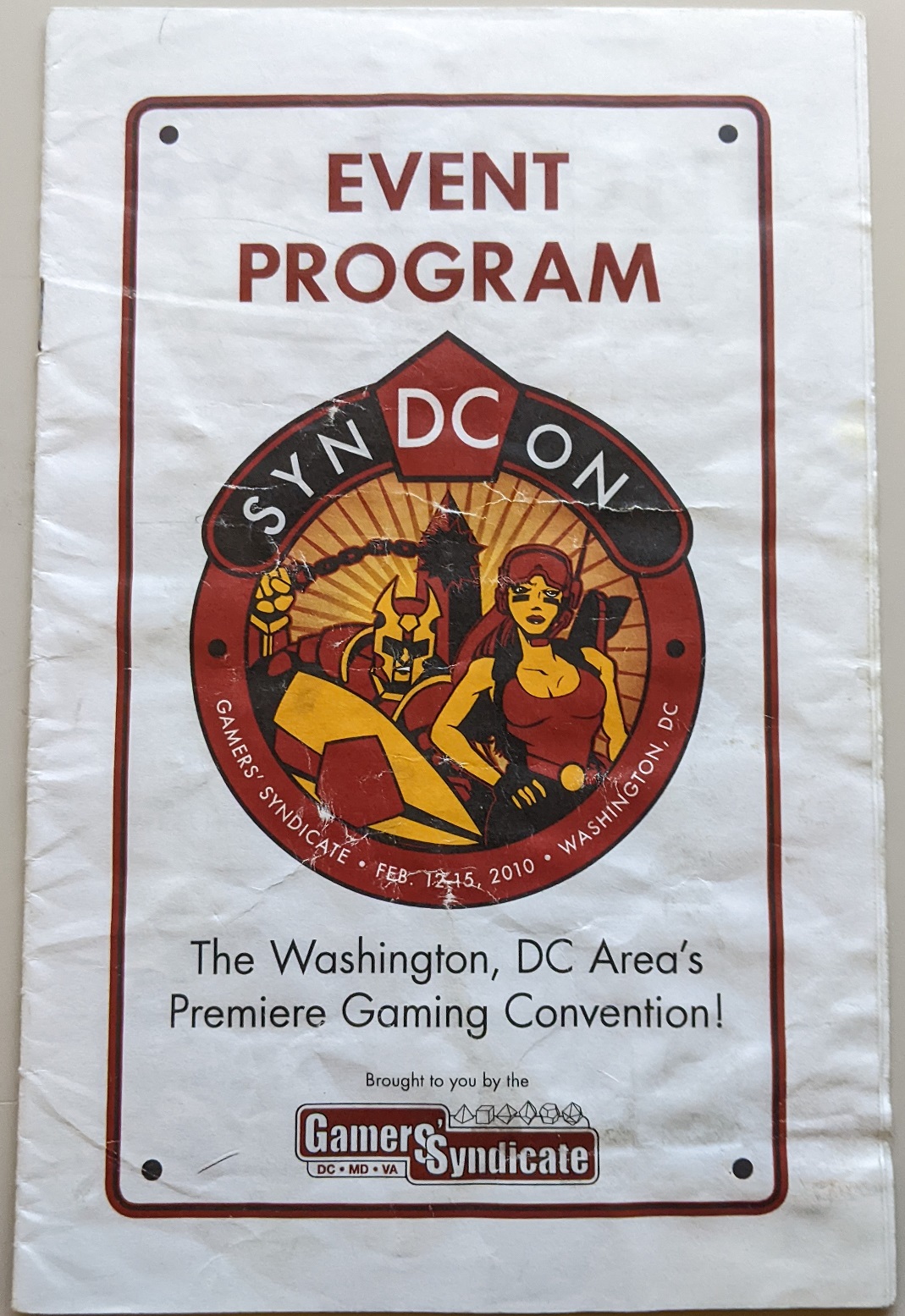
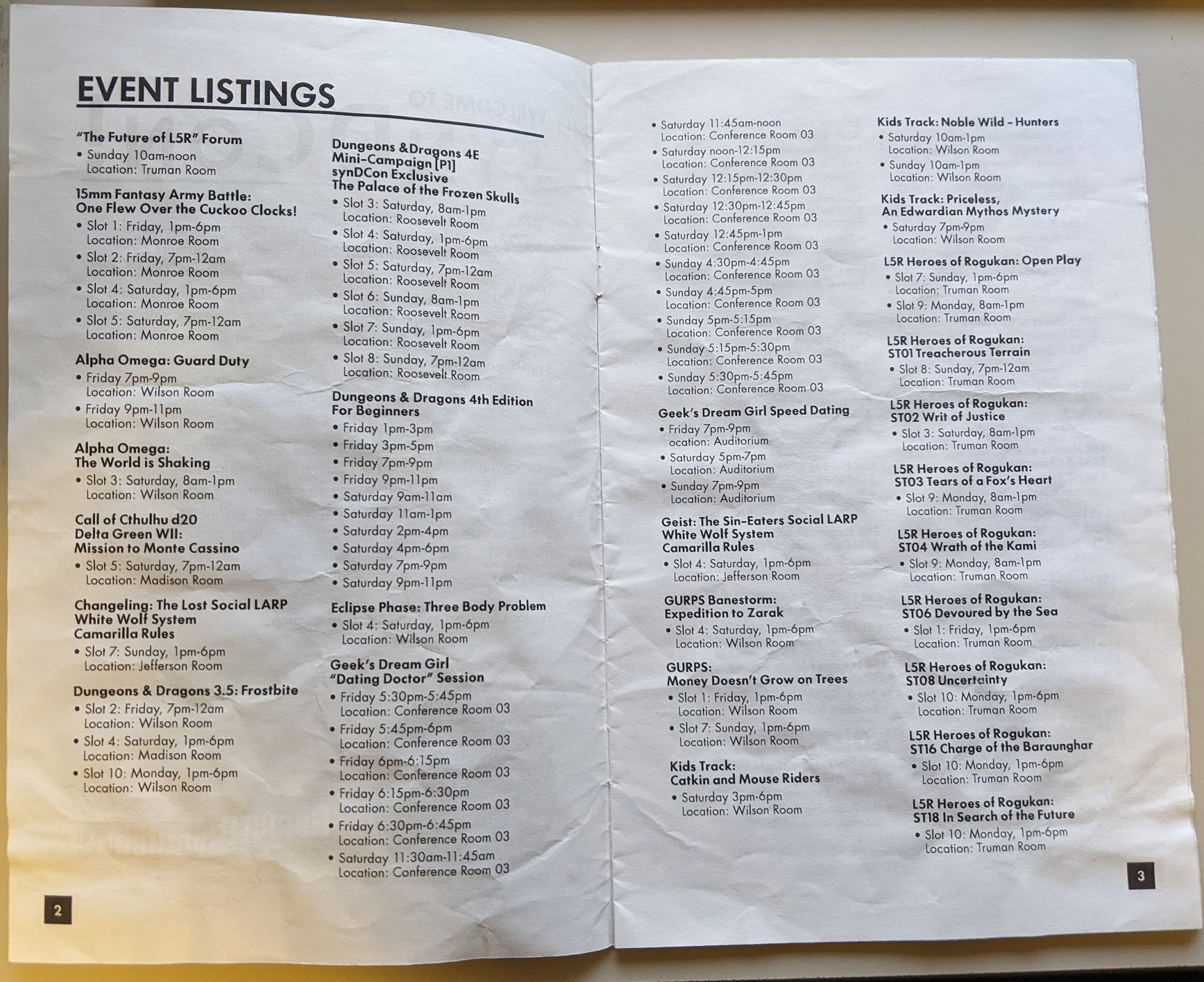
A couple of days ago, I posted about some things I found while continuing to unpack. One thing I found deserves its own post: the program for our first synDCon gaming convention (2010). When we decided we were going to put on a convention, we had a meeting of at least 20 people at the Cracker Barrel in Chantilly, Virginia. This took place after one of our Living Forgotten Realms game days at the now defunct Game Parlor. Only seven people decided to come on board as owners, with two quickly moving to Arizona before we could even get started, and then two others flaking out. It was basically Vic, Cassandra, and I doing everything.
Front Cover
The cover art and Gamers’ Syndicate logo were both designed and illustrated by Erik_Nowak, and he also designed this program.
Welcome Statement
I remember a meeting when there were just five of us. We had to decide who would be the number one person: the Convention Coordinator. I didn’t volunteer because I didn’t want to be too pushy, but no one else wanted to do it. This was typically unnecessary nerd angst on all our parts, because in the end it didn’t matter. Everyone had to work hard (until they flaked out), and no one was really the boss among us.
Pages 2 and 3
I’m proud of two things. First, look at that first page, and continue to examine the ones that follow. Even when we had seven planned owners, everyone was almost exclusively a 4th Edition D&D player. Nevertheless, our relatively small convention had a ton of variety in what was run. There were card games, board games, RPGs, and miniature war games. Within the RPGs, we had a ton of variety as well, and there were games run specifically for beginners. We also had a “synDCon special,” which was written by Erik and D. Hunter Phillips.
Pages 4 and 5
The second thing of which I’m proud was my idea (<patting myself on the back>). We had staggered slots. Instead of the typical 8am-12pm, 1pm-5pm, 7pm-11pm schedule for RPG games, we added in slots at 10am-2pm and 3pm-7pm as well. Again, for a small con, the fact that this worked out so well was remarkable. Many people took advantage of the opportunity to sleep in, try our Dungeon Delves for a couple of hours, sit in on a seminar or author book reading, or try new systems at the beginners’ tables. Another great idea of mine was to allow only 5 seats per game in presale despite tables seating 6 players. This made it far easier to sit players that didn’t preregister or wanted to change tables. No one had a problem with it, but a lot of people appreciated the flexibility.
Venue Map
This was a nice hotel, and it was conveniently located near a Metro stop (our public rail transportation system). And being who I am, I especially wanted a site in Maryland so that we could register for a federal trademark if it ever came to that. 🙂
Pages 8 and 9
Okay, yes, we definitely emphasized Living Forgotten Realms, but I’m still happy with how much Heroes and Rokugan and Pathfinder Society we had (these are living campaigns for the RPGs Legend of the Five Rings and Pathfinder respectively).
Pages 10 and 11
Note well, though, that there was more going on than the program states. We had a board game room, and open play for both card games and miniature war games. Saturday night, my cousin and I, a.k.a., Wet Paint, performed for a crowd of beer-drinking gamers some hits of the 80s and 90s. That’s when we played together, so our song set came from those decades.
Only Mike and I are Wet Paint. Matt James was an interloper. He’s considered a member of “Trail Mix,” which is anyone that’s ever played with us.
Seriously, for a small, first-time convention, look at how much variety we had. I loved it, and I never saw it with conventions this small. We also had seminars featuring authors and game designers. Being in the DC area, we actually knew a lot of those people, so it was relatively easy to get them here. This, in turn, allowed us to do this . . . .
Pages 12 and 13
We received a small amount of support from most of these companies, and others were actually present. Our prize for the first person to buy a convention badge was a ticket to GenCon. GenCon gave those away to conventions all the time; no inside track was necessary. However, we also had, for example, a member of Green Ronin participate in a seminar and run the (then-new) Dragon Age RPG, and Rob Hobart (AEG), the head of Heroes of Rokugan, ran a seminar and (I think) a few games.
I touched up this image of the back cover to delete some handwriting. Pay no attention to the fields of ecru.
We chose a great venue, and synDCon 2010 was a four-day convention. Yep, four days. Just like the big guys. Monday was a holiday, and adding that day to the schedule didn’t increase our costs noticeably. Of course, by cost I mean financial cost. My feet were sore (which is why I was sitting for the Wet Paint performance), and I ran, at best, on four hours of sleep a night, with only two on performance night. I’d say it was a success considering that we got hit with a snowstorm right before the convention, scaring off a lot of people.
The following year, we moved synDCon 2011 to mid-April to make sure we’d have better weather, but we had late snow that year. It wasn’t as bad as the previous year, but it still affected attendance. Infuriating. However, synDCon 2011 was an official convention within the circuit of competitive Munchkin published by Steve Jackson Games. In fact, we may have done that for synDCon 2010. I really don’t remember at this point. I just know we had a great time both years. Unfortunately, it’s too hard a thing to run with, for all practical purposes, two people running the entire show and Mother Nature chasing us around with snowstorms. This isn’t to say that there weren’t a lot of other people that did a lot of work. We had a lot of help, with a few people being organizers for Living Forgotten Realms, Pathfinder Society, and Heroes of Rokugan, and we still had decent numbers. However, in the end it falls on the organizers, and there were only two of us. Both Vic and I would rather not have a convention than do one half-assed, so we didn’t have a third one.
Would I like to bring it back? Yes. Do we have the financial means to do so? Probably. Do I see enough people getting on board to make the workload manageable? No. There are very few people I could trust to see it through, and I’m not getting any younger.
I told my coworkers that I was using one of the bedrooms in my new home into a den. They started calling it a mancave. Well, if this is a mancave, it’s the nerdiest one ever. I also can’t see it as a “cave” considering it’s on the second floor. It seems more like a man loft.
That doesn’t make any sense, does it?
Last week, I bought a 6′ tall bookshelf that finally allowed me to unpack most of my gaming material. This weekend, I picked up a new desk, which again allows me to unpack office supplies and other things. The room is finally coming together, and I’m fairly well organized.
This den, mancave, or whatever you want to call it is oddly important to me. I’ve lived a rather simple lifestyle up to now. I’m used to a small place, and while this home isn’t what anyone would call large, it’s exceptionally large for me. In fact, it’s too large. It’s great that I have room for everything that I have and much of what I don’t have yet, but I spend 90% of my waking hours in this room. For lack of a better word, it feels cozy, and I’m jamming it with everything I want around me in my free time at home.
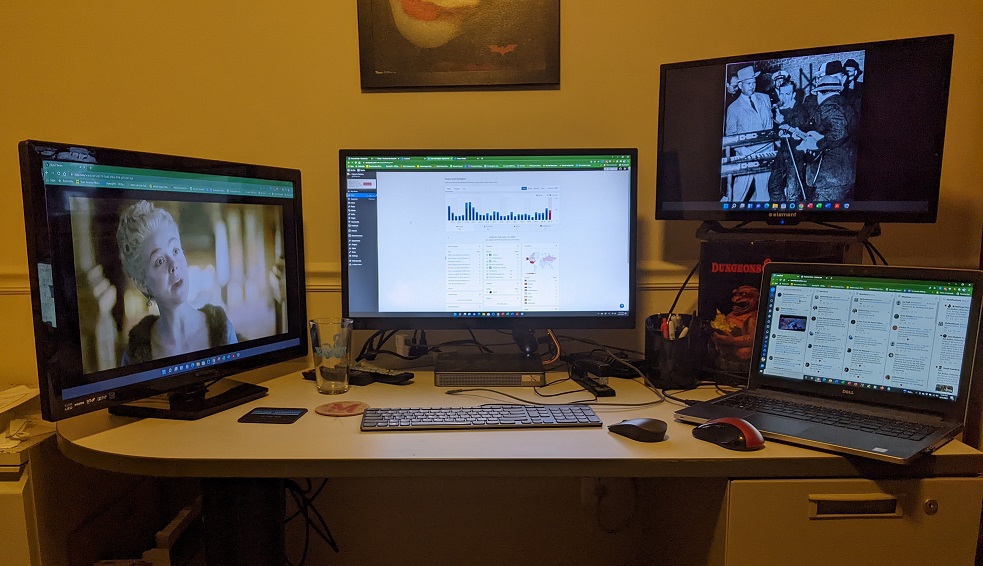
Do I have enough screens?
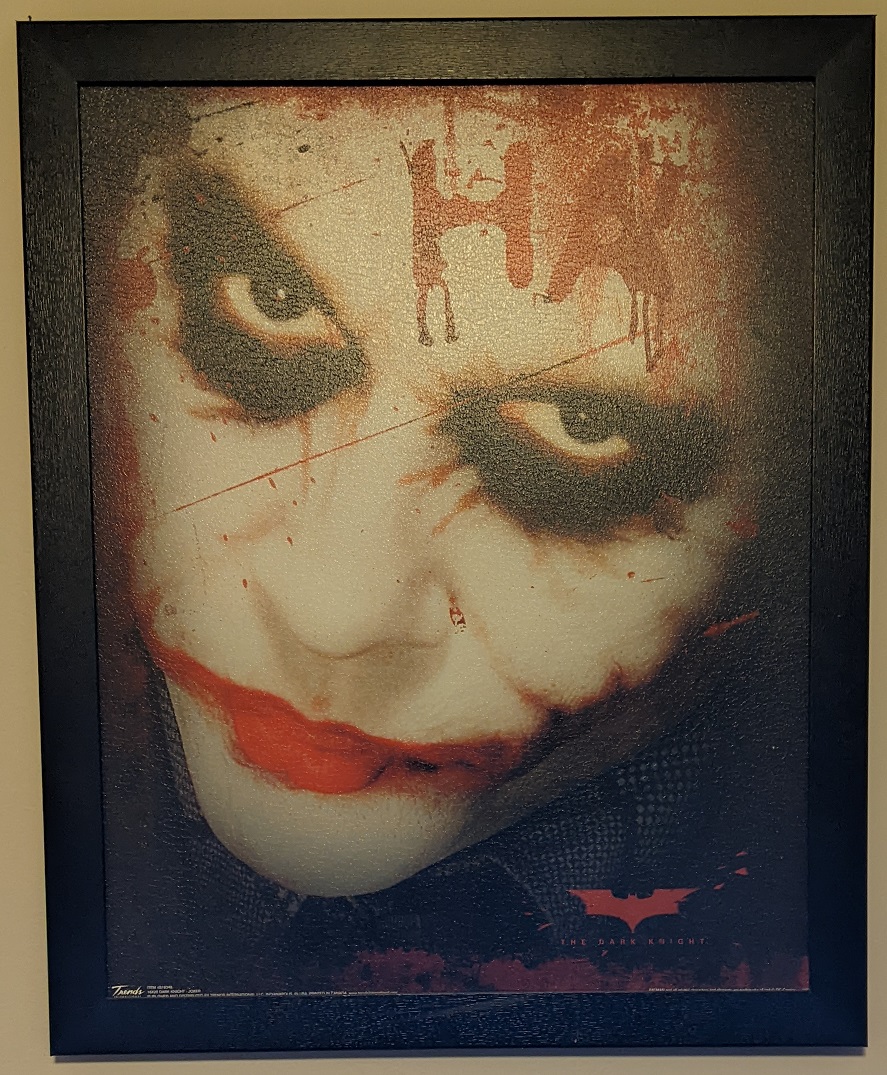
I have a lot of Jeff Dee originals to hang, but so far the only art on the walls is this guy over the desk.
Judging every one of my Google searches.
My cousin gave me a magazine rack. I asked, “What am I? 108 years old?” But I had just the use for it.
Though I may never read them again, I like having them.
Seriously. This is a mancave?
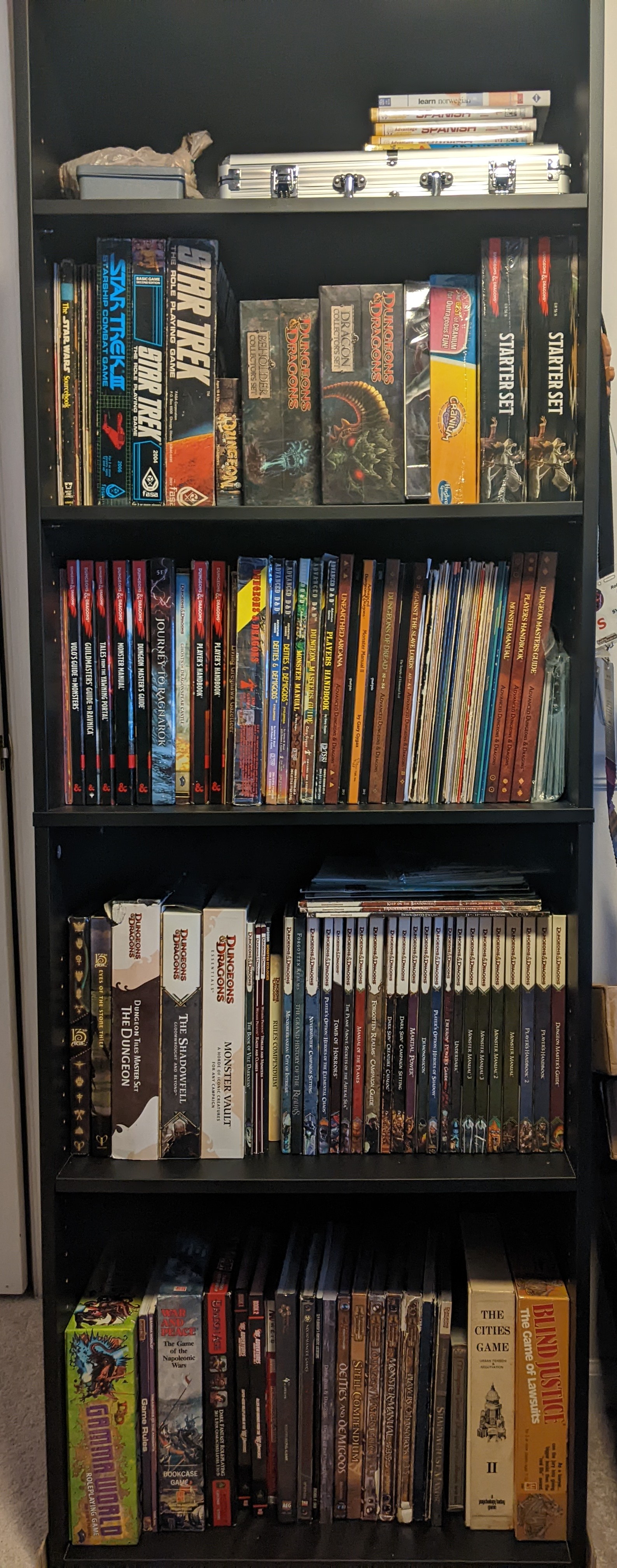
Almost one shelf per edition of D&D.
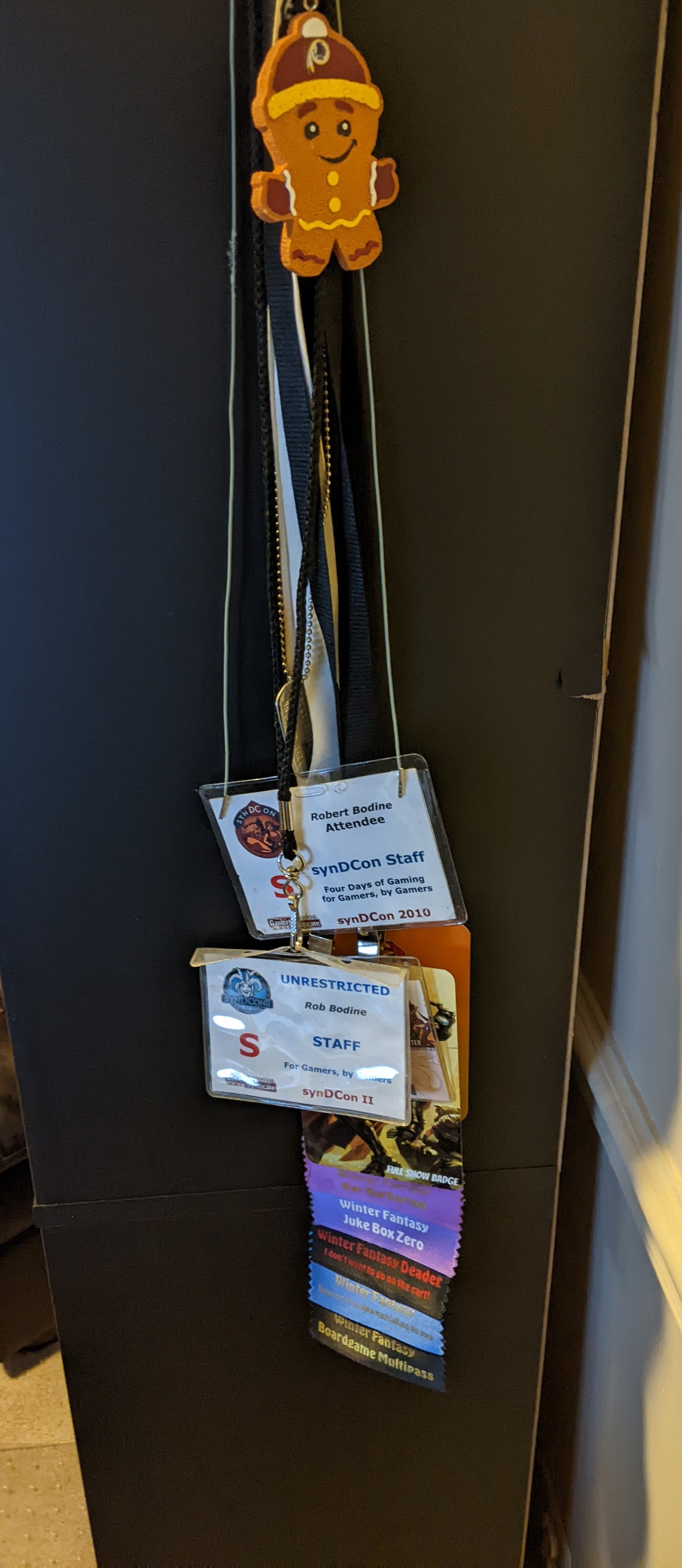
I have tons of other books not related to gaming, but the second bookshelf hasn’t even been put together. On the side of this bookshelf, I hung some memorabilia.
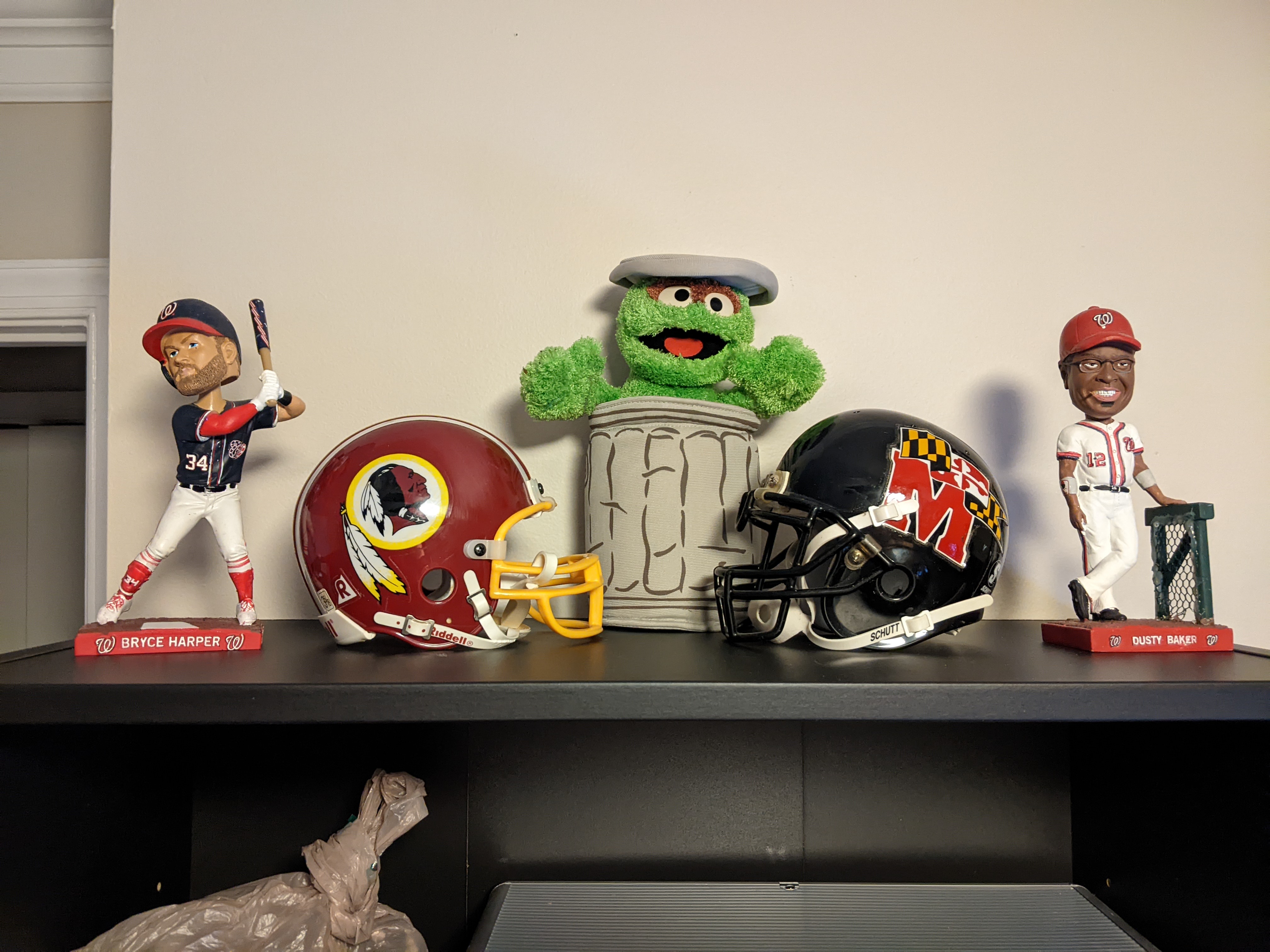
Okay, maybe it’s a mancave after all, but just barely.
The one thing that won’t fit are my musical instruments. I’m keeping them downstairs. That’s probably for the best. It’s a townhome, and the neighbors probably wouldn’t appreciate any noise being upstairs near their bedrooms.
Make no mistake about it: My keyboard playing is properly defined as “noise.”
Dungeons & Dragons is a trademark of Wizards of the Coast, LLC, who neither contributed to, nor endorsed, the contents of this post. (Okay, jackasses?)