Let's roll some dice, watch some movies, or generally just geek out. New posts at 6:30 pm ET but only if I have something to say. Menu at the top. gsllc@chirp.enworld.org on Mastodon and @gsllc on Twitter.
Last week, I watched season 2 of Ragnarok. I previously discussed season 1, which I think I liked more than I should have. I’m a sucker for mythology, so I sometimes give modern dramatizations a little more credit than they deserve (though this is not absolute). This certainly applies here. The acting was rather sour at times, and I’m not sure whether that’s because the English is dubbed. However, I haven’t seen a better representation of mythology on film than this show, and that’s despite the fact that it intentionally (and appropriately) takes the “gods” and “giants” in a different direction.
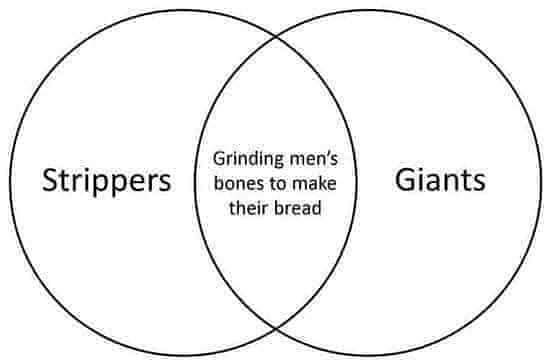
The premise is that the war between gods and giants never ends. Both groups are continuously reincarnated but in different ways. You learn in season 2 that the giants know who they are their entire lives, even as they take on new ones through reincarnation. However, because the gods represent the interests of humans, they possess or are reincarnated as (probably the former, but unclear) humans, taking time to remember/learn who they are. This creates a foot race. The giants are busy destroying the world (in the most modern of ways in this show), searching for evidence that the gods are returning. Once they learn that the gods are back, they race to complete their plans, or even kill the gods, before the gods gain their full strength. The complication for the giants are that they’re bound by the rules of the game, which doesn’t allow them to act directly at times.
See?Giants aren’t all that bad.
Despite getting to the action this season, there’s still character development in play. For example, there’s an obscure character in Norse mythology, Járnsaxa (don’t click the link if you don’t want to be able to infer spoilers), whose role took me by surprise. Her character was in front of my face for two seasons, and I didn’t recognize her until the last episode of season 2. Based on the myths, her presence is important to how the series should wrap up. Some new characters were “born” in this season as well, including two extremely important ones, Loki and … something else.
The actor playing Loki is no Tom Hiddleston — who is? — but he does a good job, and the writing for his character is as good as any I’ve seen for any god from any mythology ever on television or in the movie theater. He’s exactly what Loki is supposed to be, which is hard to fit into modern storytelling. He’s not evil. He’s not even always selfish. He’s . . . Loki. Moreover, Thor’s reluctance to remove Loki as a threat makes a ton of sense, just as it does in Norse mythology, but not in exactly the same way, because this show takes place today.
Season 1 was very slow — all set up — but season 2 really got us into the mythology. Unfortunately, it’s only six, 50-minute (or so) episodes. I wanted a lot more.
I can’t guarantee you’ll like it if you’re not a mythology nut like me, so as always, YMMV.
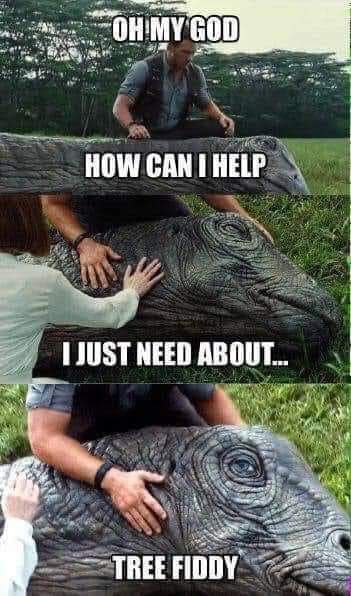
Going forward, Sundays are lazy days for me. I either post something silly or other people’s work. Usually both. Today, it’s a preview for the next Jurassic Park sequel.
Admit it: this couldn’t be worse than the last movie.
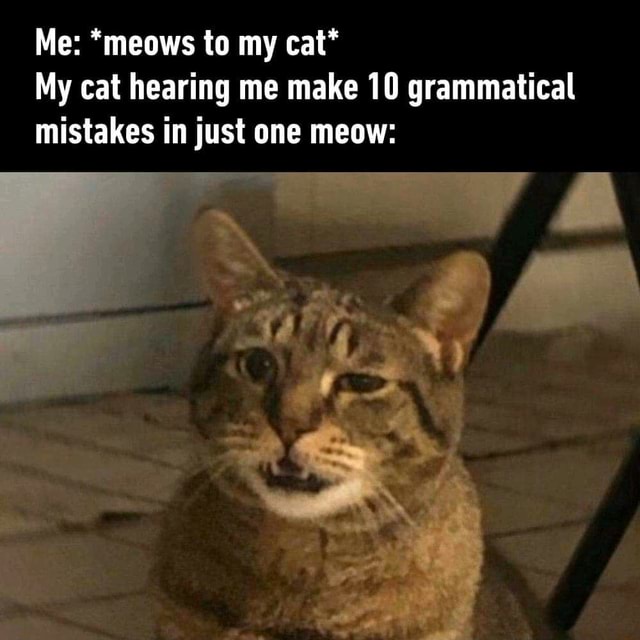
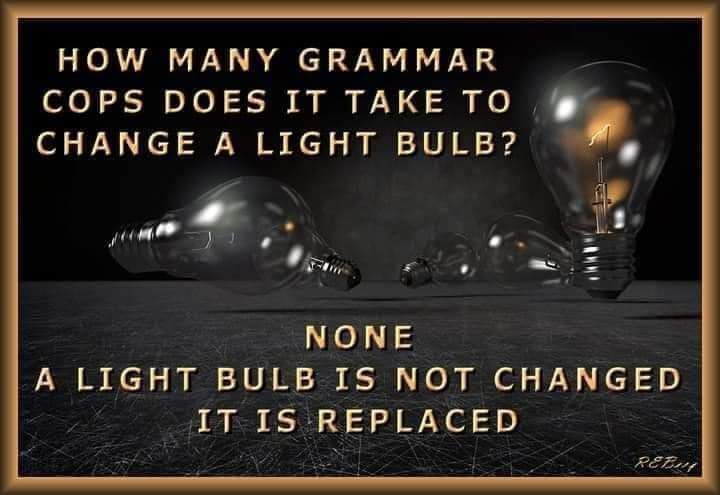
As a follow up to yesterday’s post on language, today I give you a combination of language and the silliness of Caturday. It’s an oldie but goodie, and by “oldie” I mean “old in the context of the internet.” It’s not old like I’m old.
It’s not as if Caturday is supposed to be taken seriously.
If you know me personally, you know I’m a language freak. Before you assume that I, a lawyer, thinks that language is a crime (as many often inappropriately accuse language freaks of being), I can assure you my view is a bit more reasonable than that.
Reasonable, but still kind of a dick. It goes with the territory.
When I was in high school, I thought I was pretty clever. Of course, I was, but my successes aren’t important right now. I had heard about the word, “ghoti,” attributed inaccurately to George Bernard Shaw. To summarize, when you take the way “gh,” “o,” and “ti” are pronounced in other words, you can justify pronouncing ghoti the same as you would pronounce the word, “fish” (click through for an explanation). Here’s where my cleverness comes in. Whenever someone as smug as I told this story, I told them that Shaw and they weren’t thorough in their spelling. The correct spelling of “fish” was actually “ghotib.” The ‘b’ on the end is silent, like in dumb.
Get it? See? I always outdid those wannabes that were taking other people’s work and peddling at their own. I at least added to the work. I told you I was clever. But not as clever as this.
Shit.
Fortunately, I’m no longer in contact with any of the people that could throw this in my face.
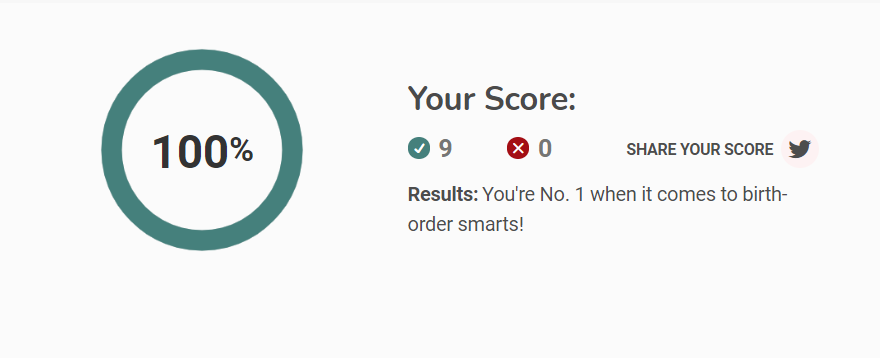
I’m the archetype of a middle child. If you look up “middle child” in your dictionary and don’t see my picture, get yourself another dictionary. I just had one of the most middle child of experiences. WebMD sent a link to a quiz on how birth order affects your choices. Every single answer was “first born,” “only child,” or “youngest child,” and only twice was “middle child” even an option. That’s right. Even a quiz about birth order ignores middle children.
How’d I do on the quiz?
First time through. No shitting around. It was easy.
Because of course I got a perfect score the first time I took the quiz. Middle children are self-aware and acutely aware of how their siblings are treated. We also aren’t liars, so don’t go down that route. We’re just accused of lying or exaggerating because the truth is so painful to their parents and the other siblings. I guarantee you that only middle children would do so well, and if I didn’t give myself credit for it, no one else would have. In fact, they would have claimed my older brother got a perfect score. He probably would have failed.
It’s Mythology Monday, but it’s also Memorial Day. So, what do I post? Here’s an article from the History Channel that may satisfy both: 8 Things You May Not Know About Memorial Day. Well, not really. Articles with titles like this generally don’t reveal the great secrets implied by their clickbaity titles. At least it’s an attempt to dispel what’s commonly mislabeled “myths.” They’re usually misconceptions. Close enough, I guess.
Let’s just not lose sight of what the holiday is really about.
Every Memorial Day, I see a lot of posts telling us that Memorial Day isn’t about BBQs, parades, and sports. Absolutely everyone knows that, so this is the typical “everyone wants to be a hero” mentality in play. Kind of ironic considering the day is supposed to be celebrating real heroes. In any event, despite positive trends, Americans still don’t take nearly as much of their vacation time as they should, and there are only eleven federal holidays, so not even one per month on average. On top of that, the private sector doesn’t recognize all of those holidays.
All of this is to say that the people who truly work for a living probably work a lot harder than we should. (I, for one, will be at work when this post goes live. EDIT: Confirmed. Three hours and counting.) If you have the opportunity to get a relaxing three-day weekend with friends or family, take advantage of it, and never apologize for it. After all, what have all those heroes fought and died for?








 Play What You Want