Let's roll some dice, watch some movies, or generally just geek out. New posts at 6:30 pm ET but only if I have something to say. Menu at the top. gsllc@chirp.enworld.org on Mastodon and @gsllc on Twitter.
If you enjoy this post, please retweet it. Other posts in this series can be accessed by clicking here.
This past Monday was the Jay and Silent Bob double feature, quarantine watch party hosted by Russ Burlingame of ComicBook.com. We watched both Jay and Silent Bob Strikes Back (which I’ve seen a handful of times) and the Jay and Silent Bob Reboot (which I had never seen). Because of how I write, I have to keep my posts short for them to remain coherent to nonlawyers, but this movie has so much good in it, I don’t know how to handle it.
In summary, this is a movie that didn’t need to be made except to repay the fans. There’s no respect given to the fourth wall, and the cameos from both the nerd and Kevin Smith movie universe were overwhelming. There was a point where Kevin Smith (for what seemed like the 100th time) broke the 4th wall and noted how he had successfully brought us to the third act with all of the characters exactly where they needed to be. I don’t know the science of filmmaking, but I doubt this movie was so we’ll structured. How could it be? It was less a movie and more of a series of “meta” fan service moments loosely strung together. Don’t misunderstand me, though. It absolutely worked for anyone who’s seen Kevin Smith’s movies and/or is a nerd in general.
— Rob Bodine #QuarantineWatchParty Fiend (@GSLLC) May 12, 2020
My one complaint: I don’t remember seeing any references to Star Trek.
Unless you count this.
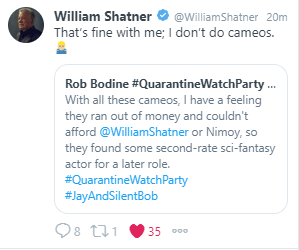
The Shatner joins the ComicBook.com quarantine watch party, only to delete the tweet a few hours later.
But I get sole credit for that.
Still, I must admit that there were certainly good filmmaking moments in the movie. For example, I kept yelling at the Twitterverse that I wanted Jay to give his daughter a hug . . .
— Rob Bodine #QuarantineWatchParty Fiend (@GSLLC) May 12, 2020
In fact, there were several times that I unwittingly predicted the jokes that were coming, which I think speaks less to my deductive reasoning and more to how much Mr. Smith knows what we wanted from him.
If you enjoy this post, please retweet it. Other posts in this series can be accessed by clicking here.
Legion has Rotten Tomatoes scores of 19 from the critics (who mean nothing to me) and 31 from the audience, which is even worse than Green Lantern. Go figure. Like Green Lantern, the cast was actually pretty good, mixing newcomers with established veterans, and a couple of up-and-coming stars. I’m sure a few of them wouldn’t appreciate me linking them here, but they did a good job with what they had.
I think there are two things that make me like this movie. First, as a mythology fan, I love it when mythology, religion, and legends are turned on their heads. It gives the stories a different take and thus isn’t a bland remake of the same story we’ve seen a million times. In this case, while not evil per se, Gabriel is still the villain. Michael, on the other hand, is the protagonist even though he’s going against the Judeo-Christian-Islamic notion of god. That’s the big difference; there are others. Maybe some of the bad ratings are based on the fact that this offended people. Perhaps just a little bit?
Second, at the time I saw it, I was still playing Dungeons & Dragons and thought it could be the basis of a really interesting campaign. Unfortunately, I never got around to it. Food for thought for the gamer nerds.
First off, Scarlet Witch is the strongest Avenger because all of these characters are defined solely by what’s in the script, and that’s what Kevin Feige says. However, art is in the eye of the beholder, so my interpretation is as valid as anyone else’s. My interpretation is that Thor has proven himself to be the strongest Avenger, and by “Avenger,” I mean “good guy we’ve seen on screen that remains alive in the MCU.”
Odin, Surtur, and Hela Are Dead … I Think
I don’t read the comics, but I know a few things, and it appears that Thor: Ragnarok recognized that Thor was finally gaining the “Thorforce.” With Odin, Surtur, and Hela dead, that would make sense. Also, with those three dead, you have a few major hurdles cleared for my claim to ring true.
Of course, Hela and Surtur could be alive, but at least one could interpret Surtur’s words as a suggestion that he would die once his destiny was fulfilled. Hela? Who knows? Damn comics! But for now, I’m assuming they’re dead, which would clear the path for the Thorforce, eventually placing Thor on Odin’s level.
Compare to Captain Marvel
This was Feige’s first claim. Powered by the Space Stone, she’s a reasonable choice, and the data we have is strongly in her favor. However, our measuring stick is Thanos, and there, Captain Marvel wasn’t as impressive. At the beginning of Endgame, she managed to control a severely injured Thanos long enough for everyone else to get in position. Sure, Rocket couldn’t do that, but <yawn>. In the final battle, she took on a full-powered Thanos one-on-one, but even though he had all six Stones, he wasn’t actively using them. They were in the gauntlet, and she was keeping his hand open, which according to Dr. Strange’s dialogue in Infinity War means that Thanos couldn’t wield any stone’s power while in the gauntlet. In that fight, we saw a brief stalemate until Thanos used the Power Stone to send Captain Marvel flying across the battlefield. Was she impressive? Yes. Did she seem as much a match for Thanos as Thor? No way.
Sure, in Thor’s first fight with Thanos, Thanos kicked his ass with the Power Stone, but that was immediately after Thor was blasted to hell by the weaponry of Thanos’s ship. In fact, in defeat Thor was impressive because he was taking the continuous force of the Power Stone to his head rather than an intermittent blast. Facing off against him later in Infinity War, Thor had no problem handling Thanos even while Thanos was using the Infinity Stones, and that’s the proper metric. Thor was depleted in Endgame because the plot needed him to be. Otherwise, the battle in Endgame would have taken 15 seconds. Thanos without the Infinity Stones v. Thor with either Stormbreaker or Mjolnir isn’t even close based on what we’ve seen, and he was wielding both. Get Thor mentally healthy, and he’s the go-to guy.
Compare to Scarlet Witch
This is Feige’s current choice, but has she proven to be as powerful as Thor? It’s clear from her fights with Proxima Midnight and Hawkeye that she’s still just a fragile human with slow human reflexes and a fragile human mind (i.e., one that would descend into madness if she tried to wield Stormbreaker). If you can get past her offense, she doesn’t have much defense, at least not against someone that can fly. Thor, on the other hand, took the brunt of a neutron star. ‘Nuff said.
But what about her offense? Arguably, she was on the verge of killing Thanos when he didn’t have the Infinity Stones. When he had 5 Stones, she was at best at a standstill, but eventually lost the tactical battle. Once Thanos had all six Stones, he was the most powerful being in the universe (so far), and Thor almost killed him. Sorry, but I’d rather have Thor watching my back. Even if you could make a compelling argument that Scarlet Witch has more raw power than Thor, sometimes what matters most is willpower. Thor wins.
Conclusion
The only character for whom I have a bias is Thor. This is because of my love of mythology, and Norse mythology in particular. I’m sure that’s obvious here, so even if you have a decent counterargument, I probably won’t buy it. That’s just how I roll. But I doubt you have a decent counterargument.
If you enjoy this post, please retweet it. Other posts in this series can be accessed by clicking here.
This week’s ComicBook.com quarantine watch party (“QWP”) was Josie and the Pussycats. It was the first hosted by Russ Burlingame, who apparently has fond feelings for it. I had never seen it. Also contributing were Deb Kaplan and Harry Elfont, as in
— Rob Bodine #QuarantineWatchParty Fiend (@GSLLC) May 8, 2020
There was a QWP earlier in the week that I joined despite not being fond of the film, and because I didn’t want to rain on anyone’s parade, I don’t think I tweeted a single thing during the movie. Josie and the Pussycats wasn’t a movie I expected to like, so I expected to say nothing for this one as well.
I counted 68 tweets.
This was a fun movie. The gist is a trio of high-school kids from Riverdale (see the Archie Comics) that have formed a rock band. They get famous because of their talent, but the stereotypical greedy executives try and split the band’s leader, Josie, from the group and jettison Melodie and Valerie. Friendship, and music, prevails. Trite? Sure, but it’s all in the execution.
The movie is geared towards people far younger than I was even in 2001 when it was released, but it still made me laugh and had some nice moments between the on-screen friends. Also, going back to my days attending Arena Stage and seeing soon-to-be-famous actors getting their starts, I love seeing actors at the beginning of their career. This movie had a ton of them.
Josie and the Pussycats is currently streaming on HBO.
If you enjoy this post, please retweet it. Other posts in this series can be accessed by clicking here.
Whether you’re an MCU nut like me, or a Pixar nut, there’s actually a lot more on Disney+ than what you subscribed for. Back in March, I watched the Finest Hours.
It starred Chris Pine as Bernard “Bernie” Webber, a real person who led a 1952 rescue of the SS Pendleton during a nor’easter. The opening act focuses on how Bernie met and fell in love with his future wife, Miriam. After that, the action picks up as the rescue gets underway, but the movie still revisits Miriam as she frets over what she sees as a suicide mission for Bernie. Whether you’re looking for action or characters, there’s at least a little bit in there for you.
The movie also stars Holliday Grainger, Casey Affleck, Eric Bana, and Ben Foster, all of whom did a good job.
For what it’s worth, the Finest Hours’ scores on Rotten Tomatoes are 64 from the critics and 66% from the audience.
If you enjoy this post, please retweet it. . . but I imagine this won’t be a popular one. Other posts in this series can be accessed by clicking here.
First off:
Yeah, I know. With Rotten Tomatoes scores of 26 from the critics (who mean nothing to me) and 45 from the audience, Green Lantern isn’t exactly well-loved, but if it were, it wouldn’t be a guilty pleasure. You chose to read this post. You’re committed to hearing me praise a movie you can’t stand.
Let’s start with the easy part: Ryan Reynolds is always great. You all love his sarcasm in Deadpool, and he delivers it here in spades. It’s a typical Ryan Reynolds performance, and if you can’t get behind that, you’re truly lost. As for the rest of the cast, I know of at least three Oscar winners (Tim Robbins, Geoffrey Rush, and Taika Watiti) and one nominee (Angela Bassett) in there. They didn’t win Oscars for this movie, but it’s a good cast.
Moving on, one of the dead horses I love to beat is that I’ve never really read comics, but there’s a method to that madness. I have an exceptional, long-term memory, and I read a few comics in childhood, so I have some idea of comics lore. However, I have no loyalty to their story lines. If Parallax is nothing like what he was in the comics, I wouldn’t know and don’t care. This isn’t a defense of Parallax — I thought he was rather goofy — but rather a means to help you understand why I hold the positions I do on this and other Guilty Pleasure posts. Ergo, many of the reasons you may have for hating this movie have no relevance to me.
Next, Sinestro. Whether we’re talking about the actor (Marc Strong) or the character, this movie was the set up for a sequel that would rival the Star Trek: The Wrath of Khan or Aliens. Whereas the first movie is always about the protagonists, the second movie is always about the villains. I know of no comic villains with a more tragic fall than Sinestro. He was made quite sympathetic and demonstrated a dedicated campaign against the fear to which he eventually succumbed. This made his fall from grace all the greater. Again, I don’t know many comic book back stories, but a second movie with Mark Strong playing Sinestro as the villain could have been incredible.
Then there’s Taika Waititi. He really sucked in this 🙂 , but considering who he’s become, this is a great look back at his beginnings. Sure, that’s not a reason to like the movie, but I consider it bonus points. He’s turned into something special and won an Oscar for his efforts elsewhere.
Finally, the music. Music is my favorite art form, and when I really like the music, it can often carry the movie. The music is overall rather weak in this movie, but there are a couple of pieces that are on one of my playlists. Here’s a short example that I thought captured the scene well:
The music starts at 0:54, but you may need the entire clip to appreciate my point.
All of this is enough for me to watch this movie occasionally despite some poor dialogue and overacting. I’m doing so as I write this.
In brightest day, in blackest night,
No evil shall escape my sight.
Let those who worship evil’s might
Beware my power–Green Lantern’s light!
If you enjoy this post, please retweet it. Other posts in this series can be accessed by clicking here.
Battle: Los Angeles just returned to Netflix. Rotten Tomatoes reports a score of 36 from the film critics (who mean nothing to me) and 48 from the audience. That means, to the population at large, it sucks. I don’t care. I love the science fiction aspect to it, and surprisingly I like that no explanations are given. Instead, the story is completely about the humans. It’s not just that they win the fight; their relationships and self-determination are in the forefront. I’m a huge Star Trek: Original Series fan precisely because it was never really about the bells and whistles of the setting, but was instead a morality play at heart. It was 20th-century humanity living in the 23rd century. Similarly, BLA is about the humans, not the alien invaders.
In yesterday’s post, I voiced my only serious complaint about the MCU: The incoherent power curve. While that certainly annoys me, Avengers: Age of Ultron keeps me from forgetting that the least powerful original Avengers, Black Widow and Hawkeye, were certainly very important to the team. If the choice I was given was having a screwy power curve or eliminating them from the story, I’ll take the screwy power curve with a smile on my face every time.
Hawkeye
Hawkeye was instrumental in stopping Scarlet Witch from tearing the Avengers apart. He was the only one who avoided her powers, and he was the one to convince her, the person that would one day become the strongest Avenger, to join the team in a meaningful way. That was done with a speech rivaling any Captain America ever delivered. This was a believable effort on his part despite not requiring a superpower. Before that, however, he reinforced the message to the other Avengers of what they were fighting for by introducing them to his family. In fact, his non-hero wife, Laura, kept him from losing touch with his own importance. For a team that was falling apart at the seams, this was critical to the believability of the Avengers continuing to work well together.
Black Widow
I’ve written several times about how Black Widow is the glue of the Avengers. Except for Thor, she had significant, on-screen bonding moments with each of the original Avengers (as well as a few others) over the course of several films. This could explain her eventual inability to stick to one side in the Avengers’ “civil war.” With this movie, we saw the development of her most significant relationship, Bruce Banner, and the expansion of her most important one (from a story perspective), Hawkeye. I vaguely relate to Black Widow’s backstory, and how it shaped who she became, in a specific but personal way I won’t discuss; however, I think we can all agree that it’s compelling enough for her own movie. The story became a mission to rescue her, but not really. Far from the archetypical damsel in distress, she instead turned the situation around from the inside, leading the Avengers to Ultron. Without screwing with the power curve, Black Widow contributed in vital ways.
These two characters were as important to the Avengers as any of the others, and neither had a superpower.
Unrelated Note
In a cinematic universe filled with brilliant one-liners, one of my favorites comes from Age of Ultron.
I’m not sure if Natasha and Clint’s friendship is the best thing about the #MCU, but it’s *really* close. Only Steve and Bucky’s rival it. #QuarantineWatchParty#AvengersEndgame
There’s one thing that the MCU does consistently that I don’t like: They screw up the power curve.
I understand that writing something so grand in scale as the 22 MCU films was tough, but I think they could do a lot better of a job in this regard. First, we can start by saying that the characters don’t have to be precisely matched up. Captain America has super serum coursing through his veins, so there’s no way Black Widow should be a match for the enemies that are a match for Captain America. Sorry, Rex, but karate, kung fu, etc. just don’t work that way. Nevertheless, if the two of them are facing off against the same enemies, I can accept that. Along the power curve, they’re certainly within a reasonable range of each other, and sometimes someone’s specific weaknesses can fall prey to their adversary’s specific strengths.
But no matter how cool it looked, having Captain America, Black Widow, and Falcon save Scarlet Witch and Vision makes no sense at all.
It did look cool though. Really cool.
At one point, Kevin Feige said that Captain Marvel was the most powerful MCU hero. Then he changed his tune, saying Scarlet Witch was. Either of these two choices makes sense (though Thor should be), as their powers come from Infinity Stones. Similarly, Vision’s power comes from an Infinity Stone, so Scarlet Witch and Vision are cosmic level beings like Thor, the dark elves, and Thanos and his adoptive children. That last group took out an entire ship of “gods” (Asgardians) including Thor, Heimdall, Loki, and Hulk. Thanos won a fist fight against the Hulk, who’s probably the only terrestrial hero that we should expect to deal with cosmic threats. Should Hawkeye have been used to save the Asgardians?
I refuse to believe that this is hard to write; I suspect they just don’t want to write it any other way. It’s fan service, but that’s why I don’t care much for it. There’s literally only one hero for which I have a bias: Thor. That’s not based on comics, which I’ve rarely read, but rather my love of mythology. I don’t need Captain America to win a fist fight against Proxima Midnight, because my love for the character doesn’t go back any further than the start of the MCU. I’d much rather see him take on threats that make sense for him, and there were certainly several present during the battle of Wakanda. If Captain is a match for Proxima, then Proxima shouldn’t be in the same ballpark as Thor. If she’s presented as such, then Thor is no tougher than the toughest human (yet can somehow take on the brunt of a neutron star). Again, this makes no sense at all.
Obviously, I’m insanely fond of the MCU, and this doesn’t bother me too much, but I’m no apologist. If the MCU is screwing up, I’ll call it out. This is, in my opinion, their one consistent screw up. They have the chance to readjust their thinking with the introduction of new characters for future phases, but I’m not optimistic they will. However, as I’ll discuss tomorrow, I’ll gladly tolerate an incoherent power curve if it gives us the two critical characters that most often screwed with it.
I suspect the majority of you just want to see your favorite guy punch the bad guy. Fair enough.
It’s rare that I find things that I don’t like about the MCU, but there are a few. As I discussed yesterday, I approved of “Fat Thor” because it was handled fairly well. However, it wasn’t handled perfectly; to-wit: War Machine. I felt that the writers unnecessarily threw Rhodey under the bus. They gave him all the mean-spirited lines, and a couple were particularly bad. This reminds me of my tweet during the Infinity War watch party.
The writers didn't have to throw Peter under the bus on this, but they did. Peter's the root cause of the other 14,000,604 outcomes. #QuarantineWatchParty#InfinityWar#MCU#GotG
If it weren’t for Peter’s completely irrational reaction, none of the 14,000,605 alternate timelines would have occurred (including the successful one). People do stupid things for one of four reasons that I can identify: 1) They’re stupid; 2) they’re kidding; 3.) they’re trolling you; or 4.) they’re acting emotional, thus abandoning all logic. Regardless of which category you think Peter is in, he behaved stupidly, and I don’t see why the writers had to do that. They could easily have made Thanos too strong for Mantis. Unfortunately, this seems to be how they write. They want a clear scapegoat among the heroes, being someone that consistently goes in a bad direction.
Rhodey
Rhodey didn’t cause Thanos’s arrival in Endgame. His issues were different; he was simply an asshole. First, let’s look at the discussion of the Infinity Stones.
Everyone’s comments and facial expressions seem to show concern for Thor, except Scott Lang, who as always is lost and therefore not sure if Thor is kidding. He may have just been giving Thor encouragement. In any case, all of these people are goodhearted in their approach. The exception is Rhodey, who makes a joke of it with, “No, I’m pretty sure he’s dead,” and arguably Clint’s facial expression when Rhodey and he share a knowing look with each other. Then we go to the discussion of time travel.
As if designed to make sure Rhodey looked as bad as possible, they left it to him to say that time travel should have been used to kill Thanos as a baby. Everyone would have forgiven that (after all, “It’s Thanos!”), but it still had a mean feel to it, and it became yet another straw on the camel’s back (so to speak).
Then consider his scene with Nebula.
Rhodey’s question, “So he’s an idiot?” came across as rhetorical. He was clearly calling Peter an idiot with an air of frustration. Nebula’s simple response of, “Yeah,” came only after a pause and a downward glance. Of all people to be reluctant to insult someone, Nebula seemed exactly that. Here were two characters saying the same exact thing about the same exact person, yet they were coming from opposite directions. Nebula’s remarkable story arc of redemption certainly colored how I viewed all of her statements, and that’s probably true for Rhodey based on the above, who seemed to be going in the opposite direction. But that’s what I’m talking about. That’s a direct result of the writing.
Moving on, remember from yesterday’s post, once it was explicitly established that Thor’s physical condition was tied to the depression and/or PTSD, the fat jokes stopped coming, except for Rhodey. He continued to insult Thor’s condition, and it didn’t come across as playful.
Objectively, “Cheez Whiz” is a funny line, but it was done not only after we learned why Thor was in a depleted physical state, but also at the exact moment Thor was having an emotional crisis. Thor was going to sacrifice himself to atone for his perceived sin of failure, which itself resulted in depression, PTSD, and his physical condition.
I’m the kind of guy that thinks no topic is forbidden from comedy. Anything can be funny if done well. The only sin in comedy is not being funny, and I’m never offended, even if my own insecurities are the butt of the joke. I far prefer laughing at myself than wallowing in self-pity, so I believe making fun of people can be funny. But it also can be not funny. With Rhodey, it came across as mean-spirited and was completely unnecessary.
The totality of just these few scenes left me with a bad impression.
Who’s to Blame?
The blame can lie with any combination of the actor, director, and screenwriter. I don’t know who to blame, but you can see from the deleted scenes in that last clip that this was exactly what they were going for. They wanted to say something mean-spirited, and the fact that Peter Quill was thrown under the bus in Infinity War suggests that the writing is to blame. In total, I felt it debased the character. Unfortunately, I don’t see much room for him to redeem himself. I haven’t heard any mention of his return to the MCU on the big screen or on Disney+.
Have you learned to dislike Rhodey? Is there a value to these lines that I don’t appreciate?