
If you enjoy this post, please retweet it (Twitter/X), boost it (Mastodon), repost it (MeWe), or repost it (BlueSky).
Based on some test scenarios of my own, I’ve been examining the combat efficiency (CE) system in FASA Star Trek RPG. Quite frankly, it’s a terrible metric for predicting the balance of an encounter, and many agree. Moreover, because this was developed in the 80s, the number of typos in the official publications resulted in the system not being faithfully represented by the game designers. However, because it’s part of the ruleset, I’m not eliminating it from my FASA Star Trek VTT/Bridge applications. I am, however, giving you another option.
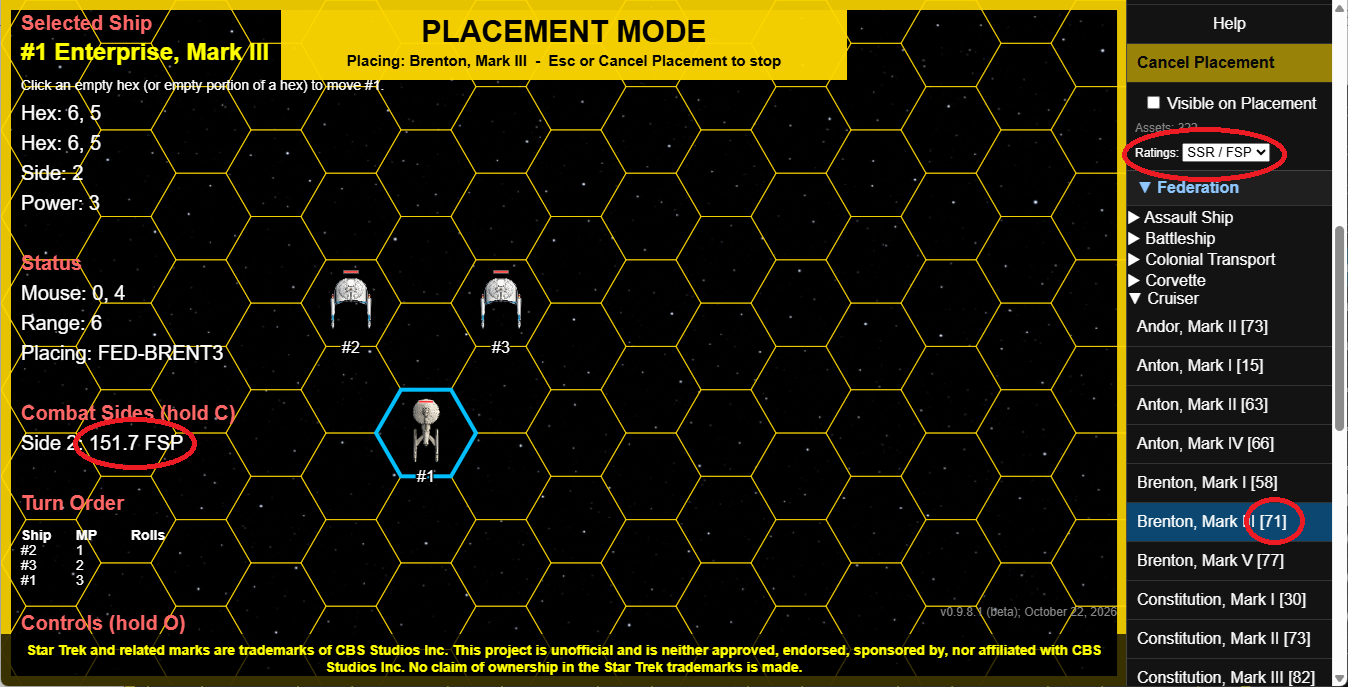
Fleet Strength Points
This system calculates the Ship Strength Rating (SSR) of a ship. This is a grade for a single ship that falls between 0 and 100. It’s the ship’s average result against every other ship in the game. An SSR of 50 is average; an SSR of 90 means the ship beats almost every ship in the FASA universe. This number represents a direct comparison between two ships and should never be added to another ship’s SSR. That’s where Fleet Strength Points (FSP) enters. A ship’s FSP is a value designed to be added up. Add the FSP of every ship on a side and compare the totals: A side with twice the FSP of the other side should usually win. The median warship is worth about 10 points.
Both come from simulated one-on-one duels between every pair of armed ships, at short, medium, and long range using the Advanced rules. Each duel uses the ship’s real superstructure, engine power, shields, weapons, firing arcs, to-hit charts, and damage table. Each ship splits its power between movement, shields, and weapons, and fires its full volley in one firing phase to break through the enemy’s shield. Penetrating damage follows the Advanced damage table: superstructure, engine power, shield generators, and weapons. SSR is the ship’s average result. FSP turns each duel’s kill times into an additive value using Lanchester’s square law, a classic model of fleet combat.
How Does It Compare to CE?
- Power can be spent only once. CE credits the same engine power twice: once in the Defense Factor (movement and shields) and again in the Weapon Damage Factor, which assumes every weapon is fully powered at once. The SSR makes each ship divide its power between movement, shields, and weapons.
- Firing arcs. CE counts every weapon whatever its arc. The SSR counts only the weapons that bear on the target.
- Range. CE is a single number. The SSR is worked out at short, medium, and long range, so brawlers and stand-off ships are both rated fairly.
- Hull strength. CE values superstructure as if most penetrating damage hits it. Under the Advanced damage table only 30% does, so sturdy hulls last longer than CE suggests.
- Damage that wears a ship down. Engine hits reduce power, and weapon and shield-generator hits remove systems. The duels play this out turn by turn.
- Cloaking devices. A cloaked ship can close unseen and strike an unshielded facing, but it pays the cloak’s power that turn. The relatively cheap Romulan cloaks gain a few points from this; costly Klingon cloaks rarely do.
- Clean data. CE depends on published D and WDF values, many of which contain typos. SSR and FSP are calculated directly from each ship’s components.
What Doesn’t This Take into Account?
The FSP doesn’t taken into account maneuvering skill, shield-facing play, evasion, crew quality, Graduate or Command & Control effects, and battle tactics involving several ships at once. Like CE, SSR and FSP are nothing more than a good guide as to who usually wins a straight fight, not a prediction of any one battle where player skill can override the mechanics anyway. However, I suspect FSP is a better predictor of combat side strength even if not perfect, and the only way to know is to test it with real humans playing it.
If you know of any combats that are even, add them to the battle map and let me know if they made a fair prediction.
Follow me on Twitter/X @gsllc
Follow me on Mastodon chirp.enworld.org/@gsllc
Follow me on MeWe robertbodine.52
Follow me on Blue Sky @robbodine

