Let's roll some dice, watch some movies, or generally just geek out. New posts at 6:30 pm ET but only if I have something to say. Menu at the top. gsllc@chirp.enworld.org on Mastodon and @gsllc on Twitter.
Sundays now are lazy days for me. I either post something silly or other people’s work. Usually both. Today, it’s an image shared in my social media stream. The title of this post serves a double meaning. As any reader of this blog knows, I’m running my first 1st Edition D&D campaign in 40 years, and I have no idea what I’m doing, so what’s old is new. The meaning I infer from the image below is to say that even something trite can shock the players.
As always, if you can translate the signature, I’d like to point people to the artist. EDIT: The artist is Miles Tevis. You can find his work here.
Dungeons & Dragons is a trademark of Wizards of the Coast, LLC, who neither contributed to, nor endorsed, the contents of this post. (Okay, jackasses?)
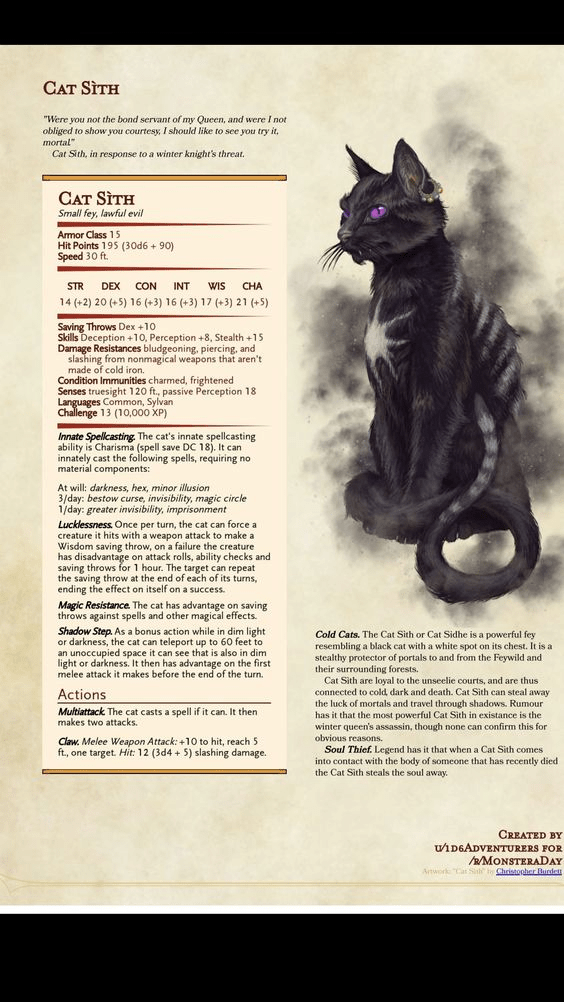
First, there was the dinosaur cat. Now, you have the cat sith. With an intelligence of 16, wisdom of 17, and spellcasting to boot, this is a much greater threat, and perhaps one that could be quite surprising to the average party. One thing that’s disappointing is that the creator uses the term “sith,” yet there’s nothing Sith-like about its powers. No telekinetics, no mind control, and, of course, no weapon use. That seems odd.
But yes, it’s just as ridiculous as the dinosaur cat.
I posted this on social media in the past, but never on my blog.
For those few that don’t know, the Mandela Effect is an effect popularized by a “paranormal consultant” (i.e., a kook) to describe false memories shared by a large number of people. Some famous examples are the misremembered movie, Shazam, starring Sinbad, which was memorialized in an April Fool’s Day joke; spelling errors like “Fruit” Loops and Oscar “Meyer”; and, of course, the alleged 1980s death of Nelson Mandela in prison from which the phenomenon gets its name.
Eats Froot Loops for breakfast and hot dogs for lunch.
Enter Juiblex, the grotesque demon lord of slimes first introduced in the 1st Edition D&DMonster Manual. Whenever I mention this, there’s always someone that chimes in that, even today, they thought JuIBlex was spelled JuBIlex. That is, many people, myself included, switched the ‘i’ and ‘b’ in the word. This might be — and I say “might” because I’m neither a psychologist nor a sociologist — because a few people made that mistake, and then it cascaded through nerd society (i.e., the Mandela Effect). It might also be because “Jubilex” is easier to pronounce, so everyone making that mistake did so independently based on some psychological effect (i.e., not, as I understand it, the Mandela Effect). I prefer the former hypothesis. It supports my premise.
Now there’s some psychological bullshit.
But wait! There’s more!
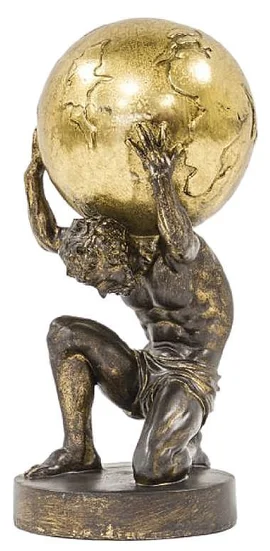
Earlier this week, I published a post on Atlas. As originally written, I pointed out that Atlas carried the world on his shoulders. I was reminded that this is, of course, wrong. Atlas held up the sky. This common mistake has changed the way Atlas is portrayed in art, and may be the origin of the phrase, “carrying the weight of the world on one’s shoulders.”
It appears this may also be an example of the Mandela Effect with an interesting impact on art and language.
Considering how cold the South Pole is, you’d think he’d wear more clothing.
Dungeons & Dragons is a trademark of Wizards of the Coast, LLC, who neither contributed to, nor endorsed, the contents of this post. (Okay, jackasses?)
The image below revived a memory from my elementary/middle school days, which is when I last played 1st Edition D&D (“1e“).
This image alone could be the subject of another post . . . on another blog.
Being a mythophile – mythology brought me to 1e, not the other way around – I loved perusing Deities & Demigods and finding ways to incorporate the material in my games. The results were ridiculous, but that’s not today’s point.
Intelligence and Wisdom of 12. That checks out.
I recall seeing Jim Roslof’s (RIP) drawing above of Atlas from Greek mythology and thought, “Wait a second. Why even stat the guy? He’s not going to be able to put up a fight if he’s got the sky on his shoulders.”
This wasn’t me at my most creative moment. Mythology itself had precedent for Atlas not always shouldering the sky. Hercules relieved him for a bit. The better question would be, “Why would you want to kill a guy who’s tasked with this burden? Who’s going to take over if you kill him? Will the sky just . . . fall?”
Perhaps a better question should be, “Shouldn’t shouldering the sky be metaphorical considering that the game contemplates the possibility of multiple, coexisting pantheons? Are Indra, Shang-Ti, Ra, and Odin also relying on Atlas to hold up the sky?”
Fortunately for my current group, these aren’t difficult questions to answer, but I was a kid.
Dungeons & Dragons is a trademark of Wizards of the Coast, LLC, who neither contributed to, nor endorsed, the contents of this post. (Okay, jackasses?)
I saw a few of these online and didn’t agree with any of them. I took it upon myself to make my own. My explanations follow. Your bullshit complaints will follow that.
LG: Dogs. They follow rules without ever questioning them, and they’re annoyingly sweet. Lawful good is always annoying.
NG: Hamsters. They’re largely chaotic, but they like their hamster wheels and other routines. They’re also never mean.
CG: Weasels. These creatures cannot be contained, but they’re always cool. Unless you’re a rabbit.
LN: Cow. Cows also follow the rules without question, and that’s the extent of their entire philosophy of life.
N: Goldfish. Too stupid for anything else. If you want something smarter, I’ll stick a human in there. Be careful what you wish for, disphit.
CN: Cat. I’ve seen dog lovers characterize them as chaotic evil. That’s only because those low-ego fools can’t handle anything but unearned and unquestioned loyalty. Any independent thought on the part of the pet is considered “evil.” The truth is that cats randomly alternate between sweet and mean, but always have an air of IDGAF.
LE: Ants. The colony will eat you, but always by the book.
NE: Rat. You have a rat as a pet? WTF you thinking? I hope you get the plague.
CE: Honey badger. These guys are like cats, but are never sweet.
Last Saturday, I ran my first session of 1st Edition D&D since 1982. It was terrible. It’s not that I wasn’t any good at it. I was spectacular. It’s just that the edition has absolutely nothing to offer gaming. There’s a good reason no one plays it anymore. Gamers have evolved, and so have games. Honestly, I regret having given it another shot. I have too much going on in my life to waste it on this trash.
No one is falling for this, are they? I had to try.
Dungeons & Dragons is a trademark of Wizards of the Coast, LLC, who neither contributed to, nor endorsed, the contents of this post. (Okay, jackasses?)
I’ve written about how poorly written (technically speaking) 1st Edition AD&D (“1e”)is written. The rules are often vague and sometimes even contradictory. Here is another article with a pretty good summary of some of the errors and omissions, and it links to a couple of other items expanding on specific issues.
I get it. Gary was a groundbreaker, and his profession was that of an insurance salesman or a cobbler. We all forgive how poorly organized and written the books are because, under the circumstances, what he did was remarkable. However, that’s no reason to deny how poorly organized and written the books are. If you don’t admit that, you’ll be of no help to people trying to return to, or try out, 1e. It’s a game with a lot of good in it. I, for one, would like to see more people playing it. They’ll need some help.
Dungeons & Dragons is a trademark of Wizards of the Coast, LLC, who neither contributed to, nor endorsed, the contents of this post. (Okay, jackasses?)