
Jurisdiction and Common Law Trademark Rights @lukegygax @TSR_games @tsrgames @Gygax_Jr @JaysonElliot @OrcishLaw #trademark #iplaw #DnD #RPG #TSR

If you enjoy this post, please retweet it.

By now, most of you nerds must be aware of the newest incarnation of TSR (“newer TSR”). They exist despite the fact that the new TSR (ummmm, “new TSR”) hasn’t died yet. Among other well-known gaming people, Ernie Gygax serves as Executive Vice President. The idea behind the newer TSR is to recapture the magic (get it?!) of the old days of the original TSR and Advanced Dungeons & Dragons. Unfortunately, Ernie casted Dispel Magic in an interview that ruffled a lot of feathers. I’m not commenting on that. As I’ve said, this is a not a blog for political issues, matters of human rights, or nuclear war. That’s way too heavy for this blog. Besides, do you really need yet another voice in this massive choir of commenters? No, so instead I’m going to discuss an aspect of IP law that’s probably relevant to the case and many of you may not know.

Disclaimer

Okay, you knew this was coming, but it’s especially important here. This is not legal advice. All I’m doing is stating the law in the abstract. If someone, including either or the two TSRs, thinks it applies to their facts, then they can hire an attorney to get legal advice. But isn’t stating the law legal advice? No, it’s not. Anyone can state what the law is (e.g., “The speed limit is 55 mph.”). Only attorneys can apply that law to another person’s fact pattern (e.g., “The speed limit is 55 mph, you’re driving 65 mph, and therefore you’re violating the law.”). No district attorney is going to prosecute you for telling someone they’re speeding, but this is an easily digestible example to define “practice of law.” This is key here because I strongly suspect that I have only a fraction of the facts surrounding this case, so it would be impossible for me to practice law here. So I ain’t. Got it?

I’m My Own Inspiration, aka, The Tweet Heard ’round the World

This blog post was ultimately inspired by, well, me. That is, it was inspired by my response to Luke Gygax’s tweets with which many of you are familiar. Of course I was deflecting from the actual topic to the law. It’s what I do.

Trademarks and the Constitution

Oh, you thought you were going to get through this without any heavy-handed legal philosophy, didn’t you? Here’s some constitutional law, suckers.

The US Constitution defines a government of limited powers. That is, unlike the states, the federal government lacks power unless 1) the US Constitution expressly says it has that power; or 2) the federal government absolutely must have that power in order to use a power that the US Constitution expressly says it has. As for number two, nowhere does the US Constitution say that the feds have the power to enter into employment contracts, yet they must have that power in order to, for example, create the IRS and hire accountants, admin assistants, janitors, etc., because otherwise the power to collect taxes would be rendered useless.

This is not a controversial statement among lawyers, though lawyers are (believe it or not) human, so many of them sometimes ignore this principle as well because . . . okay, no pontificating. The notion that the feds lack the power to act by default seems to be lost on many people, but there it is. Accept it or deny it, but it’s 100% true.

Okay, back on point, the Arts & Sciences Clause grants the federal government the power to grant patents and copyrights, but it doesn’t mention trademarks. That’s left largely to the states. (Weird, huh? When have you ever heard of state trademarks?) However, there’s a back door that gets the feds into that game. The Commerce Clause allows the feds to regulate “interstate commerce” (i.e., business transactions that cross state lines). If a vendor in Arizona sells something to a consumer in Utah, then that sale could open the door to federal regulation even if the feds don’t otherwise have the power to stick their noses into it. So, the Lanham Act provides for federal registration of trademarks with the US Patent and Trademark Office only if the owner is using their trademark in multiple jurisdictions. If you’re using the trademark in only one state, you don’t qualify for a federal trademark. However, if you do qualify for a federal trademark, it applies across the entire United States. (Well, almost, which will be my ultimate point.)

There’s a limited exception for those with an “intent to use,” but I’ve given you enough to digest.

So what happens if you don’t register your trademark federally? As long as you’re using the trademark in commerce, you develop “common law trademark rights,” but unlike the federal trademark rights, those rights apply only in the jurisdiction or region where you’ve been using the trademark.

If you’re doing business in a large state, common law trademark rights may arise only in your local region. In that case, registering your trademark with that Secretary of State for that state would grant you trademark rights across the entire state.

Seniority of Trademarks

Okay, I’m finally approaching my point. Imagine a situation where I’m using a trademark, Bodine’s Bovines, on my cow farm in Virginia. Therefore, I have trademark rights only in Virginia. Only I can use that trademark in Virginia.

This probably ends as poorly for me as it did the MacDougals.

Next, Fred Bodine (no relation) opens a couple of cow farms, one in Utah and one in Nevada, both using the same Bodine’s Bovines trademark. He registers the trademark federally based on his use across state lines, so now he has a trademark that applies across the entire United States. Finally, I decide to open a second farm in North Carolina. I try to register my trademark federally, but Fred beat me to it, so my application is denied. Also, Fred sends me a cease-and-desist letter preventing me from using Bodine’s Bovines at all. Does he have a right to do that? In North Carolina, yes, but in Virginia, no. I opened my Virginia farm first, and even though I never registered the trademark with either the feds or even the Commonwealth of Virginia, my use in Virginia was “senior” to Fred’s use (i.e., because I used it in Virginia first). However, Fred can block me from using it outside Virginia because he registered the trademark federally before I opened the North Carolina farm.

What if instead I had a federal trademark based on prior use both in Virginia and North Carolina, let it lapse, and then Fred came along and grabbed it based on his use in Utah and Nevada? I’d still have senior rights in both Virginia and North Carolina.
Hint Hint GIFs | Tenor
Take a hint, people.

So, you can think of a federal registration as having the same effect of using the trademark in every state starting at the time you registered it. Where you got there first, you get to use it, but you’re blocked where you didn’t get there first. In a more complex case, you could imagine a patchwork of multiple, identical trademarks being used by several different companies in several jurisdictions, with one of those companies having a federal trademark covering the unclaimed jurisdictions. So, the company with the federal trademark could nevertheless be blocked from using that trademark in jurisdictions with senior users. This isn’t a far-fetched scenario, but if its mere possibility surprises you, then . . . surprise!

So, what happens next? Well, when the two parties each have something the other wants, they could strike a deal. For example, each could license the other the right to use their trademark in jurisdictions in which they’d otherwise be prevented from marketing. If both parties are on relatively equal footing, the license fee may be, I don’t know, as small as $10 per year. However, if one party doesn’t realize how much of an advantage they have or lack the funds to enforce their advantage, they may make the same deal.

Sound familiar? No? Well, too bad. I’m not getting into specific cases. 🙂

Epilogue

After completing this post, I found a relevant Twitter thread.

There’s a lot of overlap, but Orcish Law makes a few other relevant legal points and peppers in a lot more gifs. I left much of that out because I have a tendency to ramble, so I try to keep my posts as short as possible. We both included disclaimers though. It’s what we do.

If the trademark is valuable, and you can afford a lawyer, get one. Otherwise, you’ll have to either cut a bad deal or find a new trademark.

Follow me on Twitter @gsllc
Follow Luke Gygax @lukegygax
Follow the newer TSR Games @TSR_games
Follow the new TSR @tsrgames
Follow Ernie Gary Gygax, Jr. @Gygax_Jr
Follow Jayson Elliott @JaysonElliot
Follow Orcish Law @OrcishLaw

Dungeons & Dragons is a trademark of Wizards of the Coast, LLC, who neither contributed to nor endorsed the contents of this post. (Okay, jackasses?)

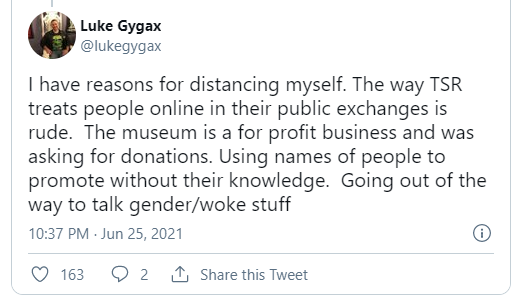
In case the tweets are deleted, here are images of them:
My Favorite D&D Classes @Erik_Nowak @WinterFantasy #DnD #RPG

If you enjoy this post, please retweet it.

A few days ago, someone on social media asked for everyone’s favorite Dungeons & Dragons class (I know; not an original thought). I’m sure many would agree with me that the answer depends on the edition. I have firsthand knowledge that some would say it’s a stupid question. This post isn’t for you.

AD&D

I loved the monk. I don’t remember AD&D very well, but I played it a few years back on the van ride home from GenCon (which has since morphed into an annual van trip to Winter Fantasy known as Winter Vantasy, the best 14 hours in gaming). In that game, the monk seemed as effective a class as any other. This is despite things I’ve heard about how weak the class was. We weren’t 1st level, but even if the monk is weak at first level, it’s no weaker than a wizard, and the wizard has a huge payoff at later levels. As long as the monk was useful, it was fun.

2nd Edition

I started playing AD&D in 1977, but due to the Satanic Panic, I was prohibited from playing it after 1981. Ergo, I never played 2nd edition until — I’m going to guess — 7 or 8 years ago. My friend, Erik, ran a game over the course of two weekends, and I chose a bard based on my love of the bard class in 4e (the then-current edition). I enjoyed it. I played one other 2nd edition class in a 2-hour game a couple years later, and I don’t remember what that class was. So, saying the bard is my favorite 2nd-edition class wouldn’t be much of a statement, would it?

3.5 Edition

Easy choice: the Warmage. I returned to D&D in 2005, having missed 2e and 3e, and my first character was Frylock, the half-elf warmage (with two levels of rogue). He was fantastic, and no other 3rd-edition class compared. I don’t overpower my characters, so having a character that was inherently good in combat without much work on my part kept the table from being frustrated with my underpowered characters. The fact that my dice were weighted towards rolling 1s was another matter. I also liked the versatility spellcasters got, but sometimes I get overwhelmed and forget everything I can do. The warmage was much better focused, so I was less prone to forget things. Sorry, but I just don’t like playing games to be work. Maybe the 3.5e bard would have been fund, but I never thought to play one.

4th Edition

I loved playing “leaders” in 4e, and the flavor of the bard was (and remains) my favorite for role-playing purposes. My famously low d20 rolls were offset by my ability to help the other characters with healing and bonuses, so playing leaders was a win-win for the table. Me being able to roleplay an entertainer was always fun. As I mentioned a couple of days ago, I enjoyed the swarm druid quite a bit, but it was no bard.

5th Edition

The bard wins again, just barely beating out the warlock. The flavor remains the same, so I imagine I’d prefer playing a bard in any edition. It’s a bit too complicated, leading me to forget, for example, to hand out bardic inspiration, but because everyone insists I cast Eldritch Blast on every turn, my warlock often gets spoiled for me.

Verdict

Clearly, the bard is my favorite in general. I never considered playing one until 4th Edition, when leaders became my thing. The AD&D bard has such huge barriers to entry that I can’t imagine many people played characters starting from 1st level that worked their way to it. Sure, it happened, but it was probably rare. The second edition bard was fun, and I never played the 3.5 edition one. Although I’m not a fan of 3.5e, maybe I’ll play again just to play the 3.5e bard.

By the way, the inspiration for this post was an article that google put in my feed: “D&D: How to Build the Perfect Bard.” If you’re interested in boosting your bardic power, maybe that article will help.

What are your favorite classes?

Follow me on Twitter @gsllc
Follow Erik_Nowak @Erik_Nowak
Follow Winter Fantasy @WinterFantasy

Dungeons & Dragons is a trademark of Wizards of the Coast, LLC, who neither contributed to nor endorsed the contents of this post. (Okay, jackasses?)

Bruno’s Earth: I Just Had to Do It @Wizards #copyright #DnD #RPG

If you enjoy this post, please retweet it.

I bought something that arrived on Thursday. It’s stupid, and it appears to be the most brazen example of copyright infringement since Napster (though with far fewer consequences). For that reason, I didn’t want to support it. But I had to. It cost less than $15 with shipping.

I discovered via Facebook a game system known as Bruno’s Earth. I’m not going to post photos because of the nature of the infringement. Instead, I point you to the Amazon listings.

Bruno’s Earth Game Book
Bruno’s Earth Creature Manual

This book shamelessly copies the artwork from the AD&D Players’ Handbook and Monster Manual (and perhaps others), including the covers of the books. There’s no way you know about these books and not know that it’s infringement, yet Wizards of the Coast, who enforces and threatens a hell of a lot more than they have any right to, has apparently taken no action. It’s bizarre. I’d be surprised to hear that Wizards licensed it, but it’s certainly possible. Until I hear otherwise, I’m assuming that. Besides, as Kermit the frog might say, “But that’s none of my business.”

Oh, by the way, I haven’t had much of a chance to review the material beyond the artwork, but I can tell you that it’s riddled with language errors/typos. I’ve been told the game system itself rather sucks. I’ll let you know what I think of that when I’ve had the chance to really look it over.

Follow me on Twitter @gsllc
Follow Wizards of the Coast @wizards

Dungeons & Dragons is a trademark of Wizards of the Coast, LLC, who neither contributed to nor endorsed the contents of this post. (Okay, jackasses?)

Merry Nerdy #Christmas #DnD #nerd

If you enjoy this post, please retweet it.

This is a nerdy blog, so even Christmas must be nerdy here. I’m stealing this from a Facebook friend, SMK. In Christmas of 1977, when I was 9, I received this as a gift:

As with most gifts I received, it was really a gift for my brother, but I managed to have a lot of fun with it until he felt it was too nerdy for him. At that point, I was ridiculed for playing it until the Satanic Panic kicked in. Then I was forbidden from playing it, and it was destroyed. No worries, though. I have a close, personal relationship with my lord and savior, eBay.

I played from 1977 to 1982. Other than my sporadic flirtation with the FASA Star Trek RPG in the mid to late 80s (I had no way to connect with gamers back then), there was no RPG gaming until 2005, which is when I started playing Living Greyhawk with the D&D 3.5 crowd. That’s how I met almost all of you, and for better or worse, that’s how most of you got (had?) to meet me. I recently stopped playing, but you represent an extension of the Christmas gift that kept on giving, even if it took a long hiatis.

And I leave you with this nerdy gem….

Merry Christmas and happy holidays.

Follow me on Twitter @gsllc

Dungeons & Dragons is a trademark of Wizards of the Coast, LLC, who neither contributed to nor endorsed the contents of this post. (Okay, jackasses?)

Ice Cream is for Suckers #dnd #rpg #gaming

If you enjoy this post, please retweet it.

Sundays are now lazy days for me. Going forward, I’m just going to re-post other people’s work or just do something silly. Today, it’s something I saw on Facebook.

ToHIceCream.jpg

Sometimes, you just want to hack and slash, but fair warning: So does the DM.

Follow me on Twitter @gsllc (please retweet!)

Calling all DMs! D&D, #Pathfinder, and #Starfinder at the All-Star Comic Con (@AllStarComicCon), June 8-9, 2019, Tysons Corner, Virginia #DnD #RPG

We’re still in need of DMs to run D&D at the All-Star Comic Con, on June 8-9, 2019, at the Sheraton in Tysons Corner, Virginia. The gaming schedule is up (available by clicking here), but only the Pathfinder and Starfinder games are allowing sign ups (do so!) because those are the only ones with assigned GMs. We still need DMs for our D&D games.

If you’re interested, please send me an email at rob@syndcon.net. Let me know which games you’re willing to run. I have two half-price badges for the con available to the first ones to sign up as DMs for a few slots.

On another note, I’ve recently been made aware of a 5th edition sequel to my favorite AD&D adventure, the C2: Ghost Tower of Inverness. I’m still reviewing it, but this is faithful to the original in that it’s written as a competitive adventure. If you’d be interested in running that, I can easily replace some adventures with that one, and I’m happy to run a table of it myself. Even if we can’t get signups for multiple tables at the same time, I can keep track of the scoring from session to session and email the results to all involved after the convention is over.

In any case, let me know if, when, and what you’re interested in running.

Follow me on Twitter @gsllc
Follow the All-Star Comic Con @AllStarComicCon

Ghost Tower of Inverness, Part 5e @1d4con #DnD #RPG

I’ll be running the Ghost Tower of Inverness this weekend at 1d4 Con. Yes, I’m a broken record about this mod, but this post is here just to provide some resources for those that will be playing on Saturday.

Pregens

Discinque, Drow Rogue (Thief)
Frylock, Half-Elf Fey Pact Warlock
Hodar, Tielfing Necromancer
Lembu, Human Fighter
Li-Hon, Halfling Monk
Ovak, Half-Orc Barbarian
Zinethar, Half-Elf War Domain Cleric

Item Selection

Item Selection

Not that it will ever come up in the game, but Lembu and Ovak know the Orc dice game, Rotting Toes. The write up for that game is available here: Rotting Toes: An Orcish Dice Game.

Follow me on Twitter @gsllc
Follow 1d4 Con on Twitter @1d4Con

C2: The Ghost Tower of Inverness Pregens for 4th Edition #DnD #ADnD #RPG

Any gamer that knows me well knows that Allen Hammock’s Ghost Tower of Inverness is my favorite RPG adventure of all time. Allen wrote it for the AD&D tournament at Wintercon VIII. I’m arranging to run my 4th Edition D&D conversion again, and that inspired me to post my versions of the pre-generated characters for that game in case my players, or anyone, wants to use them. As 4th edition is often played with 6 characters, I created my own character, Three, which I’ve provided as well. I also took some liberties with the races of the characters for the sake of stirring the pot and updating to the modern gaming community. These were created some time ago, and I’m no min/maxer, so you might want to make some modifications if you’re going to use them.

Discinque, Drow Rogue (Thief)
Hodar, Tiefling Wizard (Mage)
Lembu, Dwarf Fighter (Knight)
Li Hon, Halfling Monk
Three, Warforged Hybrid (Artificer|Swordmage)
Zinethar The Wise Half-Elf Cleric (Warforged)

If you’d like the character builder files, just let me know. WordPress won’t let me upload them here.

Follow me @gsllc

#ADnD Mod B1: In Search of the Unknown Free PDF Download #WotC #DnD #RPG #Loremaster

EDIT: This post from January 24, 2013, is one of the first links provided by a Google search for downloading this module, but it’s understandably a bit out of date. The PDF is no longer free to download, but the current link to purchase it is here: https://www.dmsguild.com/product/17081/B1-In-Search-of-the-Unknown-Basic?term=b1+.

In case you didn’t hear: You can now download PDFs of prior edition Dungeons & Dragons materials over at http://www.dndclassics.com/. My first mod, B1: In Search of the Unknown, is free to download … 100% legal. With that, I point you appropriately to my article from Loremaster.org, The Rise and Fall of Norrin the Barbarian (Loremaster.com is no longer available).

Follow me @gsllc

Rotting Toes: An #Orcish Dice Game #DnD #4e CC: @Erik_Nowak

Yeah, this game is probably fair.

This is a guest post from DM extraordinaire, Erik Nowak. I was one of the players in this game and have used Rotting Toes in the last season of D&D Encounters. I hope you enjoy it as much as we did.

==============================

In a recent D&D 4E session set in Neverwinter, the players needed access to the city’s orc-controlled River District. They approached a gate guarded by several bored orc soldiers. Some of the orcs were lightly dozing, while others were gambling, playing a dice game in the dirt. It was to be a simple role-playing exchange: the orcs act tough and demand 10 gold pieces per character to enter their territory – either the heroes paid, or they act tough and refuse and a fight breaks out. Instead it went like this:

“Can I make a check to see what game they are playing?”, one player asked.
[Rolls a skill check; super high result, of course.]

I responded, “Um… sure. It’s called, uh, rotting toes.” That sounded fittingly orcish.

“How is it played? And can we join in?”

“Sure, the orcs are happy to take your gold.”

Then I found myself in a pickle: I needed a dice game! I don’t know any dice games other than craps, and I didn’t want to use that.

So I made one up on the spot.

The first thing I thought of was the old school AD&D method of rolling for ability scores: roll 4d6 and drop the lowest die. I started there and was able to tie it in with the name by thinking that the die-dropping represented a toe rotting away from a diseased foot. Then I made the rest up right there and let the players have a go!

History

The game has its root in the story of an orc warrior who was suffering from a wasting disease of the foot that resisted magical healing. A shaman of Yurtrus, the orc god of death and disease, told the warrior that his fate was in the hand of Yurtrus alone, and the inscrutable, silent god would do as he pleased, unmovable by deed or prayer. All the other orcs could do was bet on whether or not the warrior’s toes would rot off.

(What happened to the orc, you ask? His toes all rotted off. Then his foot, followed by the rest of the leg. Then he died. Orc tales don’t have happy endings, people.)

Pictured: Someone who didn’t take the feat, Skill Training: Math.

Playing the Game

To play rotting toes, you need 4 six-sided dice and a group of several players with coin, one of whom is the Hand of Yurtrus, or “the Hand” (the dice roller). The role of the Hand switches to a new player each round.

The Hand places a bet, typically 1 gold piece. Other players place bets on whether the Hand will lose or win (“rot” or “not”). The Hand has three chances to roll doubles in 2 separate throws of the dice. If 2 throws yield doubles, the Hand wins, and the players who bet on a loss lose their coins, which are distributed evenly amongst the Hand and the players who bet on a win. Otherwise, the Hand loses, and his coins, plus the coins of the players who bet on a win, are evenly distributed amongst the players who bet on a loss.

Order of Play

1)      First Throw: The Hand rolls 4 dice, looking for any set of doubles. Regardless of whether or not doubles were rolled, the lowest die is removed from play (a “toe” has “rotted away”), and the Hand rolls again.

2)      Second Throw: The Hand rolls 3 dice, again looking for a set of doubles.

  • If doubles were rolled previously, and doubles are rolled here, the round ends and the Hand wins.
  • If neither throw yielded a set of doubles, the game ends and the Hand loses.
  • If doubles were rolled in one of the throws, play continues to a third throw with the lowest die removed from play.

3)      Third Throw: The Hand rolls 2 dice, again looking for a set of doubles.

  • If doubles were rolled previously, and doubles are rolled here, the round ends and the Hand wins.
  • If a second set of doubles is not rolled, the Hand loses.

Playing Rotting Toes in Your Campaign

To play rotting toes in your D&D game, have a PC take the role of the Hand and place a bet. Allow other PCs to make win or lose bets as well, but these bets are optional.

The Hand then rolls the dice until he wins or loses, as outlined above. For ease of use, I didn’t bother recording the number of actual rotting toes players or how each one of them bet. I simply said that when the Hand won on a 1 gp bet, he gained 2d4 gp to represent the winnings taken from the pot. Anyone betting on the Hand to win gains the same amount. If the Hand loses, any PC who bet on the Hand to lose gains 2d4 gp.

Cheating

One character in my game – the rogue, of course – asked if he could cheat. I allowed for it, but due to the number of eyes on the dice, it would be difficult to do unless the cheater brought his own weighted dice – which the orcs would never allow! To cheat, the Hand throws the dice and makes a Hard DC Thievery check. On a success, the Hand may change the result of one die thrown. A failed check makes the other players suspicious, and the DC for future checks increases by +2. A second failed check confirms the players’ suspicions, and will get the thrower ejected from the game (at best), or attacked. When playing with orcs, a Hand caught cheating is very likely to be killed immediately.

Additionally, it is a little-known fact that when playing with orcs, winning too many times as the Hand will also arouse suspicions of cheating, whether the winner actually cheated or not. Typically, if a player wins more than 3 times in a row as the Hand, he is given a savage beating – even if there is no evidence at all of cheating – just for being “too lucky” and making a mockery of Yurtrus’ judgment.

Follow Erik @Erik_Nowak
Follow me @GSLLC