Let's roll some dice, watch some movies, or generally just geek out. New posts at 6:30 pm ET but only if I have something to say. Menu at the top. gsllc@chirp.enworld.org on Mastodon and @gsllc on Twitter.
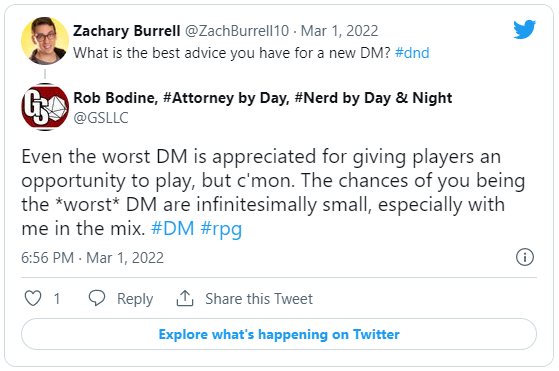
Even the worst DM is appreciated for giving players an opportunity to play, but c'mon. The chances of you being the *worst* DM are infinitesimally small, especially with me in the mix. #DM#rpg
— Rob Bodine, #Attorney by Day, #Nerd by Day & Night (@GSLLC) March 1, 2022
This was a timely question to ask me because this Saturday I’m going to run 1st Edition AD&D for the first time since 1982. I’m going to suck, but I don’t think anyone’s going to care. This is not only their chance to play a game, but also their chance to play an edition (relatively) rarely played today.
Who wants to do me a solid? If you have a #3e or #5e#DnD game this weekend, give me a tally of how many times each #spell was cast in a session (ignore spells not cast of course). DMs probably have no time for this, but a player should (if not surfing the net between turns). 🙂
— Rob Bodine, #Attorney by Day, #Nerd by Day & Night (@GSLLC) March 23, 2022
In case the tweet is ever deleted, here’s a screenshot of it.
Dungeons & Dragons is a trademark of Wizards of the Coast, LLC, who neither contributed to, nor endorsed, the contents of this post. (Okay, jackasses?)
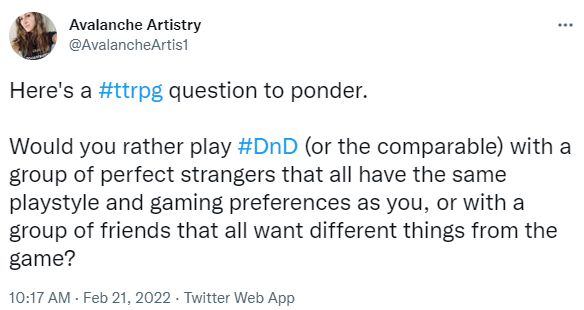
Would you rather play #DnD (or the comparable) with a group of perfect strangers that all have the same playstyle and gaming preferences as you, or with a group of friends that all want different things from the game?
This is a tough one, and I don’t want to admit the answer, but I will. Like everyone, I want my cake and to eat it too. I want my friends to share my play style, but I have tangible data suggesting that’s never going to happen (at least not long- or even mid-term). So, my answer is this: I’d rather play with strangers that share my play style.
Consider the following: I can’t stand3rd Edition D&D (“3e“). When I returned to the game after 23 years away from it, I was so happy to be back that I ignored how frustrating the system was. Besides, ignorance is bliss, and for all practical purposes I had nothing to which to compare it. I hadn’t played any RPGs for decades. Nevertheless, within the past couple of years, I’ve played a little bit of 3e. I played a few sessions of Greyhawk Reborn, which is the revival of the Living Greyhawk living campaign. Why? Because some of my friends never moved on from it, and that meant I never saw them. It was a chance to reconnect, which is important to me, but it didn’t take long for 3e to drive me away again.
On the other hand, I like 5th Edition D&D, and even more of my friends play it. Nevertheless, differing play styles grated on me. My style appears to be very firmly in the minority, so I find the game more tedious than it should be, but certainly more tedious than anything designed to entertain should be.
Would you rather this or Game of Thrones?
While I’m planning to return to D&D after deciding not to play anymore, I’m doing so on my own terms, or at least I’m trying to. I’m going to run some 1st Edition D&D sessions because I suspect that system will nudge players towards the way I want to play. Even if that’s true, it may not be to their liking, so this could be a short-lived experiment. In any event, the only hope for me playing regularly would be if the style shifted to my liking. You can’t force that on people, but if some strangers came along and had a similar approach, I wouldn’t have to.
Of course, if there were personality clashes with the strangers, then I’d leave the game again, but I fear that my best chance for a long-term return to D&D is through strangers, not my existing friends. This isn’t the end of the world. I’m at least in contact with my friends via social media, we’ll probably resume seeing movies and doing trivia night when the pandemic passes, and there’s always Winter Fantasy. Also, there’s no reason to assume there’d be personality clashes with strangers. Meeting strangers should be seen as an opportunity to make even more friends. We should all try that out from time to time anyway. That may be difficult without giving in to the online gaming fad.
So, I’d have to say that I’d rather play the game I want to play with strangers than to play the one I don’t with existing friends, but only because my friends aren’t going away.
Dungeons & Dragons is a trademark of Wizards of the Coast, LLC, who neither contributed to, nor endorsed, the contents of this post. (Okay, jackasses?)
In case the tweet is ever deleted, here’s a screenshot of it.
Yesterday, I spoke out against dawdling, and how 1st Edition D&D dealt with it. Here’s an adventure idea that takes that to the ultimate level.
Someone posted an encounter idea on Facebook. The gist of it is an adventure where the PCs are asked to retrieve an item at an adventure site. They arrive at their destination, and it’s littered with dead bodies. The wander through the entire site towards the room where they know the object is kept. When they get there, they run into another party. They have the item and are drinking some brandy in celebration of their accomplishment. In other words, another party got there first. How do you handle it?
Honestly, I don’t care because I think the opposite scenario is better.
My Scenario
The PCs’ benefactor hires them to retrieve the item. When they agree, the benefactor hands them the bottle of brandy and says, “This is for when you succeed in finding the staff. It’ll make it easier for you to get back to me.”
That makes it sound like the brandy has magical properties, but all the benefactor means it that it gets you drunk. This is a flimsy way to try to get the PCs to get drunk once they’ve accomplished their task, but it’s not critical. Moving on, allow the party to do what they expect. They arrive at the site, fight off the creatures, and retrieve the item. Ideally, they’re the ones drinking the brandy, and that’s when the other party arrives. The party face asks, “Did you really think your benefactor was the only one that hired parties to retrieve such an important item? There are several of us.”
Coming out to Play
Obviously, absent miraculous role-play, the other party attacks a (hopefully drunk) party. When the PCs have dispensed with the other party, the adventure pivots to something like the movie, The Warriors. The job now is to avoid as many fights as possible against rival adventurers (as well as the occasional wandering monsters) while returning the item to the benefactor.
There’s a reason I prefer my scenario. First, the PCs get what they signed up for. They were told they were going to infiltrate, for example, a mind flayer necromancer’s stronghold, and that’s what they got. It doesn’t mean they can’t be surprised by what they find there, but it’s what the players were anticipating.
…
Second, I’m going to assume that the scenario I rejected doesn’t consist of just one fight, but instead, several planned challenges on the way home. However, if the spirit of the twist is respected, those challenges on the way home are one adventuring party after the other. Repeatedly facing five to six classed humanoids will quickly get boring. Keeping the bulk of the adventures in the stronghold has a potential for far more variety of challenges. Lastly, the rejected scenario’s “dead time” consists of just walking through a dungeon following a map, noting the already looted corpses along the way. That’s also boring. In my scenario, the “dead time” is still very much alive; it’s just a different kind of action. The PCs must use skills and logic to avoid those fights. Maybe that’s boring for some players, but it’s not as boring as the rejected scenario, and it’s a great change of pace for those who enjoy it. It also doesn’t handwave a part of the adventure that’s generally handwaved (returning home), which means the players are given more to do. This is a general idea that can be tailored to your adventure’s mission and, if necessary, to your RPG’s genre and setting.
While I’m sure this has been done before, I don’t recall having seen it.
They have more claim to being here than your PCs do.
I left D&D in 1982 due to the Satanic Panic and didn’t return until 2005, so my recollection of 1st Edition D&D (“1e”) isn’t precise. When I returned during the days of 3rd Edition D&D (“3e”), rolling for wandering monsters wasn’t a common mechanic (though I occasionally saw it in published mods). Without appreciating why it was used in 1e, I simply thought that the use of wandering monsters was stupid. If you have a cool monster on hand, use it. Otherwise, it’s a waste of a perfectly good encounter. On the other hand, if your wandering monster is the same creature that the PCs are facing from time to time in the planned encounters, then they add nothing to the game, so don’t waste time on them. That could make the game tedious. Now that I’ve reacquainted myself with 1e, I realize their point: They’re designed to discourage dawdling.
Hurry Up!
Searching for secret doors, examining magic items, counting your loot, and sleeping are time-consuming activities. DMs are expected to keep track of time so that, when a given interval of time has passed, they know to roll for wandering monsters. These random encounters often didn’t result in any treasure and drained valuable resources from the party, so they weren’t something that the PCs wanted. However, they didn’t make the game tedious because 1e combats were quick. So, the concern I mentioned above that they may not add anything to the game isn’t a serious one. Their primary effect was to drain resources, which, as I’ll discuss in the next section, serves a couple of connected purposes.
This isn’t something that goes over well with modern gamers. Modern gamers (and legacy gamers that have moved on) tend to explore every single room and grab every single piece of treasure they can. Anything less than complete is seen as a failure. I’ll give you a specific example. When discussing playing experiences with Lost Mines of Phandelver, the adventure from the Dungeons and Dragons Starter Set for 5th Edition D&D (“5e”), players that failed to obtain the Staff of Defense would always be frustrated when others discussed it. Several of them that I knew would play the mod again with a character specifically designed to make use of that staff. Players would also take note in that adventure (and others) of forks in the road (so to speak), always promising to double back so that they covered the entire complex. Because of this mentality (I’ve been guilty of it myself), the D&D Adventurers League living campaign changed its rules such that every player could take a magic item found in the game even if there was only one. Everyone wants everything, so that’s what’s given despite how little sense it makes.
But Why Shouldn’t You Dawdle?
If this is what makes you happy, that’s fine, but my problem with this approach to the game is that it discourages immersion in the game world and can’t possibly work unless the risk of character death drops so low as to be negligible. As to the first point (which is a tangent from my main thesis), the logic of the game world becomes inconsistent. I can suspend my disbelief and accept a dragon that breathes a cone of cold, but I can’t accept the notion of a Rod of Cancellation spontaneously generating multiple copies of itself because multiple characters want it. The latter just doesn’t make sense, and no attempt is made to make sense of it. There’s no drain of resources to make it happen. There’s no need to visit the local archmage to make copies of it. It just happens.
As to the second point (now we’re back on track), a game where I know the DM will never kill me bores me. A game where I’ll get killed if I don’t think things through logically is far more fun. Sure enough, I’ve rarely seen character death in 5e. In fact, I saw far more character death in 4th Edition D&D (“4e“), and 1st-level 4e characters are intentionally durable. The more gamers become unwilling to suffer even the smallest of setbacks, the less we see them, which is why I stopped playing. There’s none of that in 1e. Can your characters survive? Sure, especially if you send the henchmen and hirelings in first. As I’ve been told, PCs can survive an entire campaign even despite the save or die mechanic (which I still don’t like). However, if you truly immerse yourself in the game, you’ll see that some actions are downright stupid and should get your characters killed. Game mechanics like wandering monsters discourage such stupidity, and as a consequence reward true immersion in the game world.
Your mission is to save the noble, not to grab an extra 5 copper pieces. Once you’ve got the noble, get the hell out of there. If this were a scenario in the real world, and you went for the coppers, your friends at your funeral would be discussing whether to submit your story to the Darwin Awards committee.
My favorite 1st Edition D&D (“1e”) adventure is C2: The Ghost Tower of Inverness. Also up there in the ranks is C1: The Hidden Shrine of Tomoachan. I’ve converted both mods** to 4th Edition D&D (“4e”) and 5th Edition D&D (“5e”). I’m always eager to run either one, and because I’ve done so multiple times, I made (and saved) maps for them.
** The last time I used the word, “mod,” for what others call “adventure” or “module,” I received an odd amount of pushback. One person even accused me of lying that it’s what I called them growing up, as if there could possibly be a motivation for something like that. I grew up in Montgomery County, MD, and every single person I gamed with called it mod. Some still do. We also occasionally used the terms adventure and module, but the point is that “mod” was the standard term. Your regional dialect, or even your specific gaming group, may have a different experience. I don’t care. I shouldn’t have had to write this aside, but if I didn’t, I might receive the same pushback over something that shouldn’t matter at all.
Ghost Tower
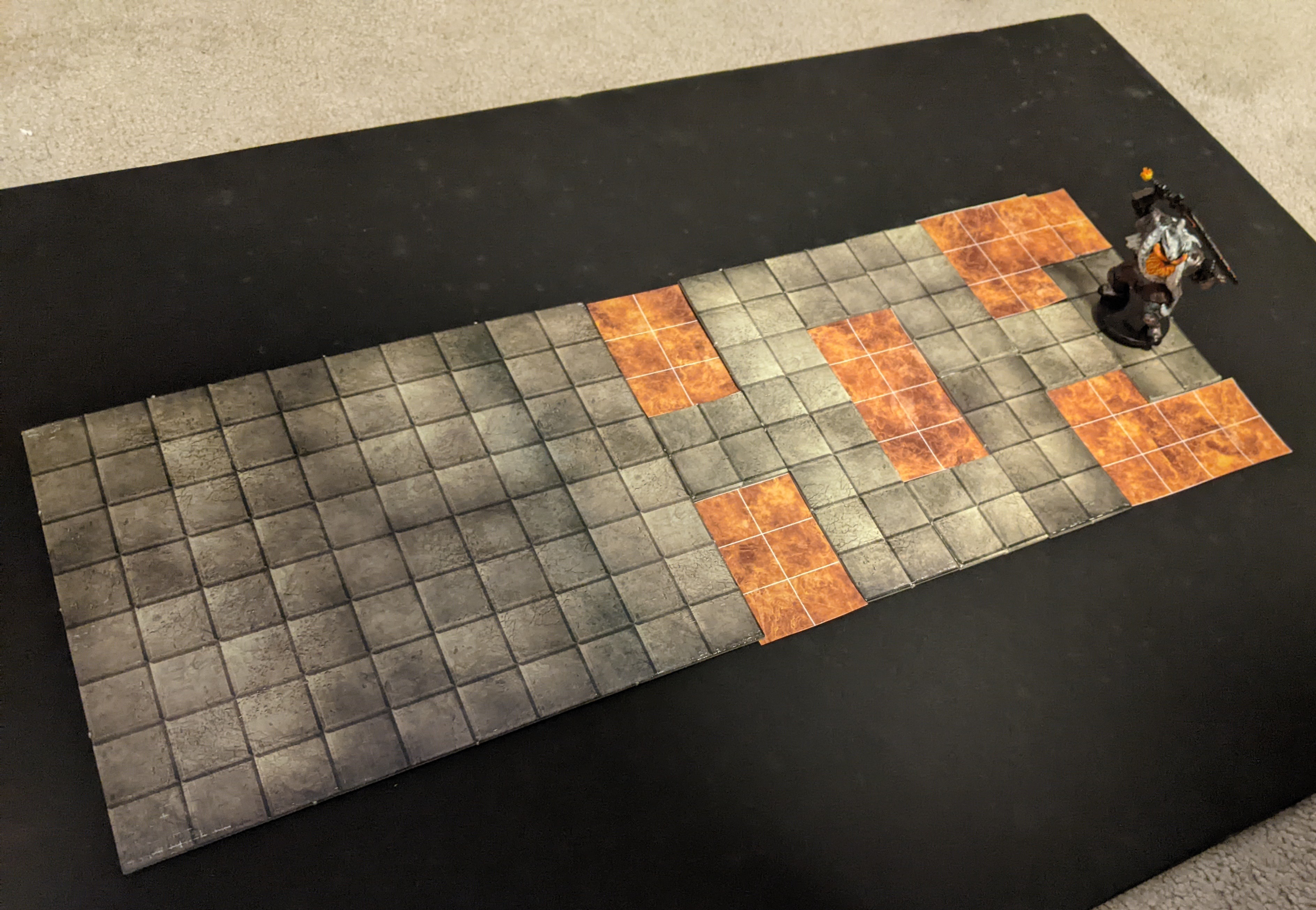
Dungeon Tiles were released during the 4e era, and I had tons of them. So much, in fact, that I had enough to spare. So, when I created the Dungeon Delves for synDCon 2011, I decided to take some of those Dungeon Tiles and permanently affix them to foam core. I’ve since used these for 5e as well. In other words, I’ve made good use of them. While unpacking recently, I discovered them. SPOILER ALERT! These cover only the Ghost Tower itself and a few iconic encounters along the four paths that lead you to it. Here are a couple of images of them.
The Earth Level
The Fire Level with a Friend
For the other encounters, I can always use these. I bought a set.
Hidden Shrine
With Hidden Shrine, I took a different approach, though not until 5e. I bought the hi-res images of the maps directly from their creator, Mike Schley. (You can see his work at https://mikeschley.com/.) I printed almost every room and hallway in the entire dungeon to cardstock (in color) so that I could use them as Dungeon Tiles. They’re exactly the correct size for minis. I also have several sound files containing phrases in Nahuatl that are either common (e.g., “Hello.”) or specifically used in the mod. They further helped set the mood. Here are some samples.
A Couple of Rooms
The problem with both of these mods is that they’re designed for competition. Each is designed for a set number of pre-generated PCs, 3 for C1 and 5 for C2 (though I created a 6th for C2), and the risk of death was unreasonably high — even by 1e standards — so that there would be one clear winner at the end of the convention. With both adventures, you can probably solve the “unreasonably high” problem (if you think that’s a problem) by having a normal party size.
In the foreseeable future, I plan to play only 1e, but I’ll make use of these maps nonetheless. “Theater of the mind” (i.e., gaming without maps) doesn’t bother me — it can be quite convenient at times — but I’m a huge fan of using maps. They help with the immersion that I often discuss, and they correct mistakes I make as DM in describing the surroundings. That doesn’t mean my 1e games won’t otherwise be theater of the mind. To me, that’s an inseparable part of the 1e experience. At least for now. 🙂
We won’t be breaking out the tape measures.
Follow me on Twitter at @gsllc Follow Mike Schley @schley
Dungeons & Dragons is a trademark of Wizards of the Coast, LLC, who neither contributed to nor endorsed the contents of this post. (Okay, jackasses?)
A couple of weeks ago, after I had already queued up about 13 posts for publication over the next two weeks, I ran into this tweet.
Theory: a great deal of ttrpg discourse is rooted in ttrpg players nerdy enough to engage in discourse (including most designers) like designs that support them where their natural skills are weaker and resent designs that support them where they are strong.
I thought it was interesting, especially because at least half of it applies to me. As I said yesterday, my professional life is filled with attention to detail. It’s also filled with conflict — not fist fights or public shaming, but disagreements over large amounts of money. In addition to that, my childhood was filled with conflict — not disagreements over large amounts of money, but fist fights and public shaming. I don’t want any of that in my gaming (which, by the way, explains why I’d much rather play cooperative games than adversarial ones, or at least team games rather than “everyone for themselves” ones).
Well, not exactly. I want my characters to have disagreements (of both types). What I don’t want is for players to disagree to the level that it creates unnecessary stress. Modern gaming seems to have far too many arguments among players and GMs. GMs want to enforce rules, and players want to “win D&D.” While I’m more than happy to admit that my childhood instincts are often to blame for this, I’m not just talking about conflicts involving me. I see this in others as well, meaning it’s not all my fault. Conventions aren’t brawls, but if you’re looking for it, you see how frustrated we get with each other. Many gamers tend to keep it to themselves, but a careful observer can spot it, and a good GM avoids it.
That’s why I’m looking forward to revisiting 1st Edition D&D (“1e”). There are a few mechanics that remove some of the tension that I’ve experienced. For example, before a group of unsuspecting PCs open a door to a room, the unsuspecting goblins inside are going about their business, moving from one side of the room to the other to stack boxes or whatever. Where they’re all standing at the very moment the PCs open the door is a matter of random chance, and in 1e, it’s understandably determined by a die roll such that the distance between the parties when the encounter starts is random. That makes things even more interesting. Note well that 1e does this without removing player agency. The player’s character sheet has, for example, ability scores that modify the rolls. Moreover, I say “unsuspecting” to make the point that in some cases the players do suspect danger and can act through role-play that adjusts these circumstances. To me, that’s ideal, however . . . .
This places me in a paradox. I don’t want to have to remember lots of rules, but I want lots of rules to avoid conflicts. I’ve often noted that one of the primary decisions game designers face is deciding whether an aspect of the game is determined by the role of the die or a discussion with the GM. I’ve also noted that the opinions expressed on this blog are sometimes unfair to game designers. Maybe I just don’t know what I want. But I’ll say this: When in doubt, force a roll. First, that’s why we’re all here: to roll dice. Second, as I noted above, forcing a roll doesn’t remove player agency. The luck of the roll is modified by the build of the character. Players are still making their impact known. They’re just forced into a position of having to accept that roll based on a rule known, and applied fairly, to all involved.
Returning to the point of this post, I understand that some of you will disagree with my general point even if you agree with my specific example. That’s fine. You have different personalities, so different things bug you, but that’s a subjective standard, not an objective one. It’s an opinion, not a fundamental truth of game theory. I think that’s what Linnaeus was saying, and if so, I agree. This is about our personalities, and that’s no small point. In a sense, edition wars are culture wars. When we complain about the choices made by the game designer, we’re indirectly attacking those that prefer those choices. I thought the mantra was supposed to be “first and foremost, games are about having fun.” Just have fun, and let others do the same.
I did not expect this post to tie into the stupidity of edition warring, but I don’t regret it.
Dungeons & Dragons is a trademark of Wizards of the Coast, LLC, who neither contributed to, nor endorsed, the contents of this post. (Okay, jackasses?)
Going forward, Sundays are lazy for me. I either post something silly or other people’s work. Usually both. Today, it’s explaining myself, then picking a fight.
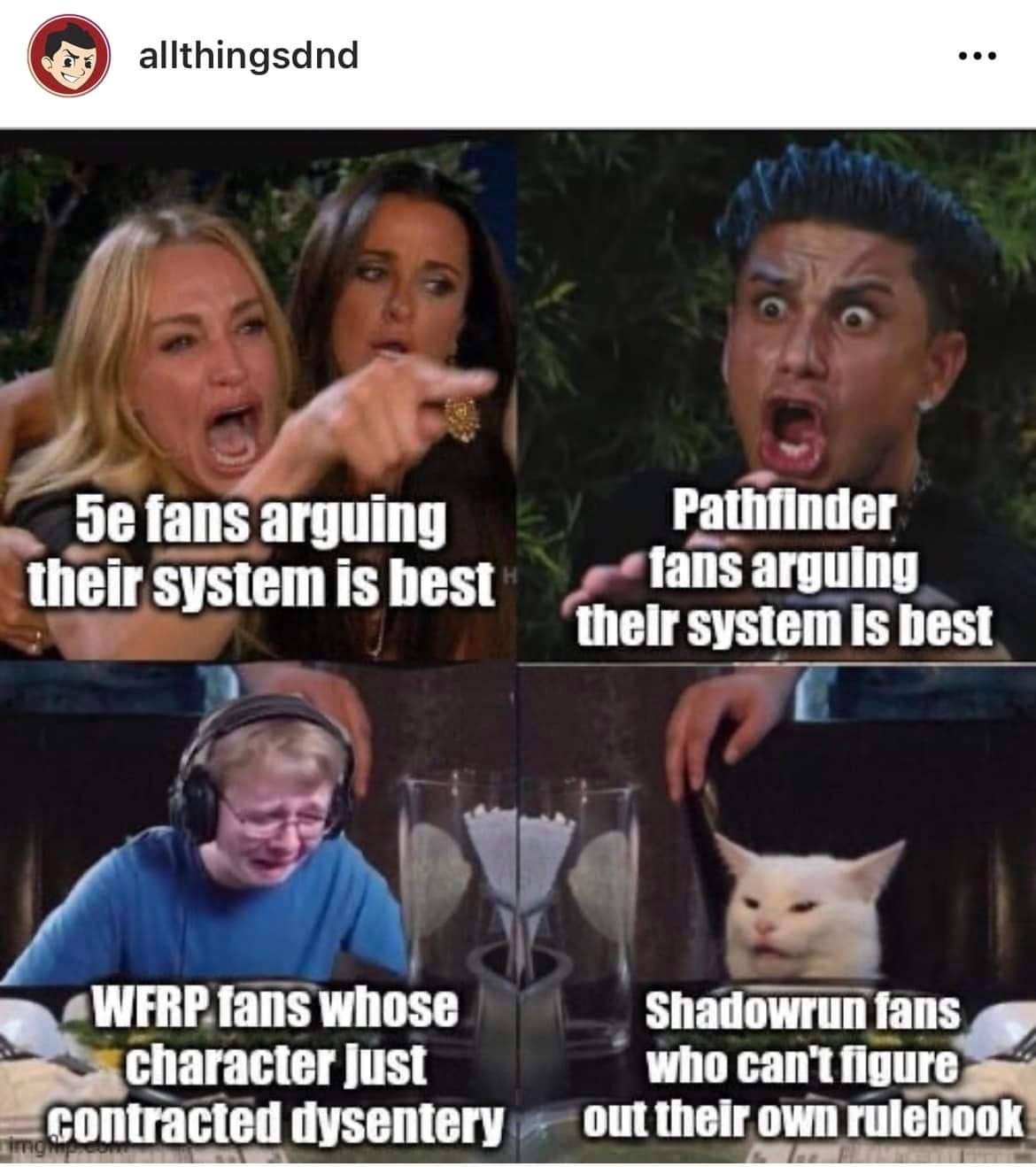
I’ll start. From left to right:
1st Edition AD&D and 4th Edition D&D Anson Mount’s Christopher Pike and William Shatner’s James Tiberius Kirk
Dungeons & Dragons is a trademark of Wizards of the Coast, LLC, who neither contributed to nor endorsed the contents of this post. (Okay, jackasses?) Shadowrun and Pathfinder are also trademarks, but I have no reason to believe their lawyers are jackasses.
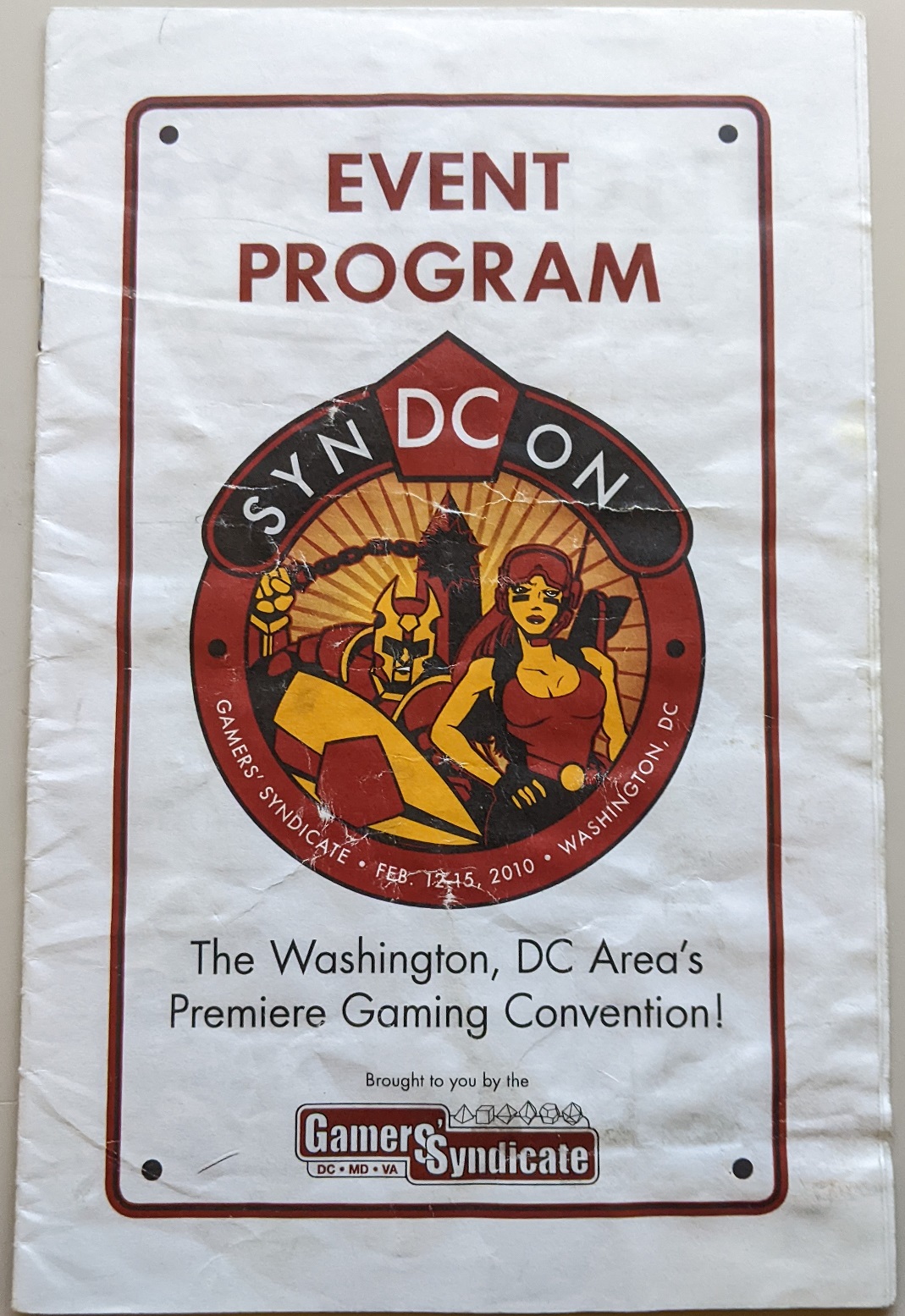
A couple of days ago, I posted about some things I found while continuing to unpack. One thing I found deserves its own post: the program for our first synDCon gaming convention (2010). When we decided we were going to put on a convention, we had a meeting of at least 20 people at the Cracker Barrel in Chantilly, Virginia. This took place after one of our Living Forgotten Realms game days at the now defunct Game Parlor. Only seven people decided to come on board as owners, with two quickly moving to Arizona before we could even get started, and then two others flaking out. It was basically Vic, Cassandra, and I doing everything.
Front Cover
The cover art and Gamers’ Syndicate logo were both designed and illustrated by Erik_Nowak, and he also designed this program.
Welcome Statement
I remember a meeting when there were just five of us. We had to decide who would be the number one person: the Convention Coordinator. I didn’t volunteer because I didn’t want to be too pushy, but no one else wanted to do it. This was typically unnecessary nerd angst on all our parts, because in the end it didn’t matter. Everyone had to work hard (until they flaked out), and no one was really the boss among us.
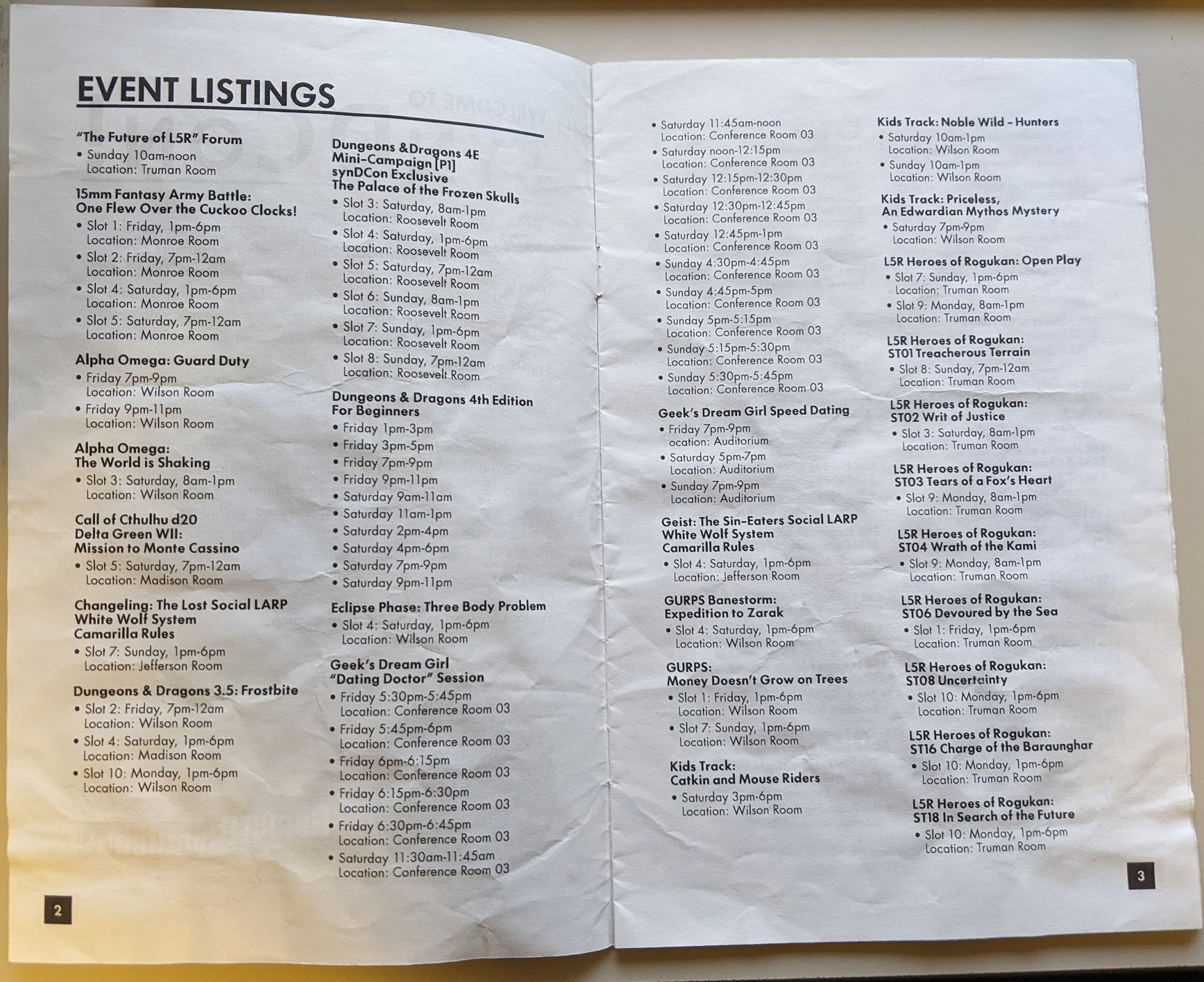
Pages 2 and 3
I’m proud of two things. First, look at that first page, and continue to examine the ones that follow. Even when we had seven planned owners, everyone was almost exclusively a 4th Edition D&D player. Nevertheless, our relatively small convention had a ton of variety in what was run. There were card games, board games, RPGs, and miniature war games. Within the RPGs, we had a ton of variety as well, and there were games run specifically for beginners. We also had a “synDCon special,” which was written by Erik and D. Hunter Phillips.
Pages 4 and 5
The second thing of which I’m proud was my idea (<patting myself on the back>). We had staggered slots. Instead of the typical 8am-12pm, 1pm-5pm, 7pm-11pm schedule for RPG games, we added in slots at 10am-2pm and 3pm-7pm as well. Again, for a small con, the fact that this worked out so well was remarkable. Many people took advantage of the opportunity to sleep in, try our Dungeon Delves for a couple of hours, sit in on a seminar or author book reading, or try new systems at the beginners’ tables. Another great idea of mine was to allow only 5 seats per game in presale despite tables seating 6 players. This made it far easier to sit players that didn’t preregister or wanted to change tables. No one had a problem with it, but a lot of people appreciated the flexibility.
Venue Map
This was a nice hotel, and it was conveniently located near a Metro stop (our public rail transportation system). And being who I am, I especially wanted a site in Maryland so that we could register for a federal trademark if it ever came to that. 🙂
Pages 8 and 9
Okay, yes, we definitely emphasized Living Forgotten Realms, but I’m still happy with how much Heroes and Rokugan and Pathfinder Society we had (these are living campaigns for the RPGs Legend of the Five Rings and Pathfinder respectively).
Pages 10 and 11
Note well, though, that there was more going on than the program states. We had a board game room, and open play for both card games and miniature war games. Saturday night, my cousin and I, a.k.a., Wet Paint, performed for a crowd of beer-drinking gamers some hits of the 80s and 90s. That’s when we played together, so our song set came from those decades.
Only Mike and I are Wet Paint. Matt James was an interloper. He’s considered a member of “Trail Mix,” which is anyone that’s ever played with us.
Seriously, for a small, first-time convention, look at how much variety we had. I loved it, and I never saw it with conventions this small. We also had seminars featuring authors and game designers. Being in the DC area, we actually knew a lot of those people, so it was relatively easy to get them here. This, in turn, allowed us to do this . . . .
Pages 12 and 13
We received a small amount of support from most of these companies, and others were actually present. Our prize for the first person to buy a convention badge was a ticket to GenCon. GenCon gave those away to conventions all the time; no inside track was necessary. However, we also had, for example, a member of Green Ronin participate in a seminar and run the (then-new) Dragon Age RPG, and Rob Hobart (AEG), the head of Heroes of Rokugan, ran a seminar and (I think) a few games.
I touched up this image of the back cover to delete some handwriting. Pay no attention to the fields of ecru.
We chose a great venue, and synDCon 2010 was a four-day convention. Yep, four days. Just like the big guys. Monday was a holiday, and adding that day to the schedule didn’t increase our costs noticeably. Of course, by cost I mean financial cost. My feet were sore (which is why I was sitting for the Wet Paint performance), and I ran, at best, on four hours of sleep a night, with only two on performance night. I’d say it was a success considering that we got hit with a snowstorm right before the convention, scaring off a lot of people.
The following year, we moved synDCon 2011 to mid-April to make sure we’d have better weather, but we had late snow that year. It wasn’t as bad as the previous year, but it still affected attendance. Infuriating. However, synDCon 2011 was an official convention within the circuit of competitive Munchkin published by Steve Jackson Games. In fact, we may have done that for synDCon 2010. I really don’t remember at this point. I just know we had a great time both years. Unfortunately, it’s too hard a thing to run with, for all practical purposes, two people running the entire show and Mother Nature chasing us around with snowstorms. This isn’t to say that there weren’t a lot of other people that did a lot of work. We had a lot of help, with a few people being organizers for Living Forgotten Realms, Pathfinder Society, and Heroes of Rokugan, and we still had decent numbers. However, in the end it falls on the organizers, and there were only two of us. Both Vic and I would rather not have a convention than do one half-assed, so we didn’t have a third one.
Would I like to bring it back? Yes. Do we have the financial means to do so? Probably. Do I see enough people getting on board to make the workload manageable? No. There are very few people I could trust to see it through, and I’m not getting any younger.
Going forward, Sundays are lazy for me. I either post something silly or other people’s work. Usually both. Today, it’s a bit less lazy of a post, but it references other people’s work, so it qualifies.
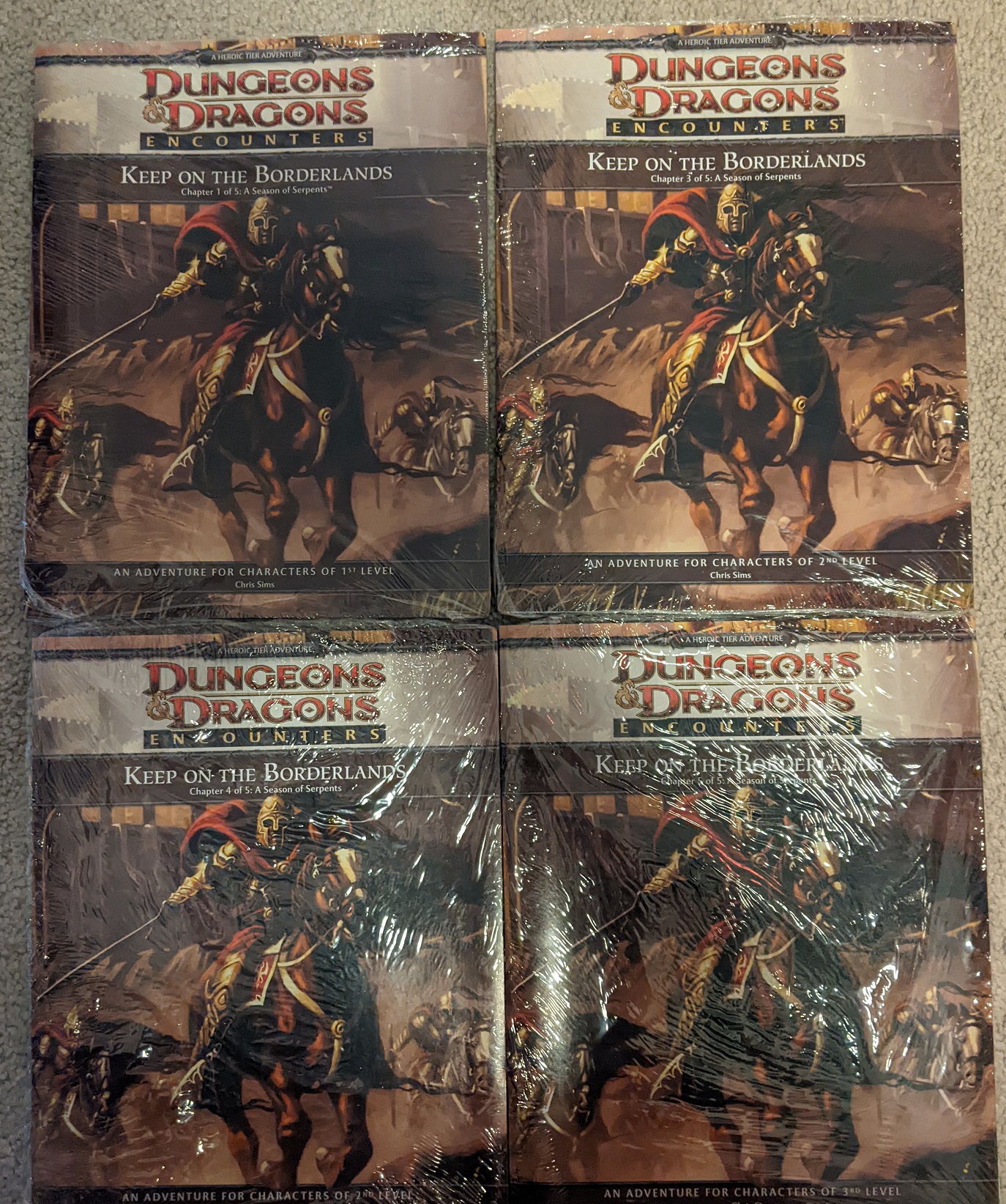
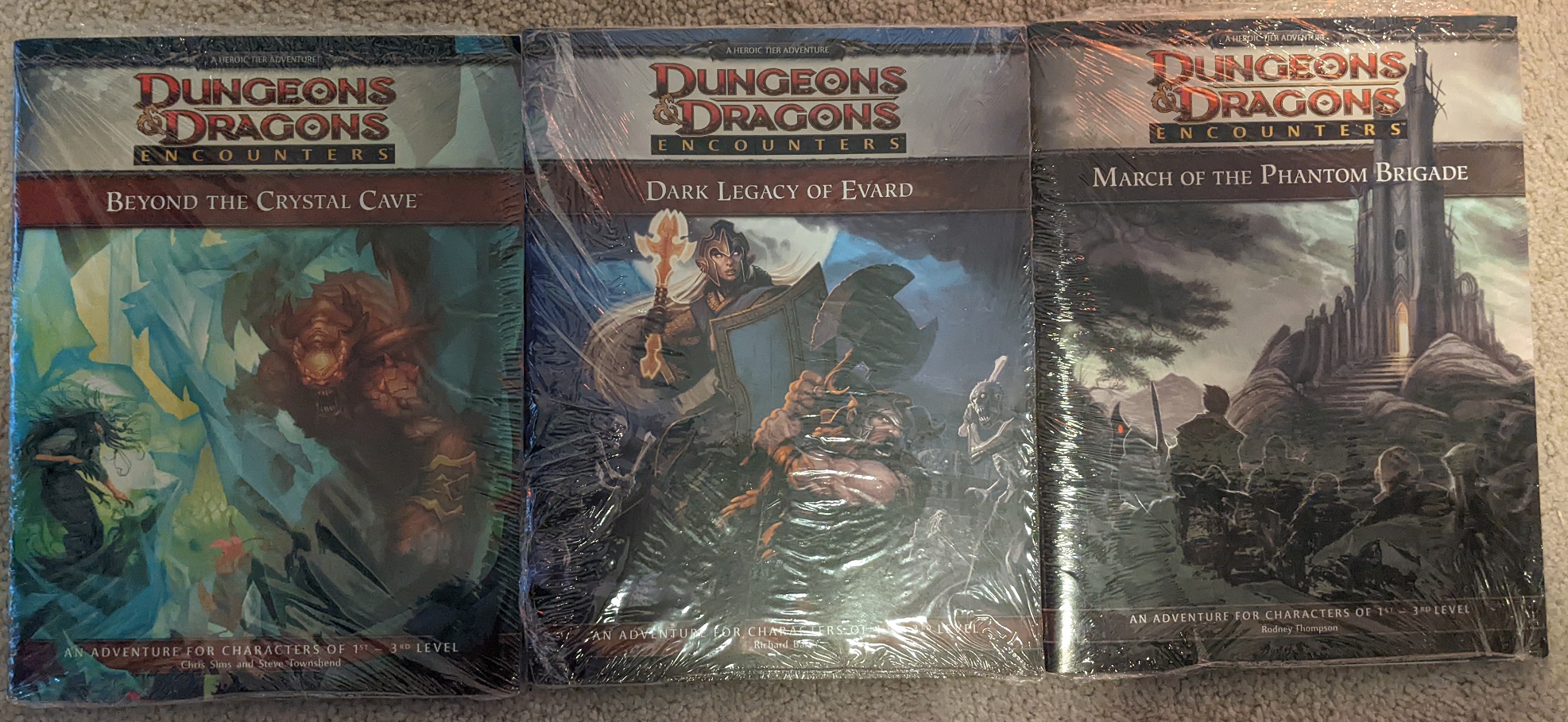
I put together another bookshelf, and in doing so started unpacking some more books. I found some gems in there. I used to run a gaming club in the Washington, DC area, and as a result, I was given a lot of WotC material for our game days, much of which was never taken out of its shrink wrap. I also have tons of duplicates. This is what I’ve discovered.
First up is material from some great writers, only one of which hates me. (Don’t hold it against him; I’m a tough pill to swallow.) Art credit to Ralph Horsley and Eric Belisle.
The latter has some supplemental material.
Major NPC cards with backstory and roleplaying information on the back.
Trigger warning: Is anyone else’s OCD going off right now? Art credit to Craig Spearing.
Where’s Chapter 2?!?!
These were something of a mistake for WotC, as I discussed with a WotC employee at GenCon who shall remain nameless. They were far too brutal for D&D Encounters, which was a program designed to introduce new players to the game. Some of us like brutal adventures and campaigns. In this century, we are clearly the minority. Art credit to William O’Connor.
Somewhere in Portland, Oregon, someone is squealing (you know who you are).
Oddly enough, I never played or ran either one of these, yet the shrink wrap has been removed from them. I’m guessing the DMs gave them back to me, but that doesn’t make a lot of sense. I allowed them to keep them because I had so many. Art credit to Eric Belisle and Alexey Aparin.
One of these authors has no idea what he’s doing (you know who you are).
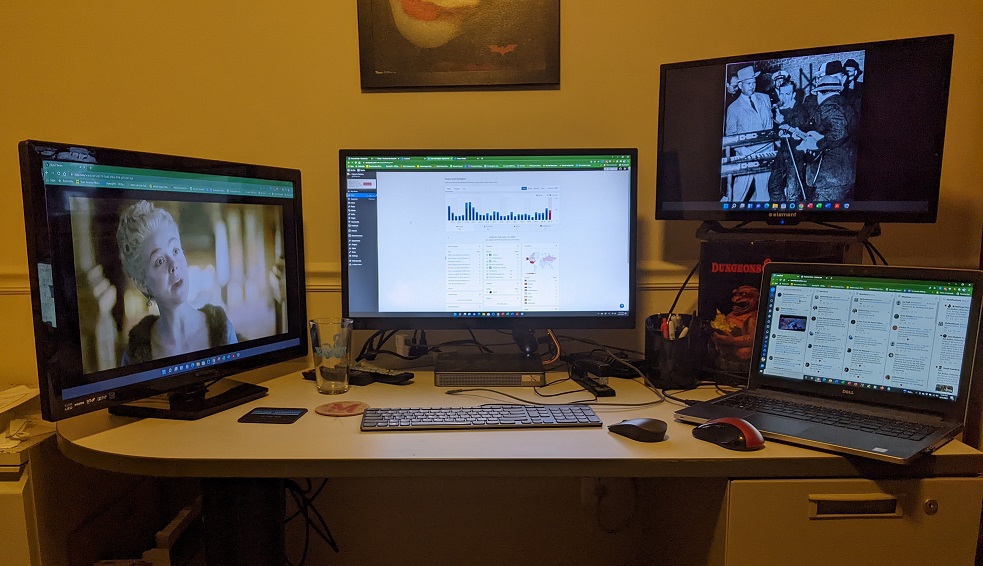
I told my coworkers that I was using one of the bedrooms in my new home into a den. They started calling it a mancave. Well, if this is a mancave, it’s the nerdiest one ever. I also can’t see it as a “cave” considering it’s on the second floor. It seems more like a man loft.
That doesn’t make any sense, does it?
Last week, I bought a 6′ tall bookshelf that finally allowed me to unpack most of my gaming material. This weekend, I picked up a new desk, which again allows me to unpack office supplies and other things. The room is finally coming together, and I’m fairly well organized.
This den, mancave, or whatever you want to call it is oddly important to me. I’ve lived a rather simple lifestyle up to now. I’m used to a small place, and while this home isn’t what anyone would call large, it’s exceptionally large for me. In fact, it’s too large. It’s great that I have room for everything that I have and much of what I don’t have yet, but I spend 90% of my waking hours in this room. For lack of a better word, it feels cozy, and I’m jamming it with everything I want around me in my free time at home.
Do I have enough screens?
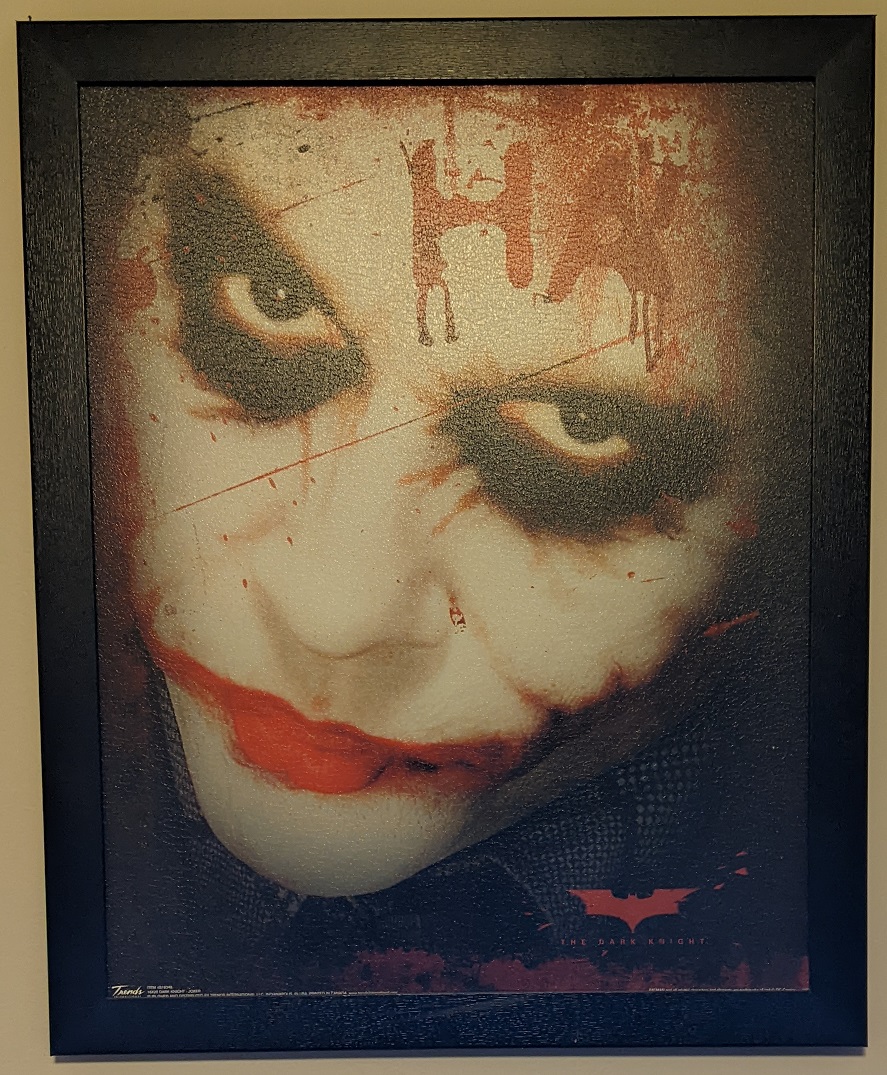
I have a lot of Jeff Dee originals to hang, but so far the only art on the walls is this guy over the desk.
Judging every one of my Google searches.
My cousin gave me a magazine rack. I asked, “What am I? 108 years old?” But I had just the use for it.
Though I may never read them again, I like having them.
Seriously. This is a mancave?
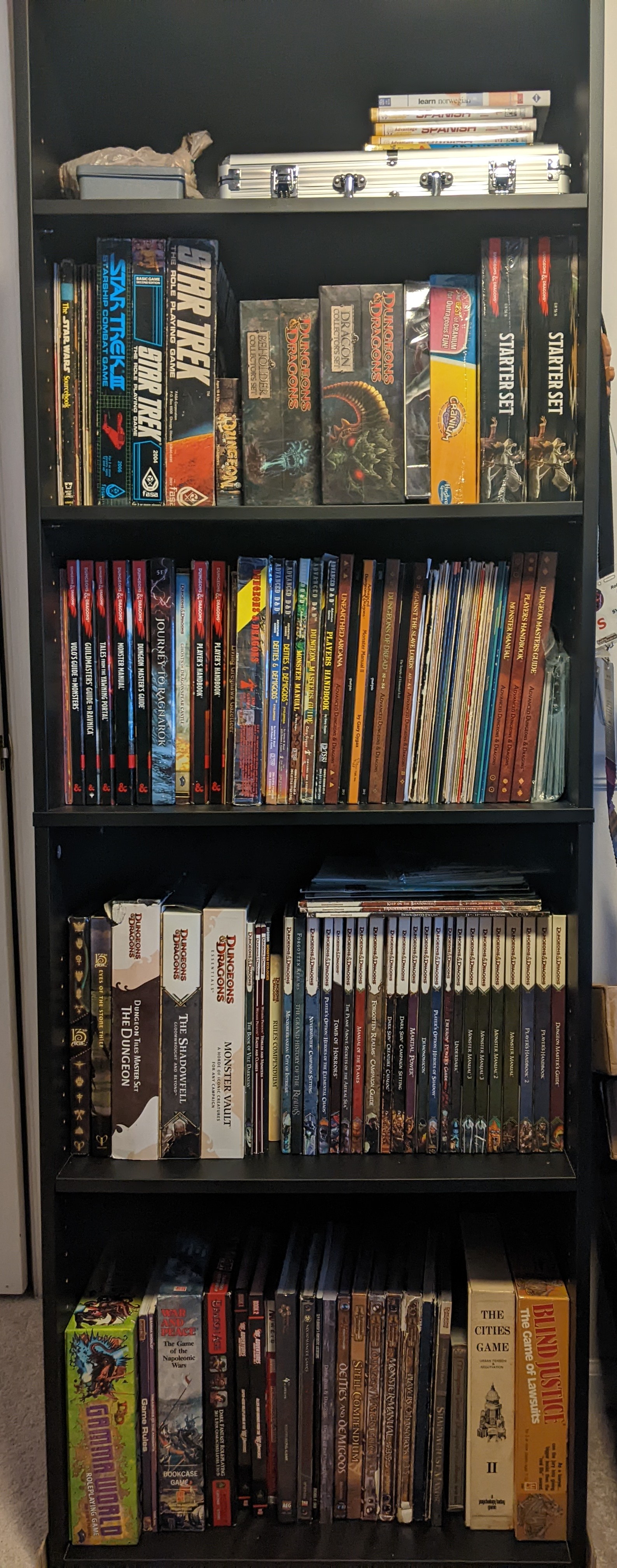
Almost one shelf per edition of D&D.
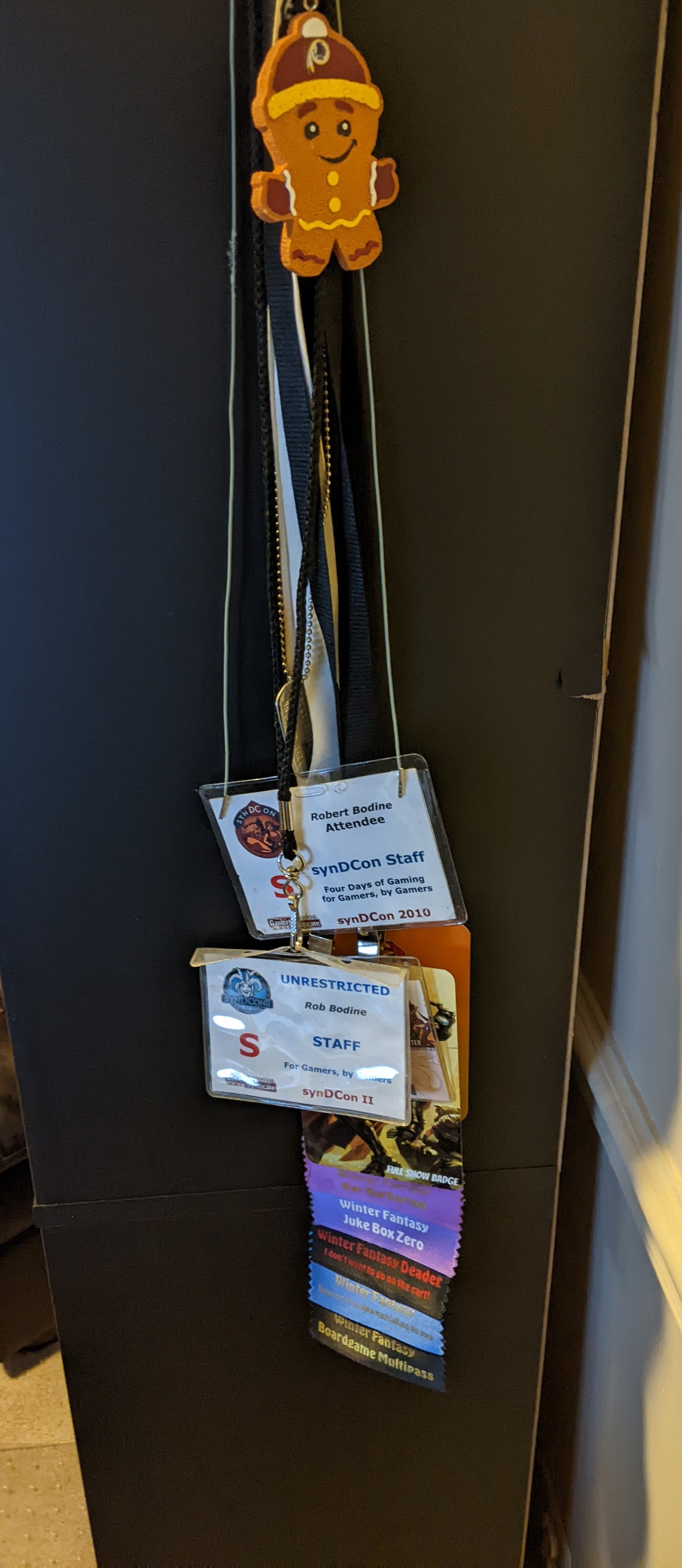
I have tons of other books not related to gaming, but the second bookshelf hasn’t even been put together. On the side of this bookshelf, I hung some memorabilia.
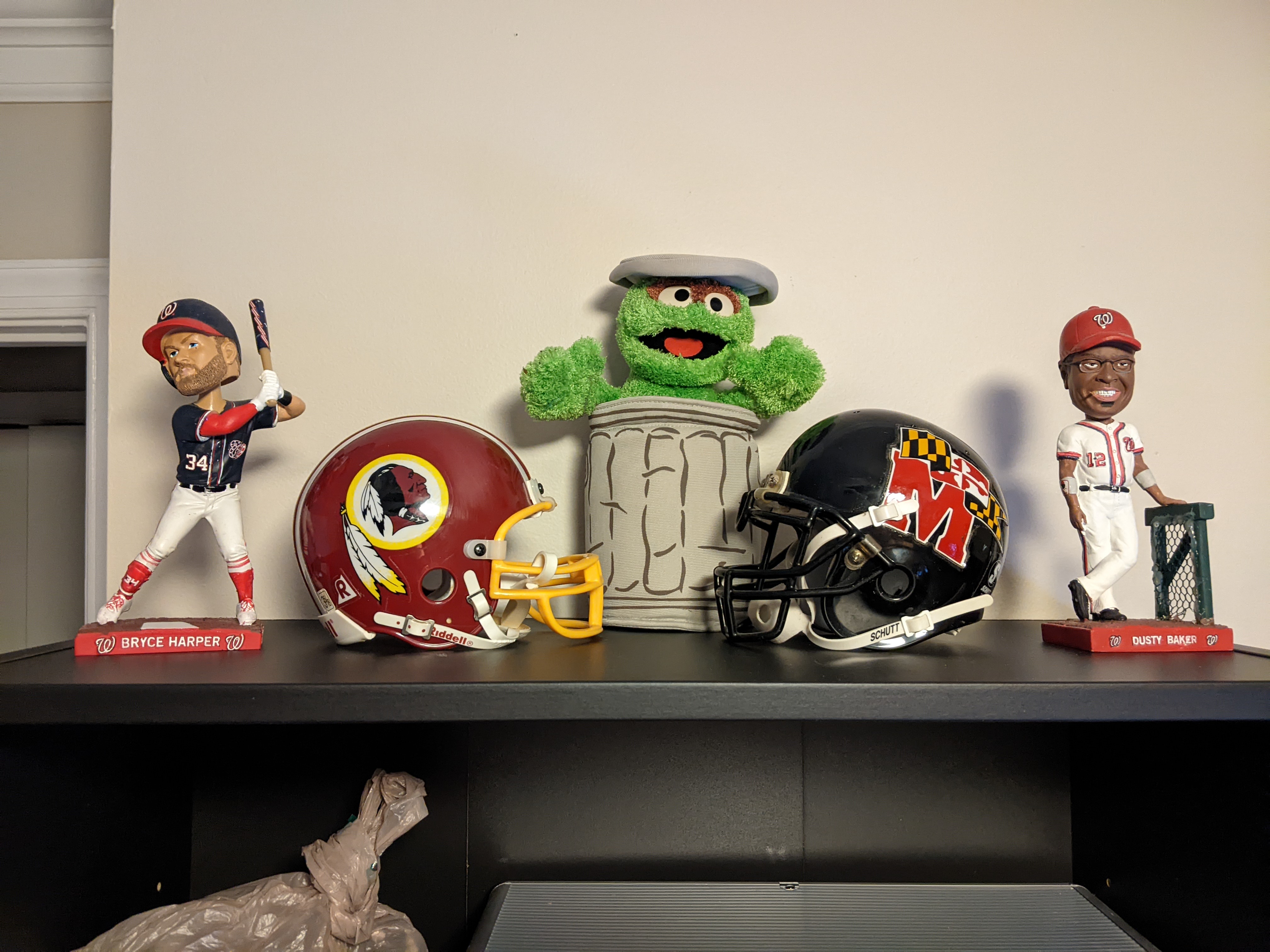
Okay, maybe it’s a mancave after all, but just barely.
The one thing that won’t fit are my musical instruments. I’m keeping them downstairs. That’s probably for the best. It’s a townhome, and the neighbors probably wouldn’t appreciate any noise being upstairs near their bedrooms.
Make no mistake about it: My keyboard playing is properly defined as “noise.”
Dungeons & Dragons is a trademark of Wizards of the Coast, LLC, who neither contributed to, nor endorsed, the contents of this post. (Okay, jackasses?)















 Play What You Want