Let's roll some dice, watch some movies, or generally just geek out. New posts at 6:30 pm ET but only if I have something to say. Menu at the top. gsllc@chirp.enworld.org on Mastodon and @gsllc on Twitter.
I’m back from my second-ever Origins trip, the last being 2009. I took today (Monday) off because I knew I’d need to decompress, so I’m taking this time to record two videos. The first is below. The second will go up tomorrow.
Here’s a good thing I forgot to mention in the video. For logistical reasons, my diet went to hell on this trip, and I hit the gym only once in three days, but because of all the running around and carrying of heavy objects, I returned home at the same weight at which I left.
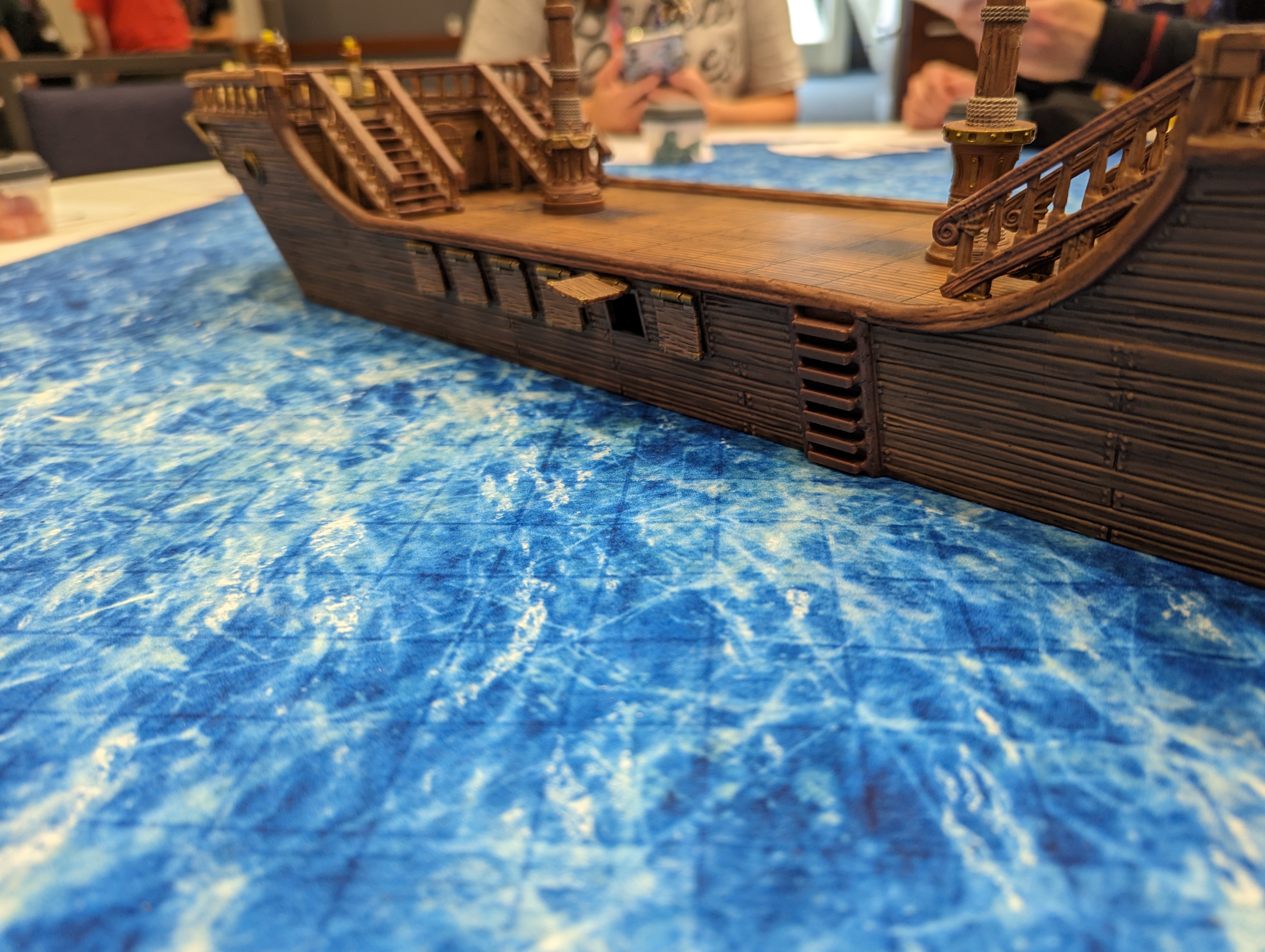
Moving on, this was a work trip. Here are some images of the “Learn to Play” game I ran. They used a model of a ship made by WizKids, which I’m told runs for $250. For what it’s worth, considering how overpriced WizKids minis are, that seems like a good deal. It’s not something everyone can afford, but at least it isn’t a genuine rip off.
The decks at either end of the ship can be removed to expose the lower decks beneath them.
That rudder moves. The only disappointing thing about this model is that the magnets holding the masts in place are too week, and there’s no magnet holding the helm in place. Still, this model provides some impressive detail.
Notice that the flaps can be opened to allow for the cannons to fire. Unfortunately, there are no cannons included. FYI, the watery battlemap costs $60.
I’m no dick. Well, actually, I am, but I was given express permission to show these players on social media.
The woman on the left had never played an RPG before that day, yet she was the first of only two players that exploited my command in the smartest way possible. I said, “Place your minis anywhere you want on the boat.” You see that archer mini on what is effectively the crow’s nest? That’s hers, completely safe from what I was about to unleash on the party. Good job, newbie.
I had a lot of fun goofing off wither everyone. While most players in my slot were experienced players looking for a 2-hour slot instead of a 4-hour slot, this was about introducing new players to the game. Those players don’t have preconceived notions as to how they’re “supposed” to play. They’re an open book and can sometimes be the best players around the table.
You’ll probably have to twist my arm to get me to go back next year.
So, here’s a shitty memory. I had a rough childhood. I won’t go into detail except as relevant to this post, which is relatively tame, but still kind of sucks in a way that gaming nerds will relate.
As a victim of the Satanic Panic, I was forbidden from playing D&D in 1982. Two years later, as a high school sophomore, my cousin introduced me to Barbarian books store in Wheaton, MD (now Barbarian Comics). This is where he bought his comic books. That didn’t interest me at all, but the store also sold RPG material. I knew not to buy D&D materials, but as a high school student, I rebelled a bit and bought FASA Star Trek material. Needless to say, I kept it secret for as long as I could, because that’s still “the same thing” as far as my family was concerned.
I bought the 1st edition box set, the 2nd edition box set, numerous adventures, and a bunch accessories. The accessories included starship models that could be used with that game. Each cost $4.00 (plus tax), so if I bought fifteen of them, that was probably about two weeks pay. Considering I was forced to pay for private high school and college, that’s a fortune, but I can assure you I bought far more than 15 of them. I continued to buy material all the way until the first couple years of college. When my family eventually found my hidden materials, they were largely destroyed. I managed to hide most of my written material, but the starship models were a total loss, and a few accessories disappeared. For a high school/college student in the mid- to late-80s, these were expensive. They were all destroyed by my older brother, who enjoyed enforcing my mother’s prohibition against, well, virtually anything that made me happy, gaming or otherwise.
A couple of years ago, I replenished my entire catalogue of 1st Edition D&D (“1e“) material. There’s nothing I ever owned, or even ever wanted, that I don’t now own. I spent somewhere between $300 and $400, but that bought me more material than I could ever hope to run in the 21 years I statistically have left on this planet. I’m fortunate enough that I afford that. However, take a look at this bullshit. If you didn’t click through (or you’re reading this years after the eBay listing was removed), this is one of those $4.00 models that is selling for $40.00 plus $4.20 shipping. Here’s a screenshot for posterity.
This is an obscure, seldom used starship.
Imagine buying merely fifteen of these now. I’m not a math major, but that should be $633.00 just for materials that aren’t strictly necessary for the game. Buying them at these prices can’t be justified unless you’re truly wealthy.
I’m now running a 1e game for the first time in 40 years, so I’m in no position to complain. However, I’d really love to play FASA Star Trek again. Unfortunately, I know of only two local people that are interested in a in-person game, and one of them isn’t what I’d call “reliable.” (Note: I hate online gaming.) In short, there’s no chance of an in-person game, and certainly none in which I’m a player. That’s a tough pill to swallow, but I can live with that. I’m fortunate to be playing 1e. Moreover, I’m working on starting a 4th Edition D&D game, which also appeals to me. I have plenty going on, and will probably have more than I can handle soon enough.
But as an American, I’m spoiled and want more.
Follow me on Twitter @gsllc Follow me on Mastodon @gsllc
On June 5th, to (understandably) little fanfare, I announced that I was heading to Origins. I’m leaving on Thursday after work, so I won’t be getting into Columbus, OH until after midnight. That means my effective schedule is as follows:
Friday
9 am – 1 pm
Free
Friday
2 pm – 6 pm
Running games
Friday
7 pm – 11 pm
Running games
Saturday
9 am – 1 pm
Running games
Saturday
2 pm – 6 pm
Free
Saturday
7 pm – 11 pm
Running games
Sunday
9 am – 2 pm
Running games
Sunday
2 pm
Leaving for home.
So, if you want to hang out during my downtime, let me know. I will want to hit the gym Friday morning, but I’m an early riser nowadays, so that shouldn’t get in the way of a breakfast or late morning hangout that day.
Here’s an Idea
I’m bringing some stuff with me. Old school stuff. AD&D stuff. I’ll be prepared to run a 1st Edition D&D version of module S2: White Plume Mountain, and I’m going to try to be able to run module C2: The Ghost Tower of Inverness in case anyone would prefer that. I’ll have pre-generated characters ready to go. This isn’t for an official slot, but if anyone wants to sit down in a hotel lobby and play a 4-hour session of one of those mods on Saturday afternoon, let me know. I’m also willing to grab a table at the convention if Dave has room and everyone would rather meet there, but if so, you’ll have to have a ticket.
If, on the other hand, you just want to hang out, that’s cool too. I tried this as an official game at the last Winter Fantasy, but it didn’t work out, and it certainly wouldn’t surprise me if it didn’t work out at Origins. Still, it can’t hurt to be prepared.
At least, that’s what the U.S. Coast Guard tells us.
One of my favorite villains is fantasy roleplaying is Medusa. In Dungeons & Dragons (“D&D”), that’s a species of creature. In Greek mythology, that’s the name of one of three of her kind, known as Gorgons. Most of you know this, but for those that don’t, here’s one of many videos on them. While I respect the work game designers do, I’m always going to prefer mythological creatures to those game designers invent. Mythology got me into D&D, not the other way around.
3.5 EditionD&D
I love the way D&D has treated medusae generally. I vaguely remember an article in Dragon Magazine during the 3.5 EditionD&D (“3.5e”) days with a writeup on their ecology, which included their male counterparts, the maedar. I never got to use that article because it came towards the end of 3.5e, and I was so caught up in running Living Forgotten Realms and other canned adventures that I didn’t write much of my own material. I always wanted to write a medusa as a BBEG.
4th Edition D&D
In 4th Edition D&D (“4e”), I loved how 4e’s game mechanic was applied to the medusa’s petrifying gaze attack. In 4e, save or die was jettisoned and replaced by what you could call “save thrice in a row or die.” That is, you got three saves over three turns before you were killed, dominated, or whatever. If you saved successfully once during that run, you shook off the effects (though relatively rarely, you still might be subject to an aftereffect on a successful save). This worked really well with the medusa because each failed save during that three-round process resulted in increasingly bad effects. That is, on the first failed save, you were slowed (i.e., speed cut in half). On the second, you were immobilized (i.e., speed of 0). On the third failed save, you were petrified. This gives the player a means to immerse oneself in the action, as the cascade of worsening effects can give you the feeling of slowly turning to stone. (FYI, medusae weren’t the only creature to use this cascade.)
1st Edition D&D
I’m running 1st Edition D&D (“1e”) for the first time in 40 years, so I had forgotten quite a bit. There are a couple of things about medusae that I relearned. First, their gaze attack targets a single creature, whereas in later editions it attacks multiple targets. Second, the gaze is active, not passive. That is, a character merely gazing upon a medusa doesn’t harm the character; the medusa has to intend to petrify the opponent. (See Monster Manual II, page 55 for more information.) While these represent a break from mythology, as you’ll see, they worked to my advantage. One other thing to note is that I house ruled petrification to use the 4e system of slow progression to being petrified.
B2: The Keep on the Borderlands
Going into last session, my group and I knew that we had reached the end of the adventure. So, I told them that I’d be railroading them a little bit to make sure we wrapped things up and that a particular encounter occurred. That encounter was with spoiler alert! a medusa – I named her Xisper – who was captured by inhabitants of the Caves of Chaos and chained to a wall. She used her gaze attack against one PC, but he saved successfully. Some of the PCs held true to their good alignment and refused to allow anyone to kill her but indicated that they’d leave her to her fate, so Xisper immediately went into negotiation mode. Long story short, that negotiation led to them freeing her to clear out the gnoll infestation (the one area the PCs never addressed) and gave me the perfect recurring NPC to bring back at a later date. She’s undoubtably evil, but alignment in my game world is always more complicated than the books present, so she could still be of use to them, and them to her. This is even better than a BBEG.
Xisper will return.
Follow me on Twitter @gsllc Follow me on Mastodon @gsllc
Dungeons & Dragons is a trademark of Wizards of the Coast, LLC, who neither contributed to nor endorsed the contents of this post. (Okay, jackasses?)
Here’s a screenshot of the PC screen for the character builder:
Westlocke is a pre-generated character from module S4: The Lost Caverns of Tsojcanth.
And here’s Westlocke’s current character sheet. The data I said would be missing has now been added, and you can see that the character sheet is, as I like to call it, “one-stop.” You don’t have to look up spells in hardcover books if you’re using my character sheet, even if those spells come from magic items.
Last weekend, I ran my 7th session of 1st Edition Dungeons & Dragons (“1e“). We spent over one hour shooting the breeze before diving into the game, and that was as much fun as the game itself. One topic that came up was magic items and how many modern gamers don’t take them seriously. One particular instance threw me off. Erik says,
In a game I was playing, we found a headband of intellect, and no one cared. They all pointed out that they weren’t intelligence-based characters, so it didn’t matter to them.
I replied,
But that’s exactly why you should want one! You can become an intelligence-based character, which matters for skill checks and role-play in general!
Erik agreed and noted that his low-intellect ranger now has a 19 intelligence. The reaction of the other members of his gaming group isn’t a surprise to me. I’ve encountered this as well. While a ranger would probably prefer a +5 vorpal longsword for mechanical reasons, the headband opens up more avenues for role-play. Why doesn’t that appeal to people? Obviously, this is a generalization not backed by science, and even if accurate, it may not apply to you. That’s not important. What’s important is that 1e makes magic items more valuable, minimizing players’ disregard for them.
I’ve already discussed how boring magic items affect the game, but this is a little different. That said, this post and the other one have a synergy to them.
In 3rd Edition, you need to-hit bonuses in order to keep up with the increase in monster power because those bonuses were built into the math. That is, the power curve for a monster was steeper than that of a PC because it was assumed PCs would gain such magic items. (I’ve talked about how stupid I think that is despite how universal that is to game design.) In 4th Edition, the same math applied, but you could forgo magic items by using “inherent bonuses” that have the same effect. You simply add a cumulative +1 to your rolls at set levels in your advancement. In 5th Edition, you should probably get better magic weapons as you advance, but as long as you can get just a +1 weapon (or, like a monk, treat your attacks as magical even without a magic weapon), then you’ll always be able to hit creatures immune to mundane weapon attacks (e.g., flesh golems). These approaches to game design lessen the impact of magic items or make them altogether unnecessary, and usually make them boring (again, as I’ve discussed).
None of these are the case for 1e. First, an anecdote. In last Saturday’s session, PCs hid themselves in small room to avoid an unnecessary combat. They followed the elven ranger and magic-user who found the secret door to that room, which meant those two characters were at the back of the room. Neither elf found the secret door at the other end of the room, so when the zombies opened up that secret door, suddenly the magic-user found herself in what was now the front of the room engaged in melee with three zombies with the BBEG high priest behind them.
The magic-user wanted to cast Sleep, but I warned the player (the aforementioned Erik) that it was possible the spell would never go off. For those of you that don’t play 1e, long story short, a combat round is divided into ten segments, and each round a single initiative die is rolled for each that sets the segment in which each side goes. Because the die is a d6, that means everyone starts during the first six segments of the round. Also, Sleep requires 1 segment to cast, which is relatively quick but not a guarantee of success. So, even if the PCs win initiative, if the zombies go on the segment immediately after the PCs, the zombies will get to attack the magic-user before she’s finished casting Sleep. If even one of the zombies hits the magic-user for even one point of damage — likely to happen considering how poor the magic-user’s armor class always is — then the spell is disrupted, and it’s lost for the day. This means that it’s exceptionally difficult to cast spells in combat, which is worse for spells like Fireball (3 segments to cast) or Time Stop (9 segments to cast). (I’ve previously discussed how much I love this, because having more useful spells require longer casting times assures that different players will choose different spells for their casters, and that material components can be another way to achieve this goal.)
How is this relevant to today’s topic? Well, using magic items (e.g., scrolls, rods, staves, wands) is often instantaneous. In fact, their powers take effect before any melee attacks are resolved regardless of initiative. That means that many magic items allow a caster to cast their spells without fear of having them disrupted. At least for casters, magic items therefore become far more valuable, and isn’t that a common trope within the fantasy genre? That’s one more way in which 1e succeeds where some supposedly “evolved” editions fail. Nowadays, all innovation in game design means is that you’ve mashed together new combinations of existing mechanics from prior games, so don’t attempt to ignore the past when designing yours. Whether you adopt the precise mechanic of a prior game or not, at the very least it may provide inspiration for the feel and tone of your end product.
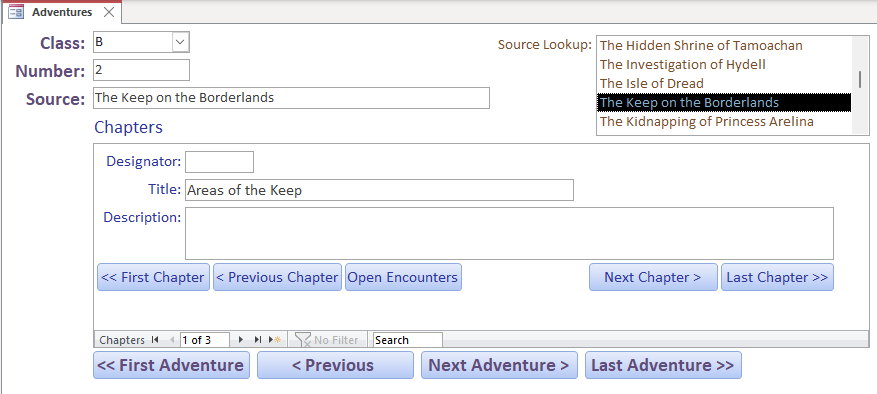
I continue to make huge strides on my 1st Edition Dungeons & Dragons (“1e“) application. I’ve collected some screenshots below. Keep in mind that my current focus is on data entry and functionality, so the user interface isn’t great. Moreover, it’s an Access database, so the user interface will probably never be great. If I don’t design a better interface in a real programming language, I’ll eventually upload the database to GitHub so that someone else can do so.
First up, adventure entry. In order to keep my adventure forms from getting too complex, they’re broken up into two forms. First, enter the adventure and the “chapters” within.
You enter the adventure itself, then add chapters within the adventure. For example, for the adventure shown, there are three chapters: Areas of the Keep, Adventures Outside the Keep, and the Caves of Chaos. Next, you add encounters within each of the chapters. These are from adventures outside the keep. The first one is an encounter I modified to mix things up a bit. Not only do I do that to avoid metagaming from players that have played these adventures many times before, but I also like to use Fiend Folio and Monster Manual II creatures that weren’t available when these adventures were written.
You can see that each encounter can have NPCs (leveled characters), actual monsters, both mundane and magical items, and coins. As you’ll see, items used (or at least held) by characters are handled on the character builder pages. The items you see here are ones stored in the encounter location (e.g., in the closet, in a chest, lying on the ground). The reason for the difference is that PCs shouldn’t have access to magic items possessed by a creature that escapes. Next up, is an encounter with NPCs.
These are humanoids (humans in this case) with class levels, so they’re handled differently than “monsters.” How are they handled? Well, here’s the character builder for PCs.
This is for PCs. The NPC form is identical. You can see that these characters can hold (and use) mundane items, armor, shields, magic items, and coins. Again, I track unattended coin and items separately because if an NPC escapes, those coins escape with the NPC. Only the unattended coin and items and those held by NPCs that are captured or killed are available to plunder. You can also see that there are buttons to call up prepared spells and the character sheet itself. Click on the links to see them in PDF format.
So, what about monsters? I refer to them as species. Here’s their data entry form.
There’s a typo above. In the Special Attacks field, it refers to a “divine attack.” That should be a “dive attack.” That’s another problem with Access. It doesn’t have spellcheck. This error has been fixed, but there are probably others.
After you’ve created the species, you then need to create a specific instance of a monster. I didn’t take a screenshot of that form, but it’s rather simple. Pick the species, calculate or designate it’s hit dice (if the species has a range of hit dice), and designate its hit points. You can also give the monster a name (e.g., Sappho, the gynosphinx from White Plume Mountain). Then your monster will be available to add to an encounter as shown above.
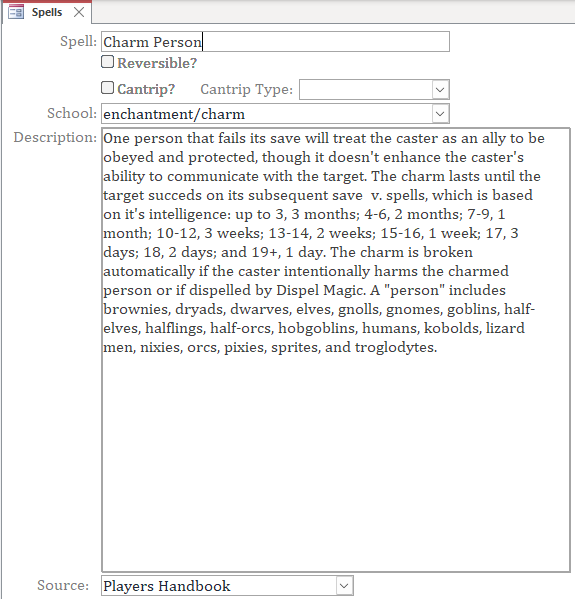
Spells deserve some discussion. There are several spells that are used by several classes, but the classes use them differently. An obvious example is Detect Magic. Clerics, druids, and magic users all use the spell, but their material components differ. The cleric uses a holy symbol, the druid a sprig of mistletoe, and the magic-user doesn’t need one. So, the way I have to handle it as follows. First, create the spell with a few characteristics that are constants across all classes.
Next, create what a software engineer would call an intersection entity to resolve the many-to-many relationship between spells and classes, entering the information that differs from class to class (e.g., material components).
In rare instances, the differences between the spells are so great that I’ve had to create different spells in the first form for different classes. In such a situation, I call the spells “[Spell Name] (arcane),” “[Spell Name] (divine),” “[Spell Name] (primal),” or “[Spell Name] (phantasm)” depending on what’s needed.
I’ve entered every spell appearing in the Player’s Handbook and Unearthed Arcana, every class appearing in those same two sources, every species from the Monster Manual, and am about halfway through the Fiend Folio. I intend to finish the Monster Manual II before releasing this software, so most of the work will be done. However, I won’t be doing everything from every adventure, and I’m not certain I’ll enter anything from Oriental Adventures. So I understand that, in the long run, the more user-friendly it is, the better.
Whether anyone ever finds this useful, I will. I’ve been using it for my game, and with the adventure-related features I’ve added over the past two weeks, my pre- and post-session tasks will be much easier.
Dungeons & Dragons is a trademark of Wizards of the Coast, LLC, who neither contributed to, nor endorsed, the contents of this post. (Okay, jackasses?)
Winter Fantasy is over, and today is still a day off from work for me. I need this day to wind down a bit, but I’ll be very happy to get back into my routine.
I tried to run three slots of 1st Edition Dungeons & Dragons (S2: White Plume Mountain), but none of the tables went off. I sold only a single ticket for one slot. Nevertheless, I go my fix. I ran it for most of the van ride home (Winter Vantasy). This meant that the days could be spent the way I wanted to spend them.
Much of my time was spent completing my 1st Edition character builder. The game exposed some bugs in the character sheet (already fixed), and there’s one more thing (non-weapon and weapon proficiencies) that I have to finish (will be finished this week), but after that, everything that remains is monster species data entry. I’ve gotten through lizard king in the Fiend Folio, then have to deal with Monster Manual II and Oriental Adventures, but that’s it. Nothing hard; just tedious. I can then upload it to GitHub where someone else can do a much better job with the front-end if they’re so inclined. I’ll try to shore up my own front end first, but there’s only so much you can do with MS Access.
My “man cave” now has an addition to the wall of badges.
So, what now? Well, I always come away from vacations feeling like I’ve had enough. Like everyone else, I complain when I get up in the morning, I’m annoyed by tough cases, etc. However, in the end, I need a purpose. I need a job for more than just paying the bills, and relatively speaking, I have a really good job. I don’t need another vacation for a while, and after speaking with Bryan CP Steele at Winter Fantasy, I’m seriously considering replacing my Vegas trip with Gamehole Con this year. If I do so, I’ll still take off a week from work, but I’ll be home for most of those days relaxing. I don’t think I need anything as intense as Vegas.
Time to return to the grind, and I’m 100% cool with that.
Today, I’m riding home from Winter Fantasy in a van running 1st Edition Dungeons & Dragons. The adventure is S2: White Plume Mountain, and one of the iconic monsters from that mod is the manticore. Here’s a short video on the manticore care of Mythology & Fiction Explained.
Another iconic monster from White Plume Mountain is the kelpie, which was created for the adventure. Here’s a significantly longer video on the kelpie.
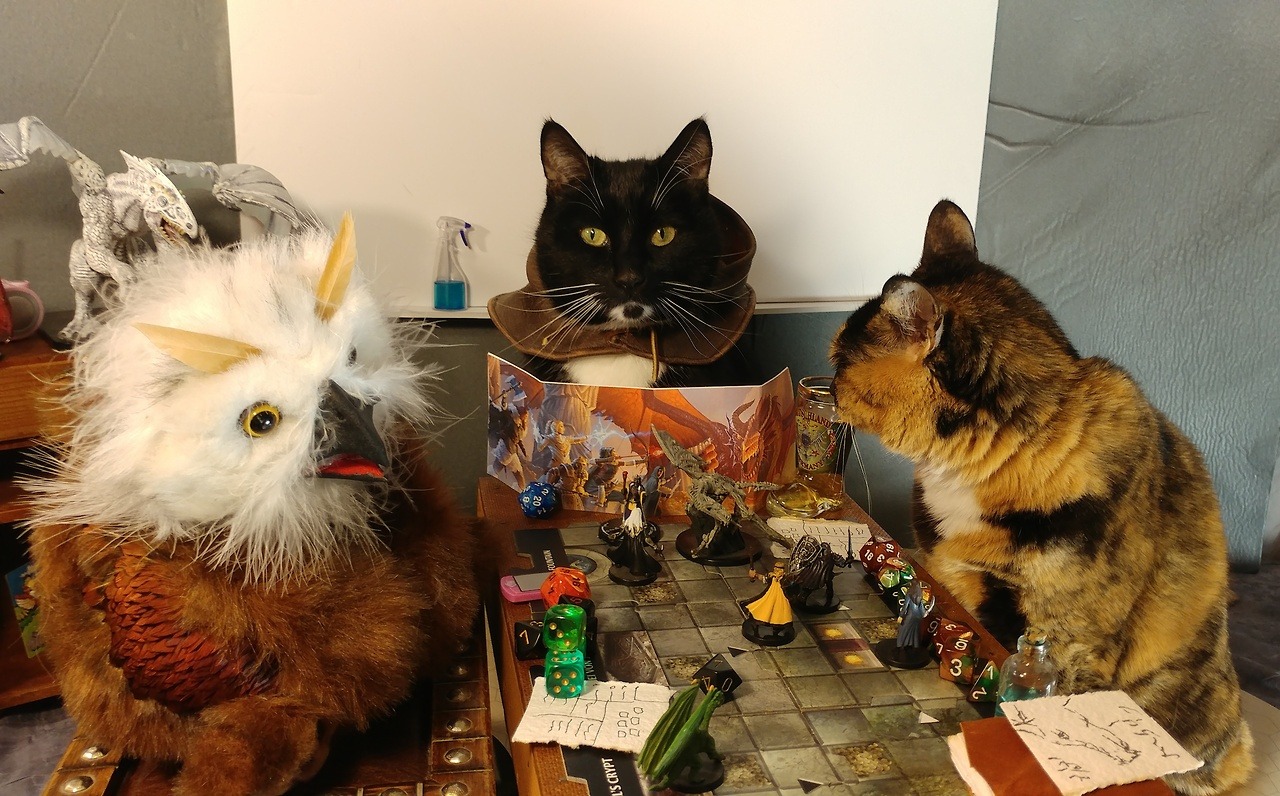
I’m at Winter Fantasy in arctic Ft. Wayne, IN, so here are some stupid Caturday images that seem appropriate.
That’s a lot of dice. That little guy must be playing a rogue.
I love that this DC (Dungeon Cat. Get it?) is preparing to pull out an old white dragon on this party. I’m not sure if that thing will fit in that room.
I was scheduled to run three sessions of 1st Edition Dungeons & Dragons. Each session would be a different leg of White Plume Mountain. Not a single table went off. I sold only one ticket for the third session, and needless to say, that guy decided to find his way onto another table. I’ll be running the adventure in the van on the way home, however, so I’ll get my fix.













 Play What You Want