Let's roll some dice, watch some movies, or generally just geek out. New posts at 6:30 pm ET but only if I have something to say. Menu at the top. gsllc@chirp.enworld.org on Mastodon and @gsllc on Twitter.
Writing yesterday’s post gave me the idea for this post. Here’s a list of my favorite RPG characters.
D&D 3.5 Edition: Frylock
This is my favorite character of all time even though I’m not a fan of 3rd edition. I left D&D in 1981 due to the Satanic Panic and returned in 2005. Frylock was the first character I created in my glorious return, which was for a Living Greyhawk game day. He was a half-elf warmage with a couple of levels in rogue. I’m not sure if I played correctly by the rules, but this was an awesome character, combining the rogues sneak attack damage with high-damage touch spells. He was high charisma, manipulative, and arrogant as hell, except for that one time he met his match. He ran into Teos’s character, Ambrosia, in whose hands Frylock was like putty. He was also a terror in combat, which was helpful considering that I’ve almost never built a character for combat. Spoon-feeding me competent character design helps keep my fellow players happy with my combat performance. If I was cheating to do it, this would explain why no one called me out for it.
For over a decade, my license plate was Frylock. That shouldn’t surprise any of you.
I’ve never been able to duplicate the feel of this character since 3rd edition. The closest I came was the supremely underpowered sorcerer-assassin hybrid in 4th edition. Maybe if I cheated, I could’ve done that in other editions. 🙂
D&D 4th Edition: Rizzen Pharn
4e is the only edition of any RPG I’ve ever played in which I loved play leaders (i.e., healers). After playing the Warlord pre-gen at some convention, I knew that would be the case. My first character I built on my own was the Drow, Rizzen. He was an Inspiring Warlord, and due to Commander’s Strike, it didn’t matter whether I rolled well on my d20s. I just gave my attacks to other people, than used my minor action to heal everyone. Suddenly, I was the most popular player on the table. I can’t remember any personality quirks I gave him. I doubt I did. At this point, 4e was new, and the character builds leant themselves inherently to personalities probably due to the emphasis on roles (i.e., controller, defender, leader, striker). I didn’t feel the need to spice it up.
D&D 4th Edition: Doofus Pharn and Snuggles
Doofus was Rizzen’s brother, and he was a beastmaster ranger. That was a really good class. Combined with the class’s features, my choice of powers gave me the ability to race across the length of a standard battle map in a single turn. The first time I did this was a disaster. I was all by myself surrounded by enemies with no actions left to fight or “ink.” Once I got the hang of the character, that mobility was remarkable. His DPS was also pretty good. His companion was a jaguar named Snuggles, and using the companion, Rizzen was able to set up his own flanks without the help of any PCs. Just like Frylock, I didn’t have to build the character for combat efficiency. The race and class combination handled that for me.
D&D 4th Edition: Luigi Deleonardis
Luigi was a riot. He was the stereotype of a senile old man, and I played him to a tee. He was a brawling fighter, which meant his primary combat tactic was “rassling.” He had a belt buckle with Kord’s holy symbol on it. He didn’t worship Kord; they grew up together. Sure, Kord was a bit younger than Luigi, but Luigi took him under his wing and showed him the ropes. He felt bad for the little guy.
Initially, Luigi always annoyed other players because they thought he’d be useless, but here’s a quick story of how I avoided that. The party had to convince wood elves to let them through their woodlands. Skill challenge! Everyone went with diplomacy or bluff, but not Luigi. As he was about to engage with the elven leader, he suddenly had a squirrel moment and decided to climb a tree. As a fighter, my Athletics was pretty high, and I (uncharacteristically) rolled well. My physical prowess was remarkably impressive, so I passed that check. When we came around again, the entire challenge came down to my roll. I was one of only two players that had to roll twice in the challenge. My (perceived) age allowed me to tell an impressive story of the gods, and with a natural 20, I saved the day. In that same adventure, the ultimate mission was to rescue a kidnapped woman, and as Luigi often did, he told that woman that she reminded him of his great, great, great, great granddaughter’s . . . granddaughter. That gave Luigi the incentive to protect her directly, which is exactly what a fighter is supposed to do.
My unorthodox style never held me back, but it always provided comic relief.
D&D 5th Edition: Balasar Kimbatuul
Balasar was a gold dragonborn battle master fighter who played the bongos, and by that I mean that I went to Toys ‘R Us and bought a set of bongs to play at the table. I created him for Sly Flourish’sHorde of the Dragon Queen campaign, and somewhere on slyflourish.com is a picture of me playing those bongos. The first leg of the campaign is a really tedious slog with little opportunity to rest and recover abilities. The rat swarm was particularly annoying, but the first leg ends with a blue dragonborn, Lennithon, calling out one of us for a one-on-one fight. I spontaneously shouted out, “Honor duel!” That became Balasar’s thing. He’s always pick the baddest NPC on the battlefield and convinced that NPC to duel him. It wasn’t through some class or racial feature, but purely through role-play, which Mike facilitated. In such a situation, it’s easy to outshine your fellow players by grabbing all the glory. I honestly don’t believe that ever happened. Besides the fact that my dice are weighted towards low numbers, so I was often knocked out, Sly Flourish is literally the best DM I ever had. He allows everyone to play as they want to play, and yet characters rarely stole each others’ thunder, nor did players annoy each other. As players, we deserve some of the credit for that, but most of it goes to Mike, and I like to remind him how grateful I am for his talent as a DM. I was in his home game for many years and play-tested most (all?) of his published work during that time.
D&D 5th Edition: Portia Tossgobble
Portia was one of four members of the Tossgobble family I created. Because I can play only one of them at a time, they never met in-game, but they were all siblings. Portia was a halfling, kensai monk in the D&D Adventurer’s League. Because I play once per year, I forgot most of her details. I was playing her at Winter Fantasy, and we needed someone to steer a ship. It suddenly occurred to me that she had a sailor background, so with a natural 20 on my attempt to steer the ship . . . well, let’s just say I finally had the opportunity to yell, “Ramming speed!” The adventure’s treasure included a perfect item for her: a +1 trident. All I need now is a magic item or feature of some sort that allows her to breath water, and she can rule however many seas Faerun has.
I could go on, but I won’t. Maybe I’ll remember some other fun characters and share them in a future post. I liked my occultist in 13th Age (another Sly Flourish campaign), but I was on my last legs as an RPG player at that point. My memory and my thrill in creating meaningful characters waned during that time.
It doesn’t surprise me in the least that all of these characters were D&D characters.
I didn’t think I’d write a part V, but here we are. Once again, I’m my own inspiration.
Reason #146 why I prefer 4e #DnD: It made combat fun for me, because all those tactics turned combat into a real-word skill for the player: puzzle/problem-solving. Ironic coming from a role-player (not roll-player) considering so many criticize 4e as being for combat lovers. #RPG
— Rob Bodine, #Attorney by Day, #Nerd by Day & Night (@GSLLC) July 1, 2021
Inside information: I made up that rule number.
I’m going to expand on this thought. For proper context, I point you to my post on how I prefer to play D&D and my dungeon crawl system PDF. Because neither of my two non-spam followers are going to click through, here’s the gist of them. Dungeon Crawl System: I created a system for 4th edition D&D that quickens combats and removes the annoyance known as the 2-hour adventuring day. (Your number of hours may vary.) My Approach to D&D: While I can enjoy a good combat, I prefer role-playing a quirky character to rolling dice, immersing myself in the game world and taking interest in even the most mundane of NPCs. That limited context will have to do if you don’t want to click thorough.
If you’re in combat and roll a natural 20, what have you accomplished? I’m not talking about your character; I’m talking about you, the player. What did you accomplish? Rolling a 20 (or any hit) is just a matter of random chance for the player, so while it represents a character’s achievement, the player hasn’t done anything of note. That’s why I prefer puzzles, moral dilemmas, and the like. They’re a challenge for me, the player. This doesn’t mean combats are useless in this regard. One thing we accomplish in all aspects of the game is that we’re telling a cool story. I just prefer that in doing so, we’re more screenwriters than moviegoers. I want to be the one writing most of the story rather than have random chance present it to me. That is, I prefer to moderate random chance so that it provides tension without overwhelming the story.
4e changed things for me. I actually enjoyed combats because winning a combat felt like I was accomplishing something. The tactics were intricate. I had to cooperate with my team of PCs to defeat the tactics of the DM, just like what you’d do in the real world.
Damn, that sounds nerdy. I know real life combat is very different. I’ve trained in the martial arts since I was 14. I’m just drawing an analogy. The point is that you have to use your brain and employ sound tactics in 4e D&D. It seems so strange to me that one of the most common criticisms of 4e is that it’s a combat simulator that sacrifices role-play. The mechanics of 4e kind of made role-playing a character part of combat, and it’s why I had a much easier time fitting in with other gamers during its run. That gives me an idea for tomorrow’s post. Seriously, typing that sentence gave me an idea.
All that said, I’ve always said that if a game system doesn’t do what you want it to do, it’s you’re own damn fault. You can use any system to play any style.
I love the Graham Norton Show. I’m not sure why — I’m not a fan of talk shows — but I’ll leave that mystery to the philosophers. I’m any case, Facebook keeps throwing the show’s videos at me. This one from 2018 had an interesting message.
Skip to 1:22 to get to my point. Skip to 1:55 to see how confused Nicole Kidman is.
TL;DR: At the time of filming, Stephen Fry had released a book called, Heroes. In discussing it, he mentioned his favorite Greek god, Hestia.
And the hearth, when you think about it is all of our ancestors, whatever our ethnicity . . . all our ancestors gathered around flames at night to stay warm and protect themselves from animals, and they told stories about things over which they had no control. . . . Everything you can’t understand and control you give a name – a god – and so these gods developed personalities around the fire. And now I think we can safely say we’ve lost the hearth. You know, we don’t eat around tables anymore, someone’s got a PlayStation in that room, and they get a delivery of pizza into it, and someone else has got another . . . they’re streaming things in another room. No one gathers around and shares stories anymore. We’ve lost our focus; we’ve lost our hearth.
Fry’s point is correct though incomplete; he failed to mention that these stories eventually became a form of entertainment because it wasn’t relevant to his point. In any event, we’ve lost the art of shared storytelling. Movies, TV shows, and novels are one-sided storytelling. The hearth gives us all the opportunity to take our turn telling our stories, or directly contribute to the stories of others through questions or commentary. Perhaps the fact that a novel inspires a reader to write their own novel provides some give-and-take, but that’s hardly an intimate experience, and it’s reserved for those with the drive, resources, skill set, and perhaps luck to publish a novel.
But then there’s we, the TTRPG nerds. We haven’t lost this at all, have we? What is a table-top, role-playing game session at someone’s dining room table if not “the hearth”? Unless you have a totalitarian DM that insists it’s “their game,” everyone at the table is telling the story.
Someone willing to DM. 🙂 Having been in @SlyFlourish's home game for years, I'm spoiled, but someone who facilitates different play styles is remarkable. Worst trait? "Hey, I'm DM. This is my game!" Mike understands the players' role in telling the story.
— Rob Bodine, #Attorney by Day, #Nerd by Day & Night (@GSLLC) July 3, 2021
We’re one of the last cultural bastions of intimate community activity. Kind of ironic that the social misfits are what’s keeping this part of our social identity alive, huh? Make sure you don’t blow that opportunity or shirk that responsibility. Personally, I think it’s tautological to say that doing so requires we focus more on the characters and story than on the mechanics, but whatever keeps *you* at the table is good enough. Food for thought.
Fry’s book, Heroes, will have to go on my reading list.
This was a failed attempt to fool the algorithm into using this as the preview image.
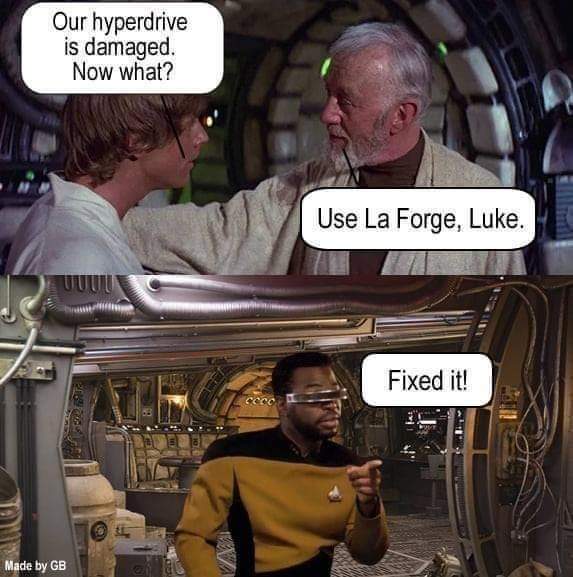
Every Saturday, and sometimes on other days, I make a point of how much better cats are than dogs. And how much better Star Trek is than Star Wars. When I can do both, it’s Nirvana.
But hey. I have an olive branch to extend to the dog-lovers out there.
Suckers. Dogs are dumb.
Oh, and another thing. Tomorrow is July 4, which is a good time to remind you that everyone goofs up from time to time. It usually works out eventually.
Note: Despite the use of the hashtag, I know nothing about psychology, other than I have deep-rooted issues. But this is a fun blog!
Earlier this week, I was really busy at work. Actually, nowadays it’d be easier to just tell you when I’m not busy. Anyhoo, my coworker, Clarissa comes in to dump more work on me, and it comes up that I’m going to have to skip lunch. She offers to heat up my soup for me. Instantly, I’m suspicious. As the archetype of a middle child, I’m thinking, “What is she up to? No one ever does anything for me. Or themselves. I always have to do other people’s work for them too. If I don’t do something, it doesn’t get done, and disaster follows. Certainly, no one makes me lunch.”
For some reason, WordPress won’t let me shrink this image. Or center text underneath an image.
Now, when I say, “I’m thinking,” I mean, “I say right to her face.” Because that’s what I do. I’m a straightforward, middle child. I have a filter; I just refuse to use it. Well, it turns out that she’s a middle child as well, which is why she instantly assumed it was her responsibility to make my lunch.
So, Clarissa took care of me, and then I informed her that I’d be thanking one of our coworkers — some oldest child — for doing such a great job with my soup. Those assholes always get credit for our work.
No sense in giving her credit. Change is scary, so I want to keep things familiar for her.
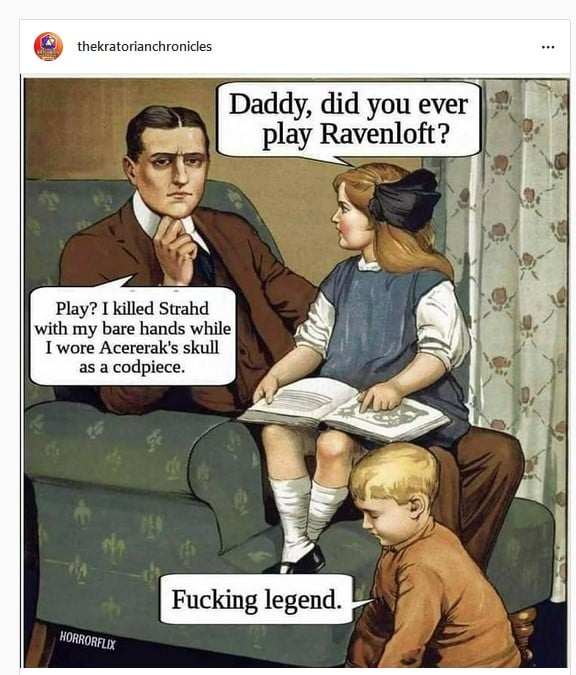
Having worked in intellectual property law, I like to give proper credit where it’s due. I found this meme and was looking for an excuse to use it.
As I was doing my research as to who produced this, I ran into an issue. I saw this shared on Facebook by a connection (I don’t remember whom), but they shared it from another source, so that person shouldn’t get credit. It looks like they got it from thekratorianchronicles via Instagram, but based on a signature of sorts within the image, thekratorianchronicles doesn’t seem to have created it, so they also shouldn’t get credit.
So, credit belongs to “HORRORFLIX,” but who are they? Searches via Instagram, Twitter, and Facebook yielded far too many entities for me to figure out who owned it. With no logo, Twitter handle, URL, or other unambiguous identifier as part of the signature, I can’t give proper credit despite how important I think that is.
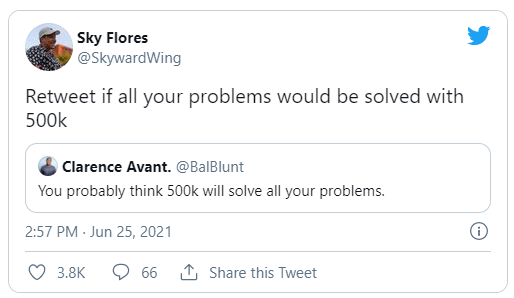
Sky’s tweet had exactly 2,100 tweets and quoted tweets as of 6:57 pm on 6/26/2021 (exactly 28 hours after posting it), and by the time you read this, I’m sure that number will go up. However, here’s the thing: The number of people who have gone bankrupt after winning a lot more than $500,000 in the lottery is staggering. Nearly one-third of U.S. lottery winners declare bankruptcy according to a study by Wolf Street. Studies show that lottery winners are more likely to declare bankruptcy within three to five years than the average American despite a much larger security blanket.
My personal view is that money can make life easy, but it can’t necessarily make life good. Would I take millions if offered? Of course I would, so I understand you wanting the money. Things are hard, and that might make them easy. But Clarence’s warning seems sound. Discarding the warning so easily is bad not only in theory, but in practice. The data shows that.
If you’re looking for a free ride, you have problems that handouts won’t solve.
By now, most of you nerds must be aware of the newest incarnation of TSR (“newer TSR”). They exist despite the fact that the new TSR (ummmm, “new TSR”) hasn’t died yet. Among other well-known gaming people, Ernie Gygax serves as Executive Vice President. The idea behind the newer TSR is to recapture the magic (get it?!) of the old days of the original TSR and Advanced Dungeons & Dragons. Unfortunately, Ernie casted Dispel Magic in an interview that ruffled a lot of feathers. I’m not commenting on that. As I’ve said, this is a not a blog for political issues, matters of human rights, or nuclear war. That’s way too heavy for this blog. Besides, do you really need yet another voice in this massive choir of commenters? No, so instead I’m going to discuss an aspect of IP law that’s probably relevant to the case and many of you may not know.
Disclaimer
Okay, you knew this was coming, but it’s especially important here. This is not legal advice. All I’m doing is stating the law in the abstract. If someone, including either or the two TSRs, thinks it applies to their facts, then they can hire an attorney to get legal advice. But isn’t stating the law legal advice? No, it’s not. Anyone can state what the law is (e.g., “The speed limit is 55 mph.”). Only attorneys can apply that law to another person’s fact pattern (e.g., “The speed limit is 55 mph, you’re driving 65 mph, and therefore you’re violating the law.”). No district attorney is going to prosecute you for telling someone they’re speeding, but this is an easily digestible example to define “practice of law.” This is key here because I strongly suspect that I have only a fraction of the facts surrounding this case, so it would be impossible for me to practice law here. So I ain’t. Got it?
I’m My Own Inspiration, aka, The Tweet Heard ’round the World
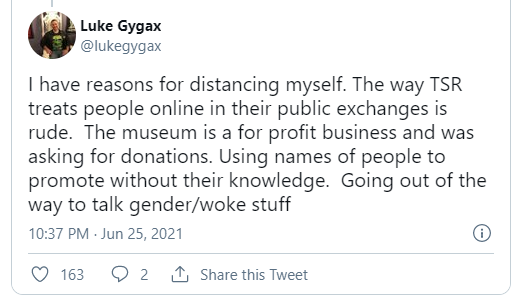
This blog post was ultimately inspired by, well, me. That is, it was inspired by my response to Luke Gygax’s tweets with which many of you are familiar. Of course I was deflecting from the actual topic to the law. It’s what I do.
I have reasons for distancing myself. The way TSR treats people online in their public exchanges is rude. The museum is a for profit business and was asking for donations. Using names of people to promote without their knowledge. Going out of the way to talk gender/woke stuff
What concerns me is that some people give up rights simply because they don't understand them or can't afford to enforce them. They may still have "senior common law" rights to "TSR." It depends on the specific facts I don't have. They really should speak to an IP attorney.
— Rob Bodine, #Attorney by Day, #Nerd by Day & Night (@GSLLC) June 26, 2021
Trademarks and the Constitution
Oh, you thought you were going to get through this without any heavy-handed legal philosophy, didn’t you? Here’s some constitutional law, suckers.
The US Constitution defines a government of limited powers. That is, unlike the states, the federal government lacks power unless 1) the US Constitution expressly says it has that power; or 2) the federal government absolutely must have that power in order to use a power that the US Constitution expressly says it has. As for number two, nowhere does the US Constitution say that the feds have the power to enter into employment contracts, yet they must have that power in order to, for example, create the IRS and hire accountants, admin assistants, janitors, etc., because otherwise the power to collect taxes would be rendered useless.
This is not a controversial statement among lawyers, though lawyers are (believe it or not) human, so many of them sometimes ignore this principle as well because . . . okay, no pontificating. The notion that the feds lack the power to act by default seems to be lost on many people, but there it is. Accept it or deny it, but it’s 100% true.
Okay, back on point, the Arts & Sciences Clause grants the federal government the power to grant patents and copyrights, but it doesn’t mention trademarks. That’s left largely to the states. (Weird, huh? When have you ever heard of state trademarks?) However, there’s a back door that gets the feds into that game. The Commerce Clause allows the feds to regulate “interstate commerce” (i.e., business transactions that cross state lines). If a vendor in Arizona sells something to a consumer in Utah, then that sale could open the door to federal regulation even if the feds don’t otherwise have the power to stick their noses into it. So, the Lanham Act provides for federal registration of trademarks with the US Patent and Trademark Office only if the owner is using their trademark in multiple jurisdictions. If you’re using the trademark in only one state, you don’t qualify for a federal trademark. However, if you do qualify for a federal trademark, it applies across the entire United States. (Well, almost, which will be my ultimate point.)
There’s a limited exception for those with an “intent to use,” but I’ve given you enough to digest.
So what happens if you don’t register your trademark federally? As long as you’re using the trademark in commerce, you develop “common law trademark rights,” but unlike the federal trademark rights, those rights apply only in the jurisdiction or region where you’ve been using the trademark.
If you’re doing business in a large state, common law trademark rights may arise only in your local region. In that case, registering your trademark with that Secretary of State for that state would grant you trademark rights across the entire state.
Seniority of Trademarks
Okay, I’m finally approaching my point. Imagine a situation where I’m using a trademark, Bodine’s Bovines, on my cow farm in Virginia. Therefore, I have trademark rights only in Virginia. Only I can use that trademark in Virginia.
This probably ends as poorly for me as it did the MacDougals.
Next, Fred Bodine (no relation) opens a couple of cow farms, one in Utah and one in Nevada, both using the same Bodine’s Bovines trademark. He registers the trademark federally based on his use across state lines, so now he has a trademark that applies across the entire United States. Finally, I decide to open a second farm in North Carolina. I try to register my trademark federally, but Fred beat me to it, so my application is denied. Also, Fred sends me a cease-and-desist letter preventing me from using Bodine’s Bovines at all. Does he have a right to do that? In North Carolina, yes, but in Virginia, no. I opened my Virginia farm first, and even though I never registered the trademark with either the feds or even the Commonwealth of Virginia, my use in Virginia was “senior” to Fred’s use (i.e., because I used it in Virginia first). However, Fred can block me from using it outside Virginia because he registered the trademark federally before I opened the North Carolina farm.
What if instead I had a federal trademark based on prior use both in Virginia and North Carolina, let it lapse, and then Fred came along and grabbed it based on his use in Utah and Nevada? I’d still have senior rights in both Virginia and North Carolina.
Take a hint, people.
So, you can think of a federal registration as having the same effect of using the trademark in every state starting at the time you registered it. Where you got there first, you get to use it, but you’re blocked where you didn’t get there first. In a more complex case, you could imagine a patchwork of multiple, identical trademarks being used by several different companies in several jurisdictions, with one of those companies having a federal trademark covering the unclaimed jurisdictions. So, the company with the federal trademark could nevertheless be blocked from using that trademark in jurisdictions with senior users. This isn’t a far-fetched scenario, but if its mere possibility surprises you, then . . . surprise!
So, what happens next? Well, when the two parties each have something the other wants, they could strike a deal. For example, each could license the other the right to use their trademark in jurisdictions in which they’d otherwise be prevented from marketing. If both parties are on relatively equal footing, the license fee may be, I don’t know, as small as $10 per year. However, if one party doesn’t realize how much of an advantage they have or lack the funds to enforce their advantage, they may make the same deal.
Sound familiar? No? Well, too bad. I’m not getting into specific cases. 🙂
Epilogue
After completing this post, I found a relevant Twitter thread.
Because @abstruce asked for it, here’s a quick runthrough of what I see are the trademark (“TM”) issues in the TSR dispute. This isn’t legal advice, just an overview of an area that I don’t specialize in. I don’t know any of the facts beyond what I read. https://t.co/kyCZEH9ApG
There’s a lot of overlap, but Orcish Law makes a few other relevant legal points and peppers in a lot more gifs. I left much of that out because I have a tendency to ramble, so I try to keep my posts as short as possible. We both included disclaimers though. It’s what we do.
If the trademark is valuable, and you can afford a lawyer, get one. Otherwise, you’ll have to either cut a bad deal or find a new trademark.










 Play What You Want