Follow me @GSLLC

Follow me @GSLLC

Recently, I came across a site providing the 20 worst Star Wars quotes to shout out during sex. Well, this is the Internet, so that means I have only one choice: plagiarize! Here, then, are the 20 worst Star Trek: The Original Series quotes (or paraphrases) to shout out during sex according to me.

Now, Star Trek and Star Wars fans have yet another reason to be competitive with one another.
Follow me @gsllc
Post script
I know, including Gaila from the latest Star Trek movie is cheating. It’s not an Original Series picture, and the fact that it’s from an alternate timeline involving the original crew is no excuse. I don’t care, and neither do you.

I’ve been revisiting the series Star Trek: Enterprise (“STE“). The episodes are available free on the Star Trek website. In light of last week’s anniversary of the first airing of Star Trek: The Original Series (“TOS“), I thought it would be appropriate to share my thoughts.
STE is a much-maligned series in the Star Trek franchise. Though I can understand why relatively new Star Trek fans didn’t like it, I never quite understood why fans of TOS didn’t. Sure there were problems with the writing; the temporal cold war was annoying and never truly resolved, and they never should have forced the Borg and Ferengi into the storylines. However, for those who’ve been with Star Trek from the beginning, we’ve seen it as a morality play first, and bells and whistles second. The futuristic setting was interesting and important. It was interesting to see where humans were going and important because it told us that somehow, despite the threat of nuclear annihilation, we were going to make it. Nevertheless, the reason we were going to make it was because of our social evolution, not our technological evolution. Greater technology, by itself, simply gives us the means to destroy ourselves. We have to rise above our instincts and insecurities to make it to the 22nd century. Story was what mattered.
So, how did we go from cross burnings to not batting an eyelash when we meet an energy-based being? We can certainly see the first part of that evolution by looking at how our real-world societies have (and haven’t) evolved since the 60s. We can also see how we’ve evolved from the Original Series to the Star Trek: The Next Generation (“TNG“) era, a time at which diversity was so extensive that we threw up our hands and surrendered to it psychologically-speaking. What’s missing is our future. By “our,” I mean those of us living in the 21st century, and those that will live in the 22nd century. What can we and our descendants expect? Star Trek: First Contact gave us a hint. First contact with the Vulcans “unit[ed] humanity in a way that no one ever thought possible, when they realize they’re not alone in the universe.” Deanna Troi, Star Trek: First Contact. That’s great, but it’s also a bit idealistic. Even if humanity no longer hated itself, could we really expect that to mean the end of bigotry instantaneously? STE answered that question, and that’s why I loved it. It told a part of the story we needed to see, both in terms of our social evolution and technical evolution. The jump from TOS to TNG wasn’t nearly as fascinating to me as the jump from right now to TOS, because that’s what will affect people I actually know, including me.
Two of the best episodes in all of Trek history were Demons and Terra Prime, a two-part series starting Peter Weller (a.k.a., Robocop) as a xenophobic human. He united black and white, male and female, gay and straight, and faithful and atheist against a common foe: Anyone who wasn’t human. It demonstrated that humans are as bigoted as their circumstances dictate. By that, I mean that whoever is most different at the time is the target of our bigotry. Sure, looking at green-blooded, pointy-earned clones of Satan, we’d probably lose focus on how we hate each other, but that focus had to go somewhere, and sure enough it did. Humans developed great resentment towards Vulcans. Of course, there wasn’t much outright hostility, but then again bigotry nowadays doesn’t often result in physical violence, but that doesn’t make the bigotry any less real. Also, humans were getting something out of their relationship with Vulcans, so that helped to mollify that resentment.
Or so my theory goes.
Still there was a story to tell there. You may agree or disagree with my point of view, and you may have preferred a different direction for Star Trek canon. That’s not what’s important. What’s important is that we’re analyzing social issues, which is what made Star Trek one of the most important series in the history of television. That analysis is the mission of the Star Trek franchise. Whatever legitimate concerns you might have for the quality of the writing, with Star Trek: Enterprise, mission accomplished.
Unless, of course, phase cannons weren’t glamorous enough for you.
Follow me on Twitter @gsllc
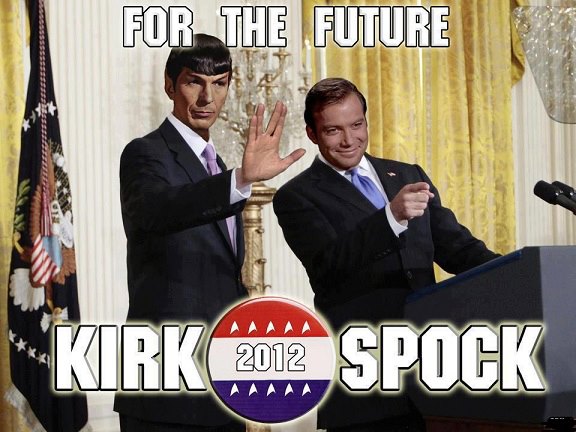
I apologize, but for the second day in a row, I’ve turned my geek-related blog into a political commentary. I can’t help it. These are two politicians I can really get behind. I refuse to stay silent when the very balance of our universe is at stake.

Follow me on Twitter @GSLLC
This is not a political blog. I have nothing to say about politics here. I provide the photo simply to give you a chuckle.
Follow me on Twitter @GSLLC
Yesterday, I received an email from Dictionary.com announcing the word of the day to be, “lodestar.” Much to my chagrin, the definition given was:
1. Something that serves as a guide or on which the attention is fixed.
2. A star that shows the way.
3. Polaris.
You see, I had actually misread the word, and I instantly thought of this instead, which is far more interesting.
Follow me on Twitter @GSLLC
The Dark Knight Rises (“TDKR”) was good, but it wasn’t very good, and certainly not great. Despite the hype around it, including claims of a possible Oscar nomination for Best Picture, it certainly wasn’t great. To give you some perspective before reading this author’s opinion, you should know a few things:
I’m going to try to minimize spoilers, but at this point, I’m guessing most people that might find their way to this blog have already seen it. For those that haven’t, if you have any capacity for deductive reasoning, you’re going to be able to deduce what I’m saying, and that’s as good as me just saying it outright. Ergo, you’re being warned:
*** SPOILER ALERT ***
Damn, for an Action Movie, It Sure Did Drag at Times
I really appreciate that filmmakers are making longer movies. We’re paying increasingly higher rates for movie tickets, so they all should feel burdened to give us our money’s worth. Instead of a 90-minute movie, the entire story should be told by adding 30-60 minutes of movie. I don’t want to fault the film for adding an extra 60 minutes, but filling in those 60 minutes with more setup material (for a subplot) is not what I had in mind. There’s enough setup required for the primary plot. I don’t need another round of it partway through the movie. Some of it is necessary, as subplots themselves are important to a film with any significant depth, and we need to understand what’s going on in the characters’ heads. TDKR took it too far, though. I kept waiting and waiting and waiting for things to get interesting again, and eventually they did, but if the extra 60 minutes is boring filler, we’re better off with a 90 minute movie after all. (Note: Not all of the 60 minutes was unimportant, so in this case, I would have cut out about 30 minutes of the movie. That’s just a guess, though. I’d have to see the movie again to be sure, so come back here after the movie hits HBO. I’m not going to see it in the theater again.)
Would you like an example of where we could have used some boring filler that would actually make the story more cohesive? Well, then . . .
The Hidden Enemy
Even with a movie where I must suspend my disbelief to enjoy it, it seems a bit much to expect me to believe that a character would spend his or her entire life becoming one of the rich and powerful in a sinister plot . . . to bring down the rich and powerful. Huh? How do you think people get rich and powerful? The lottery? Usually, no. Inheritance. Yeah, sometimes, but all of the rich were targeted simply because they did the things that are required to become rich and powerful. If you believe those things to be so unfair to the less fortunate that terrorism is justified, you’re not likely to do those things yourselves. Sure, it’s a twist that makes you say, “Oh, I didn’t see that coming,” but if you make the mistake of thinking about it for just a second, you then say, “But how? Why? That makes no sense! It’s a twist for its own sake!” Without a better explanation, you’re left expecting a sequel or prequel to explain it all, and that’s not an option.
For comic book geeks, there’s probably plenty of explanation over the decades of writing, but I (and many other filmgoers) are left hanging, struggling to justify what the movie did. It’s Nolan’s job to write the story, not mine. I don’t mind having to make some logical leaps – in fact, I like that movies require that – but this was central to the story and raises serious logical inconsistencies.
Bill Gates is not in the midst of a secret plot to take down the rich.
Casting
I heard a rumor that one of the characters introduced in this movie would be – I can’t say this without a spoiler – Batman’s successor. I went into this movie saying that if this were true, it would ruin the film for me considering the actor that’s playing that character. Well, it turned out to be true, but fortunately I was exaggerating. While the film wasn’t ruined, it certainly hurt. Ultimately, though, it was a good way to end the trilogy, and it made sense that the character was the successor. My issue is with the casting only. I know you all like him as an actor, but he isn’t suited to play that role.
Edit: The Evening Star
One of the worst movies I’ve ever seen was the Evening Star, which was the sequel to Terms of Endearment. (I had a subscription to HBO. I was already paying for it, so I figured I’d watch it. If it makes you feel any better, my life is less valuable because it’s stained with the memory of that movie.) One of many problems with that movie was that it was about tying up loose ends. The movie itself had no meaning outside the scope of its prequel, which is to say the movie itself was worthless. At times, the Dark Knight Rises fell into the same trap. Much of the movie that was dedicated to setup wasn’t even setting up the story but rather wrapping up the prior stories from the first two movies. Yes, it’s a trilogy, but it has to stand on its own. The parts that wrap up the past must do so by representing a step forward so that what’s happening now has actual value. Interestingly enough, the movie did that in one sense — ‘you must fear your own death to reach your full potential’ — but fell short enough to annoy me. I wanted the current story to be the focus, and it wasn’t.
Most Importantly, the Hype
The hype concerns me the most. I’ve never been one to raise my expectations too high going into a movie. It would seem out of character for me to be unfairly harsh on TDKR simply because people were saying it might get nominated for Best Picture. Still, it’s a possibility I have to accept, and I’m sure something many people will assume. Take all of this with a grain of salt. The bottom line is that it wasn’t a waste of the $5.00 I paid for the movie ticket. (Yeah, you read that right. I paid only $5.00.) The popcorn, however, wasn’t worth half what I paid for it, but that’s my fault.
Again, I reiterate, this was a good action movie. It could have been a great action movie. The Dark Knight was a great action movie. Inception was a great movie. Nolan has it in him. A shame he didn’t end the series on as strong as a note as I came to expect of him.
Or maybe I’m just getting old. Get off my lawn, you brats.
Follow me @GSLLC
Stories and photos from Scotland
Don't Take This Too Seriously. I Don't.
An Ennie Nominated D&D Blog & Podcast. Home of tutorials, advice, and downloads for new DM's
No rules but my own.
The Official Blog of Obsidian Portal
A site about all things bound up within me.