Good Watch: What We Do in the Shadows @Natasia1andonly @porksmith @m_proksch @HARVEYGUILLEN @DougJones @TaikaWaititi @hulu #GoodWatch #QuarantineLife

If you enjoy this post, please retweet it. Other posts in this series can be accessed by clicking here.

What We Do in the Shadows isn’t the kind of show I would have expected to like. I liked Galaxy Quest because it made fun of my favorite intellectual property, Star Trek, but I’m no into horror movies at all, so I didn’t expect this to appeal to me. However, after the first few episodes, I found it hilarious, which is unsurprising considering Taika Waititi’s warped brain is behind it. Kayvan Novak absolutely steals the show, but the entire cast has some great moments. 

WWDitS airs on Hulu, with new episodes every Thursday night. Catching up would be a snap, as each episode is less than 30 minutes long. That makes it easy to sneak in an episode whenever you have a moment. Plus, each season is only 10 episodes long, and they haven’t finished the second season yet.

As always, YMMV.

Follow me on Twitter @gsllc (please retweet!)
Follow Natasia Demetriou @Natasia1andonly
Follow Matt Berry @porksmith
Follow Mark Proksch @m_proksch
Follow Harvey Guillen @HARVEYGUILLEN
Follow Doug Jones @DougJones
Follow Taika Waititi @TaikaWaititi
Follow Netflix @hulu

Trademark and Laches: Enforcing Your Trademark #trademark #ip

If you enjoy this post, please retweet it.

Blog posts cannot substitute for legal advice. If the topics discussed in this post are relevant to a real case you have, please consult an attorney.

If trademark holders don’t maintain control over their marks, the law dictates that they’ll lose them. This results in some pretty aggressive behavior by mark holders that is often unfairly criticized by the public. The public needs to understand that businesses often can’t afford to lose that investment.

A trademark or service mark is a right to exclude competitors from using a catch phrase, logo, or other brand identifier (or one that’s confusingly similar) in connection with the competitor’s goods or services. A mark’s distinctiveness is defined by how strongly that association between the mark and the goods or services is to the average consumer. The distinctiveness of a mark can be derived from its very nature (e.g., how catchy it is), but also from its frequent and consistent use. That is, having a constant reminder of the association . Obviously, if a competitor uses that mark (or one confusingly similar), the mark will lose its distinctiveness. Because the purpose of granting the mark is not to reward the mark holder, but rather to provide the general public with a means to tell one brand from another, a mark that has no distinctiveness is useless. Accordingly, it’s well-settled that doctrine of laches applies to marks (unlike copyright). Laches commands that an unreasonable delay in enforcing one’s rights will result in a loss of those rights, so if mark holders don’t send out cease-and-desist letters and/or sue infringers, they’ll lose their investment and possibly have to start over again.

Mark holders are in a catch-22. If they pursue infringers, they’re characterized as heartless, greedy money-grabbers, but if they don’t, they could lose a lot … maybe everything. The truth is often somewhere in between those two extremes. As Mr. Vargas says, have a heart.

Follow me on Twitter @gsllc (please retweet!)

Rob Bodine is a Virginia attorney focusing his practice on real estate and intellectual property law. He’s currently Virginia counsel with Cardinal Title Group, a Virginia title insurance and settlement company. Rob is also a licensed title insurance agent in Maryland and Virginia.

90s Movies v. 80s Movies #QuarantineLife #movie

If you enjoy this post, please retweet it.

Quarantine life has me watch a ton of movies. Many are repeats, but even more are new to me. Of the latter set, quite a few are movies I never saw when they first came out, going all the way back to childhood (e.g., Taxi Driver). This past weekend, I watched Grosse Point Blank (1997) for the first time, which gave me a thought. I’ve noticed that 90s movies seem to hold up far better than 80s movies, and I’m not sure why. Is it because the filmmakers of the 90s were better at their craft, or is it because I’m more emotionally attached to the 90s? The latter makes more sense, but it could actually be both. Note: For the purposes of this post, my definition of “hold up” is I like the 80s or 90s movie even though I’ve seen it for the first time within the past 10 years. An equally interesting definition is Later generations like the movie. I’m curious as to whether any of you have had the same experiences in that regard as I did.

Is It Me?

I always try to place my bias in check, and I certainly have a bias when it comes to the 90s. Movies from a shared era follow similar themes, so a movie from a given era can often represent that era well. I don’t want to bring down the conversation, but to address this I have to point out a few things. My childhood wasn’t exactly happy, nor were my high school of college years. They were actually quite miserable, and I haven’t maintained the few, weak friendships I had from those eras. If it weren’t for Facebook, I would never have heard from them again, and that’s the extent of our relationships to this day. In fact, I have better online relationships with people I’ve never met. On the other hand, I finally had the “college experience” when I attended law school in my late 20s to early 30s. That was 1996-2000, and it was literally the best time of my life. I have close friendships with the people I met there, and whenever I drop into Chicago, my schedule is packed. This could certainly affect how I view movies from that era.

The Case Against the 80s

The best way to assess which decade holds up better is by watching movies for the first time at a much later date. I missed a ton, but I’m sure all of you missed at least a few. A good example of a cult classic that I didn’t see until after 2010 is Ferris Bueller’s Day Off. I don’t want to rain on your respective parades, but that was some stupid shit. To start, because of a scene appearing in the script that never made it to the screen, we know how Ferris financed this remarkably expensive day: He stole his parents’ bonds and cashed them in. I already hate this punk, though it wasn’t on screen, so perhaps we should ignore that one. That’s fine, because the dumbest part about the movie it its lesson. If you give it some thought, the moral of the story is “If your father claims you’re too irresponsible to drive his expensive sports car without destroying it, teach him a lesson by stealing the car, irresponsibly destroying it, and taking out a large percentage of his house along with it. That’ll show him!

Only a kid in high school could get behind that.

Seriously, that’s stupid, but I fully expect you to like it if A) you’re in high school, or B) you first saw the movie when you were in high school. This is one of many examples of 80s movies I didn’t see until my 40s or later.

Other examples: The Dark Crystal (1982), Willow (1988)

Notable exception: The Princess Bride (1987). That holds up as well as any movie in history.

The Case for the 90s

The Big Lebowski. QED.

Alright, alright; here’s a little more. I first saw that movie about 5 years ago (2015 or so). It’s one of the funniest movies I’ve ever seen, and for a comedy to be funny to a later generation (which I effectively represent) says a lot about how well it was made. Usually, the joke gets lost on future generations. Dramas aren’t immune to this effect either. Grosse Point Blank did not evoke any emotional effect (other than some of the music), but I still enjoyed it more than I do most 80s movies.

Notable exception: American Pie (1999). Even though I still find the film funny, the surveillance scene doesn’t hold up well at all, though I understood that when I first saw it. I was in law school at the time and thought, “Everyone involved should go to jail.”

Facts are facts, but there’s no escaping the emotional bonds you have to media. Sometimes facts and emotional bonds are in sync. I suspect they are here. The 90s win.

Follow me on Twitter @gsllc (please retweet!)

Good Watch: F Is for Family @billburr @netflix #GoodWatch #QuarantineLife

If you enjoy this post, please retweet it. Other posts in this series can be accessed by clicking here.

F Is for Family is the R-rated brainchild of my favorite active comedian, Bill Burr. There are currently three seasons posted on Netfilx, with the fourth set to be released on June 12, 2020. It’s a sitcom about middle-class, suburban America in the 70s.

Mr. Burr isn’t even a month younger than I, so he’s writing a story that I’ve lived as well, and thus is something to which I relate. There are other parallels to my personal life. Half of my family tree is essentially Irish and Scottish, and my nuclear family consists of an eldest son, a middle-child son (me), and a youngest daughter. For about a decade, until my younger brother came along, that was my family’s dynamic. The middle-child in the show is named Bill, leading me to believe that Mr. Burr, like me, is the middle child.

By the start of season 3, the father’s yelling seemed to get more annoying than funny. I’m not sure if  that’s because it grew old or if the scripts changed, but that’s the only thing I don’t like about this series.

I don’t know if I like this show because I related to a lot of it, but Bill Burr has a large fan base. If you’re a part of it, you may like it too.

Follow me on Twitter @gsllc (please retweet!)
Follow Bill Burr @billburr
Follow Netflix @netflix

Casey Biggs and Star Trek: Deep Space Nine @netflix @arenastage #QuarantineLife #StarTrek #DS9

If you enjoy this post, please retweet it.

My favorite movie and television property is Star Trek. I wasn’t fond of Star Trek Into Darkness but otherwise am an apologist for the property. However, Star Trek Deep Space Nine wrapped up while I was in law school, so it’s the only series for which I haven’t seen all the episodes. I’m currently remedying that situation by watching seasons 6 and 7.

There’s nothing I can say about the series that hasn’t been said before. Instead, I’ll mention a personal anecdote. I’ve been attending the theater since I was 5 years old, so over 4 decades. However, it wasn’t just any theater; it was Arena Stage. Arena is high-quality theater. I can’t tell you how many now-famous actors I’ve seen cut their teeth at Arena, as well as stop by for a visit after getting their big break.

So, when I saw that Casey Biggs had joined the cast of Deep Space Nine as Damar, I was thrilled. Mr. Biggs has a history with Arena. He was the first actor I had ever seen on TV (L.A. Law) that I first saw at Arena. My favorite two roles for him were that of Odysseus in Homer’s Odyssey and Petruchio in Taming of the Shrew. He appears to be assigned to soap opera hell but consistently gets one-shot roles on prominent TV shows.

He remains an obscure actor, but I’ve paid attention and appreciate what he’s done through these years.

Follow me on Twitter @gsllc (please retweet!)
Follow Netflix @netflix
Follow Arena Stage @arenastage

Good Watch: #Dolemite Is My Name @netflix #GoodWatch #QuarantineLife

If you enjoy this post, please retweet it. Other posts in this series can be accessed by clicking here.

Dolemite Is My Name has been on my list since it came out, but I never got around to seeing it. Enter SARS-COV-2. It’s the story of Rudy Ray Moore, who made and released his first blaxploitation film, Dolemite, in 1975. I’d never heard this story and have never seen any of the Dolemite movies. It was a good blend of funny and serious. It showed how difficult it was for Moore and others in 70s America but kept it lighthearted. At times, it was even inspirational.

I wasn’t the target demographic for blaxploitation films, but this story still appealed to me. As always, YMMV.

Follow me on Twitter @gsllc (please retweet!)
Follow Netflix @netflix

Guilty Pleasure: Star Trek: Nemesis @SirPatStew @BrentSpiner @jonathansfrakes @gates_mcfadden @Marina_Sirtis @DinaMeyer @startrekcbs #GuiltyPleasure #QuarantineLife #StarTrek

If you enjoy this post, please retweet it. Other posts in this series can be accessed by clicking here.

B-4 | Memory Alpha | Fandom
Star Trek X: The Search for Data

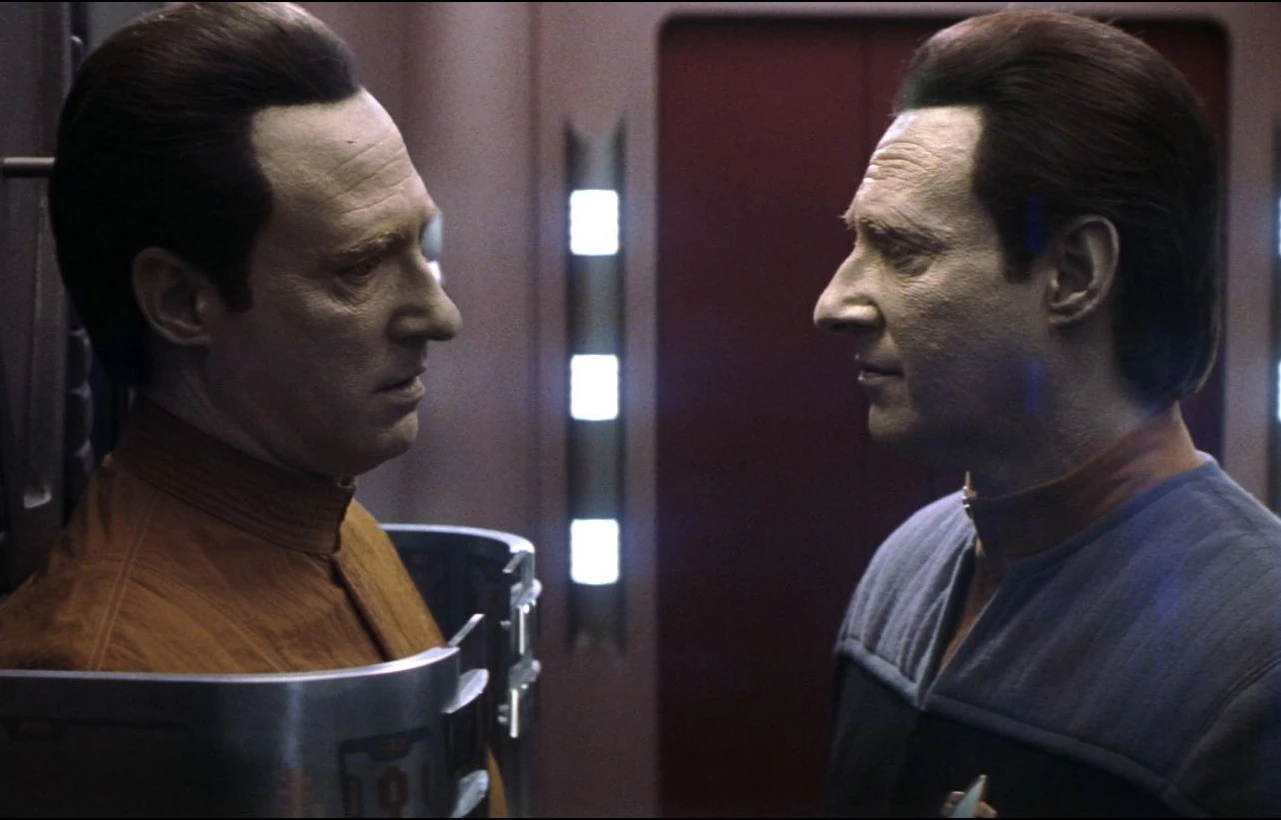
Rotten Tomatoes reports scores of 38 from the critics (who I don’t care about) and 49 from the audience, both of which are rotten scores. Nemesis is certainly a guilty pleasure, and I get that. Troi porn, a childish android, and the worst toast in the history of weddings are just a few of the examples of why this movie earned such low scores, but it had some good points. Moral philosophy is the foundation upon which Star Trek was built, and at its heart, it was an examination of the nature v. nurture debate. Nevertheless, it didn’t skimp on the action.

The goal of the movie was to recapture the magic of Star Trek II: The Wrath of Khan by giving Picard a fitting nemesis, just as Wrath of Khan gave Kirk his, and by having Picard suffer a loss as did Kirk. Nemesis is no Wrath of Khan, and Shinzon is no Khan, but SPOILER ALERT being Picard’s clone inherently made Shinzon a good match for Picard, and Shinzon’s lifetime of pain resulted in a rage mimicking that of Khan. Data’s death also mimicked Spock’s. I didn’t find this to be lazy plagiarism as it’s sometimes been labeled. There are only seven stories, and this story used the themes that have been proven to appeal to Star Trek fans (and non-fans).

The movie also set up the Picard series in a couple of ways. It set the foundation for Picard’s connection to the Romulans, and Picard resolved Data’s story without cheapening his death in Nemesis.

Sprinkle in the fact that I’m a Star Trek apologist, and I like this movie. You don’t have to.

Follow me on Twitter @gsllc (please retweet!)
Follow Patrick Stewart @SirPatStew
Follow Brent Spiner @BrentSpiner
Follow Jonathan Frakes @jonathansfrakes
Follow Gates McFadden @gates_mcfadden
Follow Marina Sirtis @Marina_Sirtis
Follow Dina Meyer @DinaMeyer 
Follow Star Trek on CBS All Access @startrekcbs 

Good Watch: #Limitless

If you enjoy this post, please retweet it. Other posts in this series can be accessed by clicking here.

Limitless was released in 2011. I was mildly intrigued but apparently not enough to actually watch it. Flash forward to last week, and I read an article referring to it as the best movie you need to watch before it leaves Netflix on May 15. Unfortunately, I have a backlog of blog posts, so by the time you’re reading this, nothing I say will matter.

Okay, that’s a bit dramatic. I’m sure you can stream it somewhere, or at least rent it on YouTube, etc.

Like the movie Lucy, it operates off of the ridiculous premise that we use “only 20% of our brains.” That’s annoying. Otherwise, as the article said (paraphrased, because it’s been lost to the interwebs), the basic premise is a really good hook. Cooper plays an underachieving writer living a lowly life. He’s given a drug that <sigh> allows him to access his entire brain, which completely changes his life. Of course, the first thing he does is get laid (his landlord’s wife), and then he turns $12,000 into $2,000,000. This is what everyone wants, right? Be careful what you wish for. It wouldn’t be drama if things didn’t go to shit by act two (at the latest).

It’s an interesting take on addiction and obsession with a sci-fi twist. One interesting but subtle device they used were memory skips. An episode of Brain Games on National Geographic covered those. My guess is that they consulted a neuroscientist to get the details right, then took a few liberties for the sake of drama. They do that in other areas. It seems impossible for a criminal to chase someone in broad daylight on the busy streets of New York City without attracting attention from the cops, but there it is. Twice.

Despite all of these criticisms, it was reasonably enjoyable and a nice change of pace from my recent fare.

Follow me on Twitter @gsllc (please retweet!)

Guilty Pleasure (in reverse): Colossal @hulu #GuiltyPleasure #QuarantineLife #colossal

If you enjoy this post, please retweet it. Other posts in this series can be accessed by clicking here.

I find myself in the odd position of agreeing with the critics and abandoning the common folks. Over on Rotten Tomatoes, Colossal earned scores of 81 from the critics and 59 from the audience. I’m with the critics.

Anne Hathaway plays a self-destructive woman who winds up in her hometown because she has nowhere else to go. She meets up with a childhood friend played by Jason Sudekis. Long story short, she discovers that she has a connection with a giant monster attacking Seoul, South Korea. However, this isn’t a story about a monster . . . except that it is. People can be as bad as any kaiju. The movie took a hard turn for the “holy crap!“, taking me completely off guard.

I thought it was clever and liked both Anne Hathaway and Jason Sudekis, neither of whom I usually like.

Follow me on Twitter @gsllc (please retweet!)
Follow Hulu @hulu 

Good Watch: Oliver & Company @billyjoel @disneyplus #GoodWatch #QuarantineLife

If you enjoy this post, please retweet it. Other posts in this series can be accessed by clicking here.

In February of 1988, I babysat for my brother’s birthday party. About 15 10-year-olds and only two adults. 🙂 We saw this animated movie as part of the party. It’s definitely a kids movie, and didn’t appeal to me even then (I was 19), but I was curious how well I remembered it. Besides, it’s only 75 minutes long, and I still listen to the theme song, “Why Should I Worry?” by Billy Joel to this day.

I looked up the cast and saw that Roscoe Lee Brown voiced Francis, which sent me down a rabbit hole. As soon as I saw his image, it lead me to this vague memory from childhood: Doctor Scorpion (1978). I can’t find any details on the plot but would love to stream it if I can find it. I’m certain it didn’t hold up well.

Oliver and Company streams on Disney+. If you have young kids, it’s probably a good watch.

Follow me on Twitter @gsllc (please retweet!)
Follow BillyJoel @billyjoel
Follow Disney+ @disneyplus