Grids and Operational Spacing #RPG #TTPRG #DnD #4e

If you enjoy this post, please retweet it. 

In 4th Edition D&D, the sizes used for creatures were Tiny, Diminutive, Small, Medium, Large, Huge, Gargantuan, and Colossal. I know that wasn’t for everyone, but I liked that. A lot. I liked that level of distinction and didn’t find it confusing or hard to memorize. In fact, in the game system Vic and I are developing, we added “Vast,” which is obviously larger than Colossal. Each of these sizes has corresponding space they take on the battle map. 

Tiny 1/8 square**
Diminutive 1/4 square
Small/Medium 1 square
Large 4 squares (2 x 2)
Huge 9 squares (3 x 3)
Gargantuan 16 squares (4 x 4)
Colossal 25 squares (5 x 5)
Vast 36 squares (6 x 6)
Medium Space (Full Table)

As I said, I liked this system a lot, but I’ve toyed with a new terminology that requires some extra abstraction. Also, to be mathematically consistent, the top row (Tiny), should be 1/9 square, but I’m probably the only person who cares about that. Besides, that’s about to be adjusted.

Note #1: I wrote a long post justifying my position with a lot of math. It referenced exponential progression and irrational numbers. I trashed all of that in favor of just giving you my conclusion.

Note: This post isn’t intending to solve a problem. It’s just introducing terminology that expresses what most people already do intuitively, but tweaks that a tiny bit.

This should be an easy exercise for you. Imagine an encounter consisting not of a bunch of medium sized creatures fighting each other but rather of platoons of troops in a mass combat, or perhaps jet fighters in a dogfight, or starships flying at incredible speeds. Despite covering very different ground within game, the dining room table and battle map are the same size. Ergo, a 1-inch square adjusts its meaning depending on the size of the combatants and/or the distances they cover.

The terminology I use to reflect this adjustment is “n-space.” We generally run our games in Medium-space (because Small/Medium-space is too wordy), which means “one square represents the area a Medium creature needs to operate,” and other size categories are represented relative to that. For an encounter involving a larger base unit, we use, for example, Large space, which looks like this.

Tiny 1/64 square = 1/26 squares 64 creatures/square
Diminutive 1/16 square = 1/24 squares 16 creatures/square
Small/Medium 1/4 square = 1/22 squares 4 creatures/square
Large 1 square = 12 squares = 1/12 squares 1 creature/square
Huge/Gargantuan 4 squares = 22 squares (2 x 2) 1 creature/4 squares
Colossal/Vast16 squares = 24 squares (4 x 4) 1 creature/16 squares
Large Space (Full Table)

You’ll notice a few things. First, the 1 creature/square entry now applies to Large creatures, which is the definition of “Large space.” Second, if you reverse engineer the math, you’ll see that 16 Tiny creatures (not 8 or 9) would occupy 1 square in Medium space, because they’re now (properly in my opinion) treated as taking half the space of a Diminutive creature. Finally, you’ll see that Huge and Gargantuan objects are lumped into the same category, as are Colossal and Vast objects. Again, unless you want me to show you some exponential progressions and irrational square roots, you’ll have to take my word for it, but rest assured there are still Huge creatures, so you don’t have to throw out your Huge minis and that Colossal red dragon you paid hundreds of dollars for on eBay. Their size remains relevant in Medium space.

If we didn’t pair Huge creatures with Gargantuan ones, we’d have to say, “12 Huge creatures fit in every 7 squares in Gargantuan space,” or “1.7 Huge creatures fit in 1 square in Gargantuan space.” No one wants that.

Well, if my goal is to simplify things, I haven’t yet met it. That table is still a lot to take. Fortunately, in Large or larger spaces, we don’t need to worry about the low-end cases, and in Large space, we probably don’t have to worry about the high end case either. This is because no one cares how many pixies fit on a starship (“A bunch; that’s how many!”), and a trebuchet isn’t going to fit in a pixie’s treehouse. We also don’t need the column explaining the math. So, here are the additional, easily-digestible tables you’ll need:

Tiny1 creature/square
Diminutive1 creature/4 squares
Small/Medium 1 creature/16 squares
Tiny Space

Tiny4 creatures/square
Diminutive1 creature/square
Small/Medium 1 creature/4 squares
Diminutive space

Small/Medium 4 creatures/square
Large 1 creature/square
Huge/Gargantuan 1 creature/4 squares
Large space

Large 4 creatures/square
Huge/Gargantuan 1 creature/square
Colossal/Vast1 creature/4 squares
Gargantuan space

Large16 creatures/square
Huge/Gargantuan  4 creatures/square
Colossal/Vast1 creature/square
Vast space

They’re nearly identical tables with three entries each, but with shifted labels. Your starship minis can be the same size as your human minis. You just need a few minis representing mobs or swarms of things (which you all have in your collection), and you’re good to go. Of course, this is what we’re all doing anyway. With just the slight tweak of how Tiny creatures are represented, and grouping larger creature sizes together in spaces larger than Medium space, I’m just introducing a terminology to define it. If this were explained in an RPG sourcebook, you could provide even less justification than I’ve done here. Most people want only the rules; they don’t need the math to justify it.

One last note: I could imagine adding Enormous space and Immense space as categories to a system like Star Trek or Star Wars because Vast space would be cosmic in size. I’m not sure that’s necessary, but if such a choice were made, it could work. Those two terms have the benefit of using a different first initial, allowing each size category to be expressed as a single letter without confusion. For that reason, Cosmic space wouldn’t work. It would create an ambiguity when referenced with Colossal space.

What do you think? Is treating a 3 x 3 creature differently from a 4 x 4 creature really that important when sieging a castle? 

Follow me on Twitter @gsllc
 

Another Thing 4e D&D Got Right . . . Then Screwed Up #DnD #RPG #4e #5e #1e #ADnD #TTRPG

If you enjoy this post, please retweet it.

Last week, I discussed spell components. The conversations I had across Facebook and MeWe led me to a follow up post, and then down a rabbit hole to today’s topic.

4th Edition D&D (“4e“) didn’t track spell components for powers, and rituals had a set cost that didn’t even list the material components. Material spell components were abstracted, so a ritual caster could remove a specified number of gold pieces from the character sheet and assume the material components were available. Based on my linked posts, you’d think I’d have a problem with this, but I didn’t. In 4e, there were no go-to spells or rituals. Everything was balanced so that players chose their suites of powers based on the type of characters they wanted to play. Tracking material spell components (or casting times as in 1st Edition D&D) was unnecessary; characters were already greatly diverse. That kind of variety made for far more interesting combats, even if most of table were playing the same classes. In 4e, there was no place for the question, “What classes are you guys playing?” It didn’t matter. You could play what you wanted without affecting the game because everyone was different even if they were the same. As someone who played a ton of 4e, I never understood the claim that all classes played the same. Even within classes, they played differently.

Rituals weren’t used very often in my experience, but I think that was the result of adventure writing rather than an inadequacy of the ritual system. In fact, I wrote a Dungeon Crawl system for 4e, and on the now-defunct loremaster.org added a post on how to convert rituals to spells (or “near-spells”). Here’s a PDF that was the basis of that post. It’s not the final draft, so it may have some rough edges.

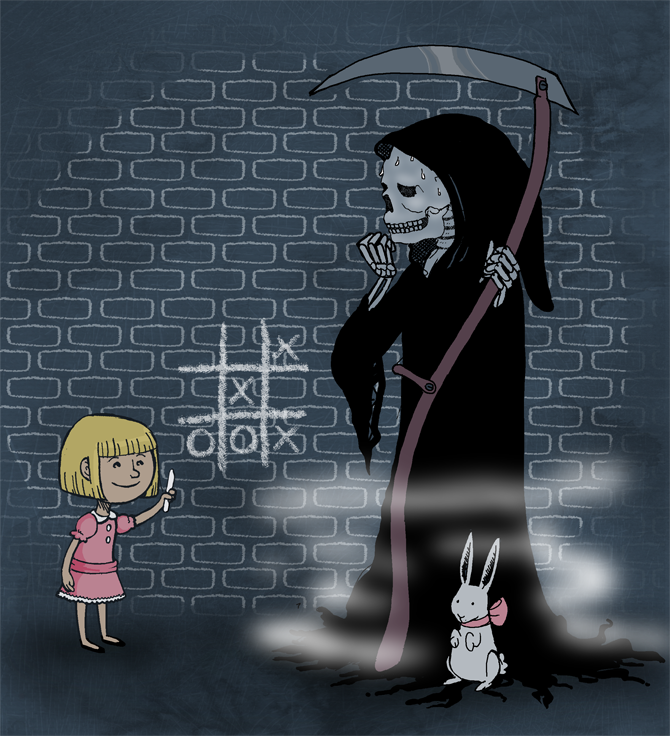
Nothing Is Certain Except Death and Taxes

As good as that was, 4e screwed up in a different but analogous way. When it came to feats, almost every class had go-to feats. In fact, there were feats that were go-to for most classes. This was known as a “feat tax.” Durable, Implement Expertise, Improved Initiative, Toughness, Weapon Expertise, and Weapon Focus immediately come to mind. This wasn’t nearly as large a sin of game design — other players generally don’t notice which feats a player has chosen — but for what it’s worth, 5e does a much better job with feats. I have trouble selecting 5e feats because a large number of them are valuable no matter what class I’m playing, so I know I’m going to make different choices than other players.

Modern games seem to have defeated the death part.

As I said in the prior posts, game designers need to pay better attention to whether their systems lead a majority of players to make the same choices. 4e proved that you can design a game of diverse characters in such a way that it doesn’t devolve into an exercise in accounting, and simultaneously broke that rule.

4e is still better than 5e. 🙂

Follow me on Twitter at @gsllc

Dungeons & Dragons is a trademark of Wizards of the Coast, LLC, who neither contributed to nor endorsed the contents of this post. (Okay, jackasses?)

Even More Gems Dug up While Unpacking @Luddite_Vic @Erik_Nowak @atomicovermind @Digitalculture0 #DnD #RPG #4e #1e #ADnD #TTRPG #StarWars #Rokugan #FateRPG #LFR #DARPG #WotC

If you enjoy this post, please retweet it.

A couple of days ago, I posted about some things I found while continuing to unpack. One thing I found deserves its own post: the program for our first synDCon gaming convention (2010). When we decided we were going to put on a convention, we had a meeting of at least 20 people at the Cracker Barrel in Chantilly, Virginia. This took place after one of our Living Forgotten Realms game days at the now defunct Game Parlor. Only seven people decided to come on board as owners, with two quickly moving to Arizona before we could even get started, and then two others flaking out. It was basically Vic, Cassandra, and I doing everything.

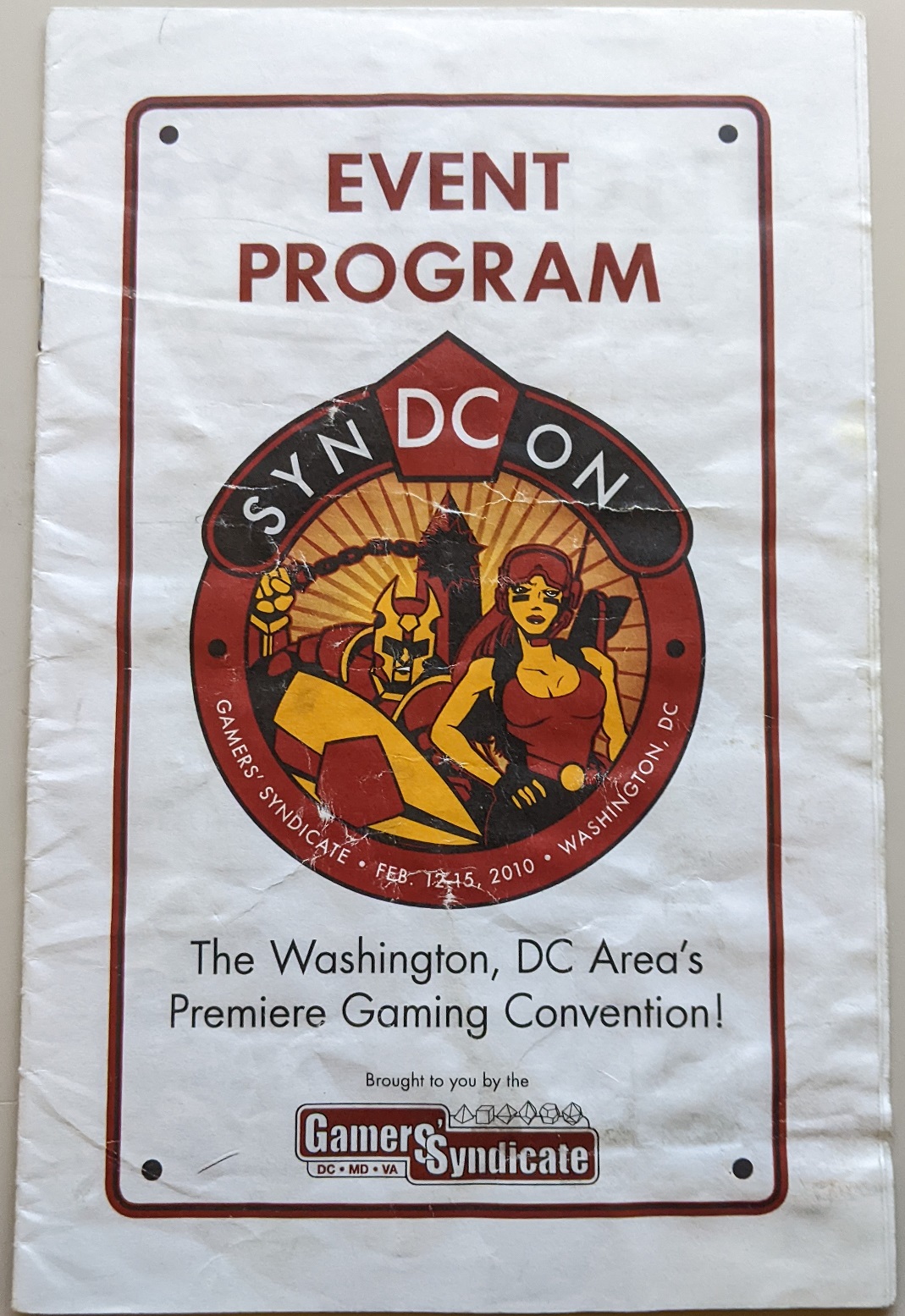
Front Cover

The cover art and Gamers’ Syndicate logo were both designed and illustrated by Erik_Nowak, and he also designed this program.

Welcome Statement

I remember a meeting when there were just five of us. We had to decide who would be the number one person: the Convention Coordinator. I didn’t volunteer because I didn’t want to be too pushy, but no one else wanted to do it. This was typically unnecessary nerd angst on all our parts, because in the end it didn’t matter. Everyone had to work hard (until they flaked out), and no one was really the boss among us.

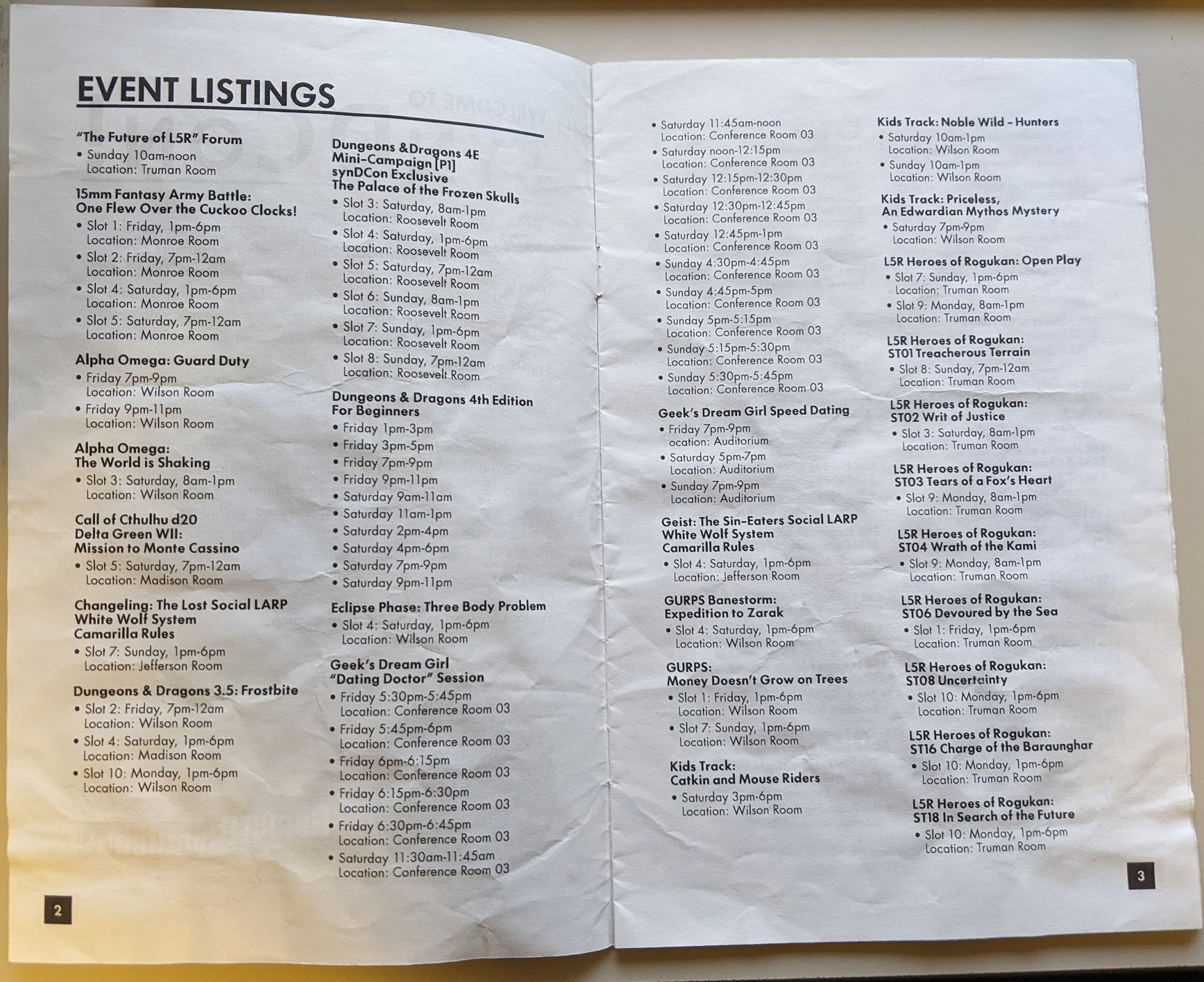
Pages 2 and 3

I’m proud of two things. First, look at that first page, and continue to examine the ones that follow. Even when we had seven planned owners, everyone was almost exclusively a 4th Edition D&D player. Nevertheless, our relatively small convention had a ton of variety in what was run. There were card games, board games, RPGs, and miniature war games. Within the RPGs, we had a ton of variety as well, and there were games run specifically for beginners. We also had a “synDCon special,” which was written by Erik and D. Hunter Phillips.

Pages 4 and 5

The second thing of which I’m proud was my idea (<patting myself on the back>). We had staggered slots. Instead of the typical 8am-12pm, 1pm-5pm, 7pm-11pm schedule for RPG games, we added in slots at 10am-2pm and 3pm-7pm as well. Again, for a small con, the fact that this worked out so well was remarkable. Many people took advantage of the opportunity to sleep in, try our Dungeon Delves for a couple of hours, sit in on a seminar or author book reading, or try new systems at the beginners’ tables. Another great idea of mine was to allow only 5 seats per game in presale despite tables seating 6 players. This made it far easier to sit players that didn’t preregister or wanted to change tables. No one had a problem with it, but a lot of people appreciated the flexibility.

Venue Map

This was a nice hotel, and it was conveniently located near a Metro stop (our public rail transportation system). And being who I am, I especially wanted a site in Maryland so that we could register for a federal trademark if it ever came to that. 🙂

Pages 8 and 9

Okay, yes, we definitely emphasized Living Forgotten Realms, but I’m still happy with how much Heroes and Rokugan and Pathfinder Society we had (these are living campaigns for the RPGs Legend of the Five Rings and Pathfinder respectively).

Pages 10 and 11

Note well, though, that there was more going on than the program states. We had a board game room, and open play for both card games and miniature war games. Saturday night, my cousin and I, a.k.a., Wet Paint, performed for a crowd of beer-drinking gamers some hits of the 80s and 90s. That’s when we played together, so our song set came from those decades.

Only Mike and I are Wet Paint. Matt James was an interloper. He’s considered a member of “Trail Mix,” which is anyone that’s ever played with us.

Seriously, for a small, first-time convention, look at how much variety we had. I loved it, and I never saw it with conventions this small. We also had seminars featuring authors and game designers. Being in the DC area, we actually knew a lot of those people, so it was relatively easy to get them here. This, in turn, allowed us to do this . . . .

Pages 12 and 13

We received a small amount of support from most of these companies, and others were actually present. Our prize for the first person to buy a convention badge was a ticket to GenCon. GenCon gave those away to conventions all the time; no inside track was necessary. However, we also had, for example, a member of Green Ronin participate in a seminar and run the (then-new) Dragon Age RPG, and Rob Hobart (AEG), the head of Heroes of Rokugan, ran a seminar and (I think) a few games.

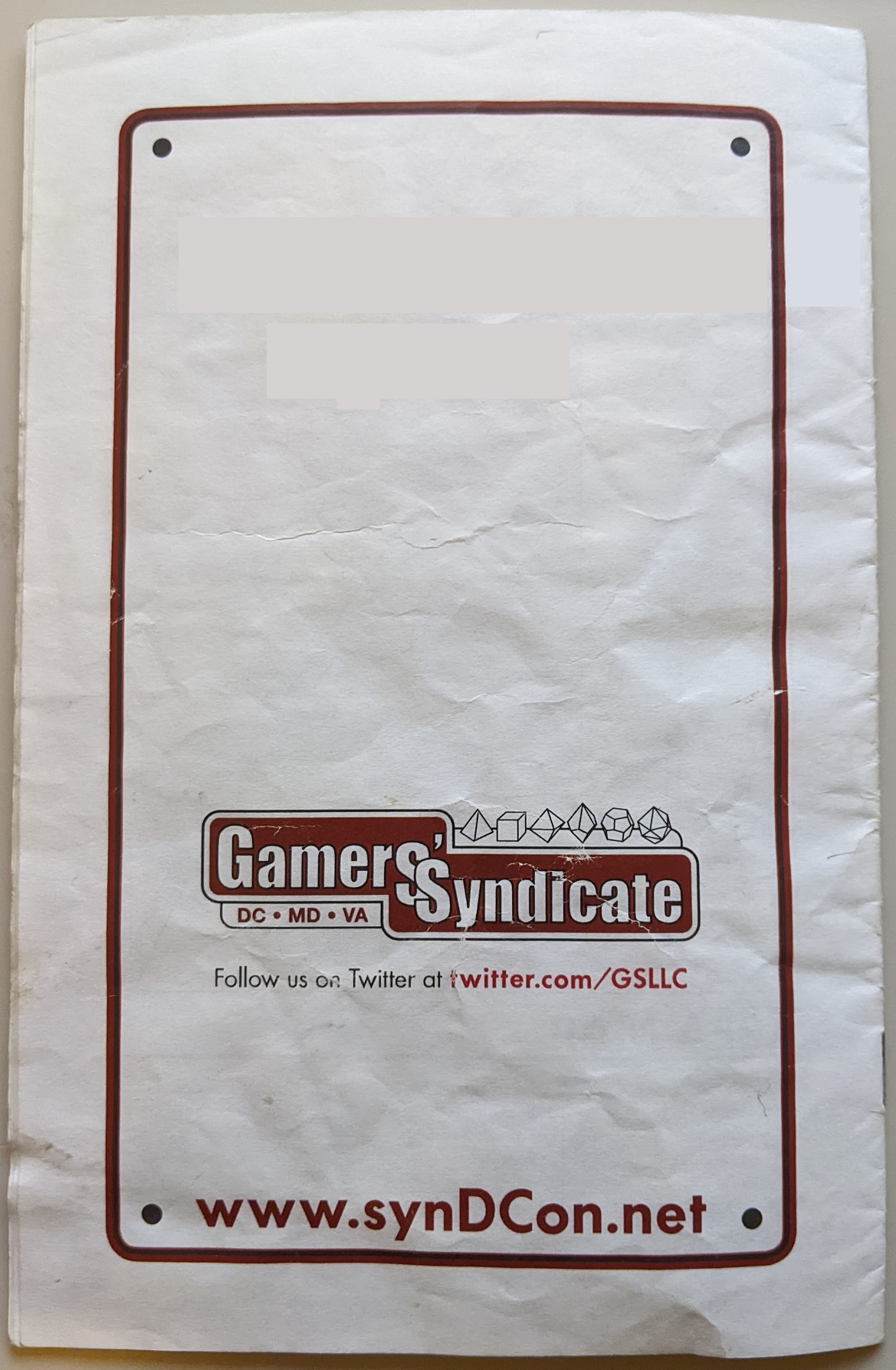
I touched up this image of the back cover to delete some handwriting. Pay no attention to the fields of ecru.

We chose a great venue, and synDCon 2010 was a four-day convention. Yep, four days. Just like the big guys. Monday was a holiday, and adding that day to the schedule didn’t increase our costs noticeably. Of course, by cost I mean financial cost. My feet were sore (which is why I was sitting for the Wet Paint performance), and I ran, at best, on four hours of sleep a night, with only two on performance night. I’d say it was a success considering that we got hit with a snowstorm right before the convention, scaring off a lot of people.

The following year, we moved synDCon 2011 to mid-April to make sure we’d have better weather, but we had late snow that year. It wasn’t as bad as the previous year, but it still affected attendance. Infuriating. However, synDCon 2011 was an official convention within the circuit of competitive Munchkin published by Steve Jackson Games. In fact, we may have done that for synDCon 2010. I really don’t remember at this point. I just know we had a great time both years. Unfortunately, it’s too hard a thing to run with, for all practical purposes, two people running the entire show and Mother Nature chasing us around with snowstorms. This isn’t to say that there weren’t a lot of other people that did a lot of work. We had a lot of help, with a few people being organizers for Living Forgotten Realms, Pathfinder Society, and Heroes of Rokugan, and we still had decent numbers. However, in the end it falls on the organizers, and there were only two of us. Both Vic and I would rather not have a convention than do one half-assed, so we didn’t have a third one.

Would I like to bring it back? Yes. Do we have the financial means to do so? Probably. Do I see enough people getting on board to make the workload manageable? No. There are very few people I could trust to see it through, and I’m not getting any younger.

I’m proud of what we did.

Follow me on Twitter at @gsllc
Follow Vic @luddite_vic
Follow Erik @Erik_Nowak
Follow Hal @atomicovermind
Follow D. Hunter Phillips @Digitalculture0

Dungeons & Dragons is a trademark of Wizards of the Coast, LLC, who neither contributed to nor endorsed the contents of this post. (Okay, jackasses?)

More Gems Dug up While Unpacking @slyflourish @alphastream @aquelajames @loganbonner @shawnmerwin @scottfgray @erikscottdebie @ChrisSSims @TheTownshend @AntarianRanger @mcleankendree @jacobsontyler @erbelisle @Alex_Aparin #DnD #RPG #4e #5e #TTRPG #WotC

If you enjoy this post, please retweet it.

Going forward, Sundays are lazy for me. I either post something silly or other people’s work. Usually both. Today, it’s a bit less lazy of a post, but it references other people’s work, so it qualifies.

I put together another bookshelf, and in doing so started unpacking some more books. I found some gems in there. I used to run a gaming club in the Washington, DC area, and as a result, I was given a lot of WotC material for our game days, much of which was never taken out of its shrink wrap. I also have tons of duplicates. This is what I’ve discovered.

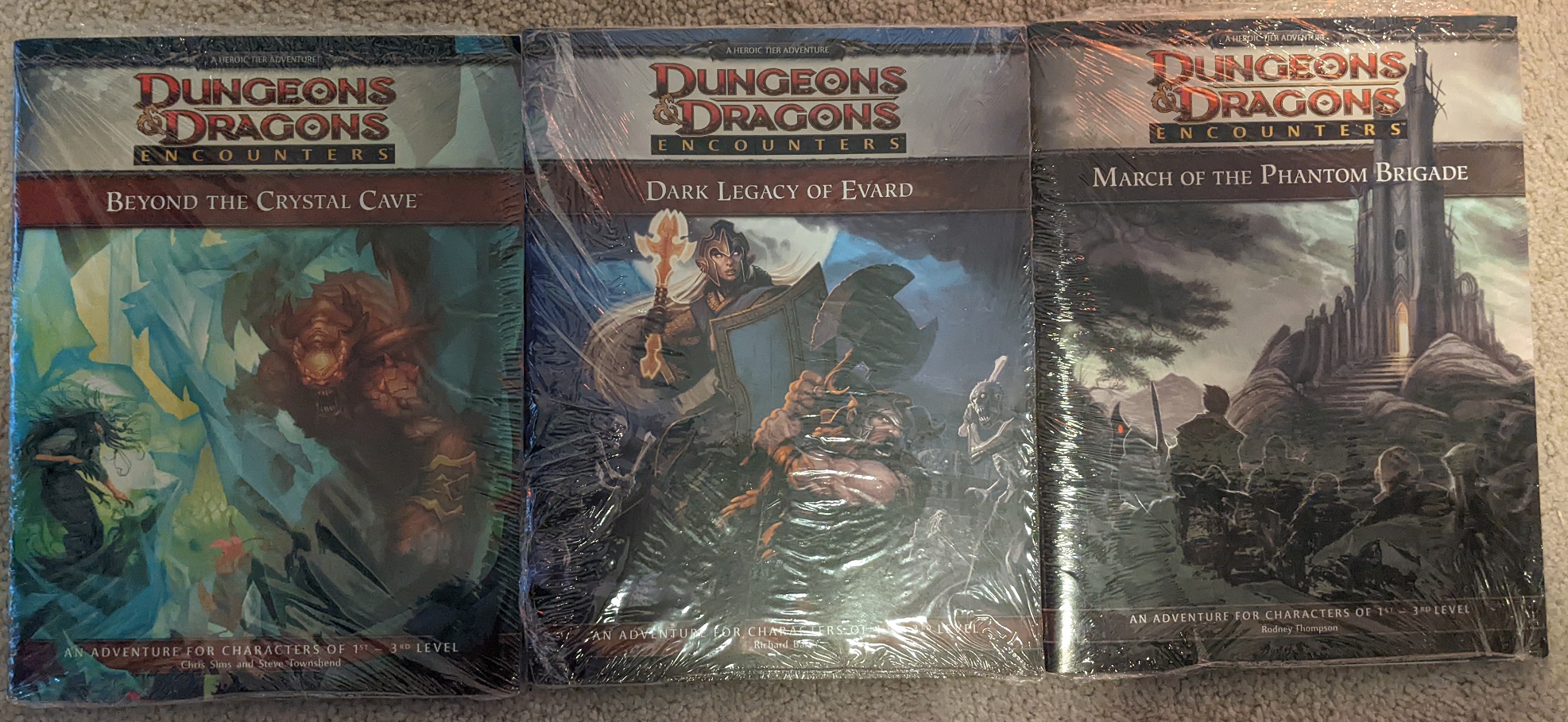
First up is material from some great writers, only one of which hates me. (Don’t hold it against him; I’m a tough pill to swallow.) Art credit to Ralph Horsley and Eric Belisle.

The latter has some supplemental material.

Major NPC cards with backstory and roleplaying information on the back.

Trigger warning: Is anyone else’s OCD going off right now? Art credit to Craig Spearing.

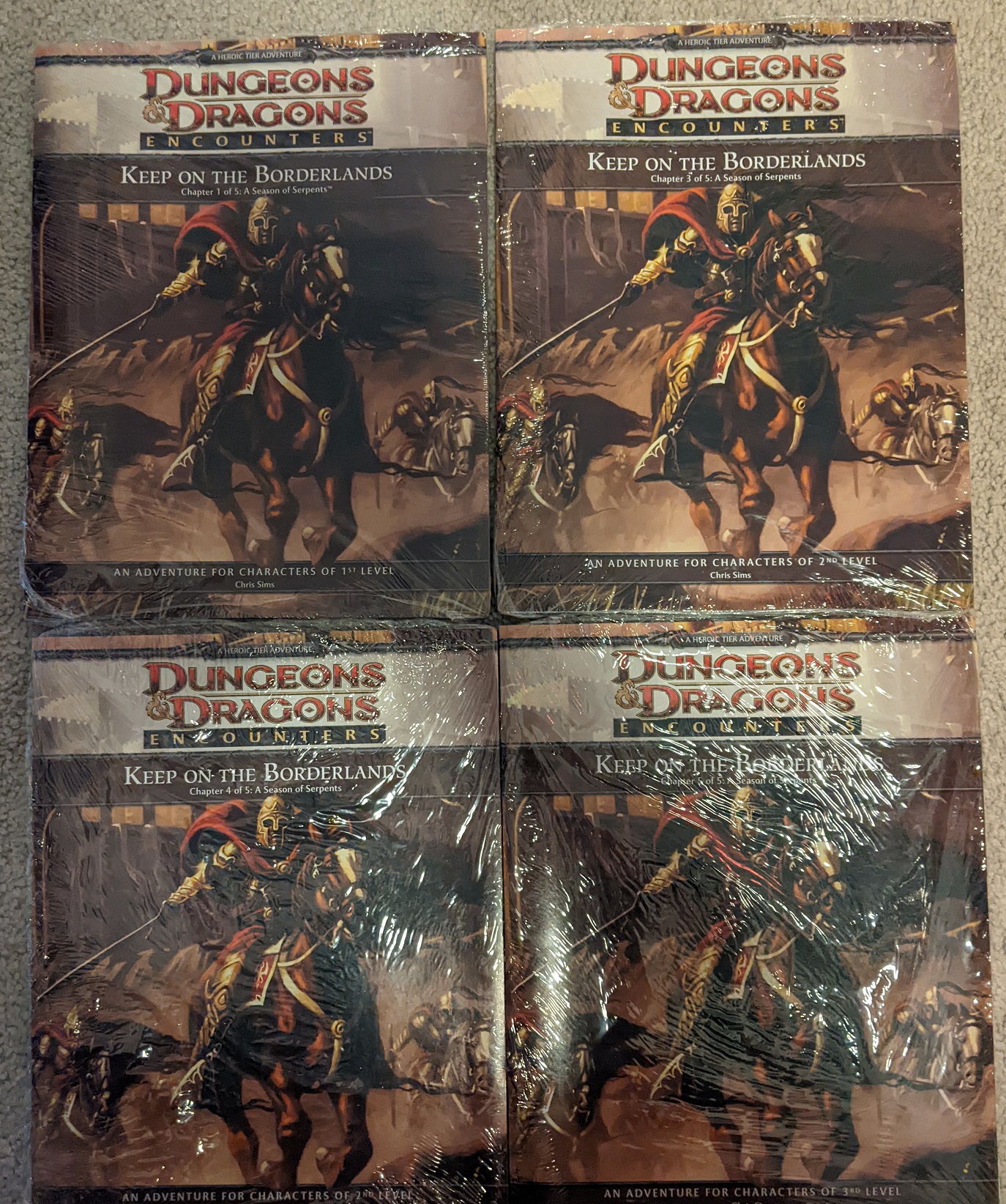
Where’s Chapter 2?!?!

These were something of a mistake for WotC, as I discussed with a WotC employee at GenCon who shall remain nameless. They were far too brutal for D&D Encounters, which was a program designed to introduce new players to the game. Some of us like brutal adventures and campaigns. In this century, we are clearly the minority. Art credit to William O’Connor.

Somewhere in Portland, Oregon, someone is squealing (you know who you are).

Oddly enough, I never played or ran either one of these, yet the shrink wrap has been removed from them. I’m guessing the DMs gave them back to me, but that doesn’t make a lot of sense. I allowed them to keep them because I had so many. Art credit to Eric Belisle and Alexey Aparin.

One of these authors has no idea what he’s doing (you know who you are).

For these, art credit goes to Alexey Aparin, Eric Belisle, and William O’Connor.

I don’t recall playing or running any of these either. I had a lot of helpers.

Okay, Logan. We get it. You like Drow. Art credit to Tyler Jacobson and McLean Kendree.

Or maybe Logan doesn’t. It’s just a job.

As I’ve said, I have unfinished business with 4th Edition D&D (and 3rd Edition and more 3rd Edition).

Follow me on Twitter at @gsllc
Follow Mike @slyflourish
Follow Teos @alphastream
Follow James @aquelajames
Follow Logan @loganbonner
Follow Shawn @shawnmerwin
Follow Scott @scottfgray
Follow Erik @erikscottdebie
Follow Chris @ChrisSSims
Follow Steve @TheTownshend
Follow Rodney @AntarianRanger
Follow McLean @mcleankendree
Follow Tyler @jacobsontyler
Follow Eric @erbelisle
Follow Alexey @Alex_Aparin
Follow Craig @craig_spearing

Dungeons & Dragons is a trademark of Wizards of the Coast, LLC, who neither contributed to nor endorsed the contents of this post. (Okay, jackasses?)

A Follow up on Spell Components #DnD #RPG #4e #1e #5e #ADnD #TTRPG

If you enjoy this post, please retweet it.

Yesterday, I discussed spell components. The conversations I had across Facebook and MeWe encouraged me to provide a quick epilogue to the spell components post.

The point I was making applies to games yet to be designed, not to current editions, and the argument is a rather trivial one: The more valuable a thing is, the higher it’s cost should be. We can all get behind that notion, right?

A problem I have with 5th Edition D&D (“5e“), and I think most editions, is that there are a list of go-to spells (or class abilities) that everyone feels they have to take, limiting the diversity of builds at the table. I have no intention of trying to “fix” existing editions to balance material spell component cost and availability with the power of spells. It turns out that for 5e (the subject of that post), that would be a lot of work. Here’s a sample of those spells (and their spell components) that I’ve mathematically proven to be preferred by WotC themselves in creating NPCs, and I suspect players favor as well.

  • Feather Fall: a piece of down or small feather.
  • Fireball: bit of guano and sulfur.
  • Fly: a feather from a bird’s wing.
  • Hold Person: a small straight piece of iron.
  • Invisibility: an eyelash encased in gum arabic.
  • Lightning Bolt: a bit of fur and a rod of amber/crystal/glass.

As you can see, all of these spells have cheap material components that are easily obtained without the DM creating an illogical scarcity. Some popular spells (Counterspell, Dimension Door, and Misty Step) don’t even require material components. So, in 5e, even if you “enforced” components, it wouldn’t change a damn thing. That, to me, is a design flaw, and one I don’t have the desire to fix. However, where there’s a high cost for a spell (e.g., Heroes Feast), I’m going to enforce it.

That said, increasing the cost or scarcity of material components is just one way to increase the cost of spells. In 1st Edition D&D (“1e“), spell cost was assessed using casting times. Combat consisted of 1-minute rounds divided into 6-second segments (i.e., 10 segments per round). Initiative determined the segment in which a character was able to act (with some caveats not relevant here). Because spells had casting times measured in segments, a caster would start casting a spell in one segment, but the casting wouldn’t complete until a later segment. If a caster took a single point of damage during this time, the spell would fail, and the caster would lose the spell slot. Therefore, casters had a choice to make: either cast a weaker spell quickly, assuring it would be of (limited) value, or cast a more powerful spell accepting the risk that it could wind up to be worthless.

In other words, 1e used casting times to increase the cost of spells, and it appears to have done so quite well. Of course, without dividing your rounds into segments, casting times may not be a viable solution.

The moral of this story is that game designers really need to pay better attention to whether their systems lead a majority of players to make the same choices. Sure, some things should be better than others, but like in the real world with food, cars, houses, and everything else, the better things should have a higher cost, regardless of how that cost is assessed. That way, different players will create widely diverse builds, and we’d (or at least I’d) see more dynamic combats.

In 5e, material spell components seem to be the intended way to do that.

Follow me on Twitter at @gsllc

Dungeons & Dragons is a trademark of Wizards of the Coast, LLC, who neither contributed to nor endorsed the contents of this post. (Okay, jackasses?)

Pick Two, but Only Two #DnD #RPG #TTRPG

If you enjoy this post, please retweet it.

No time for anything clever. Here’s something stupid.

I choose Fly and Magnificent Mansion, which would remove my transportation, food, and housing expenses.

With all that freed-up money, who’d need Charm Person to get laid?

Follow me on Twitter @gsllc

Dungeons & Dragons is a trademark of Wizards of the Coast, LLC, who neither contributed to nor endorsed the contents of this post. (Okay, jackasses?)


A Familiar (Hidden?) Trope in Horde of the Dragon Queen @DoubleDM @slyflourish #5e #DnD #RPG

If you enjoy this post, please retweet it.

A Twitter conversation last week led me down a rabbit hole.

In case DoubleDM’s tweet is deleted, it asks, “So have you had more Dungeons or Dragons in your #DnD Games?” I responded, “Dragons by far.” Another person’s reply brought up the adventure, Horde of the Dragon Queen, for 5th Edition D&D (“5e“). This had me remembering Balasar Kimbatuul, one of my favorite D&D characters, known for invoking honor duels in Sly Flourish’s home game. For those who haven’t played it, the party faces a blue dragonborn, Lennithon, at the end of the first act. One PC has to face him, and there’s no chance the PC will win, even rolling all crits. It’s just impossible. At some point in the next act, the PCs meet Lennithon again, but are far better suited for the challenge. Despite Balasar insisting on an honor duel, he’s able to defeat Lennithon on his own, with his fellow PCs picking off Lennithon’s allies.

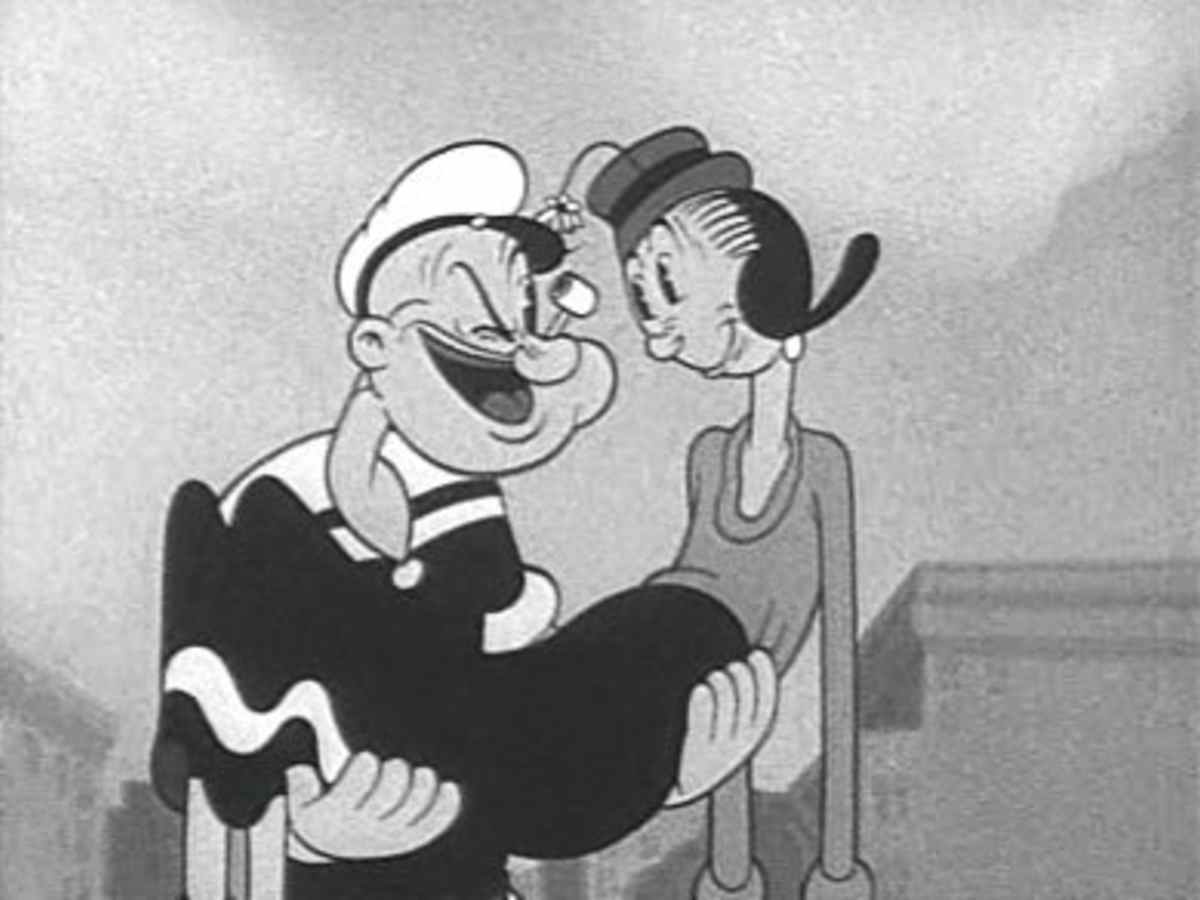
So, why bring this up? Because this segment of Horde of the Dragon Queen is essentially the plot of Popeye the Sailor Man cartoons.

Celebrating Popeye the Sailor Man With Spinach Festival in Crystal City, TX  - LetterPile
Imagine these two with scaly skin. Or not.

In many of the cartoons, and in the live-action motion picture with Robin Williams, Popeye has two fights with Bluto/Brutus. The first one, he loses, and after some story and/or character development, Popeye exacts his revenge. While Popeye relies on spinach for that final push, PCs in Horde of the Dragon Queen rely on hit point and ability increases and the acquisition of better equipment that comes with leveling up.

Of course, this is a trope, so it’s not unique to Popeye. A scene in Only the Strong immediately popped into my head in which the protagonist claims that this time he isn’t playing around. This eventually gave the viewers (all three of us, I presume) the same result in the final, cheesy battle for supreme control over high school kids.

Winning a fight always comes down to what music is playing, right? Right?

There are other, better-known examples. Nevertheless, this is the first time I drew the connection, in part because I don’t recall ever seeing that before in a TTRPG story, and in other part because of the distance between those two scenes with Lennithon. With respect to the former, I’ve had characters meet a BBEG before their final fight, and sometimes on not-so-friendly terms, but I’ve never had a direct fight with one. I find it interesting that this isn’t a more common trope in D&D. It reinforces my belief that players are far too averse to losing a fight, and adventure writers write their adventures accordingly.

It’s not railroading; it’s drama.

Follow me on Twitter @gsllc
Follow DoubleDM @DoubleDM
Follow Sly Flourish @slyflourish

Dungeons & Dragons is a trademark of Wizards of the Coast, LLC, who neither contributed to nor endorsed the contents of this post. (Okay, jackasses?)


Resets Within the System #RPG #DnD #ADnD

If you enjoy this post, please retweet it.

As I’m continuing my data entry of 1e monsters into my database, I relearned a rule I don’t ever recall from my 1e days: Magic resistance isn’t a constant. A monster’s magic resistance is calculated based on an 11th-level caster, adding/subtracting 5% for each caster level below/above 11th. For example, if a monster’s magic resistance is 50%, then a 10th-level caster has only a 45% chance of piercing it, whereas a 12th-level caster has a 55% chance of piercing it. Once again, this sent me down a rabbit hole, though a shallow one.

First, some obvious context. There are a lot of conditions or effects you can place on an enemy creature. These effects become available at various character levels throughout the game, getting progressively more problematic (interesting) as one progresses in level. If you give a low-level character too powerful of an arsenal, it makes the game boring because 1) it’s too easy at lower levels, or 2) if the monsters also get that same arsenal, you run out of effects to earn, and the game becomes the same for far too long during the adventuring life of your characters. Put another way, your 20-level system could have a sweet spot from levels 1-5, with levels 6-20 being identical. I’m sure this is obvious to everyone. Basic stuff.

Here’s where all of this took me. Going beyond 1e, other editions made it a lot easier, for example, to make saves. Save bonuses continued to go up, but certain abilities screwed with that system. For example, in 4e characters might eventually gain the ability to save at the start of their turn rather than the end. One response that undid the value of that ability was that some high-level characters couldn’t be hit by low-level characters no matter the attacker’s to hit modifier, weapon, or d20 roll. That was simply a feature of the NPC.

Magic resistance is a simple, open, uniform, and thus elegant way to implement this. It was a way of resetting the system when characters got to be a certain level. Monster’s still got saves, but a lot of high level spells didn’t grant saves. No worries. The monsters remained a challenge because they didn’t need a save. Magic resistance gave them a secondary sort of save. Another example that wasn’t developed this way, but should have been, was the hellfire created by 3.5e’s Mestopholes. It was fire that penetrated fire resistance, and it was said to worry Asmodeus greatly (see Fiendish Codex II: Tyrants of the Nine Hells). Something like that could have, again, more elegantly been used to reset the bloated system of resistances while still keeping things interesting. Granted, this would require a subtle touch, but 1e magic resistance didn’t piss off the masses, did it? The tiers of 4e (i.e., heroic, paragon, and epic corresponding to 10-level ranges) were perfect for such periodic adjustments. Unfortunately, the desire of game designers to hide their mechanics prevents such elegant mechanics, resulting in unnecessary bloat and math at the table.

Game designers should focus on their characters, campaign settings, and adventures. Mechanics should be streamlined.

Follow me on Twitter @gsllc

Dungeons & Dragons is a trademark of Wizards of the Coast, LLC, who neither contributed to nor endorsed the contents of this post. (Okay, jackasses?)

Grading Customer Support at the DMs Guild @ChrisSSims @dms_guild @DriveThruRPG #ADnD #DnD #RPG

If you enjoy this post, please retweet it.

I’ve been prattling on for weeks as to how I’m relearning 1st Edition Advanced Dungeons & Dragons (“1e”) and posting images of my recent purchases from the DMs Guild. On Tuesday (8/24), I received my last shipment for the time being: The print-on-demand reprints of the 1e Players Handbook, 1e Monster Manual, and 1e Fiend Folio. This happened.

Because people have asked about the quality of the materials (addressed in this post), I think a longer story is in order. The reprinted Fiend Folio is available only in soft cover, and that apparently allowed the cover to get caught up in the glue that binds the packaging. Moreover, the ends of the packaging were open. I’m genuinely surprised that nothing fell out during shipping, but it’s clear that the books were able to move around far too much. That movement almost certainly contributed to the damage.

Here’s the thing: The product is technically usable. The only damage is to the back cover, so while that makes it “ugly,” all the substance is there. But I don’t want ugly. I’ve already arranged to purchase an original, hard copy of the Fiend Folio from a friend. As with all my 40+ year-old original copies, that will go on the shelf not taking any further abuse. Buying the reprint is about having a clean copy for my daily use, so the starting point needs to be new/mint condition. In other words, I’m being high maintenance, and perhaps unreasonably so. However, the DMs Guild is accommodating that. They sent three emails at various stages of analysis and shipped a replacement by the next morning.

I received a response from Chris Sims.

For the record, the DMs Guild uses the same engine as Drive Thru RPG. If I log into one, I can see my purchases with the other. Accordingly, Drive Thru RPG deserves the credit as well, so it’s important to mention that here. In fact, the response to my complaint was from them.

The only open question is this: Do I have to return the damaged copy? In my complaint form, I mentioned that I’d be happy to do so if they sent a return label from FedEx, UPS, or whomever. They didn’t mention that. I may be able to keep it, but I don’t want to abuse the system. If they don’t want it back, then I’ll probably give it away to someone who doesn’t mind the damage. Spread the wealth, and all that.

DMs Guild customer service is yet another reason to buy from them.

Follow me on Twitter @gsllc
Follow Chris S. Sims @ChrisSSims
Follow the DMs Guild @dms_guild
Follow the Drive Thru RPG @DriveThruRPG

Dungeons & Dragons is a trademark of Wizards of the Coast, LLC, who neither contributed to nor endorsed the contents of this post. (Okay, jackasses?)

Musings on Game Design and Revisiting AD&D 1st Edition: Campaign Settings and Pantheons @Luddite_Vic #DnD #RPG #ADnD #MythologyMonday #MythologyMonandæg

If you enjoy this post, please retweet it.

Introduction to Each Post in This Series

On Friday (July 23, 2021), I mentioned that I was relearning AD&D 1st Edition (“1e“) with the intention of running it. As I read through the Player’s Handbook (“PHB“), certain mechanics or text will strike me as odd or surprising, but in either case worthy of discussion. In fact, the most surprising thing I’m experiencing is that I’m finding a lot more great ideas in 1e that we’ve since abandoned. I find myself asking, “Why?” As a result, I’ll be writing several posts over the next few weeks. I’m sure everything I’m thinking has been discussed before — sometimes be me — so perhaps my questions have been answered, and my concerns resolved, years ago. My experience with RPGs is relatively limited in scope, having played a small number of games, so I’m sure a lot of what I’m going to say has been incorporated into games I’ve never even heard of. (Some have certainly been addressed by future editions of D&D themselves.) Nevertheless, bringing this directed conversation to the public is new to me, so here it goes.

Posts in this series: | My Playlist | Campaign Settings and Pantheons | Languages | Level | “Dead Levels” | Division of Labor, Distance, and Time | Initiative | Combat Subsystems | Armor Class Ratings | Alignment and Reputation | The Feel of a School of Magic | Boring Magic Items | Ability Score Bonuses and Skill Rolls | The Problem with Democracies | Hitting More Frequently | Encounter Balance and Shooting Yourselves in the Feet |

As with my prior post, this post was written yesterday (7/25). That makes it the eighth post I’ve written in the series. It’s out of order because Mondays are for mythology, and writing something relevant to both topics is easy. So, here comes session 0.5.

A friend (Vic) and I are designing an RPG system. Our design sessions are months apart, so don’t expect this system to ever see the commercial light of day. It’s a fun exercise, so if nothing ever comes of it, I won’t feel I’ve wasted my time. As I was doing my homework on the campaign setting, a memory came to mind. In the original 1e Deities & Demigods, the chief god of the Egyptian pantheon was Ra. By 3rd Edition, it was Re-Horakhty (f/k/a, Horus). This switch mirrors the real-world switch of ancient Egypt. What we call the Egyptian empire lasted almost 3,000 years, and during those 30 centuries different dynasties held control. These dynasties were devoted to different temples, so as the dynasties rose and fell, so did the influence of the temples. Thus, the god seen as chief among the pantheon changed.

A Controversial Opinion?

As broad a view as that is, let’s go even broader and tie this to campaign setting design. First, I want to say that I believe campaign settings should be system agnostic, and game systems should be campaign setting agnostic. That is, if I want to run a campaign in the Forgotten Realms using Dragon Age RPG‘s AGE system, there’s no reason I can’t do it. Maybe I need to do a little tweaking to run Legend of the Five Rings using the Savage Worlds system, but if I can’t, the fault is on the system. Systems can and should be flexible enough to accommodate whatever story elements are needed. GMs, or at least the game designers themselves, could write a patch that addresses the needs of another setting. 1e is open-ended enough that you might think it was suited to this task, but I’m not certain that’s true. In any event, this opinion may or may not be well-received by game designers, but that’s not the point of this post; it’s just stated to give you context for my point.

A Long, Long Time Ago . . . .

Going back to my design efforts, I thought, “What if players wanted to play my game in a low-magic setting? That would certainly work in a more primitive campaign setting.” If we were inclined to create such a setting, why start from scratch? Why not just take the high-magic setting and make it more primitive? For example, the gods of the moon, sun, and sky would be the same god in a simplified pantheon. Not only would this save us a lot of work, but one setting would represent the natural evolution of the previous one, as that hypothetical god would be split into three different gods as mortals became more civilized and sophisticated. Oddly enough, that sounds like science, which branches out into an ever-increasing number of specialties the more we learn.

But wait! There’s more! A gold mine in a “wild west” setting could uncover archeological sites tied to the fantasy setting that came before it. The same could be said of a World War II setting where an occult-obsessed dictator could be looking for artifacts of great power. Depending on what type of game a DM wants to run, those artifacts could be nothing more than trinkets, or they could actually hold some form of supernatural or scientifically advanced power. Also consider that even in a high-fantasy setting, traveling the “astral plane” can take a character to space. The same setting could be adapted for the far future for a campaign resembling either Star Wars or Star Trek, and similar connections could be made.

What I’m saying is that all the campaign settings could exist as part of the same planet and universe in general. In a sense, it’s an ambitious plan, but in another sense, future efforts would be made easier by taking advantage of the ones that came before them. A large gaming company could easily do that, even one like WotC that’s already established. I suspect many people assume Theros, Faerun, and other planets all exist in the same universe, and the gods just have different names from planet to planet. In fact, I once read (can’t currently prove) that the Olman people from Greyhawk weren’t “like Aztecs,” but rather were Aztecs. Earth and Oerth were linked for some time by an interdimensional portal, so they were the same people. This might have been a fan theory, but clearly these connections are easy to make.

In an ideal world in which Vic or I win the lottery, maybe we’d commit to our efforts full time. If we did, this is definitely an idea I’d want to pursue.

Have any game designers connected campaign settings in this way?

Follow me on Twitter @gsllc
Follow Vic @Luddite_Vic

If you’re on Twitter, please consider voting in my two Twitter polls.


Dungeons & Dragons is a trademark of Wizards of the Coast, LLC, who neither contributed to nor endorsed the contents of this post. (Okay, jackasses?)