Twitter-Inspired Thoughts, Part III: Why 4e D&D “Failed” (Did It Really?) @newbiedm @Dm_LSP @MerricB #DnD #5e

If you enjoy this post, please retweet it.

Last Saturday, I tweeted the following.

All of those discussions were inspired by or involved NewbieDM, S Keldor lord of Castle Greyskull DMLSP (that’s a mouthful), Roving Band of Misfits, and Merric Blackman. I can say that NewbieDM and Merric are good at doing that; I’ve never interacted with S Keldor. Note that while I’ll be quoting them in these posts, much like my brain at 3 am acknowledged about me, I can’t do their arguments justice either. You’ll have to click through to see everything they’ve said. My only purpose here is to express my own opinions while providing context for their genesis and giving credit to those that inspired them. If you want to know what they think, click through and ask them to clarify.To keep my posts short, each issue will be dealt with in its own post, all with this same introduction. | Part I | Part II | Part III | Part IV |

To keep my posts short, each issue will be dealt with in its own post, all with this same introduction. | Part I | Part II | Part III | Part IV |Part V |

Part 3: Why 4th Edition Dungeons & Dragons “Failed” (Did It)?

Here’s where I pick a fight. 🙂 To make sure you stay laser focused on my point, here’s my thesis up front: 4e was not a significantly less marketable game design than 5e; it was simply a victim of circumstances beyond the control of its designers. Ergo, while you’re free to legitimately hate its mechanics, you can’t reasonably argue that it was a failure. 5e would have suffered from the same circumstances if it were released in 2008.

4th Edition D&D is my favorite edition of D&D (stay focused!), so I love the nostalgic ramblings I’m seeing on Twitter. As S Keldor noted, not everyone agrees.

Wizards of the Coast has never been in the business of losing money. As S Keldor pointed out, they kept producing material despite this supposed failure. 4th Edition didn’t fail in a meaningful sense of the word. They, and others, thought that they didn’t succeed enough; hence, the relatively quick release of 5th Edition. Maybe. Let’s dive a little deeper.

Why wasn’t 4e as successful as it could have been? Here was Merric’s answer (again, just 280 characters of it) and my response.

I love Merric’s ramblings on Twitter and respect his analysis and opinions, so I say this with a great deal of respect.

Starting first with my third point, he analogizes 4e to a movie that cost twice as much to make as it took in as a profit. Even respecting that he was exaggerating, for the analogy to stick you must presume that 4e costs more to make than 5e. To my knowledge, 5e books cost just as much to produce as 4e books (maybe more adjusting for inflation). The cost to produce the game isn’t higher. A more appropriate analogy is to two movies, one that costs $1M to make and that brought in $100M at the box office, and another that cost $1M to make and that brought in $200M at the box office. Both are successful, but one more than the other. The “failure,” therefore, is less about failing per se and more about missing an opportunity to have done even better.

Logarithmic v. Linear Thinking

Now, I’m no economist, and I don’t have access to WotC‘s sales reports, but I’m at least as good as most of you at analysis and speculation. As I stated in my third point, there are probably other factors that affect one’s interpretation of “failure.” How much better are 5e’s sales if factoring in inflation? Also, let’s consider the difference between raw numbers and percentages. If we have 10 consumers, and 5 of them buy a product, you’ve captured 50% of the consumer base. Now let’s say that by the time you produce your new product, the consumer base has jumped to 20 (not due to marketing, but because the population in general has doubled), and 7 of them buy a product. You’ve captured more consumers, and therefore are making more money with the second product, but you’ve captured only 35% of the consumer base. Anyone that’s ever rolled a d20 should know this. 😉 In other words, your new product may represent the “missed opportunity” above despite looking like it was a greater success. I doubt that’s what happened here — as Merric did, I’m using a simple equation to illustrate a point — but without proof to that effect, and not just taking WotC‘s word for it, we can’t reasonably argue from our couches as to the full context. Either way, it’s outlandish to believe that WotC didn’t make a profit off of 4e, so even merely analogizing to such an example is a bit off the mark.

Unit Cost

Let’s now assume that 5e overcomes all of that. How should I know they didn’t? Let’s say that the cost to produce their books is less than the cost to produce 4e books, which would validate Merric’s use of his analogy. Let’s also say that 5e is outselling 4e adjusting for both inflation and general population increases. This still doesn’t address several important factors. I’ll deal with the simple issue first. If it currently costs less to produce RPG books today than it did between 2008 through 2011 due to market factors, then that would have applied if 5e was produced during that span. That is, if 5e were released in 2008, its costs would have matched that higher cost of production. That can’t be said to be a failure specific to 4e’s mechanics, so 4e could still be seen as the most successful it (or 5e) could have been at the time. Remember, we’re trying to figure out if 4e’s design was a mistake. You can’t use generally applicable circumstances to justify that position.

Market Hysteria

Here’s the bigger issue representing points 1 and 2 in my post above, and it isn’t meant as a counter to anything Merric said, but rather what I’ve heard over the past 13 years on the subject. Without exception, the community always had a large subset that reacted very poorly to the announcement of a new edition, even if some of those naysayers were destined to accept the new edition once it was released. 4e was no exception. Accusations that 4e ruined the game flew by like those damned cicadas even before the game was released, meaning those accusations were based on ignorance. This, in turn, means they were really based on emotion (**see sidebar below). RPGs are expensive, and being the market leader with the most valuable trademark in the industry, WotC is clearly no exception to that rule. They can charge what they want, and consumers will pay that amount, but those consumers won’t be happy having to spend that amount of money all over again for the new edition to keep up with their fellow gamers. This sense of entitlement isn’t unique to gamers, but clearly gamers aren’t immune to it. We just call it nerd rage when applied to gamers and our kin.

** A good example of this was 1st level hit points. When 4th edition was released, one of the complaints was that 1st level characters had too many hit points, making them too durable. 3.5e, they said, had a much more reasonable number of hit points. It didn’t take long for 4e defenders to point to similar complaints about 3.5e. There were posts (lost to time) complaining that 3.5 characters had too many hit points because they didn’t have to roll for them at first level. That is, if their hit die was a d8, they didn’t roll a d8 for starting hit points, but instead just received 8 hit points. Even that was deemed too much. Why? Because those naysayers were looking for an excuse to complain, and they latched onto 1st level hit point mechanics to give credibility to their nerd rage. The more things change, the more they stay exactly the same.

The Perfect Storm

In comes Paizo, who lost the license for publishing Dragon and Dungeon magazines. However, unlike the other third parties publishing official content, they were in a position to make a move to compete seriously via Pathfinder. I don’t have access to the internal machinations of Paizo, but I (and you) personally know that they had a foothold not just in the gaming community generally, but specifically in the D&D community. Paizo took advantage of both their position and that customary anger/resentment, giving those naysayers what they wanted, even including a living campaign. People fear change, and Pathfinder gave a certain group a means to avoid it (to a large extent). Moreover, their public playtest was launched (2007) before 4e was released (2008), so by the time consumers were making their decision to invest in 4e, they knew that Pathfinder was not merely a twinkle in some nerd’s eye. This was a real game that was going to be published come Avernus or high water by a talented set of designers, and it was more familiar than what was coming from WotC. No other edition of D&D faced this combination of talent, market presence, timing, and appeal to the naysayers. None. How would 5e have fared against this perfect storm of competition? How would any game or edition have fared? These are obvious but inconvenient questions that are, unsurprisingly, ignored by the 4e haters.

Finally, I’ll remind you of what I wrote yesterday. The game has a low barrier to entry for players but high barrier entry to casual adventure designers. That’s a strength of marketing, but not of game design. That is, 5e doesn’t necessarily sell better because it’s a more enjoyable game, but because it’s built to force sales on the consumer. This isn’t at all devious or “wrong,” but I believe it’s an accurate assessment that cuts against the notion that 4e was a mistake.

WotC Did a Good Job with 4e

This is why I don’t believe WotC’s abandonment of 4e was a sign of failure. If not for those outside factors completely beyond the control of the game’s designers, the naysayers would have come back around as they always have. Because they didn’t, 5e was released sooner rather than later as an attempt to regain what WotC had lost at the hands of an intelligent, talented, and opportunistic competitor. WotC was punished for experimenting and knew that they needed to go backwards in some ways (even offering strategic mea culpas at times) to get back that share of the market. I don’t think that the following equation is perfect, but it’s probable that most of Pathfinder‘s revenue represents money that otherwise would have gone to 4e. It’s impossible to prove but also impossible to disprove; however, it makes sense based on history. When all was said and done, a significant portion of the naysayers would have come around and invested in 4e, had fun playing well-written adventures with good friends, developed a nostalgic attachment to the game (if not love), and cried just as hard when 5e was eventually announced (regardless of how they ranked 4e against other editions). The cycle would have repeated because those initial complaints are based on your financial investment in the game, not the game’s mechanics. If they were based on mechanics (which is perfectly reasonable; play what you like), you’d probably just keep playing that version and not worry about what everyone else was doing, but as history shows us, you’d have been in the minority if you left the D&D community altogether over a new edition.

So, add Pathfinder‘s sales to 4e’s sales and tell me with a straight face (and reliable, hard data) that 4e wouldn’t have been just as successful as 5e, adjusting for inflation and population. Seriously, tell me. I don’t know the numbers. I’m going off of my extensive, well-connected, but ultimately anecdotal experiences. 5e may legitimately be doing better than 4e, but I bet those speculative 4e numbers are far from “failure” numbers.

Haters Gonna Hate

All of this is to say that the factors that went into 4e’s disappointing sales numbers would have impacted 5e as well, so calling 4e a mistake is unfair until proven otherwise. This is unsurprising considering that those same 4e haters use every mention of 4e to spew vitriol on 4e and those that love it (no accusation intended towards Merric; he’s always respectful). Because Pathfinder gave 4e haters a “3.75e” D&D for a large community, and even gave them a living campaign on top of that, they didn’t have to get over their hate, so they never did. We can’t stop the vitriol, of course, but we can call it what it is: pathetic and assinine (the latter is intentionally misspelled). When they use sales numbers without proper context as a placeholder for their hate, it’s almost certainly based on ignorance or evasion of that context. Of course, no one should spew such vitriol at someone who legitimately prefers 3.5e, Pathfinder, or 5e, but that’s a relatively rare occurrence. The only people I’ve seen do that are those few playing only AD&D or 2nd Edition.

In any case, to say 4e failed, and that 5e was objectively a more marketable design, you have to prove that 5e wouldn’t have been similarly impeded if it had been presented as the 4th edition of D&D at that particular time in history, and so far I’ve seen no one even address that issue, let alone prove it to my satisfaction. I’d be interested in seeing data supporting that position.

Follow me on Twitter @gsllc
Follow Newbie DM @newbiedm
Follow S Keldor lord of Castle Greyskull DMLSP @Dm_LSP
Follow Merric Blackman @MerricB
Follow Roving Band of Misfits @bandofmisfits

Dungeons & Dragons is a trademark of Wizards of the Coast, LLC, who neither contributed to nor endorsed the contents of this post. (Okay, jackasses?)

In case the tweet is deleted, here’s an image of it.

Twitter-Inspired Thoughts, Part II: 5th Edition D&D Is Accessible. So What? @newbiedm @Dm_LSP @MerricB @Pablodnd @DarkplaneDM @LeslieGMgrrl @ChattyDM #DnD #5e

If you enjoy this post, please retweet it.

Last Saturday, I tweeted the following.

All of those discussions were inspired by or involved NewbieDM, S Keldor lord of Castle Greyskull DMLSP (that’s a mouthful), Roving Band of Misfits, and Merric Blackman. I can say that NewbieDM and Merric are good at doing that; I’ve never interacted with S Keldor. Note that while I’ll be quoting them in these posts, much like my brain at 3 am acknowledged about me, I can’t do their arguments justice either. You’ll have to click through to see everything they’ve said. My only purpose here is to express my own opinions while providing context for their genesis and giving credit to those that inspired them. If you want to know what they think, click through and ask them to clarify.

To keep my posts short, each issue will be dealt with in its own post, all with this same introduction. | Part I | Part II | Part III | Part IV |Part V |

Part #2: 5th Edition D&D Is Accessible. So What?

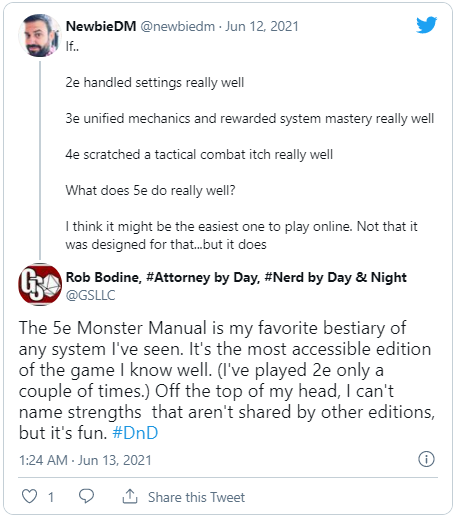
This one starts with NewbieDM.

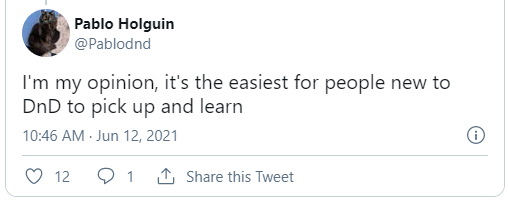
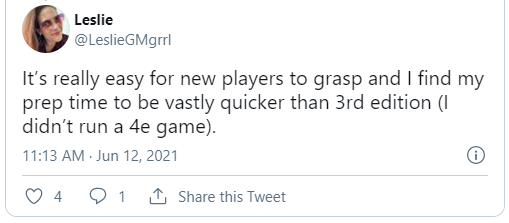
Notice my comment: 5th Edition Dungeons & Dragons is accessible. In our community, that means there’s a low bar to entry, so I was saying that picking up 5th Edition is easy for new players. I’m not alone in my view.
This is certainly going to be shorter than yesterday’s post, because that’s my entire point.

We all understand why it’s important for a game to be accessible: You can’t sell books to new or casual players if the game is too complex. People want instant (or at least quick) gratification from their games. If they’re always being run over by the hardcore gamers that study the game as if it was their full-time job, then the game’s community will inevitably consist of only hardcore gamers. Game designers need to keep that big picture in mind. However, there’s more to the big picture. They also have to appeal to their current players, giving them more to discover as they learn the game. If the game doesn’t keep giving more at a rate that satisfies players’ needs for new material, and the release schedule doesn’t compensate for that, then the success won’t last.

Also of note is that the one and only serious gripe I have about 5e is its encounter building system. You have to run your numbers through a formula to produce your encounter, then run that encounter through another formula to get it right, solving a partial differential equation along the way (not really). Even then, creatures like the Banshee make it impossible to know whether those formulas produced an encounter with the intended difficulty. As for DMs — and more to the point, adventure designers — the game really isn’t that accessible, and I lost interest in trying to build fair or accurate encounters long before other things took me away from playing RPGs. The only thing that saves 5e in this narrow regard is, as I said yesterday, the beauty of the 5e Monster Manual. So, we have a low barrier to entry for players, resulting in a huge number of players buying Player’s Handbooks, but a high barrier to entry to casual adventure designers, resulting in a huge number of DMs resorting to buying adventures. Hmmm, good marketing strategy, I guess. 🙂

So, all but one of the responses I saw to NewbieDM’s tweet mentioned accessibility, and that’s great, but only one mentioned anything else. This shared observation answers NewbieDM’s question as such: Other than accessibility, the consensus is that 5e doesn’t do anything better than any prior edition of D&D. This isn’t a fatal flaw, of course, because 5e is fun, and people are sticking with it. Perhaps a focus on accessibility is the best approach. After all, 5e is reported to be selling better than all previous editions, but that observation seems to ignore another part of the bigger picture. Could they have done even better if they had taken a different approach? Is the reason for their unprecedented success based on other factors that didn’t apply before (and may not apply in the future)? Despite the success, is there yet another lesson to learn for other game designers? Well, that’s for my next post on these Twitter thoughts and will probably be far more controversial.

More foreshadowing!

Follow me on Twitter @gsllc
Follow Newbie DM @newbiedm
Follow S Keldor lord of Castle Greyskull DMLSP @Dm_LSP
Follow Merric Blackman @MerricB
Follow Roving Band of Misfits @bandofmisfits
Follow Pablo Holguin @Pablodnd
Follow Graham Ward @DarkplaneDM
Follow Leslie @LeslieGMgrrl
Follow Philippe-Antoine Menard @ChattyDM

Dungeons & Dragons is a trademark of Wizards of the Coast, LLC, who neither contributed to nor endorsed the contents of this post. (Okay, jackasses?)

In case the tweets are deleted, here are images of them:

Twitter-Inspired Thoughts, Part I: This is Why the 5th Edition D&D Monster Manual is My Favorite RPG Bestiary @newbiedm @Dm_LSP @MerricB #DnD #5e

If you enjoy this post, please retweet it.

Last Saturday, I tweeted the following.

All of those discussions were inspired by or involved NewbieDM, S Keldor lord of Castle Greyskull DMLSP (that’s a mouthful), Roving Band of Misfits, and Merric Blackman. I can say that NewbieDM and Merric are good at doing that; I’ve never interacted with S Keldor. Note that while I’ll be quoting them in these posts, much like my brain at 3 am acknowledged about me, I can’t do their arguments justice either. You’ll have to click through to see everything they’ve said. My only purpose here is to express my own opinions while providing context for their genesis and giving credit to those that inspired them. If you want to know what they think, click through and ask them to clarify.

To keep my posts short, each issue will be dealt with in its own post, all with this same introduction. | Part I | Part II | Part III | Part IV |Part V |

Part 1: This is Why the 5th Edition D&D Monster Manual is My Favorite RPG Bestiary

The 4e and 5e Monster Manuals took opposite approaches to how they loaded them with monsters. Very generally, and something you all already know, the Dungeons & Dragons 4th edition Monster Manual (let’s just say MM going forward) sacrificed variety for detail. The 4eMM1 (get it?) was the first bestiary we had for 4e, yet it didn’t include some iconic monsters such as metallic dragons and frost giants. No frost giants?!?! Even a 4e apologist like me (stay focused!) complained. The trade off was that there was more room to discuss the ecology and history of the monsters that were included, and there were more stat blocks for each of those creatures within that group. Plus, we got humans as monsters. 😐

Bill Murray - Imgflip

5e took the opposite approach. With only a few exceptions, such as dragons, giants, and slaadi (I get a smug sense of satisfaction for knowing the proper plural form of slaad), we got no ecology or history and only one stat block per monster. This provided a lot of variety but considering how hard it is for new DMs to create monsters in 5e (compared to 4e), it was initially frustrating. On the bright side, they had room to give us the flumph. 😐

Bill Murray - Imgflip

Ironically, it would seem that WotC should have taken opposite approaches in both situations, giving us only one, easily-leveled monster for 4e, but giving us multiple monsters for 5e so that we didn’t have to figure out how to create them. But didn’t they? Foreshadowing!

Enough complaining. Considering the title of this post, there must be a happy ending. As a result of my one-stop stat blocks project, I have in my possession something that I’ll never publish: a Word document containing my treatment of all of the 5eMM stat blocks, including ones that aren’t actually in the 5eMM (i.e., variant giant lizards, diseased giant rats, cave bear, and variant insect swarms). That is, I recreated by rote every single stat block in the 5eMM and then some. That gave me some perspective that I’m not sure one can have without at least intently reading the book cover to cover relatively rapidly.

Reskinning monsters is pretty easy in 5e. Here are two examples. First, let’s look at the giants. Before my stat block project, I was arguing with a friend (let’s call him Rob #247). He didn’t like the 5eMM, and I did. He complained that all the giants were the same: weapon attack, throw a rock, and multiattack. He found it boring and uncreative. I don’t think that’s fair. First, it’s actually important that the giants are very similar. It gives a sense that the giants were related evolutionarily speaking. Granted, You have to suspend quite a bit of disbelief in order to play D&D, but when logic is successfully applied, it triggers our instincts for familiarity and order. Second, when you visit the glacial rift of the frost giant Jarl, you don’t expect to see many, if any, fire giants, stone giants, etc. Maybe you’ll see one other giant type who’s an envoy from his leader (such as the cloud giant ambassador in Steading of the Hill Giant Chief), but that’s about it. That means that you can easily adapt the stat blocks for the other giants into the ones you need, even at different CRs , without appearing to use the same stat blocks over and over. There are plenty of other creatures with similar formats (e.g., cyclopes) that can be used as any form of giant.

Let’s now consider the kraken. Maybe you want to unleash it (yeah, I know) on your PCs, but that’s not an option for low level characters. What do you do? Well, have a giant octopus capsize their raft. Still too high a level? Then have a rock capsize the raft, and send a bunch of octopuses (octopi isn’t an English word) attack them. Maybe such a low level encounter isn’t that high a priority for your adventure, making ordinary octopi (octopodes also isn’t an English word) unimportant, but if your BBEG is a kraken, they become important as a means of foreshadowing or providing a theme. Need a lower-CR treant? Try the awakened tree.

The bottom line: The stat blocks are connected in such a way that you realistically have several stat blocks at different CRs that can be trivially adapted to represent the monsters you want. Because the 5eMM went almost 100% in the direction it did, the connections are far better than I’ve ever seen in a bestiary. You don’t just have to reskin some unrelated monster. You can reskin something that’s really close to it both mechanically and thematically, no matter which one you choose. That makes the game far more accessible for DMs than it otherwise would be.

Talk about foreshadowing! My thoughts on accessibility are the topic of the next post!

Follow me on Twitter @gsllc
Follow Newbie DM @newbiedm
Follow S Keldor lord of Castle Greyskull DMLSP @Dm_LSP
Follow Merric Blackman @MerricB
Follow Roving Band of Misfits @bandofmisfits

Dungeons & Dragons is a trademark of Wizards of the Coast, LLC, who neither contributed to nor endorsed the contents of this post. (Okay, jackasses?)
My Brief Thoughts on the Satanic Panic @WeisMargaret #DnD #RPG #SatanicPanic

If you enjoy this post, please retweet it.

Margaret Weis, as nerds tend to do from time to time, recently reraised the issue of the Satanic Panic, sharing one of her anecdotes and inspiring others to do the same.

I don’t want to share an anecdote, but rather make some general comments. I was a victim of this bullshit. Though my father was present until the day he died, my mother did all of the child rearing, and she’s an infallibility-of-the-Pope Catholic. (She may not be because Pope Francis isn’t conservative enough, but I wouldn’t know because I no longer speak with her.) As the primary authority figure, she wasn’t fond of me playing D&D. Note well that her favorite way of disciplining me when I was too young to resist was hitting me with a metal spoon with a sharp edge to it. This was no small matter. Another way she liked to discipline me was to give my older brother a free pass to beat the shit out of me daily. They were both part of the Satanic Panic mistreatment.

I have an opinion as to why these dipshits were in such a panic. First, though, I want to assure you that I don’t want to insult the faithful generally. I’m an agnostic, but I see the value to religion, so if you’re religious, I’m cool with it. In fact, in my early days of congoing, I’ve helped make sure some of you found a church to attend in an unfamiliar city. You don’t have to be this way in order to be faithful, but some of you are.

I think D&D was seen as competition for my mother, et al. Even though I saw Zeus, Thor, Shango, and Raiden as the center of fun stories, they saw them as competitors to their religious thrones. I apologize for the offense this will cause, but I agree. They are competitors, because the philosophies, stories, and views of many of the religious even today aren’t much less ridiculous to me than those of the ancient people who would see a microwave oven as witchcraft. This is consistent with the fact that a lot of faith is placed in the writings of ancient people who, in fact, would also see a microwave oven as witchcraft. One who blindly accepts the words of people like that isn’t much better than those people.

Regardless of the psychological rationale, and regardless of your lack of experience with it, the Satanic Panic was real, as was the needless hurt it caused a lot of people. If anyone denies or understates the existence of the Satanic Panic, they’re either lying or ignorant as to its scope.

Perhaps both.

Follow me on Twitter @gsllc
Follow Margaret Weis @WeisMargaret

Dungeons & Dragons is a trademark of Wizards of the Coast, LLC, who neither contributed to nor endorsed the contents of this post. (Okay, jackasses?)

The Best Lolth @TheRealLolth #DnD #RPG #Lolth

If you enjoy this post, please retweet it.

Good gravy. Nerds have found yet another stupid thing to fight about. Well, I’m not one to say I’m better than anyone else, so I’m jumping into the fray.

This is the best Lolth (hyperlinked because I’m no copyright infringer!). Here’s another source in case that one disappears. That’s right. Just like the rest of the nerds, I think it’s not merely my opinion, but objective fact, and the world depends on everyone accepting that.

Don’t get me wrong. This sort of thing could be fun if you’d approach it that way. Unfortunately, the edition wars still rage on, so we’ve learned nothing.

Do you hear how ridiculous it sounds? Just because of this, I’m doing another mean post today.

Follow me on Twitter @gsllc
Follow Lolth @TheRealLolth (if you have her permission)

It’s Magic! #MCU #DnD #RPG

If you enjoy this post, please retweet it.

I love merging two worlds that I love. In this case, it’s D&D and the MCU.

I think I’m getting some ideas for some characters . . . .

Follow me on Twitter @gsllc

Here’s a Conspiracy Theory I Can Get Behind @weeklyworldnews #gaming #ttrpg #rpg

If you enjoy this post, please retweet it.

Going forward, Sundays are lazy days for me. I either post something silly or other people’s work. Usually both. Today, I give you a conspiracy theory that’s right up my alley care of the most trusted name in news media.

You must admit that this would explain the coexistence of Ohio and the Appalachian Mountains in such close proximity.

I want it to be true, so it is.

Follow me on Twitter at @gsllc
Follow the Weekly World News @weeklyworldnews

In case the tweet is deleted, here’s a screenshot.

An Inconvenient (Though Overblown) Truth @ITCrowdSupport #DnD #RPG #ITCrowd

If you enjoy this post, please retweet it.

Going forward, Sundays are lazy days for me. I either post something silly or other people’s work. Usually both. Today, I deal with an inconvenient truth via a show that had some great moments.

Don’t shoot the messenger. Everyone’s doing it.

Of course, this is bullshit, as my experience has been that marriage is as common among nerds as it is among the general population.

Follow me on Twitter @gsllc
Follow the IT Crowd @ITCrowdSupport

Dungeons & Dragons is a trademark of Wizards of the Coast, LLC, who neither contributed to nor endorsed the contents of this post. (Okay, jackasses?)

My Favorite D&D Classes @Erik_Nowak @WinterFantasy #DnD #RPG

If you enjoy this post, please retweet it.

A few days ago, someone on social media asked for everyone’s favorite Dungeons & Dragons class (I know; not an original thought). I’m sure many would agree with me that the answer depends on the edition. I have firsthand knowledge that some would say it’s a stupid question. This post isn’t for you.

AD&D

I loved the monk. I don’t remember AD&D very well, but I played it a few years back on the van ride home from GenCon (which has since morphed into an annual van trip to Winter Fantasy known as Winter Vantasy, the best 14 hours in gaming). In that game, the monk seemed as effective a class as any other. This is despite things I’ve heard about how weak the class was. We weren’t 1st level, but even if the monk is weak at first level, it’s no weaker than a wizard, and the wizard has a huge payoff at later levels. As long as the monk was useful, it was fun.

2nd Edition

I started playing AD&D in 1977, but due to the Satanic Panic, I was prohibited from playing it after 1981. Ergo, I never played 2nd edition until — I’m going to guess — 7 or 8 years ago. My friend, Erik, ran a game over the course of two weekends, and I chose a bard based on my love of the bard class in 4e (the then-current edition). I enjoyed it. I played one other 2nd edition class in a 2-hour game a couple years later, and I don’t remember what that class was. So, saying the bard is my favorite 2nd-edition class wouldn’t be much of a statement, would it?

3.5 Edition

Easy choice: the Warmage. I returned to D&D in 2005, having missed 2e and 3e, and my first character was Frylock, the half-elf warmage (with two levels of rogue). He was fantastic, and no other 3rd-edition class compared. I don’t overpower my characters, so having a character that was inherently good in combat without much work on my part kept the table from being frustrated with my underpowered characters. The fact that my dice were weighted towards rolling 1s was another matter. I also liked the versatility spellcasters got, but sometimes I get overwhelmed and forget everything I can do. The warmage was much better focused, so I was less prone to forget things. Sorry, but I just don’t like playing games to be work. Maybe the 3.5e bard would have been fund, but I never thought to play one.

4th Edition

I loved playing “leaders” in 4e, and the flavor of the bard was (and remains) my favorite for role-playing purposes. My famously low d20 rolls were offset by my ability to help the other characters with healing and bonuses, so playing leaders was a win-win for the table. Me being able to roleplay an entertainer was always fun. As I mentioned a couple of days ago, I enjoyed the swarm druid quite a bit, but it was no bard.

5th Edition

The bard wins again, just barely beating out the warlock. The flavor remains the same, so I imagine I’d prefer playing a bard in any edition. It’s a bit too complicated, leading me to forget, for example, to hand out bardic inspiration, but because everyone insists I cast Eldritch Blast on every turn, my warlock often gets spoiled for me.

Verdict

Clearly, the bard is my favorite in general. I never considered playing one until 4th Edition, when leaders became my thing. The AD&D bard has such huge barriers to entry that I can’t imagine many people played characters starting from 1st level that worked their way to it. Sure, it happened, but it was probably rare. The second edition bard was fun, and I never played the 3.5 edition one. Although I’m not a fan of 3.5e, maybe I’ll play again just to play the 3.5e bard.

By the way, the inspiration for this post was an article that google put in my feed: “D&D: How to Build the Perfect Bard.” If you’re interested in boosting your bardic power, maybe that article will help.

What are your favorite classes?

Follow me on Twitter @gsllc
Follow Erik_Nowak @Erik_Nowak
Follow Winter Fantasy @WinterFantasy

Dungeons & Dragons is a trademark of Wizards of the Coast, LLC, who neither contributed to nor endorsed the contents of this post. (Okay, jackasses?)

#DruidWorldProblems @jwrp666 #DnD #RPG

If you enjoy this post, please retweet it.

I must admit I never thought of this.

This meme reminded me of one of my favorite characters, who was the only druid I’d ever played up to that point. Named after Jeff Goodblum’s character in the Fly, Brundle was a thri-kreen swarm druid that could turn into small primates. In other words, he was a bug that turned into a swarm of little humanoids.

I played him in a Dark Sun campaign in which all but the human cleric were thri-kreen from the same hive. I was the middle child of the bunch (no acting necessary) and of low intelligence (no acting necessary), so everyone picked on me (no acting necessary). To make things easier on the DM, I wrote up the post-session journals but did so from the point of view of Brundle. The facts were largely accurate but overstated his importance and criticized the others as useless. Brundle was always the hero and leader of the group … in the journal.

4e swarm druids were the coolest druids.

Follow me on Twitter @gsllc
Follow JWRP @jwrp666 (I think he was in the group at this point)

Dungeons & Dragons and Dark Sun are trademarks of Wizards of the Coast, LLC, who neither contributed to nor endorsed the contents of this post. (Okay, jackasses?)