Myths for Millennials #MythologyMonday #MythologyMonandæg

If you enjoy this post, please retweet it.

Okay, settle down. I know that millennials aren’t teenagers, and that millennial jokes have grown tedious (as are your complaints about those jokes). This isn’t that, so don’t have a fit. Just enjoy the jokes.

Who says mythology can’t be funny? Nobody I know.

Follow me on Twitter @gsllc


7 Native American Monsters @npishak #MythologyMonday #MythologyMonandæg #DnD #ADnD #RPG

If you enjoy this post, please retweet it.

Great Shatner’s ghost, I love mythology. Here’s a link to an article on Native American monsters care of Natasha Ishak. Because of this blog’s current focus on Dungeons & Dragons, I note that some of these monsters don’t appear in these precise forms in any RPGs I’ve played or read. There are similarities, of course, but some of these represent variations of what I’ve seen, so there’s some room for inspiration here. This is true despite how extensive the gaming library is.

Mythology is an eternal fountain of ideas. There’s always more you can grab from it.

Follow me on Twitter @gsllc
Follow Natasha Ishak @npishak

Dungeons & Dragons is a trademark of Wizards of the Coast, LLC, who neither contributed to nor endorsed the contents of this post. (Okay, jackasses?)


You Forgot Orthrus #MythologyMonday #MythologyMonandæg #Orthrus

If you enjoy this post, please retweet it.

100th day in a row with a post!

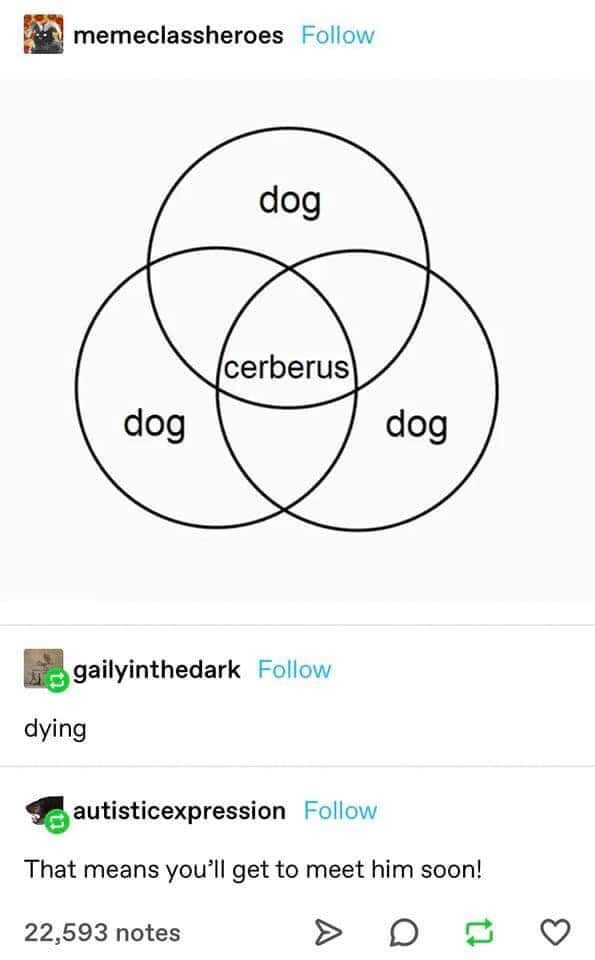
I found this moderately funny Venn diagram.

Cute, right? Well, as any fan of Clash of the Titans will tell you, it’s incomplete. Here’s my revised version.

C’mon, man. Orthrus was a player in the 10th labor of Heracles. He deserves your remembrance.

Capitalization matters too.

Follow me on Twitter @gsllc


Legendary Watch: The Green Knight @joeledgerton1 @ralphineson @BarryKeoghan @A24 @tracydeonn #MythologyMonday #MythologyMonandæg #TheGreenKnight #GoodWatch

If you enjoy this post, please retweet it.

Last Saturday, I did something that I rarely do: I took a nap. It’s probably been about a year since I did that, and I haven’t taken naps more frequently than that since college. I also did something else that I hadn’t done since September: I went to the movies. I used to do that almost every Sunday, but with the pandemic, that’s non longer common practice.

I think these two things are connected. I took a nap, felt revitalized, and figured I see a movie at a late hour. I bought a ticket to Old and almost immediately regretted it. I wanted to see The Green Knight first and didn’t realize it had been released. Fortunately, Old ended right about the the Green Knight‘s start time. With previews, I didn’t miss a thing.

The Green Knight dragged at times, but I’ve come to expect that from movies about legend and mythology. We sometimes say that a picture is worth a thousand words, and that’s certainly true of a movie. As a result, most myths can be told in 45-60 minutes on film. Filmmakers have two choices: borrow material from other myths and legends or fill in the story with creations of their own. I usually see the former, but in this case, it was the latter as far as I could tell. If they were borrowing from specific myths and legends, I didn’t recognize them. This is where it dragged, but for an apologist for such things, I still enjoyed it.

This also means that it’s probably not the story you know beyond the broad strokes. Besides the original filler, the filmmaker took some liberties with the story, but this can hardly be considered inappropriate. From generation through generation, Arthurian legend is essentially a collection of fan fiction. It appears to have changed with almost every telling of a story. Who’s to say that the filmmaker is wrong for doing their own thing?

The cast was great, BTW.

I give it a B+, but remember that comes from an apologist. YMMV. Old was good too, but I like everything M. Night Shamalamadingdong does, even including the much-maligned The Village. So yeah, YMMV.

So, now that this is over with, let’s gear back up for my continuation of my 1st Edition Advanced Dungeons & Dragons revisit by asking why the hell haven’t I seen the Green Knight appear in any official D&D text after the original Deities and Demigods? Even in that source, there was very little provided by the description. What villain could provide a greater hook than one whose villainy is merely teaching you a valuable lesson? FYI, A24 created an RPG based on the movie, which they released about a year ago. Googling it provides several reviews of it from CBR.com, Polygon, and others.

I didn’t think there’d be a post-credit scene in a movie like The Green Knight, so I left too early. Oops.

Follow me on Twitter @gsllc
Follow Joel Edgerton @joeledgerton1
Follow Ralph Ineson @ralphineson
Follow Barry Keoghan @BarryKeoghan
Follow A24 @A24
Follow Tracy Deonn @tracydeonn


Musings on Game Design and Revisiting AD&D 1st Edition: Campaign Settings and Pantheons @Luddite_Vic #DnD #RPG #ADnD #MythologyMonday #MythologyMonandæg

If you enjoy this post, please retweet it.

Introduction to Each Post in This Series

On Friday (July 23, 2021), I mentioned that I was relearning AD&D 1st Edition (“1e“) with the intention of running it. As I read through the Player’s Handbook (“PHB“), certain mechanics or text will strike me as odd or surprising, but in either case worthy of discussion. In fact, the most surprising thing I’m experiencing is that I’m finding a lot more great ideas in 1e that we’ve since abandoned. I find myself asking, “Why?” As a result, I’ll be writing several posts over the next few weeks. I’m sure everything I’m thinking has been discussed before — sometimes be me — so perhaps my questions have been answered, and my concerns resolved, years ago. My experience with RPGs is relatively limited in scope, having played a small number of games, so I’m sure a lot of what I’m going to say has been incorporated into games I’ve never even heard of. (Some have certainly been addressed by future editions of D&D themselves.) Nevertheless, bringing this directed conversation to the public is new to me, so here it goes.

Posts in this series: | My Playlist | Campaign Settings and Pantheons | Languages | Level | “Dead Levels” | Division of Labor, Distance, and Time | Initiative | Combat Subsystems | Armor Class Ratings | Alignment and Reputation | The Feel of a School of Magic | Boring Magic Items | Ability Score Bonuses and Skill Rolls | The Problem with Democracies | Hitting More Frequently | Encounter Balance and Shooting Yourselves in the Feet |

As with my prior post, this post was written yesterday (7/25). That makes it the eighth post I’ve written in the series. It’s out of order because Mondays are for mythology, and writing something relevant to both topics is easy. So, here comes session 0.5.

A friend (Vic) and I are designing an RPG system. Our design sessions are months apart, so don’t expect this system to ever see the commercial light of day. It’s a fun exercise, so if nothing ever comes of it, I won’t feel I’ve wasted my time. As I was doing my homework on the campaign setting, a memory came to mind. In the original 1e Deities & Demigods, the chief god of the Egyptian pantheon was Ra. By 3rd Edition, it was Re-Horakhty (f/k/a, Horus). This switch mirrors the real-world switch of ancient Egypt. What we call the Egyptian empire lasted almost 3,000 years, and during those 30 centuries different dynasties held control. These dynasties were devoted to different temples, so as the dynasties rose and fell, so did the influence of the temples. Thus, the god seen as chief among the pantheon changed.

A Controversial Opinion?

As broad a view as that is, let’s go even broader and tie this to campaign setting design. First, I want to say that I believe campaign settings should be system agnostic, and game systems should be campaign setting agnostic. That is, if I want to run a campaign in the Forgotten Realms using Dragon Age RPG‘s AGE system, there’s no reason I can’t do it. Maybe I need to do a little tweaking to run Legend of the Five Rings using the Savage Worlds system, but if I can’t, the fault is on the system. Systems can and should be flexible enough to accommodate whatever story elements are needed. GMs, or at least the game designers themselves, could write a patch that addresses the needs of another setting. 1e is open-ended enough that you might think it was suited to this task, but I’m not certain that’s true. In any event, this opinion may or may not be well-received by game designers, but that’s not the point of this post; it’s just stated to give you context for my point.

A Long, Long Time Ago . . . .

Going back to my design efforts, I thought, “What if players wanted to play my game in a low-magic setting? That would certainly work in a more primitive campaign setting.” If we were inclined to create such a setting, why start from scratch? Why not just take the high-magic setting and make it more primitive? For example, the gods of the moon, sun, and sky would be the same god in a simplified pantheon. Not only would this save us a lot of work, but one setting would represent the natural evolution of the previous one, as that hypothetical god would be split into three different gods as mortals became more civilized and sophisticated. Oddly enough, that sounds like science, which branches out into an ever-increasing number of specialties the more we learn.

But wait! There’s more! A gold mine in a “wild west” setting could uncover archeological sites tied to the fantasy setting that came before it. The same could be said of a World War II setting where an occult-obsessed dictator could be looking for artifacts of great power. Depending on what type of game a DM wants to run, those artifacts could be nothing more than trinkets, or they could actually hold some form of supernatural or scientifically advanced power. Also consider that even in a high-fantasy setting, traveling the “astral plane” can take a character to space. The same setting could be adapted for the far future for a campaign resembling either Star Wars or Star Trek, and similar connections could be made.

What I’m saying is that all the campaign settings could exist as part of the same planet and universe in general. In a sense, it’s an ambitious plan, but in another sense, future efforts would be made easier by taking advantage of the ones that came before them. A large gaming company could easily do that, even one like WotC that’s already established. I suspect many people assume Theros, Faerun, and other planets all exist in the same universe, and the gods just have different names from planet to planet. In fact, I once read (can’t currently prove) that the Olman people from Greyhawk weren’t “like Aztecs,” but rather were Aztecs. Earth and Oerth were linked for some time by an interdimensional portal, so they were the same people. This might have been a fan theory, but clearly these connections are easy to make.

In an ideal world in which Vic or I win the lottery, maybe we’d commit to our efforts full time. If we did, this is definitely an idea I’d want to pursue.

Have any game designers connected campaign settings in this way?

Follow me on Twitter @gsllc
Follow Vic @Luddite_Vic

If you’re on Twitter, please consider voting in my two Twitter polls.


Dungeons & Dragons is a trademark of Wizards of the Coast, LLC, who neither contributed to nor endorsed the contents of this post. (Okay, jackasses?)

NASA Is Sexist! @NASA #NASA #Artemis #MythologyMonday #MythologyMonandæg

If you enjoy this post, please retweet it.

Seriously, how hard was it to get this right, space nerds?

I’m actually more offended that the meme-maker didn’t capitalize, “Apollo.”

Follow me on Twitter @gsllc
Follow NASA @NASA


A Sad Tale, and Perhaps a Lesson: Ray Harryhausen’s Retirement @DenofGeekUS #DenOfGeek #MythologyMonday #MythologyMonandæg

If you enjoy this post, please retweet it.

This is a link to a sad story for me, care of Den of Geek. It celebrates the birthday of the special effects pioneer, Ray Harryhausen. As I’ve written, I love Clash of the Titans. It was a huge part of my childhood. It’s a shame that it represents the end of an era. TL;DR: A brutal review of Clash of the Titans by a dense, visionless critic (not my favorite group of people) writing for Variety drowned out the positive reviews and disheartened Harryhausen. This was the proverbial straw that broke the camel’s back, causing him to retire from filmmaking. While his techniques had largely (not completely!) become antiquated at that point, my guess is that he would have adapted if he had stayed. We’ll never know. Even if that’s not the case, the article points out that he was more than just a special effects guy.

For the average person, social media isn’t as focused as a movie review. That is, as a non-celebrity, I don’t wake up every morning expecting an attack on my character, but the volume of commentary is so large that you’d be a fool not to think it’ll come your way eventually. Don’t let it bum you out, especially when it comes from people that don’t know you that are saying things that aren’t true.

Ray left for Olympus in 2013. Rest in peace, good sir.

Wouldn’t it be cool if he were buried on Mt. Olympus?

Follow me on Twitter @gsllc
Follow Den of Geek @DenofGeekUS


How TTRPGs Took Hestia’s Place in Our Culture @stephenfry #MythologyMonday #MythologyMonandæg #RPG

If you enjoy this post, please retweet it.

I love the Graham Norton Show. I’m not sure why — I’m not a fan of talk shows — but I’ll leave that mystery to the philosophers. I’m any case, Facebook keeps throwing the show’s videos at me. This one from 2018 had an interesting message.

Skip to 1:22 to get to my point. Skip to 1:55 to see how confused Nicole Kidman is.

TL;DR: At the time of filming, Stephen Fry had released a book called, Heroes. In discussing it, he mentioned his favorite Greek god, Hestia.

And the hearth, when you think about it is all of our ancestors, whatever our ethnicity . . . all our ancestors gathered around flames at night to stay warm and protect themselves from animals, and they told stories about things over which they had no control. . . . Everything you can’t understand and control you give a name – a god – and so these gods developed personalities around the fire. And now I think we can safely say we’ve lost the hearth. You know, we don’t eat around tables anymore, someone’s got a PlayStation in that room, and they get a delivery of pizza into it, and someone else has got another . . .  they’re streaming things in another room. No one gathers around and shares stories anymore. We’ve lost our focus; we’ve lost our hearth.

Fry’s point is correct though incomplete; he failed to mention that these stories eventually became a form of entertainment because it wasn’t relevant to his point. In any event, we’ve lost the art of shared storytelling. Movies, TV shows, and novels are one-sided storytelling. The hearth gives us all the opportunity to take our turn telling our stories, or directly contribute to the stories of others through questions or commentary. Perhaps the fact that a novel inspires a reader to write their own novel provides some give-and-take, but that’s hardly an intimate experience, and it’s reserved for those with the drive, resources, skill set, and perhaps luck to publish a novel.

But then there’s we, the TTRPG nerds. We haven’t lost this at all, have we? What is a table-top, role-playing game session at someone’s dining room table if not “the hearth”? Unless you have a totalitarian DM that insists it’s “their game,” everyone at the table is telling the story.

We’re one of the last cultural bastions of intimate community activity. Kind of ironic that the social misfits are what’s keeping this part of our social identity alive, huh? Make sure you don’t blow that opportunity or shirk that responsibility. Personally, I think it’s tautological to say that doing so requires we focus more on the characters and story than on the mechanics, but whatever keeps *you* at the table is good enough. Food for thought.

Fry’s book, Heroes, will have to go on my reading list.

Follow me on Twitter @gsllc
Follow Stephen Fry @stephenfry


My Appreciation for Hephaestus #MythologyMonday #MythologyMonandæg

If you enjoy this post, please retweet it.

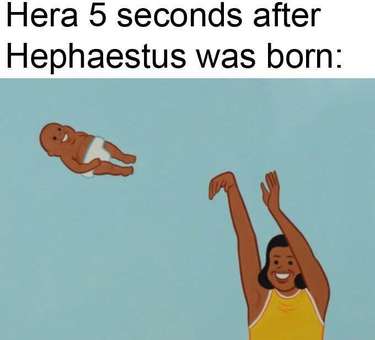
Hephaestus got a bum deal. He was born ugly (not his fault), and for that he was cast out from Olympus by his mother, Hera. This disabled him. Or maybe the next casting out did. A lot of this depends on whom you ask.

This looks familiar.

Somehow, he made it back to Olympus, but despite always coming through for the gods via his skills as a blacksmith, this treatment continued. He was cast out again, this time by Zeus (who may have been his dad) after a family spat. He made it back a second time because some drunk hedonist named Dionysus snuck him in. Even Dionysus screwed him over, though, foiling his plans to teach Hera a lesson. As the archetype of the “middle child,” I can relate to all of this. I was always treated like crap despite being the only reliable member of the family. But hey, it was my fault for continuing to keep them in my life for the first forty years or so. Hephaestus should have cut ties as well.

However, Hephaestus ultimately had it better than I. He was put in an arranged marriage with Aphrodite in order to avoid a war among the other gods for her hand in marriage. I’m sure he liked this arrangement. Aphrodite has not returned my requests for comments on the matter, but her infidelity speaks volumes. In the end, she wasn’t much of an olive branch.

Yes, I used a hashtag including a Norse word in it. Norse gods >> Greek gods.

Follow me on Twitter @gsllc


Mythology Problems #MythologyMonday

If you enjoy this post, please retweet it.

This is an oldie but goodie.

Here’s an example of #1

Here’s an example of #2

Here’s an example of #3

Here’s an example of #4

Spelling counts.

Follow me on Twitter @gsllc