
Pepper Potts Sucks! @ComicBook @BrandonDavisBD @Rowaenthe @RobertDowneyJr #IronMan #QuarantineWatchParty #MCU

If you enjoy this post, please retweet it.

June 30 was the first ComicBook.com quarantine watch party in quite some time. As always, I made a few more Twitter connections through the conversations that came from it. These conversations inspired three posts for my blog. This is the second one that in some sense serves as a sequel to the first one.

I must admit that I’m a little out of my element. As I said in the prior Iron Man-related post, I don’t analyze these movies from the perspective of an expert in screenwriting. I focus on themes that are important to me. This post eventually strays into an analysis of moviemaking and human relationships, so I have far more questions than I have answers, and my affirmative claims are often mere speculation. My primary question is: What purpose to the larger story did Pepper’s naivete and/or stubbornness serve?

Here’s what I’m talking about:

In other words, there are several incidents throughout the MCU where Pepper makes the same mistake that many people make in the real world. She tries to interfere with a strong person doing what’s necessary because she doesn’t understand what strength of character is, or at least why it’s important. As shown in Shazam!, attitude is often far more important than actual ability, which is why even in the non-caveman, modern world, strength is an important feature. While Pepper is a hard worker, intelligent, and portrayed as strong in other ways, that’s not a realistic portrayal. She’s simply serving a plot, so the script has her acting both strong and weak at different points.

While we all have our strengths and weaknesses, this paradox is far more profound than that. She doesn’t get a simple reality that, again, I’ve seen a lot in the real world: Telling Tony not to act because it places him at risk is counterproductive. If he doesn’t act, the bad guys will win, and Tony will die anyway (along with many other people). This is absolutely maddening, and it happens during Paltrow’s entire tenure in the MCU. At the end of Iron Man 3, Tony temporarily gives up being Iron Man for her. Fortunately, real world economics prevail, and the screenwriters quickly send Tony back into the fray to save half the universe. But the point is that, if you’re weak, that’s fine, but don’t stand in the way of the strong. They have a job to do, and it’s generally saving your ass.

How Did the Relationship Work?

Sorry, but my writing gets a little choppy here because I’m suddenly shifting gears.

I’m light years from my area of expertise, but perhaps Stark latched onto a person with such a silly outlook because her motivation was seemingly unconditional love, and that’s what he was searching for. According to Captain America: Civil War, he lost that relationship for a while, but as soon as he could, he grabbed her and didn’t let go. As I speculated in the prior Iron Man-related post, that’s probably because Tony’s lack of a family was haunting him (as it often haunts me). Or maybe it’s far simpler: Opposites attract. Because it’s just a movie, they were able to write the script anyway they wanted, so the resulting relationship with Pepper worked even if it wouldn’t in the real world, which wouldn’t be so generous. (For the record, Civil War screenwriter Stephen McFeely stated that her presence would have calmed Tony, but he needed to remain dark and angry in order for the events to play out as they did.) Tony never got “fixed’ by anything we saw on screen; the script just pushed him in that direction leaving the details to our imagination (other than the unwitting therapy session with Bruce Banner in Iron Man 3). Figuring out why is merely speculation. As complex as some of these MCU characters are relative to other movie characters, they’re still not real. They’re just two-dimensional characters driven more by dramatic forces than by real, psychological or logical ones.

It appears that Pepper’s behavior always served to advance the plot. She could hold Tony back or push him forward as needed, but she usually held him back. When she did so, her thought processes were wildly illogical, and that grated on me.

I don’t want to hate Pepper Potts, but I do. There. I said it.

Follow me on Twitter @gsllc (please retweet!)
Follow ComicBook.com @ComicBook
Follow Brandon Davis @BrandonDavisBD
Follow Angela Rynan Durrell @Rowaenthe
Follow Robert Downey Jr. @RobertDowneyJr

Dysfunctional to Functional Family: Tony Stark, Obadiah Stane, Spiderman, and Morgan Stark @ComicBook @BrandonDavisBD @Rowaenthe @TheJeffBridges @RobertDowneyJr #IronMan #QuarantineWatchParty #MCU #Spiderman

If you enjoy this post, please retweet it.

June 30 was the first ComicBook.com quarantine watch party in quite some time. As always, I made a few more Twitter connections through the conversations that came from it. These conversations inspired three posts for my blog, this being the first one.

My posts aren’t about getting clicks. If no one read any of my posts, I wouldn’t really care. Writing them is more about catharsis than fame. Moreover, I’m no film student, psychologist, or sociologist, so I can’t break down the science of movie-making or human behavior. Instead, these posts are about analyzing the themes used within the movies due to my personal connection to their messages (accordingly, YMMV). As a result, my favorite posts have been about Nebula’s Redemption, my comparison of Shazam! and Guardians of the Galaxy, and others dealing with a particular theme. That theme is realizing and accepting that your idealized vision of family is complete nonsense, breaking away from those abusive relationships, and appreciating the family you didn’t realize was in front of you the whole time (though for me personally, the third has been elusive). Not everyone has these experiences, but it’s a recurring theme in superhero movies. I never considered that the first Iron Man movie implicitly raised issues related to this theme.

Father Figure

Tony Stark’s (Robert Downey, Jr.) father died, and then Tony disappeared for a while. This isn’t surprising considering how self-absorbed he is, but when he returned to Stark Industries, Obadiah Stane (Jeff Bridges) must have served as a father-figure for him. Before I go forward, I want to mention . . .

Tony didn’t show as much respect for Obadiah as you would want to see from your own child, but Tony didn’t ever show much respect for any authority figure, so it’s still fair to assume Obadiah acted as an adoptive father to him. That is, Obadiah wasn’t merely a coworker, boss, or even family friend. Assuming that, it must have been absolutely devastating for Tony when he realized Obadiah had called for his removal from the company, and even worse, his death. That betrayal would hold back Tony’s growth, which became a slow burn throughout the Infinity War saga. It helps make Tony’s grief over Black Widow’s death as believable as that of any other character despite his never overtly expressing that grief or deep feelings for her. It wasn’t until the first Avengers that Tony showed a willingness to “lay down on a wire” for his allies, but his ego made sure that no one would forget that. Somehow, it was still about him . . . until he started to understand fatherhood in Captain America: Civil War.

Peter Parker and Morgan Stark

In Civil War, Tony latched onto Peter Parker/Spiderman. At first, he was looking for a little more firepower to take down Team Cap ®©TM℗SM, but by Infinity War it was clear he had a genuine emotional attachment to Peter.

By Avengers: Endgame, he was devastated because he “lost the kid,” but he got a second chance in that film. Tony’s life became about Pepper and their daughter, Morgan. He was reluctant to restore the Vanished because doing so threatened what he had finally found after a lifetime of searching, even if it meant giving up on his filial figure, Peter.

Tony’s progression from self-absorbed brat to the guy who’d “make the sacrifice play” was 22 movies long probably because of Obadiah more than anything else we saw, but Tony made it there, and that wound up saving half the universe.

Follow me on Twitter @gsllc (please retweet!)
Follow ComicBook.com @ComicBook
Follow Brandon Davis @BrandonDavisBD
Follow Angela Rynan Durrell @Rowaenthe
Follow Jeff Bridges @TheJeffBridges
Follow Robert Downey Jr. @RobertDowneyJr

A Summary of the #MCU Leading up to #Endgame @MarvelStudios

If you enjoy this post, please retweet.

Sundays are now lazy days for me. Going forward, I’m just going to re-post other people’s work. Today, it’s one hour and 14 minutes of some of the most important moments in the MCU leading up to Avengers: Endgame.

Maybe watch it at double speed.

Follow me on Twitter @gsllc (please retweet!)
Follow Marvel Studios @MarvelStudios

Black Widow Dies #MCU @JeremyRenner @MarvelStudios

If you enjoy this post, please retweet.

Sundays are going to be lazy days for me. Going forward, I’m just going to re-post other people’s work. Today, it’s one of the best sacrifices in the MCU. As I’ve said, I don’t know if the relationship between Black Widow and Hawkeye was the best thing in the MCU, but it’s pretty damn close.

Follow me on Twitter @gsllc (please retweet!)
Follow Jeremy Renner @JeremyRenner
Follow Marvel Studios @MarvelStudios

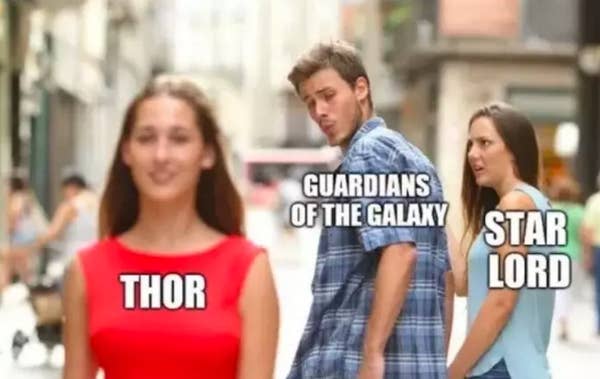
All Hail (Once Again) the Greatest Individual Entrance in Cinematic History, and Other Things I Didn’t Create #MCU #Thor #HDB to me @ChrisHemsworth @samuelljackson

If you enjoy this post, please retweet.

For my birthday, I’m being lazy and just giving you material others have done. First, here’s a fantastic moment from a fantastic character as played by a fantastic actor.

It’s no wonder that Portals in Avengers: Endgame used a variation of this theme for the entrance of the formerly dusted into the final battle against Thanos.

And now for some more.

Image may contain: 5 people, meme and text

That’s it.

Follow me on Twitter @gsllc (please retweet!)
Follow Chris Hemsworth @ChrisHemsworth
Follow Samuel L. Jackson @samuelljackson

#Thor Is the Strongest #Avenger @chrishemsworth @brielarson #MCU

If you enjoy this post, please retweet it.

First off, Scarlet Witch is the strongest Avenger because all of these characters are defined solely by what’s in the script, and that’s what Kevin Feige says. However, art is in the eye of the beholder, so my interpretation is as valid as anyone else’s. My interpretation is that Thor has proven himself to be the strongest Avenger, and by “Avenger,” I mean “good guy we’ve seen on screen that remains alive in the MCU.”

Odin, Surtur, and Hela Are Dead … I Think

I don’t read the comics, but I know a few things, and it appears that Thor: Ragnarok recognized that Thor was finally gaining the “Thorforce.” With Odin, Surtur, and Hela dead, that would make sense. Also, with those three dead, you have a few major hurdles cleared for my claim to ring true.

Of course, Hela and Surtur could be alive, but at least one could interpret Surtur’s words as a suggestion that he would die once his destiny was fulfilled. Hela? Who knows? Damn comics! But for now, I’m assuming they’re dead, which would clear the path for the Thorforce, eventually placing Thor on Odin’s level.

Compare to Captain Marvel

This was Feige’s first claim. Powered by the Space Stone, she’s a reasonable choice, and the data we have is strongly in her favor. However, our measuring stick is Thanos, and there, Captain Marvel wasn’t as impressive. At the beginning of Endgame, she managed to control a severely injured Thanos long enough for everyone else to get in position. Sure, Rocket couldn’t do that, but <yawn>. In the final battle, she took on a full-powered Thanos one-on-one, but even though he had all six Stones, he wasn’t actively using them. They were in the gauntlet, and she was keeping his hand open, which according to Dr. Strange’s dialogue in Infinity War means that Thanos couldn’t wield any stone’s power while in the gauntlet. In that fight, we saw a brief stalemate until Thanos used the Power Stone to send Captain Marvel flying across the battlefield. Was she impressive? Yes. Did she seem as much a match for Thanos as Thor? No way.

Sure, in Thor’s first fight with Thanos, Thanos kicked his ass with the Power Stone, but that was immediately after Thor was blasted to hell by the weaponry of Thanos’s ship. In fact, in defeat Thor was impressive because he was taking the continuous force of the Power Stone to his head rather than an intermittent blast. Facing off against him later in Infinity War, Thor had no problem handling Thanos even while Thanos was using the Infinity Stones, and that’s the proper metric. Thor was depleted in Endgame because the plot needed him to be. Otherwise, the battle in Endgame would have taken 15 seconds. Thanos without the Infinity Stones v. Thor with either Stormbreaker or Mjolnir isn’t even close based on what we’ve seen, and he was wielding both. Get Thor mentally healthy, and he’s the go-to guy.

Compare to Scarlet Witch

This is Feige’s current choice, but has she proven to be as powerful as Thor? It’s clear from her fights with Proxima Midnight and Hawkeye that she’s still just a fragile human with slow human reflexes and a fragile human mind (i.e., one that would descend into madness if she tried to wield Stormbreaker). If you can get past her offense, she doesn’t have much defense, at least not against someone that can fly. Thor, on the other hand, took the brunt of a neutron star. ‘Nuff said.

But what about her offense? Arguably, she was on the verge of killing Thanos when he didn’t have the Infinity Stones. When he had 5 Stones, she was at best at a standstill, but eventually lost the tactical battle. Once Thanos had all six Stones, he was the most powerful being in the universe (so far), and Thor almost killed him. Sorry, but I’d rather have Thor watching my back. Even if you could make a compelling argument that Scarlet Witch has more raw power than Thor, sometimes what matters most is willpower. Thor wins.

Conclusion

The only character for whom I have a bias is Thor. This is because of my love of mythology, and Norse mythology in particular. I’m sure that’s obvious here, so even if you have a decent counterargument, I probably won’t buy it. That’s just how I roll. But I doubt you have a decent counterargument.

A mentally and physically healthy Thor is clearly the strongest Avenger. He also had the best individual entrance in cinematic history.

Follow me on Twitter at @gsllc (please retweet!)
Follow Chris Hemsworth @chrishemsworth
Follow Brie Larson @brielarson

#Avengers: Age of #Ultron: The Flip Side of the #MCU Power Curve @JeremyRenner @lindacardellini

If you enjoy this post, please retweet it.

In yesterday’s post, I voiced my only serious complaint about the MCU: The incoherent power curve. While that certainly annoys me, Avengers: Age of Ultron keeps me from forgetting that the least powerful original Avengers, Black Widow and Hawkeye, were certainly very important to the team. If the choice I was given was having a screwy power curve or eliminating them from the story, I’ll take the screwy power curve with a smile on my face every time.

Hawkeye

Hawkeye was instrumental in stopping Scarlet Witch from tearing the Avengers apart. He was the only one who avoided her powers, and he was the one to convince her, the person that would one day become the strongest Avenger, to join the team in a meaningful way. That was done with a speech rivaling any Captain America ever delivered. This was a believable effort on his part despite not requiring a superpower. Before that, however, he reinforced the message to the other Avengers of what they were fighting for by introducing them to his family. In fact, his non-hero wife, Laura, kept him from losing touch with his own importance. For a team that was falling apart at the seams, this was critical to the believability of the Avengers continuing to work well together.

Black Widow

I’ve written several times about how Black Widow is the glue of the Avengers. Except for Thor, she had significant, on-screen bonding moments with each of the original Avengers (as well as a few others) over the course of several films. This could explain her eventual inability to stick to one side in the Avengers’ “civil war.” With this movie, we saw the development of her most significant relationship, Bruce Banner, and the expansion of her most important one (from a story perspective), Hawkeye. I vaguely relate to Black Widow’s backstory, and how it shaped who she became, in a specific but personal way I won’t discuss; however, I think we can all agree that it’s compelling enough for her own movie. The story became a mission to rescue her, but not really. Far from the archetypical damsel in distress, she instead turned the situation around from the inside, leading the Avengers to Ultron. Without screwing with the power curve, Black Widow contributed in vital ways.

These two characters were as important to the Avengers as any of the others, and neither had a superpower.

Unrelated Note

In a cinematic universe filled with brilliant one-liners, one of my favorites comes from Age of Ultron.

“Oh, for God’s sake!”

James Spader is awesome.

Sometimes you must take the bad with the good. Black Widow and Hawkeye were really good.

Follow me on Twitter @gsllc (please retweet!)
Follow Jeremy Renner @JeremyRenner
Follow Linda Cardellini @lindacardellini (season 2 of Dead to Me drops on Netflix 5/8!)

Throwing Rhodey Under the Bus in Avengers: #Endgame @DonCheadle @MarvelStudios #MCU

If you enjoy this post, please retweet it.

It’s rare that I find things that I don’t like about the MCU, but there are a few. As I discussed yesterday, I approved of “Fat Thor” because it was handled fairly well. However, it wasn’t handled perfectly; to-wit: War Machine. I felt that the writers unnecessarily threw Rhodey under the bus. They gave him all the mean-spirited lines, and a couple were particularly bad. This reminds me of my tweet during the Infinity War watch party.

The scene is here. Start at 1:04.

If it weren’t for Peter’s completely irrational reaction, none of the 14,000,605 alternate timelines would have occurred (including the successful one). People do stupid things for one of four reasons that I can identify: 1) They’re stupid; 2) they’re kidding; 3.) they’re trolling you; or 4.) they’re acting emotional, thus abandoning all logic. Regardless of which category you think Peter is in, he behaved stupidly, and I don’t see why the writers had to do that. They could easily have made Thanos too strong for Mantis. Unfortunately, this seems to be how they write. They want a clear scapegoat among the heroes, being someone that consistently goes in a bad direction.

Rhodey

Rhodey didn’t cause Thanos’s arrival in Endgame. His issues were different; he was simply an asshole. First, let’s look at the discussion of the Infinity Stones.

Everyone’s comments and facial expressions seem to show concern for Thor, except Scott Lang, who as always is lost and therefore not sure if Thor is kidding. He may have just been giving Thor encouragement. In any case, all of these people are goodhearted in their approach. The exception is Rhodey, who makes a joke of it with, “No, I’m pretty sure he’s dead,” and arguably Clint’s facial expression when Rhodey and he share a knowing look with each other. Then we go to the discussion of time travel.

As if designed to make sure Rhodey looked as bad as possible, they left it to him to say that time travel should have been used to kill Thanos as a baby. Everyone would have forgiven that (after all, “It’s Thanos!”), but it still had a mean feel to it, and it became yet another straw on the camel’s back (so to speak).

Then consider his scene with Nebula.

Rhodey’s question, “So he’s an idiot?” came across as rhetorical. He was clearly calling Peter an idiot with an air of frustration. Nebula’s simple response of, “Yeah,” came only after a pause and a downward glance. Of all people to be reluctant to insult someone, Nebula seemed exactly that. Here were two characters saying the same exact thing about the same exact person, yet they were coming from opposite directions. Nebula’s remarkable story arc of redemption certainly colored how I viewed all of her statements, and that’s probably true for Rhodey based on the above, who seemed to be going in the opposite direction. But that’s what I’m talking about. That’s a direct result of the writing.

Moving on, remember from yesterday’s post, once it was explicitly established that Thor’s physical condition was tied to the depression and/or PTSD, the fat jokes stopped coming, except for Rhodey. He continued to insult Thor’s condition, and it didn’t come across as playful.

Objectively, “Cheez Whiz” is a funny line, but it was done not only after we learned why Thor was in a depleted physical state, but also at the exact moment Thor was having an emotional crisis. Thor was going to sacrifice himself to atone for his perceived sin of failure, which itself resulted in depression, PTSD, and his physical condition.

I’m the kind of guy that thinks no topic is forbidden from comedy. Anything can be funny if done well. The only sin in comedy is not being funny, and I’m never offended, even if my own insecurities are the butt of the joke. I far prefer laughing at myself than wallowing in self-pity, so I believe making fun of people can be funny. But it also can be not funny. With Rhodey, it came across as mean-spirited and was completely unnecessary.

The totality of just these few scenes left me with a bad impression.

Who’s to Blame?

The blame can lie with any combination of the actor, director, and screenwriter. I don’t know who to blame, but you can see from the deleted scenes in that last clip that this was exactly what they were going for. They wanted to say something mean-spirited, and the fact that Peter Quill was thrown under the bus in Infinity War suggests that the writing is to blame. In total, I felt it debased the character. Unfortunately, I don’t see much room for him to redeem himself. I haven’t heard any mention of his return to the MCU on the big screen or on Disney+.

Have you learned to dislike Rhodey? Is there a value to these lines that I don’t appreciate?

Follow me on Twitter @gsllc (please retweet!)
Follow Chris Hemsworth @DonCheadle
Follow Marvel Studios @MarvelStudios

“Fat” #Thor’s #Depression/#PTSD in Avengers #Endgame @chrishemsworth @MarvelStudios #MCU

If you enjoy this post, please retweet it.

I’m not a psychologist, but I don’t have to be for the sake of this post, and neither do you. The only expertise we need for this post is to diagnose Thor as having depression, post-traumatic stress disorder (“PTSD”), or both. Because he’s a make-believe character, what that really means is that we have to infer whether that’s what the writers intended when writing for the character. If you’re one of the few that don’t infer that, then this post isn’t for you. I’m operating from the assumption that Thor’s physical condition is the result of one or both of those mental/emotional conditions (perhaps another that’s more appropriate), and so I will certainly not be arguing that assumption here.

Thor’s physical condition clearly sprang from his mental illness. Was that a good thing? I believe it was, both for script purposes and for real world purposes.

Script

What started in Thor: Ragnarok came to fruition in Avengers: Infinity War: Thor is the strongest Avenger. With only one exception, Thor never took a legitimate blow from the Hulk, getting hit only when he was trying to stop the fight or when the Grandmaster cheated. He developed what was probably the Thorforce from the comics, and with both Odin and Hela dead, that makes sense. He took on the brunt of a neutron star. He almost took out Thanos while Thanos was wielding all six Infinity Stones. The Russos came up with a lame excuse (Thanos was taken by surprise), but if Thor had just gone for the head . . . .

So, if Thor is that powerful, what happens in Endgame? Most likely, the battle lasts about 15 seconds with Thor saving the world. That’s not particularly dramatic. His weakness was necessary to give Thanos a fighting chance and to give us the grand finale we all wanted.

Real World

All that said, the only reason this plot device worked is because Thor was deemed worthy. Depression and PTSD are illnesses. Having them doesn’t necessarily make you a weak person, though they do give you certain vulnerabilities. Mjolnir gives us an objective standard to tell us whether or not someone is “worthy.” Thor’s ability to summon and wield Mjolnir tells us that his condition and value as a hero aren’t connected. It tells us that our own conditions and values as human beings aren’t connected. For this reason, I not only think Fat Thor was nothing worth being offended about, but was actually very important.

Moreover, once it was explicitly established that Thor’s physical condition was tied to the depression and/or PTSD, the jokes stopped coming, or at least shifted focus. “Lebowski” wasn’t a comment about weight. Endgame wasn’t perfect, though. For some inexplicable reason, Rhodey continued to insult Thor, and it didn’t come across as playful. I’ll discuss this in depth in tomorrow’s post.

Did you think “Fat Thor” was handled well?

Follow me on Twitter @gsllc (please retweet!)
Follow Chris Hemsworth @chrishemsworth
Follow Marvel Studios @MarvelStudios


Why Captain America: The Winter Soldier Is My Favorite #MCU Movie @MarvelStudios #CaptainAmerica

If you enjoy this post, please retweet it.

As you know, I love the MCU. Marvel Studios could have relied on the action and fantasy elements inherent to the source material to make a ton of money on crappy movies, but they didn’t. They spent a ton of money on special effects, but also on hiring highly talented writers, directors, and actors (some with Oscars under their belts) so that the movies had substance as well. No movie exemplifies that more than Captain America: The Winter Soldier.

Like many MCU movies, it had the theme of establishing deep friendships that represented more than just coworkers or bar buddies. No, these friends were so close as to represent an adoptive family, replacing the biological families that Steve Rogers, Natasha Romanov, and Nick Fury lost, never knew, or never had. As wonderfully as it was executed, all of that is actually par for the course in the MCU. The Winter Soldier goes a step further.

Winter Soldier dealt with a political issue that is both timely and important: How do we strike the balance between security and liberty? Both are important. If we lax our security, we won’t have liberty for long, because nefarious forces from within and/or without will steal it. However, if security replaces liberty, then what kind of an existence are we actually fighting for? That’s why, when push comes to shove, liberty must win. In Winter Soldier, all of the good guys either fought for liberty or joined the fight after eventually realizing that they should have been all along. This decision shouldn’t be made naively, but those characters didn’t do that.

Okay, they sometimes did. The commitment to liberty was excessively idealistic, but this is a movie. Filmmakers must deal with extremes or risk losing the crowd. Many moviegoers aren’t observant enough to pick up key points being made unless they’re hit with it over the head, and a major theme is certainly a “key point.” This is why horrible characters that deserve the most serious punishment under the law can be forgiven and exalted by an audience simply because they’ve learned how to love a sibling. The movie world is different from the real world, and I’m sure you understand that. If not, movies must seem utterly ridiculous to you.

With that in mind, Winter Soldier dealt with an important and timely issue, came down on the right side of it (liberty) without being (too) naïve, and somehow managed to do that without pissing off members of any political party.

As a lawyer, how can I not get into that?

Follow me on Twitter @gsllc (please retweet!)
Follow Marvel Studios @MarvelStudios