More Gems Dug up While Unpacking @slyflourish @alphastream @aquelajames @loganbonner @shawnmerwin @scottfgray @erikscottdebie @ChrisSSims @TheTownshend @AntarianRanger @mcleankendree @jacobsontyler @erbelisle @Alex_Aparin #DnD #RPG #4e #5e #TTRPG #WotC

If you enjoy this post, please retweet it.

Going forward, Sundays are lazy for me. I either post something silly or other people’s work. Usually both. Today, it’s a bit less lazy of a post, but it references other people’s work, so it qualifies.

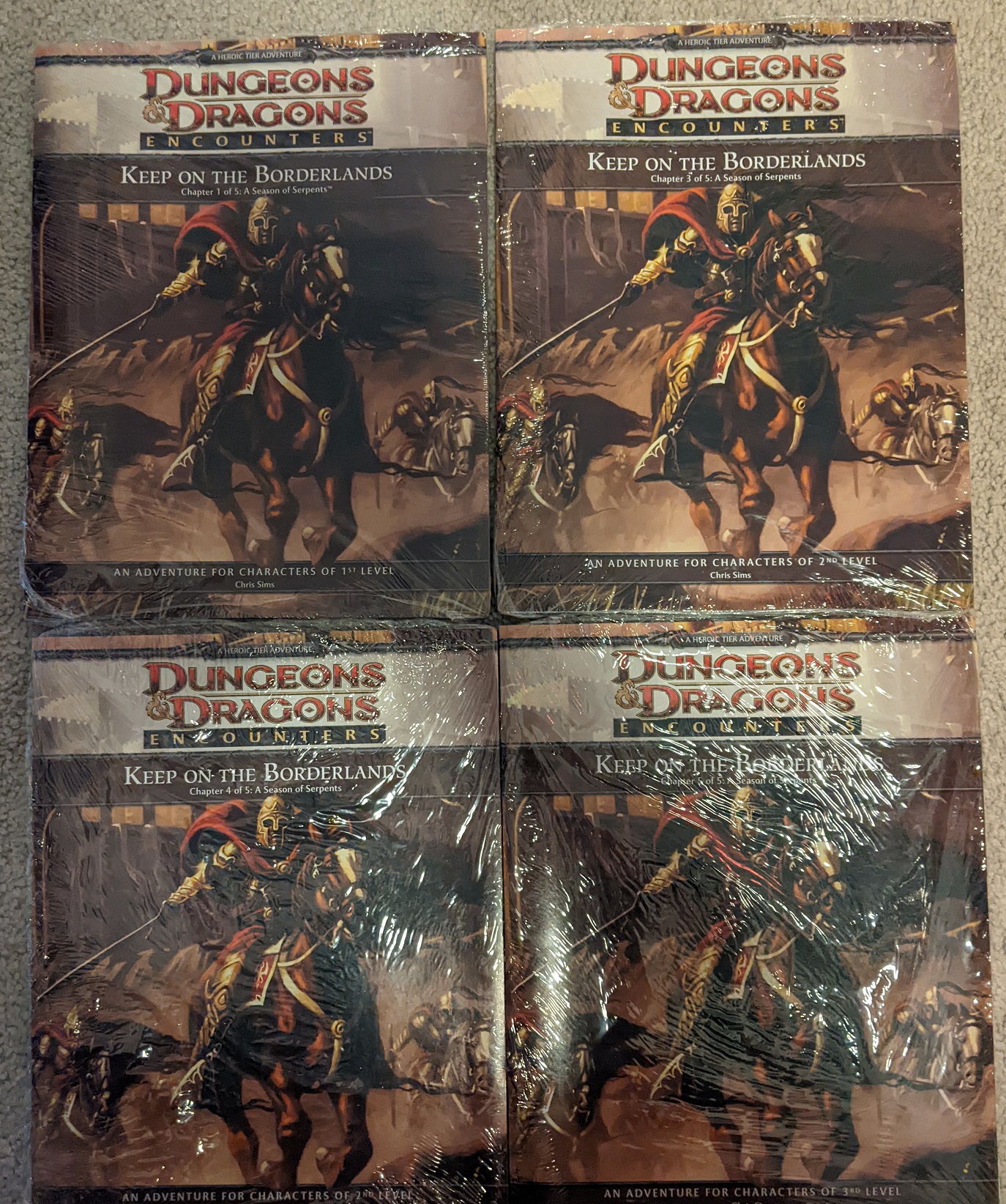
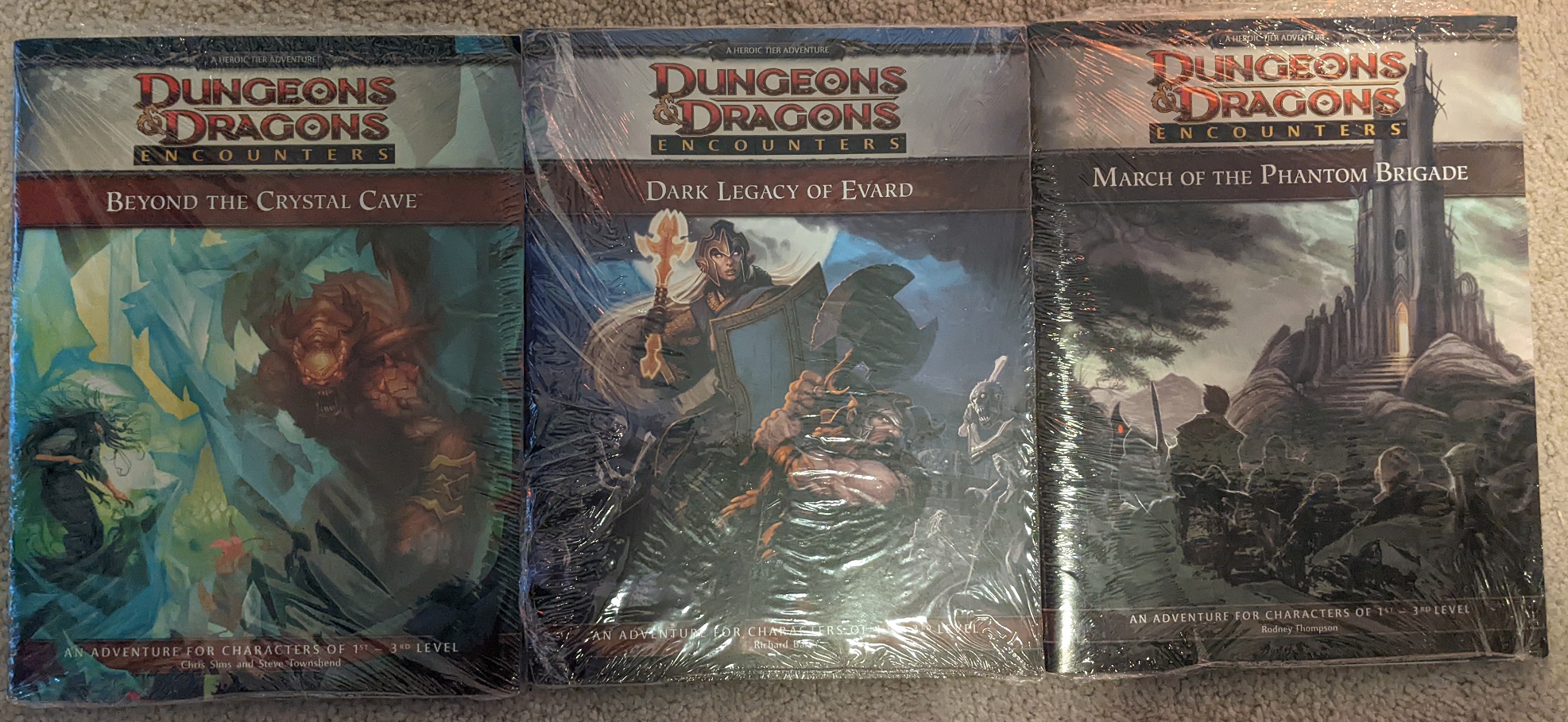
I put together another bookshelf, and in doing so started unpacking some more books. I found some gems in there. I used to run a gaming club in the Washington, DC area, and as a result, I was given a lot of WotC material for our game days, much of which was never taken out of its shrink wrap. I also have tons of duplicates. This is what I’ve discovered.

First up is material from some great writers, only one of which hates me. (Don’t hold it against him; I’m a tough pill to swallow.) Art credit to Ralph Horsley and Eric Belisle.

The latter has some supplemental material.

Major NPC cards with backstory and roleplaying information on the back.

Trigger warning: Is anyone else’s OCD going off right now? Art credit to Craig Spearing.

Where’s Chapter 2?!?!

These were something of a mistake for WotC, as I discussed with a WotC employee at GenCon who shall remain nameless. They were far too brutal for D&D Encounters, which was a program designed to introduce new players to the game. Some of us like brutal adventures and campaigns. In this century, we are clearly the minority. Art credit to William O’Connor.

Somewhere in Portland, Oregon, someone is squealing (you know who you are).

Oddly enough, I never played or ran either one of these, yet the shrink wrap has been removed from them. I’m guessing the DMs gave them back to me, but that doesn’t make a lot of sense. I allowed them to keep them because I had so many. Art credit to Eric Belisle and Alexey Aparin.

One of these authors has no idea what he’s doing (you know who you are).

For these, art credit goes to Alexey Aparin, Eric Belisle, and William O’Connor.

I don’t recall playing or running any of these either. I had a lot of helpers.

Okay, Logan. We get it. You like Drow. Art credit to Tyler Jacobson and McLean Kendree.

Or maybe Logan doesn’t. It’s just a job.

As I’ve said, I have unfinished business with 4th Edition D&D (and 3rd Edition and more 3rd Edition).

Follow me on Twitter at @gsllc
Follow Mike @slyflourish
Follow Teos @alphastream
Follow James @aquelajames
Follow Logan @loganbonner
Follow Shawn @shawnmerwin
Follow Scott @scottfgray
Follow Erik @erikscottdebie
Follow Chris @ChrisSSims
Follow Steve @TheTownshend
Follow Rodney @AntarianRanger
Follow McLean @mcleankendree
Follow Tyler @jacobsontyler
Follow Eric @erbelisle
Follow Alexey @Alex_Aparin
Follow Craig @craig_spearing

Dungeons & Dragons is a trademark of Wizards of the Coast, LLC, who neither contributed to nor endorsed the contents of this post. (Okay, jackasses?)

The Den . . . errrr, Mancave Is Coming Together #RPG #nerd #game #gaming #DnD #ADnD #FASA #StarTrekRPG

If you enjoy this post, please retweet it.

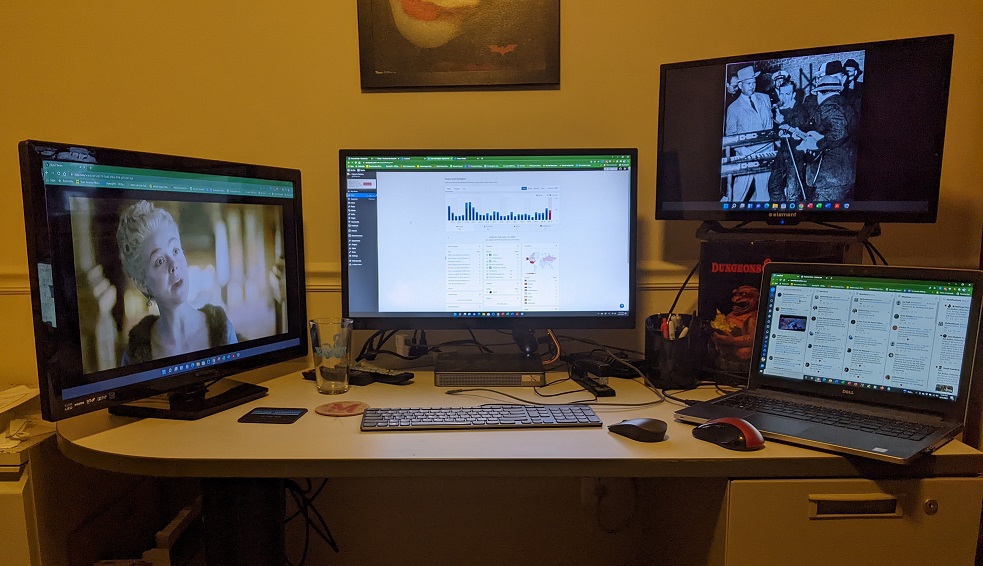
I told my coworkers that I was using one of the bedrooms in my new home into a den. They started calling it a mancave. Well, if this is a mancave, it’s the nerdiest one ever. I also can’t see it as a “cave” considering it’s on the second floor. It seems more like a man loft.

That doesn’t make any sense, does it?

Last week, I bought a 6′ tall bookshelf that finally allowed me to unpack most of my gaming material. This weekend, I picked up a new desk, which again allows me to unpack office supplies and other things. The room is finally coming together, and I’m fairly well organized.

This den, mancave, or whatever you want to call it is oddly important to me. I’ve lived a rather simple lifestyle up to now. I’m used to a small place, and while this home isn’t what anyone would call large, it’s exceptionally large for me. In fact, it’s too large. It’s great that I have room for everything that I have and much of what I don’t have yet, but I spend 90% of my waking hours in this room. For lack of a better word, it feels cozy, and I’m jamming it with everything I want around me in my free time at home.

Do I have enough screens?

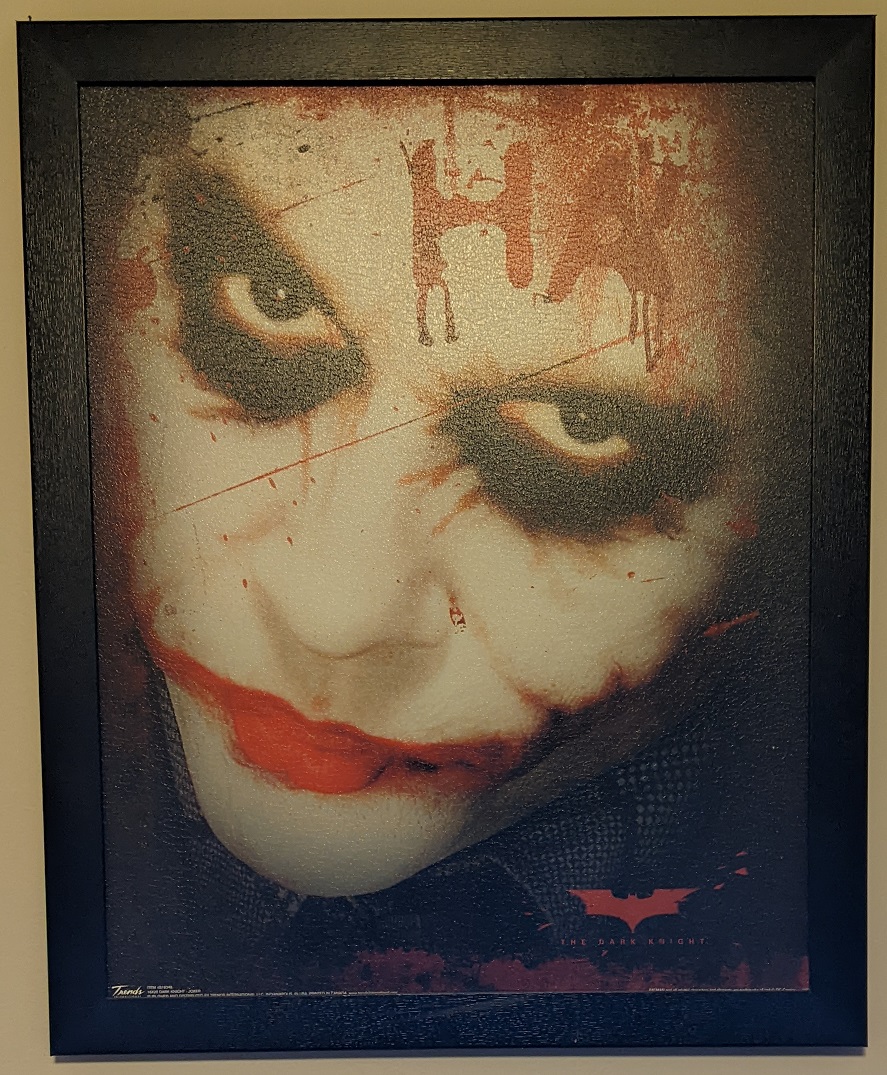
I have a lot of Jeff Dee originals to hang, but so far the only art on the walls is this guy over the desk.

Judging every one of my Google searches.

My cousin gave me a magazine rack. I asked, “What am I? 108 years old?” But I had just the use for it.

Though I may never read them again, I like having them.

Seriously. This is a mancave?

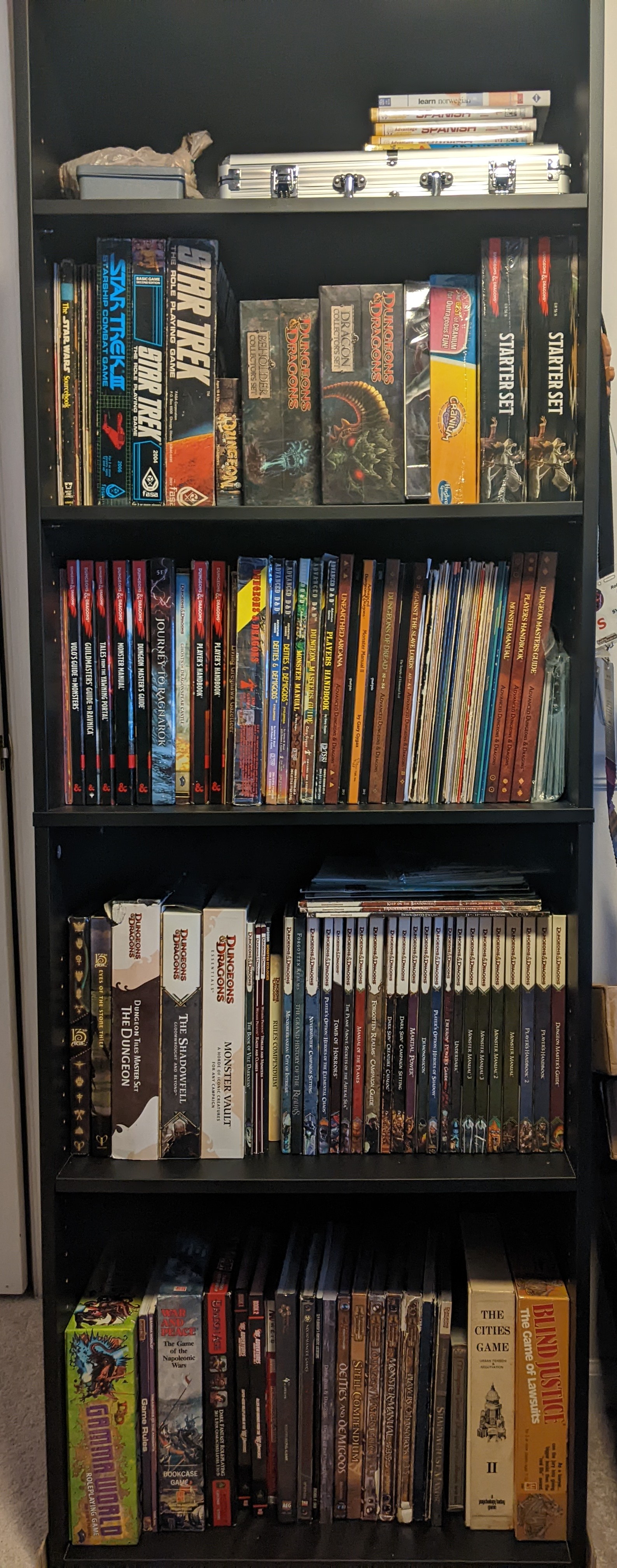
Almost one shelf per edition of D&D.

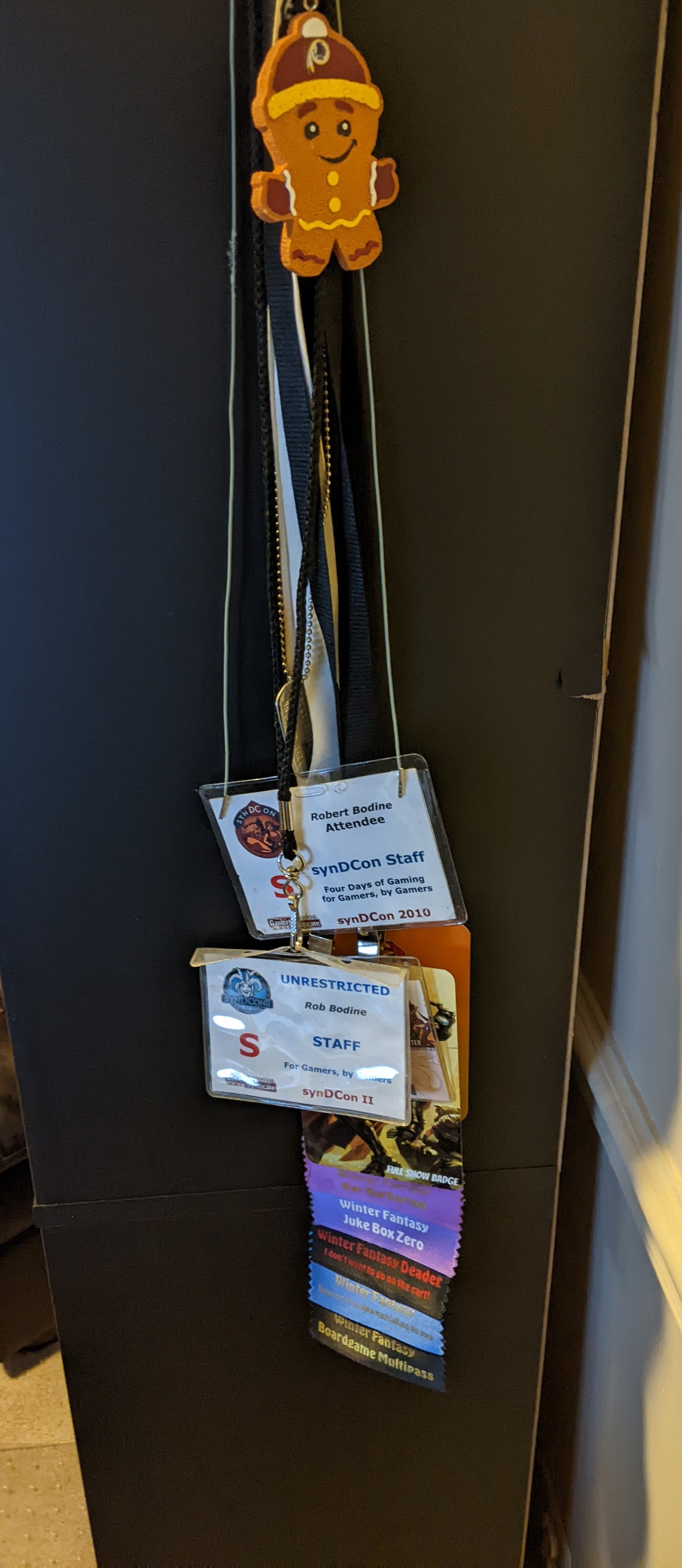
I have tons of other books not related to gaming, but the second bookshelf hasn’t even been put together. On the side of this bookshelf, I hung some memorabilia.

Badges? We don’t need no stinking badges!

As far as conventions go, the badges are from All-Star Comic Con 2018, GenCon 2011, synDCon I and II, and Winter Fantasy 2020 & 2022. And then there’s something on top of that bookshelf.

Okay, maybe it’s a mancave after all, but just barely.

The one thing that won’t fit are my musical instruments. I’m keeping them downstairs. That’s probably for the best. It’s a townhome, and the neighbors probably wouldn’t appreciate any noise being upstairs near their bedrooms.

Make no mistake about it: My keyboard playing is properly defined as “noise.”

Follow me on Twitter @gsllc

Dungeons & Dragons is a trademark of Wizards of the Coast, LLC, who neither contributed to, nor endorsed, the contents of this post. (Okay, jackasses?)

I’m Glad “Save or Die,” Well, Died, But . . . . #DnD #RPG #1e #4e #SaveOrDie

If you enjoy this post, please retweet it.

Save or die in RPGs refers to the notion that a character can be in a position where their life relies on a single saving throw. This is quite common in 1st Edition D&D (“1e”) but was completely eliminated in 4th Edition D&D (“4e”). Despite my enthusiasm of returning to 1e, I think its demise was a good thing. Much like ordinary swings of a sword, devastating but really cool attacks could be unleased on a character without taking them out of the game immediately.

30 Stocks to Sell That Are Currently on a Deathwatch | InvestorPlace

For example, one of my favorite monsters is the medusa, so I want to use them to their full potential and (relatively) often. In 1e, however, one medusa could take out the entire party before they could say, “The Amazon commercial with Medusa is stupid.” That’s quite a buzzkill, and it can destroy a gaming session. In 4e, however, I had no issues unleashing that petrifying gaze upon the group. On a successful attack roll, those in a close blast 5 were slowed. A failed save on their next turn left them immobilized. Finally, if they failed a second save on the turn after that, they’d be petrified. At any point in that process, a single successful save ended the effect. Poison and other fatal (or effectively fatal) effects manifested similarly. A rare few monsters had abilities with aftereffects, which were brilliant. If at any point you successfully saved, it would end the primary effect but would trigger a secondary effect requiring its own save.

Medusa: The Ancient Greek Myth of the Snake-Haired Gorgon

I’m not sure how I’d eliminate save or die in 1e, or even whether I should eliminate it. Messing with something so deeply baked into the game could create issues. Or not. 1e is remarkably adaptable to house rules. To start, though, I’m going to keep it.

So, make sure your henchmen go into each room first.

Follow me on Twitter at @gsllc

Dungeons & Dragons is a trademark of Wizards of the Coast, LLC, who neither contributed to nor endorsed the contents of this post. (Okay, jackasses?)

A Follow up on Spell Components #DnD #RPG #4e #1e #5e #ADnD #TTRPG

If you enjoy this post, please retweet it.

Yesterday, I discussed spell components. The conversations I had across Facebook and MeWe encouraged me to provide a quick epilogue to the spell components post.

The point I was making applies to games yet to be designed, not to current editions, and the argument is a rather trivial one: The more valuable a thing is, the higher it’s cost should be. We can all get behind that notion, right?

A problem I have with 5th Edition D&D (“5e“), and I think most editions, is that there are a list of go-to spells (or class abilities) that everyone feels they have to take, limiting the diversity of builds at the table. I have no intention of trying to “fix” existing editions to balance material spell component cost and availability with the power of spells. It turns out that for 5e (the subject of that post), that would be a lot of work. Here’s a sample of those spells (and their spell components) that I’ve mathematically proven to be preferred by WotC themselves in creating NPCs, and I suspect players favor as well.

  • Feather Fall: a piece of down or small feather.
  • Fireball: bit of guano and sulfur.
  • Fly: a feather from a bird’s wing.
  • Hold Person: a small straight piece of iron.
  • Invisibility: an eyelash encased in gum arabic.
  • Lightning Bolt: a bit of fur and a rod of amber/crystal/glass.

As you can see, all of these spells have cheap material components that are easily obtained without the DM creating an illogical scarcity. Some popular spells (Counterspell, Dimension Door, and Misty Step) don’t even require material components. So, in 5e, even if you “enforced” components, it wouldn’t change a damn thing. That, to me, is a design flaw, and one I don’t have the desire to fix. However, where there’s a high cost for a spell (e.g., Heroes Feast), I’m going to enforce it.

That said, increasing the cost or scarcity of material components is just one way to increase the cost of spells. In 1st Edition D&D (“1e“), spell cost was assessed using casting times. Combat consisted of 1-minute rounds divided into 6-second segments (i.e., 10 segments per round). Initiative determined the segment in which a character was able to act (with some caveats not relevant here). Because spells had casting times measured in segments, a caster would start casting a spell in one segment, but the casting wouldn’t complete until a later segment. If a caster took a single point of damage during this time, the spell would fail, and the caster would lose the spell slot. Therefore, casters had a choice to make: either cast a weaker spell quickly, assuring it would be of (limited) value, or cast a more powerful spell accepting the risk that it could wind up to be worthless.

In other words, 1e used casting times to increase the cost of spells, and it appears to have done so quite well. Of course, without dividing your rounds into segments, casting times may not be a viable solution.

The moral of this story is that game designers really need to pay better attention to whether their systems lead a majority of players to make the same choices. Sure, some things should be better than others, but like in the real world with food, cars, houses, and everything else, the better things should have a higher cost, regardless of how that cost is assessed. That way, different players will create widely diverse builds, and we’d (or at least I’d) see more dynamic combats.

In 5e, material spell components seem to be the intended way to do that.

Follow me on Twitter at @gsllc

Dungeons & Dragons is a trademark of Wizards of the Coast, LLC, who neither contributed to nor endorsed the contents of this post. (Okay, jackasses?)
Spell Components @Erik_Nowak @brian_c_taylor #DnD #RPG #5e

If you enjoy this post, please retweet it.

I had a brief interaction with Erik on Twitter (yes, him again) within the context of 5th Edition D&D (“5e”).

Material Components

62,200 Vintage Apothecary Stock Photos, Pictures & Royalty-Free Images -  iStock

I stand by my statement but want to clarify it. The spell, Fly, has a single material component: a feather. As Erik mentioned, Heroes’ Feast has a significant one: A bowl worth 1,000 gps. The reason there’s a distinction between the material components for these items is that Heroes’ Feast is far more powerful in the long run. It’s a 6th-level spell vs. a 3rd-level spell, so there needs to be something to balance that effect. This is obvious. What’s less obvious is that the bowl has to be encrusted with jewels, which requires a long process by a skilled craftsman. That’s a spell component with far more limited availability than “a wing feather from any bird.” Such scarcity puts a check on overpowered spells, or at least an overpowered application of such spells.

This isn’t rules lawyering; it’s game mechanics. If you don’t want game mechanics, why are you playing a game?

If a DM tracks material components that have a high financial or logistical cost but largely ignores those with a low cost, game balance is maintained without turning the game into a spreadsheet. It also gives players another strategic dimension. A player must choose between having to collect 1,000 gp bowls to heal up and fortify defenses, or an offensive implement that prevents that damage in the first place. The decision isn’t merely mechanical; it also affects what kind of character a player wants to play.

Somatic and Verbal Components

Speaking of strategy, non-monetary components are also important. Ignoring components robs players of some of the fun. For example, Shatter has a verbal component. That makes sense. You shout to produce sound waves, then magically manipulate those waves to produce the damaging effect. If you remove that requirement, then the Silence spell is completely nerfed for combat, and with few remaining useful applications, the spell will largely be ignored by players. This means that everyone reverts to the same, short list of spells they choose. That’s boring (q.v., though it’s what’s happened for other reasons). This isn’t boring: Because NPCs may use Silence to prevent casting spells, PCs are given yet another strategy to consider during character design.

221 Casting Spell Stock Photos, Pictures & Royalty-Free Images - iStock

The same is true of somatic components. Most players ignore somatic components when their PCs have been placed in shackles or tied together. PCs should have to pay attention to the components required by the spells they’ve chosen and make sure they haven’t placed their eggs in too many baskets. That is, they must make sure that some spells have no material components, some have no somatic components, and some have no verbal components. Do enough such spells exist?

How This Impacts Game Design

If there’s a problem here, it’s probably that there are too many spells with verbal or somatic components, so there’s no effective strategy to be had.

Let’s test that hypothesis.

As you may recall, I have a database of all 5e spells that I created for my one stop stat blocks project. You can find details for my methodology buried within this post, but I’ll point out that there are a total of 457 spells in those sources (deleting duplicates between the Elemental Evil’s Player Companion and Xanathar’s Guide to Everything). A simple query gives me the following:

 Number (Percentage)
V52 (11.38%)
VS149 (32.60%)
VM11 (2.41%)
VSM220 (48.14%)
S17 (3.72%)
SM8 (1.75%)
Number (Percentage) of Spells by Combination of Components Required

Material components are required by over 52% of spells, but never is there a spell that can be cast by a caster who’s bound and gagged but manages to pull a material component out of a hidden pocket. That is, there are no spells that require only a material component. 15% of spells can be cast with either a verbal or somatic component by itself, so those spells should be quite useful if material components are tracked. Almost 95% of spells require a verbal component, and over 84% require a somatic component. Clearly, the game designers didn’t intend for casters to be able to cast while bound and/or gagged.

SourceLevelSpell
Player’s Handbook8Demiplane
Guildmaster’s Guide to Ravinca0Encode Thoughts
Elemental Evil Player’s Guide0Control Flames
Elemental Evil Player’s Guide0Mold Earth
Elemental Evil Player’s Guide0Shape Water
Elemental Evil Player’s Guide0Thunderclap
Elemental Evil Player’s Guide1Absorb Elements
Elemental Evil Player’s Guide1Catapult
Elemental Evil Player’s Guide1Ice Knife
Xanathar’s Guide to Everything0Primal Savagery
Xanathar’s Guide to Everything1Snare
Xanathar’s Guide to Everything2Mind Spike
Xanathar’s Guide to Everything3Catnap
Xanathar’s Guide to Everything5Steel Wind Strike
Xanathar’s Guide to Everything6Mental Prison
Xanathar’s Guide to Everything8Illusory Dragon
Xanathar’s Guide to Everything9Psychic Scream
Spells requiring no verbal component.

I’d like to think that having a verbal component to, for example, a Power Word spell is more a question of flavor than mechanics. Even if that’s the normal approach, playtesters were probably forced to abide by the relevant rules when playtesting, and so the balance in the game was inevitably shaken out requiring components in most scenarios.

Consider that one of my criticisms of how D&D monsters are designed is that they all use the same spell selection. This list of spells is heavily weighted towards spells that are either overpowered or simple to remember without having to look up their details. For the first five levels, here are the top five spells by use by NPCs in the relevant sourcebooks (“preferred spells”). I skipped preferred spells higher than 5th level because there are far too few of those spells even used for a “top 5” list to make any sense, and besides, above 5th level none of those spells are used more than 8 times in all the sourcebooks combined.

  • Cantrips: Mage Hand, Prestidigitation, Light, Minor Illusion, Ray of Frost
  • 1st: Shield, Detect Magic, Magic Missile, Mage Armor, Cure Wounds
  • 2nd: Hold Person, Invisibility, Detect Thoughts, Misty Step, Scorching Ray
  • 3rd: Dispel Magic, Counterspell, Fireball, Lightning Bolt, Fly
  • 4th: Dimension Door, Banishment, Stoneskin, Blight, Polymorph
  • 5th: Scrying, Hold Monster, Cloudkill, Wall of Force, Cone of Cold

I’ve played with hundreds of different people through organized play, organized weekly game days across the Washington, DC area for a gaming club over about 250 members, and ran a convention for a couple of years. In my anecdotal experience, this is nearly identical to the list used by PCs, but I can’t technically prove that. Almost no one responds to my polls. 🙂

So, just for shits and giggles, let’s look at what happens to the numbers above when we limit ourselves to preferred spells.

 Number (Percentage)
V2 (6.67%)
VS11 (36.67%)
VM1 (3.33%)
VSM14 (46.67%)
S1 (3.33%)
SM1 (3.33%)
Number (Percentage) of Common Spells by Combination of Components Required

The numbers are too small to take too seriously, but they look about the same with the exception of spells requiring only verbal components (only Dimension Door and Misty Step). In case you’re curious, Counterspell is the only preferred spell requiring only a somatic component. So, preferred spells can be even more often nerfed if we enforce components. If we do so, perhaps we’ll see a more varied suite of spells at the table, but not by much in 5e. There don’t seem to be many alternatives that avoid the need for particular components.

What Have We Learned? Not Much.

I think this was a bit of work to say simply that the game was balanced during playtesting under a strong assumption that casters could be nerfed, especially by one another. Not enforcing components just further aggravates the existing problem of only a few spells ever being used. In the end, I’m sure people are having fun even if they don’t worry about components, but if a DM wants to remove spell components, I’d much rather see the DM remove them to urge players to choose spells other than the ones on the preferred (spell list, giving several spells the ability to be cast with only one type of component.

Food for thought for game designers of the future and those willing to do the work in changing 5e now.

Variety is the spice of life.

Follow me on Twitter at @gsllc
Follow Erik Nowak @Erik_Nowak
Follow Brian Taylor @brian_c_taylor

Dungeons & Dragons is a trademark of Wizards of the Coast, LLC, who neither contributed to nor endorsed the contents of this post. (Okay, jackasses?)

WotC’s New Stat Block Format @Erik_Nowak @Wizards_DnD #copyright #DnD #RPG #5e

If you enjoy this post, please retweet it.

I had a discussion during Winter Vantasy: The Return with Erik with respect to Wizards of the Coast’s (“WotC”) new stat block format. The new stat block has some rearranging of material, but that wasn’t the subject matter of the conversation. We were discussing the removal of spells and spell-like abilities from the new WotC stat block. Erik doesn’t like it and referenced my concerns about the complexity within the current stat block format. Erik referred to my position as “ridiculous,” but WotC’s switch proves that Erik’s view is the minority one. I didn’t have a large enough internet footprint to prove it on my own. More importantly, however, Erik understandably mischaracterized my position. I wasn’t saying that the Monster Manual got it wrong. In fact, quite the opposite. I’ve mentioned before that I think it’s the best RPG bestiary I’ve ever read. My concern is that WotC didn’t supplement it properly, then attempted to shut me down when I did.

Important Note: I’m not 100% certain that WotC’s stat blocks have been changed in the way we’re all assuming they were. I’ve seen a sample of the new format (below), but it was for a low level creature whose stat block would be simple anyway. Thus, this discussion comes from a place of partial ignorance, and I may get some things wrong. Take this all with a grain of salt.

When you look at a complex stat block (e.g., Mummy Lord), unless you have a truly eidetic or nearly eidetic memory, there’s no way you can effectively run that stat block as written, especially if the encounter is a combat encounter. There’s too much going on, and what we’ve all seen (and I actually got Erik to admit to an extent!) is that every DM just gives up and resorts to using the common spells they all know: Magic Missile, Hold Person, Fireball, Counterspell, etc., even for higher spell slots. Why? Well, first you must figure out which sourcebook contains the spell in order to look it up. If it isn’t a Player’s Handbook spell, you may not know, so you wind up searching through a couple of books before finding the correct one. Second, you must read the spell, which could take a while if it’s not one like Fly. If it were a spell like Fly, you may not have to look it up at all, which is why Fly is one of the spells to which DMs eventually resort. Something like Control Weather has far too much going on for most people to memorize. Erik is sometimes willing to do that, but there are very few players whose eyes don’t glaze over with boredom during that long process. Moreover, if you’re playing with a real-world time limit (e.g., convention play), that’s certainly not time you have to waste. At the table, the spell’s details should be right in front of your face. I don’t understand why anyone would disagree, and those with eidetic memories shouldn’t care one way or the other.

That said, in theory these stat blocks provide a framework for the culture of that creature. (In my second stat block/copyright post, I mathematically proved that WotC fails to do so, but that’s not relevant here.) So, the Monster Manual itself shouldn’t eliminate that complexity (I know; WotC can’t win with me), but rather use it as a framework for creating specific monsters within that cultural framework but suited to the encounter at hand. That last sentence is a tough read, so here’s an example. (I’m going from my memory, which is not eidetic.) The Couatl has both offensive and divination spells. If your encounter involved the Couatl using Detect Thoughts to aid in an interrogation, then you wouldn’t need the Couatl to have Shield. On the other hand, that position would be reversed if the Couatl were to engage in combat against the PCs (i.e., it would need Shield but I don’t think, from memory, Detect Thoughts would have value). The Monster Manual stat block provides you the spells a Couatl needs for all situations, but not every Couatl will appear in all situations. In fact, I doubt any will unless the Couatl is a PC, but a Couatl PC is clearly not what I’m talking about. For NPCs at the table, you need only the spells that that specific NPC will need in that specific encounter. Everything else muddies the water. However, it’s good that all situations are covered by the general stat block in the Monster Manual, because that’s what you use to build such table-based stat blocks.

So, in my ideal world, this is how WotC (or any game designer with sufficient resources) should approach their stat blocks. Make them as complex as WotC did in the Monster Manual, using only spell names as shorthand to make the stat block printable, but modify their online tools with check boxes allowing DMs to pick which spells and spell-like abilities appear on a final stat block at the table (whether in hard or soft copy). For that final stat block at the table, make sure that the spell descriptions are presented fully so that there’s no need to resort to multiple hardcopy resources to know details that are relevant to the combat, but at the same time make sure that the stat block isn’t cluttered with irrelevant details. If there are no online tools, provide one-stop stat blocks for all NPCs (as I did) as a PDF. They could also provide PDFs containing generic spell entries with coded placeholders such as, “Magic Missile, Atk: [L]+3+IntMod, . . . .” (or whatever it is), so that DMs could copy and paste them into their own stat blocks as needed. All my project did was the one part of that process that I could, which is something WotC didn’t do.

I fully appreciate that some (most?) game designers can’t do this. Online tools are a huge investment of time and resources they may not have, but some in the gaming community do. Game designers simply need to stay out of the way and allow the community to do that heavy lifting for them. On the other hand, WotC has both the time and resources to create this ideal that appeals to the most people, but they’re still getting it wrong, probably because there’s more profit in selling a new hardcopy (which I suspect will be very good nonetheless).

So yeah, WotC can’t win with me, but only because they’re choosing to lose. We’ll see how the final product shakes out.

Follow me on Twitter at @gsllc
Follow Dungeons & Dragons @Wizards_DnD
Follow Erik Nowak @Erik_Nowak

Dungeons & Dragons is a trademark of Wizards of the Coast, LLC, who neither contributed to nor endorsed the contents of this post. (Okay, jackasses?)

Hybrid Creatures @WinterFantasy @mike_amer #MythologyMonday #MythologyMonandæg #folklore #WinterFantasy

If you enjoy this post, please retweet it.

I was at Winter Vantasy/Fantasy these past few days. As I’ve mentioned, I go there to hang out with friends, not to game. I wound up playing two games. One was run by Mike.

That owlbear ass got me thinking about hybrid creatures, which led me to this video. It’s not … the best narrated video — it’s a bit annoying that one of the first things said contradicts the title of the video — but it’ll do.

I was going to post a video about Baalshamin, but the only ones I could find were depressing.

Follow me on Twitter @gsllc
Follow WinterFantasy @WinterFantasy
Follow Mike Amer @mike_amer


Travel Gods @WinterFantasy #MythologyMonday #MythologyMonandæg #folklore #Ganesha #India #WinterFantasy

If you enjoy this post, please retweet it.

Travels GIFs - Get the best GIF on GIPHY

This week is Winter Vantasty/Fantasy, so I needed to come up with something for Mythology Monday that was D&D (or at least RPG) appropriate, but I’ve done a lot of that.

Sexy nerd
I searched for a photo of a sexy nerd, and this is what came up.

Instead, here’s a list of travel deities that should help us on our trek over the Appalachian Mountains on our way to the Arctic Circle (Ft. Wayne, Indiana): Travel Deities: Meet the Gods, Goddesses, and Patron Saints of Travel.

“But Rob, I don’t wanna read!”

Okay, hippy; here’s a video on Ganesha, a sort of jack-of-all-trades among gods, resulting in his inevitable designation as a protector of travelers.

I was going to post a video about Baalshamin, but the only ones I could find were depressing.

Follow me on Twitter @gsllc
Follow WinterFantasy @WinterFantasy


My Favorite TTRPG Characters @slyflourish @alphastream #DnD #3e #4e #5e #RPG

If you enjoy this post, please retweet it.

Writing yesterday’s post gave me the idea for this post. Here’s a list of my favorite RPG characters.

D&D 3.5 Edition: Frylock

This is my favorite character of all time even though I’m not a fan of 3rd edition. I left D&D in 1981 due to the Satanic Panic and returned in 2005. Frylock was the first character I created in my glorious return, which was for a Living Greyhawk game day. He was a half-elf warmage with a couple of levels in rogue. I’m not sure if I played correctly by the rules, but this was an awesome character, combining the rogues sneak attack damage with high-damage touch spells. He was high charisma, manipulative, and arrogant as hell, except for that one time he met his match. He ran into Teos’s character, Ambrosia, in whose hands Frylock was like putty. He was also a terror in combat, which was helpful considering that I’ve almost never built a character for combat. Spoon-feeding me competent character design helps keep my fellow players happy with my combat performance. If I was cheating to do it, this would explain why no one called me out for it.

For over a decade, my license plate was Frylock. That shouldn’t surprise any of you.

I’ve never been able to duplicate the feel of this character since 3rd edition. The closest I came was the supremely underpowered sorcerer-assassin hybrid in 4th edition. Maybe if I cheated, I could’ve done that in other editions. 🙂

D&D 4th Edition: Rizzen Pharn

4e is the only edition of any RPG I’ve ever played in which I loved play leaders (i.e., healers). After playing the Warlord pre-gen at some convention, I knew that would be the case. My first character I built on my own was the Drow, Rizzen. He was an Inspiring Warlord, and due to Commander’s Strike, it didn’t matter whether I rolled well on my d20s. I just gave my attacks to other people, than used my minor action to heal everyone. Suddenly, I was the most popular player on the table. I can’t remember any personality quirks I gave him. I doubt I did. At this point, 4e was new, and the character builds leant themselves inherently to personalities probably due to the emphasis on roles (i.e., controller, defender, leader, striker). I didn’t feel the need to spice it up.

D&D 4th Edition: Doofus Pharn and Snuggles

Doofus was Rizzen’s brother, and he was a beastmaster ranger. That was a really good class. Combined with the class’s features, my choice of powers gave me the ability to race across the length of a standard battle map in a single turn. The first time I did this was a disaster. I was all by myself surrounded by enemies with no actions left to fight or “ink.” Once I got the hang of the character, that mobility was remarkable. His DPS was also pretty good. His companion was a jaguar named Snuggles, and using the companion, Rizzen was able to set up his own flanks without the help of any PCs. Just like Frylock, I didn’t have to build the character for combat efficiency. The race and class combination handled that for me.

D&D 4th Edition: Luigi Deleonardis

Luigi was a riot. He was the stereotype of a senile old man, and I played him to a tee. He was a brawling fighter, which meant his primary combat tactic was “rassling.” He had a belt buckle with Kord’s holy symbol on it. He didn’t worship Kord; they grew up together. Sure, Kord was a bit younger than Luigi, but Luigi took him under his wing and showed him the ropes. He felt bad for the little guy.

Initially, Luigi always annoyed other players because they thought he’d be useless, but here’s a quick story of how I avoided that. The party had to convince wood elves to let them through their woodlands. Skill challenge! Everyone went with diplomacy or bluff, but not Luigi. As he was about to engage with the elven leader, he suddenly had a squirrel moment and decided to climb a tree. As a fighter, my Athletics was pretty high, and I (uncharacteristically) rolled well. My physical prowess was remarkably impressive, so I passed that check. When we came around again, the entire challenge came down to my roll. I was one of only two players that had to roll twice in the challenge. My (perceived) age allowed me to tell an impressive story of the gods, and with a natural 20, I saved the day. In that same adventure, the ultimate mission was to rescue a kidnapped woman, and as Luigi often did, he told that woman that she reminded him of his great, great, great, great granddaughter’s . . . granddaughter. That gave Luigi the incentive to protect her directly, which is exactly what a fighter is supposed to do.

My unorthodox style never held me back, but it always provided comic relief.

D&D 5th Edition: Balasar Kimbatuul

Balasar was a gold dragonborn battle master fighter who played the bongos, and by that I mean that I went to Toys ‘R Us and bought a set of bongs to play at the table. I created him for Sly Flourish’s Horde of the Dragon Queen campaign, and somewhere on slyflourish.com is a picture of me playing those bongos. The first leg of the campaign is a really tedious slog with little opportunity to rest and recover abilities. The rat swarm was particularly annoying, but the first leg ends with a blue dragonborn, Lennithon, calling out one of us for a one-on-one fight. I spontaneously shouted out, “Honor duel!” That became Balasar’s thing. He’s always pick the baddest NPC on the battlefield and convinced that NPC to duel him. It wasn’t through some class or racial feature, but purely through role-play, which Mike facilitated. In such a situation, it’s easy to outshine your fellow players by grabbing all the glory. I honestly don’t believe that ever happened. Besides the fact that my dice are weighted towards low numbers, so I was often knocked out, Sly Flourish is literally the best DM I ever had. He allows everyone to play as they want to play, and yet characters rarely stole each others’ thunder, nor did players annoy each other. As players, we deserve some of the credit for that, but most of it goes to Mike, and I like to remind him how grateful I am for his talent as a DM. I was in his home game for many years and play-tested most (all?) of his published work during that time.

D&D 5th Edition: Portia Tossgobble

Portia was one of four members of the Tossgobble family I created. Because I can play only one of them at a time, they never met in-game, but they were all siblings. Portia was a halfling, kensai monk in the D&D Adventurer’s League. Because I play once per year, I forgot most of her details. I was playing her at Winter Fantasy, and we needed someone to steer a ship. It suddenly occurred to me that she had a sailor background, so with a natural 20 on my attempt to steer the ship . . . well, let’s just say I finally had the opportunity to yell, “Ramming speed!” The adventure’s treasure included a perfect item for her: a +1 trident. All I need now is a magic item or feature of some sort that allows her to breath water, and she can rule however many seas Faerun has.

I could go on, but I won’t. Maybe I’ll remember some other fun characters and share them in a future post. I liked my occultist in 13th Age (another Sly Flourish campaign), but I was on my last legs as an RPG player at that point. My memory and my thrill in creating meaningful characters waned during that time.

It doesn’t surprise me in the least that all of these characters were D&D characters.

Follow me on Twitter @gsllc
Follow Sly Flourish @slyflourish
Follow Teos @alphastream

Dungeons & Dragons is a trademark of Wizards of the Coast, LLC, who neither contributed to nor endorsed the contents of this post. (Okay, jackasses?)
Twitter-Inspired Thoughts, Part V: 4th Edition Combat #DnD #4e

If you enjoy this post, please retweet it.

| Part I | Part II | Part III | Part IV | Part V |

I didn’t think I’d write a part V, but here we are. Once again, I’m my own inspiration.

Inside information: I made up that rule number.

I’m going to expand on this thought. For proper context, I point you to my post on how I prefer to play D&D and my dungeon crawl system PDF. Because neither of my two non-spam followers are going to click through, here’s the gist of them. Dungeon Crawl System: I created a system for 4th edition D&D that quickens combats and removes the annoyance known as the 2-hour adventuring day. (Your number of hours may vary.) My Approach to D&D: While I can enjoy a good combat, I prefer role-playing a quirky character to rolling dice, immersing myself in the game world and taking interest in even the most mundane of NPCs. That limited context will have to do if you don’t want to click thorough.

If you’re in combat and roll a natural 20, what have you accomplished? I’m not talking about your character; I’m talking about you, the player. What did you accomplish? Rolling a 20 (or any hit) is just a matter of random chance for the player, so while it represents a character’s achievement, the player hasn’t done anything of note. That’s why I prefer puzzles, moral dilemmas, and the like. They’re a challenge for me, the player. This doesn’t mean combats are useless in this regard. One thing we accomplish in all aspects of the game is that we’re telling a cool story. I just prefer that in doing so, we’re more screenwriters than moviegoers. I want to be the one writing most of the story rather than have random chance present it to me. That is, I prefer to moderate random chance so that it provides tension without overwhelming the story.

4e changed things for me. I actually enjoyed combats because winning a combat felt like I was accomplishing something. The tactics were intricate. I had to cooperate with my team of PCs to defeat the tactics of the DM, just like what you’d do in the real world.

See the source image

Damn, that sounds nerdy. I know real life combat is very different. I’ve trained in the martial arts since I was 14. I’m just drawing an analogy. The point is that you have to use your brain and employ sound tactics in 4e D&D. It seems so strange to me that one of the most common criticisms of 4e is that it’s a combat simulator that sacrifices role-play. The mechanics of 4e kind of made role-playing a character part of combat, and it’s why I had a much easier time fitting in with other gamers during its run. That gives me an idea for tomorrow’s post. Seriously, typing that sentence gave me an idea.

All that said, I’ve always said that if a game system doesn’t do what you want it to do, it’s you’re own damn fault. You can use any system to play any style.

I’m a Napoleon Dynamite-esque martial artist.

Follow me on Twitter @gsllc

Dungeons & Dragons is a trademark of Wizards of the Coast, LLC, who neither contributed to nor endorsed the contents of this post. (Okay, jackasses?)