
Rotting Toes: An #Orcish Dice Game #DnD #4e CC: @Erik_Nowak

Yeah, this game is probably fair.

This is a guest post from DM extraordinaire, Erik Nowak. I was one of the players in this game and have used Rotting Toes in the last season of D&D Encounters. I hope you enjoy it as much as we did.

==============================

In a recent D&D 4E session set in Neverwinter, the players needed access to the city’s orc-controlled River District. They approached a gate guarded by several bored orc soldiers. Some of the orcs were lightly dozing, while others were gambling, playing a dice game in the dirt. It was to be a simple role-playing exchange: the orcs act tough and demand 10 gold pieces per character to enter their territory – either the heroes paid, or they act tough and refuse and a fight breaks out. Instead it went like this:

“Can I make a check to see what game they are playing?”, one player asked.
[Rolls a skill check; super high result, of course.]

I responded, “Um… sure. It’s called, uh, rotting toes.” That sounded fittingly orcish.

“How is it played? And can we join in?”

“Sure, the orcs are happy to take your gold.”

Then I found myself in a pickle: I needed a dice game! I don’t know any dice games other than craps, and I didn’t want to use that.

So I made one up on the spot.

The first thing I thought of was the old school AD&D method of rolling for ability scores: roll 4d6 and drop the lowest die. I started there and was able to tie it in with the name by thinking that the die-dropping represented a toe rotting away from a diseased foot. Then I made the rest up right there and let the players have a go!

History

The game has its root in the story of an orc warrior who was suffering from a wasting disease of the foot that resisted magical healing. A shaman of Yurtrus, the orc god of death and disease, told the warrior that his fate was in the hand of Yurtrus alone, and the inscrutable, silent god would do as he pleased, unmovable by deed or prayer. All the other orcs could do was bet on whether or not the warrior’s toes would rot off.

(What happened to the orc, you ask? His toes all rotted off. Then his foot, followed by the rest of the leg. Then he died. Orc tales don’t have happy endings, people.)

Pictured: Someone who didn’t take the feat, Skill Training: Math.

Playing the Game

To play rotting toes, you need 4 six-sided dice and a group of several players with coin, one of whom is the Hand of Yurtrus, or “the Hand” (the dice roller). The role of the Hand switches to a new player each round.

The Hand places a bet, typically 1 gold piece. Other players place bets on whether the Hand will lose or win (“rot” or “not”). The Hand has three chances to roll doubles in 2 separate throws of the dice. If 2 throws yield doubles, the Hand wins, and the players who bet on a loss lose their coins, which are distributed evenly amongst the Hand and the players who bet on a win. Otherwise, the Hand loses, and his coins, plus the coins of the players who bet on a win, are evenly distributed amongst the players who bet on a loss.

Order of Play

1)      First Throw: The Hand rolls 4 dice, looking for any set of doubles. Regardless of whether or not doubles were rolled, the lowest die is removed from play (a “toe” has “rotted away”), and the Hand rolls again.

2)      Second Throw: The Hand rolls 3 dice, again looking for a set of doubles.

  • If doubles were rolled previously, and doubles are rolled here, the round ends and the Hand wins.
  • If neither throw yielded a set of doubles, the game ends and the Hand loses.
  • If doubles were rolled in one of the throws, play continues to a third throw with the lowest die removed from play.

3)      Third Throw: The Hand rolls 2 dice, again looking for a set of doubles.

  • If doubles were rolled previously, and doubles are rolled here, the round ends and the Hand wins.
  • If a second set of doubles is not rolled, the Hand loses.

Playing Rotting Toes in Your Campaign

To play rotting toes in your D&D game, have a PC take the role of the Hand and place a bet. Allow other PCs to make win or lose bets as well, but these bets are optional.

The Hand then rolls the dice until he wins or loses, as outlined above. For ease of use, I didn’t bother recording the number of actual rotting toes players or how each one of them bet. I simply said that when the Hand won on a 1 gp bet, he gained 2d4 gp to represent the winnings taken from the pot. Anyone betting on the Hand to win gains the same amount. If the Hand loses, any PC who bet on the Hand to lose gains 2d4 gp.

Cheating

One character in my game – the rogue, of course – asked if he could cheat. I allowed for it, but due to the number of eyes on the dice, it would be difficult to do unless the cheater brought his own weighted dice – which the orcs would never allow! To cheat, the Hand throws the dice and makes a Hard DC Thievery check. On a success, the Hand may change the result of one die thrown. A failed check makes the other players suspicious, and the DC for future checks increases by +2. A second failed check confirms the players’ suspicions, and will get the thrower ejected from the game (at best), or attacked. When playing with orcs, a Hand caught cheating is very likely to be killed immediately.

Additionally, it is a little-known fact that when playing with orcs, winning too many times as the Hand will also arouse suspicions of cheating, whether the winner actually cheated or not. Typically, if a player wins more than 3 times in a row as the Hand, he is given a savage beating – even if there is no evidence at all of cheating – just for being “too lucky” and making a mockery of Yurtrus’ judgment.

Follow Erik @Erik_Nowak
Follow me @GSLLC

D&D Next = Dungeon Crawl System, Second Edition: Validation!

I said this on Twitter, and I’ll say it again here. Based on what I’ve seen from the later D&D 4e products, the current season of D&D Encounters, and D&D Next, I feel like all the work I did on the dungeon crawl system was completely validated. (It’s a shame the Living Forgotten Realms living campaign writers didn’t follow suit, as it would have breathed new life into the campaign.) WotC basically took 4e in the direction I took it about a year ahead of time, and after processing the feedback from 4e players, D&D Next is looking like a “dungeon crawl system, second edition.”
Please note that I’m not suggesting they plagiarized my work (though I know they were aware of it), and even if they did, it’s not illegal. I’m simply pointing out that great minds think alike, and apparently I’m a great mind. 🙂

Follow my ego on Twitter @GSLLC

Hit Point Charts and Pregenerated Characters for War of Everlasting Darkness

More than a couple of you were appreciative of me sharing my hit point charts I use for running D&D Encounters (or D&D generally), so I’m sharing my next set for this season of Encounters: War of Everlasting Darkness. Please reference that past article for explanations as to read the document.

Hit Point Charts

This season, for lack of a better term, is weird. This isn’t a criticism, but it means that, among other things, I didn’t adjust the combats for parties of four or six players. Each encounter is actually better termed a “mini-adventure.” I suspect adjustments are a bad idea, even if you have seven or eight players, because you won’t have the time to finish the session if you increase the number of NPCs as well (unless you’re cheating and running this at home). Just run the encounters as written, adjusting on the fly as you see fit. If I see that adjustments are practical — I usually have 6 players at my table — then I’ll update the document.

As before, at the time I’m first posting this, I haven’t read the entire adventure. Please let me know if I need to perform edits for any reason. My schedule doesn’t allow me to make any edits during the week. Any changes will have to wait until the weekend.

Pregens

Because some of my players are kids without access to the character builder, and because the season takes the characters from levels 1 to 8 in eight sessions, I needed to create pregenerated characters as well, spanning those levels. I’m creating only two that are specifically designed for the players at my table. They use inherent bonuses, which is suggested by the adventure itself, and they’re designed to be very simple to run. Accordingly, if you like to optimize your characters, these will be disappointing (especially because I took so long to give Darthon Superior Will — I’m not redoing the work :)). However, I’m providing the character builder XML files as well, so if you sort of like what you see here, you can make some adjustments fairly easily.

The Links

Hit Point Charts

1st 2nd 3nd 4th 5th 6th 7th 8th
Slayer PDF  XML PDF  XML PDF  XML PDF  XML PDF  XML PDF  XML PDF  XML PDF  XML
Sorceror PDF  XML PDF  XML PDF  XML PDF  XML PDF  XML PDF  XML PDF  XML PDF  XML

Follow me on Twitter @GSLLC
Follow Wizards of the Coast on Twitter @Wizards_DnD

Updating My “Bloodied” List for 4th Edition D&D

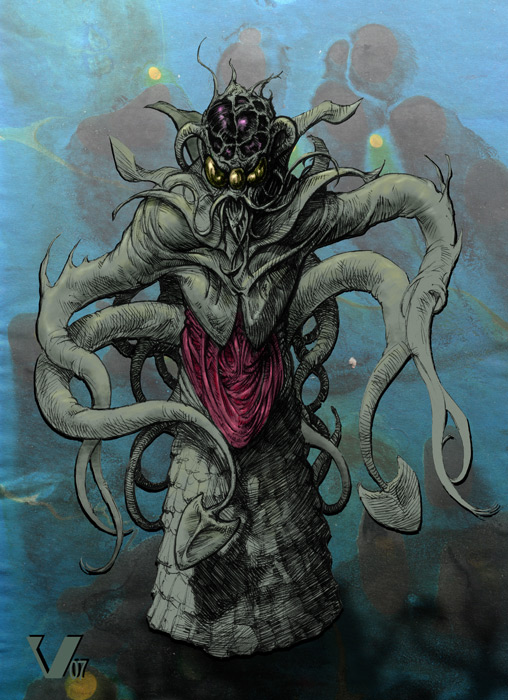
Image care of http://www.elfwood.com/~vibe/Deity-09-Aberration.3340270.html

In my post, Three Thoughts From Last Week’s Game, I presented a list of terms I use to substitute for “bloodied” (a term used in 4th Edition Dungeons & Dragons for a creature who’s been reduced to half their full hit points). It gives the game a bit more flavor. Last night’s game had an addition to the list (care of Luddite Vic) for Aberrations. These are creatures from the Far Realm, which is a plane of existence that’s unimaginably confusing, resulting in insanity relatively quickly for any that visit (and somehow survive that long). The list is updated below.

Oh, and the session was fun. All we got through was two combats, but they’re two of the longest combats in the Hall of the Fire Giant King, and we’re talking high-paragon level. Compared to most 4e D&D games, my Dungeon Crawl System moves very quickly. I wouldn’t want to think about how slow it would have been if I were using the standard system for encounter design.

Follow me on Twitter @GSLLC
Follow Luddite Vic on Twitter @Luddite_Vic

Aberrations unraveling
Flame creatures steamy (as if doused with water to put out the flames)
Ice creatures watery, wet
Incorporeal creatures (e.g., ghosts) misty
Insects, demons, and devils ichory
Oozes, water creatures low viscosity

Hit Point Charts for Council of Spiders

For those of you running the Council of Spiders adventure for the latest season of D&D Encounters, I’d like to provide you with a game aid I like to use when DMing: D&D Encounters Council of Spiders HP Charts. These charts provide an easy-to-use format for tracking hit points and recording whether encounter powers have been used without requiring you to mark up your adventure book. If you’ve seen my 4th edition stat blocks for the gods of the Egyptian and Central American pantheons, this will be familiar to you.  Each creature has an entry that provides the creature name; the creature’s defenses; the mini being used to represent the creature; check boxes to record whether they’ve used their recharge, encounter, or daily powers; and their hit points, accompanied by columns to track damage.

First, I have some general comments for you. If the number of players varies at your table, you’ll  likely be adding or removing certain NPCs from the encounter. Those characters have their hit points provided in bold, italicized fonts to indicate they’re optional characters. Also, a recharge power is indicated by the American trademark symbol followed by a number (if applicable). Thus, the power Ricochet Shot, recharge  , appears as Ricochet Shot®5.

I generally use charts for minions only when the creatures have encounter or recharge powers; however, I’ve included them for all encounters in case you wanted them.

I’ve also included the DC charts that I stole from Sly Flourish. (Click that link. He has a lot to offer the D&D gamer.) I use them often enough that it’s useful to have them on hand on the same sheet of paper as the encounter charts. They’re in the footer of every page.

Finally, you’ll note the copyright notice at the bottom. I can’t help it. I’m an attorney focusing my practice on intellectual property law (and real estate law). I have to include it. Note that there’s also permission to use this for personal use. Basically, all that concerns me is the idea that someone might sell my work product. I doubt that’s a problem, and unless it’s your intent to do so, you won’t have any complaints from me. Don’t make money off of my work, and we have no issues between us.

As a final note, I’ll mention that, as I become more familiar with the adventure, I might add some notes to the pages that help remind me of key elements of the encounter that are easily forgotten or hard to reference quickly when buried in the adventure booklet’s write up. (For an example from last season, I had an italicized, underlined sentence that spelled out the schedule by which teams of skeletons animated as the combat progressed.) Feel free to come back here to see if I’ve updated the document or if you have any such suggestions.

In any case, I hope you find these useful. I’ve provided specific notes for each encounter. Mild spoilers follow.

Encounter 1

As mentioned above, the minion chart might not be useful here. If not, just ignore it.

Encounter 2

It seems strange to eliminate the Ambusher from this encounter if only 4 players are present, but technically he’s the appropriate one to eliminate. Again, the minion chart might not be useful here.

Encounters 3, 4, and 5

No notes.

Encounter 6

This is not likely to break out into combat, so stat blocks aren’t provided in the adventure package. I created stat blocks and placed them here so you wouldn’t have to bounce back and forth between encounters.

Encounter 7

The encounter is level 4, so but there’s only 1 level 4 character on the board: the Drow Acolyte. If you have 6 players, add another Drow Acolyte. Simple enough. Because of the importance of that character, though, removing her isn’t the best option if you have only 4 players. You’re obviously free to do so, but I chose to design the encounter blocks to eliminate 2 of the Drow Templars. YMMV.

Again, the minion chart might not be useful here.

Encounter 8

It makes absolutely no sense to eliminate Valan Jaelre from this encounter, though I guess it makes sense to add another character of his type. Nevertheless, to keep it simple, and to keep the spotlight on Valan as unique, I treated the Hex Knights as the NPCs that should be added or removed from the encounter to adjust for the number of players. They are also of level 4.

You’ll note that the recharge symbol for Valan’s Webbed Miasma power doesn’t have a number after it. That’s because it doesn’t recharge on a die roll. You’ll just have to reference the stat block or remember that it recharges when he’s first bloodied.

Again, the minion chart might not be useful here, especially considering there could easily be no Bone Spiders appearing during the encounter, and even if they do appear, there could easily be no more than one on the board at any one time.

Follow me on Twitter @GSLLC
Follow Mike “Sly Flourish” Shea on Twitter @SlyFlourish

Three Thoughts from Last Week’s Game

I’m currently running my 4th edition D&D conversion of the classic AD&D adventure G3: Hall of the Fire Giant King. My players have run through G1: Steading of the Hill Giant Chief and G2: Glacial Rift of the Frost Giant Jarl, and assuming everyone’s interested, G3 will lead to conversions of the D1-2-3 and Q1 modules as well. The conversions have been performed using  my Dungeon Crawl system, which makes high paragon and epic level play much faster, but most importantly, the system allows for a more realistic approach to dungeon crawls, wilderness treks, or other DM stories that make the 15-minute adventuring day seem ridiculous in both 3rd edition D&D and 4th edition D&D (and probably others).

There were three things that came up in that game that I thought were worth noting here.

Surprise!

Here’s the set up: The PCs are opening a door. The door makes noise. There’s no way to stealthily enter without the NPCs being aware of their presence. However, there’s no reason for the NPCs to be on guard. They’re busy working in the armory, so the door opening won’t necessarily be alarming. They might not even look over, meaning the PCs could still get the drop on them (i.e., gain surprise).

Under those facts, whether the PCs gain surprise is really a matter of luck, which is always handled with a die roll. So, I reached back into my (fuzzy) memory and recalled that surprise in AD&D was handled with the roll of a d6. I told the players that I wanted a d6 roll, and on a 1 or a 2, they’d gain surprise. Knowing my tendency to roll low, they asked me to roll the d6, so I said, “Fine, but you gain surprise on a 5 or 6, then.” They said they’d accept that, because they knew my rolling curse wasn’t a matter of always rolling low, but rather always rolling poorly. I rolled a 5. The PCs gained surprise.

My memory was indeed flawed. AD&D surprise was determined by rolling opposed d6s. From the DMG,

Surprise is determined by rolling a six-sided die for each party concerned, modifying the result by using the most favorable member of the party concerned, i.e., a ranger, surprised only on a roll of 1, will represent the whole of a group of other character types. Note, however, the effect of dexterity as detailed below. The same holds for mixed types of monsters. Of surprise is indicated for both parties concerned, the party which has lesser surprise subtracts its result from the result of the greater to find the number of segments the latter are inactive. Nonetheless, it is possible for both parties to be surprised equally — with surprise having no effect.

Surprise is usually expressed as a 2 in 6 chance for all parties concerned . . . . Each 1 of surprise equals 1 segment (6 seconds) of time lost to the surprised party, and during the lost time the surprising party can freely act to escape or attack or whatever . . . .

There’s more, including a table, but that’s the gist of it. Refer to the AD&D DMG for more.

DM Screen

At DDXP a couple of years ago, I was in an official WotC seminar. DDXP is great because the seminars are small but give you access directly to WotC personnel. (Whether this will change now that WotC has pulled out of the Ft. Wayne convention in January remains to be seen.) I mentioned to Chris Perkins that, despite the 4e DM screen being printed in landscape orientation, it’s still too tall. I like having certain information at my finger tips, but even an 8-1/2″ tall screen blocks too much of the battle map. If I can’t see what’s going on, I’d rather ditch the screen and just rely on a player to look up a rule if necessary. The one thing I can’t live without (for 4e D&D) is the DC chart, but as I provided in one of my Protection from Chaos articles, Protection from Chaos, Part IX: For My Conversion of an Adventure, What May I Publish?, I include that in the footer of my adventures.

Bloodied? How Boring

I’ve always used different words to describe a character as bloodied. (For non-4e D&D players, this refers to a character who’s been reduced to half their normal hit points.) For example, mechanical constructs don’t have blood, so it doesn’t make sense to call them “bloodied.” Instead, I call them oily reflecting that oil, not blood, is spewing from their bodies upon taking a certain amount of damage. Not all constructs, however, are “mechanical.” A stone golem is nothing by stone animated by a spirit of some sort, so stone golems get “gravelly.” Here are some of my favorites (YMMV):

Flame creatures steamy (as if doused with water to put out the flames)
Ice creatures watery, wet
Incorporeal creatures (e.g., ghosts) misty
Insects, demons, and devils ichory
Oozes, water creatures low viscosity

As you should always do, I’m just making the game my own. In my case, that means making the game a smart-ass.

Follow me on Twitter @GSLLC

Composite Skill Bonuses in the d20 System

My love of the FASA Star Trek RPG gave me an idea on how to handle certain situations that I’ve seen before and believe to be handled less-than-ideally by DMs. I ran a quick Google check to see if anyone had already written about this topic, and apparently they haven’t. This surprises me, so perhaps I just couldn’t find it, but I propose using composite skill bonuses to handle an individual task that simultaneously requires multiple skills.

An Example from FASA Star Trek RPG

FASA Star Trek RPG is a d100, skill-based system so that each character would have a skill rating from 0-99 in each of the skills. To determine the success of an action, a player would roll a d100 against the relevant PC skill rating. Roll less than the skill rating, and it’s a success. For complicated tasks requiring multiple simultaneous skills, however, your target wasn’t a single skill rating, but rather an average of all of the relevant skills.

You’ve just boarded your enemy’s starship. It’s a Klingon scout ship with a crew of 8, so it’s no surprise that the entire enemy crew is dead. Unfortunately, the crew activated the self-destruct sequence and severely damaged the only computer that could be used to deactivate the sequence. Time’s running out. There’s no time to fix the computer, then consult a Klingon-to-English dictionary. What do you do?

You roll against your skill in Computer Technology (i.e., repair of computers), Computer Operations (i.e., use of computer interfaces), and Language: Klingon (i.e., your ability to translate what’s on the screen). So, if your skills are Computer Technology 60, Computer Operation 70, and Language: Klingon 20, your target number is (60 + 70 + 20)/3 = 50. If you never learned a word of Klingon (skill rating 0), you’d be at a severe disadvantage, but your general knowledge of computers could still make for a reasonable chance of success (60 + 70 + 0)/3 = 43. Therefore, not knowing Klingon doesn’t automatically make you useless if you beam over to the ship. You’re still contributing on your own merits.

An Example from 4th Edition Dungeons & Dragons

It shouldn’t be hard to imagine some examples of how this would work in the d20 system. Let’s use 4th Edition Dungeons & Dragons as an example.

There’s a group of ogres sitting around a campfire playing the Orc dice game, Rotting Toes. They’re unfamiliar with the game and downright stupid, but they’re also tough combatants that technically are standing watch. If disturbed, they might sound an alarm.

Hat tip to Erik Nowak for creating Rotting Toes.

The party decides that the best way to handle this encounter is to avoid it. Needless to say, the 3rd-level Rogue rolls a Stealth check (+12), succeeds with flying colors, and passes right on by. Unfortunately, the Paladin is in full plate mail armor. Stealth isn’t much of an option.

The accepted solution is a group Stealth check. Everyone rolls their dice, and as long as half of the group makes the check, the party as a whole succeeds. I’m not a fan of this. I know this is a game of magic and monsters, but at times, this solution defies logic. If, for example, due to the surrounding environment, each character must move one at a time across a long distance, the Rogue isn’t going to be able to help the Paladin stay silent. Any way you slice it, the Paladin is on his own, yet the group Stealth check inappropriately allows the Rogue to help.

More importantly, however, is that this is also a game of creativity and imagination, and the group Stealth check stifles that. Even if the Paladin could enlist the help of his friends, that doesn’t me he should. If I were playing the Paladin, I’d want my actions to count. I don’t want someone else to dictate my success in a situation where a little thinking outside the box will keep my fate in my own hands. There are enough opportunities for teamwork elsewhere in the game. Here, I want to be on my own.

Instead, let’s say the Paladin decides to throw a stick to create a distraction. Is this an Athletics check? Is it a Bluff check? How about both? It’s a single action, so if both skills are in play, both should affect the outcome.

The 3rd-level Goliath Avenging Paladin’s relevant skills are Athletics +5, Bluff +3, and Stealth -1. He should have no problem dealing with Ogre psychology (Bluff), but he also has to toss the stick accurately to place it exactly where he wants it to go (Athletics). So, it looks like his bonus to the skill roll for the composite skill bonus is (5+3)/2 = +4. That’s certainly better than a -1. However, this is a Goliath we’re talking about. He’s got a +2 to Wisdom, and his Widsom score is a respectable 14 because it’s his tertiary stat. Moreover, his background includes a strange parentage; he was raised by wolves (Background: Parentage-Raised by Wolves), giving him a +2 background bonus to Nature checks. As a result, his Nature score is a whopping +8.

The Paladin knows that lemurs are the ogres favorite food, and he also knows that this area has plenty of lemurs in it. Instead of throwing the stick simply to get the ogres to look the other way, he chooses to throw it into a lemon tree where Comyrean lemurs are known to play. This way, the ogres not only will look the other way, but also will keep looking, possibly sending one off to grab some lemurs. In order to reflect this mechanically, the Paladin now gets to add his Nature bonus into the mix. His composite skill bonus is now (5+3+8)/3 = +5, which is appropriate for a single action using each of his three relevant skills.

If the DM rewards the creativity with the typical +2, the Paladin has a bonus to his roll of +7, and he deserves it based on his own ingenuity and character build. In fact, the rest of the party might thank him if one of the ogres leaves to investigate — such a ruling is more appropriate for a Bluff check than a Stealth check — as that means one less ogre remains to spot the remaining PCs during their checks.

The +7 is a far cry from the +12 to Stealth that the 3rd-level Halfling Rogue might have, but it’s still pretty good, and it’s his.

It’s Not All About the PCs

This isn’t just a means to inspire creativity. As my FASA Star Trek RPG example demonstrates, sometimes the DM should require the use of a skill (in that case, Language: Klingon) because it’s logical. I’m sure the character with a skill rating of 0 in Language: Klingon wouldn’t want to have to include it, but it makes sense to require it. In the D&D example, perhaps all of the PCs should be required to include their Nature bonus to their checks due to some natural hazard present in the area. There’s a logic to the composite skill bonus that I find hard to ignore. (Yes, I know; magic and monsters….) In any case, a composite skill is appropriate only where a single d20 roll must simultaneously include knowledge or ability covered by multiple skills, such as where there isn’t enough time to take multiple actions.

What Do You Think?

As DM, you could certainly decide that there were no such lemurs present that night, but why would you? This is a system that allows each character to be judged on his or her own merits, and it encourages creative thinking. I can’t imagine any drawbacks, but if you have any, please feel free to share them in the comments below.

Follow me @GSLLC
Follow synDCon @synDCon
Follow Erik Nowak @Erik_Nowak