Let's roll some dice, watch some movies, or generally just geek out. New posts at 6:30 pm ET but only if I have something to say. Menu at the top. gsllc@chirp.enworld.org on Mastodon and @gsllc on Twitter.
As promised, work has progressed on this project. These are self-sufficient stat blocks for 5th edition D&D as described in One-Stop 5e Stat Blocks. The one additional change I made to the blocks was to provide check boxes to keep track of how many times the creature has used its limited-use spells.
As a 4e player, I find the 5th edition stat blocks a major step backwards. The idea of having to comb through multiple spell descriptions in the PHB while trying to run an NPC is unappetizing to say the least. I preferred the self-sufficient stat blocks of 4e. I know there’s a lot of hate for 4e out there, but even the most hateful edition warriors might be able to appreciate one-stop stat blocks. Well, here they are. I’ve gone through the 5e Monster Manual and expanded the stat blocks so that you need nothing more than the stat block to run the creature.
Well, that’s not 100% true. If you want your NPC to shove another creature, then you’ll still have to look up the rules on shoving. However, those rules are the same for all creatures, easy to memorize, and in some cases not used very often, so they’re best left for ad hoc reference to the PHB.
Here are some notes:
In most cases, the basic idea is to expand the spell-like abilities, providing a full description for each. This could get insanely long, so I used some shorthand. A min/maxer would be able to manipulate this language to his or her advantage, but you’re the DM. I doubt that’s your goal.
In addition to making the stat blocks self-contained, I also tried to make the monsters more interesting. In quite a few cases, the stat blocks follow a specific, boring pattern: “Multiattack, Bite, Claw, Claw” or “Multiattack, Melee weapon.” The giants, for example, are remarkably similar. The only difference between the hill, fire, frost, and stone giants are reach and resistance. So, even for a CR 2 NPC like the Azer, it made sense to give it Innate Spellcasting. This gave it an underpowered ranged attack, making the Azer more interesting without making it overpowered.
I’ve noticed that the player power curve beings to distance itself from the NPC power curve by 5th or 6th level. This isn’t surprising in light of the fact that the table on page 274 of the Dungeon Master’s Guide, Monster Statistics by Challenge Rating, requires higher damage expressions for many higher-level monsters than what appears in the Monster Manual. My stat blocks reflect what’s in the Dungeon Master’s Guide, so expect tougher monsters. Note: I did not increase monster AC or hit points, because I didn’t want NPCs that would create seemingly interminable encounters.
Legendary creatures are, across the board, interesting and well-stated out. I haven’t made any changes to the statistics of legendary creatures.
The couatl is an example of a stat block that requires some discussion. Despite not being a legendary creature, when I converted the stat block to my format, it was over a page long (9-point font, 1/2” margins). There are some that are even bigger. This can be seen as a failure of monster design (i.e., it’s too complicated to expect a DM ever to use it as written) or a success of monster type. By the latter I mean that the full stat block should be seen as a starting point. You can delete spell-like abilities that you’re never going to use, leaving a smaller, more manageable, and more practical stat block. When you’ve deleted certain spell-like abilities, what’s left could be a couatl that focuses on healing, focuses on damage, or is best suited for a role-playing challenge. Or not. If you want to run it as written, go for it. I’m not barking out orders; I’m just providing some options.
The further I went into the Monster Manual, the bigger the stat blocks became. High-level casters have a lot of spells.
I added a suggestion for using a slaad in an otherwise boring encounter. I’ve had some fun with it and hope you do as well.
For the final version, I’ve made several changes. Mostly they were pagination choices, but I had to fix my screwed up dryad (forgot some spells), and I had to correct all of the spell descriptions for Suggestion (adding the save). If you find any errors, please let me know.
There’s a discussion about these stat blocks on ENWorld here. I’m making several changes based on the feedback I receive there. If you want the latest, greatest document, bookmark that discussion or this page.
And so, here is the complete set of one-stop stat blocks for 5e:
Completed October 26, 2015
Edited 10/31/2015: Added appendix showing all changes I made to stat blocks. Added a table of contents. Every stat block starts on a new page. Corrected several typographical errors due to copy-and-paste errors, including (among other things) missing powers, extraneous powers, and incorrect to-hit and damage expressions.
Edited 11/1/2015: Corrected cut-and-paste errors appearing in Hill Giant stat block. Added Hill Giant’s Rock power to errata.
Edited 11/1/2015: Added a date and time stamp so you can make sure you have the latest version. Added a spellcasting sheet for hag covens.
Edited 11/7/2015: Added the spellcasting variant of the Vampire. Corrected a typo in the Pixie stat block.
Edited 11/23/2015: Corrected the Archmage stat block to reflect that Fire Bolt as a cantrip.
Edited 12/05/2015: Corrected the Yugoloth: Nycaloth stat block to reference itself rather than the Lamia in the Mirror Image spell.
Edited 12/06/2015: Corrected the Yugoloth: Nycaloth stat block to reference itself rather than the Lamia in the Mirror Image spell (there were two errors, one of which was missed in yesterday’s edit).
Edited 12/26/2015: Incorporated the Official Monster Manual Errata from Wizards of the Coast. Corrected the Drow Elite Warrior to include poison damage in the shortsword attack.
Edited 06/01/2016: Corrected the typo in a Dao’s feature.
Edited 06/17/2016: Corrected the Fire Giant’s Burning Hands spell.
Edited 10/29/2016: Corrected both mind flayer stat blocks to reflect the property creature type (aberration) and alignment (lawful evil).
Remember, if you like what you see and want the upcoming Kobold Press bestiary to use this stat block format, pummel Wolfgang Baur with tweets saying so! He’s at @MonkeyKing on twitter, and Kobold Press is, not surprisingly, at @KoboldPress.
As a follow up to yesterday’s post providing the converted pre-generated characters, I provide you the encounters for Ghost Tower of Inverness converted to 4th Edition D&D. Note that these encounters are designed using my dungeon crawl system for 4e.
Due to copyright law, only the mechanics of the encounters are presented. The only creative content you’ll find within is that which I created myself to update the encounters to 4th edition, but those are very few in number. This is the best adventure every written for D&D; it didn’t need my help.
Any gamer that knows me well knows that Allen Hammock’s Ghost Tower of Inverness is my favorite RPG adventure of all time. Allen wrote it for the AD&D tournament at Wintercon VIII. I’m arranging to run my 4th Edition D&D conversion again, and that inspired me to post my versions of the pre-generated characters for that game in case my players, or anyone, wants to use them. As 4th edition is often played with 6 characters, I created my own character, Three, which I’ve provided as well. I also took some liberties with the races of the characters for the sake of stirring the pot and updating to the modern gaming community. These were created some time ago, and I’m no min/maxer, so you might want to make some modifications if you’re going to use them.
… or is it a Fate Accelerated hack of D&D? I get that confused.
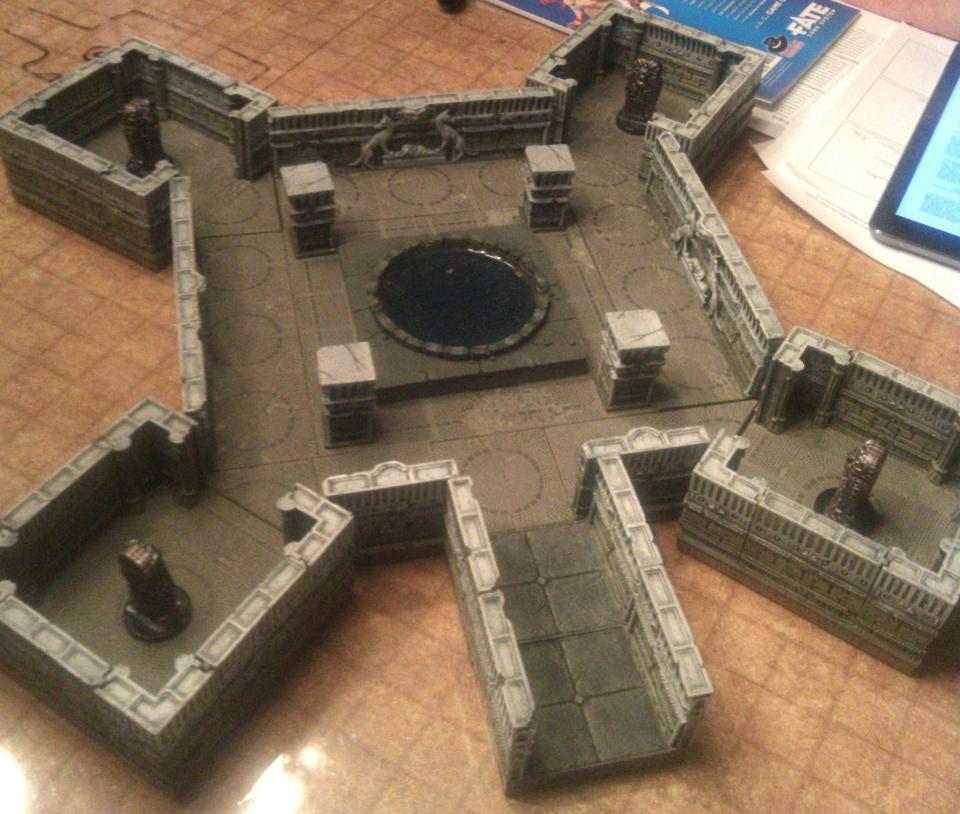
Every single room had a pool in the center. “Lazy” doesn’t cover it.
On New Year’s Eve, Mike Shea, a.k.a. Sly Flourish, introduced me to another game. Well, actually, he introduced me to Fate back at GenCon (via his Aeon Wave project), but being that I almost completely forgot the game rules, it felt new to me last night. Mr. Flourish (as you should address him when you meet him) has adapted Fate Accelerated to fantasy role-playing using much of the terminology/approach of 4th Edition D&D, and has labeled it “Dungeons of Fate.” He ran an abbreviated version of the classic AD&D adventure compilation, Desert of Desolation, and the system allowed him to do so with no real preparation of mechanics beforehand (quite appropriate for a Lazy DM). After the game was over, he asked me, “So, does it feel like D&D?” This one question sparked a discussion on gaming philosophy, dragging in Michelle (a.k.a., Mrs. Flourish) and another player, Brian. In the end, I think we agreed on most, if not all, of the points all of us were making, but here’s my take on what we discussed.
1. Not Everything Has to Be D&D
Dungeons of Fate didn’t feel like D&D to me, and to that we should all be collectively responding, “So what?” The only game that has to be D&D is D&D, so no matter who owns the intellectual property, they must always respect the brand or it isn’t really D&D. D&D, as the most powerful RPG intellectual property, is 6 attributes (Strength, Constitution, Dexterity, Intelligence, Wisdom, and Charisma, regardless in what order you present them), hit points, an armor class representing your ability to avoid damage from a hit, and a bunch of funny-shaped dice. These are the constants (among others) that must be in any edition of D&D regardless of who owns the property. This is reason #1,942 why the Edition Wars are stupid: All of the versions of D&D are “real D&D” because they all respect that rule. Whatever else is added to that base, the presence of that base makes it D&D. You don’t have to like it, but it’s still D&D.
However, Fate isn’t D&D. I couldn’t care less whether Dungeons of Fate feels like D&D.
Scratch that. I do care. I don’t want it to feel like D&D. If it did, why create it? Why didn’t Evil Hat Productions just post to their blog, “Hey, everyone, we’re not going to create a new game. Just play, D&D, okay?” They didn’t do that because they wanted to create something different. Whether you like Fate or not, the industry and community are better off because we have something different.
On the other hand, Dungeons of Fate does allow for the proper feel for a fantasy setting. That should be the more important issue to players, GMs, and Evil Hat.
2. Fate Isn’t Omnipresent, But It Has It’s Place
Reasonable minds disagree, but in my humble and honest opinion, Fate Accelerated is a horrible system for a long-term campaign. There’s no significant advancement, and the simplicity of the characters runs the risk of making them boring from a mechanical point of view. (Perhaps the full Fate Core addresses this.)
So where does that leave Fate Accelerated? Well, it leaves it in plenty of places. Not every RPG game has to be a weekly campaign lasting nine months. One-shots are a common practice, and two- and three-shots are hardly rare. Fate Accelerated certainly works for gaming groups organized that way. Personally, I’m more a fan of the two-shot or three-shot, even for D&D, so the idea of my home groups organizing around them doesn’t bother me at all. Unlike D&D, however, Dungeons of Fate requires no prep time for NPC mechanics, and if you’re focused (granted, most gamers aren’t), the entire table can have its characters ready to go in 30 minutes or less.
Mind you, these characters are exactly the characters the players want to play. If you want to play a ranger that is just as competent with melee as he is with striking, you can do that. If you want to play a “stone mage” more statute than human, go right ahead. You don’t have to worry about fitting your characters into the strict constructs provided by other RPG systems, nor do you have to wade through a seemingly infinite number of options in order to find the one strict construct that matches your character concept. You also don’t have to rewrite the rules in order to make room for your character concept. In other words, Dungeons of Fate as is gives you remarkable flexibility without having to overload you with options in order to do so.
3. On the Whole, Dungeons of Fate (and Fate Accelerated) Is Pretty Good
It all comes down to this: Is Dungeons of Fate fun? Absolutely. I really don’t like stress points. In fact, I don’t know why Fate Accelerated players do. One of Fate Accelerated’s best features is simplicity. Stress points seem to be a slight bit more complex than they need to be. I don’t get it, but I don’t have to get it, because this isn’t a deal breaker. It’s literally the only thing about Fate Accelerated I don’t like, and I don’t hate it. To a realistic game designer, that’s about the best you can ever expect; you can’t please everyone all the time. Leaving it in there still leaves me with a great time at the table.
Much like 13th Age, I encourage any RPG enthusiast to give Fate Accelerated a try, if for no other reason than this: If you every find yourself at a gaming store or convention with a hole in your schedule and you’re looking for something to do, you could always jump into a quick pick-up game of Fate. It’s as suited to that situation as a simple card or board game, yet the role-playing opportunities are just as robust as any other RPG.
Information has slowly been swirling through or local Washington, DC gaming community, and to a lesser extent, beyond that. The Gamers’ Syndicate has put synDCon on hold and is focusing its efforts instead on something that you can enjoy all year round: A living campaign for 4th Edition Dungeons & Dragons. Many 4e players feel that there’s still more to do with 4e, just as 3rd Edition players felt there was more to do with 3e, and we’re seeking to give 4e players that same opportunity that Paizo gave the 3e players with Pathfinder and, more to the point, Pathfinder Society.
Living Campaign
For those of you that don’t know what a “living campaign” is, I point you to the Wikipedia entry, because Wikipedia never lies. Actually, “living campaign” is often defined differently by different people. To me, the most important aspect of a living campaign is allowing all of us to meet each other. In other words, it grows the role-playing game community; however, there are other important aspects to it. It allows the players to shape the campaign world even though their playing pre-written adventures. That is, if the majority of players accomplished a task in one adventure, that fact will be tracked by the authors and shape how future adventures are written. What the players do matters, even though they’re sharing the experience with thousands of players worldwide.
The Campaign Setting
Every campaign needs a campaign setting: a world that needs protecting and sometimes saving. Some famous examples of Dungeons & Dragons campaign settings include Ed Greenwood’s Forgotten Realms, Keith Baker’s Eberron, and Gary Gygax’s (everyone bow, right now!) Greyhawk. Our campaign setting hasn’t yet been named, but it’s one of our own design, spearheaded by the devious mind of Erik Nowak (who, if you recall, brought us Rotting Toes). Erik premiered the first two adventures (co-written by Dave Phillips) for this campaign setting at synDCon I and synDCon II. The setting is high fantasy, but not quite that high. Characters will use inherent bonuses so that acquiring magic items won’t be critical, and when they are acquired, they’ll be special.
We’re also introducing a mechanic for tracking a character’s reputation in the kingdom, and have a fairly ambitious plan in the works, but those are topics for later posts.
GenCon 2013
As I’ve mentioned before, I’ll be running the two introductory adventures at GenCon this year, which serves as a sneak preview of the campaign. However, we’re working on the first four adventures, so we’re on track for an official start not too far in the future. Stay tuned.
For the first time, I’m going to GenCon and not working for Baldman Games. (You should work for them if you like Dungeons & Dragons. They give great rewards for running games.) I’m just going to play (though I’m running four slots). I’m honestly not sure how much gaming I’ll want to do. I might get bored and do something else. In any case, like all the other con-goers, I sat there at my computer just waiting for the countdown clock to strike zero at noon. I was lucky enough to be assigned #738 in the queue. Anything under 1,000 is lucky as all hell, and as a result, I got everything I wanted. This includes two puzzle-oriented True Dungeon adventures and a few role-playing games, none of which I’ve ever before played. Isn’t that what GenCon is supposed to be about: Trying new games? That’s my philosophy. I bought an extra ticket for each of the True Dungeon adventures, so I can help out a friend get into the game.
My current GenCon schedule is below. I have absolutely no complaints.
Thursday: Dungeon World (RPG1341359) at 1pm, then the One Ring (RPG1343873) at 8pm.
Friday: True Dungeon (Lycan’s Afoot, TDA1348116) at 9:37am, then running the Gamers’ Syndicate new living campaign adventures at 1pm (RPG1343708) and 7pm (RPG1343710).
Saturday: True Dungeon (Golembane, TDA1348648) at 9:39am, then running the Gamers’ Syndicate new living campaign adventures at 1pm (RPG1343709) and 7pm (RPG1343711).
Sunday: A seminar on game design (SEM1346700) at 10am, then Far Trek RPG (RPG1342003) at noon.
This schedule lets me sleep in for the most part, and gives me plenty of time to roam the halls and keep myself fed. Let me know if you’re in any of my games.
EDIT: This post from January 24, 2013, is one of the first links provided by a Google search for downloading this module, but it’s understandably a bit out of date. The PDF is no longer free to download, but the current link to purchase it is here: https://www.dmsguild.com/product/17081/B1-In-Search-of-the-Unknown-Basic?term=b1+.
In case you didn’t hear: You can now download PDFs of prior edition Dungeons & Dragons materials over at http://www.dndclassics.com/. My first mod, B1: In Search of the Unknown, is free to download … 100% legal. With that, I point you appropriately to my article from Loremaster.org, The Rise and Fall of Norrin the Barbarian (Loremaster.com is no longer available).
This is a guest post from DM extraordinaire, Erik Nowak. I was one of the players in this game and have used Rotting Toes in the last season of D&D Encounters. I hope you enjoy it as much as we did.
==============================
In a recent D&D 4E session set in Neverwinter, the players needed access to the city’s orc-controlled River District. They approached a gate guarded by several bored orc soldiers. Some of the orcs were lightly dozing, while others were gambling, playing a dice game in the dirt. It was to be a simple role-playing exchange: the orcs act tough and demand 10 gold pieces per character to enter their territory – either the heroes paid, or they act tough and refuse and a fight breaks out. Instead it went like this:
“Can I make a check to see what game they are playing?”, one player asked.
[Rolls a skill check; super high result, of course.]
I responded, “Um… sure. It’s called, uh, rotting toes.” That sounded fittingly orcish.
“How is it played? And can we join in?”
“Sure, the orcs are happy to take your gold.”
Then I found myself in a pickle: I needed a dice game! I don’t know any dice games other than craps, and I didn’t want to use that.
So I made one up on the spot.
The first thing I thought of was the old school AD&D method of rolling for ability scores: roll 4d6 and drop the lowest die. I started there and was able to tie it in with the name by thinking that the die-dropping represented a toe rotting away from a diseased foot. Then I made the rest up right there and let the players have a go!
History
The game has its root in the story of an orc warrior who was suffering from a wasting disease of the foot that resisted magical healing. A shaman of Yurtrus, the orc god of death and disease, told the warrior that his fate was in the hand of Yurtrus alone, and the inscrutable, silent god would do as he pleased, unmovable by deed or prayer. All the other orcs could do was bet on whether or not the warrior’s toes would rot off.
(What happened to the orc, you ask? His toes all rotted off. Then his foot, followed by the rest of the leg. Then he died. Orc tales don’t have happy endings, people.)
Pictured: Someone who didn’t take the feat, Skill Training: Math.
Playing the Game
To play rotting toes, you need 4 six-sided dice and a group of several players with coin, one of whom is the Hand of Yurtrus, or “the Hand” (the dice roller). The role of the Hand switches to a new player each round.
The Hand places a bet, typically 1 gold piece. Other players place bets on whether the Hand will lose or win (“rot” or “not”). The Hand has three chances to roll doubles in 2 separate throws of the dice. If 2 throws yield doubles, the Hand wins, and the players who bet on a loss lose their coins, which are distributed evenly amongst the Hand and the players who bet on a win. Otherwise, the Hand loses, and his coins, plus the coins of the players who bet on a win, are evenly distributed amongst the players who bet on a loss.
Order of Play
1) First Throw: The Hand rolls 4 dice, looking for any set of doubles. Regardless of whether or not doubles were rolled, the lowest die is removed from play (a “toe” has “rotted away”), and the Hand rolls again.
2) Second Throw: The Hand rolls 3 dice, again looking for a set of doubles.
If doubles were rolled previously, and doubles are rolled here, the round ends and the Hand wins.
If neither throw yielded a set of doubles, the game ends and the Hand loses.
If doubles were rolled in one of the throws, play continues to a third throw with the lowest die removed from play.
3) Third Throw: The Hand rolls 2 dice, again looking for a set of doubles.
If doubles were rolled previously, and doubles are rolled here, the round ends and the Hand wins.
If a second set of doubles is not rolled, the Hand loses.
Playing Rotting Toes in Your Campaign
To play rotting toes in your D&D game, have a PC take the role of the Hand and place a bet. Allow other PCs to make win or lose bets as well, but these bets are optional.
The Hand then rolls the dice until he wins or loses, as outlined above. For ease of use, I didn’t bother recording the number of actual rotting toes players or how each one of them bet. I simply said that when the Hand won on a 1 gp bet, he gained 2d4 gp to represent the winnings taken from the pot. Anyone betting on the Hand to win gains the same amount. If the Hand loses, any PC who bet on the Hand to lose gains 2d4 gp.
Cheating
One character in my game – the rogue, of course – asked if he could cheat. I allowed for it, but due to the number of eyes on the dice, it would be difficult to do unless the cheater brought his own weighted dice – which the orcs would never allow! To cheat, the Hand throws the dice and makes a Hard DC Thievery check. On a success, the Hand may change the result of one die thrown. A failed check makes the other players suspicious, and the DC for future checks increases by +2. A second failed check confirms the players’ suspicions, and will get the thrower ejected from the game (at best), or attacked. When playing with orcs, a Hand caught cheating is very likely to be killed immediately.
Additionally, it is a little-known fact that when playing with orcs, winning too many times as the Hand will also arouse suspicions of cheating, whether the winner actually cheated or not. Typically, if a player wins more than 3 times in a row as the Hand, he is given a savage beating – even if there is no evidence at all of cheating – just for being “too lucky” and making a mockery of Yurtrus’ judgment.
I said this on Twitter, and I’ll say it again here. Based on what I’ve seen from the later D&D 4e products, the current season of D&D Encounters, and D&D Next, I feel like all the work I did on the dungeon crawl system was completely validated. (It’s a shame the Living Forgotten Realms living campaign writers didn’t follow suit, as it would have breathed new life into the campaign.) WotC basically took 4e in the direction I took it about a year ahead of time, and after processing the feedback from 4e players, D&D Next is looking like a “dungeon crawl system, second edition.”
Please note that I’m not suggesting they plagiarized my work (though I know they were aware of it), and even if they did, it’s not illegal. I’m simply pointing out that great minds think alike, and apparently I’m a great mind. 🙂



 I said this on Twitter, and I’ll say it again here. Based on what I’ve seen from the later D&D 4e products, the current season of D&D Encounters, and D&D Next, I feel like all the work I did on the
  Play What You Want