Let's roll some dice, watch some movies, or generally just geek out. New posts at 6:30 pm ET but only if I have something to say. Menu at the top. gsllc@chirp.enworld.org on Mastodon and @gsllc on Twitter.
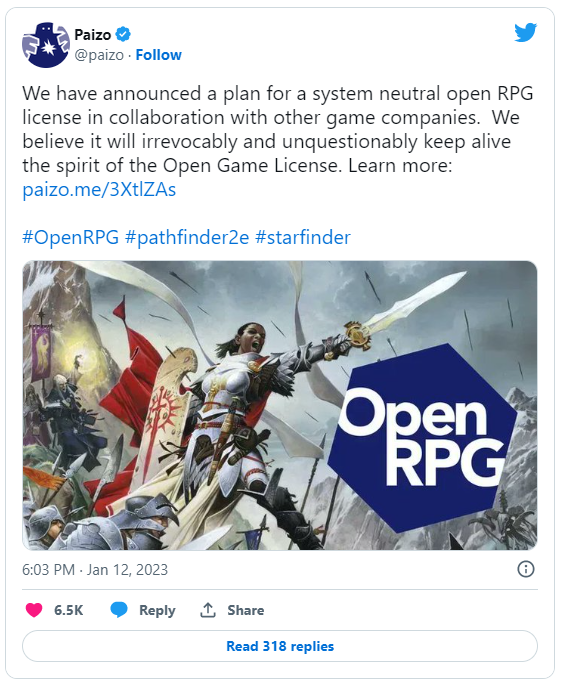
Yesterday, Paizo announced that they were developing a “system-neutral, open RPG license.” It’s overwhelmed with traffic, so you’ll have to be patient when trying to load it. They had a form for volunteering to review it and give feedback. After I signed up, I noticed some text that said it was for game designers only, so I doubt I’ll get an advanced copy for review. Maybe that’s a good idea considering my initial impression.
Same Old Song & Dance
As I’ve been running into the ground for well almost 15 years, the OGL isn’t a real license, and claiming it is has done a lot of damage that we’re finally seeing manifest in real harm, which I predicted. You can’t say I haven’t been warning you that this day would come. Talking about irrevocability or any other concept that applies to contracts shows that you’re missing that critical point, and that’s exactly what Paizo does in this announcement.
We believe that any interpretation that the OGL 1.0 or 1.0(a) were intended to be revocable or able to be deauthorized is incorrect, and with good reason.
Unless their position is that those interpretations are incorrect because they simply don’t apply to non-contracts, then they’re advancing the same false narrative that Wizards of the Coast (“WotC”) has since at least 2004. The fact that they intend to state their proposed consideration in a separate document suggests that we’ll be dealing with a “contract” with far too much uncertainty as to what it actually licenses. Maybe it’ll be an unmalleable appendix rather than a separate document — we don’t know — but everything I read in that press release leaves me pessimistic.
Remember, the OGL should have been an acknowledgement of the material WotC conceded they didn’t own. If they wanted it to be a real license, then it must be 1) specific about exactly what material the public now use, and 2) that material must be material the public otherwise wouldn’t have been able to use. That is, the consideration must be both obvious and real. Any other approach with Paizo’s license will mean that Paizo is continuing to feed the public that false and dangerous narrative. Granted, no one’s going to die because of this, but people’s livelihoods are on the line, so “dangerous” fits in that context. If you continue to buy into it this false narrative, you’ve learned nothing from the turmoil the OGL has caused, but you can’t blame WotC for it any longer. Like the danger from cigarettes, the information is out there, so it’s on you if you accept the risks.
And now we finally have WotC’s official statement, which demonstrates a victim complex. They 1) still intend to treat it as a legitimate license (of course); 2) act as if, on the week the final copy was to be distributed, that they were always just looking for feedback; and 3) overfocus on the non-discrimination provision to which no one objected, all to make themselves look like the good guy. Additionally, as Stephen Radney-MacFarland pointed out, you expect us to believe that they “didn’t see this coming”? Unbelievable, and yet paradoxically exactly what we expected.
But It’s Pazio!
You may believe Paizo’s promise of irrevocability even though it wouldn’t be legally enforceable. Some of the readers of this blog know Paizo management personally, so maybe you’re right for trusting them. But consider this: What if Hasbro’s chief rival, Mattel, decides to take advantage of Hasbro’s tarnished reputation and enter the RPG market? What would be their best way to jump start such an effort? If I were them, I’d buy Paizo, and if that happened, would you still trust Paizo to do the right thing? Do you know any Mattel executives? Would that even matter? Would a $7.18 billion business never change course because they’re a “nice bunch of guys”?
Still, everyone, including me, should give Paizo a chance. Maybe they’ll surprise me despite this reckless language.
Just a quick note today, as my next bit of legal analysis I’m preparing is going to take a while to write. Try not to shoot the messenger for today’s post. I’m just trying to help.
I see a lot of people online calling for a new open gaming license that’s done correctly. Sadly, that’s missing the point.
Our problems aren’t going to go away as long as you continue to buy into the fiction that the Open Gaming License (“OGL”) is a real license. It clearly isn’t, but if you treat it that way by giving lip service to its arguments that apply only to real contracts (“It’s irrevocable!” “It can’t be deauthorized!”), or make calls for bigger, better, open gaming licenses, you can still be duped. As I said yesterday, the OG”L” (which should no longer contain the misleading letter L in it) should be a statement of what the game designer acknowledges they don’t own, and thus have no power to stop you from sharing. With RPGs, that’s far more material than you probably realize.
To the extent that a publisher has copyrightable material and wants to dedicate it to the public domain, they should simply do that with an undeniably clear statement to that effect. (Copyright law won’t allow contract ambiguities to result in such a dedication.) Otherwise, you might as well draft a “closed gaming” license with proper means of acceptance (i.e., signatures) and clearly stated (and proper) consideration, and just make sure the terms aren’t unreasonable. What many of you are actually asking for is oxymoronic, and as a result, using SRD material that has even the tiniest chance of being copyrightable could still get you in trouble. It hasn’t been licensed to you because the OGL is not a license, and there’s no doctrine of laches in copyright, so the copyright remains enforceable even after 20 years.
I’m glad so many of you, especially attorneys, are finally catching up with my rants from the past 10-15 years and my posts from 3 years ago, but some of your hearing has thus far been selective. I’m making a call for awareness from game designers and honesty from and the attorneys they employ, but the public’s insistence on believing the lies surrounding the OGL is a serious hurdle to those goals. This is not me merely demanding legal precision. Figurative use of the word, license, has added to your misplaced faith, so it’s no longer acceptable for any so-called “open license” to use that word. We’re seeing the very real, tangible effects it’s having on the community and industry right now.
We don’t need another fake license; we need an honest legal statement or a real license. As long as you allow this fiction to rule the day, the community and industry will suffer regardless of how this whole OGL 1.1 thing shakes out.
Reality checks can sometimes be helpful, but you need to be open to the help.
So, the Open Gaming License 1.1 (“OGL”) was leaked. Let’s remember that 1) it could be fake; 2) it could be real but modified; and 3) it could have been an intentional leak designed to get feedback in dumbest way possible. We don’t strictly know which of the three it is, though the response of Wizard of the Coast (“WotC”) makes me believe that #1 is not an option. Here’s the response:
Oh, I’m sorry. Wrong media. Here it is.
We know you have questions about the OGL and we will be sharing more soon. Thank you for your patience.
I think it’s fair to be thinking about the issues this leak raises. I’d just prefer people not assume the sky is falling. Changes could be coming, however unlikely or meaningless they may be. Anyway, with all those caveats above . . . .
A Brief Review
When it comes to consideration, the OGL 1.1 falls into the same structural trap that the OGL 1.0 does. It licenses you “methods, procedures, processes and routines” as well as ” any additional content clearly identified as Open Game Content by the Contributor. . . .” The first part of that grant mirrors language in the Patent Act and patent law practice defining what can be patented. Likewise, these same words are used in the Copyright Act (specifically 17 U.S. Code § 102(b)) and copyright law practice to describe things not copyrightable. So, for a company like WotC that isn’t using the OGL to license patented subject matter (which is pretty much the case for all RPG producers), that first part clearly licenses nothing.
The second part of that grant is meant to reference the System Reference Document (“SRD”), but by its own terms could mean a press conference. A clear statement is a clear statement. However, in WotC’s case, they use the SRD. The content of the SRD is either mechanical (never copyrightable), an inseparable mix of mechanical and creative (and thus not copyrightable), or so simple and trite as to not represent even the “modicum of creativity” necessary to be copyrighted. So, my position has always been that, even with that second part, they’re still giving you nothing.
"Wizards, however, rarely releases Open Content that is not just mechanics." If the #SRD is the #OGL's consideration, and only a small part of it isn't mechanics, isn't #WotC conceding my arguments about stat blocks (a large part of the SRD) being just mechanics? #DnD#RPG#TTRPGpic.twitter.com/SWCkHklwsb
— Rob Bodine, gsllc@chirp.enworld.org or @dice.camp (@GSLLC) January 7, 2023
It’s apparently WotC’s position as well.
Now, with a new OGL on the horizon, maybe they’ll fix that. Maybe the SRD 5.1 (and OneD&D’s SRD) will contain licensable material. Assuming that material (or you’re assuming the material in the current OGL) is creative, does that mean the OGL won’t fail for lack of consideration?
Nope. It still fails, and here’s why.
An Analogy: Renting an Apartment
Recently, I started sharing this analogy on social media, and I think it makes it easier to understand the structural failure of the OGL. Let’s say you sign a lease to rent an apartment. It’s states that your rent is $800 (cheap nowadays), and that it runs from January 1 to December 31. Easy, right? Let’s say it also has a provision stating that you agree to abide by all the Rules & Regulations that appear in a second document. This is hardly rare. I’ve seen them more times than I can remember.
So, why put Rules & Regulations in a separate document? Is it to save space? Clearly not. If the lease is 3 pages long, and the Rules & Regulations are 10 pages long, then combined they’ll be 13 pages. Either way, it’s 13 pages of content, most of which you’re unlikely to read until there’s a dispute, so you’ll just skip ahead to the signature page and sign it. If the concern is organizational, then why not include them an exhibit or appendix? Again, why put them in separate documents that often aren’t even available when you sign the lease?
There’s only one reason: The Rules & Regulations are expected to change as circumstances change.
If the waste disposal company changes their pickup day from Tuesday to Monday, it makes no sense to say that trash can’t be put out until Monday evening after sunset. The Rules & Regulations must adapt. Use of common areas gives rise to the same need for flexibility. If anything in the Rules & Regulations were expected to go unchanged during the term of the lease, they could have been included in the lease.
Well, the OGL is your lease, and the SRD is your Rules & Regulations. The OGL sets the basic terms that can or cannot be revoked (separate discussion), but they reference a separate document where you get the current set of intellectual property that WotC (or any licensor) wants to license to you. There’s no legal or contractual reason to infer that any given licensor using the OGL is restricted from changing the contents of that document, and every reason to believe they can change it whenever they want.
You may think that, in this case, there is a reason to separate the two into different documents that has nothing to do with whether they can be changed. The OGL was intended to be used by other gaming companies with only their intellectual property within it. But that only solidifies that SRDs must be flexible. Also, it doesn’t get around the fact that the “clear statement” of the licensor could have been referenced as a required appendix or exhibit to the license itself rather than a separate document. It could have flat out stated that it was immutable, and absolutely should have said it is “incorporated by reference.” Again, there’s nothing (I’m aware of) in the contract, the law, or the history of interpreting consumer contracts that leads us to infer that the SRD can’t be changed. It’s a separate document (or oral statement!) that otherwise has no need to be separate. If I’m wrong, please point me to an example of a consumer contract with a separate, unsigned document (not merely an appendix, exhibit, schedule, etc.), not necessarily drafted at the time the contract is accepted, and not required to be in writing, that doesn’t expressly demand immutability in that separate document, yet is interpreted to require the separate document to be fixed. (That’s a mouthful, but it’s a lawyers job to interpret such sentences, so they know what I want.)
Aside: One thing that makes the OGL laughable is, carrying this analogy further, the OGL is like the lease and Rules & Regulations, but where the unit you live in, the amount of your rent, and the term of your rent all appear in the Rules & Regulations rather than the lease itself. I hope you see how batshit insane that is, but that’s what we’re dealing with.
This kind of uncertainty of consideration, especially where the licensor has no patents to license, calls the entire structure into question. I find it unlikely that this “contract” survives judicial scrutiny even if the licensee (non-drafter) of the OGL, wants consideration found so that you can enforce it. (Of course, what do you do with interpretation if the licensor is a game designer other than WotC? In that case, neither party drafted the contract, and by the OGL’s own terms, the licensor may not change it [the OGL].) Courts aren’t going to decide for the parties what they think should be included in the SRD with no guidance from the OGL to decide that. All it says is that there must be a “clear statement.” Statements change all the time.
Going back to the lease, your rent and term are set in stone. No matter what they do with the Rules & Regulations, your rent and term can’t be changed. The same is true here. The terms of the OGL aren’t changed by the SRD. You still can use their patents without any apparent restriction (isn’t that odd?), you still can’t use “environments” WotC mentions (that’s crazy), you can still accept the license merely by playing the game even if you’ve never heard of Dungeons & Dragons (“WTF?!”), etc. But again, there’s no reason to believe that the contents of the SRD are set in stone. They’re expected to change, and that also makes sense when considering that WotC has a federal right to control its copyrighted material. WotC hasn’t dedicated their work to the public, but a contrary interpretation could lead to exactly that without a clear statement of intent to do so. Federal copyright law will always override state-based interpretive principles. That is, state contract theories don’t overrule federal law (let alone the Arts & Sciences clause of the U.S. Constitution). I’ll have more to say on that in a future post, because the fact that copyright is involved adds even further strength to this argument.
On a side note, this is why the alleged irrevocability of the OGL is completely irrelevant. The OGL may be irrevocable, but the SRD isn’t (so to speak).
Could Things Have Been Different?
Someone asked me whether a license is even possible. Yes, it is, but not in the way the OGL was intended, and certainly not in the way you’ve all treated it all these years. The OGL 1.1 approaches a real license. It’s a shitty one, but it’s nearly a real license, and I don’t think it would have been received well even if the terms weren’t so onerous. I don’t think the OGL should have ever been (mis)characterized as license. Again, it’s point was to say, “We’re letting you use everything we put in the SRD,” even though most, if not all, of that material is not copyrightable.
What the SRD should have been was instead the exact opposite. It should have been a statement by WotC conceding what they didn’t own, and thus what you were free to use for all time because they had no right to stop you. They should also have said that, in the event they did own anything in the SRD, it’s dedicated to the public domain. If you think it through, that’s how you’re using it, and at least for the overwhelming majority (if not all) of that material, that’s what the SRD discloses. This would also alleviate every single concern I’ve ever stated on the OGL, because the OGL wouldn’t be needed.
Depending on WotC’s eventual statement, I may publish a post I have written that will be quite a serious statement on my part, but either way, I’ll be diving into some heavier copyright theory. Stay tuned.
Either way, can we all agree that WotC screwed up?
Isn’t Microsoft Paint the best?! Eat your heart out, Nowak!
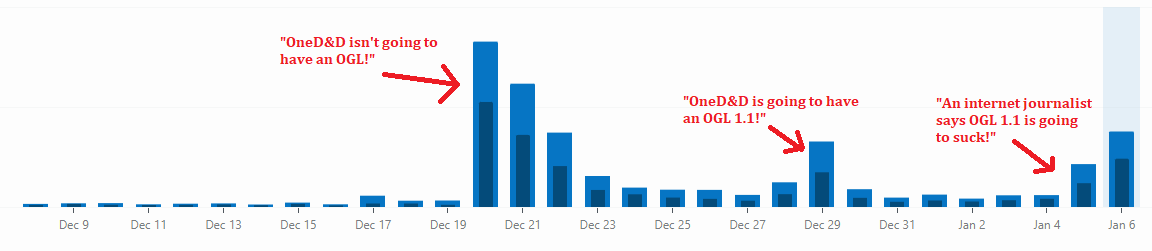
But wait! It gets … worse? Better? Throughout those posts, if I referenced a legal concept that wasn’t critical to the theme, rather than spell it out for you, I saved space by linking to a discussion of that legal concept on my far less popular legal blog. Here are the hits for that blog over the past few days.
Since writing this post, these numbers have gotten MUCH bigger. Today’s hits are now twice as large as December 29th’s and are approaching December 21st’s.
I don’t want to be famous, so I may have to shut down these blogs. 🙂
Also, I should have tagged John and Tales of Arcanayesterday, so I’m doing so today — with top billing — even though they have nothing to do with this post. So, there you go. If I’m going to be famous, I’m pulling those nerds into it with me.
Something Serious
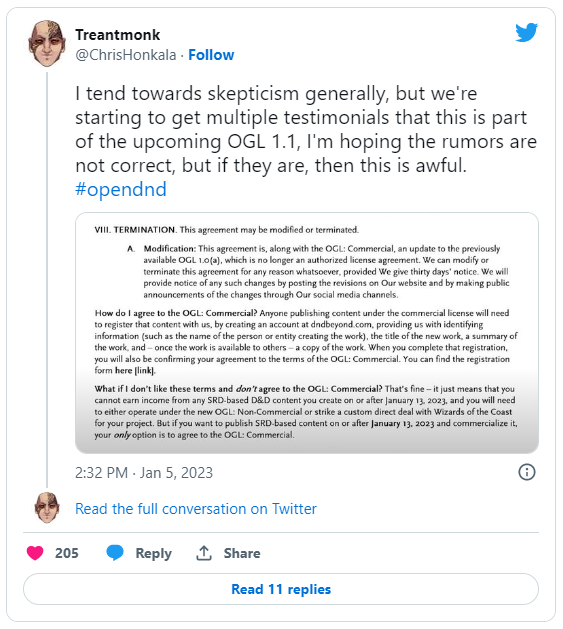
This is a supposed excerpt from the OGL 1.1. I have no idea if it’s real.
I tend towards skepticism generally, but we're starting to get multiple testimonials that this is part of the upcoming OGL 1.1, I'm hoping the rumors are not correct, but if they are, then this is awful.#opendndpic.twitter.com/VIAdnzIz4z
. . . you’re welcome. Sort of. It’s clear that my concerns about the OGL are being met, for better or worse, and I know WotC Legal read my posts. This means that there’s a good chance that the OGL 1.1 will be a real license because I pointed out why 1.0 wasn’t. The speculation is that 1.1 will be arduous, but the fake OGL is no less arduous. It simply appears open because WotC is lying to you about what they’ve actually licensed to you (reminder: NOTHING!). They could always have changed their mind and done this. Some people have said to me that WotC could never pull the rug from underneath the community because they’d revolt, but now that they’re telling you the truth, they’re saying (straining the metaphor a bit) that no rug is henceforth standard operating procedure. They’re expressly doing what I told you they always could, and the community is preparing a revolt. Voila!
So, now they’re going to tell you the real story, and it’s clear you don’t like it. Maybe you shouldn’t. Either way, this may not be good for business, and this may not change WotC Legal’s status as . . . well, you know my opinion, but at least you’re going to be protected from deceit (again, assuming this is real and representative of what they’re going to do throughout the OGL 1.1).
And then there’s this:
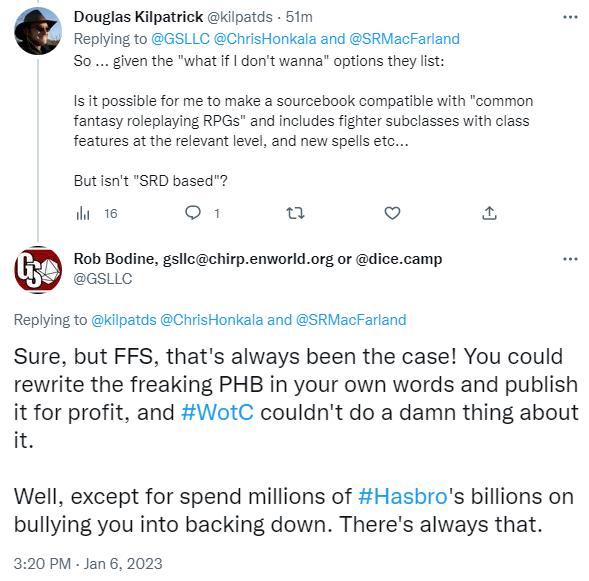
Sure, but FFS, that's always been the case! You could rewrite the freaking PHB in your own words and publish it for profit, and #WotC couldn't do a damn thing about it.
Well, except for spend millions of #Hasbro's billions on bullying you into backing down. There's always that.
— Rob Bodine, gsllc@chirp.enworld.org or @dice.camp (@GSLLC) January 6, 2023
Think about it, people, but not too hard, because . . .
As you all know, someone got a hold of a snippet of the new OGL 1.1 draft. A few people (publicly and privately) have asked me to weigh in based on my Tome of WotC Criticism. Sorry, but I’m not going to make the same mistake many people did jumping to conclusions about the OGL 1.1, so I’m certainly not going to comment on its text that I haven’t read. I’m also not relying on Gizmodo’s interpretation due to all of humanity’s experience with news media. I will remind you all that the current OGL isn’t a real license. No one has signed it, it’s terms for otherwise accepting it are laughable, and it doesn’t actually license you anything.
Beating a Dead Horse
WotC owns its expression of the game mechanics, but despite their implications, they never license that to you. The OGL (even assuming it’s real) uses terminology appearing in both the Patent Act and Copyright Act, saying “this stuff is what we’re licensing.” Those things are stated to be patentable subject matter in the Patent Act and are expressly excluded from copyrightable subject matter in the Copyright Act. And just to be on the safe side, the OGL says (in case it’s not already obvious, paraphrasing):
If any part of what we’re licensing falls under copyright or trademark [you know, such as the specific expression of game rules!], then we take that out of Open Gaming Content, stick it in Product Identity, and don’t license it to you.
No matter how seriously you take the OGL as a license, there’s simply no way to interpret, “processes, methods, routines, and procedures” as including anything copyrightable, which means nothing copyrightable is being licensed. So, despite the SRD containing WotC’s expression of game rules, and despite WotC’s claim to be allowing you to use that material, WotC is free to pull the rug out at any time and say, “You used out expression!” They never actually license it to you because the SRD is not in any way incorporated into the OGL.
Back on Point
It’s a bit hard to answer your questions or respond to your concerns when they’re all based on so weak a foundation, but here’s something on point. There’s a huge debate going around as to whether the OGL can be revoked. For those that say it can, you’re wrong because there’s nothing to revoke. It isn’t real. For those that say it can’t, you’re referencing language from the FAQ and OGL itself that suggests that. Why do you think that language makes it so clearly irrevocable? The FAQ itself states that “people will just ignore [a revocation] anyway.” How is it that a real license can simply be ignored? Because it’s not a real license. The answer to both groups is the same. You’re both right because you’re both wrong.
While the originally stated intentions were noble, this is, at least for at least the past decade or so, a big sham, and it’ll be very interesting to see whether the OGL 1.1 addresses these fatal shortcomings. Even worse for WotC, here’s an attorney taking the OGL seriously and threatening WotC with a lawsuit if they don’t clarify their position on revocation. To defend against any such lawsuit, or even to respond to the letter, may require WotC to take my OGL post and just read it. They’ll have to admit the OGL is a sham. Funny.
For now, though, I’m in the same holding pattern as you. Until we see the text, we don’t know. If, however, the OGL 1.1 corrects its errors as I’ve identified them, my arrogance level will rise so high that, well, I’d probably qualify for employment with WotC legal.
Blog posts cannot substitute for legal advice. If the topics discussed in this post are relevant to a real case you have, please consult an attorney.
I tweeted yesterday!
My dad was born 11 years after #Sherlock's creation and died 25 years before it expired. There is nothing good about a #copyright that easily outlives someone who was over a decade late for its creation. "Limited Times"? By whose standard, #Methuselah's? Copyright needs reform. https://t.co/eoYxaFS9aG
— Rob Bodine, gsllc@chirp.enworld.org or @dice.camp (@GSLLC) December 29, 2022
Okay, it was a retweet. Whatever. Don’t be a pedant. That’s my thing.
To what am I referring when I invoke Methuselah? I’ve discussed the term of a copyright before on another blog, linking to a handy flowchart, but none of that is required reading. All you need to know is that the “term” of the copyright is how long it lasts, and I’m here to argue that it lasts far too long.
Constitutional Authority
Congress’s authority to grant copyrights comes from the Arts and Sciences Clause.
[The Congress shall have Power t]o promote the Progress of Science and useful Arts, by securing for limited Times to Authors and Inventors the exclusive Right to their respective Writings and Discoveries;
Article I, Section 8, Clause 8
The Sciences and Discoveries are the subject of patents, and the Arts and Writings are the subject matter of copyright, though these terms are being used more broadly than you’d ordinarily use them. For example, a sculpture is a “writing” in this context because sculptures can be copyrighted. I’m not going to get into that. You’ll fall asleep before I get to my point.
Limited Times
My focus is on “limited Times.” What does that even mean? From who’s perspective must the term of the copyright be limited? The artist? The general public at the time of creation? Humanity in general? An ant? Depending on your choice of perspective, “limited” could be a few minutes or a few centuries, and who’s to say that one interpretation of that vague phrase is better than another? (Spoiler alert: Me; that’s who.) Unfortunately, a 7-2 majority of the Supreme Court in Eldred v. Ashcroft (2003) seems to think it’s effectively unlimited. (Methuselah; remember?) I’m here to tell you why they’ we’re dead wrong.
By the way, you don’t get to blame this on Republicans or Democrats. Justice Ginsberg wrote the majority opinion, and Justice Scalia joined her. Though the two dissenters, Justice Stevens and Breyer, would be considered “liberal” by a layman’s standard, some conservatives would have joined their dissent. Fortunately, I’m smarter than all of them.
Call me smart, right now!
First, lets dive into some Constitutional text. The clause secures rights to “author[s],” not owners, for a limited time, and that’s an important distinction. Even if you sell your copyright, you’re always its author. Look up “copyright termination” for an example as to how this distinction can play out. So, if we’ve secured rights to authors for a “limited time,” then the perspective should be that of the author, not an ant or humanity in general, and not even a purchaser of the copyright (i.e., the owner). Thus, the term of a copyright shouldn’t be designed to outlive the author itself, even if he or she has sold their copyright. Otherwise, it’s not limited from the author’s perspective.
But that’s a bit philosophical, gets complicated when dealing with corporate authors (i.e., works made for hire), and subject to (barely) reasonable disagreement, so let’s further ground ourselves with history.
The first Copyright Act was passed in 1790, one year after the Constitution was deemed to be in effect. Therefore, the same people that debated and approved of the Arts & Sciences Clause did the same for that Copyright Act, and they granted authors copyrights with a term of 14 years eligible for renewal for another fourteen only “if, at the expiration of the said term, the author or authors, or any of them, be living” (emphasis added). The 1790 legislature was trying to keep copyrights from outliving their authors, and they’re the legislature that wrote the Arts & Sciences Clause. Who better to know what they meant? Of course, you can’t provide a guarantee in this regard, because unless you murder someone, etc., you don’t know when they’ll die. The mechanism that was used was the best way possible to minimize copyrights outliving their authors in a way that could be reasonably expressed in a statute, while recognizing that people’s dependence on a copyright might also outlive the author by a bit.
By 1831, members of Congress had lost sight of the original intent of the Founders. The Copyright Act was amended to grant a term of 28 years extendable for another 14, and in 1909, the term became 28 years extendable for another 28 years. For both of those acts, Congress had dropped the requirement that the renewal couldn’t outlive the author, as their heirs could still renew the copyright. While both of these laws should have been declared unconstitutional, even they show a clear intent to keep the term short enough that most people living during the time of a copyright grant would see the work pass into the public domain. That is, even with the 1909 statute’s possible 56-year term, a copyright born during my father’s lifetime would not have outlived him, and certainly would not have outlived the majority of the general public alive at that time. If someone grew up reading Sherlock Holmes, they should have been able to write fan fiction as adults without fear of getting sued.
Mickey Mouse is a Dick
Then Disney started lobbying Congress for longer copyright terms, and all hell broke loose. The current copyright term for a human author (as opposed to a corporate author) is life of the author plus 70 years, or 70 years beyond the life of the last living author for a joint work. Based on my interpretation, life plus anything is unconstitutional, but now the term is life of the author plus another person’s lifetime. This is insane. Note well that the purpose of intellectual property law isn’t to reward authors and inventors for a job well done. That reward is just a mechanism. It’s the means by which we encourage creation and invention. The purpose, however, is to make sure that the public has access to such subject matter. We employ the mechanism to limit affordability for a while so that creators and inventors have an incentive to create and invent in the first place, but the public must eventually gain full access to it. That’s the entire point of encouraging creation and invention in the first place. However, if I write a song today, no member of the current public, or even their children’s public, will ever see it in the public domain. Again, that’s an insane interpretation of the Arts & Sciences Clause cutting against its very purpose, so it simply cannot be the correct one.
Patent Law
We also see support for my interpretation in patent law. While the term of the patent has changed, it’s still only 17 years and not extendable. Thus, my interpretation is consistent with how patents were, and still are, treated. The fact that patent term is stricter is not because their legal foundations are different — they’re both grounded in the Arts & Science Clause — but rather the fact that patents represent a stronger intellectual property monopoly than copyrights. Still, the copyright monopoly is strong enough to warrant similar treatment.
But, But, But . . . .
What about trademarks? Trademarks are probably the weakest of intellectual property monopolies, so that alone justifies their indefinite term (only as long as you’re using them in commerce). Similarly, trade secrets are indefinite, but only as long as they remain secrets. However, there’s an additional consideration as to why these two forms of IP are treated differently: They originate in state law, and the federal government can regulate them only indirectly through the application of the Commerce Clause. I’m sure you’re dozing off, so I have no intention of digressing into that discussion. Just understand that these two forms of IP aren’t subject to the “limited Times” qualifier because they don’t arise from the Arts & Sciences Clause. If you’re still awake and would like to understand this a bit better, you can read my post on how state and federal law intersect on trademarks.
So that’s it. We have a problem, and there’s nothing any of us can do about it. Nevertheless, I’ll shout it from the rooftops: Copyright needs reform.
Rob Bodine is a Virginia attorney focusing his practice on real estate and intellectual property law. He’s currently Virginia counsel with Cardinal Title Group, a Virginia title insurance and settlement company. Rob is also a licensed title insurance agent in Maryland and Virginia.
In case the tweets are ever deleted, here’s an image of them.
Blog posts cannot substitute for legal advice. If the topics discussed in this post are relevant to a real case you have, please consult an attorney.
I’ve previously dispelled a common misconception between copyrights and trademarks. In summary, the “doctrine of laches” does not apply to copyrights. That is, if a copyright holder doesn’t enforce their copyright, they don’t lose the copyright. The doctrine of laches does apply to trademarks. Bayer’s Aspirin is an example of a trademark that fell prey to the doctrine of laches and was subsequently “genericized.” But there’s a legal twist to this story.
The German company, Bayer, held a patent in acetyl salicylic acid (“ASA”), and a trademark in Aspirin to identify it. The patent expired in 1917, but they continued to sell it under the brand name Aspirin, so the trademark lingered. Due to World War I, Bayer lost all its assets including its intellectual property. A new, company, bought those assets (including the trademarks “Bayer” and “Aspirin”) and continued selling ASA using the Aspirin trademark. Unfortunately, “considerably more than 220 tons” of counterfeit Aspirin flooded the U.S. market. This ASA was sold as “aspirin” throughout the general public, but with perhaps only an insignificant percentage of exceptions, manufacturing chemists, retail druggists, and physicians didn’t use or sell the infringing ASA.
In Bayer Co. v. United Drug Co., 272 F. 505 (S.D.N.Y. 1921), Bayer sued to enforce the trademark, and the result was, despite the Honorable Learned Hand’s claim, a first in the law. Here’s the relevant quote, which I’ll next explain.
The case, therefore, presents a situation in which, ignoring sporadic exceptions, the trade is divided into two classes, separated by vital differences. One, the manufacturing chemists, retail druggists, and physicians, has been educated to understand that “Aspirin” means the plaintiff’s manufacture, and has recourse to another and an intelligible name for it, actually in use among them. The other, the consumers, the plaintiff has, consciously I must assume, allowed to acquaint themselves with the drug only by the name “Aspirin,” and has not succeeded in advising that the word means the plaintiff at all. If the defendant is allowed to continue the use of the word of the first class, certainly without any condition, there is a chance that it may get customers away from the plaintiff by deception. On the other hand, if the plaintiff is allowed a monopoly of the word as against consumers, it will deprive the defendant, and the trade in general, of the right effectually to dispose of the drug by the only description which will be understood. It appears to me that the relief granted cannot in justice to either party disregard this division; each party has won, and each has lost.
Id. at 513-14.
What all of this means is that, to the general public, aspirin was no longer a trademark. Anyone could sell ASA to the general public and call it aspirin (with a small A), because to the general public, they were the same thing. However, Aspirin (with a capital A) was still a distinctive mark among manufacturing chemists, retail druggists, and physicians, because they never treated it as a generic term. As professionals in the industry, they weren’t burdened by having to call the generic drug acetyl salicylic acid (or monoaceticacidester of salicylicacid), so they continued to do so. Also, those professionals weren’t willing to trade in infringing goods, so they never did.
The net result was that the trademark was no longer applicable to the general public, but it was still valid when selling to manufacturing chemists, retail druggists, and physicians.
I had a discussion during Winter Vantasy: The Return with Erik with respect to Wizards of the Coast’s (“WotC”) new stat block format. The new stat block has some rearranging of material, but that wasn’t the subject matter of the conversation. We were discussing the removal of spells and spell-like abilities from the new WotC stat block. Erik doesn’t like it and referenced my concerns about the complexity within the current stat block format. Erik referred to my position as “ridiculous,” but WotC’s switch proves that Erik’s view is the minority one. I didn’t have a large enough internet footprint to prove it on my own. More importantly, however, Erik understandably mischaracterized my position. I wasn’t saying that the Monster Manual got it wrong. In fact, quite the opposite. I’ve mentioned before that I think it’s the best RPG bestiary I’ve ever read. My concern is that WotC didn’t supplement it properly, then attempted to shut me down when I did.
Important Note: I’m not 100% certain that WotC’s stat blocks have been changed in the way we’re all assuming they were. I’ve seen a sample of the new format (below), but it was for a low level creature whose stat block would be simple anyway. Thus, this discussion comes from a place of partial ignorance, and I may get some things wrong. Take this all with a grain of salt.
When you look at a complex stat block (e.g., Mummy Lord), unless you have a truly eidetic or nearly eidetic memory, there’s no way you can effectively run that stat block as written, especially if the encounter is a combat encounter. There’s too much going on, and what we’ve all seen (and I actually got Erik to admit to an extent!) is that every DM just gives up and resorts to using the common spells they all know: Magic Missile, Hold Person, Fireball, Counterspell, etc., even for higher spell slots. Why? Well, first you must figure out which sourcebook contains the spell in order to look it up. If it isn’t a Player’s Handbook spell, you may not know, so you wind up searching through a couple of books before finding the correct one. Second, you must read the spell, which could take a while if it’s not one like Fly. If it were a spell like Fly, you may not have to look it up at all, which is why Fly is one of the spells to which DMs eventually resort. Something like Control Weather has far too much going on for most people to memorize. Erik is sometimes willing to do that, but there are very few players whose eyes don’t glaze over with boredom during that long process. Moreover, if you’re playing with a real-world time limit (e.g., convention play), that’s certainly not time you have to waste. At the table, the spell’s details should be right in front of your face. I don’t understand why anyone would disagree, and those with eidetic memories shouldn’t care one way or the other.
That said, in theory these stat blocks provide a framework for the culture of that creature. (In my second stat block/copyright post, I mathematically proved that WotC fails to do so, but that’s not relevant here.) So, the Monster Manual itself shouldn’t eliminate that complexity (I know; WotC can’t win with me), but rather use it as a framework for creating specific monsters within that cultural framework but suited to the encounter at hand. That last sentence is a tough read, so here’s an example. (I’m going from my memory, which is not eidetic.) The Couatl has both offensive and divination spells. If your encounter involved the Couatl using Detect Thoughts to aid in an interrogation, then you wouldn’t need the Couatl to have Shield. On the other hand, that position would be reversed if the Couatl were to engage in combat against the PCs (i.e., it would need Shield but I don’t think, from memory, Detect Thoughts would have value). The Monster Manual stat block provides you the spells a Couatl needs for all situations, but not every Couatl will appear in all situations. In fact, I doubt any will unless the Couatl is a PC, but a Couatl PC is clearly not what I’m talking about. For NPCs at the table, you need only the spells that that specific NPC will need in that specific encounter. Everything else muddies the water. However, it’s good that all situations are covered by the general stat block in the Monster Manual, because that’s what you use to build such table-based stat blocks.
So, in my ideal world, this is how WotC (or any game designer with sufficient resources) should approach their stat blocks. Make them as complex as WotC did in the Monster Manual, using only spell names as shorthand to make the stat block printable, but modify their online tools with check boxes allowing DMs to pick which spells and spell-like abilities appear on a final stat block at the table (whether in hard or soft copy). For that final stat block at the table, make sure that the spell descriptions are presented fully so that there’s no need to resort to multiple hardcopy resources to know details that are relevant to the combat, but at the same time make sure that the stat block isn’t cluttered with irrelevant details. If there are no online tools, provide one-stop stat blocks for all NPCs (as I did) as a PDF. They could also provide PDFs containing generic spell entries with coded placeholders such as, “Magic Missile, Atk: [L]+3+IntMod, . . . .” (or whatever it is), so that DMs could copy and paste them into their own stat blocks as needed. All my project did was the one part of that process that I could, which is something WotC didn’t do.
I fully appreciate that some (most?) game designers can’t do this. Online tools are a huge investment of time and resources they may not have, but some in the gaming community do. Game designers simply need to stay out of the way and allow the community to do that heavy lifting for them. On the other hand, WotC has both the time and resources to create this ideal that appeals to the most people, but they’re still getting it wrong, probably because there’s more profit in selling a new hardcopy (which I suspect will be very good nonetheless).
So yeah, WotC can’t win with me, but only because they’re choosing to lose. We’ll see how the final product shakes out.
Blog posts cannot substitute for legal advice. If the topics discussed in this post are relevant to a real case you have, please consult an attorney.
I’m designing a database for 1st Edition Dungeons & Dragons and am close to finishing the data entry on spells. This brought a copyright issue to the forefront. Characters can be copyrighted. This isn’t a controversial position. However, the name of a character is not copyrightable, and unless a name is used as a brand for your line of products, it doesn’t even receive the (much weaker) protection of trademark. So why does everyone remove proper names from spell names when referencing D&D spells?
Copyrighting a Single Word or Short Phrase
While there is no “bright line” rule stating a minimum number of words necessary to secure a copyright, it’s well settled that a short phrase is not copyrightable. Either they lack tiny amount of creativity necessary for copyright (thus likely representing independent creation) or the merger doctrine applies. A simple Google search will uncover a multitude of articles supporting this notion.
Only nothing at all is more minimal than a single word, so there’s no doubt (outside of Poland) that a single word can’t be copyrighted. But even a short phrase, such as the name of a spell, can’t be copyrighted, especially where it’s descriptive of the mechanics of the spell (mostly the case).
The Nichols Case and Copyrighting Characters
The standard for copyrighting characters comes from Nichols v. Universal Pictures Corp., 45 F.2d 119 (2d Cir. 1930), in which the Court stated:
If Twelfth Night were copyrighted, it is quite possible that a second comer might so closely imitate Sir Toby Belch or Malvolio as to infringe, but it would not be enough that for one of his characters he cast a riotous knight who kept wassail to the discomfort of the household, or a vain and foppish steward who became amorous of his mistress. These would be no more than Shakespeare’s “ideas” in the play. . . . It follows that the less developed the characters, the less they can be copyrighted; that is the penalty an author must bear for marking them too indistinctly.
45 F.2d 119, 121 (2d Cir. 1930). This has since become known as the “well delineated character” test.
Can a spy be protected? Of course not. What if that spy uses sex as a tool of the trade? Don’t all spies (at least in fiction) do that? How about if he’s a martini drinker? Hmm, that sounds familiar. “Shaken not stirred”? Well. . . . Eventually, we get to the specific character of James Bond, and he’s certainly a copyrighted character, but it took a bit of detail beyond his name to get there. If I created a fictional character of James Bond who was an accountant, I’d be just fine. In fact, I could even have him joke, “I’m not that James Bond.” I’m not using Ian Fleming’s James Bond, just referencing him, and to the extent James Bond is trademarked, readers will understand from context that I don’t have the endorsement of whoever currently owns the character.
The less common, “story being told” test isn’t relevant here, but in case you’re interested, see Warner Bros. Pictures v. Columbia Broadcasting Sys., 216 F.2d 945 (9th Cir. 1954), cert. denied, 348 U.S. 971 (1955) (“It is conceivable that the character really constitutes the story being told, but if the character is only the chessman in the game of telling the story he is not within the area of the protection afforded by the copyright.”).
Elsewhere when discussing the precise boundaries of copyright as it related to plays, the Nichols Court went on to add that, “[n]obody has ever been able to fix that boundary, and nobody ever can.” Nichols at 121. That makes copyright hard, but it’s not impossible, and sometimes it’s even easy. A name cannot be protected by copyright, even within the context of a spell name of a few words.
Tenser’s Floating Disc
So why do so many of you seem to think that you’re avoiding copyright infringement by avoiding writing, “Tenser’s Floating Disc,” “Mordenkainen’s Magnificent Mansion,” and “Tasha’s Hideous Laughter”? Based solely on the text of the spell as written, can you tell who Mordenkainen is? Is Mordenkainen the wizard that wrote the spell? The wizard’s significant other, child, or pet? The name of the Wizard’s favorite watering hole anthropomorphized into the owner of a mansion? Even if the original spell as written by TSR contained the answers to such questions in sufficient detail to flesh out the character (it didn’t even try), a reproduction of the spell not including such information, but rather limited to the spell’s mechanical effects, wouldn’t infringe on the character of Mordenkainen just by using the name. The name isn’t what’s copyrighted; the combination of several traits defining the character are, but they’ve been left out.
Seriously? You think WotC can restrict use of the name, Tasha?
This is as ridiculous as, for example, using the word “Forgeborn” for “Warforged” as if WotC owns the word, “Warforged,” and that use of “Forgeborn” relieves the writer of any infringement of WotC’s text describing the species. Such a writer is focusing on the wrong thing. Think of it this way: If you think that dropping the name off of the spell cures your text of copyright infringement, then you concede my point that spell text describing the mechanical effect of a spell within the context of an RPG isn’t usually copyrightable. Great! However, you then must be thinking** that the name itself is where the copyright lies. That can’t possibly be true. It flies in the face of every knowledgeable commentator (again, outside of Poland) that’s ever addressed the issue.
** Unless, of course, you’re still under the mistaken impression that the OGL is somehow a valid contract, and that its terms, if taken seriously, wouldn’t constitute copyright misuse. But if you really want to know why that’s silly, you’ll have to read that long post.
There’s absolutely no legal reason not to use those names in spells, and it doesn’t hurt WotC at all to use them (other than perhaps robbing their arrogant legal department of their hubris). Why is this important? Because there are too many misconceptions about copyright law that have had far reaching consequences to the gaming industry and the gaming community in general. The text of the Open Gaming License and System Reference Documentcollectively foster this misinterpretation, and I suspect (can’t prove) that’s an intentional scam. If WotC legal gets you to focus on the word, “Tasha,” but does nothing to stop you from copying the text of the spell, then you still may be infringing whatever copyright they arguably have. If you do something that’s 100% legal later down the road, but it’s something they don’t like, they can go after you for that infringement. As I’ve discussedelsewhere, this can often lead to copyright misuse, but most gamers aren’t sophisticated or wealthy enough to hit back on those grounds. More importantly to the community as a whole, while using these names in spells is not creative on your part, your misconceptions eventually lead down the road of stifling your own creativity. The purpose of copyright is to promote creativity. When copyright law stifles creativity, its entire purpose vanishes, in which case we may as well not even have copyright.
You can’t know what you can’t do unless you also know what you can do.
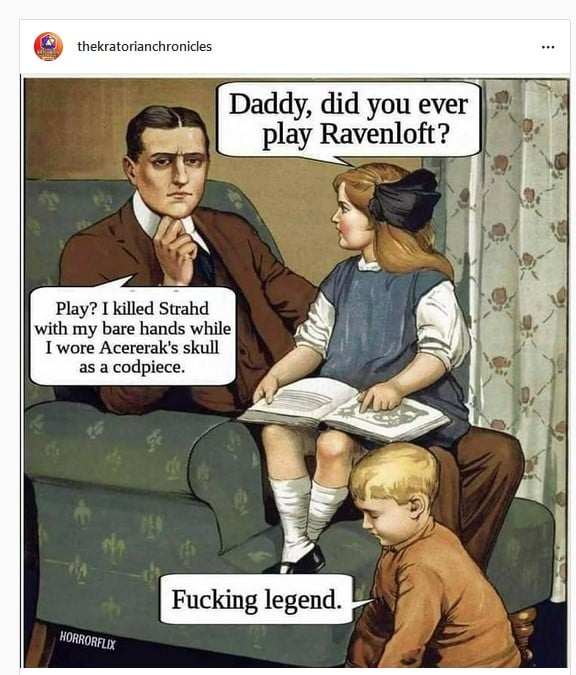
Having worked in intellectual property law, I like to give proper credit where it’s due. I found this meme and was looking for an excuse to use it.
As I was doing my research as to who produced this, I ran into an issue. I saw this shared on Facebook by a connection (I don’t remember whom), but they shared it from another source, so that person shouldn’t get credit. It looks like they got it from thekratorianchronicles via Instagram, but based on a signature of sorts within the image, thekratorianchronicles doesn’t seem to have created it, so they also shouldn’t get credit.
So, credit belongs to “HORRORFLIX,” but who are they? Searches via Instagram, Twitter, and Facebook yielded far too many entities for me to figure out who owned it. With no logo, Twitter handle, URL, or other unambiguous identifier as part of the signature, I can’t give proper credit despite how important I think that is.






 Play What You Want