Grids and Operational Spacing #RPG #TTPRG #DnD #4e

If you enjoy this post, please retweet it

In 4th Edition D&D, the sizes used for creatures were Tiny, Diminutive, Small, Medium, Large, Huge, Gargantuan, and Colossal. I know that wasn’t for everyone, but I liked that. A lot. I liked that level of distinction and didn’t find it confusing or hard to memorize. In fact, in the game system Vic and I are developing, we added “Vast,” which is obviously larger than Colossal. Each of these sizes has corresponding space they take on the battle map. 

Tiny 1/8 square**
Diminutive 1/4 square
Small/Medium 1 square
Large 4 squares (2 x 2)
Huge 9 squares (3 x 3)
Gargantuan 16 squares (4 x 4)
Colossal 25 squares (5 x 5)
Vast 36 squares (6 x 6)
Medium Space (Full Table)

As I said, I liked this system a lot, but I’ve toyed with a new terminology that requires some extra abstraction. Also, to be mathematically consistent, the top row (Tiny), should be 1/9 square, but I’m probably the only person who cares about that. Besides, that’s about to be adjusted.

Note #1: I wrote a long post justifying my position with a lot of math. It referenced exponential progression and irrational numbers. I trashed all of that in favor of just giving you my conclusion.

Note: This post isn’t intending to solve a problem. It’s just introducing terminology that expresses what most people already do intuitively, but tweaks that a tiny bit.

This should be an easy exercise for you. Imagine an encounter consisting not of a bunch of medium sized creatures fighting each other but rather of platoons of troops in a mass combat, or perhaps jet fighters in a dogfight, or starships flying at incredible speeds. Despite covering very different ground within game, the dining room table and battle map are the same size. Ergo, a 1-inch square adjusts its meaning depending on the size of the combatants and/or the distances they cover.

The terminology I use to reflect this adjustment is “n-space.” We generally run our games in Medium-space (because Small/Medium-space is too wordy), which means “one square represents the area a Medium creature needs to operate,” and other size categories are represented relative to that. For an encounter involving a larger base unit, we use, for example, Large space, which looks like this.

Tiny 1/64 square = 1/26 squares 64 creatures/square
Diminutive 1/16 square = 1/24 squares 16 creatures/square
Small/Medium 1/4 square = 1/22 squares 4 creatures/square
Large 1 square = 12 squares = 1/12 squares 1 creature/square
Huge/Gargantuan 4 squares = 22 squares (2 x 2) 1 creature/4 squares
Colossal/Vast16 squares = 24 squares (4 x 4) 1 creature/16 squares
Large Space (Full Table)

You’ll notice a few things. First, the 1 creature/square entry now applies to Large creatures, which is the definition of “Large space.” Second, if you reverse engineer the math, you’ll see that 16 Tiny creatures (not 8 or 9) would occupy 1 square in Medium space, because they’re now (properly in my opinion) treated as taking half the space of a Diminutive creature. Finally, you’ll see that Huge and Gargantuan objects are lumped into the same category, as are Colossal and Vast objects. Again, unless you want me to show you some exponential progressions and irrational square roots, you’ll have to take my word for it, but rest assured there are still Huge creatures, so you don’t have to throw out your Huge minis and that Colossal red dragon you paid hundreds of dollars for on eBay. Their size remains relevant in Medium space.

If we didn’t pair Huge creatures with Gargantuan ones, we’d have to say, “12 Huge creatures fit in every 7 squares in Gargantuan space,” or “1.7 Huge creatures fit in 1 square in Gargantuan space.” No one wants that.

Well, if my goal is to simplify things, I haven’t yet met it. That table is still a lot to take. Fortunately, in Large or larger spaces, we don’t need to worry about the low-end cases, and in Large space, we probably don’t have to worry about the high end case either. This is because no one cares how many pixies fit on a starship (“A bunch; that’s how many!”), and a trebuchet isn’t going to fit in a pixie’s treehouse. We also don’t need the column explaining the math. So, here are the additional, easily-digestible tables you’ll need:

Tiny1 creature/square
Diminutive1 creature/4 squares
Small/Medium 1 creature/16 squares
Tiny Space

Tiny4 creatures/square
Diminutive1 creature/square
Small/Medium 1 creature/4 squares
Diminutive space

Small/Medium 4 creatures/square
Large 1 creature/square
Huge/Gargantuan 1 creature/4 squares
Large space

Large 4 creatures/square
Huge/Gargantuan 1 creature/square
Colossal/Vast1 creature/4 squares
Gargantuan space

Large16 creatures/square
Huge/Gargantuan  4 creatures/square
Colossal/Vast1 creature/square
Vast space

They’re nearly identical tables with three entries each, but with shifted labels. Your starship minis can be the same size as your human minis. You just need a few minis representing mobs or swarms of things (which you all have in your collection), and you’re good to go. Of course, this is what we’re all doing anyway. With just the slight tweak of how Tiny creatures are represented, and grouping larger creature sizes together in spaces larger than Medium space, I’m just introducing a terminology to define it. If this were explained in an RPG sourcebook, you could provide even less justification than I’ve done here. Most people want only the rules; they don’t need the math to justify it.

One last note: I could imagine adding Enormous space and Immense space as categories to a system like Star Trek or Star Wars because Vast space would be cosmic in size. I’m not sure that’s necessary, but if such a choice were made, it could work. Those two terms have the benefit of using a different first initial, allowing each size category to be expressed as a single letter without confusion. For that reason, Cosmic space wouldn’t work. It would create an ambiguity when referenced with Colossal space.

What do you think? Is treating a 3 x 3 creature differently from a 4 x 4 creature really that important when sieging a castle? 

Follow me on Twitter @gsllc
 

Another Thing 4e D&D Got Right . . . Then Screwed Up #DnD #RPG #4e #5e #1e #ADnD #TTRPG

If you enjoy this post, please retweet it.

Last week, I discussed spell components. The conversations I had across Facebook and MeWe led me to a follow up post, and then down a rabbit hole to today’s topic.

4th Edition D&D (“4e“) didn’t track spell components for powers, and rituals had a set cost that didn’t even list the material components. Material spell components were abstracted, so a ritual caster could remove a specified number of gold pieces from the character sheet and assume the material components were available. Based on my linked posts, you’d think I’d have a problem with this, but I didn’t. In 4e, there were no go-to spells or rituals. Everything was balanced so that players chose their suites of powers based on the type of characters they wanted to play. Tracking material spell components (or casting times as in 1st Edition D&D) was unnecessary; characters were already greatly diverse. That kind of variety made for far more interesting combats, even if most of table were playing the same classes. In 4e, there was no place for the question, “What classes are you guys playing?” It didn’t matter. You could play what you wanted without affecting the game because everyone was different even if they were the same. As someone who played a ton of 4e, I never understood the claim that all classes played the same. Even within classes, they played differently.

Rituals weren’t used very often in my experience, but I think that was the result of adventure writing rather than an inadequacy of the ritual system. In fact, I wrote a Dungeon Crawl system for 4e, and on the now-defunct loremaster.org added a post on how to convert rituals to spells (or “near-spells”). Here’s a PDF that was the basis of that post. It’s not the final draft, so it may have some rough edges.

Nothing Is Certain Except Death and Taxes

As good as that was, 4e screwed up in a different but analogous way. When it came to feats, almost every class had go-to feats. In fact, there were feats that were go-to for most classes. This was known as a “feat tax.” Durable, Implement Expertise, Improved Initiative, Toughness, Weapon Expertise, and Weapon Focus immediately come to mind. This wasn’t nearly as large a sin of game design — other players generally don’t notice which feats a player has chosen — but for what it’s worth, 5e does a much better job with feats. I have trouble selecting 5e feats because a large number of them are valuable no matter what class I’m playing, so I know I’m going to make different choices than other players.

Modern games seem to have defeated the death part.

As I said in the prior posts, game designers need to pay better attention to whether their systems lead a majority of players to make the same choices. 4e proved that you can design a game of diverse characters in such a way that it doesn’t devolve into an exercise in accounting, and simultaneously broke that rule.

4e is still better than 5e. 🙂

Follow me on Twitter at @gsllc

Dungeons & Dragons is a trademark of Wizards of the Coast, LLC, who neither contributed to nor endorsed the contents of this post. (Okay, jackasses?)

Even More Gems Dug up While Unpacking @Luddite_Vic @Erik_Nowak @atomicovermind @Digitalculture0 #DnD #RPG #4e #1e #ADnD #TTRPG #StarWars #Rokugan #FateRPG #LFR #DARPG #WotC

If you enjoy this post, please retweet it.

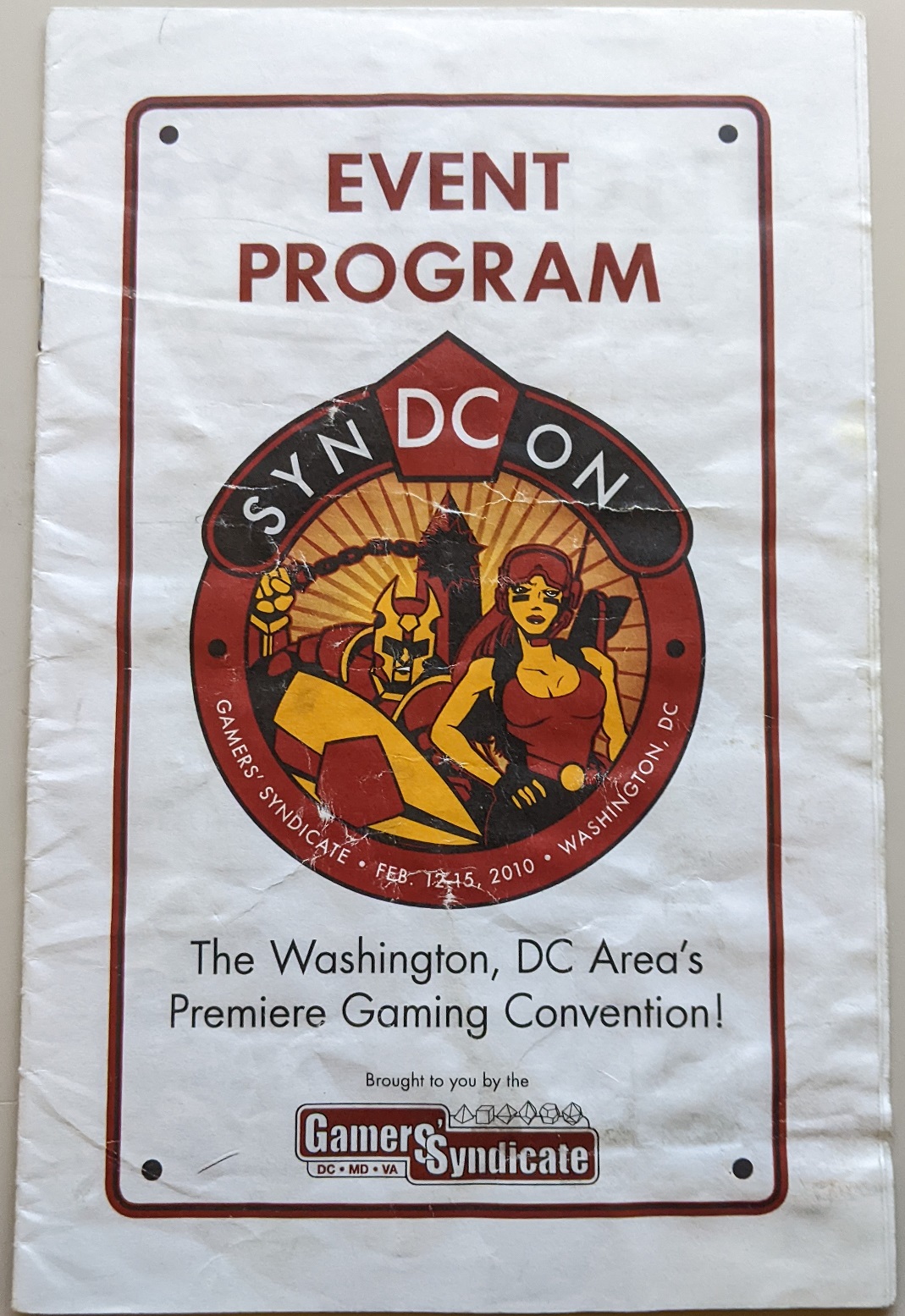
A couple of days ago, I posted about some things I found while continuing to unpack. One thing I found deserves its own post: the program for our first synDCon gaming convention (2010). When we decided we were going to put on a convention, we had a meeting of at least 20 people at the Cracker Barrel in Chantilly, Virginia. This took place after one of our Living Forgotten Realms game days at the now defunct Game Parlor. Only seven people decided to come on board as owners, with two quickly moving to Arizona before we could even get started, and then two others flaking out. It was basically Vic, Cassandra, and I doing everything.

Front Cover

The cover art and Gamers’ Syndicate logo were both designed and illustrated by Erik_Nowak, and he also designed this program.

Welcome Statement

I remember a meeting when there were just five of us. We had to decide who would be the number one person: the Convention Coordinator. I didn’t volunteer because I didn’t want to be too pushy, but no one else wanted to do it. This was typically unnecessary nerd angst on all our parts, because in the end it didn’t matter. Everyone had to work hard (until they flaked out), and no one was really the boss among us.

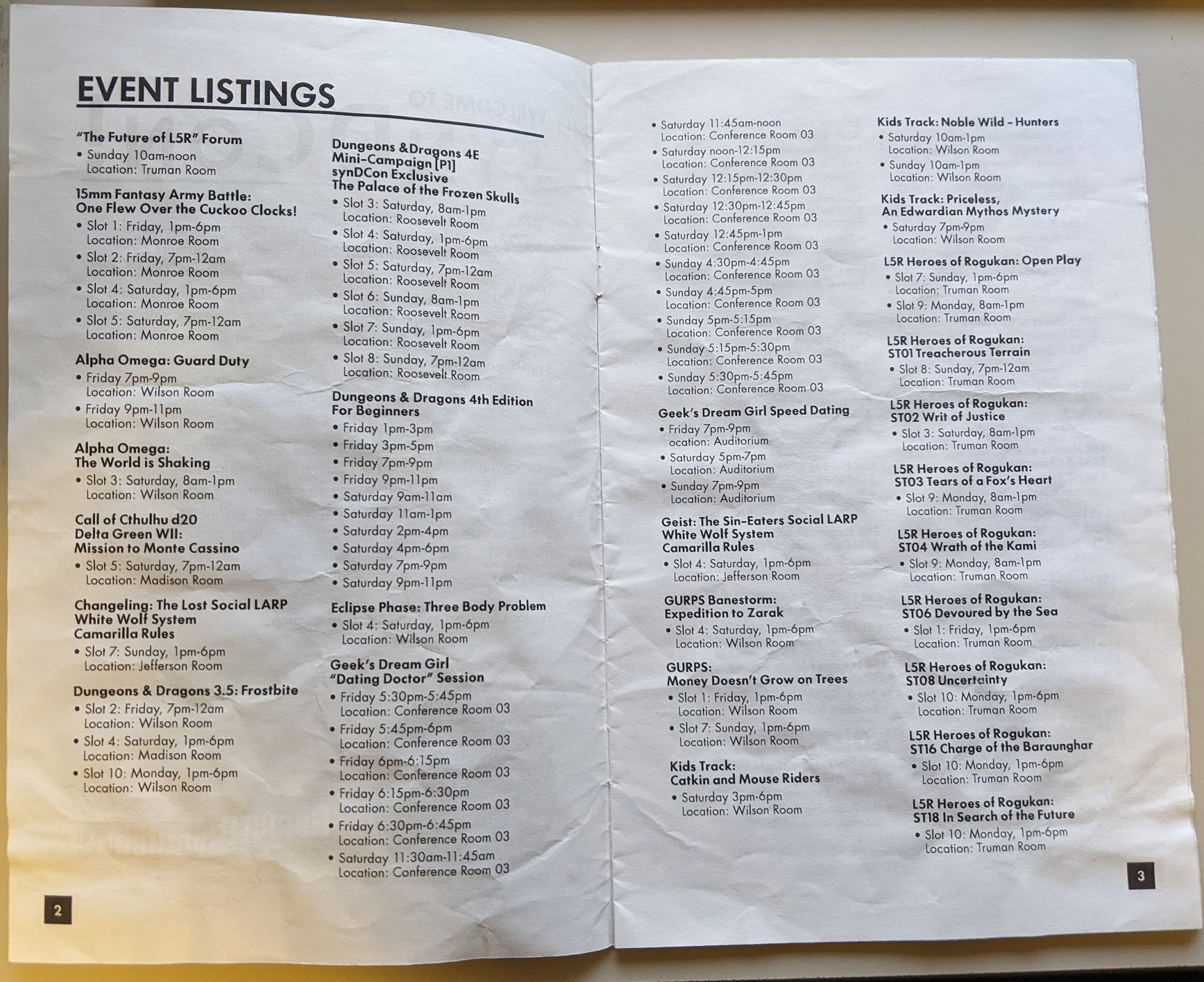
Pages 2 and 3

I’m proud of two things. First, look at that first page, and continue to examine the ones that follow. Even when we had seven planned owners, everyone was almost exclusively a 4th Edition D&D player. Nevertheless, our relatively small convention had a ton of variety in what was run. There were card games, board games, RPGs, and miniature war games. Within the RPGs, we had a ton of variety as well, and there were games run specifically for beginners. We also had a “synDCon special,” which was written by Erik and D. Hunter Phillips.

Pages 4 and 5

The second thing of which I’m proud was my idea (<patting myself on the back>). We had staggered slots. Instead of the typical 8am-12pm, 1pm-5pm, 7pm-11pm schedule for RPG games, we added in slots at 10am-2pm and 3pm-7pm as well. Again, for a small con, the fact that this worked out so well was remarkable. Many people took advantage of the opportunity to sleep in, try our Dungeon Delves for a couple of hours, sit in on a seminar or author book reading, or try new systems at the beginners’ tables. Another great idea of mine was to allow only 5 seats per game in presale despite tables seating 6 players. This made it far easier to sit players that didn’t preregister or wanted to change tables. No one had a problem with it, but a lot of people appreciated the flexibility.

Venue Map

This was a nice hotel, and it was conveniently located near a Metro stop (our public rail transportation system). And being who I am, I especially wanted a site in Maryland so that we could register for a federal trademark if it ever came to that. 🙂

Pages 8 and 9

Okay, yes, we definitely emphasized Living Forgotten Realms, but I’m still happy with how much Heroes and Rokugan and Pathfinder Society we had (these are living campaigns for the RPGs Legend of the Five Rings and Pathfinder respectively).

Pages 10 and 11

Note well, though, that there was more going on than the program states. We had a board game room, and open play for both card games and miniature war games. Saturday night, my cousin and I, a.k.a., Wet Paint, performed for a crowd of beer-drinking gamers some hits of the 80s and 90s. That’s when we played together, so our song set came from those decades.

Only Mike and I are Wet Paint. Matt James was an interloper. He’s considered a member of “Trail Mix,” which is anyone that’s ever played with us.

Seriously, for a small, first-time convention, look at how much variety we had. I loved it, and I never saw it with conventions this small. We also had seminars featuring authors and game designers. Being in the DC area, we actually knew a lot of those people, so it was relatively easy to get them here. This, in turn, allowed us to do this . . . .

Pages 12 and 13

We received a small amount of support from most of these companies, and others were actually present. Our prize for the first person to buy a convention badge was a ticket to GenCon. GenCon gave those away to conventions all the time; no inside track was necessary. However, we also had, for example, a member of Green Ronin participate in a seminar and run the (then-new) Dragon Age RPG, and Rob Hobart (AEG), the head of Heroes of Rokugan, ran a seminar and (I think) a few games.

I touched up this image of the back cover to delete some handwriting. Pay no attention to the fields of ecru.

We chose a great venue, and synDCon 2010 was a four-day convention. Yep, four days. Just like the big guys. Monday was a holiday, and adding that day to the schedule didn’t increase our costs noticeably. Of course, by cost I mean financial cost. My feet were sore (which is why I was sitting for the Wet Paint performance), and I ran, at best, on four hours of sleep a night, with only two on performance night. I’d say it was a success considering that we got hit with a snowstorm right before the convention, scaring off a lot of people.

The following year, we moved synDCon 2011 to mid-April to make sure we’d have better weather, but we had late snow that year. It wasn’t as bad as the previous year, but it still affected attendance. Infuriating. However, synDCon 2011 was an official convention within the circuit of competitive Munchkin published by Steve Jackson Games. In fact, we may have done that for synDCon 2010. I really don’t remember at this point. I just know we had a great time both years. Unfortunately, it’s too hard a thing to run with, for all practical purposes, two people running the entire show and Mother Nature chasing us around with snowstorms. This isn’t to say that there weren’t a lot of other people that did a lot of work. We had a lot of help, with a few people being organizers for Living Forgotten Realms, Pathfinder Society, and Heroes of Rokugan, and we still had decent numbers. However, in the end it falls on the organizers, and there were only two of us. Both Vic and I would rather not have a convention than do one half-assed, so we didn’t have a third one.

Would I like to bring it back? Yes. Do we have the financial means to do so? Probably. Do I see enough people getting on board to make the workload manageable? No. There are very few people I could trust to see it through, and I’m not getting any younger.

I’m proud of what we did.

Follow me on Twitter at @gsllc
Follow Vic @luddite_vic
Follow Erik @Erik_Nowak
Follow Hal @atomicovermind
Follow D. Hunter Phillips @Digitalculture0

Dungeons & Dragons is a trademark of Wizards of the Coast, LLC, who neither contributed to nor endorsed the contents of this post. (Okay, jackasses?)

I’m Glad “Save or Die,” Well, Died, But . . . . #DnD #RPG #1e #4e #SaveOrDie

If you enjoy this post, please retweet it.

Save or die in RPGs refers to the notion that a character can be in a position where their life relies on a single saving throw. This is quite common in 1st Edition D&D (“1e”) but was completely eliminated in 4th Edition D&D (“4e”). Despite my enthusiasm of returning to 1e, I think its demise was a good thing. Much like ordinary swings of a sword, devastating but really cool attacks could be unleased on a character without taking them out of the game immediately.

30 Stocks to Sell That Are Currently on a Deathwatch | InvestorPlace

For example, one of my favorite monsters is the medusa, so I want to use them to their full potential and (relatively) often. In 1e, however, one medusa could take out the entire party before they could say, “The Amazon commercial with Medusa is stupid.” That’s quite a buzzkill, and it can destroy a gaming session. In 4e, however, I had no issues unleashing that petrifying gaze upon the group. On a successful attack roll, those in a close blast 5 were slowed. A failed save on their next turn left them immobilized. Finally, if they failed a second save on the turn after that, they’d be petrified. At any point in that process, a single successful save ended the effect. Poison and other fatal (or effectively fatal) effects manifested similarly. A rare few monsters had abilities with aftereffects, which were brilliant. If at any point you successfully saved, it would end the primary effect but would trigger a secondary effect requiring its own save.

Medusa: The Ancient Greek Myth of the Snake-Haired Gorgon

I’m not sure how I’d eliminate save or die in 1e, or even whether I should eliminate it. Messing with something so deeply baked into the game could create issues. Or not. 1e is remarkably adaptable to house rules. To start, though, I’m going to keep it.

So, make sure your henchmen go into each room first.

Follow me on Twitter at @gsllc

Dungeons & Dragons is a trademark of Wizards of the Coast, LLC, who neither contributed to nor endorsed the contents of this post. (Okay, jackasses?)

Unfinished Business III: Electric Jubilee @rjschwalb #4e #3e #DnD #RPG

If you enjoy this post, please retweet it.

A recent purchase sent me down a rabbit hole. Last Wednesday, I whined about my unfinished business with 4th Edition D&D (“4e“) with 3rd Edition D&D (“3e“). Yesterday, I showed how that can put you in a “you can never go back” position. Today, I’m not whining (too much), but this is really about praising a great RPG writer, Rob Schwalb, a.k.a., the Demon Lord, a.k.a., Satan Claus.

Elf Will Ferrell GIF - Elf Will Ferrell SANTA - Discover & Share GIFs

Full disclosure: Though we’ve never sat down and had a beer together (why the fuck not?), I know the guy, and I know that he’s done a lot of writing for D&D. However, I don’t pay attention to the authors on those books because I trust the brand and am going to buy those books regardless of who the freelance author was. I honestly had no idea he authored some of my favorite D&D books. Only the ones I consider my favorites are noted below, but the full list is here (or so claims Amazon.com).

Fiendish Codexes, 3e

As I’ve whined before, the Fiendish Codexes are two 3e sourcebooks I regret having sold off, and as much as I want them in my physical library, I’m not paying $135 or more for either. Rob co-wrote the second one, Tyrants of the Nine Hells, with Robin D. Laws. I’ll have to settle on the fact that my new character I’m playing at Winter Vantasy will be Tybalt the Cursed (Tyrants of the Nine Hells, page 79), or at least as close as I can get. Feel free to make suggestions to his character sheet at 1st level and 5th level.

Tome of Magic, 3e

Only one class can truly compete with bard for my favorite class: the Truenamer from Tome of Magic (for which I’m not paying $50+). I made one my BBEG for a campaign I ran but never played one as a PC. Mechanically, it’s not the best class. It has a weird power curve because it’s attacks are based on skills, so as you level up you became weaker until you hit 4th, 8th, 12th, etc. level where you get a huge jump in power. It also depends on a very specific set of magic items in order to keep up with the NPC power curve. Nevertheless, it has great flavor, so I’d have been happy to play one. I’ve annoyed people by playing bongos or a recorder at the game table for my bards, but can you imagine roleplaying a truenamer? I’d be screaming profanity in an unknown language every time I attacked.

SRD - Truenamer
Okay, maybe it’s best that I never played one.

Drow of the Underdark

Last week, I purchased a soft cover copy of Drow of the Underdark via the DMs Guild (PDF included). I loved that book and wanted it in my physical library. I’m very happy with my soft cover of the Fiend Folio for 1st Edition D&D, so the format doesn’t bother me at all.

Martial Power, 4e (the First One)

In 4e, all I wanted to play were leaders, which were the classes that did most of the healing. This is odd because I disliked playing healers in every other edition of D&D that I’ve played (though 5th Edition D&D‘s tempest cleric is reasonably fun). However, the one 4e non-leader class/build that I loved to play as much as a leader was the beastmaster ranger from Martial Power. I could win initiative and run across an entire battle map on the first turn. Impressive, though reckless. I did it only once. Once. But being able to self-flank with your beast companion was fun.

Monster Manual 3, 4e

My favorite enemies are demons, devils, drow, and slaadi. This book had cambions, 7 demons (molydeus!) 8 devils (using a picture of a Binder from Tome of Magic for 3e), 6 drow, Lolth, Eclavdra, and 2 slaadi. Lolth’s stat block was about as clever as they come, changing from a lurker to a brute when her lurker form was “killed.” Rob confirmed with me that he drafted it. (Sly Flourish‘s Cryonax stat block was pretty good too. Never used it. Shit.)

How could I not love this sourcebook? This is, of course, just scratching the surface. This sourcebook introduced a lot of iconic monsters to 4e. I added an intellect devourer to my home game as soon as I had that stat block.

Exemplars of Evil and Elder Evils, 3e

These were not among my favorites. I mention them only to say, yeah, it figures he wrote these. Crazy bastard.

This list is itself just scratching the surface. He’s done a lot of solid work, which is unsurprising. You don’t keep getting jobs if you’re producing shoddy work. Some of my favorite titles have his bloody fingerprints all over them.

Hail!

See more unfinished business here and here.

Follow me on Twitter @gsllc

Follow Satan Claus @rjschwalb

Dungeons & Dragons is a trademark of Wizards of the Coast, LLC, who neither contributed to nor endorsed the contents of this post. (Okay, jackasses?)


Unfinished Business II, Electric Boogaloo: Dragon Magic for 3.5e D&D #4e #3e #DnD #RPG #DontBeADick

If you enjoy this post, please retweet it.

I recently wrote about my unfinished business with 4th Edition D&D (“4e“). In short, the edition was (mostly) abandoned by WotC while there was still more of their material to explore. This was a problem only because most of my friends and I were the kind of people that would always move on to the current edition, so there’s no blame to assess. That’s just the way it is. Well, as I mentioned in that post, the same thing happened with 3rd Edition D&D (“3e“); it just wasn’t as devastating for me.

So, moving onto the topic at hand, I recently came across a 3e supplement I had forgotten but was a sore point for me: Dragon Magic. In WotC’s words,

This D&D supplement presents an unprecedented variety of new options for your character, each one drawing on some element of draconic might. It presents a new standard class, the dragonfire adept, who combines a potent breath weapon with various magical invocations. It reveals many new ways to wield the magic of dragons, including draconic auras, dragonpacts, and draconic racial variants.

For the DM, this book also provides dragon-themed adventure seeds and campaign ideas, magical locations to explore, and new options for making dragons more powerful and exciting.

I’ve always been a “kitchen sink” DM, by which I mean that I never forbade a player from using an official WotC resource for their D&D character. I didn’t care how it broke the game; I’d adjust. If they bought the book, they should be able to make use of it. I found it bizarre that WotC’s Living Greyhawk living campaign wasn’t so generous. They’re the ones that were trying to sell the book. Why forbid its use? But I digress. The point is that I bought Dragon Magic and really wanted to try the class it introduced, the dragonfire adept. I never got that opportunity, and the one time I tried, the DM forbade it because he wasn’t familiar with the material.

I have no idea whether it was a fun class. I have no idea whether the draconic subspecies, variant class features, draconic feats, draconic spells, dragon pacts, or draconic auras were any good. But I really wish I had had the opportunity to find out. To be clear, I’m being a whiny little bitch about this. It’s not enough that 4e, 5e, or any other game system created similar options. I wanted to play these options in 3e at that time, and I’m a little bitter I was denied that. As I’m not a fan of 3e, and the only times I’ve played it in recent years has been within the resurrected Living Greyhawk campaign, which forbids it, so this will never happen. That’s a shame.

The NeverEnding Story Noah Hathaway as Atreyu Talking with Falcor 8 x 10  inch photo at Amazon's Entertainment Collectibles Store
All I wanted was to ride Falcor!

In other words, the real message of this post is: Don’t deny your players the opportunity to use the materials for which they’ve paid good money (i.e., don’t be a dick).

See more unfinished business here and here.

Follow me on Twitter @gsllc

Dungeons & Dragons is a trademark of Wizards of the Coast, LLC, who neither contributed to nor endorsed the contents of this post. (Okay, jackasses?)


Another Blast from the Past: Print Issues of Dragon and Dungeon Magazines #ADnD #DnD #3e #4e #RPG 

If you enjoy this post, please retweet it.

Last week, I mentioned that, during my move, I found the hard copies of my Dungeon Delves from synDCon. Well, I also found some print issues of Dragon and Dungeon magazines. Any mechanics or setting-based discussed in the magazines is for 3rd Edition D&D (“3e“), which I no longer enjoy playing, but much of the material is system agnostic. It’s still good stuff.

As I’ve said in many other contexts, I left D&D in 1982 due to the Satanic Panic, dabbled a bit in the Star Trek RPG in high school and college, then finally returned to D&D and a small amount of other RPGs in 2005. Because of my age, my awareness, my family’s restrictions, and logistics, I didn’t subscribe to Dragon and Dungeon until 2005 or 2006. It was fantastic. As someone still trying to get a feel for writing and running my own gaming material, I loved the advice and rules explanations that magazine offered. Unfortunately, shortly after I started subscribing, the rug was pulled out. They announced that they were moving the magazines online, and shortly thereafter, 4th Edition D&D (“4e“) was announced at GenCon 2007. The last issues of each were dated for September, 2007.

I wasn’t a fan of the online magazines. I wanted to find a color magazine in my Delaware post office box twice a month, but the reality of our world took over, and I eventually started receiving them online with my DDO subscription. How much did I prefer print? I printed out several of the PDFs, but in black and white. It wasn’t the same, and the ink costs were too high despite not being in color, so that practice didn’t last.

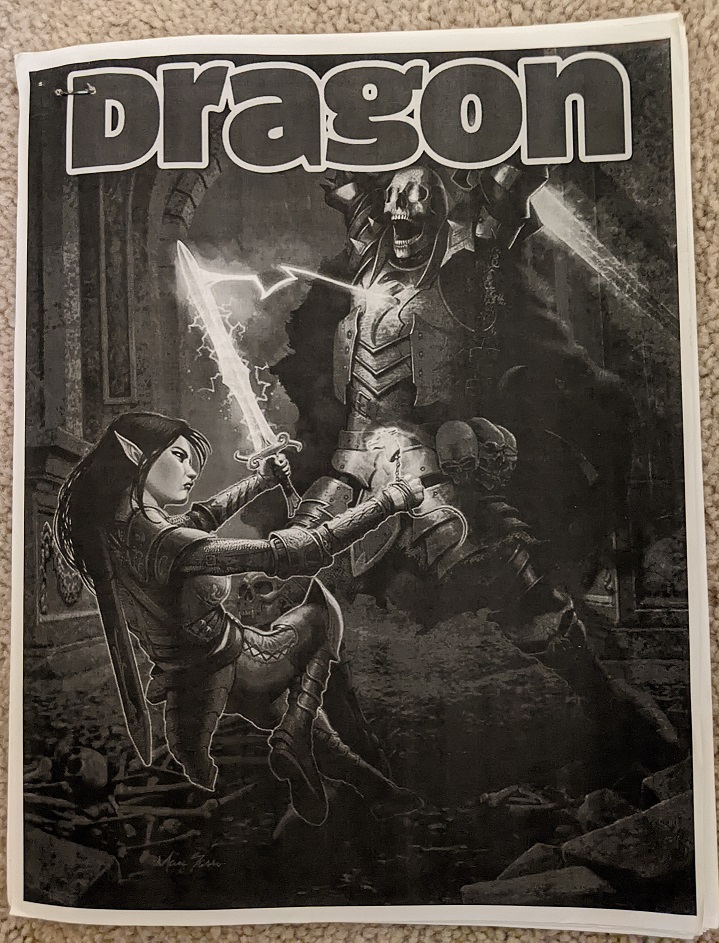
I think this was the first online issue.

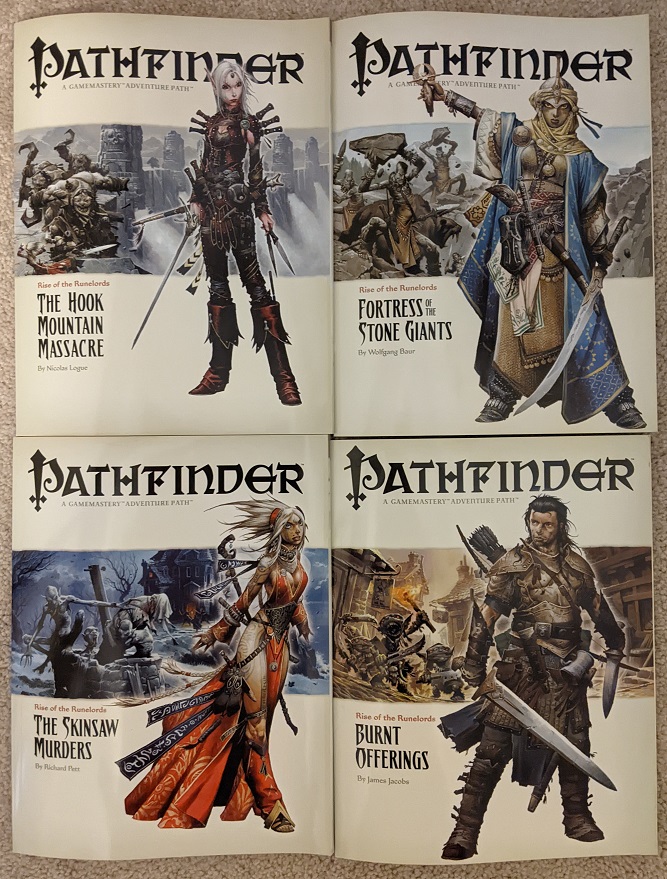
Because I appreciated Paizo for publishing them, I gave them a chance by continuing to subscribe to their Pathfinder adventure path books. I recall telling them that in response to their sales pitch they delivered via email.

You can buy these here, but they seem to have new covers.

Sadly (for Paizo), they weren’t for me, so I never used the material. Honestly, I always found their style of artwork better suited for children (especially the goblin), and, as I said above, I also knew that I wouldn’t be staying behind for 3e due to my participation in organized play. In hindsight, that wouldn’t have been a barrier due to the introduction of Pathfinder Society, but I would have abandoned Pathfinder anyway. I greatly prefer 4e, so I’m happy with my decision. Still, I’m happy Paizo enjoyed success, even though that success created a misconception as to how 4e fared, and that people were able to continuing playing an improved system they enjoyed.

My recent revisiting of 1st Edition D&D has me asking questions, and many people have pointed me to old editions of Polyhedron, Dragon, and Dungeon magazines. Apparently, these were a valuable resource long before I subscribed.

I’m old school, so I want those magazines, but I completely understand why I can’t have them.

Follow me on Twitter @gsllc

Dungeons & Dragons is a trademark of Wizards of the Coast, LLC, who neither contributed to nor endorsed the contents of this post. (Okay, jackasses?)

Unfinished Business @Erik_Nowak #4e #3e #DnD #RPG

If you enjoy this post, please retweet it.

Yet again, my move has uncovered some things that I haven’t laid my eyes upon in years. This time, I found a bunch of 4th Edition D&D (“4e“) material that I never used, and some I didn’t really use.

I know that 4e wasn’t for everyone. If it wasn’t for you, and you’re just a hater, then this post isn’t for you. Stop reading and go do what makes you happy. No one will give you shit for it.

When 4e ended, I knew what was coming. Everyone with whom I played D&D — and I mean everyone — would be moving onto 5th Edition (“5e“). Why? Because we were all people that met, directly or indirectly, through organized play. Therefore, we were all people who’d just move on to next edition without questioning it. We’d always have to be playing the current edition, whatever it was.

At the time 5e was announced, my friend, Erik, and I had a conversation. We were both of the mindset that 4e was ending too soon. (Erik would eventually be happy because he prefers 5e to 4e.) There was far too much material that we hadn’t yet used. Well, I was reminded of this as I unpacked a ton of 4e adventures and source books that I never used. Sure, I had seen some Shadar-Kai in Living Forgotten Realms, but I never played a Shadowfell campaign. I really wanted to make use of The Shadowfell supplement, either as a player or DM. That’s just one example. There are more than I could list here, especially when you consider the multitude of adventures.

But it’s not just 4e. Once 4e came out, I was so happy with it that I completely abandoned 3rd Edition (“3.0e” and “3.5e“). (Having to confirm critical hits is the dumbest rule in RPG history, so I was happy to see it go away.) As I’ve mentioned, I sold off all my 3.5e material because, as above, I knew that everyone with whom I played would move to 4e. This was a lot of material. I owned literally every sourcebook WotC published for 3.5e, a couple for 3.0e that were never upgraded to 3.5e, as well a ton of adventures (though not all that WotC had published). I also sold off a few 3rd-party products. The only things I kept were the three core books, the Spell Compendium, and Mongoose Publishing’s Pocket Player’s Handbook. I came to regret selling Deities & Demigods, Hordes of the Abyss, and Tyrants of the Nine Hells. I don’t know what the hell I was thinking (pun absolutely intended). Fortunately, Deities & Demigods was gifted to me later, but that’s not great for campaigns. I would really have liked to used Hordes of the Abyss, and Tyrants of the Nine Hells, but I’m not going to pay a minimum of $75 for Hordes or a minimum of $150 for Tyrants.

Of course, I’m capable of reading the material and adapting it to whatever edition I want to DM. Many of the monsters already exist across editions (though not 4e‘s uber-cool Immolith, except unofficially), but the cosmology and character options are very different. Crossing those streams has two disadvantages: 1) it’s more work; and 2) it subverts my players’ expectations for how the cosmology is currently structured. I wouldn’t know how to convert the Hellbred race from Tyrants of the Nine Hells to 1st Edition (“1e“), which is my current focus. Also, I want to start with the classic adventures first. Adapting adventures from other editions will happen later rather than sooner.

I’m not sure it’s in the cards, but there’s a lot of great legacy material out there that I wish I had used.

See more unfinished business here and here.

Follow me on Twitter @gsllc
Follow Erik @Erik_Nowak

Dungeons & Dragons is a trademark of Wizards of the Coast, LLC, who neither contributed to nor endorsed the contents of this post. (Okay, jackasses?)


The Other D&D: Deities and Demigods @SerpentineOwl @Luddite_Vic #ADnD #DnD #RPG #MythologyMonday #MythologyMonandæg #folklore

If you enjoy this post, please retweet it.

Every now and then, someone posts to a D&D group asking how everyone used Deities & Demigods in your games. The question almost always refers to 1st Edition D&D (“1e”). I suspect the reason for that is 1) many people that used it as kids so (like me) their answers will depend on how long ago they played; and 2) later editions of D&D overtly incorporated combat with divine creatures, or their avatars, for epic level adventurers. I’ve also played 3rd Edition D&D (“3e”), 4th Edition D&D (“4e”), and 5th Edition D&D (“5e”), so I’m going to address all of them.

Yes, there’s a clear pattern in my abbreviations, but this is how lawyers write.

1e

As a kid, I loved reading mythology before I had even heard of D&D. Mythology is what drew me in, so of course I was going to use Deities and Demigods anyway I could. I remember during my earliest days (1977 or 1978), I created a list of 100 (or so) magic items from that sourcebook (e.g., Thor’s hammer, Enlil’s helm), and each PC was permitted to roll a d100 to determine their starting magic weapon. Yes, a 7th-level level character could wield Zeus’s Aegis. As an adult, this sounds stupid, but there’s no wrong way to play D&D, right? We had fun with it.

Hiatus

I stopped playing D&D in 1982 due to the Satanic Panic, so no 2nd Edition or 3rd Edition D&D for me.

3.5e

I returned to the game of D&D in 2005, and 3.5e was the current edition. I never played or ran epic level for 3.5e, so that edition’s Deities and Demigods was nothing more than reading material. I sold off almost all my 3e materials when 4e came out, but when I repurchased some for posterity, I made sure to grab that one (actually, it was gifted to me by James). I love that book, but what stood out the most to me about it was the transition to Horus as the supreme leader of the Egyptian pantheon. Like the real world, leadership switched. But I never used it in game.

Side Note: I really wish I’d never sold Hordes of the Abyss or Tyrants of the Nine Hells. They’re great resources valuable in any edition, but buying them now would be a horrible waste of money.

4e

There was no 4e Deities and Demigods. Divine creatures, or their avatars (DM’s choice as to which), appeared throughout various monster manuals, and they were designed as encounters for epic level creatures. Basically, Wizards of the Coast (“WotC”) surrendered to the notion that a lot of us wanted to face the divine, and it became part of the game. How the monster was interpreted – the actual creature or just an avatar – was a matter for the DM to decide, but they were there. Well, a few of them. I don’t recall WotC publishing gods beyond their own proprietary pantheons. I believe you had to go to third parties for that material, and sometimes it wasn’t right on point (e.g., Soldiers of Fortune had a Thor equivalent, but he wasn’t called “Thor”).

Going Backwards

Now that I’m going backwards, I must decide how to deal with divine creatures. They aren’t baked into the scheme like they are with 4e. In fact, as some have pointed out, it really should be impossible for PCs to compete against the divine on their home plane, which is the only place where they can finally be defeated. Once you leave the Prime Material Plane, many spells don’t work or are severely weakened. The environment itself works against the PCs but is home sweet home for divine creatures. There’s no upper limit to class levels for PCs, so eventually PCs should be able to fight the divine within the rules, but who’s going to level up to level 1,000? No one, and isn’t advancement through adventuring the real fun of the game? I’m not just going to say, “Okay, you’re all 1,000th level. Let’s go fight some gods.” I’m also not going to rewrite the rules in some odd way to make divine encounters more practical. It’s assumed that DMs will tweak the rules a bit, but eventually that reaches a point where we aren’t playing D&D anymore. That doesn’t interest me.

Of course, I don’t have to make my decision anytime soon. In fact, I may never have to make it. Once I sit down at the table, I may lose interest in 1e quickly. We’ll see.

Shameless Plug

This isn’t much of a plug, but here it goes. Luddite Vic and I are designing our own RPG. It’ll never see the commercial light of day because we don’t meet frequently enough to get it done. However, the system so far is, unsurprisingly, exactly what I want from an RPG. One of our design schemes relevant here is to make sure that PCs can emulate characters from mythology, folklore, or literature even at first level. I’ve never seen that in an RPG.

For example, how might one emulate Thor in 5e? One less-than-ideal option would be a hammer-wielding human tempest cleric, but that cleric would barely be distinguishable from any other cleric build until 3rd level, and even then, it’s going to take a while before it’s obvious to other players what you’re trying to do. You could just tell them, but if you need to do that, you’re not really playing Thor yet. What about Tarzan? How long would a half-naked, dagger-wielding barbarian last in a game of 5e?

In our system, everyone would know from the get-go exactly what you were doing with your lightning/thunder-based, hammer-wielding, human tempest, or a half-naked, dagger-wielding barbarian, even though those characters wouldn’t be any more or less powerful than any other 1st-level characters. That’s the real solution, but I know of no other game that does that. One game was mentioned to me where the PCs are the gods, but from what I understand, they don’t start as anything resembling 1st-level for other RPGs. That’s not bad, but it’s not the same thing. I want to start as first level with that character concept and earn divinity.

That’s how I’d prefer to “use Deities and Demigods.” I shouldn’t need to. I should be able to make the PCs and NPCs exactly what I need them to be. But in 1e, they’re just avatars.

Maybe someday Vic and I will finish our game.

Follow me on Twitter @gsllc
Follow James @SerpentineOwl
Follow Luddite Vic @Luddite_Vic

Dungeons & Dragons is a trademark of Wizards of the Coast, LLC, who neither contributed to nor endorsed the contents of this post. (Okay, jackasses?)


My synDCon Dungeon Delves @Luddite_Vic @flashedarling #ADnD #DnD #4e #RPG 

If you enjoy this post, please retweet it.

I know you’re all sick of hearing about my new house, but hear me out. This is a D&D post. During my move, I found some things I had lost. Sort of. I have the original Word and PDF versions, but I found the bounded hard copies. First, some context.

Luddite Vic and I ran a gaming club called the Gamers’ Syndicate, and ran a convention about a decade ago called synDCon, playing off the association with the Syndicate. It took place in the DC area (Rockville, MD, to be precise); hence, the odd capitalization in the convention’s name.

I’m like a free agent: Unrestricted.

The current edition of D&D at the time was 4th, and one of the marketing efforts for that edition was the “dungeon delve.” These were 30-45 minute (if I recall correctly) collections of three or four combat-only scenarios. They were great at conventions for giving gamers something to do if their adventures ran over. In many cases, there were minor prizes for completing the delves, which wasn’t always easy.

Well, I took that idea and ran with it for synDCon II. It was my pet project because I was able to combine a couple of ideas to make it worth my trouble. I created delves based on iconic encounters in 1st Edition AD&D adventures, added in pregens created by Galen, and named the event synDClash (shut up). Here’s the rundown:

  1. Return to the Borderlands (easy): The Mad Hermit, the Owlbear, and the Minotaur, all based on Keep on the Borderlands.
  2. Giant Problems (easy): The kitchen encounter from Steading of the Hill Giant Chief, the frozen tomb from Glacial Rift of the Frost Giant Jarl, and the children’s barracks from Hall of the Fire Giant King (they were actually “Fire Giant Tweens”).
  3. The Ruins at Inverness (medium): The chessmen, the medusa and “strange apes,” and the fire giant from my favorite D&D adventure, Ghost Tower of Inverness, which I’ve converted to 4e and 5e (only characters were published).
  4. Erelhei-Cinlu Rises (difficult): A troglodyte, wyverns, and piercers in a cavern from Descent into the Depths of the Earth; the statute of Blibdoolpoolp and some kuo-toa from from Shrine of the Kuo-Toa, and the married couple Belgos and Silussa (the succubus) from Vault of the Drow.
  5. The Great Metal Dungeon (difficult): The mind flayer and vegepygmies, the combat-based robots, and the bulette from second favorite D&D adventure Expedition to the Barrier Peaks.
  6. The Pit of the Queen (very difficult, by which I meant impossible): The demonweb maze populated by various giant arachnids, the two drow clerics sitting on towers, and Lolth herself from Queen of the Demonweb Pits.

We also allowed DMs to run the Fool’s Grove Delve, which was published by WotC. For synDClash (shut up), it was medium difficulty.

As you might guess, the Pit of the Queen was completely unfair. For those of you that have knowledge of 4e, here are three features that stand out for the final encounter with Lolth. First, the encounter begins with a lot of space between the PCs and Lolth, but with spider swarms near the PCs. The swarms have a close blast 3 basic attack(!). That is, if one PC provoked, the spider would execute a blast that could affect multiple PCs, and considering the cramped space and the range of the attack, there were always multiple targets. Oh, and of course that attack went off the moment the swarm was destroyed. Second, she had some animated statutes that kept PCs prone. Third, Lolth had a power that made her appear as “artillery.” However, the moment more than one PC at a time was adjacent to her, it became clear she was a “soldier.” No one saw that coming. They thought that once they got nearby, they’d have her, but that didn’t happen. There’s no way PCs could win this encounter if the DM played it as written, but that didn’t stop PCs from trying.

Josie, if you’re reading this, you’re credited on one of these as a playtester under the name, Jamie Morgan. I have no idea how that happened. 🙂

I was happy to see how popular synDClash (shut up) was. There were some people playing multiple delves for an entire slot, and not because there weren’t seats available at regular games. They enjoyed the nostalgia as well. If we had run a third synDCon, my next plan was to make a bunch of delves based on fairy tales, but it wasn’t meant to be.

I also found this gem from 1986.

One of these days, I’d like to run these again, and having hard copies for the adventures and the pre-generated characters makes that easy.

Follow me on Twitter @gsllc
Follow Vic at @Luddite_Vic
Follow Galen @flashedarling

Dungeons & Dragons is a trademark of Wizards of the Coast, LLC, who neither contributed to nor endorsed the contents of this post. (Okay, jackasses?)