Let's roll some dice, watch some movies, or generally just geek out. New posts at 6:30 pm ET but only if I have something to say. Menu at the top. gsllc@chirp.enworld.org on Mastodon and @gsllc on Twitter.
I’m waaaaay ahead on my blog writing, so this post, written on 2/18/2022, relates to a tweet from 2/11/2022, and is being published (assuming I don’t move my schedule around) on 3/3/2022.
Luck. If it's good enough for the #FASA#StarTrek#RPG, it's good enough for all of them.
The FASA Star Trek RPG (“STRPG“) is one of my two favorite RPG systems, so of course I had that one on the brain. STRPG was a d100, skill-based system, where players collected skill points based on their Star Fleet Academy (or other) training, and placed them into various skills. Their ability scores were also based on d100, so ability and skill checks were treated the same way.
The ability scores in STRPG had a one-to-one relationship with those of D&D, but STRPG added two extra skills: PSI (psionics) and LUC (luck). As you know, D&D has had different ways of dealing with psionics, none of which involved a separate ability score. In 1st Edition, a minimum Intelligence of X gave you a 1% chance of having psionic talents, opening up a new system of mechanics. I never played 2nd Edition, but from 3rd Edition forward, psionics became a class feature. If you took a psionic class, you had psionics. Otherwise, you didn’t (though some magic did psychic damage). Ergo, I didn’t respond with PSI. D&D couldn’t really use it.
LUC is a different story. There’s room for it in D&D. In a reasonably balanced system, LUC was a way of giving the PCs an advantage over the NPCs. There are other ways to do that (e.g., 3rd Edition action points, inherent mechanics), but a LUC score wasn’t a bad choice. If all roleplaying and dice rolls failed the PC, they could request one more shot at success with a LUC roll. If they rolled less than their LUC score, they succeeded despite those failures. Of course, it was up to the gamemaster to define what that success was, which could be partial rather than total. Considering how focused modern gamers are on player agency, I suspect that a LUC ability score should appeal to many of them.
BTW, if you’ve never read my blog before this post, I’ve probably left you in suspense.
For the record, my other favorite RPG system is 4th Edition D&D.
If I fail my LUC check, my love of 4th Edition could start a nuclear war.
Dungeons & Dragons is a trademark of Wizards of the Coast, LLC, who neither contributed to, nor endorsed, the contents of this post. (Okay, jackasses?)
In case the tweet is ever deleted, here’s a screenshot of it.
A couple of days ago, I posted about some things I found while continuing to unpack. One thing I found deserves its own post: the program for our first synDCon gaming convention (2010). When we decided we were going to put on a convention, we had a meeting of at least 20 people at the Cracker Barrel in Chantilly, Virginia. This took place after one of our Living Forgotten Realms game days at the now defunct Game Parlor. Only seven people decided to come on board as owners, with two quickly moving to Arizona before we could even get started, and then two others flaking out. It was basically Vic, Cassandra, and I doing everything.
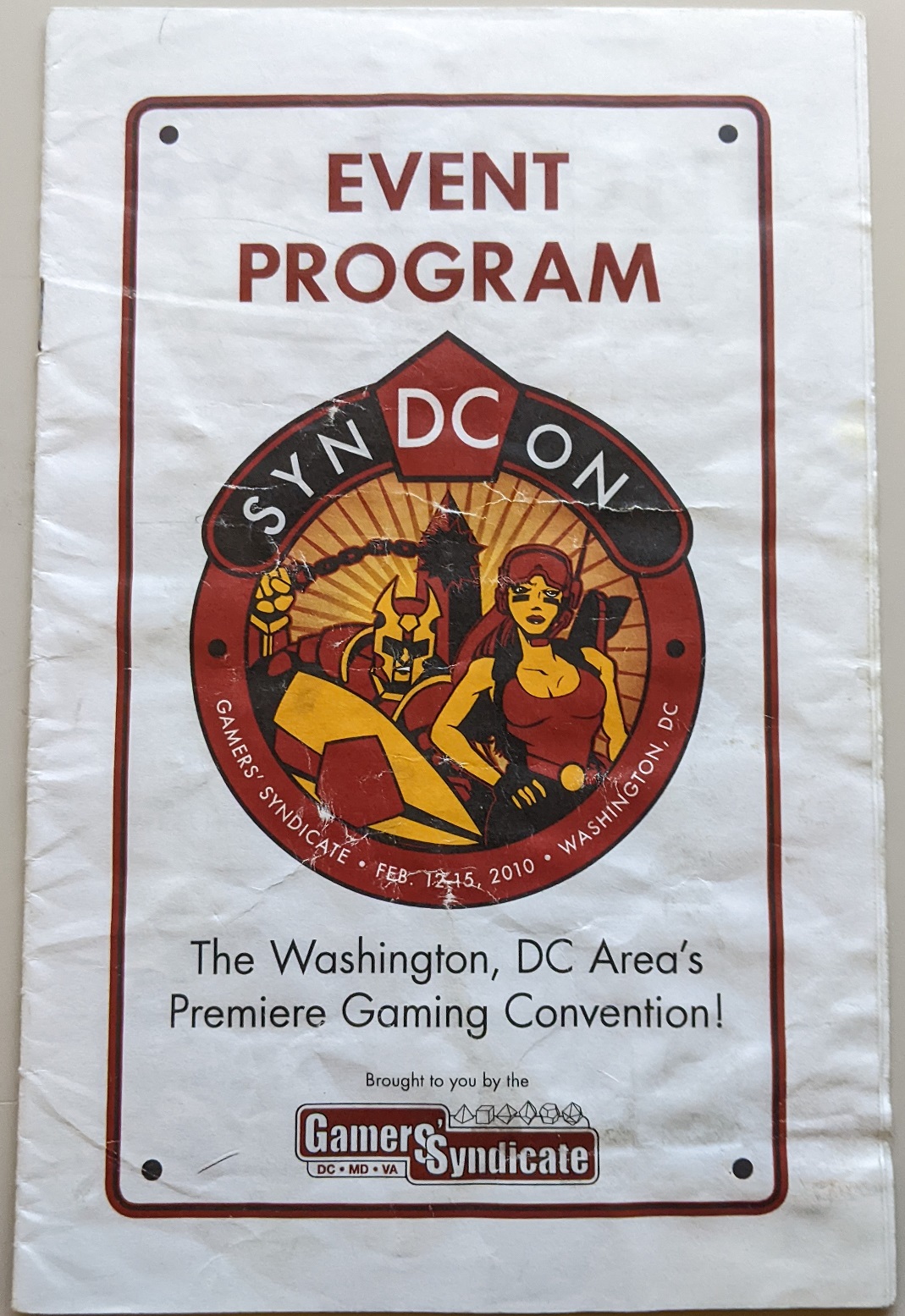
Front Cover
The cover art and Gamers’ Syndicate logo were both designed and illustrated by Erik_Nowak, and he also designed this program.
Welcome Statement
I remember a meeting when there were just five of us. We had to decide who would be the number one person: the Convention Coordinator. I didn’t volunteer because I didn’t want to be too pushy, but no one else wanted to do it. This was typically unnecessary nerd angst on all our parts, because in the end it didn’t matter. Everyone had to work hard (until they flaked out), and no one was really the boss among us.
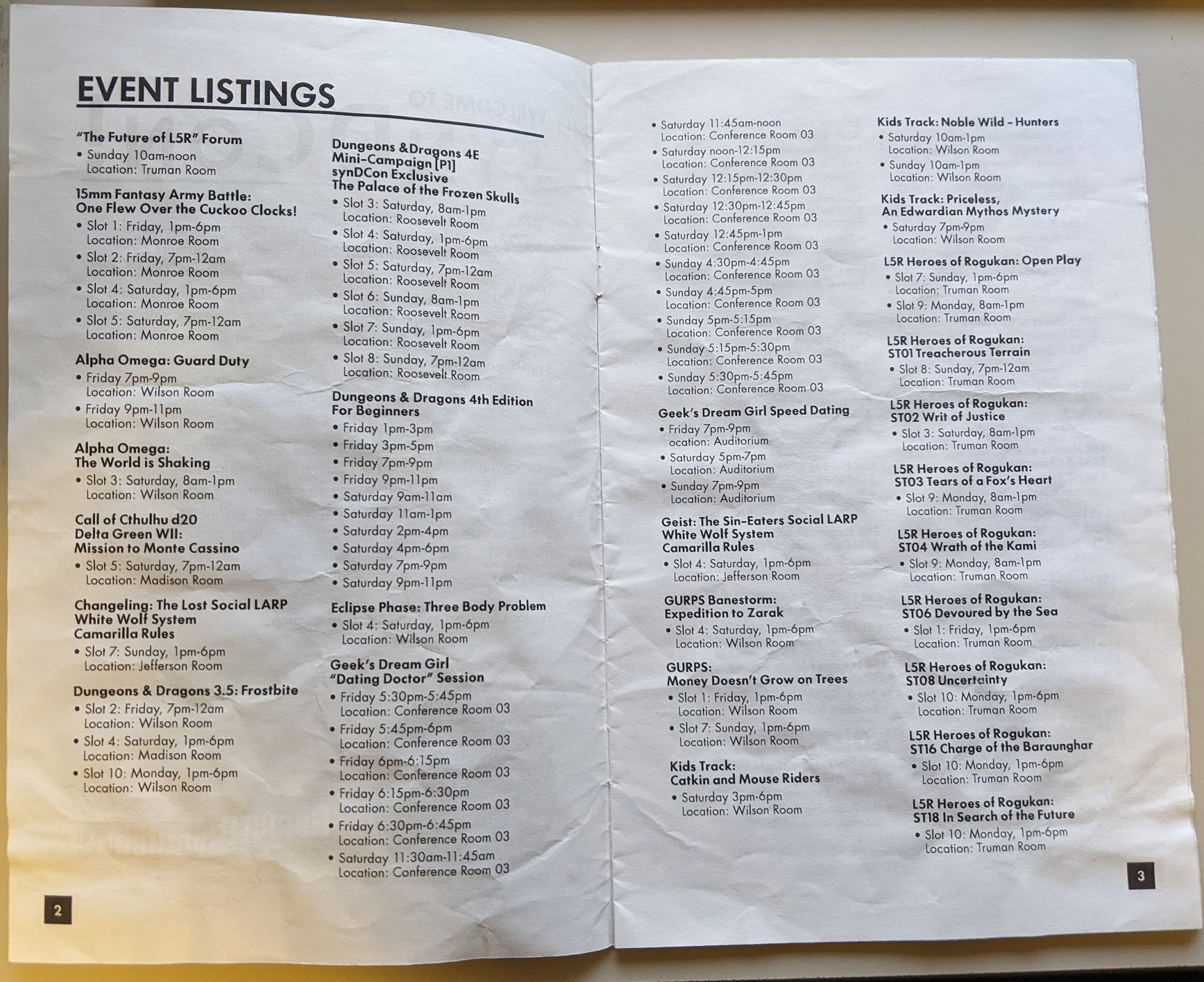
Pages 2 and 3
I’m proud of two things. First, look at that first page, and continue to examine the ones that follow. Even when we had seven planned owners, everyone was almost exclusively a 4th Edition D&D player. Nevertheless, our relatively small convention had a ton of variety in what was run. There were card games, board games, RPGs, and miniature war games. Within the RPGs, we had a ton of variety as well, and there were games run specifically for beginners. We also had a “synDCon special,” which was written by Erik and D. Hunter Phillips.
Pages 4 and 5
The second thing of which I’m proud was my idea (<patting myself on the back>). We had staggered slots. Instead of the typical 8am-12pm, 1pm-5pm, 7pm-11pm schedule for RPG games, we added in slots at 10am-2pm and 3pm-7pm as well. Again, for a small con, the fact that this worked out so well was remarkable. Many people took advantage of the opportunity to sleep in, try our Dungeon Delves for a couple of hours, sit in on a seminar or author book reading, or try new systems at the beginners’ tables. Another great idea of mine was to allow only 5 seats per game in presale despite tables seating 6 players. This made it far easier to sit players that didn’t preregister or wanted to change tables. No one had a problem with it, but a lot of people appreciated the flexibility.
Venue Map
This was a nice hotel, and it was conveniently located near a Metro stop (our public rail transportation system). And being who I am, I especially wanted a site in Maryland so that we could register for a federal trademark if it ever came to that. 🙂
Pages 8 and 9
Okay, yes, we definitely emphasized Living Forgotten Realms, but I’m still happy with how much Heroes and Rokugan and Pathfinder Society we had (these are living campaigns for the RPGs Legend of the Five Rings and Pathfinder respectively).
Pages 10 and 11
Note well, though, that there was more going on than the program states. We had a board game room, and open play for both card games and miniature war games. Saturday night, my cousin and I, a.k.a., Wet Paint, performed for a crowd of beer-drinking gamers some hits of the 80s and 90s. That’s when we played together, so our song set came from those decades.
Only Mike and I are Wet Paint. Matt James was an interloper. He’s considered a member of “Trail Mix,” which is anyone that’s ever played with us.
Seriously, for a small, first-time convention, look at how much variety we had. I loved it, and I never saw it with conventions this small. We also had seminars featuring authors and game designers. Being in the DC area, we actually knew a lot of those people, so it was relatively easy to get them here. This, in turn, allowed us to do this . . . .
Pages 12 and 13
We received a small amount of support from most of these companies, and others were actually present. Our prize for the first person to buy a convention badge was a ticket to GenCon. GenCon gave those away to conventions all the time; no inside track was necessary. However, we also had, for example, a member of Green Ronin participate in a seminar and run the (then-new) Dragon Age RPG, and Rob Hobart (AEG), the head of Heroes of Rokugan, ran a seminar and (I think) a few games.
I touched up this image of the back cover to delete some handwriting. Pay no attention to the fields of ecru.
We chose a great venue, and synDCon 2010 was a four-day convention. Yep, four days. Just like the big guys. Monday was a holiday, and adding that day to the schedule didn’t increase our costs noticeably. Of course, by cost I mean financial cost. My feet were sore (which is why I was sitting for the Wet Paint performance), and I ran, at best, on four hours of sleep a night, with only two on performance night. I’d say it was a success considering that we got hit with a snowstorm right before the convention, scaring off a lot of people.
The following year, we moved synDCon 2011 to mid-April to make sure we’d have better weather, but we had late snow that year. It wasn’t as bad as the previous year, but it still affected attendance. Infuriating. However, synDCon 2011 was an official convention within the circuit of competitive Munchkin published by Steve Jackson Games. In fact, we may have done that for synDCon 2010. I really don’t remember at this point. I just know we had a great time both years. Unfortunately, it’s too hard a thing to run with, for all practical purposes, two people running the entire show and Mother Nature chasing us around with snowstorms. This isn’t to say that there weren’t a lot of other people that did a lot of work. We had a lot of help, with a few people being organizers for Living Forgotten Realms, Pathfinder Society, and Heroes of Rokugan, and we still had decent numbers. However, in the end it falls on the organizers, and there were only two of us. Both Vic and I would rather not have a convention than do one half-assed, so we didn’t have a third one.
Would I like to bring it back? Yes. Do we have the financial means to do so? Probably. Do I see enough people getting on board to make the workload manageable? No. There are very few people I could trust to see it through, and I’m not getting any younger.
A recent purchase sent me down a rabbit hole. Last Wednesday, I whined about my unfinished business with 4th Edition D&D (“4e“) with 3rd Edition D&D (“3e“). Yesterday, I showed how that can put you in a “you can never go back” position. Today, I’m not whining (too much), but this is really about praising a great RPG writer, Rob Schwalb, a.k.a., the Demon Lord, a.k.a., Satan Claus.
Full disclosure: Though we’ve never sat down and had a beer together (why the fuck not?), I know the guy, and I know that he’s done a lot of writing for D&D. However, I don’t pay attention to the authors on those books because I trust the brand and am going to buy those books regardless of who the freelance author was. I honestly had no idea he authored some of my favorite D&D books. Only the ones I consider my favorites are noted below, but the full list is here (or so claims Amazon.com).
Fiendish Codexes, 3e
As I’ve whined before, the Fiendish Codexes are two 3e sourcebooks I regret having sold off, and as much as I want them in my physical library, I’m not paying $135 or more for either. Rob co-wrote the second one, Tyrants of the Nine Hells, with Robin D. Laws. I’ll have to settle on the fact that my new character I’m playing at Winter Vantasy will be Tybalt the Cursed (Tyrants of the Nine Hells, page 79), or at least as close as I can get. Feel free to make suggestions to his character sheet at 1st level and 5th level.
Tome of Magic, 3e
Only one class can truly compete with bard for my favorite class: the Truenamer from Tome of Magic (for which I’m not paying $50+). I made one my BBEG for a campaign I ran but never played one as a PC. Mechanically, it’s not the best class. It has a weird power curve because it’s attacks are based on skills, so as you level up you became weaker until you hit 4th, 8th, 12th, etc. level where you get a huge jump in power. It also depends on a very specific set of magic items in order to keep up with the NPC power curve. Nevertheless, it has great flavor, so I’d have been happy to play one. I’ve annoyed people by playing bongos or a recorder at the game table for my bards, but can you imagine roleplaying a truenamer? I’d be screaming profanity in an unknown language every time I attacked.
Okay, maybe it’s best that I never played one.
Drow of the Underdark
Last week, I purchased a soft cover copy of Drow of the Underdark via the DMs Guild (PDF included). I loved that book and wanted it in my physical library. I’m very happy with my soft cover of the Fiend Folio for 1st Edition D&D, so the format doesn’t bother me at all.
Martial Power, 4e (the First One)
In 4e, all I wanted to play were leaders, which were the classes that did most of the healing. This is odd because I disliked playing healers in every other edition of D&D that I’ve played (though 5th Edition D&D‘s tempest cleric is reasonably fun). However, the one 4e non-leader class/build that I loved to play as much as a leader was the beastmaster ranger from Martial Power. I could win initiative and run across an entire battle map on the first turn. Impressive, though reckless. I did it only once. Once. But being able to self-flank with your beast companion was fun.
Monster Manual 3, 4e
My favorite enemies are demons, devils, drow, and slaadi. This book had cambions, 7 demons (molydeus!) 8 devils (using a picture of a Binder from Tome of Magic for 3e), 6 drow, Lolth, Eclavdra, and 2 slaadi. Lolth’s stat block was about as clever as they come, changing from a lurker to a brute when her lurker form was “killed.” Rob confirmed with me that he drafted it. (Sly Flourish‘s Cryonax stat block was pretty good too. Never used it. Shit.)
FYI, I'm writing a blog post and thought about this stat block. Google sent me to this tweet. With Lolth (MM3), this is one of my two favorite 4e stat blocks. It's not about the power for me; it's about how clever those stat blocks were drafted.
How could I not love this sourcebook? This is, of course, just scratching the surface. This sourcebook introduced a lot of iconic monsters to 4e. I added an intellect devourer to my home game as soon as I had that stat block.
Exemplars of Evil and Elder Evils, 3e
These were not among my favorites. I mention them only to say, yeah, it figures he wrote these. Crazy bastard.
This list is itself just scratching the surface. He’s done a lot of solid work, which is unsurprising. You don’t keep getting jobs if you’re producing shoddy work. Some of my favorite titles have his bloody fingerprints all over them.
I recently wrote about my unfinished business with 4th Edition D&D (“4e“). In short, the edition was (mostly) abandoned by WotC while there was still more of their material to explore. This was a problem only because most of my friends and I were the kind of people that would always move on to the current edition, so there’s no blame to assess. That’s just the way it is. Well, as I mentioned in that post, the same thing happened with 3rd Edition D&D (“3e“); it just wasn’t as devastating for me.
So, moving onto the topic at hand, I recently came across a 3e supplement I had forgotten but was a sore point for me: Dragon Magic. In WotC’s words,
This D&D supplement presents an unprecedented variety of new options for your character, each one drawing on some element of draconic might. It presents a new standard class, the dragonfire adept, who combines a potent breath weapon with various magical invocations. It reveals many new ways to wield the magic of dragons, including draconic auras, dragonpacts, and draconic racial variants.
For the DM, this book also provides dragon-themed adventure seeds and campaign ideas, magical locations to explore, and new options for making dragons more powerful and exciting.
I’ve always been a “kitchen sink” DM, by which I mean that I never forbade a player from using an official WotC resource for their D&D character. I didn’t care how it broke the game; I’d adjust. If they bought the book, they should be able to make use of it. I found it bizarre that WotC’s Living Greyhawk living campaign wasn’t so generous. They’re the ones that were trying to sell the book. Why forbid its use? But I digress. The point is that I bought Dragon Magic and really wanted to try the class it introduced, the dragonfire adept. I never got that opportunity, and the one time I tried, the DM forbade it because he wasn’t familiar with the material.
I have no idea whether it was a fun class. I have no idea whether the draconic subspecies, variant class features, draconic feats, draconic spells, dragon pacts, or draconic auras were any good. But I really wish I had had the opportunity to find out. To be clear, I’m being a whiny little bitch about this. It’s not enough that 4e, 5e, or any other game system created similar options. I wanted to play these options in 3e at that time, and I’m a little bitter I was denied that. As I’m not a fan of 3e, and the only times I’ve played it in recent years has been within the resurrected Living Greyhawk campaign, which forbids it, so this will never happen. That’s a shame.
All I wanted was to ride Falcor!
In other words, the real message of this post is: Don’t deny your players the opportunity to use the materials for which they’ve paid good money (i.e., don’t be a dick).
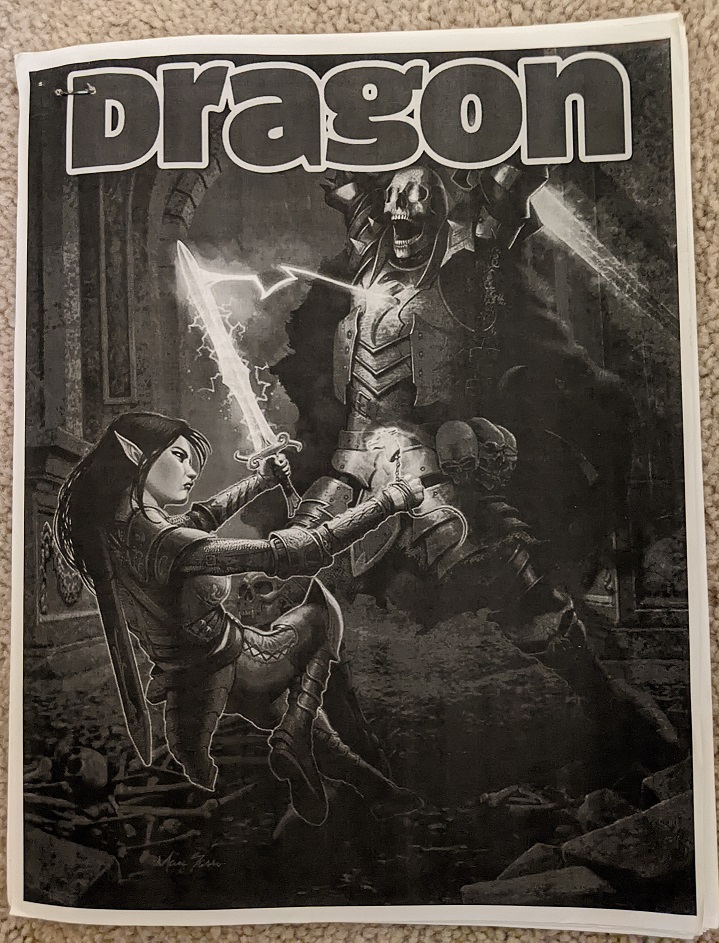
Last week, I mentioned that, during my move, I found the hard copies of my Dungeon Delves from synDCon. Well, I also found some print issues of Dragon and Dungeon magazines. Any mechanics or setting-based discussed in the magazines is for 3rd Edition D&D (“3e“), which I no longer enjoy playing, but much of the material is system agnostic. It’s still good stuff.
As I’ve said in many other contexts, I left D&D in 1982 due to the Satanic Panic, dabbled a bit in the Star Trek RPG in high school and college, then finally returned to D&D and a small amount of other RPGs in 2005. Because of my age, my awareness, my family’s restrictions, and logistics, I didn’t subscribe to Dragon and Dungeon until 2005 or 2006. It was fantastic. As someone still trying to get a feel for writing and running my own gaming material, I loved the advice and rules explanations that magazine offered. Unfortunately, shortly after I started subscribing, the rug was pulled out. They announced that they were moving the magazines online, and shortly thereafter, 4th Edition D&D (“4e“) was announced at GenCon 2007. The last issues of each were dated for September, 2007.
I wasn’t a fan of the online magazines. I wanted to find a color magazine in my Delaware post office box twice a month, but the reality of our world took over, and I eventually started receiving them online with my DDO subscription. How much did I prefer print? I printed out several of the PDFs, but in black and white. It wasn’t the same, and the ink costs were too high despite not being in color, so that practice didn’t last.
I think this was the first online issue.
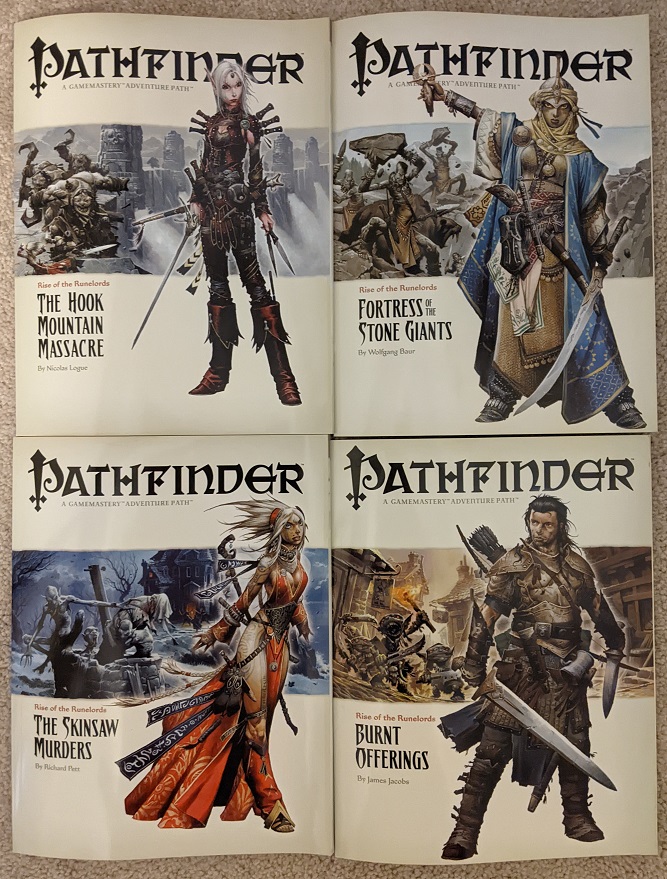
Because I appreciated Paizo for publishing them, I gave them a chance by continuing to subscribe to their Pathfinder adventure path books. I recall telling them that in response to their sales pitch they delivered via email.
You can buy these here, but they seem to have new covers.
Sadly (for Paizo), they weren’t for me, so I never used the material. Honestly, I always found their style of artwork better suited for children (especially the goblin), and, as I said above, I also knew that I wouldn’t be staying behind for 3e due to my participation in organized play. In hindsight, that wouldn’t have been a barrier due to the introduction of Pathfinder Society, but I would have abandoned Pathfinder anyway. I greatly prefer 4e, so I’m happy with my decision. Still, I’m happy Paizo enjoyed success, even though that success created a misconception as to how 4e fared, and that people were able to continuing playing an improved system they enjoyed.
My recent revisiting of 1st Edition D&D has me asking questions, and many people have pointed me to old editions of Polyhedron, Dragon, and Dungeon magazines. Apparently, these were a valuable resource long before I subscribed.
I’m old school, so I want those magazines, but I completely understand why I can’t have them.
Yesterday, I asserted that confirming critical hits was the worst rule in the history of D&D. Why? Well, this is how I imagine the rule came to be.
Designer 1: “Do you know who I really hate?” Designer 2: “Who?” Designer 1: “Players.” Designer 2: “Oh, no kidding. They’re the worst.” Designer 1: “Well, I have a new idea for a rule that will completely screw them.” Designer 2: “Ooooo, tell me! Tell me!” Designer 1: “So, if you roll an unmodified (aka ‘natural’) 20, it’s considered a ‘critical hit’ that does something really cool.” Designer 2: “Wait, how is that screwing them? You promised we’d be screwing them!” Designer 1: “Hold on; hold on. I’m not done. So, the player rolls a natural 20, which itself is relatively rare, but in that relatively rare instance when they do, this happens:
Player: “Hooray! I get to do something cool!” DM: “Um, no you don’t.” Player: “What? I rolled a natural 20. That’s a critical hit. I get to do something cool.” DM: “Um, no. Roll again.” Player: “Why?” DM: “Because if you want to do something cool, you have to earn it.” Player: “I thought I just did.” DM: “Yeah, that was good, but I need more. Roll again.” Player: “Okay. I guess so. . . . I got a 7.” DM: “Well, that misses, so your hit isn’t critical. Just roll normal damage and be happy I didn’t kill your character.” Player: <grumbles knowing that every 3rd Edition D&D DM will do the same thing, so there’s no way out>
Designer 2: “Holy crap! That’s maddening! Players will be soooo frustrated.” Designer 1: “And don’t forget, RPGs are balanced under the assumption that things like this will occasionally happen, so even when they get the critical hit, the mechanical benefit is illusory. This is just a way to dangle a carrot of being able to do cool things, then snatching it from them. It’s all about generating that frustration. Why? Because it’s what they deserve.” Designer 2: “You are a god of game design!” Designer 1:
Yet again, my move has uncovered some things that I haven’t laid my eyes upon in years. This time, I found a bunch of 4th Edition D&D (“4e“) material that I never used, and some I didn’t really use.
I know that 4e wasn’t for everyone. If it wasn’t for you, and you’re just a hater, then this post isn’t for you. Stop reading and go do what makes you happy. No one will give you shit for it.
When 4e ended, I knew what was coming. Everyone with whom I played D&D — and I mean everyone — would be moving onto 5th Edition (“5e“). Why? Because we were all people that met, directly or indirectly, through organized play. Therefore, we were all people who’d just move on to next edition without questioning it. We’d always have to be playing the current edition, whatever it was.
At the time 5e was announced, my friend, Erik, and I had a conversation. We were both of the mindset that 4e was ending too soon. (Erik would eventually be happy because he prefers 5e to 4e.) There was far too much material that we hadn’t yet used. Well, I was reminded of this as I unpacked a ton of 4e adventures and source books that I never used. Sure, I had seen some Shadar-Kai in Living Forgotten Realms, but I never played a Shadowfell campaign. I really wanted to make use of The Shadowfell supplement, either as a player or DM. That’s just one example. There are more than I could list here, especially when you consider the multitude of adventures.
But it’s not just 4e. Once 4e came out, I was so happy with it that I completely abandoned 3rd Edition (“3.0e” and “3.5e“). (Having to confirm critical hits is the dumbest rule in RPG history, so I was happy to see it go away.) As I’ve mentioned, I sold off all my 3.5e material because, as above, I knew that everyone with whom I played would move to 4e. This was a lot of material. I owned literally every sourcebook WotC published for 3.5e, a couple for 3.0e that were never upgraded to 3.5e, as well a ton of adventures (though not all that WotC had published). I also sold off a few 3rd-party products. The only things I kept were the three core books, the Spell Compendium, and Mongoose Publishing’s Pocket Player’s Handbook. I came to regret selling Deities & Demigods, Hordes of the Abyss, and Tyrants of the Nine Hells. I don’t know what the hell I was thinking (pun absolutely intended). Fortunately, Deities & Demigods was gifted to me later, but that’s not great for campaigns. I would really have liked to used Hordes of the Abyss, and Tyrants of the Nine Hells, but I’m not going to pay a minimum of $75 for Hordes or a minimum of $150 for Tyrants.
Of course, I’m capable of reading the material and adapting it to whatever edition I want to DM. Many of the monsters already exist across editions (though not 4e‘s uber-cool Immolith, except unofficially), but the cosmology and character options are very different. Crossing those streams has two disadvantages: 1) it’s more work; and 2) it subverts my players’ expectations for how the cosmology is currently structured. I wouldn’t know how to convert the Hellbred race from Tyrants of the Nine Hells to 1st Edition (“1e“), which is my current focus. Also, I want to start with the classic adventures first. Adapting adventures from other editions will happen later rather than sooner.
I’m not sure it’s in the cards, but there’s a lot of great legacy material out there that I wish I had used.
Every now and then, someone posts to a D&D group asking how everyone used Deities & Demigods in your games. The question almost always refers to 1st Edition D&D (“1e”). I suspect the reason for that is 1) many people that used it as kids so (like me) their answers will depend on how long ago they played; and 2) later editions of D&D overtly incorporated combat with divine creatures, or their avatars, for epic level adventurers. I’ve also played 3rd Edition D&D (“3e”), 4th Edition D&D (“4e”), and 5th Edition D&D (“5e”), so I’m going to address all of them.
Yes, there’s a clear pattern in my abbreviations, but this is how lawyers write.
1e
As a kid, I loved reading mythology before I had even heard of D&D. Mythology is what drew me in, so of course I was going to use Deities and Demigods anyway I could. I remember during my earliest days (1977 or 1978), I created a list of 100 (or so) magic items from that sourcebook (e.g., Thor’s hammer, Enlil’s helm), and each PC was permitted to roll a d100 to determine their starting magic weapon. Yes, a 7th-level level character could wield Zeus’s Aegis. As an adult, this sounds stupid, but there’s no wrong way to play D&D, right? We had fun with it.
Hiatus
I stopped playing D&D in 1982 due to the Satanic Panic, so no 2nd Edition or 3rd Edition D&D for me.
3.5e
I returned to the game of D&D in 2005, and 3.5e was the current edition. I never played or ran epic level for 3.5e, so that edition’s Deities and Demigods was nothing more than reading material. I sold off almost all my 3e materials when 4e came out, but when I repurchased some for posterity, I made sure to grab that one (actually, it was gifted to me by James). I love that book, but what stood out the most to me about it was the transition to Horus as the supreme leader of the Egyptian pantheon. Like the real world, leadership switched. But I never used it in game.
Side Note: I really wish I’d never sold Hordes of the Abyss or Tyrants of the Nine Hells. They’re great resources valuable in any edition, but buying them now would be a horrible waste of money.
4e
There was no 4e Deities and Demigods. Divine creatures, or their avatars (DM’s choice as to which), appeared throughout various monster manuals, and they were designed as encounters for epic level creatures. Basically, Wizards of the Coast (“WotC”) surrendered to the notion that a lot of us wanted to face the divine, and it became part of the game. How the monster was interpreted – the actual creature or just an avatar – was a matter for the DM to decide, but they were there. Well, a few of them. I don’t recall WotC publishing gods beyond their own proprietary pantheons. I believe you had to go to third parties for that material, and sometimes it wasn’t right on point (e.g., Soldiers of Fortune had a Thor equivalent, but he wasn’t called “Thor”).
Going Backwards
Now that I’m going backwards, I must decide how to deal with divine creatures. They aren’t baked into the scheme like they are with 4e. In fact, as some have pointed out, it really should be impossible for PCs to compete against the divine on their home plane, which is the only place where they can finally be defeated. Once you leave the Prime Material Plane, many spells don’t work or are severely weakened. The environment itself works against the PCs but is home sweet home for divine creatures. There’s no upper limit to class levels for PCs, so eventually PCs should be able to fight the divine within the rules, but who’s going to level up to level 1,000? No one, and isn’t advancement through adventuring the real fun of the game? I’m not just going to say, “Okay, you’re all 1,000th level. Let’s go fight some gods.” I’m also not going to rewrite the rules in some odd way to make divine encounters more practical. It’s assumed that DMs will tweak the rules a bit, but eventually that reaches a point where we aren’t playing D&D anymore. That doesn’t interest me.
Of course, I don’t have to make my decision anytime soon. In fact, I may never have to make it. Once I sit down at the table, I may lose interest in 1e quickly. We’ll see.
Shameless Plug
This isn’t much of a plug, but here it goes. Luddite Vic and I are designing our own RPG. It’ll never see the commercial light of day because we don’t meet frequently enough to get it done. However, the system so far is, unsurprisingly, exactly what I want from an RPG. One of our design schemes relevant here is to make sure that PCs can emulate characters from mythology, folklore, or literature even at first level. I’ve never seen that in an RPG.
For example, how might one emulate Thor in 5e? One less-than-ideal option would be a hammer-wielding human tempest cleric, but that cleric would barely be distinguishable from any other cleric build until 3rd level, and even then, it’s going to take a while before it’s obvious to other players what you’re trying to do. You could just tell them, but if you need to do that, you’re not really playing Thor yet. What about Tarzan? How long would a half-naked, dagger-wielding barbarian last in a game of 5e?
In our system, everyone would know from the get-go exactly what you were doing with your lightning/thunder-based, hammer-wielding, human tempest, or a half-naked, dagger-wielding barbarian, even though those characters wouldn’t be any more or less powerful than any other 1st-level characters. That’s the real solution, but I know of no other game that does that. One game was mentioned to me where the PCs are the gods, but from what I understand, they don’t start as anything resembling 1st-level for other RPGs. That’s not bad, but it’s not the same thing. I want to start as first level with that character concept and earn divinity.
That’s how I’d prefer to “use Deities and Demigods.” I shouldn’t need to. I should be able to make the PCs and NPCs exactly what I need them to be. But in 1e, they’re just avatars.
Writing yesterday’s post gave me the idea for this post. Here’s a list of my favorite RPG characters.
D&D 3.5 Edition: Frylock
This is my favorite character of all time even though I’m not a fan of 3rd edition. I left D&D in 1981 due to the Satanic Panic and returned in 2005. Frylock was the first character I created in my glorious return, which was for a Living Greyhawk game day. He was a half-elf warmage with a couple of levels in rogue. I’m not sure if I played correctly by the rules, but this was an awesome character, combining the rogues sneak attack damage with high-damage touch spells. He was high charisma, manipulative, and arrogant as hell, except for that one time he met his match. He ran into Teos’s character, Ambrosia, in whose hands Frylock was like putty. He was also a terror in combat, which was helpful considering that I’ve almost never built a character for combat. Spoon-feeding me competent character design helps keep my fellow players happy with my combat performance. If I was cheating to do it, this would explain why no one called me out for it.
For over a decade, my license plate was Frylock. That shouldn’t surprise any of you.
I’ve never been able to duplicate the feel of this character since 3rd edition. The closest I came was the supremely underpowered sorcerer-assassin hybrid in 4th edition. Maybe if I cheated, I could’ve done that in other editions. 🙂
D&D 4th Edition: Rizzen Pharn
4e is the only edition of any RPG I’ve ever played in which I loved play leaders (i.e., healers). After playing the Warlord pre-gen at some convention, I knew that would be the case. My first character I built on my own was the Drow, Rizzen. He was an Inspiring Warlord, and due to Commander’s Strike, it didn’t matter whether I rolled well on my d20s. I just gave my attacks to other people, than used my minor action to heal everyone. Suddenly, I was the most popular player on the table. I can’t remember any personality quirks I gave him. I doubt I did. At this point, 4e was new, and the character builds leant themselves inherently to personalities probably due to the emphasis on roles (i.e., controller, defender, leader, striker). I didn’t feel the need to spice it up.
D&D 4th Edition: Doofus Pharn and Snuggles
Doofus was Rizzen’s brother, and he was a beastmaster ranger. That was a really good class. Combined with the class’s features, my choice of powers gave me the ability to race across the length of a standard battle map in a single turn. The first time I did this was a disaster. I was all by myself surrounded by enemies with no actions left to fight or “ink.” Once I got the hang of the character, that mobility was remarkable. His DPS was also pretty good. His companion was a jaguar named Snuggles, and using the companion, Rizzen was able to set up his own flanks without the help of any PCs. Just like Frylock, I didn’t have to build the character for combat efficiency. The race and class combination handled that for me.
D&D 4th Edition: Luigi Deleonardis
Luigi was a riot. He was the stereotype of a senile old man, and I played him to a tee. He was a brawling fighter, which meant his primary combat tactic was “rassling.” He had a belt buckle with Kord’s holy symbol on it. He didn’t worship Kord; they grew up together. Sure, Kord was a bit younger than Luigi, but Luigi took him under his wing and showed him the ropes. He felt bad for the little guy.
Initially, Luigi always annoyed other players because they thought he’d be useless, but here’s a quick story of how I avoided that. The party had to convince wood elves to let them through their woodlands. Skill challenge! Everyone went with diplomacy or bluff, but not Luigi. As he was about to engage with the elven leader, he suddenly had a squirrel moment and decided to climb a tree. As a fighter, my Athletics was pretty high, and I (uncharacteristically) rolled well. My physical prowess was remarkably impressive, so I passed that check. When we came around again, the entire challenge came down to my roll. I was one of only two players that had to roll twice in the challenge. My (perceived) age allowed me to tell an impressive story of the gods, and with a natural 20, I saved the day. In that same adventure, the ultimate mission was to rescue a kidnapped woman, and as Luigi often did, he told that woman that she reminded him of his great, great, great, great granddaughter’s . . . granddaughter. That gave Luigi the incentive to protect her directly, which is exactly what a fighter is supposed to do.
My unorthodox style never held me back, but it always provided comic relief.
D&D 5th Edition: Balasar Kimbatuul
Balasar was a gold dragonborn battle master fighter who played the bongos, and by that I mean that I went to Toys ‘R Us and bought a set of bongs to play at the table. I created him for Sly Flourish’sHorde of the Dragon Queen campaign, and somewhere on slyflourish.com is a picture of me playing those bongos. The first leg of the campaign is a really tedious slog with little opportunity to rest and recover abilities. The rat swarm was particularly annoying, but the first leg ends with a blue dragonborn, Lennithon, calling out one of us for a one-on-one fight. I spontaneously shouted out, “Honor duel!” That became Balasar’s thing. He’s always pick the baddest NPC on the battlefield and convinced that NPC to duel him. It wasn’t through some class or racial feature, but purely through role-play, which Mike facilitated. In such a situation, it’s easy to outshine your fellow players by grabbing all the glory. I honestly don’t believe that ever happened. Besides the fact that my dice are weighted towards low numbers, so I was often knocked out, Sly Flourish is literally the best DM I ever had. He allows everyone to play as they want to play, and yet characters rarely stole each others’ thunder, nor did players annoy each other. As players, we deserve some of the credit for that, but most of it goes to Mike, and I like to remind him how grateful I am for his talent as a DM. I was in his home game for many years and play-tested most (all?) of his published work during that time.
D&D 5th Edition: Portia Tossgobble
Portia was one of four members of the Tossgobble family I created. Because I can play only one of them at a time, they never met in-game, but they were all siblings. Portia was a halfling, kensai monk in the D&D Adventurer’s League. Because I play once per year, I forgot most of her details. I was playing her at Winter Fantasy, and we needed someone to steer a ship. It suddenly occurred to me that she had a sailor background, so with a natural 20 on my attempt to steer the ship . . . well, let’s just say I finally had the opportunity to yell, “Ramming speed!” The adventure’s treasure included a perfect item for her: a +1 trident. All I need now is a magic item or feature of some sort that allows her to breath water, and she can rule however many seas Faerun has.
I could go on, but I won’t. Maybe I’ll remember some other fun characters and share them in a future post. I liked my occultist in 13th Age (another Sly Flourish campaign), but I was on my last legs as an RPG player at that point. My memory and my thrill in creating meaningful characters waned during that time.
It doesn’t surprise me in the least that all of these characters were D&D characters.










 Play What You Want