
Let's roll some dice, watch some movies, or generally just geek out. New posts at 6:30 pm ET but only if I have something to say. Menu at the top. gsllc@chirp.enworld.org on Mastodon and @gsllc on Twitter.
Another thing that always bugged me about superhero movies (yes, I can pick at the things I love) are the comlinks that the heroes use to communicate. It’s some sort of Bluetooth thing going on; a earpiece with a built in microphone. I always thought, “Why aren’t they constantly talking over one another?”
It just seemed impractical. Of course, we all just let it go; there are far bigger things requiring the suspension of our disbelief. However, I recently started playing D&D again on Wednesday nights via Zoom, and that has brought this thought back to the surface. Even when there are only 5 of us, the cross-chatter makes it impossible for everyone to be heard. It drives me nuts. I’d think there was a lot more planning involved in the defense of New York City from an alien army then there is in deciding how to navigate a bar fight. And don’t tell me about military discipline. The Hulk, Tony Stark, and Thor don’t care about your silly, human, military procedures for communication.
The Two Popes is another movie that’s been sitting in my queue since it came out, but I never got around to seeing it. It’s led by Jonathan Pryce (Pope Francis) and Anthony Hopkins (Pope Benedict, a.k.a., Johnny Ratz), so you know it’s going to be well-acted. There are two things that struck me about it. First, it’s an interesting behind-the-scenes account not only of the drama of a retiring pope (the focus), but also how the mechanism of the Vatican’s selection process. I always find the latter fascinating.
Second, I had my reaction to the movie, of course, but I suspect how people take this movie will be far more varied than most because of the subject matter. My interpretation is that, despite the mission of the Vatican, the mechanism and politics are no different than any large business. Some may say it’s run more like a government, and that may be true (technically, it is one), but that’s not how I saw this movie. Still others may see it from the religious point of view, seeing it as either an exaltation or a fall from grace of the church (depending on the viewer’s perspective).
Way back in the 80s, my cousin (Tom) and I started awarding a “Superman IV Award” to the most disappointing film of the year. It’s not enough that it was bad; it had to be disappointing. The origin of the award makes sense. Superman III was mediocre at best, and we were promised a return to something like Superman II, which was a great film for its time. Instead we got a steaming pile of hot kryptonite.
Highlander II: The Quickening (1991) was an award winner. We loved Highlander for reasons I doubt I need to justify to my fellow nerds, but Highlander II turned out to be the single worst movie ever. (Full disclosure: I’ve never seen the Room.) To go from such a high to such a low is the very definition of disappointment.
Then there was Showgirls (1995). There we were, two straight guys in their mid-20s watching a movie that was specifically about women getting naked. What could possibly go wrong? Well, everything. It was horrible, and our lives are worth just a little bit less having been stained by the memory of that film.
I don’t remember all the movies that received the award. We didn’t have a ceremony on cable access for the thing. It was just something we decided in person once a year. When considering nominees, you have to remember that it must be disappointing. Batman and Robin was pretty bad, but that entire series was going downhill after the first entry. By the time B&R came around, I expected nothing of it, so it couldn’t disappoint me.
With all the movie watching I’m doing, I may just start doing this again once the theaters open up.
Sundays are now lazy days for me. Going forward, I’m just going to re-post other people’s work or just do something silly. Today, it’s my favorite movie of all time offered without any sort of analysis. It’s about a group of people that are dying of the plague, and in order to fend him off, a knight plays chess with death. If he wins, they all survive. You may be familiar with its influence elsewhere. The entire movie is available free on YouTube, though YouTube also offers it as a paid rental. I re-watched it last week. This is a movie I studied in school, and it’s one of those that has lots to unpack. I’ll leave it to you to peel them away if you so choose, though there’s always some help available.
If you enjoy this post, please retweet it. Other posts in this series can be accessed by clicking here.
I do not like most horror movies. Doctor Sleep was the kind of horror movie I like. There were no obviously stupid moves made by the characters, which means two things: 1) the writing was uncharacteristically tight; and 2) I wound up rooting for the good guys. When people do stupid things in movies, I always think to myself, “Well, I’m glad you’re going to die, dumb ass.” The movie serves as a sequel to 1980’s the Shining. In that story, a father, mother, and son were staying in a remote Colorado hotel during the off-season. Spirits were awakened and possessed the father, who tried to kill them both. Snowed in from the customary weather, the mother and son were left with few options, so they had to fight back. Doctor Sleep is the story of SPOILER ALERT the son, who survived along with his mother, and now faces a completely different threat. While he could continue to keep himself hidden, he connects with another like him — a young girl — and feels compelled to help her as someone once helped him (and still does).
As a sequel to the Shining, it also tugged on the nostalgia heartstrings quite a bit, which may mean nothing to you. I saw the Shining in the theater when I was 12 years old. That was a fantastic movie, and Doctor Sleep did a great job of lining up with the Shining while still carving out its own path. For what it’s worth, its scores on Rotton Tomatoes are 77% from the critics (who don’t matter to me; well, usually), and 89% from the audience. These aren’t as good as the 85%/93% the Shining received, but close enough for you to consider it.
Doctor Sleep is currently streaming on HBO. As always, YMMV.
If you enjoy this post, please retweet it. Other posts in this series can be accessed by clicking here.
Horns is a movie from 2013, and I’m shocked that I had never even heard of it before Netflix notified me that it was on their service. I was missing out.
Daniel Radcliffe plays a boy wizard … no, that’s not right. He plays a boyfriends suspected of having murdered his religious girlfriend. The entire town and the news media (always blame the media!) assume he’s guilty. As the emotional walls come closing in, he wakes up in the morning with a pair of horns sticking out of his head. (Side note: It’s clear that we’re supposed to assume they’re devil’s horns, but as a sporadic D&D player, I saw them as satyr horns.) Once he has horns, most (not all) people in close proximity begin to confess their inner immorality and negative feelings, often acting them out. On the other hand, some people can’t even see the horns. In some ways, this made it easier to unravel the mystery, but in some ways it made it harder.
The ending is a bit heavy-handed, but a scene leading up to that ending is heart-wrenching. I don’t handle death in movies particularly well, but that actually draws me to those movies because, as strange as this sounds, I’m not afraid of my fears. The reason why is something I’d never share publicly and have only once shared privately (I’ll be damned if that wasn’t a huge mistake), though I suspect someone who grew up with me understands it. The point is that there’s really no reason to believe anyone would enjoy the movie as much as I, and that appears to be the case.
This is one of those movies where I get hooked from the beginning, wanting to know how it’s going to unfold. As always, YMMV.
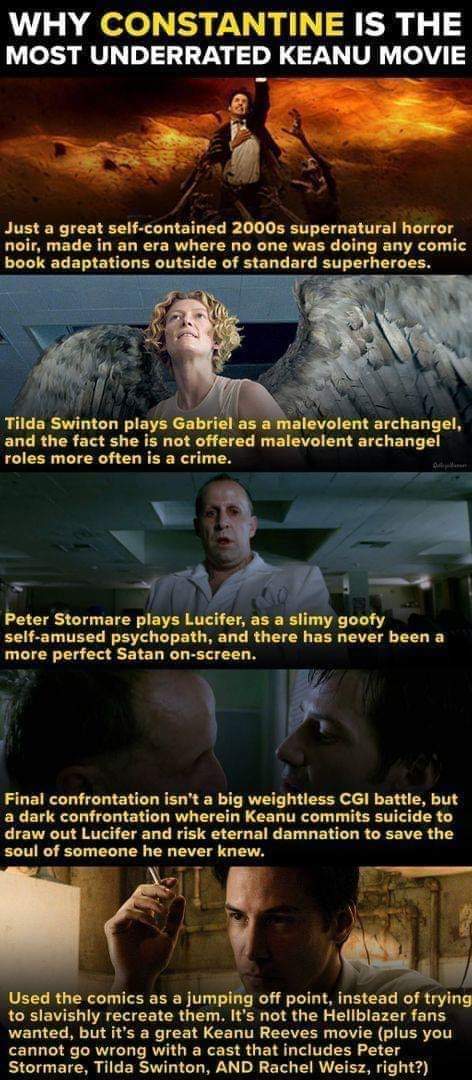
I ran into this meme on Facebook, and it triggered a long-held thought that I suspect is still relevant today.
Constantine (if you know the source of this meme, please let me know so I can give proper credit)
This refers to the movie Constantine, which I love. Its Rotten Tomatoes scores are typical of the divide between film credits and the audience. The last panel in the meme is what grabbed me. It references the fact that comics and movies are different media, and so they should play out differently. That appears to be something many (not necessarily most) comic book fans can’t grasp. Even when they accept, for example, the death of Thanos, they immediately start spreading theories as to how he could return in future movies. That attitude is still prevalent, and as much as I loved Thanos, I don’t get why.
This issue goes back a long way for me. I remember my cousin, and avid comic book collector, not liking that the Joker died in Michael Keaton’s first Batman movie (1989). In part, he saw it as a waste of a character that could be put to good use later. (His views may have changed, but others still make this argument.) The thing is, the Joker is not a character that they should have used again, precisely because it’s a movie.
It’s necessary for villains to survive in the comics. There are only so many ideas for villains, and with comic story lines having to last decades, killing off villains would create a shortage of adversaries for your stories. The only way to fix that would be to have another person take up that villain’s mantle. Sometimes that works, but doing that too often would leave the reader with the notion that they’re effectively dealing with the same character, so the writers are (cheaply) trying to have it both ways. Hence, you instead put them in prison or Arkham Asylum, they escape, and then you start the cycle again.
Movies are different. Most audience members require definitive closure, with death providing the most dramatic end to a story. Because the MCU‘s “blistering” pace still produces only three movies per year, there are actually far too many interesting villains that will go unused if you’re going to reuse the ones you’ve already shown. By the time you genuinely need to reuse a villain (if ever), you’re probably rebooting the cinematic universe for a different generation of viewers anyway. Ergo, for movies, you can have the closure your audience craves without painting yourself into a corner. If that pisses off a small percentage of your core fans that are still going to watch your movies anyway, you have an acceptable outcome.
I finished re-watching the entire series, Aqua Teen Hunger Force, on Monday. This is one of my favorite shows, but I saw only a couple of episodes of the last three seasons. In 2015, Adult Swim president Mike Lazzo made the decision to end ATHF, stating he “was ready to move on from it.” I completely understand why. They were weak seasons. I didn’t like the final final ending, but that’s no surprise. It’s hard for me not to laugh at the characters; with 11- to 12-minute episodes, story could never be the focus of the show. Nevertheless, I found myself watching it for the sake of watching it.
I'm all the way up to season 9 of Aqua Team Hunger Force (a.k.a., Aqua Something You Know Whatever). Damn has this show jumped the shark storywise. It doesn't matter, though, as the characters are just as funny, and that's always been the focus. #ATHF#Assemble!
— Rob, also gsllc@chirp.enworld.org (@GSLLC) July 5, 2020
There’s no way those last couple of seasons could spoil one of my favorite shows, but the show had clearly run its course.
It’s not the size of the dog in the fight, but the size of the fight in the dog.
— Mark Twain
Yesterday, I wrote about my re-watch of Batman v. Superman: Dawn of Justice. As soon as I finished, I re-watched Justice League because of course I did. My favorite scene from Justice League was the fight between Superman and the others, and within that scene, I loved where the Flash entered the speed force (his element), Superman was ready for it, Superman cast off the other members with ease, and then beat up the Flash before the other three even hit the ground. Once and for all, it established Superman as a badass. A badass with the exploitable weakness of his concern for others, but nevertheless a badass.
What struck me about that scene within the scene is that Superman won on Flash’s home turf. He shouldn’t have, but yet he did. Superman won because he was confident, and the Flash was an insecure kid who had never been in a fight before he teamed up with Batman, et al. (which didn’t go so well for him). This isn’t the first time we’ve seen a superhero movie address this theme.
The script establishes that Shazam is more powerful, but he's losing anyway. It's all about confidence and experience that a kid just won't have. #QuarantineWatchParty#Shazam
— Rob Bodine #QuarantineWatchParty Fiend (@GSLLC) April 2, 2020
Also, within Justice League, Victor Stone had to take control back from the machine that infected him, and he couldn’t do that while it still intimidated him. There are quite a few examples. On the flip side, Arthur Curry was far too arrogant when he agreed to face his half-brother, King Orm, in the Combat of the Kings (Aquaman). Arrogance can be just as damaging as meekness. You need to strike a balance between the two to realize your full potential, but the point is that attitude certainly matters and always will.
I hope Flash won the race from the mid-credit scene, but he probably spent too much time looking at Superman to see who was currently winning, which always slows you down. Meekness. 😦
I liked Batman v. Superman: Dawn of Justice, but because it currently has a 62% audience rating on Rotten Tomatoes, I can’t say it’s a Guilty Pleasure. I do hear a lot of hate from my social media connections, though, and many of them have told me that they actually liked the Ultimate Edition because of the additional information it provides. (One suggested that the same thing could be said about the Watchman Extended Cut.) I agree that the additional scenes improve BvS, but that raised a question for me: Why not keep them in the cinematic release?
The Ultimate Edition is 3 hours and 3 minutes long (including credits). I’ve seen 3-hour movies in the theater, so if the scenes are already filmed and modified in post production (i.e., paid for), why waste them? Give people their money’s worth, improve the movie, and your reviews will be better. I can think of three responses to my question.
Response 1: You want some deleted scenes to make the home release more enticing. Counterpoint: If people don’t like your movie, nothing will entice them to buy your home releases.
Response 2: I’m operating from hindsight. There was no way to know that the deleted scenes would have improved the movie. Counterpoint: Does anyone really think that the test audiences didn’t like the deleted scenes? They made the movie much better. Aren’t filmmakers professionals? Why can’t they figure out how to use test audiences to get the right result, especially for movies with such huge budgets?
Response 3: Three hour (or more) movies are too long. Counterpoint: Bring back the intermission so that people with short attention spans and weak bladders can handle it. Oh, snap!
Who’s got a response #4? I’ll defeat that one too.
I can’t believe they cut Jon Stewart. At this point, I suspect that cutting scenes is simply a strange sort of tradition among filmmakers.