Let's roll some dice, watch some movies, or generally just geek out. New posts at 6:30 pm ET but only if I have something to say. Menu at the top. gsllc@chirp.enworld.org on Mastodon and @gsllc on Twitter.
As a follow up to yesterday’s post providing the converted pre-generated characters, I provide you the encounters for Ghost Tower of Inverness converted to 4th Edition D&D. Note that these encounters are designed using my dungeon crawl system for 4e.
Due to copyright law, only the mechanics of the encounters are presented. The only creative content you’ll find within is that which I created myself to update the encounters to 4th edition, but those are very few in number. This is the best adventure every written for D&D; it didn’t need my help.
Any gamer that knows me well knows that Allen Hammock’s Ghost Tower of Inverness is my favorite RPG adventure of all time. Allen wrote it for the AD&D tournament at Wintercon VIII. I’m arranging to run my 4th Edition D&D conversion again, and that inspired me to post my versions of the pre-generated characters for that game in case my players, or anyone, wants to use them. As 4th edition is often played with 6 characters, I created my own character, Three, which I’ve provided as well. I also took some liberties with the races of the characters for the sake of stirring the pot and updating to the modern gaming community. These were created some time ago, and I’m no min/maxer, so you might want to make some modifications if you’re going to use them.
… or is it a Fate Accelerated hack of D&D? I get that confused.
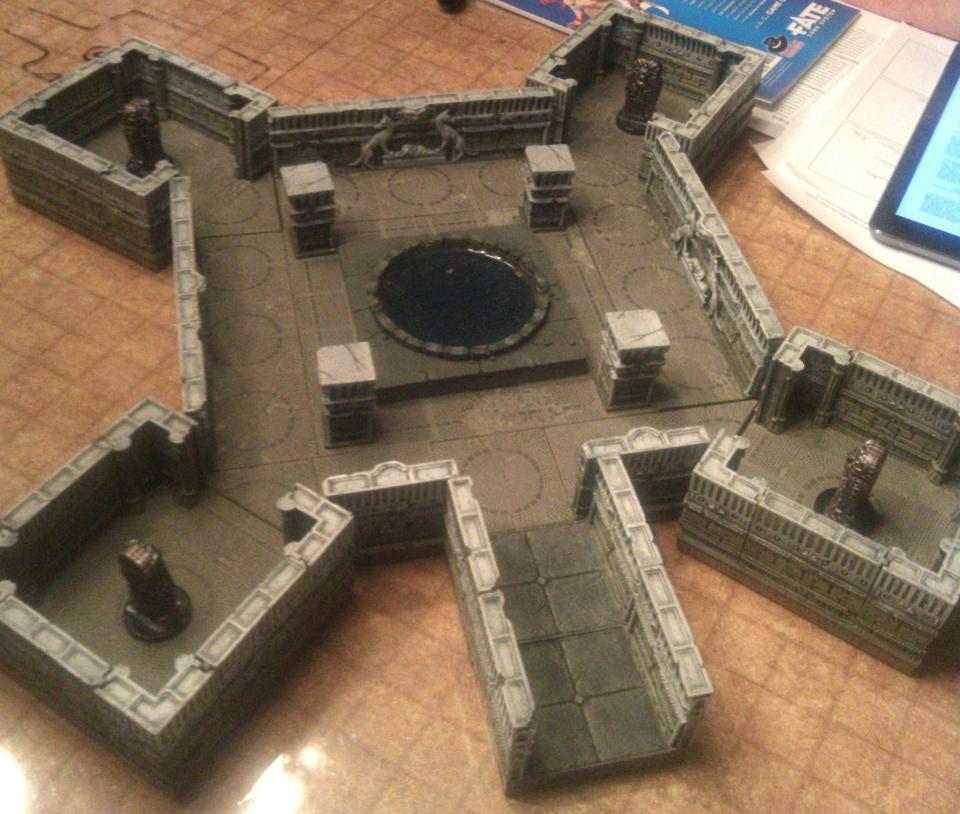
Every single room had a pool in the center. “Lazy” doesn’t cover it.
On New Year’s Eve, Mike Shea, a.k.a. Sly Flourish, introduced me to another game. Well, actually, he introduced me to Fate back at GenCon (via his Aeon Wave project), but being that I almost completely forgot the game rules, it felt new to me last night. Mr. Flourish (as you should address him when you meet him) has adapted Fate Accelerated to fantasy role-playing using much of the terminology/approach of 4th Edition D&D, and has labeled it “Dungeons of Fate.” He ran an abbreviated version of the classic AD&D adventure compilation, Desert of Desolation, and the system allowed him to do so with no real preparation of mechanics beforehand (quite appropriate for a Lazy DM). After the game was over, he asked me, “So, does it feel like D&D?” This one question sparked a discussion on gaming philosophy, dragging in Michelle (a.k.a., Mrs. Flourish) and another player, Brian. In the end, I think we agreed on most, if not all, of the points all of us were making, but here’s my take on what we discussed.
1. Not Everything Has to Be D&D
Dungeons of Fate didn’t feel like D&D to me, and to that we should all be collectively responding, “So what?” The only game that has to be D&D is D&D, so no matter who owns the intellectual property, they must always respect the brand or it isn’t really D&D. D&D, as the most powerful RPG intellectual property, is 6 attributes (Strength, Constitution, Dexterity, Intelligence, Wisdom, and Charisma, regardless in what order you present them), hit points, an armor class representing your ability to avoid damage from a hit, and a bunch of funny-shaped dice. These are the constants (among others) that must be in any edition of D&D regardless of who owns the property. This is reason #1,942 why the Edition Wars are stupid: All of the versions of D&D are “real D&D” because they all respect that rule. Whatever else is added to that base, the presence of that base makes it D&D. You don’t have to like it, but it’s still D&D.
However, Fate isn’t D&D. I couldn’t care less whether Dungeons of Fate feels like D&D.
Scratch that. I do care. I don’t want it to feel like D&D. If it did, why create it? Why didn’t Evil Hat Productions just post to their blog, “Hey, everyone, we’re not going to create a new game. Just play, D&D, okay?” They didn’t do that because they wanted to create something different. Whether you like Fate or not, the industry and community are better off because we have something different.
On the other hand, Dungeons of Fate does allow for the proper feel for a fantasy setting. That should be the more important issue to players, GMs, and Evil Hat.
2. Fate Isn’t Omnipresent, But It Has It’s Place
Reasonable minds disagree, but in my humble and honest opinion, Fate Accelerated is a horrible system for a long-term campaign. There’s no significant advancement, and the simplicity of the characters runs the risk of making them boring from a mechanical point of view. (Perhaps the full Fate Core addresses this.)
So where does that leave Fate Accelerated? Well, it leaves it in plenty of places. Not every RPG game has to be a weekly campaign lasting nine months. One-shots are a common practice, and two- and three-shots are hardly rare. Fate Accelerated certainly works for gaming groups organized that way. Personally, I’m more a fan of the two-shot or three-shot, even for D&D, so the idea of my home groups organizing around them doesn’t bother me at all. Unlike D&D, however, Dungeons of Fate requires no prep time for NPC mechanics, and if you’re focused (granted, most gamers aren’t), the entire table can have its characters ready to go in 30 minutes or less.
Mind you, these characters are exactly the characters the players want to play. If you want to play a ranger that is just as competent with melee as he is with striking, you can do that. If you want to play a “stone mage” more statute than human, go right ahead. You don’t have to worry about fitting your characters into the strict constructs provided by other RPG systems, nor do you have to wade through a seemingly infinite number of options in order to find the one strict construct that matches your character concept. You also don’t have to rewrite the rules in order to make room for your character concept. In other words, Dungeons of Fate as is gives you remarkable flexibility without having to overload you with options in order to do so.
3. On the Whole, Dungeons of Fate (and Fate Accelerated) Is Pretty Good
It all comes down to this: Is Dungeons of Fate fun? Absolutely. I really don’t like stress points. In fact, I don’t know why Fate Accelerated players do. One of Fate Accelerated’s best features is simplicity. Stress points seem to be a slight bit more complex than they need to be. I don’t get it, but I don’t have to get it, because this isn’t a deal breaker. It’s literally the only thing about Fate Accelerated I don’t like, and I don’t hate it. To a realistic game designer, that’s about the best you can ever expect; you can’t please everyone all the time. Leaving it in there still leaves me with a great time at the table.
Much like 13th Age, I encourage any RPG enthusiast to give Fate Accelerated a try, if for no other reason than this: If you every find yourself at a gaming store or convention with a hole in your schedule and you’re looking for something to do, you could always jump into a quick pick-up game of Fate. It’s as suited to that situation as a simple card or board game, yet the role-playing opportunities are just as robust as any other RPG.
Mike Shea, a.k.a. Sly Flourish, invited me to play in a 13th Age “one-shot” Sunday. With the Redskins not playing until Monday night, that worked for me. (#HttR)
I really enjoyed the system, and that’s saying quite a bit considering only one of the players had more than a rudimentary command over the rules, and our GM wasn’t much more informed. Truthfully, you just don’t have to be that knowledgeable because it isn’t that complex (for the most part), and I can say that even though I played a bard, which is technically the most complicated character class, and the game was an 8th level one-shot. There were definitely a few things any given player would forget from time to time, but they mostly centered on damage expressions. It seems like the players were constantly apologizing for the amount of damage they were doing because, at 8th level, it’s a ton.
I also love the flavor of the icon structure, which we all used, but enough has been written on that already. You are free to form your own opinions (or assumptions for those who haven’t played yet).
My verdict is that it’s a system that does exactly what it intends to do: Take the good parts from D&D 3.5 and 4e, and get rid of the bad parts. (Full disclosure: I’m a 4e player.) Despite our confusion with the system and the fact we were playing 8th level characters built the week before we played, the combats were fast and furious. The escalation die wasn’t much of a factor for any of us that I could tell, so once we start using that to our advantage, it’ll likely go even faster.
Information has slowly been swirling through or local Washington, DC gaming community, and to a lesser extent, beyond that. The Gamers’ Syndicate has put synDCon on hold and is focusing its efforts instead on something that you can enjoy all year round: A living campaign for 4th Edition Dungeons & Dragons. Many 4e players feel that there’s still more to do with 4e, just as 3rd Edition players felt there was more to do with 3e, and we’re seeking to give 4e players that same opportunity that Paizo gave the 3e players with Pathfinder and, more to the point, Pathfinder Society.
Living Campaign
For those of you that don’t know what a “living campaign” is, I point you to the Wikipedia entry, because Wikipedia never lies. Actually, “living campaign” is often defined differently by different people. To me, the most important aspect of a living campaign is allowing all of us to meet each other. In other words, it grows the role-playing game community; however, there are other important aspects to it. It allows the players to shape the campaign world even though their playing pre-written adventures. That is, if the majority of players accomplished a task in one adventure, that fact will be tracked by the authors and shape how future adventures are written. What the players do matters, even though they’re sharing the experience with thousands of players worldwide.
The Campaign Setting
Every campaign needs a campaign setting: a world that needs protecting and sometimes saving. Some famous examples of Dungeons & Dragons campaign settings include Ed Greenwood’s Forgotten Realms, Keith Baker’s Eberron, and Gary Gygax’s (everyone bow, right now!) Greyhawk. Our campaign setting hasn’t yet been named, but it’s one of our own design, spearheaded by the devious mind of Erik Nowak (who, if you recall, brought us Rotting Toes). Erik premiered the first two adventures (co-written by Dave Phillips) for this campaign setting at synDCon I and synDCon II. The setting is high fantasy, but not quite that high. Characters will use inherent bonuses so that acquiring magic items won’t be critical, and when they are acquired, they’ll be special.
We’re also introducing a mechanic for tracking a character’s reputation in the kingdom, and have a fairly ambitious plan in the works, but those are topics for later posts.
GenCon 2013
As I’ve mentioned before, I’ll be running the two introductory adventures at GenCon this year, which serves as a sneak preview of the campaign. However, we’re working on the first four adventures, so we’re on track for an official start not too far in the future. Stay tuned.
For the first time, I’m going to GenCon and not working for Baldman Games. (You should work for them if you like Dungeons & Dragons. They give great rewards for running games.) I’m just going to play (though I’m running four slots). I’m honestly not sure how much gaming I’ll want to do. I might get bored and do something else. In any case, like all the other con-goers, I sat there at my computer just waiting for the countdown clock to strike zero at noon. I was lucky enough to be assigned #738 in the queue. Anything under 1,000 is lucky as all hell, and as a result, I got everything I wanted. This includes two puzzle-oriented True Dungeon adventures and a few role-playing games, none of which I’ve ever before played. Isn’t that what GenCon is supposed to be about: Trying new games? That’s my philosophy. I bought an extra ticket for each of the True Dungeon adventures, so I can help out a friend get into the game.
My current GenCon schedule is below. I have absolutely no complaints.
Thursday: Dungeon World (RPG1341359) at 1pm, then the One Ring (RPG1343873) at 8pm.
Friday: True Dungeon (Lycan’s Afoot, TDA1348116) at 9:37am, then running the Gamers’ Syndicate new living campaign adventures at 1pm (RPG1343708) and 7pm (RPG1343710).
Saturday: True Dungeon (Golembane, TDA1348648) at 9:39am, then running the Gamers’ Syndicate new living campaign adventures at 1pm (RPG1343709) and 7pm (RPG1343711).
Sunday: A seminar on game design (SEM1346700) at 10am, then Far Trek RPG (RPG1342003) at noon.
This schedule lets me sleep in for the most part, and gives me plenty of time to roam the halls and keep myself fed. Let me know if you’re in any of my games.
What does this have to do with Sybok? I don’t care, and neither do you.
As opening night for Star Trek into Darkness (also my birthday) approaches, I wanted to make sure I reserve the opportunity to say, “I told you so,” even though there’s little chance that opportunity will actually present itself. My cousin, John (aka, @kesseljunkie) and I are big fans of the much-maligned Star Trek V: The Final Frontier (“TFF”). As a movie, it has its share of problems, but as most of you will agree with that statement, I won’t bother to justify it. Where I will take you to task, however, is with the character of Sybok.
Just a Little Misunderstood
As one of the six or so humans on the planet that actually read the novelization of TFF (John being one of the others), I have a deeper appreciation for the character of Sybok. Sybok was not just some lunatic. His reasons for accepting emotion spring from his mother’s views, which were seen as heretical by most of Vulcan. As geeks that are stereotypically considered outcasts for our interests, this is a character that we should have all embraced. Unfortunately, Sybok’s backstory was never fully developed by the film. This is understandable, as a book always has more room to do so than a movie, but it was a missed opportunity to say the least. While we didn’t necessarily have to agree with Sybok, we should have had a ton more sympathy for him, but unless you read the book (or are a completely delusional Star Trek apologist unable to criticize the franchise at all), you probably weren’t left with the same impression as I.
A Perfect Antagonist
I googled for an image of Sybok, and got this one … from kesseljunkie.com. I shit you not.
The destruction of Vulcan gave us the opportunity to revisit and reimagine Sybok. This is a Vulcan who embraces his emotion, and his people were all but wiped out because of Star Fleet’s failure to protect the planet. Sure, that’s an unfair criticism in light of the advanced technology of the attacking ship, but people who do bad things, especially when motivated by anger, generally don’t have the firmest grip on logic. In fact, that’s the whole point of Sybok’s character. He has all the advantages of being a superhuman Vulcan without the logic to restrain his selfish impulses. There’s a lot of potential for a good story if a cataclysmic event pushed him over the edge.
Could I Be Right?
The trailers and actors’ interviews have hinted at reasons Sybok could be the villain. Cumberbatch jumps from a great height and exhibits exceptional strength by throwing around a large piece of metal during a fight. (Vulcans are stronger than humans.) Cumberbatch has referred to his character as a terrorist, but one that thinks he’s doing the right thing by Star Fleet. (This is right in line with the way Sybok thinks and acts.) Sure, Sybok wasn’t a Star Fleet agent in the other timeline, but with the destruction of Vulcan, and with few friends among the survivors, perhaps Sybok was recruited for a task for which he was quite suited: Getting revenge on the Romulans. We know the Klingons interacted with Nero from the last movie, and we know they play a role here. Perhaps they’re siding with Sybok, who’s changed his mind about what he has to do.
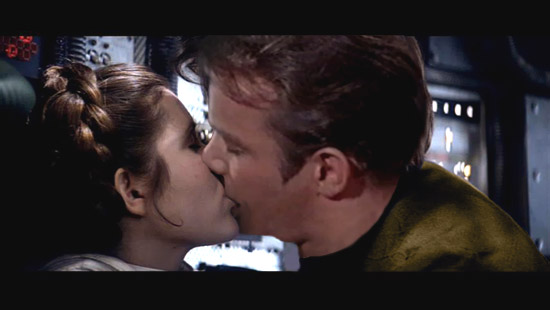
Hey! That’s not Kirk’s shirt color!
John pointed out to me that the scene from the trailer where Kirk and Spock are performing the “live long and prosper” salute through a pane of glass (mimicking their last actions in Star Trek: The Wrath of Khan) in fact could be Spock and “JohnHarrison.” It’s clearly Spock, but the other sleeve is charcoal in color, which is the color shirt Cumberbatch is wearing while standing behind the pane of glass. The voice over then says, “Is there anything you wouldn’t do for your family?” Was that line spoken to Kirk, whose family hasn’t played a significant role in the reboot, or Spock, who is Sybok’s family?
Does all of this mean that John Harrison must actually be Sybok? Of course not. He could easily (probably?) be an augment, or perhaps even the Khan (which would be a tremendous shame). Gary Mitchell seems unlikely at this point, but still a possibility. All I’m saying is that Sybok would be a reasonable choice based on everything we’ve seen, and in this author’s humble opinion, would be the best choice. It would throw off everyone, and it would open the door to a proper telling of the character’s backstory.
But No
All that being said, I doubt it’s Sybok, but if it is, the IMAX Airbus theater in Chantilly, VA is going to have at least two geeks standing up during the big reveal, shouting, “Nailed it! We told you so!” (8:55pm showing on May 17 if you’re interested.)
But probably not, and that makes me a little sad.
Side Note: Why Not Khan?
For those not wanting to read the IO9 article to which I linked, let me explain quickly why Cumberbatch shouldn’t play Khan (besides the obvious concern of “been there, done that … twice already”). Back in the old days when Star Trek was less about bells and whistles and more about story and the big three, almost every episode was a kick in the gonads of racism. What could possibly be more ironic and insulting to the “superior race” crowd than a “master race” led by a “darkie.” An Hispanic actor playing an Indian superman? Perfect. The Nazi’s were turning in their graves. Casting a white guy to play that role misses a lot of the point Roddenberry was trying to make. By itself, it won’t ruin the film or the Khan character, but it would make the character a little less meaningful.
Last night, my cousin, Kessel Junkie, and I had our monthly (or so) outing at Buffalo Wing Factory. As always, we talk about all things both political and nerdical. Of all the things we discussed, there was one point made that was wholly mine, rather than a consensus between our two views. It’s not that Kessel Junkie hadn’t heard the argument before and accepted it in the context of Star Trek, but I took it to a larger level.
For all it’s bells and whistles, all of the new iterations of Star Trek will never (apparently) have what the Original Series had: character development. At first, this seems like a ridiculous argument, but I’m serious. It’s not that TNG, DS9, and the rest don’t have character development; the problem is that they spread that development too thinly across too many characters.
The Triumverate of Nerd
TOS had three characters: Kirk, Spock, and McCoy. Everyone else was secondary. Can any of the newer series or movies say that? No, they can’t. They’ve all moved from being about “the main characters” to being about “the ensemble,” and the result is that none of the characters mean anywhere’s near as much as the original three. As I’ve pointed out before, we know the year that O’Brien’s mother-in-law was born. That’s a bit crazy. If you’re filling in that level of detail about the most minor of characters, you’re not spending time on who matters most. Granted, TOS lasted less years than any of the other series, so inevitably we would have known more about the minor characters as future seasons were released, but it still would have been about the big three.
It’s Not Just Star Trek
I pointed out to Kessel Junkie, a rabid Star Wars fan (seriously, check out his blog), that this isn’t just Star Trek. The original Star Wars trilogy was about Luke, Leia, and Han. Is Obi-Won Kenobi getting too important? Cut the bastard in half … or into thin air. Whatever. Same with Yoda. Bring them back as ghosts occasionally, but get them out of the action.
The Star Wars prequels became about the ensemble. While it should have been about Anakin, Obi-Won, and Padme, it wasn’t. Mace Windu, Yoda, and a freaking astromech droid were just as important. They got a ton of action independent of the main characters.
A Larger Trend
I haven’t done any serious math here, but this appears to be a larger trend, especially in light of the success of comic book movies. This isn’t necessarily a bad thing. It allows screenwriters to tell a different set of good stories. It’s also no longer “progressive” to just stick a minority on screen, make her a secretary, tell everyone she’s good at math, and rarely let her speak words other than, “I’m frightened.” I can understand a need to continue our social evolution, but it has its drawbacks with respect to the development of characters with whom the audience can relate. If we had the Avengers but didn’t have the benefit of two Iron Man movies, a Captain America movie, a Thor movie, and two Hulk movies, you wouldn’t care as much for those characters as you did (unless you had decades of development through reading their comics, which I do not have).
And this is why Picard will never have shit on original Kirk. Get over it and get off my lawn, you rotten kids.
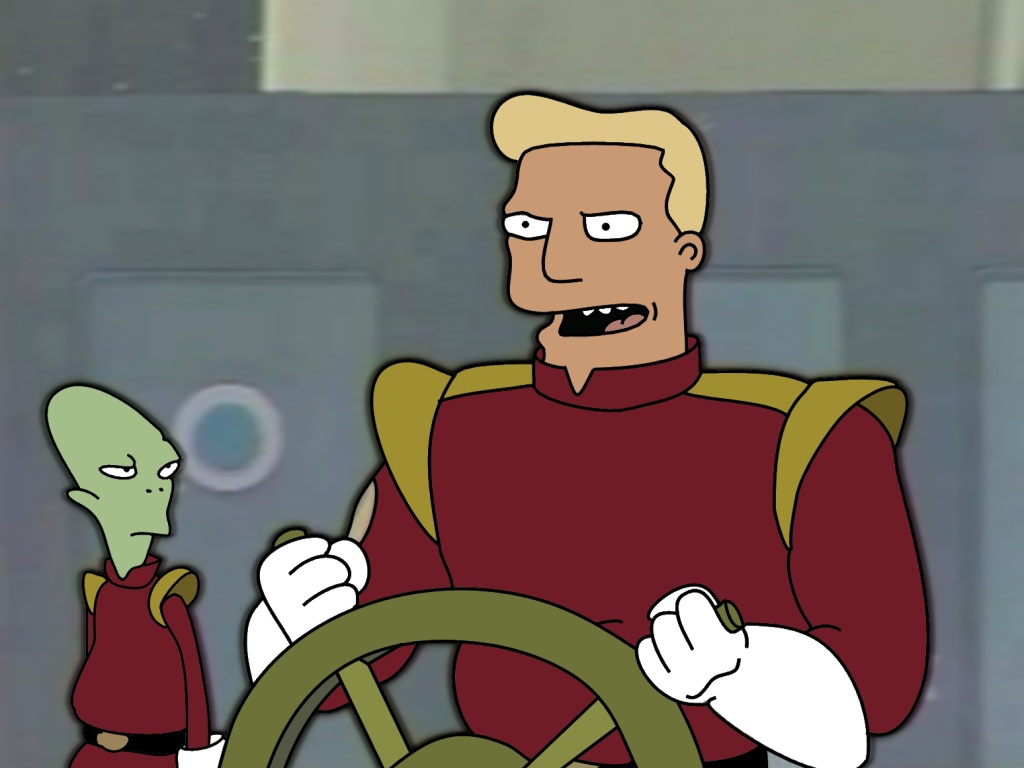
Of course, Zap’s better than both of those sissies put together.
P.S. Opening day for Star Trek into Darkness is my birthday. Great gift, though it would be better if Cumberbatch were playing Sybok.
I’ll miss you, old friend … until I play you again a week from Saturday.
Despite my many hours playing Dungeons & Dragons since 2005 (after a 24-year absence from the game), I’m really not much of an RPG gamer. I love FASA Star Trek RPG, but what do you expect? I loved Enterprise! I’ve played Gamma World 4e, Legend of the Five Rings (3rd edition) three times, Dragon Age RPG (Green Ronin Publishing) a few times (mostly as Game Master), and Star Wars Saga Edition once (again, as Game Master). I enjoyed all of those games but played Call of Cthulhu d100 twice and hated it. If I’ve played any other RPGs with dice, I don’t remember it off the top of my head, so apparently they didn’t make much of an impact. (I’ve also played the diceless RPG, Fiasco, which was great.)
I’d like to broaden my horizons as far as RPGs are concerned, so when my friend, Rishi, offered me the chance to join his new Marvel RPG game, I jumped at the chance. I’ve heard good things about it, so I was intrigued even though I never read comic books. (Come to think of it, I’m not a good geek in general. I don’t play video games, and I find Dr. Who to be retardis.) I wanted to play the mechanics everyone was talking about, so I agreed to play for a couple of sessions before gracefully bowing out.
I don’t think I’ll be bowing out. Our first session was a lot of fun for me. My approach to RPGs has always been to focus on a character concept, where the character has some interesting, overriding character trait, usually but not always a flaw. I then play that trait to the extreme. With my group, that wasn’t only tolerated but welcomed with open arms. As comic book fans, the other players liked the fact that I played my character’s traits so faithfully, even to the detriment of the team, because these are the characters the players love.
Clearly, I’m the baddest ass of the bunch!
Incidentally, I played a guy by the name of Hank Pym, a.k.a., Yellow Jacket. I’d never heard of him but am sure that means something to a lot of you. It also meant something to my cousin, Tom, who still collects comics. When Rishi gave me a list of characters from which to choose, I passed the ones in favor of the Super Human Registration Act to Tom, who told me to pick Yellow Jacket. It’s worked out so far. An insecure, nerdy guy who 1) supports government registration of people, and 2) gains experience points by blaming his own major failing on a loved one? Yeah, I can do this.
Mechanics
And that (finally) brings me to my first point. The mechanics of the game have their flaws, but overall it’s an fun system, especially for someone like me.
The Bad: The dice rolling is unnecessarily convoluted, requiring you to figure out which types of dice to roll (d4, d6, d8, d10, or d12) and in what number every single time you roll. Once I’m used to it, it’ll probably become second nature, but it creates a barrier for entry. If I were the rule rather than the exception, the group probably would have moved on and never played it again. Instead, I was the odd man out. I was the only one that didn’t have experience with the game and wasn’t a comic book reader. Keeping this game going will be easy despite the unnecessary complexity, but I don’t think that will be the case for all groups.
The Good: Rewarding me for domestic violence? Brilliant! I know that sounds bad, but stay with me. No one’s perfect, not even superheroes. We all have flaws, and a role-playing game that doesn’t hide from that fact, even among the heroes, is exactly what I need to make me happy. (Also, I don’t actually have to beat my wife in the game. It’s not necessarily that specific.) Needless to say, this doesn’t always go over well in other systems. In 4e D&D, I have a stereotypical, senile old man, Luigi, who’s great for comic relief, but when I play him in character during combat or role-play, he usually makes bad decisions. It’s never once actually hurt the group when all was said and done — he was responsible for winning a “social skill challenge” in one adventure despite his eccentricity — but while it’s occurring, it’s tough to convince the other players of that. Some people get very annoyed by his erratic behavior. With Marvel RPG, no one is complaining, and I doubt this is a characteristic of my group itself. The mechanics of the game actually encourage me and them to act the fool at times. And it works.
The Good but with a Caveat: The initiative system is fantastic, but it wouldn’t work in a game like D&D where building a character to go first has so many advantages. Other game systems would have to be tweaked dramatically to allow for the Marvel RPG initiative system. Still, it’s something every game publisher should at least consider.
It’s All About IP
My second point is, as always, that the world lives and dies based on intellectual property law, and this is the more important of the two points. IP law governs everything, and there’s a lesson to be learned here. RPG publishing is a low-profit exercise. It’s tough to do well in it, and whether most publishers will admit it or not, it’s ability to succeed as well as it has depends a great deal on the continued success of Wizards of the Coast. WotC produces Dungeons and Dragons (among others), and does so with the mighty weight of Hasbro behind it. They’re able to do things no other RPG publishers can do, and the entire industry benefits as a result. However, even WotC could hold on to the Star Wars license for only so long. With such a low profit-margin in the first place, having to give up a non-negligible chunk of that in the licensing fee reduces the profit margin even more. Also, unless you’re willing to give up and even bigger chunk of the profits, you have to settle with a non-exclusive license (if it’s even offered), meaning you won’t even be the only game of your kind available. It’s a no-win situation over the long haul.
With that in mind, be disappointed but not angry. I’ve never met or spoke with Margaret Weis, so I have no inside information here, but I’d put good money on the bet that she had a very good reason for letting the license go. This isn’t the fault of Ms. Weis, or of Marvel. It’s just the nature of the industry. The game was selling well, but the numbers just don’t add up in the long run. Everyone needs the core rulebook, but sales of add-ons will always be at least a little less, and often will be much less.
Fortunately, there’s a lot of material out there with even more to come, and many gamers will put together supplemental materials in the form of PDFs freely downloadable from their private sites. This game won’t die anytime soon, and that’s a good thing.
The End
Despite my optimism in the two sentences immediately preceding this one, it feels like there’s been a death in the family (not that bad, though; on the level of a step-cousin). 🙂 I just wanted to offer a eulogy of sorts, if for no other reason than to make myself feel good about it. It’s a good game, we’ll all continue to play it, but like all good things, eventually it must come to an end, and no one is to blame for that. Gaming will go on.
Star Trek into Darkness opens on Friday, May 17, which happens to be this Trek-nerd’s 45th birthday. So, anyone in the Washington, DC area (Northern Virginia) wanna go see it with me that night?