Guest Poster: ChatGPT #AI #computer #ttrpg #rpg #ChatGPT

If you enjoy this post, please retweet it.

Today, I have a special surprise for you. My friend, ChatGPT, wrote a guest post. I asked it to write a post on role-playing games, which he insisted should be entitled, Table-Top Role-Playing Games: A Guide for Beginners. Here are its thoughts.

Table-Top Role-Playing Games: A Guide for Beginners

Table-top role-playing games (RPGs) are a unique and exciting form of gaming that has been around for decades. They offer a chance for players to enter a completely different world and take on a new persona. RPGs allow players to create their own storylines and characters while collaborating with others to explore a fictional universe. Here’s a beginner’s guide to getting started with table-top RPGs.

  1. Choosing a Game

The first step is choosing a game that suits your interests. Dungeons & Dragons (“D&D“) is one of the most popular and widely known RPGs. However, there are countless other options available, each with their own rules, settings, and storylines. Some other popular RPGs include Pathfinder, Call of Cthulhu, and Shadowrun. Consider the themes and genre that you enjoy most in books, movies, or video games when choosing an RPG.

  1. Finding a Group

Once you’ve chosen an RPG, it’s time to find a group to play with. Look online for local gaming stores or gaming groups that are actively seeking new players. Social media platforms like Facebook, Discord, or Reddit can also help you connect with other players. Joining an existing group will help you get started with the game and understand the rules and mechanics quickly.

  1. Creating Your Character

Once you have a group and a game, it’s time to create your character. This is one of the most exciting and fun aspects of RPGs. You can create any type of character you want, from a sneaky rogue to a powerful wizard. Many RPGs provide character creation sheets that walk you through the process. You will need to decide on your character’s race, class, background, and abilities. It’s essential to have a clear understanding of your character’s backstory, personality, and motivations to make them come alive.

  1. Playing the Game

During the game, players take on the role of their characters, and the Game Master (“GM”) guides the story. The GM is responsible for creating the world, setting up the encounters and challenges, and controlling non-player characters (“NPCs”). Players use dice to determine the outcomes of their actions and decide on their next moves as a team.

  1. Having Fun

Table-top RPGs are meant to be fun, social, and creative. Players should never feel stressed or pressured to perform. Instead, focus on storytelling, teamwork, and immersion in the game world. Don’t be afraid to make mistakes or ask for help from the group. Remember, the ultimate goal is to have fun and enjoy the game.

In conclusion, table-top RPGs are a fantastic way to explore new worlds, make new friends, and exercise your creativity. With the right group of people, you can create unforgettable memories and epic adventures. So, find your group, choose your game, create your character, and start playing. The possibilities are endless!

Okay, that was useless, so I asked, “Can you write a more advanced post for me?” I requested the mathematics used to generate a system. Here’;’s the response.

The Mathematics Behind Table-Top Role-Playing Game Systems

Table-top role-playing games (RPGs) are a unique blend of storytelling, game mechanics, and mathematics. While the storytelling aspect is the most noticeable and critical, the underlying math used to generate the game system is equally important. In this advanced post, we’ll explore the math behind table-top RPG systems and how it affects gameplay.

Game Design and Probability Theory

The mechanics behind table-top RPG systems are based on probability theory, which is a branch of mathematics that deals with the likelihood of an event occurring. Game designers use probability theory to determine how different actions in the game will affect the outcome of the player’s actions. The result is a series of rules and dice-rolling mechanics that determine the success or failure of actions taken by the players.

Dice Rolling and Randomness

Dice rolling is the most common method used to introduce randomness into the game system. Each type of die has a different number of sides and represents different probabilities of success or failure. For example, a 20-sided die has a 5% chance of rolling any specific number from 1 to 20.

Game designers use dice rolling mechanics to introduce randomness into the game system. For example, a player attempting to hit a target may need to roll a 15 or higher on a 20-sided die to succeed. The outcome is not predetermined, and players must rely on their luck and probability to succeed.

Game designers also use probability theory to create balanced systems. They must ensure that the probabilities of success and failure are fair for all players, regardless of their abilities or character types. This balancing act can be challenging, as different character types may have different abilities and skill sets that affect their probabilities of success.

Mathematics and Game Mechanics

Game designers use a range of mathematical concepts to create different game mechanics. One of the most important is probability theory, which we’ve already mentioned. Other mathematical concepts used in table-top RPGs include:

  • Geometry: Used to determine the range and area of attacks, spells, and abilities.
  • Calculus: Used to determine rates of change, such as the speed at which a character is moving.
  • Algebra: Used to determine the values of variables such as hit points, armor class, and damage.

Game designers use these mathematical concepts to create game mechanics that are balanced, fair, and realistic. For example, a spell that affects an area of effect may be limited to a specific radius or shape, based on geometric calculations. Similarly, a character’s ability to move and attack may be determined by their speed, which is calculated using calculus.

In Conclusion

The mathematics behind table-top RPG systems is complex and requires a deep understanding of probability theory, geometry, calculus, and algebra. Game designers use these mathematical concepts to create balanced and fair game mechanics that allow players to immerse themselves in a fictional world. Understanding the mathematics behind RPG systems can help players better understand the game mechanics and how their actions affect the outcome of the game. Ultimately, table-top RPGs are a fascinating blend of storytelling, game mechanics, and mathematics that provide a unique and engaging gaming experience.

I pressed further to see which game systems use calculus, and it said that both Champions and GURPS do. I’ve never played either, so I have no idea if that’s correct. In any event, I had a better idea, but I’ve said enough for today.

Tuesday’s post should be weird.

Follow me on Twitter @gsllc


Dwindling Watch: Scorpion @paramountplus #ParamountPlus #GoodWatch #television #science #math #computer #scorpion

If you enjoy this post, please retweet it. Other posts in this series can be accessed by clicking here.

Welcome to post #1,001!

I have a really annoying habit. Actually, I have several, but this one annoys me. I have to finish what I start. In the context of this post, it means that, once I’ve set my mind to binging the entire run of a television show, I can’t stop until I’m finished no matter how bad the show is. That’s what happened with Scorpion.

Scorpion aired on CBS from 2014-2017, and now you can watch it on demand on Paramount Plus. It centered on a team of underachieving, supra-geniuses who finally get their big break when the Department of Homeland Security designates them a contractor. It started off well enough, and the ratings were some of the best CBS enjoyed during its run. One executive referred to it as “our Big Bang Theory, but as a drama.” However, by season four, the ratings were terrible, and despite a cult following and a tense cliffhanger to end season four, the show was cancelled.

Good riddance.

The show was wildly unrealistic. As anyone with a physics degree, a first career in software engineering, and a current career as an attorney can tell you, most shows are. I have no problem with that. You have to enter into any television show or movie with a certain suspension of disbelief, and I’m happy to do so for the sake of drama. After all, despite not being a comics reader, I’m a huge fan of the MCU and DCEU. What could be less realistic?

I called a fair game today.

But this show dives into many different branches of science, and it gets them all terribly wrong. Moreover, while each episode presents a preexisting peril to be solved, while addressing the peril, the Scorpion team members always make things worse, and usually in the most ridiculous or unrealistic of ways. It’s terrible writing that eventually grates on the viewer. Sharks don’t act that way. Computers don’t act that way. Gravity doesn’t act that way. How is it that you’re always getting your jacket caught right before you have to make a getaway? You’ve been on a deserted island for three weeks; how are you all so clean, and why is Cabe still wearing a suit and tie?

As the charm of the show tends to wane, there’s little left to keep the viewer interested. But I have to say, if there were a season five, I’d have watched it.

Sometimes I hate myself.

Follow me on Twitter @gsllc
Follow Paramount+ @paramountplus

There’s More of Them! #tech #AI #ArtificialIntelligence

If you enjoy this post, please retweet it.

For a guy that said he was taking a break from blogging three days ago, I sure have had a lot to say. This is a follow up to yesterday’s threat to have my blog generated by artificial intelligence. A while back, I (and many others) shared through social media an AI rendition of Family Guy. Well, the inevitable has happened. There are tons more of them. You can find them here, but I’ve linked directly to my favorites below.

Why does Leela have two eyes? Was this trailer from the Cyber House Rules? If so, where’s Adlai?

We see too much of Kenny’s face here, and Wendy seems too old for Stan. Also, while AI seems to be learning how to handle hands, it still hasn’t mastered the fine art of tear ducts. Cartman is as confusing as an umber hulk, coincidentally with the same shape to his head.

Yes, these are my favorites because I never grew up.

Homer has too much hair.

They got Butthead’s braces right, and I’m glad to see Daria get a mention.

A lot of characters in the video look like they’re being played by the same actor, and as I said above, tear ducts (among other things) still aren’t handled correctly. Then there’s Nothing, Forever, an AI-generated episode of Seinfeld that’s been running since December. It’s 8-bit graphics, so the real “magic” is in the dialogue, but that often falls apart too.

I don’t think we have to worry about an AI takeover anytime soon.

Follow me on Twitter @gsllc

My Blog is Going High-Tech! (Not Really) #blog #tech #AI #ArtificialIntelligence #journalism @buzzfeed

If you enjoy this post, please retweet it.

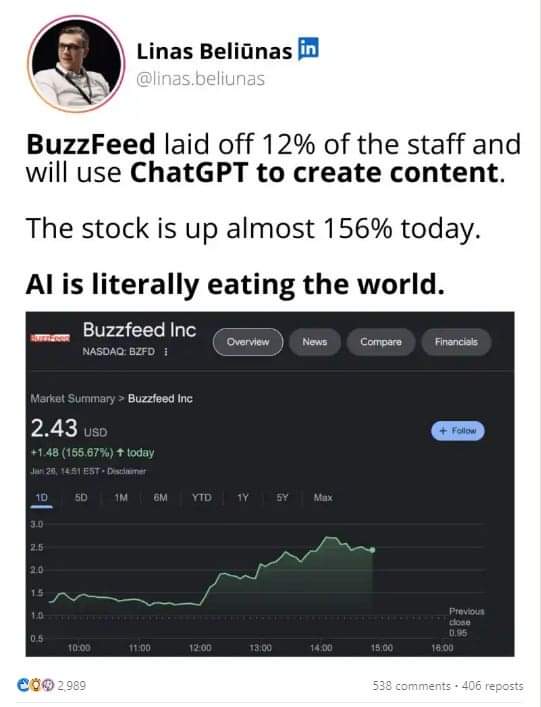
All this blogging has been exhausting, but thanks to Buzzkill . . . Buzzfeed, I feel comfortable having all my posts generated by artificial intelligence! https://knowyourmeme.com/memes/ai-generated-80s-family-sitcoms

Because Buzzfeed and I are the same level of journalism.

Follow me on Twitter @gsllc
Follow Buzzfeed @buzzfeed

AI Villains #AI #computer #art

If you enjoy this post, please retweet it.

Sundays now are lazy days for me. I either post something silly or other people’s work. Usually both. Today, I’m giving you some irony that’s likely to generate some heat. Here’s a video showing the result of asking artificial intelligence to make villains out of various countries.

The irony? This art can provide inspiration for TTRPG villains.

I love this version of Anubis. I’d like to see a species based on Anubis that serves his interests.

Spain created its villain, and he’s looking for payback.

Follow me on Twitter @gsllc


A Fifth (Not Really) Random Memory: White Plume Mountain and My Undergraduate Degree #ADnD #DnD #RPG #TTRPG #1e #physics

If you enjoy this post, please retweet it.

This memory isn’t really random. It has a catalyst.

I registered to run a 1st Edition Dungeons & Dragons game at Winter Fantasy. To prepare for running it, I’m going through my usual routing of creating a Word document placing the encounters in my own words and organizing them in a way that’s more intuitive for me at the table.

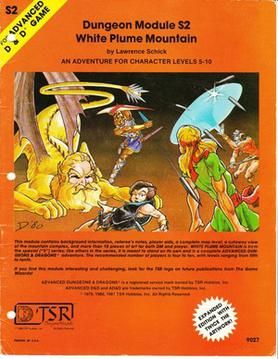
I’m sure Wizards of the Coast’s legal department would consider that, and this image, copyright infringement. Jackasses.

Eventually, I came to encounter 22, (spoiler alert!) the frictionless room, which spurred a series of memories from when I was an undergraduate physics major at the University of Maryland. Friction always made things difficult when solving problems related to movement, so unless you were specifically studying differential equations, our problems would assume no friction (as well as assuming every chicken is a sphere). Accordingly, my professors occasionally (and unnecessarily) thought it was necessary to remind us that friction is actually a good thing.

Made better with the right weaponry.

We’re physics majors. We know that friction is important, and life would be impossible without it. Perhaps our professors should have instead just had us play White Plume Mountain as part of the curriculum.

Yeah, I’m pretty clever like that.

Follow me on Twitter @gsllc

Dungeons & Dragons is a trademark of Wizards of the Coast, LLC, who neither contributed to, nor endorsed, the contents of this post. (Okay, jackasses?)

Hippocrates #science #medicine #philosophy #history #Hippocrates @WrongHands1

If you enjoy this post, please retweet it.

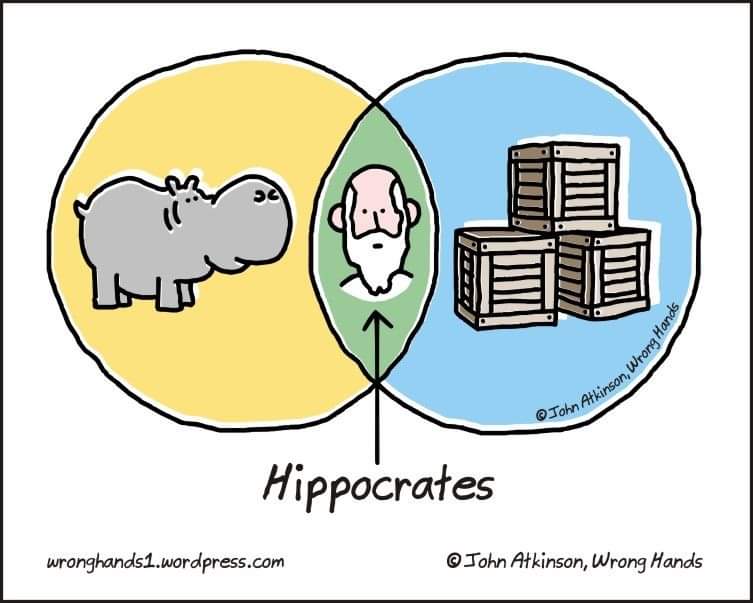
Sundays now are lazy days for me. I either post something silly or other people’s work. Usually both. Today, I’m pointing out that we all know the Hippocratic oath. But did you know . . . ?

That’s right. He’s just a damn hippo-box hybrid. This calls the entire medical profession into question. Okay, boys! It’s back to bloodletting and leaches! Now go buy Wrong Hands a coffee.

Everyone takes Hippocrates so damn seriously.

Follow me on Twitter @gsllc
Follow Wrong Hands @WrongHands1

Random Memory: The “Bionic” Shows #TV #science #engineering #bionic @mslindsaywagner

If you enjoy this post, please retweet it.

I had a random memory pop in my head last week. During the early part of its run, my favorite show was the Six Million Dollar Man (1973-1978). Lee Majors played the titular Steve Austin. I also loved its spinoff, The Bionic Woman (1976-1978). The origin of the latter was a sad and frustrating one. The bionics screwed with Jaime Sommers’s body and seemingly killed her. The premise of the show was that she was somehow saved but lost all memory of her romantic relationship with Steve Austin.

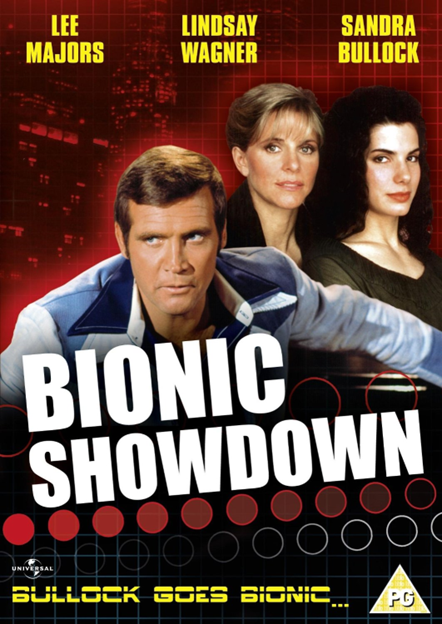
Like most of society, I lost interest in the shows as I grew up, but when they announced an upcoming made-for-TV movie bringing back the characters, I was moderately intrigued. It was a huge part of my childhood that wasn’t that far removed from (what was then) the present day. I don’t remember watching the first one, The Return of the Six Million Dollar Man and the Bionic Woman (1987), but I do remember seeing the second one, Bionic Showdown: The Six Million Dollar Man and the Bionic Woman (1989) with an unknown Sandra Bullock playing the next generation of bionic human.

Proof!

What stood out in my memory of that show was that Jaime Sommers’s memories had returned, and at the end of the second movie, she interrupted his proposal of marriage to propose to him. Even though I remember not liking the movie, I remember being happy with the resolution. Why? I don’t know. They’re make-believe characters, and they’re not part of a series I was currently watching, so their relationship meant nothing the second the final credits rolled. But humans are weird like that, and their failure to connect even upon her resurrection for the Bionic Woman was disappointing.

There was a third movie, Bionic Ever After?, but I’m sure I never saw it. By 1994, I had more important things to do.

As of this writing, Lee Majors and Lindsay Wagner are still going strong at 83 and 73 years old respectively.

Follow me on Twitter @gsllc
Follow Lindsay Wagner @mslindsaywagner

A Friendly Reminder #science #internet #scam

If you enjoy this post, please retweet it.

Just a friendly reminder that, in 2022, shouldn’t have to be given, but does.

What can I say? I’m generous.

Another streak of 100 days in a row!

Follow me on Twitter @gsllc


I Figured out Mastodon #Mastodon #SocialMedia #tech

If you enjoy this post, please retweet it.

A few days ago, I complained about how clunky Mastodon was. I stand by that. However, I managed to figure it out. So, let me tell you some things that, for some ridiculous reason, no one else seems willing to tell you.

First, if you go to Mastodon.com, you’re screwed. It won’t work. So, how do you do it? The best way to get on Mastodon is to know what server you want to join. In my case, I went with https://chirp.enworld.org/web/home. Another popular one for nerds is https://dice.camp/explore. I applied for membership 🙄, which was accepted. Mastadon.social appears to be the baseline, as a few celebrities are on there, but it doesn’t allow signups for some reason (maybe it’s just me). However, I learned that you don’t have to be on a server to follow someone on another server. As long as you see them appear in your server through a re-toot (yeah, their “tweets” were called “toots,” but now they’re called “posts”), you can follow them. I’m not sure how that works, but it does, so there you go.

Now, if I wanted to join a server that’s dedicated to sports, I wouldn’t know where to start. Someone had to give me the name of a server for me to find it. Again, going to Mastodon.com doesn’t help. You just have to know the URL of the server to find it, but for all I know, no such server exists. How could I possible find it?

I’m sure it can be done, but Mastodon is horribly clunky, so it’ll be a slow burn to get there. It’ll also take a while to get followers. To do so, I think I need to pepper my followers on other social media outlets to do so. In other words, the only way to even get on Mastodon in the first place, then to make it work for you, is to use other social media sites. Not a good business plan. Note, however, that there’s a setting in your profile that allows you to be found and promoted based on other members’ searches. It’s off by default, so I imagine you’ll want to turn it on.

So, join whatever server you want, then migrate to my profile and follow me. I’m at https://chirp.enworld.org/web/@gsllc and https://dice.camp/web/@gsllc. I believe these can also be found by searching for gsllc@chirp.enworld.org or gsllc@dice.camp once you’re in Mastodon.

Follow me!

Follow me on Twitter @gsllc