If you enjoy this post, please retweet it.
This identity theft is both meta and not.


It’s not a joke . . . or is it?
Follow me at @gsllc
Follow Star Trek @StarTrek
Follow Star Wars at @starwars

If you enjoy this post, please retweet it.
This identity theft is both meta and not.
It’s not a joke . . . or is it?
Follow me at @gsllc
Follow Star Trek @StarTrek
Follow Star Wars at @starwars
If you enjoy this post, please retweet it.
Last week, I discussed spell components. The conversations I had across Facebook and MeWe led me to a follow up post, and then down a rabbit hole to today’s topic.
4th Edition D&D (“4e“) didn’t track spell components for powers, and rituals had a set cost that didn’t even list the material components. Material spell components were abstracted, so a ritual caster could remove a specified number of gold pieces from the character sheet and assume the material components were available. Based on my linked posts, you’d think I’d have a problem with this, but I didn’t. In 4e, there were no go-to spells or rituals. Everything was balanced so that players chose their suites of powers based on the type of characters they wanted to play. Tracking material spell components (or casting times as in 1st Edition D&D) was unnecessary; characters were already greatly diverse. That kind of variety made for far more interesting combats, even if most of table were playing the same classes. In 4e, there was no place for the question, “What classes are you guys playing?” It didn’t matter. You could play what you wanted without affecting the game because everyone was different even if they were the same. As someone who played a ton of 4e, I never understood the claim that all classes played the same. Even within classes, they played differently.
Rituals weren’t used very often in my experience, but I think that was the result of adventure writing rather than an inadequacy of the ritual system. In fact, I wrote a Dungeon Crawl system for 4e, and on the now-defunct loremaster.org added a post on how to convert rituals to spells (or “near-spells”). Here’s a PDF that was the basis of that post. It’s not the final draft, so it may have some rough edges.
Nothing Is Certain Except Death and Taxes
As good as that was, 4e screwed up in a different but analogous way. When it came to feats, almost every class had go-to feats. In fact, there were feats that were go-to for most classes. This was known as a “feat tax.” Durable, Implement Expertise, Improved Initiative, Toughness, Weapon Expertise, and Weapon Focus immediately come to mind. This wasn’t nearly as large a sin of game design — other players generally don’t notice which feats a player has chosen — but for what it’s worth, 5e does a much better job with feats. I have trouble selecting 5e feats because a large number of them are valuable no matter what class I’m playing, so I know I’m going to make different choices than other players.
As I said in the prior posts, game designers need to pay better attention to whether their systems lead a majority of players to make the same choices. 4e proved that you can design a game of diverse characters in such a way that it doesn’t devolve into an exercise in accounting, and simultaneously broke that rule.
4e is still better than 5e. 🙂
Follow me on Twitter at @gsllc
Dungeons & Dragons is a trademark of Wizards of the Coast, LLC, who neither contributed to nor endorsed the contents of this post. (Okay, jackasses?)
If you enjoy this post, please retweet it.
A couple of days ago, I posted about some things I found while continuing to unpack. One thing I found deserves its own post: the program for our first synDCon gaming convention (2010). When we decided we were going to put on a convention, we had a meeting of at least 20 people at the Cracker Barrel in Chantilly, Virginia. This took place after one of our Living Forgotten Realms game days at the now defunct Game Parlor. Only seven people decided to come on board as owners, with two quickly moving to Arizona before we could even get started, and then two others flaking out. It was basically Vic, Cassandra, and I doing everything.
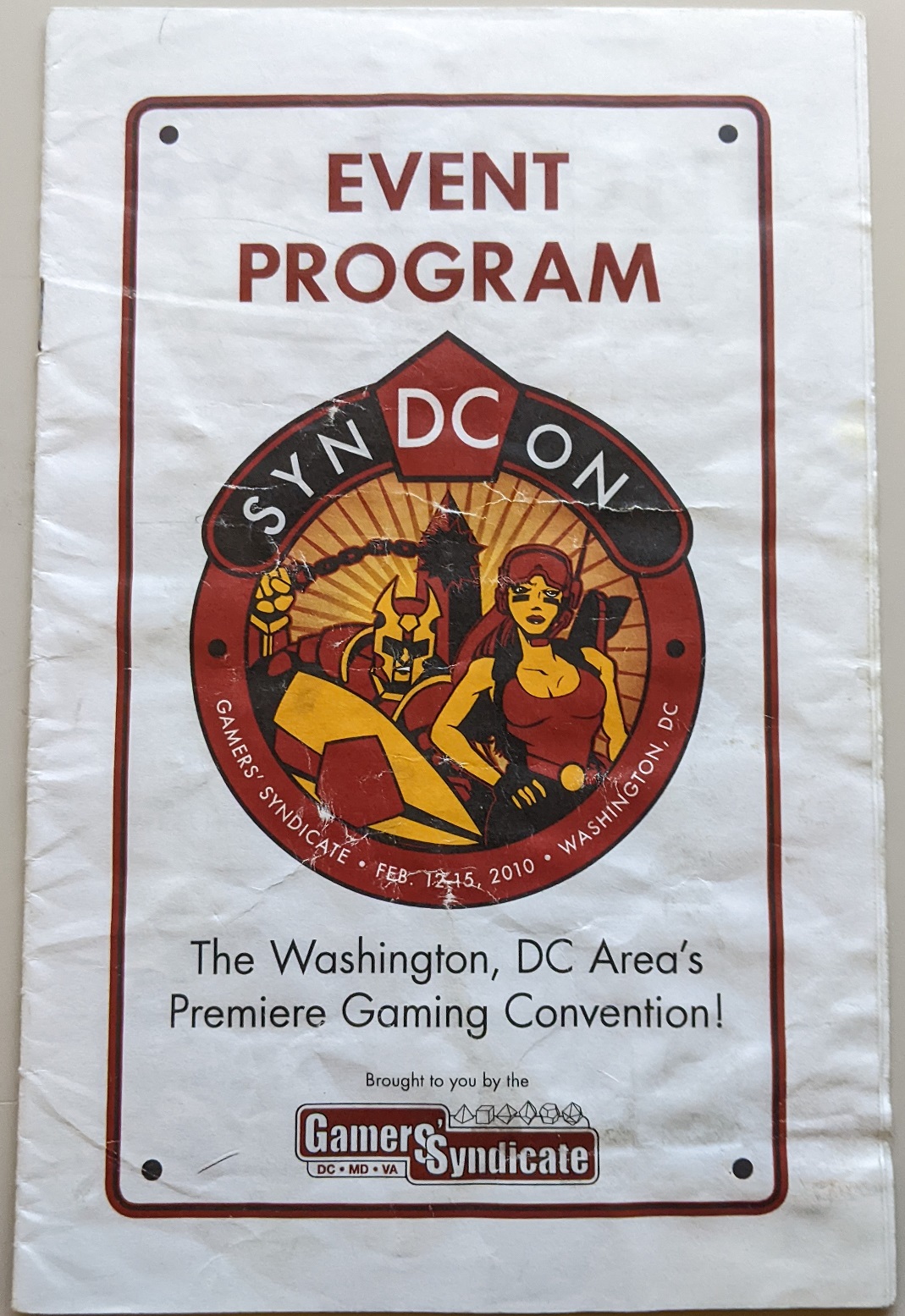
The cover art and Gamers’ Syndicate logo were both designed and illustrated by Erik_Nowak, and he also designed this program.

I remember a meeting when there were just five of us. We had to decide who would be the number one person: the Convention Coordinator. I didn’t volunteer because I didn’t want to be too pushy, but no one else wanted to do it. This was typically unnecessary nerd angst on all our parts, because in the end it didn’t matter. Everyone had to work hard (until they flaked out), and no one was really the boss among us.
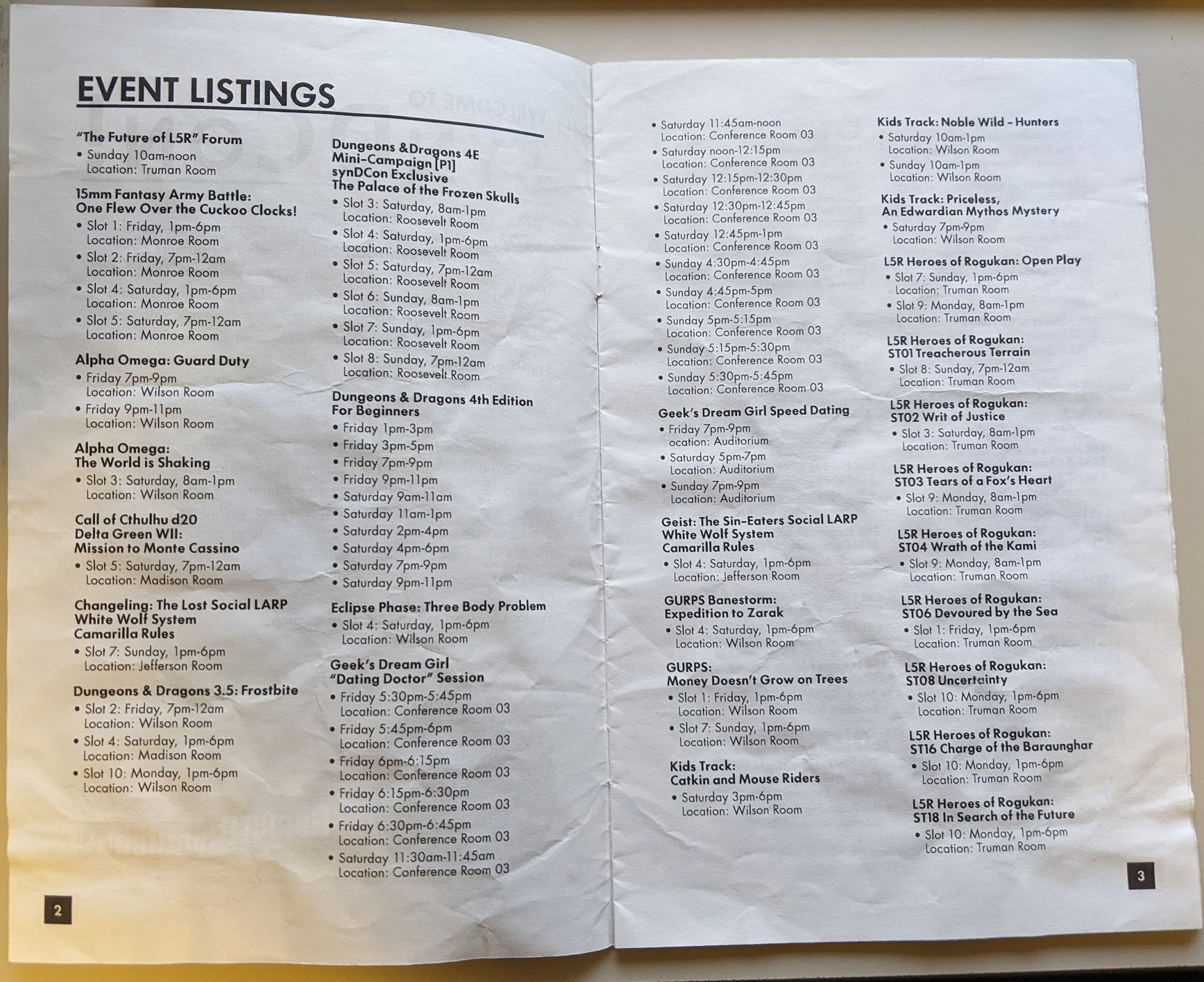
I’m proud of two things. First, look at that first page, and continue to examine the ones that follow. Even when we had seven planned owners, everyone was almost exclusively a 4th Edition D&D player. Nevertheless, our relatively small convention had a ton of variety in what was run. There were card games, board games, RPGs, and miniature war games. Within the RPGs, we had a ton of variety as well, and there were games run specifically for beginners. We also had a “synDCon special,” which was written by Erik and D. Hunter Phillips.

The second thing of which I’m proud was my idea (<patting myself on the back>). We had staggered slots. Instead of the typical 8am-12pm, 1pm-5pm, 7pm-11pm schedule for RPG games, we added in slots at 10am-2pm and 3pm-7pm as well. Again, for a small con, the fact that this worked out so well was remarkable. Many people took advantage of the opportunity to sleep in, try our Dungeon Delves for a couple of hours, sit in on a seminar or author book reading, or try new systems at the beginners’ tables. Another great idea of mine was to allow only 5 seats per game in presale despite tables seating 6 players. This made it far easier to sit players that didn’t preregister or wanted to change tables. No one had a problem with it, but a lot of people appreciated the flexibility.

This was a nice hotel, and it was conveniently located near a Metro stop (our public rail transportation system). And being who I am, I especially wanted a site in Maryland so that we could register for a federal trademark if it ever came to that. 🙂

Okay, yes, we definitely emphasized Living Forgotten Realms, but I’m still happy with how much Heroes and Rokugan and Pathfinder Society we had (these are living campaigns for the RPGs Legend of the Five Rings and Pathfinder respectively).

Note well, though, that there was more going on than the program states. We had a board game room, and open play for both card games and miniature war games. Saturday night, my cousin and I, a.k.a., Wet Paint, performed for a crowd of beer-drinking gamers some hits of the 80s and 90s. That’s when we played together, so our song set came from those decades.

Seriously, for a small, first-time convention, look at how much variety we had. I loved it, and I never saw it with conventions this small. We also had seminars featuring authors and game designers. Being in the DC area, we actually knew a lot of those people, so it was relatively easy to get them here. This, in turn, allowed us to do this . . . .

We received a small amount of support from most of these companies, and others were actually present. Our prize for the first person to buy a convention badge was a ticket to GenCon. GenCon gave those away to conventions all the time; no inside track was necessary. However, we also had, for example, a member of Green Ronin participate in a seminar and run the (then-new) Dragon Age RPG, and Rob Hobart (AEG), the head of Heroes of Rokugan, ran a seminar and (I think) a few games.
We chose a great venue, and synDCon 2010 was a four-day convention. Yep, four days. Just like the big guys. Monday was a holiday, and adding that day to the schedule didn’t increase our costs noticeably. Of course, by cost I mean financial cost. My feet were sore (which is why I was sitting for the Wet Paint performance), and I ran, at best, on four hours of sleep a night, with only two on performance night. I’d say it was a success considering that we got hit with a snowstorm right before the convention, scaring off a lot of people.
The following year, we moved synDCon 2011 to mid-April to make sure we’d have better weather, but we had late snow that year. It wasn’t as bad as the previous year, but it still affected attendance. Infuriating. However, synDCon 2011 was an official convention within the circuit of competitive Munchkin published by Steve Jackson Games. In fact, we may have done that for synDCon 2010. I really don’t remember at this point. I just know we had a great time both years. Unfortunately, it’s too hard a thing to run with, for all practical purposes, two people running the entire show and Mother Nature chasing us around with snowstorms. This isn’t to say that there weren’t a lot of other people that did a lot of work. We had a lot of help, with a few people being organizers for Living Forgotten Realms, Pathfinder Society, and Heroes of Rokugan, and we still had decent numbers. However, in the end it falls on the organizers, and there were only two of us. Both Vic and I would rather not have a convention than do one half-assed, so we didn’t have a third one.
Would I like to bring it back? Yes. Do we have the financial means to do so? Probably. Do I see enough people getting on board to make the workload manageable? No. There are very few people I could trust to see it through, and I’m not getting any younger.
I’m proud of what we did.
Follow me on Twitter at @gsllc
Follow Vic @luddite_vic
Follow Erik @Erik_Nowak
Follow Hal @atomicovermind
Follow D. Hunter Phillips @Digitalculture0
Dungeons & Dragons is a trademark of Wizards of the Coast, LLC, who neither contributed to nor endorsed the contents of this post. (Okay, jackasses?)
If you enjoy this post, please retweet it.
Here’s something interesting I never knew. The 3rd Edition Deities & Demigods had a printing that included an appendix for adjustments to 3.5 Edition. As you may recall from my past writings, Deities & Demigods is one of the books I later regretted selling off, but I got lucky in that it was gifted to me by James. After reading the linked article, I thought, “Hey, maybe I actually have the 3.5 update printing.
Yep, I do.
In the ultra-rare instance that I’d ever play 3.5e again, I wouldn’t likely make use of it, so … how disappointing, eh?
Follow me on Twitter @gsllc
Follow Serpentine Owl @SerpentineOwl
Dungeons & Dragons is a trademark of Wizards of the Coast, LLC, who neither contributed to, nor endorsed, the contents of this post. (Okay, jackasses?)
If you enjoy this post, please retweet it.
Going forward, Sundays are lazy for me. I either post something silly or other people’s work. Usually both. Today, it’s a bit less lazy of a post, but it references other people’s work, so it qualifies.
I put together another bookshelf, and in doing so started unpacking some more books. I found some gems in there. I used to run a gaming club in the Washington, DC area, and as a result, I was given a lot of WotC material for our game days, much of which was never taken out of its shrink wrap. I also have tons of duplicates. This is what I’ve discovered.
First up is material from some great writers, only one of which hates me. (Don’t hold it against him; I’m a tough pill to swallow.) Art credit to Ralph Horsley and Eric Belisle.

The latter has some supplemental material.

Trigger warning: Is anyone else’s OCD going off right now? Art credit to Craig Spearing.
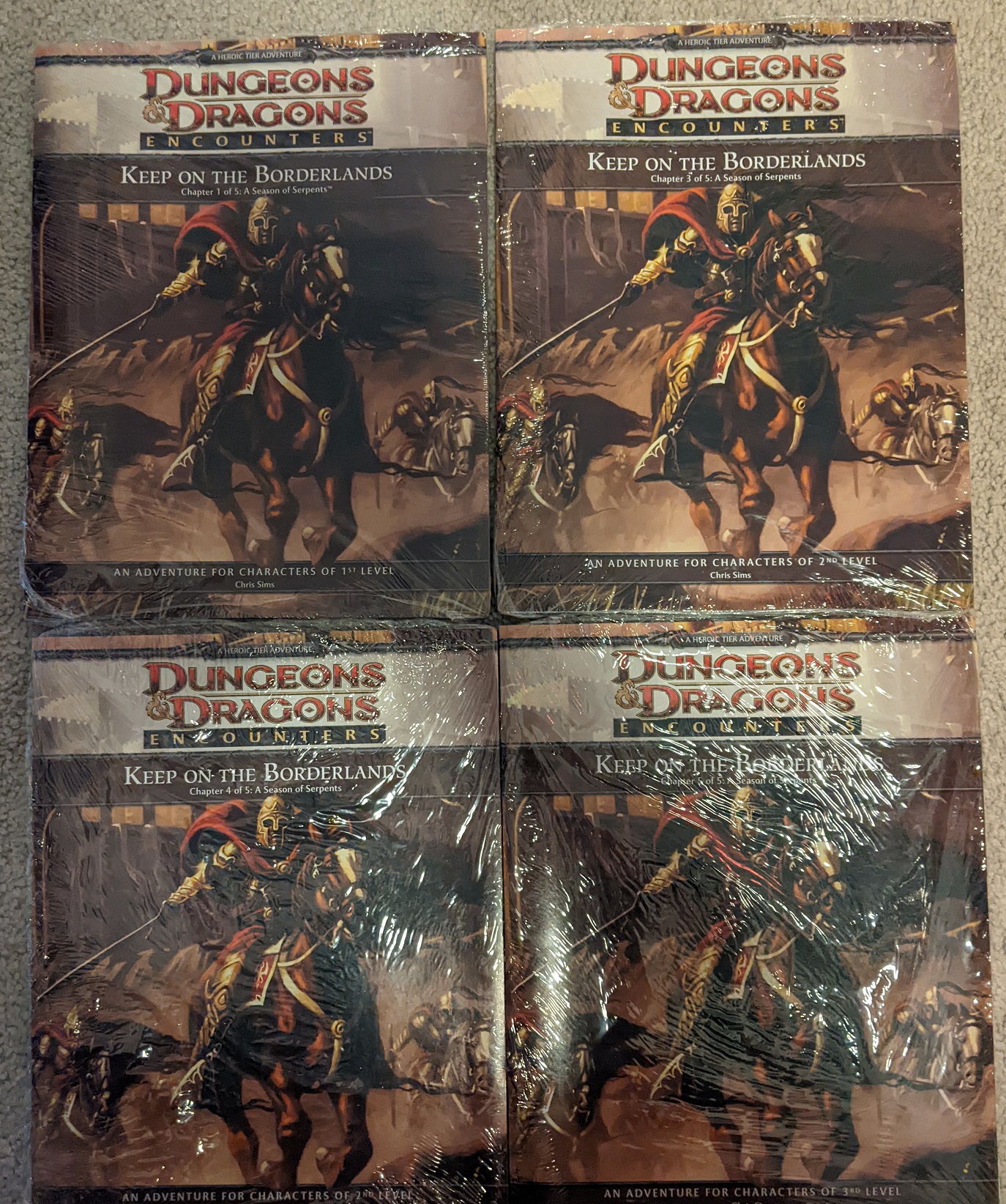
These were something of a mistake for WotC, as I discussed with a WotC employee at GenCon who shall remain nameless. They were far too brutal for D&D Encounters, which was a program designed to introduce new players to the game. Some of us like brutal adventures and campaigns. In this century, we are clearly the minority. Art credit to William O’Connor.

Oddly enough, I never played or ran either one of these, yet the shrink wrap has been removed from them. I’m guessing the DMs gave them back to me, but that doesn’t make a lot of sense. I allowed them to keep them because I had so many. Art credit to Eric Belisle and Alexey Aparin.

For these, art credit goes to Alexey Aparin, Eric Belisle, and William O’Connor.
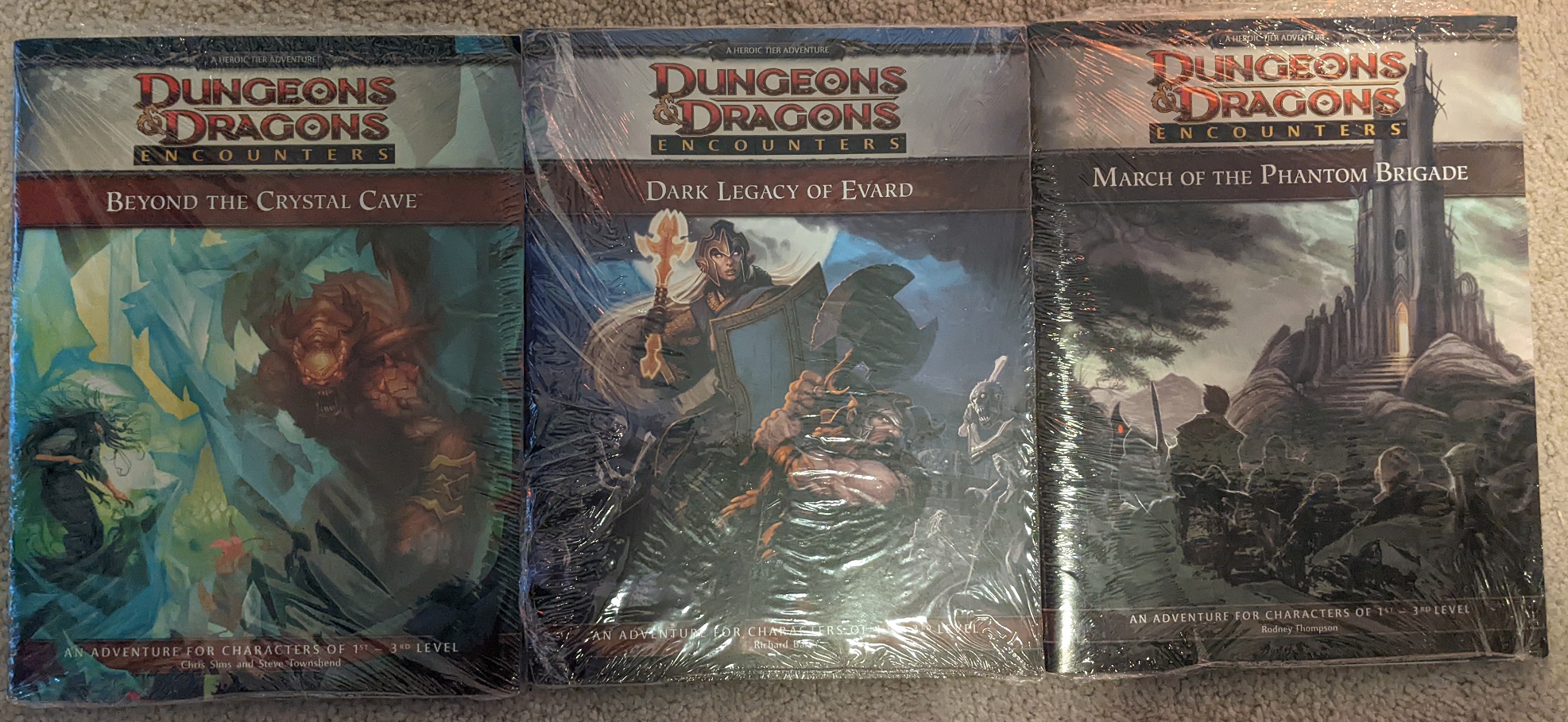
Okay, Logan. We get it. You like Drow. Art credit to Tyler Jacobson and McLean Kendree.

As I’ve said, I have unfinished business with 4th Edition D&D (and 3rd Edition and more 3rd Edition).
Follow me on Twitter at @gsllc
Follow Mike @slyflourish
Follow Teos @alphastream
Follow James @aquelajames
Follow Logan @loganbonner
Follow Shawn @shawnmerwin
Follow Scott @scottfgray
Follow Erik @erikscottdebie
Follow Chris @ChrisSSims
Follow Steve @TheTownshend
Follow Rodney @AntarianRanger
Follow McLean @mcleankendree
Follow Tyler @jacobsontyler
Follow Eric @erbelisle
Follow Alexey @Alex_Aparin
Follow Craig @craig_spearing
Dungeons & Dragons is a trademark of Wizards of the Coast, LLC, who neither contributed to nor endorsed the contents of this post. (Okay, jackasses?)
If you enjoy this post, please retweet it.
I told my coworkers that I was using one of the bedrooms in my new home into a den. They started calling it a mancave. Well, if this is a mancave, it’s the nerdiest one ever. I also can’t see it as a “cave” considering it’s on the second floor. It seems more like a man loft.
That doesn’t make any sense, does it?
Last week, I bought a 6′ tall bookshelf that finally allowed me to unpack most of my gaming material. This weekend, I picked up a new desk, which again allows me to unpack office supplies and other things. The room is finally coming together, and I’m fairly well organized.
This den, mancave, or whatever you want to call it is oddly important to me. I’ve lived a rather simple lifestyle up to now. I’m used to a small place, and while this home isn’t what anyone would call large, it’s exceptionally large for me. In fact, it’s too large. It’s great that I have room for everything that I have and much of what I don’t have yet, but I spend 90% of my waking hours in this room. For lack of a better word, it feels cozy, and I’m jamming it with everything I want around me in my free time at home.
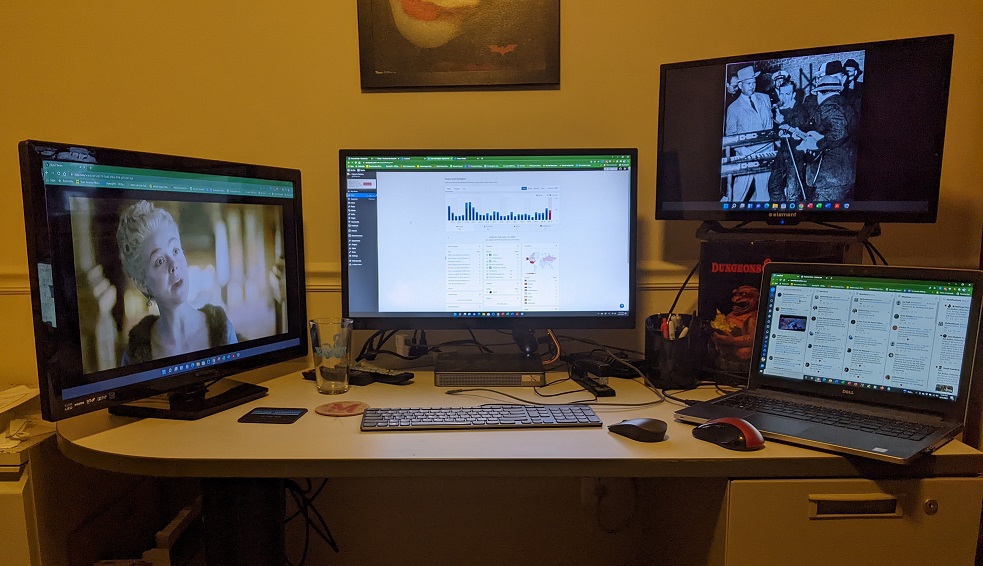
I have a lot of Jeff Dee originals to hang, but so far the only art on the walls is this guy over the desk.
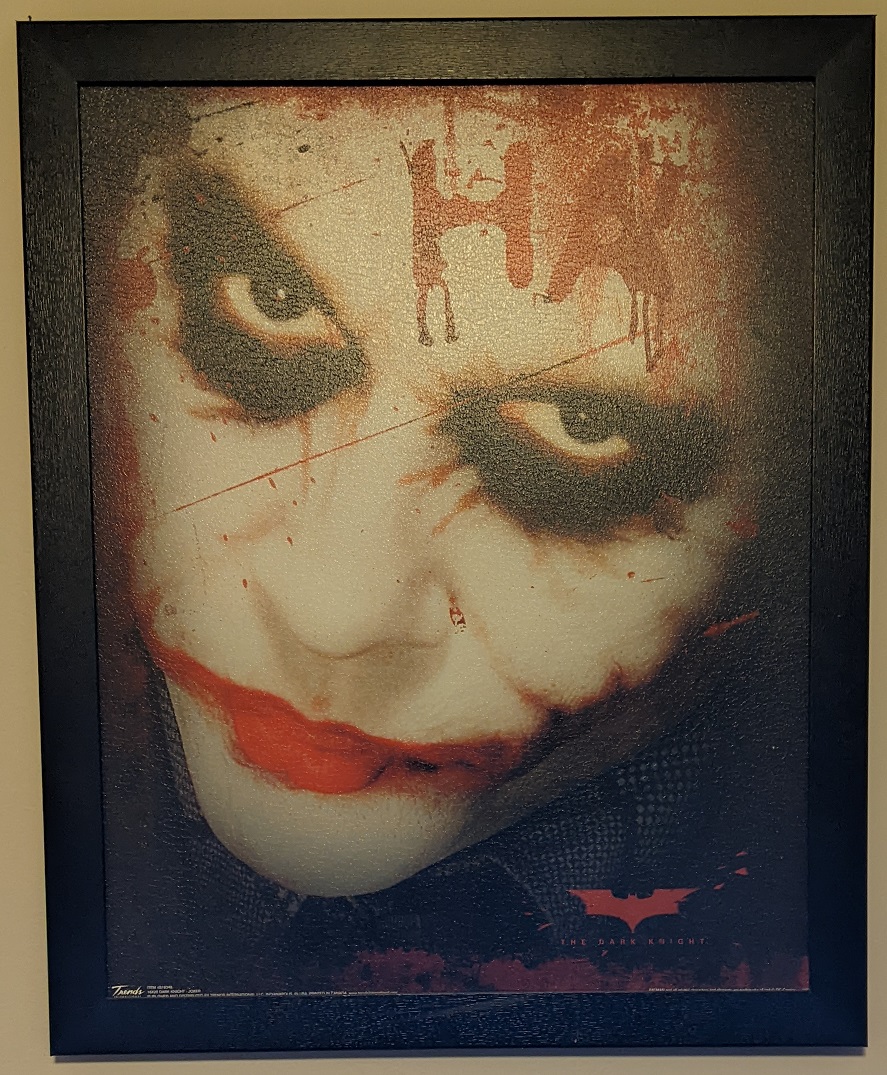
My cousin gave me a magazine rack. I asked, “What am I? 108 years old?” But I had just the use for it.

Seriously. This is a mancave?
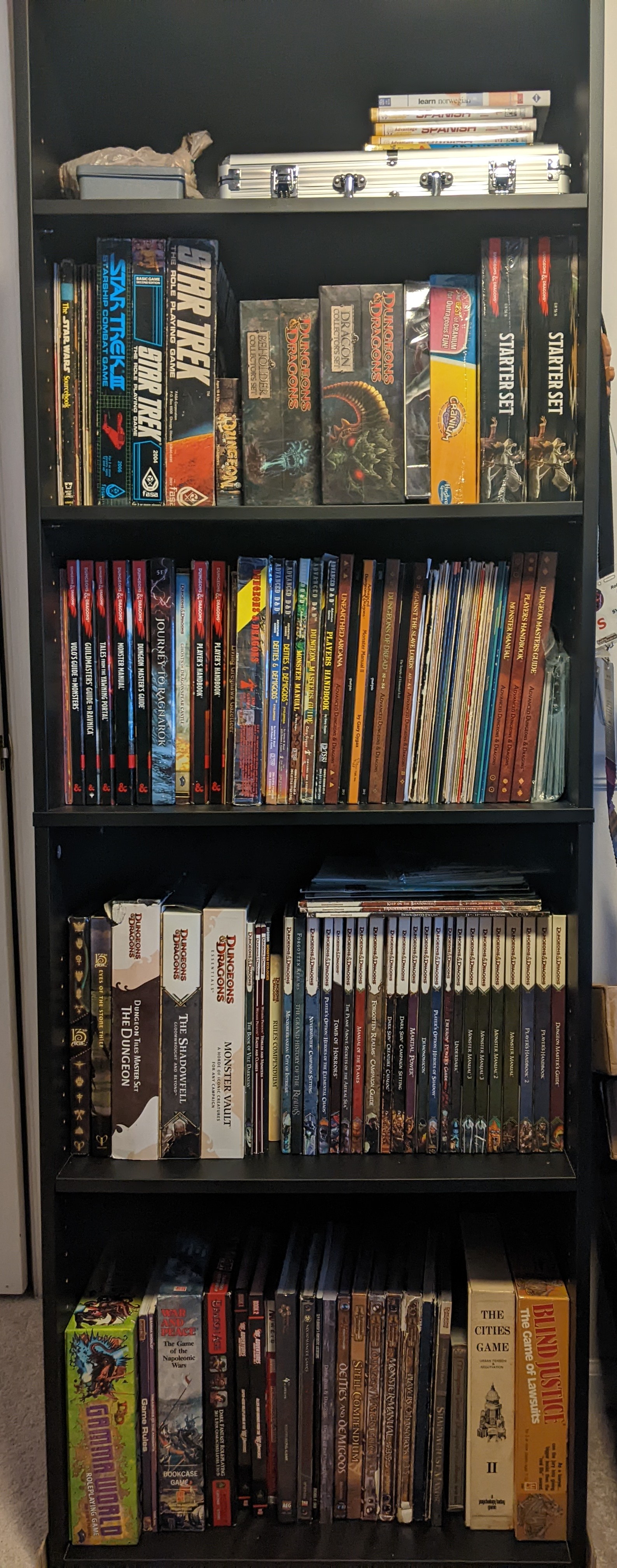
I have tons of other books not related to gaming, but the second bookshelf hasn’t even been put together. On the side of this bookshelf, I hung some memorabilia.
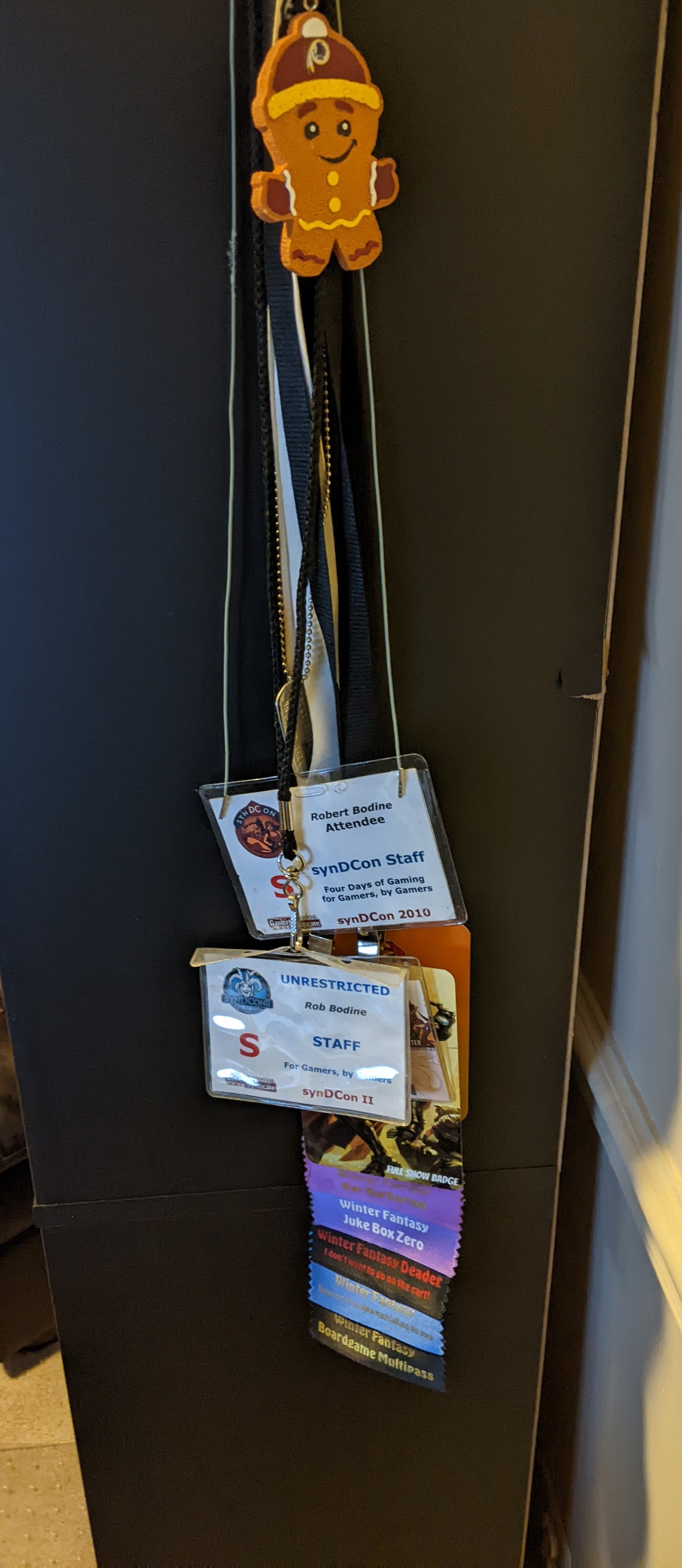
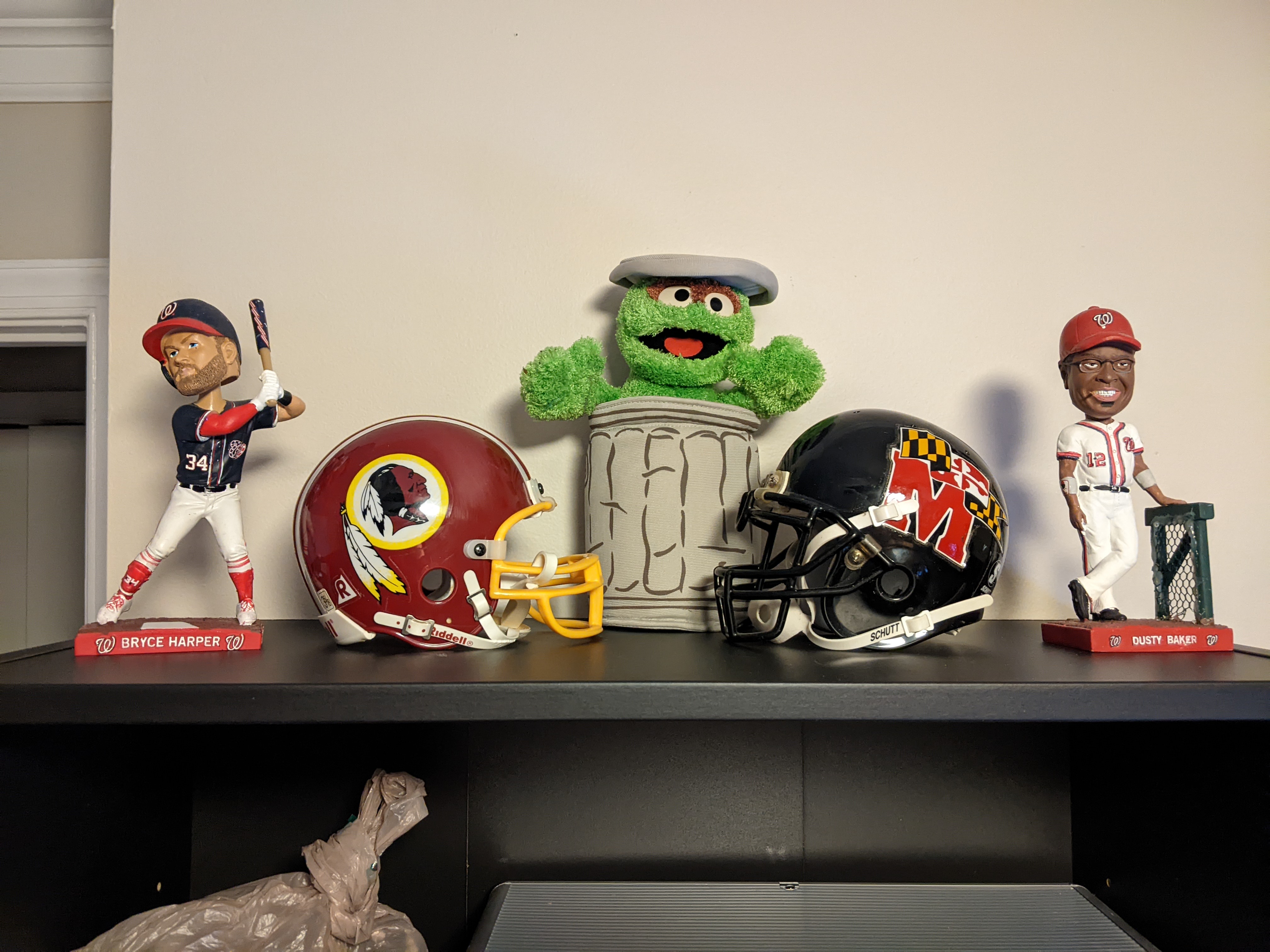
As far as conventions go, the badges are from All-Star Comic Con 2018, GenCon 2011, synDCon I and II, and Winter Fantasy 2020 & 2022. And then there’s something on top of that bookshelf.
The one thing that won’t fit are my musical instruments. I’m keeping them downstairs. That’s probably for the best. It’s a townhome, and the neighbors probably wouldn’t appreciate any noise being upstairs near their bedrooms.
Make no mistake about it: My keyboard playing is properly defined as “noise.”
Follow me on Twitter @gsllc
Dungeons & Dragons is a trademark of Wizards of the Coast, LLC, who neither contributed to, nor endorsed, the contents of this post. (Okay, jackasses?)
If you enjoy this post, please retweet it.
Save or die in RPGs refers to the notion that a character can be in a position where their life relies on a single saving throw. This is quite common in 1st Edition D&D (“1e”) but was completely eliminated in 4th Edition D&D (“4e”). Despite my enthusiasm of returning to 1e, I think its demise was a good thing. Much like ordinary swings of a sword, devastating but really cool attacks could be unleased on a character without taking them out of the game immediately.

For example, one of my favorite monsters is the medusa, so I want to use them to their full potential and (relatively) often. In 1e, however, one medusa could take out the entire party before they could say, “The Amazon commercial with Medusa is stupid.” That’s quite a buzzkill, and it can destroy a gaming session. In 4e, however, I had no issues unleashing that petrifying gaze upon the group. On a successful attack roll, those in a close blast 5 were slowed. A failed save on their next turn left them immobilized. Finally, if they failed a second save on the turn after that, they’d be petrified. At any point in that process, a single successful save ended the effect. Poison and other fatal (or effectively fatal) effects manifested similarly. A rare few monsters had abilities with aftereffects, which were brilliant. If at any point you successfully saved, it would end the primary effect but would trigger a secondary effect requiring its own save.
/Perseus_and_Medusa_Cellini-0fe22fdf638f4638aaf35c3a1fb68d71.jpg)
I’m not sure how I’d eliminate save or die in 1e, or even whether I should eliminate it. Messing with something so deeply baked into the game could create issues. Or not. 1e is remarkably adaptable to house rules. To start, though, I’m going to keep it.
So, make sure your henchmen go into each room first.
Follow me on Twitter at @gsllc
Dungeons & Dragons is a trademark of Wizards of the Coast, LLC, who neither contributed to nor endorsed the contents of this post. (Okay, jackasses?)
If you enjoy this post, please retweet it.
Yesterday, I discussed spell components. The conversations I had across Facebook and MeWe encouraged me to provide a quick epilogue to the spell components post.
The point I was making applies to games yet to be designed, not to current editions, and the argument is a rather trivial one: The more valuable a thing is, the higher it’s cost should be. We can all get behind that notion, right?
A problem I have with 5th Edition D&D (“5e“), and I think most editions, is that there are a list of go-to spells (or class abilities) that everyone feels they have to take, limiting the diversity of builds at the table. I have no intention of trying to “fix” existing editions to balance material spell component cost and availability with the power of spells. It turns out that for 5e (the subject of that post), that would be a lot of work. Here’s a sample of those spells (and their spell components) that I’ve mathematically proven to be preferred by WotC themselves in creating NPCs, and I suspect players favor as well.
As you can see, all of these spells have cheap material components that are easily obtained without the DM creating an illogical scarcity. Some popular spells (Counterspell, Dimension Door, and Misty Step) don’t even require material components. So, in 5e, even if you “enforced” components, it wouldn’t change a damn thing. That, to me, is a design flaw, and one I don’t have the desire to fix. However, where there’s a high cost for a spell (e.g., Heroes Feast), I’m going to enforce it.
That said, increasing the cost or scarcity of material components is just one way to increase the cost of spells. In 1st Edition D&D (“1e“), spell cost was assessed using casting times. Combat consisted of 1-minute rounds divided into 6-second segments (i.e., 10 segments per round). Initiative determined the segment in which a character was able to act (with some caveats not relevant here). Because spells had casting times measured in segments, a caster would start casting a spell in one segment, but the casting wouldn’t complete until a later segment. If a caster took a single point of damage during this time, the spell would fail, and the caster would lose the spell slot. Therefore, casters had a choice to make: either cast a weaker spell quickly, assuring it would be of (limited) value, or cast a more powerful spell accepting the risk that it could wind up to be worthless.
In other words, 1e used casting times to increase the cost of spells, and it appears to have done so quite well. Of course, without dividing your rounds into segments, casting times may not be a viable solution.
The moral of this story is that game designers really need to pay better attention to whether their systems lead a majority of players to make the same choices. Sure, some things should be better than others, but like in the real world with food, cars, houses, and everything else, the better things should have a higher cost, regardless of how that cost is assessed. That way, different players will create widely diverse builds, and we’d (or at least I’d) see more dynamic combats.
In 5e, material spell components seem to be the intended way to do that.
Follow me on Twitter at @gsllc
Dungeons & Dragons is a trademark of Wizards of the Coast, LLC, who neither contributed to nor endorsed the contents of this post. (Okay, jackasses?)
If you enjoy this post, please retweet it.
I had a brief interaction with Erik on Twitter (yes, him again) within the context of 5th Edition D&D (“5e”).
Material Components

I stand by my statement but want to clarify it. The spell, Fly, has a single material component: a feather. As Erik mentioned, Heroes’ Feast has a significant one: A bowl worth 1,000 gps. The reason there’s a distinction between the material components for these items is that Heroes’ Feast is far more powerful in the long run. It’s a 6th-level spell vs. a 3rd-level spell, so there needs to be something to balance that effect. This is obvious. What’s less obvious is that the bowl has to be encrusted with jewels, which requires a long process by a skilled craftsman. That’s a spell component with far more limited availability than “a wing feather from any bird.” Such scarcity puts a check on overpowered spells, or at least an overpowered application of such spells.
If a DM tracks material components that have a high financial or logistical cost but largely ignores those with a low cost, game balance is maintained without turning the game into a spreadsheet. It also gives players another strategic dimension. A player must choose between having to collect 1,000 gp bowls to heal up and fortify defenses, or an offensive implement that prevents that damage in the first place. The decision isn’t merely mechanical; it also affects what kind of character a player wants to play.
Somatic and Verbal Components
Speaking of strategy, non-monetary components are also important. Ignoring components robs players of some of the fun. For example, Shatter has a verbal component. That makes sense. You shout to produce sound waves, then magically manipulate those waves to produce the damaging effect. If you remove that requirement, then the Silence spell is completely nerfed for combat, and with few remaining useful applications, the spell will largely be ignored by players. This means that everyone reverts to the same, short list of spells they choose. That’s boring (q.v., though it’s what’s happened for other reasons). This isn’t boring: Because NPCs may use Silence to prevent casting spells, PCs are given yet another strategy to consider during character design.

The same is true of somatic components. Most players ignore somatic components when their PCs have been placed in shackles or tied together. PCs should have to pay attention to the components required by the spells they’ve chosen and make sure they haven’t placed their eggs in too many baskets. That is, they must make sure that some spells have no material components, some have no somatic components, and some have no verbal components. Do enough such spells exist?
How This Impacts Game Design
If there’s a problem here, it’s probably that there are too many spells with verbal or somatic components, so there’s no effective strategy to be had.
Let’s test that hypothesis.
As you may recall, I have a database of all 5e spells that I created for my one stop stat blocks project. You can find details for my methodology buried within this post, but I’ll point out that there are a total of 457 spells in those sources (deleting duplicates between the Elemental Evil’s Player Companion and Xanathar’s Guide to Everything). A simple query gives me the following:
| Number (Percentage) | |
| V | 52 (11.38%) |
| VS | 149 (32.60%) |
| VM | 11 (2.41%) |
| VSM | 220 (48.14%) |
| S | 17 (3.72%) |
| SM | 8 (1.75%) |
Material components are required by over 52% of spells, but never is there a spell that can be cast by a caster who’s bound and gagged but manages to pull a material component out of a hidden pocket. That is, there are no spells that require only a material component. 15% of spells can be cast with either a verbal or somatic component by itself, so those spells should be quite useful if material components are tracked. Almost 95% of spells require a verbal component, and over 84% require a somatic component. Clearly, the game designers didn’t intend for casters to be able to cast while bound and/or gagged.
| Source | Level | Spell |
| Player’s Handbook | 8 | Demiplane |
| Guildmaster’s Guide to Ravinca | 0 | Encode Thoughts |
| Elemental Evil Player’s Guide | 0 | Control Flames |
| Elemental Evil Player’s Guide | 0 | Mold Earth |
| Elemental Evil Player’s Guide | 0 | Shape Water |
| Elemental Evil Player’s Guide | 0 | Thunderclap |
| Elemental Evil Player’s Guide | 1 | Absorb Elements |
| Elemental Evil Player’s Guide | 1 | Catapult |
| Elemental Evil Player’s Guide | 1 | Ice Knife |
| Xanathar’s Guide to Everything | 0 | Primal Savagery |
| Xanathar’s Guide to Everything | 1 | Snare |
| Xanathar’s Guide to Everything | 2 | Mind Spike |
| Xanathar’s Guide to Everything | 3 | Catnap |
| Xanathar’s Guide to Everything | 5 | Steel Wind Strike |
| Xanathar’s Guide to Everything | 6 | Mental Prison |
| Xanathar’s Guide to Everything | 8 | Illusory Dragon |
| Xanathar’s Guide to Everything | 9 | Psychic Scream |
I’d like to think that having a verbal component to, for example, a Power Word spell is more a question of flavor than mechanics. Even if that’s the normal approach, playtesters were probably forced to abide by the relevant rules when playtesting, and so the balance in the game was inevitably shaken out requiring components in most scenarios.
Consider that one of my criticisms of how D&D monsters are designed is that they all use the same spell selection. This list of spells is heavily weighted towards spells that are either overpowered or simple to remember without having to look up their details. For the first five levels, here are the top five spells by use by NPCs in the relevant sourcebooks (“preferred spells”). I skipped preferred spells higher than 5th level because there are far too few of those spells even used for a “top 5” list to make any sense, and besides, above 5th level none of those spells are used more than 8 times in all the sourcebooks combined.
I’ve played with hundreds of different people through organized play, organized weekly game days across the Washington, DC area for a gaming club over about 250 members, and ran a convention for a couple of years. In my anecdotal experience, this is nearly identical to the list used by PCs, but I can’t technically prove that. Almost no one responds to my polls. 🙂
So, just for shits and giggles, let’s look at what happens to the numbers above when we limit ourselves to preferred spells.
| Number (Percentage) | |
| V | 2 (6.67%) |
| VS | 11 (36.67%) |
| VM | 1 (3.33%) |
| VSM | 14 (46.67%) |
| S | 1 (3.33%) |
| SM | 1 (3.33%) |
The numbers are too small to take too seriously, but they look about the same with the exception of spells requiring only verbal components (only Dimension Door and Misty Step). In case you’re curious, Counterspell is the only preferred spell requiring only a somatic component. So, preferred spells can be even more often nerfed if we enforce components. If we do so, perhaps we’ll see a more varied suite of spells at the table, but not by much in 5e. There don’t seem to be many alternatives that avoid the need for particular components.
What Have We Learned? Not Much.
I think this was a bit of work to say simply that the game was balanced during playtesting under a strong assumption that casters could be nerfed, especially by one another. Not enforcing components just further aggravates the existing problem of only a few spells ever being used. In the end, I’m sure people are having fun even if they don’t worry about components, but if a DM wants to remove spell components, I’d much rather see the DM remove them to urge players to choose spells other than the ones on the preferred (spell list, giving several spells the ability to be cast with only one type of component.
Food for thought for game designers of the future and those willing to do the work in changing 5e now.
Variety is the spice of life.
Follow me on Twitter at @gsllc
Follow Erik Nowak @Erik_Nowak
Follow Brian Taylor @brian_c_taylor
Dungeons & Dragons is a trademark of Wizards of the Coast, LLC, who neither contributed to nor endorsed the contents of this post. (Okay, jackasses?)
If you enjoy this post, please retweet it.
Sundays now are lazy days for me. I either post something silly or other people’s work. Usually both. Today, it’s a continuation of my obsession with how to deal with aquatic encounters.

I discussed how there are plenty of viable aquatic PC races in 1st Edition D&D (“1e“). This image contains more threats, much of which don’t appear (as far as I can tell) among official 1e bestiaries, and I’m sure there are plenty of options from other eras to add to what we have. If 1e weren’t so human-centric, the writers may have done a better job contemplating aquatic campaigns, and then we’d have more of these. Perhaps some reskinning is in order.
Oh, and happy Super Bowl Sunday! Go Sean McVay! Remind Daniel Snyder how much of a dipshit he is!
Someone stat that shit!
Follow me on Twitter @gsllc
Dungeons & Dragons is a trademark of Wizards of the Coast, LLC, who neither contributed to, nor endorsed, the contents of this post. (Okay, jackasses?)
Stories and photos from Scotland
Don't Take This Too Seriously. I Don't.
An Ennie Nominated D&D Blog & Podcast. Home of tutorials, advice, and downloads for new DM's
No rules but my own.
The Official Blog of Obsidian Portal
A site about all things bound up within me.
 Play What You Want