Let's roll some dice, watch some movies, or generally just geek out. New posts at 6:30 pm ET but only if I have something to say. Menu at the top. gsllc@chirp.enworld.org on Mastodon and @gsllc on Twitter.
This unboxing is for the very last thing I plan to purchase for 1st Edition AD&D. I have everything I want for sentimental reasons, and there’s nothing left that I need to actually run the game.
It’s been a minute since I’ve written about D&D, and it’s going to be a little while before I do so again. (The next couple weeks of posts have been written.) So, I wanted to get back on track. I’ve talked about how I prefer to play D&D, and why that drove me from the game for a while, and in that post I discussed puzzles a bit. This expands on that.
I like puzzles.
Acrostics, sudoku, crosswords, Wordle . . . you name it, I love to solve them or write them. I also like to be challenged, which means if I always succeed, I lose interest. I’ve noticed that many players don’t like puzzles, and that many who do like them will get frustrated unless they always succeed. That’s fine, of course; play what you like, but it’s part of why I stopped playing altogether, and even now am just running games. I seem to be in a small minority among the nerd circles I frequent. Crafting puzzles is as much about finding the right level of difficulty for the group as it is about the logic of its design.
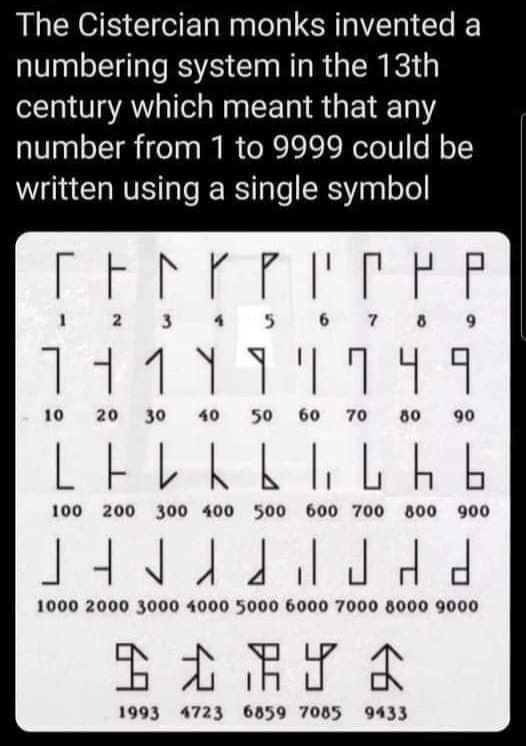
I think I found the basis for a puzzle that many people can enjoy. I present to you the Cistercian numbers.
If you have a group that doesn’t like hard puzzles, then simply writing a number can be the puzzle itself. To make sure you get it write (intentional typo, because I think I’m funny), here’s a converter care of @dCode_fr. If you have a group that likes hard puzzles, this can throw a wrinkle into the mix. If they need to calculate or otherwise decode a number, make them read the puzzle, or write the answer, in this system. You could also provide a hint that the characters must add the appropriate markings in the order in which they appear in the Arabic numerals (i.e., if the number is 12, add the horizontal line running left first, and then the one running right second — 10 than 2). Perhaps a Cistercian clock could be counting down, so that you don’t know how much time you have. That would probably require some software engineering on your part, but if you can code and you like puzzles, why not?
Okay, I know I burdened you with a lame unboxing just 5 days ago, but this is a good one. This is without a doubt the nicest collectable I now own. Behold, the unboxing of a 1st Edition D&DWilderness Survival Guide with James Ward’s signature in the inner cover.
As a follow up to yesterday’s post, I provide a video talking about the history of vampires. Sure, I should have posted this last Monday, as I had just seen Morbius the day before, but I’m weeks ahead of schedule in my writing, and I’m too lazy to shuffle around the posts and rewrite them so their new order of publication jives with the text within.
My 1st Edition AD&D (“1e“) players’ characters are still in their adventuring infancy, so it’s too early to throw a vampire at them, but I look forward to it. Maybe I could create a more level-appropriate 1e Dhampir myself.
Sundays now are lazy days for me. I either post something silly or other people’s work. Usually both. Today, it’s an image shared in my social media stream. The title of this post serves a double meaning. As any reader of this blog knows, I’m running my first 1st Edition D&D campaign in 40 years, and I have no idea what I’m doing, so what’s old is new. The meaning I infer from the image below is to say that even something trite can shock the players.
As always, if you can translate the signature, I’d like to point people to the artist. EDIT: The artist is Miles Tevis. You can find his work here.
Dungeons & Dragons is a trademark of Wizards of the Coast, LLC, who neither contributed to, nor endorsed, the contents of this post. (Okay, jackasses?)
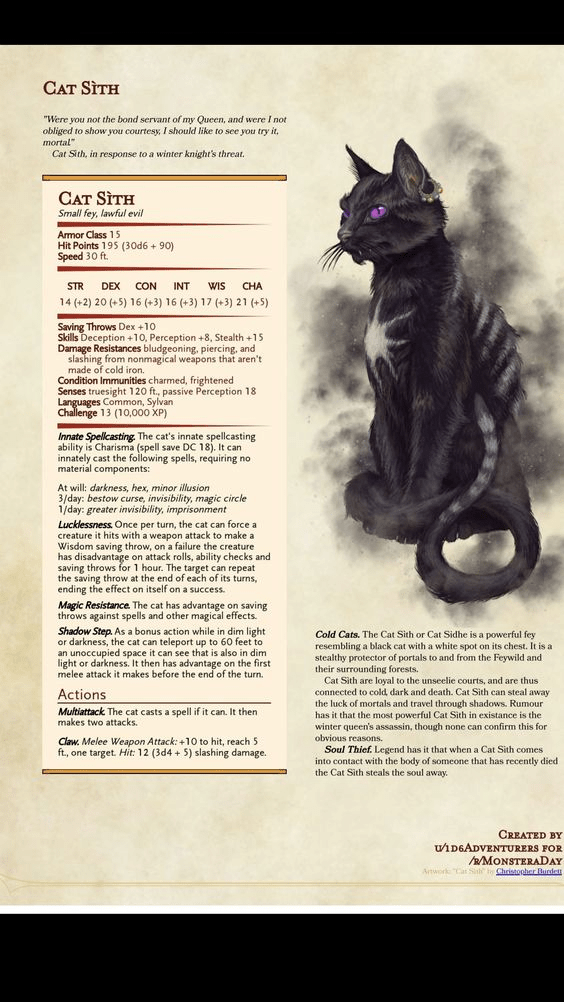
First, there was the dinosaur cat. Now, you have the cat sith. With an intelligence of 16, wisdom of 17, and spellcasting to boot, this is a much greater threat, and perhaps one that could be quite surprising to the average party. One thing that’s disappointing is that the creator uses the term “sith,” yet there’s nothing Sith-like about its powers. No telekinetics, no mind control, and, of course, no weapon use. That seems odd.
But yes, it’s just as ridiculous as the dinosaur cat.
I posted this on social media in the past, but never on my blog.
For those few that don’t know, the Mandela Effect is an effect popularized by a “paranormal consultant” (i.e., a kook) to describe false memories shared by a large number of people. Some famous examples are the misremembered movie, Shazam, starring Sinbad, which was memorialized in an April Fool’s Day joke; spelling errors like “Fruit” Loops and Oscar “Meyer”; and, of course, the alleged 1980s death of Nelson Mandela in prison from which the phenomenon gets its name.
Eats Froot Loops for breakfast and hot dogs for lunch.
Enter Juiblex, the grotesque demon lord of slimes first introduced in the 1st Edition D&DMonster Manual. Whenever I mention this, there’s always someone that chimes in that, even today, they thought JuIBlex was spelled JuBIlex. That is, many people, myself included, switched the ‘i’ and ‘b’ in the word. This might be — and I say “might” because I’m neither a psychologist nor a sociologist — because a few people made that mistake, and then it cascaded through nerd society (i.e., the Mandela Effect). It might also be because “Jubilex” is easier to pronounce, so everyone making that mistake did so independently based on some psychological effect (i.e., not, as I understand it, the Mandela Effect). I prefer the former hypothesis. It supports my premise.
Now there’s some psychological bullshit.
But wait! There’s more!
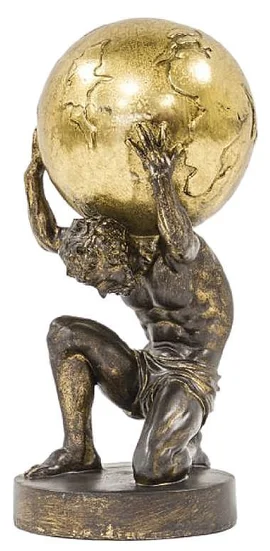
Earlier this week, I published a post on Atlas. As originally written, I pointed out that Atlas carried the world on his shoulders. I was reminded that this is, of course, wrong. Atlas held up the sky. This common mistake has changed the way Atlas is portrayed in art, and may be the origin of the phrase, “carrying the weight of the world on one’s shoulders.”
It appears this may also be an example of the Mandela Effect with an interesting impact on art and language.
Considering how cold the South Pole is, you’d think he’d wear more clothing.
Dungeons & Dragons is a trademark of Wizards of the Coast, LLC, who neither contributed to, nor endorsed, the contents of this post. (Okay, jackasses?)
Dungeons & Dragons is a trademark of Wizards of the Coast, LLC, who neither contributed to, nor endorsed, the contents of this post. (Okay, jackasses?)
The image below revived a memory from my elementary/middle school days, which is when I last played 1st Edition D&D (“1e“).
This image alone could be the subject of another post . . . on another blog.
Being a mythophile – mythology brought me to 1e, not the other way around – I loved perusing Deities & Demigods and finding ways to incorporate the material in my games. The results were ridiculous, but that’s not today’s point.
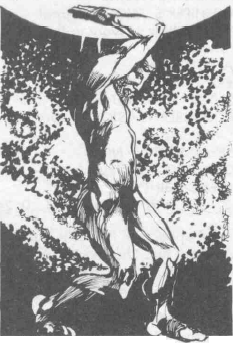
Intelligence and Wisdom of 12. That checks out.
I recall seeing Jim Roslof’s (RIP) drawing above of Atlas from Greek mythology and thought, “Wait a second. Why even stat the guy? He’s not going to be able to put up a fight if he’s got the sky on his shoulders.”
This wasn’t me at my most creative moment. Mythology itself had precedent for Atlas not always shouldering the sky. Hercules relieved him for a bit. The better question would be, “Why would you want to kill a guy who’s tasked with this burden? Who’s going to take over if you kill him? Will the sky just . . . fall?”
Perhaps a better question should be, “Shouldn’t shouldering the sky be metaphorical considering that the game contemplates the possibility of multiple, coexisting pantheons? Are Indra, Shang-Ti, Ra, and Odin also relying on Atlas to hold up the sky?”
Fortunately for my current group, these aren’t difficult questions to answer, but I was a kid.









 Play What You Want