If you enjoy this post, please retweet it.
It’s probably not the best choice, but I’m a glaive guy.
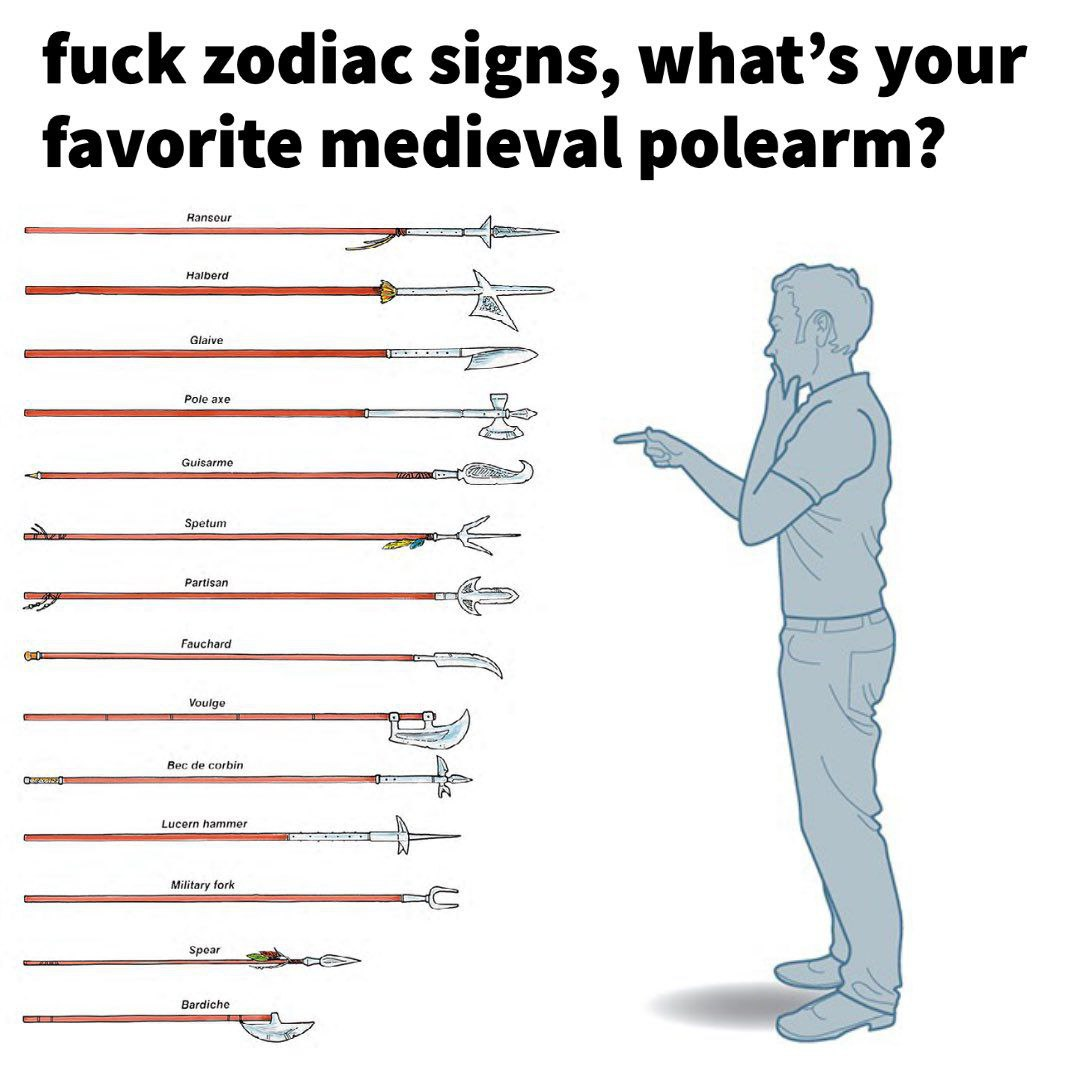
I also don’t know what that means.
Follow me on Twitter @gsllc

If you enjoy this post, please retweet it.
It’s probably not the best choice, but I’m a glaive guy.
I also don’t know what that means.
Follow me on Twitter @gsllc
If you enjoy this post, please retweet it.
This one comes from the heart.
A few weeks ago, I hosted another 1st Edition Dungeons & Dragons (“1e”) game at my home. The group spent over an hour at the start of the session just reminiscing about the good old days when most of us first met. This was during the era of 4th Edition. Inevitably, the subject of synDCon came up. synDCon was the gaming convention financed primarily by Vic and me. The two of us did almost all the work of running the convention once it began. It was large enough that we had everything represented (see below), yet still maintained the coziness of conventions like Winter Fantasy.
synDCon Was Awesome

I need to put my modesty aside for a bit and say that we pulled off something magical (pun absolutely intended). In our first year, we took advantage of a holiday and put on a four-day convention. We provided tons of organized play: Living Forgotten Realms (4e), Pathfinder Society, and Heroes of Rokugan (Legend of the Five Rings). We also had individual games from less popular RPGs being run here and there, tons of card games (including, of course, Magic the Gathering), tons of board games, and we were the official DC-area convention for Munchkin. We had special events, a LARP, dungeon delves I wrote based on classic 1e adventures, and live music on Saturday night for one of the cons. Our slots were staggered so that slots didn’t start every four hours but rather every two hours. If you wanted to sleep in a bit, you could. You’d just start playing at 11 am instead of 9 am, but there were enough 2-hour slots of other things to do that you could still get three slots of gaming in.
It wasn’t run in a convention center, nor in the basement of a mediocre hotel, but rather in a really nice “hotel and executive meeting center” right across the street from a Metro (subway) stop in Rockville, Maryland. As the county seat for Montgomery County, there were tons of restaurants, et al. in the area, including a gaming store down the street. Of course, we had a gaming store as our in-convention vendor both years, and we generated about 200 attendees both years. Our attendees represented everywhere in the United States east of the Mississippi (e.g., Florida, Georgia, and Ohio), but we gave an award to a guy named Matt for having come the farthest for the con (Alaska).
We had tremendous support from volunteers that helped organize the detail while Vic and I focused on the big picture, and we’re forever indebted to those friends, but I’ll be damned if my feet weren’t atrociously sore by the end of both cons.
Seriously, it was stupendous, and everyone that attended and commented on it said so.
A Slight Diversion Before My Point
I’ve been thinking of doing something other than a Vegas blackjack trip for my fall vacation – I say this every year, so we’ll see if I follow through – and was considering an RPG gaming convention instead. Because I wanted to play 1e, I was initially thinking about GaryCon, but a friend pushed me towards GameholeCon. It was an easy sell because the timing would be better. GaryCon would interfere with Winter Fantasy, but GameholeCon would slide right into the Vegas slot (again, pun absolutely intended). The trouble is that Winter Fantasy and synDCon have spoiled me. I have no intention of going to a convention and paying between $100 and $200 per night for my hotel room if I’m staying at least 2 miles from the convention. That’s ridiculous. It’s like GenCon on a smaller scale. The city is obviously not big enough to handle the convention. So, I decided to look into other options.
There Aren’t Any
Sadly, I went through all my options I could find online, and nothing quite matches the magic of Winter Fantasy or synDCon as far as I can tell. The lists were not complete – Winter Fantasy wasn’t even mentioned (?!) – so maybe there are some other cons out there, but I can’t find them. The cons are at least one of the following: in an inconvenient or excessively crowded location, lack inexpensive parking, or focused on only a few things (usually the shiny new things of the day). Some are also not “cozy,” which I define as between 200 and 350 people. It’s large enough that there can be plenty to do, and you can meet new people, but small enough that you’ll always be able to find your friends and hang out with them. Winter Fantasy doesn’t even satisfy all of these characteristics perfectly – I tried to run 1e but only one ticket for only one slot of three was sold – but it’s as close to perfect as I think practical for a cozy con. It’s also in Ft. Wayne, Indiana. I’m fine going out there, and I will every year they’ll have me, but I find it odd that an area with as big a gaming community as DC doesn’t have something like this.
And this is my point. DC needs a convention like synDCon or Winter Fantasy. Such a con isn’t going to hit the radar scope of the big players (i.e., Wizards of the Coast and Paizo), but it’ll appeal to plenty of players. The DC area is filled with them. Our Gamers’ Syndicate gaming club had over 200 people that identified as members, and we ran game days every single weekend in as many as five gaming stores at a time. While organizing synDCon, I learned of several other groups just as large that had never even heard of us. They were organizing at other stores. This area has an abundance of gamers, and I suspect there are even more here over 10 years later.
Will There Be a synDCon III?
That’s the magic question. I’m happy to organize it, but as we discussed at the game session, my demands are high. First off, I want to do it right or not do it at all. I’m not willing to put together a con in “the basement of the Best Western.” No offense to the chain in general, but that happens to be a hotel we visited that would be the site of a con not worth having. It was downright gross but not unlike venues of cons I’ve attended in the early 2000s. No thanks. Second, having learned from my experiences with the first two, the only way I’d do it is if I had a number of additional owners willing to slap down cashier’s checks for at least $2,000 each (or more depending on how many people commit) and having signed an operating agreement that prevents them from every cashing out that initial investment. That is, I need a sizeable stable of people willing to commit whole-heartedly so that I know I’ll have both the funds and the work ethic necessary to make this doable. Trust me when I say that it’s not enough that someone throw money at me. I need to know that they’re committed to doing the work necessary to pull off a great con. Because it’s been over 10 years, I don’t know what the minimum acceptable number of owners would be, especially without knowing exactly how much each would be willing to contribute up front, but I do know $2,000 is enough to motivate most gamers to stay the course and do what they could not to throw that money away. Any of them willing to drop $2,000 are likely to take it seriously.
Another thing I remember is that no one wanted to be the guy, the “convention coordinator” or CEO who had to make the calls when weird situations arose. While I’m happy to be that guy, I’m not willing to be the one that puts out the feelers (beyond this post, I guess) and see if there’s interest. If I thought my odds were better than 50% of finding such interest, I would, but I don’t think there are enough people willing to make this kind of commitment, so why bother trying? I did my part for king and country, and wound up with a small, overworked group. If this is meant to be, then someone else will have to get the ball rolling. So, while I’m not the one destined to put this together, I strongly suspect there’s a market for it, and my recent thoughts and conversations on the matter sure leave me wishing someone would.
If that’s you, drop me an email when you think you’ve got something real.
Follow me on Twitter @gsllc
Follow Vic @Luddite_Vic
If you enjoy this post, please retweet it.
I’m probably seeing Shazam! Fury of the Gods tonight, so here’s something stupid that didn’t take a lot of work to post. EDIT: A work outing kept me from seeing the movie, but still kept me busy tonight. It’s not even my image. Bards are my favorite Dungeons & Dragons class overall.

Also, happy St. Patrick’s Day!
It’s not St. Patrick’s Day until these three bards have their say.
You’re a hamster!
Follow me on Twitter @gsllc
Dungeons & Dragons is a trademark of Wizards of the Coast, LLC, who neither contributed to, nor endorsed, the contents of this post. (Okay, jackasses?)
If you enjoy this post, please retweet it.
I see this meme from time to time.
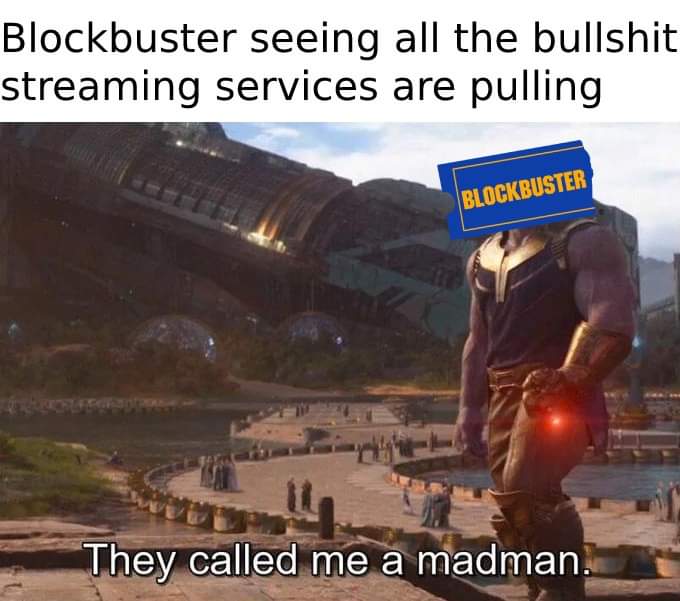
It seems familiar. Wait a second! This reminds me of something!
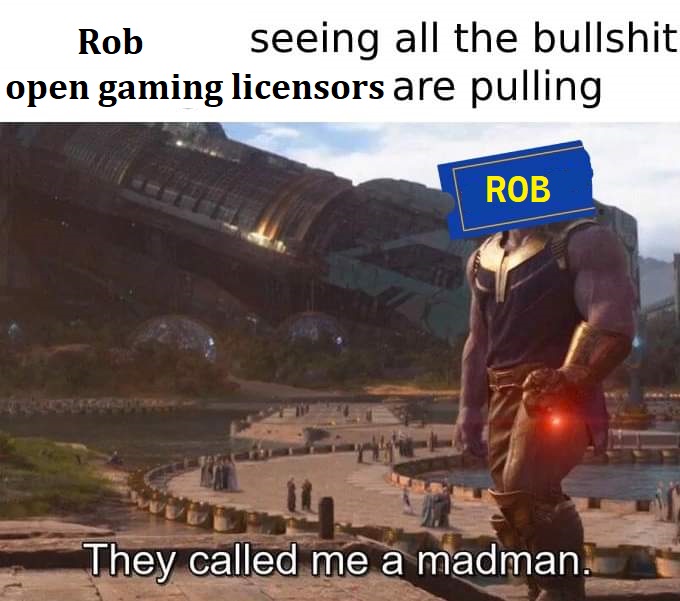
Fixed it for ya!

Yeah, I know.
Follow me on Twitter @gsllc
Dungeons & Dragons is a trademark of Wizards of the Coast, LLC, who neither contributed to nor endorsed the contents of this post. (Okay, jackasses?)
If you enjoy this post, please retweet it.
Last weekend, I ran my 7th session of 1st Edition Dungeons & Dragons (“1e“). We spent over one hour shooting the breeze before diving into the game, and that was as much fun as the game itself. One topic that came up was magic items and how many modern gamers don’t take them seriously. One particular instance threw me off. Erik says,
In a game I was playing, we found a headband of intellect, and no one cared. They all pointed out that they weren’t intelligence-based characters, so it didn’t matter to them.
I replied,
But that’s exactly why you should want one! You can become an intelligence-based character, which matters for skill checks and role-play in general!
Erik agreed and noted that his low-intellect ranger now has a 19 intelligence. The reaction of the other members of his gaming group isn’t a surprise to me. I’ve encountered this as well. While a ranger would probably prefer a +5 vorpal longsword for mechanical reasons, the headband opens up more avenues for role-play. Why doesn’t that appeal to people? Obviously, this is a generalization not backed by science, and even if accurate, it may not apply to you. That’s not important. What’s important is that 1e makes magic items more valuable, minimizing players’ disregard for them.
I’ve already discussed how boring magic items affect the game, but this is a little different. That said, this post and the other one have a synergy to them.
In 3rd Edition, you need to-hit bonuses in order to keep up with the increase in monster power because those bonuses were built into the math. That is, the power curve for a monster was steeper than that of a PC because it was assumed PCs would gain such magic items. (I’ve talked about how stupid I think that is despite how universal that is to game design.) In 4th Edition, the same math applied, but you could forgo magic items by using “inherent bonuses” that have the same effect. You simply add a cumulative +1 to your rolls at set levels in your advancement. In 5th Edition, you should probably get better magic weapons as you advance, but as long as you can get just a +1 weapon (or, like a monk, treat your attacks as magical even without a magic weapon), then you’ll always be able to hit creatures immune to mundane weapon attacks (e.g., flesh golems). These approaches to game design lessen the impact of magic items or make them altogether unnecessary, and usually make them boring (again, as I’ve discussed).
None of these are the case for 1e. First, an anecdote. In last Saturday’s session, PCs hid themselves in small room to avoid an unnecessary combat. They followed the elven ranger and magic-user who found the secret door to that room, which meant those two characters were at the back of the room. Neither elf found the secret door at the other end of the room, so when the zombies opened up that secret door, suddenly the magic-user found herself in what was now the front of the room engaged in melee with three zombies with the BBEG high priest behind them.
The magic-user wanted to cast Sleep, but I warned the player (the aforementioned Erik) that it was possible the spell would never go off. For those of you that don’t play 1e, long story short, a combat round is divided into ten segments, and each round a single initiative die is rolled for each that sets the segment in which each side goes. Because the die is a d6, that means everyone starts during the first six segments of the round. Also, Sleep requires 1 segment to cast, which is relatively quick but not a guarantee of success. So, even if the PCs win initiative, if the zombies go on the segment immediately after the PCs, the zombies will get to attack the magic-user before she’s finished casting Sleep. If even one of the zombies hits the magic-user for even one point of damage — likely to happen considering how poor the magic-user’s armor class always is — then the spell is disrupted, and it’s lost for the day. This means that it’s exceptionally difficult to cast spells in combat, which is worse for spells like Fireball (3 segments to cast) or Time Stop (9 segments to cast). (I’ve previously discussed how much I love this, because having more useful spells require longer casting times assures that different players will choose different spells for their casters, and that material components can be another way to achieve this goal.)

How is this relevant to today’s topic? Well, using magic items (e.g., scrolls, rods, staves, wands) is often instantaneous. In fact, their powers take effect before any melee attacks are resolved regardless of initiative. That means that many magic items allow a caster to cast their spells without fear of having them disrupted. At least for casters, magic items therefore become far more valuable, and isn’t that a common trope within the fantasy genre? That’s one more way in which 1e succeeds where some supposedly “evolved” editions fail. Nowadays, all innovation in game design means is that you’ve mashed together new combinations of existing mechanics from prior games, so don’t attempt to ignore the past when designing yours. Whether you adopt the precise mechanic of a prior game or not, at the very least it may provide inspiration for the feel and tone of your end product.
Magic items should matter.
Follow me on Twitter @gsllc
Follow Erik Nowak @Erik_Nowak
Dungeons & Dragons is a trademark of Wizards of the Coast, LLC, who neither contributed to nor endorsed the contents of this post. (Okay, jackasses?)
If you enjoy this post, please retweet it.
First, there was the dinosaur cat. Then, the cat sith. Now, I’ve found the cat mimic on an archived Reddit thread.

Cat mimics >> dog mimics.
Follow me on Twitter @gsllc
Dungeons & Dragons is a trademark of Wizards of the Coast, LLC, who neither contributed to nor endorsed the contents of this post. (Okay, jackasses?)
If you enjoy this post, please retweet it.
Sundays are now lazy days for me. I post either someone else’s work, or something silly. Usually both. Today is a meme created by Alex Tate over on the Facebook group, Tiamat’s Tavern. Alex granted me permission to reproduce it here.

The thing is, I’m with Jesse on this one. I get the need for dungeon fodder, but there are a lot of options for that. Besides, simply denying PCs the opportunity to flank a low-level NPC isn’t particularly overpowered if you find other ways to adjust the NPC to maintain balance. So, I have no problem with adding a bit of realism to my game even if not required from a gaming perspective. In fact, I prefer it.
But this is still silly.
Follow me on Twitter @gsllc
Dungeons & Dragons is a trademark of Wizards of the Coast, LLC, who neither contributed to, nor endorsed, the contents of this post. (Okay, jackasses?)
If you enjoy this post, please retweet it, and please visit my 1st Edition D&D resources page.
Okay, time to show off!
I continue to make huge strides on my 1st Edition Dungeons & Dragons (“1e“) application. I’ve collected some screenshots below. Keep in mind that my current focus is on data entry and functionality, so the user interface isn’t great. Moreover, it’s an Access database, so the user interface will probably never be great. If I don’t design a better interface in a real programming language, I’ll eventually upload the database to GitHub so that someone else can do so.
First up, adventure entry. In order to keep my adventure forms from getting too complex, they’re broken up into two forms. First, enter the adventure and the “chapters” within.
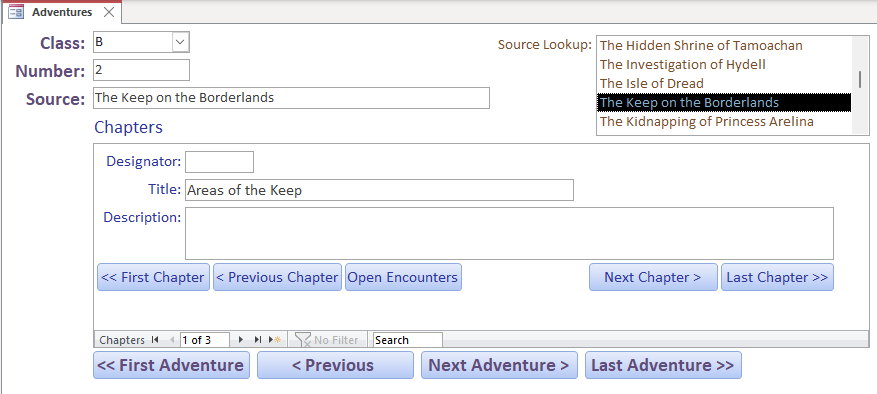
You enter the adventure itself, then add chapters within the adventure. For example, for the adventure shown, there are three chapters: Areas of the Keep, Adventures Outside the Keep, and the Caves of Chaos. Next, you add encounters within each of the chapters. These are from adventures outside the keep. The first one is an encounter I modified to mix things up a bit. Not only do I do that to avoid metagaming from players that have played these adventures many times before, but I also like to use Fiend Folio and Monster Manual II creatures that weren’t available when these adventures were written.

You can see that each encounter can have NPCs (leveled characters), actual monsters, both mundane and magical items, and coins. As you’ll see, items used (or at least held) by characters are handled on the character builder pages. The items you see here are ones stored in the encounter location (e.g., in the closet, in a chest, lying on the ground). The reason for the difference is that PCs shouldn’t have access to magic items possessed by a creature that escapes. Next up, is an encounter with NPCs.

These are humanoids (humans in this case) with class levels, so they’re handled differently than “monsters.” How are they handled? Well, here’s the character builder for PCs.

This is for PCs. The NPC form is identical. You can see that these characters can hold (and use) mundane items, armor, shields, magic items, and coins. Again, I track unattended coin and items separately because if an NPC escapes, those coins escape with the NPC. Only the unattended coin and items and those held by NPCs that are captured or killed are available to plunder. You can also see that there are buttons to call up prepared spells and the character sheet itself. Click on the links to see them in PDF format.
So, what about monsters? I refer to them as species. Here’s their data entry form.

There’s a typo above. In the Special Attacks field, it refers to a “divine attack.” That should be a “dive attack.” That’s another problem with Access. It doesn’t have spellcheck. This error has been fixed, but there are probably others.
After you’ve created the species, you then need to create a specific instance of a monster. I didn’t take a screenshot of that form, but it’s rather simple. Pick the species, calculate or designate it’s hit dice (if the species has a range of hit dice), and designate its hit points. You can also give the monster a name (e.g., Sappho, the gynosphinx from White Plume Mountain). Then your monster will be available to add to an encounter as shown above.
Spells deserve some discussion. There are several spells that are used by several classes, but the classes use them differently. An obvious example is Detect Magic. Clerics, druids, and magic users all use the spell, but their material components differ. The cleric uses a holy symbol, the druid a sprig of mistletoe, and the magic-user doesn’t need one. So, the way I have to handle it as follows. First, create the spell with a few characteristics that are constants across all classes.
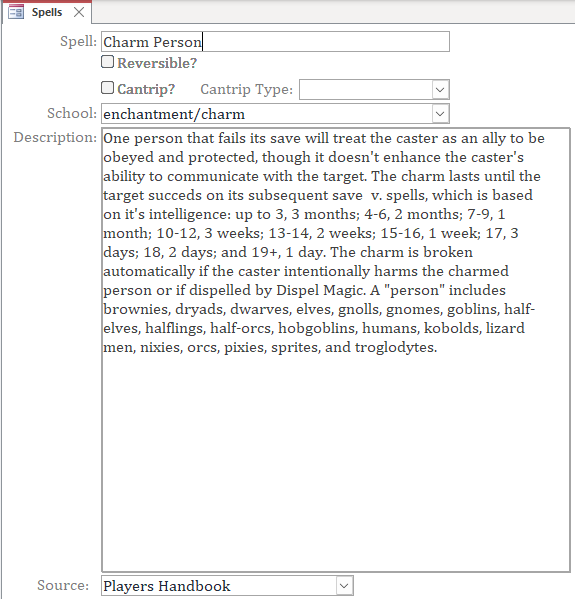
Next, create what a software engineer would call an intersection entity to resolve the many-to-many relationship between spells and classes, entering the information that differs from class to class (e.g., material components).

In rare instances, the differences between the spells are so great that I’ve had to create different spells in the first form for different classes. In such a situation, I call the spells “[Spell Name] (arcane),” “[Spell Name] (divine),” “[Spell Name] (primal),” or “[Spell Name] (phantasm)” depending on what’s needed.
I’ve entered every spell appearing in the Player’s Handbook and Unearthed Arcana, every class appearing in those same two sources, every species from the Monster Manual, and am about halfway through the Fiend Folio. I intend to finish the Monster Manual II before releasing this software, so most of the work will be done. However, I won’t be doing everything from every adventure, and I’m not certain I’ll enter anything from Oriental Adventures. So I understand that, in the long run, the more user-friendly it is, the better.
Whether anyone ever finds this useful, I will. I’ve been using it for my game, and with the adventure-related features I’ve added over the past two weeks, my pre- and post-session tasks will be much easier.
After all, it’s all about me.
Follow me on Twitter @gsllc
Dungeons & Dragons is a trademark of Wizards of the Coast, LLC, who neither contributed to, nor endorsed, the contents of this post. (Okay, jackasses?)
If you enjoy this post, please retweet it.
Welcome to my 1,000th post!!!
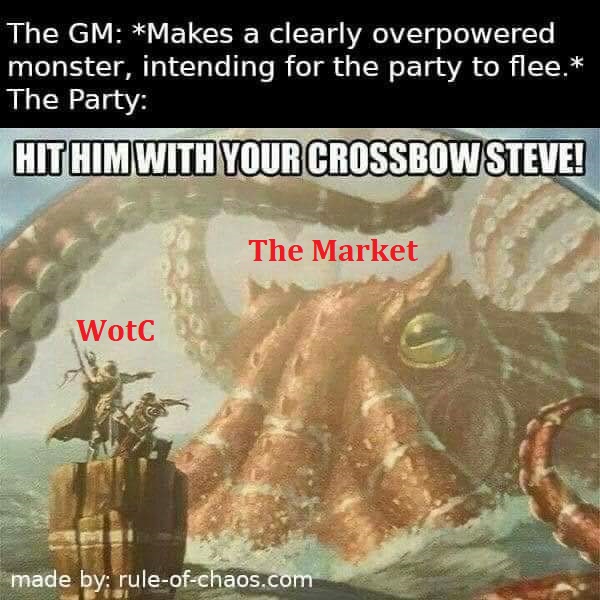
The only difference, of course, is that WotC created this market.
They just forgot that it took on a life of its own.
Follow me on Twitter @gsllc
Dungeons & Dragons is a trademark of Wizards of the Coast, LLC, who neither contributed to nor endorsed the contents of this post. (Okay, jackasses?)
If you enjoy this post, please retweet it.
This is why I need to play simple characters.

My history of rolling dice makes this particular comic frustrating.
I’m getting old.
Follow me on Twitter @gsllc
Dungeons & Dragons is a trademark of Wizards of the Coast, LLC, who neither contributed to nor endorsed the contents of this post. (Okay, jackasses?)
Stories and photos from Scotland
Don't Take This Too Seriously. I Don't.
An Ennie Nominated D&D Blog & Podcast. Home of tutorials, advice, and downloads for new DM's
No rules but my own.
The Official Blog of Obsidian Portal
A site about all things bound up within me.
 Play What You Want