Abstracted Combat II: Electric Boogaloo #DnD #ADnD #gaming #RPG #TTRPG #1e @Luddite_Vic @Erik_Nowak

If you enjoy this post, please retweet it, and please visit my 1st Edition D&D resources page.
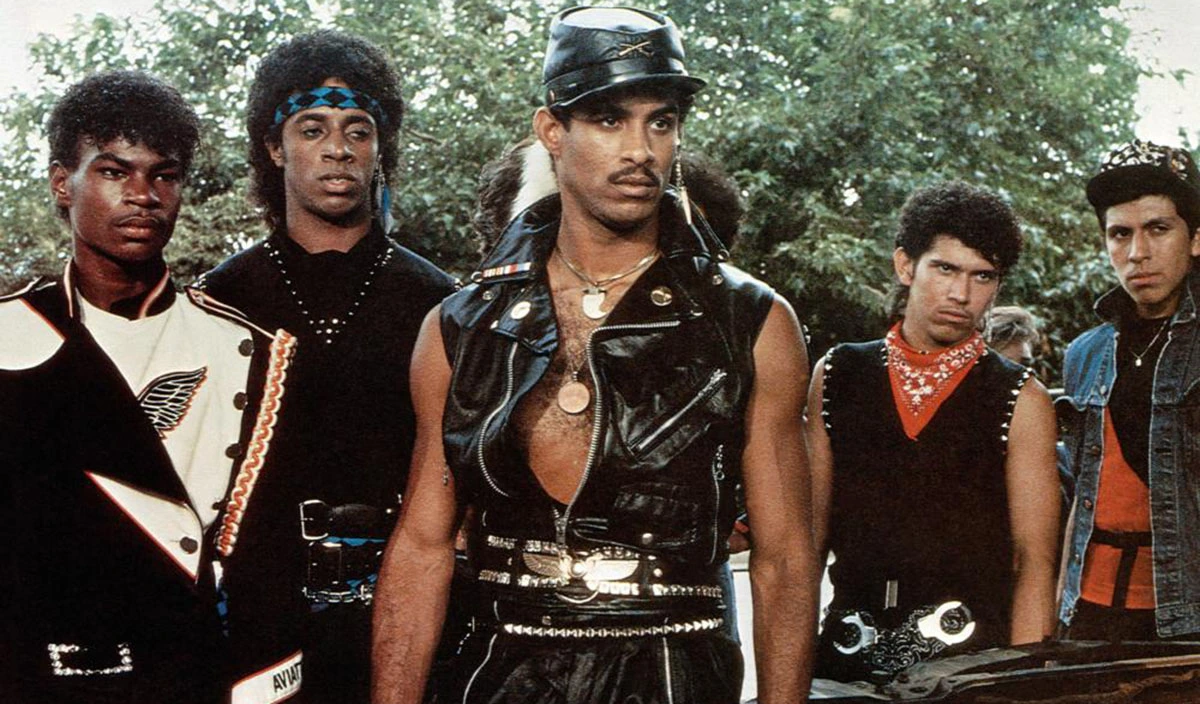
My players wished their characters were this cool.

Two days ago, I published a system for abstracted combat that seemed appropriate for dealing with the (wonderful) circumstances the players created for themselves in my run of B2: The Keep on the Borderlands.

In short, the evil wizard (PC) charmed an orc while invading their lair, killed the orc boss, and then convinced the remaining orcs (12 warriors and 19 non-combatants) that they were taking over the tribe. The wizard was assisted by his charmed victim as well as the half-orc rogue PC. Their first mission was to use the orcs to clear out the kobold lair. Rather than play it out as a combat involving over 30 characters, I decided to come up with a d6 system on the fly. One of the players said, “Do it like in the game, Risk,” and to the best of my recollection I did. Each combat required an evolution of the system, as its shortcomings kept revealing themselves. This evolution continued as I created example combats on that last blog post. Here’s are the only corrections I need to make to that last system:

  1. When determining how many dice to roll, use your gut, but try to get to 3-5 dice for each side.
  2. To avoid difficult fractions, allow one or two characters from a side to sit out a round of combat.

You have to read the last post for context, but here’s how this would play out. As to #1, let’s say each side has 16 hit dice (“HD”). I could roll 8 dice for each side, with a “loss” resulting in 2 HD lost for the side. I could also roll 2 dice on each side, with a loss resulting in 8 HD lost for each side. The first way is rolling far too many dice, and the second way is far too swingy (i.e., the combat is likely to be resolved after only one round). So, you should instead have each side roll 4 dice with each loss resulting in 4 HD lost for each side. Of course, the multiplier is optional, so even if you roll 4 dice, you could choose for each loss to result in either 1 or 2 HD lost for each side depending on how long you want the combat to run. However, I’d think you’d want to go more quickly than that considering that this entire system is meant to provide a relatively quick resolution to combats you don’t want to play out meticulously.

As to #2, let’s say one side has 16 characters and another has 15 characters. The only common divisor (that produces an integer) is 1, so that means you’re rolling 16 dice for one side and 15 for the other. That’s fine if you have that many d6s (who doesn’t?) and you want to roll that many dice (who does?), but I’d rather roll between 3-5 dice. So, what do I do? I have one of the characters on the first side sit out that round. Maybe he tripped while attempting to close into melee. Maybe he pulled out a broken arrow and needed to grab another one. Whatever the explanation, now it’s 15 v. 15, and I can roll 3 dice, each representing 5 HD of characters, or I can roll 5 dice, each representing 3 HD of characters. The 16th character doesn’t get an automatic win but is also immune from getting killed. You may not like this solution. You may be thinking that having more characters should result in a tactical advantage, so you should give the side with the extra character an extra die to represent that advantage. However, that already occurs only when the advantage is significant (i.e., 15 v. 9 with one side rolling 5 dice – two uncontested – and the other 3). Adding a die here would be quite an advantage (i.e., mathematically, it’s always rounding up no matter how small the fraction), but to each their own. I’m not the boss of you.

An Addition to the Rule

Now I have to break new ground. What if the PCs want to get involved? A PC could join one of the groups as a leader, adding their own level (HD) to the mix. For that to make sense, there must be both a risk and a reward attached to it. Here’s what I’m thinking:

  1. On a loss, that loss must be shared by a PC such that every other round each PC involved must share in the loss suffered. This loss is expressed in hit points, not HD, such that if a PC takes a loss of 4 HD, the PC actually loses only 4 hps. Otherwise, a 1st or 2nd level PC would never survive past the 2nd round.
  2. One PC should also be able to use what’s on their character sheet to influence the combat beyond simply adding their HD to the equation.

I think #1 is self-explanatory, but we clearly need guidelines for #2. Remember, this is being written for 1st Edition Dungeons & Dragons, so you’ll have to translate these ideas into to your own system. Imagine a larger combat where each PC leads a small group of NPCs in their fight against a group of enemy NPCs. Only one PC should be permitted to lead a given group to avoid these benefits being cumulative, though a second PC could certainly be permitted to join a group led by another PC so as to increase the number of HD in that group and share the PC hit point damage from #1.

  1. Cleric: Can subtract one HD from the HD lost by the PC’s side for a single die rolled in a round OR add one HD to the HD lost from the other side in a round if the other side has at least one undead creature on it.
  2. Druid: Can subtract one HD from the HD lost by the PC’s side for a single die rolled in a round OR use terrain such that the druid’s side is considered the defender for the purposes of ties.
  3. Fighter (Barbarian, Ranger), Cavalier, Thief (Assassin, Thief-Acrobat), or Monk: Can add one HD to the HD lost from the other side in a round, but every even numbered round can add two HD to the HD lost from the other side in a round.
  4. Ranger: Can add one HD to the HD lost from the other side in a round OR use terrain such that the PC’s side is considered the defender for the purposes of ties.
  5. Illusionist, Paladin, or Wizard : Can add one HD to the HD lost from the other side in a round OR subtract one HD from the HD lost by the PC’s side for a single die rolled in a round.
  6. Bard: Can add one HD to the HD lost from the other side in a round OR can subtract one HD from the HD lost by the PC’s side for a single die rolled in a round OR use terrain such that the bard’s side is considered the defender for the purposes of ties.

Example #1: Five d6s are rolled, each representing 2 HD, and a cleric’s team loses 3 times. Rather than losing 6 HD, that team loses 5 HD because one of those loses is reduced from 2 HD to 1 HD.

Example #2: Five d6s are rolled, each representing 2 HD, and a fighter’s team wins 3 times. Rather than inflict 6 HD of loss to the other side, that team inflicts 7 HD of loss because one of those wins is increased from 1 HD to 2 HD.

Note: PCs should be permitted to choose which effect they want to deliver after they see the results of the rolls.

There isn’t much variation here because the system isn’t complex enough to support it. Each class should have the same degree of impact on the combat, but if the system is simple (as it should be), that precludes significant variation in class abilities. That said, players should be able to suggest how they can appropriately contribute to their groups, even if based on alignment, race, or a specific spell in their arsenal. I suggest being careful not to allow an imbalance. Remember, NPCs often have those abilities as well, and what’s good for the goose is good for the gander. The NPCs should often be able to introduce such complexities. Don’t overcomplicate this system and place yourself in a position where you might as well play out combat meticulously.

I’m also considering adding a morale shortcut for cutting off combats when it’s clear the other side should be routed, which would in turn allow me to give the fighter and ranger a means to boost their team’s morale in light of their ability to attract followers. Even a small group could do some damage, and that may prove useful in the big picture.

You might see another sequel to this series of posts with better ideas.

Mass Battles?

I have this urge to somehow distinguish between melee and ranged attackers in this system, and to make the benefits level-dependent, but no matter how I imagine it, it makes the system far more complex than it should be for combats involving 10s of characters rather than 100s of characters. The former is my focus, so it wouldn’t surprise me if this system didn’t work as well for battles between armies (if at all). If that’s the case, so be it. I can always look up how others have handled those situations if needed.

My Ending to the Keep on the Borderlands

I have an idea for how to end this adventure mod. Though it’s easy to guess what it would be, I won’t post it here because my players may read it. I posted it to my D&D MeWe groups because none of the players are members, so if you want to read about it, head over there. This idea would allow me to use this rules system as modified, but it would also allow the characters to gain reputation points. As I’ve written, I have a reputation system that’s important to how I run this game. By being involved, the players aren’t just crossing their fingers and watching the DM roll dice, and they can increase their reputation in the process.

Clearly this system needs tweaking, so your constructive comments are appreciated.

Follow me on Twitter @gsllc
Follow Luddite Vic @luddite_vic
Follow Erik Nowak @Erik_Nowak

Dungeons & Dragons is a trademark of Wizards of the Coast, LLC, who neither contributed to, nor endorsed, the contents of this post. (Okay, jackasses?)

Abstracted Combat System #DnD #ADnD #gaming #RPG #TTRPG #1e @Luddite_Vic @Erik_Nowak

If you enjoy this post, please retweet it, and please visit my 1st Edition D&D resources page.

On Sunday, I promised a post explaining my abstracted combat system. This came in handy when my 1st Edition Dungeons & Dragons PCs took over an orc tribe and sent them in to clean out a kobold gang and some bugbears. However, I built it on the fly based in part on how Risk handles combats, so I never ran it quite as I wanted it to go.

Remember kiddies: Game rules aren’t copyrightable. Even Risk didn’t do this first.

Here’s the system:

  1. Add up the number of hit dice on both sides, treating any “+” as 0.5 HD (e.g., HD 2+1), giving a total hit dice for each side (always rounding up so that no character is rendered useless). (If using a different system, perhaps CR or level would be more appropriate.)
  2. If it’s practical to roll a number of dice for each side equal to their number of hit dice, then do that, but otherwise divide those total hit dice values by the least common devisor between them (using at least 2 to avoid a 1 unless absolutely necessary), giving each side a modified number of dice to be rolled (rounded as suggested below).
  3. Roll a number of d6s for each side equal to their number of dice (which could differ for each side).
  4. Starting from the highest roll for each side, compare the rolls, giving each side a win when they roll higher than the other side, giving a side an automatic win for each extra die they roll, and if one side can be deemed to be on their home turf, awarding a win to such a defender on a tie.
  5. Optional: To speed up combat, multiply the number of wins for each side by the greatest common devisor.
  6. Subtract a number of characters from a side with hit dice equal to the number of wins its opponent received (rounded as suggested below), starting with the lowest hit dice creatures available, but always modifying your selections if it avoids having to round fractions.
  7. Rinse and repeat.

As for rounding, as a physics major, I was told to round down for decimals below 0.5, round up for decimals above 0.5, and round to an even number for decimals of exactly 0.5. Thus, 4.5 would be rounded down to 4, but 5.5 would be rounded up to 6.

As always, examples help to explain the rules.

Combat 1

Side 1: 12, 1-hit dice (“HD”) orcs

Side 2: 6, 1/2 HD kobolds defending their home turf.

  1. The orcs have 12 HD (= 12 x 1), and the kobolds have 3 HD (= 6 x 1/2).
  2. The least common devisor between sides is 3 such that the orcs will roll 4d6 (= 12/3) and the kobolds will roll 1d6 (= 3/3).
  3. The orcs roll a 1, 2, 3, and 6, and the kobolds roll a 6.
  4. As defenders, the kobolds get one win on the tie against the orcs’ 6, but the orcs get three wins because of their unopposed dice.
  5. Optional: The wins are multiplied by least common devisor, which is 9 (= 3 x 3) wins for the orcs and 3 (= 1 x 3) wins for the kobolds.
  6. The orcs lose 3 characters (3 wins for the kobolds costs the orc side 3, 1-HD characters) and all the kobolds are killed because their total hit dice (3) are less than how many they lost (9).

There are no kobolds left, so the combat is over.

Combat 2

Side 1: 9, 1- HD orcs

Side 2: 19, 1/2 HD giant rats defending their home turf.

  1. The orcs have 9 HD (= 9 x 1), and the giant rats have 10 HD (= 19 x 1/2, rounding 9.5 up to 10).
  2. The least common devisor between sides is 2 such that the orcs will roll 4d6 (= 9/5, rounding 4.5 down to 4) and the giant rats will roll 5d6 (= 10/5 = 2).
  3. The orcs roll a 6, 5, 1, and 1, and the giant rats roll 5, 3, 1, 1, and 1.
  4. The orcs get two wins (6 v. 5 and 5 v. 3), and the giant rats get three wins (the tied 1s go to the defender, plus the one unopposed die).
  5. The orcs lose 3 characters (left with 6 characters), and the giant rats lose 4 characters (2 x 1/2 HD, left with 15 characters).
  6. The orcs now have 6 HD (= 6 x 1 HD each), and the giant rats have 6 HD (= 15 1/2-HD each, rounding 7.5 up to 8).
  7. The least common devisor between sides is 2 such that the orcs will roll 3d6 (= 6/2) and the giant rats will roll 3d6 (= 6/2).
  8. The orcs roll 5 and 4, and the giant rats roll 3, 2, and 1.
  9. The orcs get two wins, and the giant rats get 1 win.
  10. The orcs lose one character (left with 5 characters), and the giant rats lose four characters (2 HD lost = 4 1/2 HD characters lost, left with 7).
  11. The orcs have 5 HD (= 5 x 1 HD each), and the giant rats have 4 HD (= 7 x 1/2, rounding 3.5 up to 4).
  12. At this point, it makes sense to simply roll 5d6 for the orcs and 4d6 for the giant rats.
  13. The orcs roll 6, 5, 4, 3, and 1, and the giant rats roll 5, 4, 4, and 3.
  14. The orcs get wins for 6 v. 5, 5 v. 4, and the extra 1, but the giant rats get victories for the ties with 4 and 3.
  15. The orcs lose two characters (left with 3 characters), and the giant rats lose six characters (3 HD lost = 6 1/2 HD characters lost, left with 1).

At this point, the orcs can’t lose. They’ll roll three dice, and the lone remaining giant rat will roll one. At best, the giant rat will take out one orc (leaving two remaining) but may just be skewered without accomplishing anything.

Let’s try one more.

Combat 3

Side 1: 10, 1- HD orcs

Side 2: 2, 1+1 HD hobgoblin guards and 1 4 HD hobgoblin chief defending their home turf.

  1. The orcs have 10 HD (= 9 x 1 HD each), and the hobgoblins have 10 HD (= 4 for the chief + 3 for the two, 1+1 HD guards, each treated as 1.5 HD).
  2. The least common devisor between sides is 2 such that each side will roll 5d6 (= 10 HD / 2).
  3. The orcs roll a 6, 6, 5, 4, and 2, and the hobgoblins roll 6, 3, 2, 2, and 1.
  4. The orcs get four wins, and the hobgoblins only one win (the tied 6s go to the defender).
  5. The orcs lose 1 character (left with 9 characters), and the hobgoblins lose 4 HD worth of characters. They can’t lose both guards because that would be a loss of only 3 HD. Therefore, they must lose the 4-HD chief. Only the two guards remain.
  6. The orcs now have 9 HD (= 9 x 1 HD each), and hobgoblins have 3 HD (= 3 1-1/2-HD guards).
  7. The least common devisor between sides is 3 such that the orcs will roll 3d6 (= 9 HD/3) and the hobgoblins will roll 1d6 (3 HD/ 3).
  8. The orcs roll a 5, 4, and 2, and the hobgoblins roll a 6.
  9. The orcs lose 1 character (left with 8 characters) and the hobgoblins lose 2 HD worth of characters. Because each hobgoblin is treated as having 1-1/2, they lose 1 guard, leaving 1/2 HD left. That rounds down to 0 HD, so the other guard survives (though not for long).

As with the giant rats from Combat 2, the lone remaining hobgoblin will at best take out one orc before the uncontested die takes him out. If you’re trying to apply this to mass battle but don’t want to take all day doing it, you can fairly and intuitively adjust the system as follows. Choose a common devisor greater than the least common devisor. After rolling the dice to determine the number of wins, multiply the number of wins by that common devisor. Here’s an example.

Combat 4

Side 1: 100, 1- HD orcs.

Side 2: 30, 2 HD hobgoblins.

  1. The orcs have 100 HD (= 100 x 1 HD each), and the hobgoblins have 60 HD (= 30 x 2 HD).
  2. The least common devisor between sides is 2 such that the orcs will roll 50d6, and the hobgoblins will roll 30d6. No thanks. Instead, we’ll divide by 20, so that the orcs will roll 5d6, and the hobgoblins will roll 3d6
  3. The orcs roll a 4, 3, 3, 3, and 2, and the hobgoblins roll 5, 5, and 4.
  4. The orcs get two wins, and the hobgoblins get three wins. Now remultiply the devisor you chose (20) and multiply the wins by that. That means the orcs have 40 wins, and the hobgoblins have 60 wins.
  5. The orcs lose 60 characters (left with 40 characters), and the hobgoblins lose 20 HD worth of characters, which amounts to 10, 2-HD characters (left with 50 characters).
  6. Now we proceed to round 2 with 40 orcs v. 50 hobgoblins. Using 10 as a new multiplier, the orcs will roll 4 dice, and the hobgoblins will roll 5 dice.
  7. The orcs roll 6, 5, 5, and 1, and the hobgoblins roll 5, 5, 3, 1, and 1. Because neither team is defending their home turf, the orcs earn two wins, two dice are ties (and thus ignored), and the hobgoblins earn one win from the unopposed die.
  8. Multiplying these wins by 10, the orcs gain 20 wins, and the hobgoblins gain 10 wins.
  9. The orcs lose 10 characters (left with 30 characters), and the hobgoblins lose 10 characters (20 HD worth of 2-HD characters), leaving them with 40 characters.
  10. In round 3, the orcs have 30 characters, and the hobgoblins have 40 characters, so we can again use a common devisor of 10, giving the orcs 3 dice and the hobgoblins 4 dice.
  11. With rolls of 5 and 4 for the orcs and 6, 5, and 4 for the hobgoblins, the orcs lose all three rolls, and thus 30 from their ranks, with no losses to the other side.

There are no more orcs left, which is good because I don’t want you to think I like orcs. So, the 40 remaining hobgoblins can now loot the bodies and drink themselves silly. Wait, does this mean I like hobgoblins?

Wrong hobgoblin.

If you’re comfortable with the system, this will go more quickly than it looks. However, I know plenty of game systems have created mass battle rules, and I wouldn’t be surprised if those rules are far better than this ad hoc one for dealing with small scale, abstracted battles. If you have any you prefer, send me a link, but you can see for yourself whether this works for you by getting out your d6s.

No, not those d6s.

FOOTNOTE: I’ve made a few changes and additions to the system. You can find them here.

Follow me on Twitter @gsllc
Follow Luddite Vic @luddite_vic
Follow Erik Nowak @Erik_Nowak

Dungeons & Dragons is a trademark of Wizards of the Coast, LLC, who neither contributed to, nor endorsed, the contents of this post. (Okay, jackasses?)

AD&D Requires Patience Before It Comes Together #DnD #ADnD #gaming #RPG #TTRPG #1e @Luddite_Vic @Erik_Nowak

If you enjoy this post, please retweet it, and please visit my 1st Edition D&D resources page.

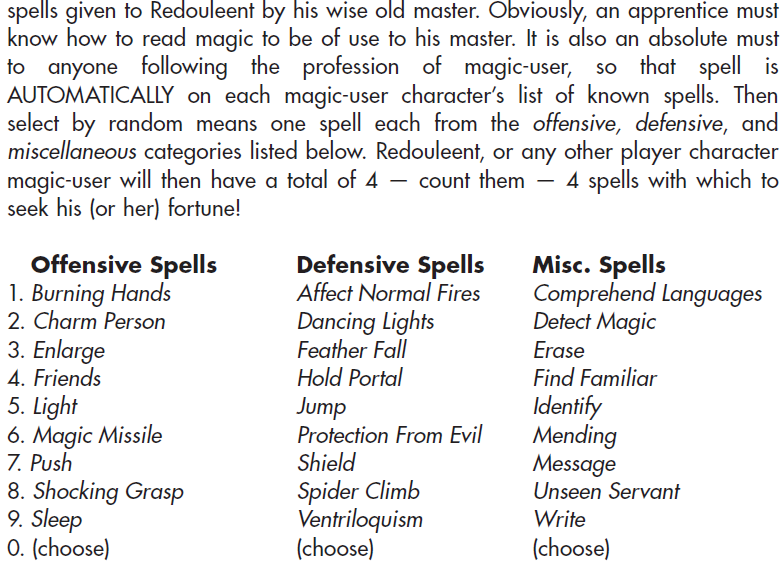
Last night was session 5 or 6 (I don’t remember) of module B2: The Keep on the Borderlands, my first 1st Edition AD&D (“1e“) game in 40 years. It was by far our best session yet. Everyone is more familiar with the combat system, so it went far more smoothly. We had two new players join: Vic and his 23-year-old son, Nicholas. For someone so young, Nicholas certainly got into the 1e spirit. He played a neutral evil wizard because . . . well, why not? He also chose to randomly select his spells, which I don’t require. Wizards get Read Magic at 1st level, but rather than randomly roll for one offensive spell, one defensive spell, and one miscellaneous spell (see Dungeon Masters Guide, p. 39), I allow them to choose one from each, and then choose another spell from either the defensive spell list or miscellaneous spell list. If they get to memorize only 1 spell at first level, they might as well have options.

As this post will show, this may come back to bite me in the ass.

So, Nicholas randomly rolled and learned Charm Person for his offensive spell. I noted at one point is a spell I’d never choose over Magic Missile or Sleep, but holy crap did that work out. Not only did his two uses of the spell have every bit as good a mechanical benefit as Sleep ever did, but it made the session memorable. In short, he charmed an orc, which (SPOILER ALERT!!!) greatly assisted towards taking over the remaining orcs in the tribe, which they then led to take out the kobold tribe. Next, they decided to clean up some unfinished business with the bugbear tribe, where the remaining orc minions lost their lives, but not before softening up the area. Nicholas’s second Charm Person was used on a prisoner that himself was evil and is supposed to wreak havoc on the party as soon as he could. That crisis was averted. Now Nicholas has two new allies that don’t get an automatic save against the charm for an entire month (in game time). The combats with the orcs were abstracted, which forced me to create a mass battle system on the fly. This session represented growing pains for that system, but with some help from the players, I think I have a good system in hand that allows for abstracted combat. I’ll discuss that system later this week.

While interesting, the anecdote above is also presented for context relevant in small part to this post’s theme.

Segments

As recently as last night’s session, I had a player (Erik) comment in passing on how stupid he thought segments were. I’ve discussed why I like segments, but here’s the short version: They replace material components that no one actually tracks (in 5th Edition at least), as a means to encourage variety among casters. That is, when you’re selecting a spell, you have to decide whether you want to take a strong spell that takes long to cast and risks being dispelled before it takes effect or a weak spell that you know will almost always take effect. Well, different players have different personalities, so that should result in different spell selection among players. A risk-averse player will choose a weaker spell rather than an uber-powerful spell that takes 8 or 9 segments to cast, while a risky player will accept the risk in favor of the reward something like Time Stop provides. Someone who’s mildly risk-averse may choose something in the middle. The same can be said for fighters. Which is better: a dagger that does only 1d4 (or 1d3) damage but has a weapon speed factor of 2, or a two-handed sword that does 1d10 (or 3d6) damage but has a weapon speed factor of 10? Well, a two-handed sword, but there are tougher choices than that.

But none of this becomes apparent at low levels. Sleep has a casting time of only 1 segment, and it’s uber-powerful for a 1st-level spell. Get to higher levels, and these decisions become far more interesting, and identically-classed, identically-raced characters will play out very differently. That’s a good thing that’s been inadequately replaced in modern versions of the game by relying on material components or, for example, increasing the number of races from which you can choose, but that can get a bit ridiculous at times (anthropomorphized hamster PCs?). Segments represent a far better way to encourage diverse character builds because they not only allow for player agency but actively encourage it. You get to build your character to suit your personality rather than according to pre-built build packages for classes.

Experience Points

Here’s another example that received far more grief last night than segments. If a DM awards experience points (“XP”) for gold found (as I do), then by definition your characters will always have more experience than they can afford to use. That’s weird, so let me explain by example. A first level thief needs 2,251 XP to level to second level, but let’s assume that the thief earns 1,000 gold pieces (“gp”) during the course of earning those XP from combat. For the sake of argument, we’re going to assume that you earn 1 XP for each gp you find adventuring, so in fact this thief is sitting on 3,251 XP (= 2,251 XP earned from killing monsters + 1,000 XP from the gold acquired). In the best case scenario, a thief must spend 1,500 gp to afford the training necessary to advance in level, so at this point, the thief is sitting on 3,251 XP he can’t use. That’s okay. He heads out to do some more adventuring. He finds another 500 gp while killing 1,000 XP worth of creatures. Now he has 1,500 gp, so he can spend it to move to level 2.

But wait a second. He just earned another 1,000 XP from killing monsters, and 500 XP from the 500 gp he found, so now he has 4,751 XP. That qualifies him for 3rd level with room to spare, but after leveling to level 2, he now has literally no gold left to pay the 3,000 gp necessary to level to third level. No, you’re going to have to go back out there and earn some coin, and that’s just going to exaggerate the problem.

I’d pull mine out too, but . . . .

Again, this is an issue at lower levels, but as the spread in required XP for leveling increases, this is less of an issue. I also noted to Erik that, “Hey, why are you complaining that you’re getting ‘too much’ gold. Just be happy you’re wealthy.” But let’s face it: That’s frustrating, so Erik has a point. You know you’re sitting on enough XP to level one or two times, but you don’t have the money to do so. It drives you nuts. That’s why I’m saying that this game requires patience. In the end, it all works out as you gain higher levels, and at that point you’re going to be very happy that you’re earning XP for wealth found, especially if you’re a fighter wanting to build a castle or a wizard wanting to build an ivory tower.

I knew plenty of wizards in law school.

Just be patient, and it’ll all work out.

So, let’s bring this full circle with a simple statement so you can all go home: As these wizards increase in level, I may regret having given these characters an extra spell at 1st level. Remember, all spells scale with level, so a 1st level spell cast by a 12th level wizards is a lot more powerful than it was when the wizards was 1st level.

But how bad could it be?

Follow me on Twitter @gsllc
Follow Luddite Vic @luddite_vic
Follow Erik Nowak @Erik_Nowak

Dungeons & Dragons is a trademark of Wizards of the Coast, LLC, who neither contributed to, nor endorsed, the contents of this post. (Okay, jackasses?)

One Year!!! #blog #StarTrek #MCU #DnD #RPG #TTRPG #ADnD

If you enjoy this post, please retweet it.

With this post, I’ve posted every day for an entire year. That’s right. The last day that I didn’t post was May 1, 2021. Before that, I was last discussing Key Lime Kit Kat bars.

No wonder I stopped.

This blows away my current record streak.

Nice.

But wait a second. Is this even real? Can the post announcing that I’ve posted every day for a year be the anniversary post itself?

I say yes, and if you disagree, just keep in mind that I posted a bonus post on April 9, April 13, April 19, and April 25, so there have already been over 365 posts in this time without this one. There may have even been a couple more bonus posts, but I’m too lazy to look.

But okay. Let’s give this post some substance.

  1. Star Trek: The Original Series is my favorite Star Trek series, Star Trek: Enterprise is the most underrated Star Trek series, but Anson Mount has overtaken William Shatner as my favorite starship captain.
  2. Captain America: The Winter Soldier is my favorite MCU film.
  3. 4th Edition D&D is my favorite edition of D&D.

On another note, today is the first day of May. May is hockey playoffs, college lacrosse playoffs, preparations for the summer, and — most importantly — the month when all the cool people are born. Plus, I was born in May.

So, in 11 days, the streak will die. I want to focus on other things, and consistency hasn’t led to a large number of non-spam followers. Rarely does anyone retweet the tweets linking to these posts (likes merely gauge your footprint, not increase it), and almost all comments occur on other social media platforms, so my streak hasn’t done anything to improve my online footprint (except for a brief moment). Besides, many of my recent posts have been rather lame. If I didn’t have something to say, I’d write anyway, and it shows. I have a few more posts scheduled for this week, some others in my head that will come soon, and a handful scheduled to publish as far out as December. However, going forward, if I don’t have something to say, I won’t say anything. I’ll never feel rushed, and anything goofy will have to be funny enough to be worth sharing.

So, this post counts.

Follow me on Twitter @gsllc

Dungeons & Dragons is a trademark of Wizards of the Coast, LLC, who neither contributed to nor endorsed the contents of this post. (Okay, jackasses?)

The Cat Sith #Caturday #DnD #RPG #TTRPG #5e

If you enjoy this post, please retweet it, and please visit my 1st Edition D&D resources page.

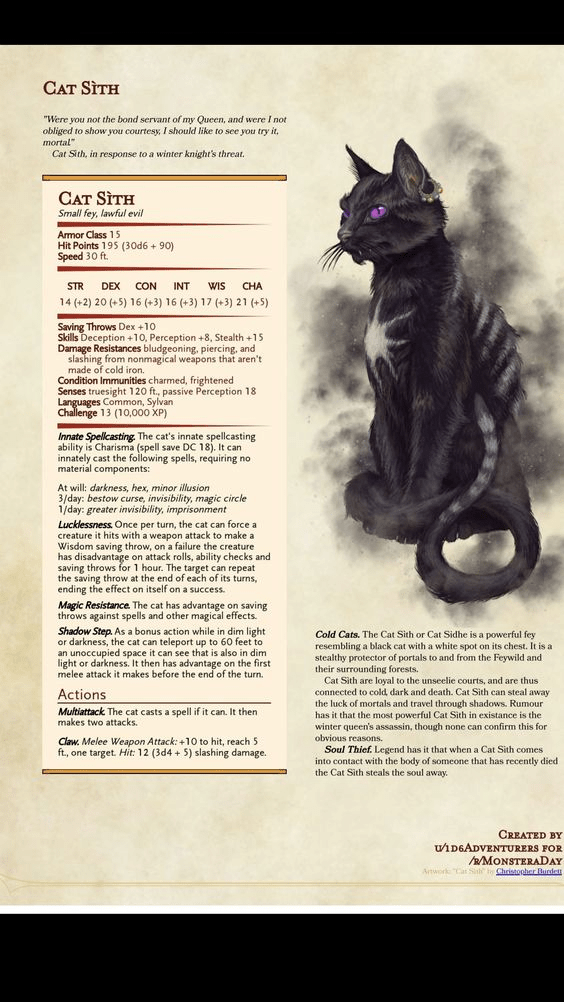
First, there was the dinosaur cat. Now, you have the cat sith. With an intelligence of 16, wisdom of 17, and spellcasting to boot, this is a much greater threat, and perhaps one that could be quite surprising to the average party. One thing that’s disappointing is that the creator uses the term “sith,” yet there’s nothing Sith-like about its powers. No telekinetics, no mind control, and, of course, no weapon use. That seems odd.

But yes, it’s just as ridiculous as the dinosaur cat.

Follow me on Twitter @gsllc

Dungeons & Dragons is a trademark of Wizards of the Coast, LLC, who neither contributed to nor endorsed the contents of this post. (Okay, jackasses?)


The Pufferfish Lich #science #biology #gaming #DnD #ADnD #RPG #TTRPG #pufferfish

If you enjoy this post, please retweet it, and please visit my 1st Edition D&D resources page.

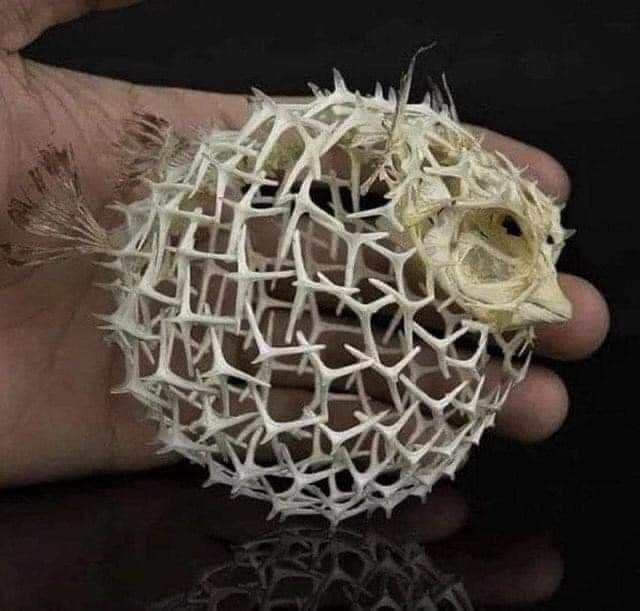
Sundays now are lazy days for me. I either post something silly or other people’s work. Usually both. Today, it’s (loosely) using science to imagine a D&D creature. I did that with the Ixitxachitl and now do it with the pufferfish. Behold the pufferfish lich!

I don’t care what spells it casts. I’m not afraid.

Follow me on Twitter @gsllc

Help!

Dungeons & Dragons is a trademark of Wizards of the Coast, LLC, who neither contributed to, nor endorsed, the contents of this post. (Okay, jackasses?)
An Answer to a Question: Ideal Playing Partners @AvalancheArtis1 #DnD #ADnD #1e #3e #5e #RPG

If you enjoy this post, please retweet it.

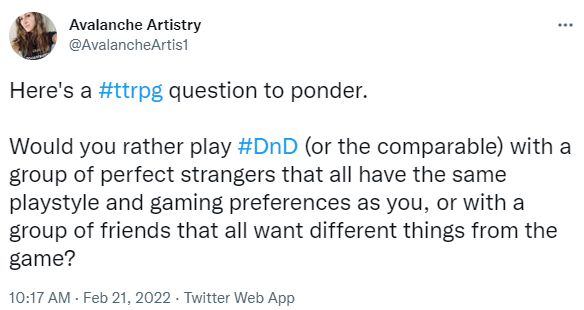
Twitter asks some good questions. Here’s another one (again, from weeks ago).

This is a tough one, and I don’t want to admit the answer, but I will. Like everyone, I want my cake and to eat it too. I want my friends to share my play style, but I have tangible data suggesting that’s never going to happen (at least not long- or even mid-term). So, my answer is this: I’d rather play with strangers that share my play style.

Consider the following: I can’t stand 3rd Edition D&D (“3e“). When I returned to the game after 23 years away from it, I was so happy to be back that I ignored how frustrating the system was. Besides, ignorance is bliss, and for all practical purposes I had nothing to which to compare it. I hadn’t played any RPGs for decades. Nevertheless, within the past couple of years, I’ve played a little bit of 3e. I played a few sessions of Greyhawk Reborn, which is the revival of the Living Greyhawk living campaign. Why? Because some of my friends never moved on from it, and that meant I never saw them. It was a chance to reconnect, which is important to me, but it didn’t take long for 3e to drive me away again.

On the other hand, I like 5th Edition D&D, and even more of my friends play it. Nevertheless, differing play styles grated on me. My style appears to be very firmly in the minority, so I find the game more tedious than it should be, but certainly more tedious than anything designed to entertain should be.

Would you rather this or Game of Thrones?

While I’m planning to return to D&D after deciding not to play anymore, I’m doing so on my own terms, or at least I’m trying to. I’m going to run some 1st Edition D&D sessions because I suspect that system will nudge players towards the way I want to play. Even if that’s true, it may not be to their liking, so this could be a short-lived experiment. In any event, the only hope for me playing regularly would be if the style shifted to my liking. You can’t force that on people, but if some strangers came along and had a similar approach, I wouldn’t have to.

Of course, if there were personality clashes with the strangers, then I’d leave the game again, but I fear that my best chance for a long-term return to D&D is through strangers, not my existing friends. This isn’t the end of the world. I’m at least in contact with my friends via social media, we’ll probably resume seeing movies and doing trivia night when the pandemic passes, and there’s always Winter Fantasy. Also, there’s no reason to assume there’d be personality clashes with strangers. Meeting strangers should be seen as an opportunity to make even more friends. We should all try that out from time to time anyway. That may be difficult without giving in to the online gaming fad.

So, I’d have to say that I’d rather play the game I want to play with strangers than to play the one I don’t with existing friends, but only because my friends aren’t going away.

I do love my friends.

Follow me on Twitter @gsllc
Follow Avalanche Artistry @AvalancheArtis1

Dungeons & Dragons is a trademark of Wizards of the Coast, LLC, who neither contributed to, nor endorsed, the contents of this post. (Okay, jackasses?)

In case the tweet is ever deleted, here’s a screenshot of it.


Wandering Monsters #ADnD #DnD #RPG #1e #3e #4e #5e

If you enjoy this post, please retweet it.

They have more claim to being here than your PCs do.

I left D&D in 1982 due to the Satanic Panic and didn’t return until 2005, so my recollection of 1st Edition D&D (“1e”) isn’t precise. When I returned during the days of 3rd Edition D&D (“3e”), rolling for wandering monsters wasn’t a common mechanic (though I occasionally saw it in published mods). Without appreciating why it was used in 1e, I simply thought that the use of wandering monsters was stupid. If you have a cool monster on hand, use it. Otherwise, it’s a waste of a perfectly good encounter. On the other hand, if your wandering monster is the same creature that the PCs are facing from time to time in the planned encounters, then they add nothing to the game, so don’t waste time on them. That could make the game tedious. Now that I’ve reacquainted myself with 1e, I realize their point: They’re designed to discourage dawdling.

Hurry Up!

Searching for secret doors, examining magic items, counting your loot, and sleeping are time-consuming activities. DMs are expected to keep track of time so that, when a given interval of time has passed, they know to roll for wandering monsters. These random encounters often didn’t result in any treasure and drained valuable resources from the party, so they weren’t something that the PCs wanted. However, they didn’t make the game tedious because 1e combats were quick. So, the concern I mentioned above that they may not add anything to the game isn’t a serious one. Their primary effect was to drain resources, which, as I’ll discuss in the next section, serves a couple of connected purposes.

This isn’t something that goes over well with modern gamers. Modern gamers (and legacy gamers that have moved on) tend to explore every single room and grab every single piece of treasure they can. Anything less than complete is seen as a failure. I’ll give you a specific example. When discussing playing experiences with Lost Mines of Phandelver, the adventure from the Dungeons and Dragons Starter Set for 5th Edition D&D (“5e”), players that failed to obtain the Staff of Defense would always be frustrated when others discussed it. Several of them that I knew would play the mod again with a character specifically designed to make use of that staff. Players would also take note in that adventure (and others) of forks in the road (so to speak), always promising to double back so that they covered the entire complex. Because of this mentality (I’ve been guilty of it myself), the D&D Adventurers League living campaign changed its rules such that every player could take a magic item found in the game even if there was only one. Everyone wants everything, so that’s what’s given despite how little sense it makes.

But Why Shouldn’t You Dawdle?

If this is what makes you happy, that’s fine, but my problem with this approach to the game is that it discourages immersion in the game world and can’t possibly work unless the risk of character death drops so low as to be negligible. As to the first point (which is a tangent from my main thesis), the logic of the game world becomes inconsistent. I can suspend my disbelief and accept a dragon that breathes a cone of cold, but I can’t accept the notion of a Rod of Cancellation spontaneously generating multiple copies of itself because multiple characters want it. The latter just doesn’t make sense, and no attempt is made to make sense of it. There’s no drain of resources to make it happen. There’s no need to visit the local archmage to make copies of it. It just happens.

As to the second point (now we’re back on track), a game where I know the DM will never kill me bores me. A game where I’ll get killed if I don’t think things through logically is far more fun. Sure enough, I’ve rarely seen character death in 5e. In fact, I saw far more character death in 4th Edition D&D (“4e“), and 1st-level 4e characters are intentionally durable. The more gamers become unwilling to suffer even the smallest of setbacks, the less we see them, which is why I stopped playing. There’s none of that in 1e. Can your characters survive? Sure, especially if you send the henchmen and hirelings in first. As I’ve been told, PCs can survive an entire campaign even despite the save or die mechanic (which I still don’t like). However, if you truly immerse yourself in the game, you’ll see that some actions are downright stupid and should get your characters killed. Game mechanics like wandering monsters discourage such stupidity, and as a consequence reward true immersion in the game world.

Your mission is to save the noble, not to grab an extra 5 copper pieces. Once you’ve got the noble, get the hell out of there. If this were a scenario in the real world, and you went for the coppers, your friends at your funeral would be discussing whether to submit your story to the Darwin Awards committee.

Be smart. Get in; get out.

Follow me on Twitter at @gsllc

Dungeons & Dragons is a trademark of Wizards of the Coast, LLC, who neither contributed to nor endorsed the contents of this post. (Okay, jackasses?)

The Dinosaur Cat @FatCatArtRu #Caturday #5e #DnD #TTRPG #RPG

If you enjoy this post, please retweet it.

Combining my love of cats with my childhood obsession with dinosaurs? Yes, please.

The original (as far as I can tell) image can be found here: https://imgur.com/gallery/IL4e9mp. The accompanying text notes that it can be used as a beastmaster ranger’s animal companion. The user apparently creates a lot of homebrew content for 5th Edition D&D.

Follow me on Twitter @gsllc

Dungeons & Dragons is a trademark of Wizards of the Coast, LLC, who neither contributed to nor endorsed the contents of this post. (Okay, jackasses?)


My Permanent Maps @schley #ADnD #DnD #RPG #1e #4e #5e

If you enjoy this post, please retweet it.

My favorite 1st Edition D&D (“1e”) adventure is C2: The Ghost Tower of Inverness. Also up there in the ranks is C1: The Hidden Shrine of Tomoachan. I’ve converted both mods** to 4th Edition D&D (“4e”) and 5th Edition D&D (“5e”). I’m always eager to run either one, and because I’ve done so multiple times, I made (and saved) maps for them.

** The last time I used the word, “mod,” for what others call “adventure” or “module,” I received an odd amount of pushback. One person even accused me of lying that it’s what I called them growing up, as if there could possibly be a motivation for something like that. I grew up in Montgomery County, MD, and every single person I gamed with called it mod. Some still do. We also occasionally used the terms adventure and module, but the point is that “mod” was the standard term. Your regional dialect, or even your specific gaming group, may have a different experience. I don’t care. I shouldn’t have had to write this aside, but if I didn’t, I might receive the same pushback over something that shouldn’t matter at all.

Ghost Tower

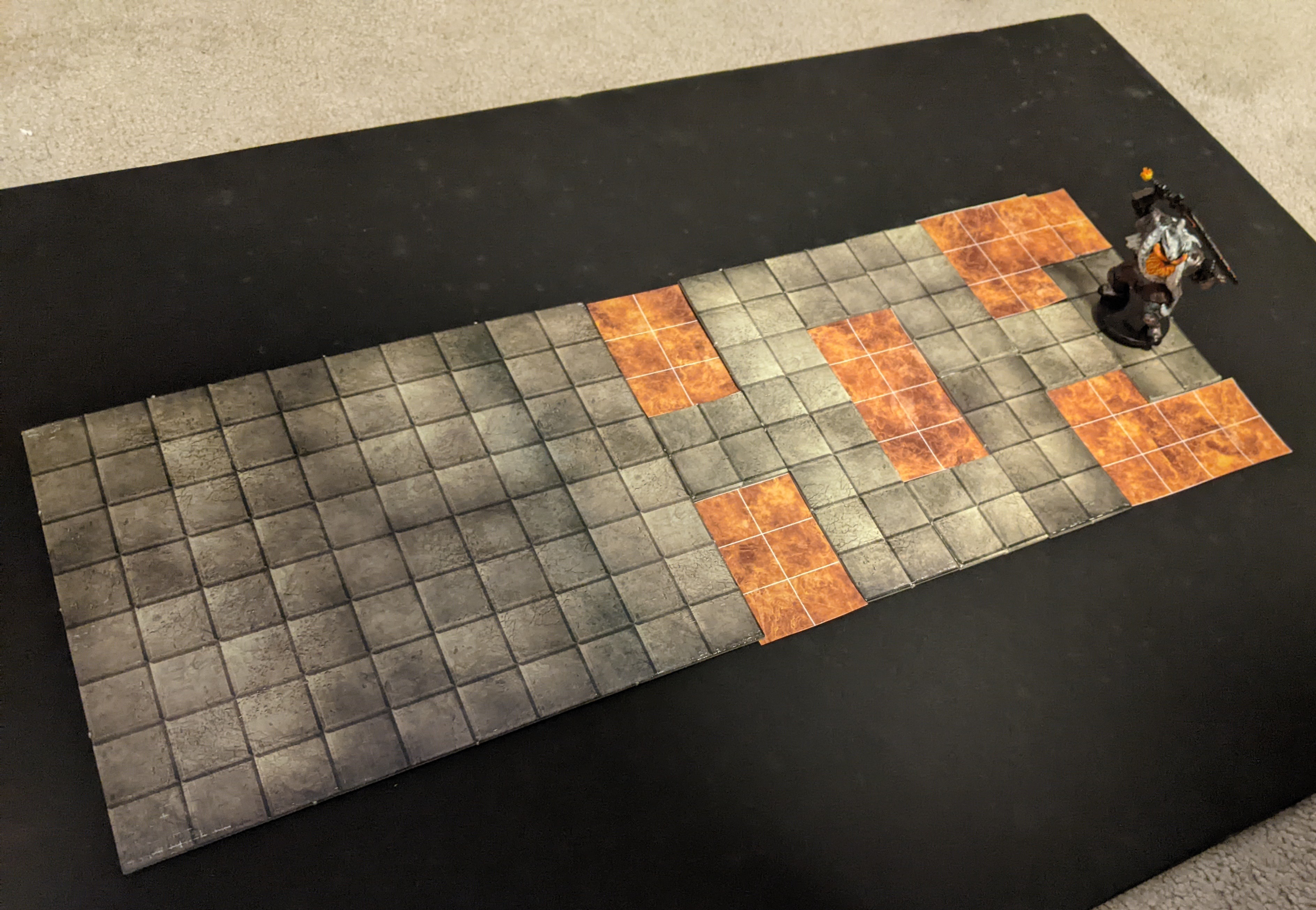
Dungeon Tiles were released during the 4e era, and I had tons of them. So much, in fact, that I had enough to spare. So, when I created the Dungeon Delves for synDCon 2011, I decided to take some of those Dungeon Tiles and permanently affix them to foam core. I’ve since used these for 5e as well. In other words, I’ve made good use of them. While unpacking recently, I discovered them. SPOILER ALERT! These cover only the Ghost Tower itself and a few iconic encounters along the four paths that lead you to it. Here are a couple of images of them.

The Earth Level

The Fire Level with a Friend

For the other encounters, I can always use these. I bought a set.

Hidden Shrine

With Hidden Shrine, I took a different approach, though not until 5e. I bought the hi-res images of the maps directly from their creator, Mike Schley. (You can see his work at https://mikeschley.com/.) I printed almost every room and hallway in the entire dungeon to cardstock (in color) so that I could use them as Dungeon Tiles. They’re exactly the correct size for minis. I also have several sound files containing phrases in Nahuatl that are either common (e.g., “Hello.”) or specifically used in the mod. They further helped set the mood. Here are some samples.

A Couple of Rooms

The problem with both of these mods is that they’re designed for competition. Each is designed for a set number of pre-generated PCs, 3 for C1 and 5 for C2 (though I created a 6th for C2), and the risk of death was unreasonably high — even by 1e standards — so that there would be one clear winner at the end of the convention. With both adventures, you can probably solve the “unreasonably high” problem (if you think that’s a problem) by having a normal party size.

In the foreseeable future, I plan to play only 1e, but I’ll make use of these maps nonetheless. “Theater of the mind” (i.e., gaming without maps) doesn’t bother me — it can be quite convenient at times — but I’m a huge fan of using maps. They help with the immersion that I often discuss, and they correct mistakes I make as DM in describing the surroundings. That doesn’t mean my 1e games won’t otherwise be theater of the mind. To me, that’s an inseparable part of the 1e experience. At least for now. 🙂

We won’t be breaking out the tape measures.

Follow me on Twitter at @gsllc
Follow Mike Schley @schley

Dungeons & Dragons is a trademark of Wizards of the Coast, LLC, who neither contributed to nor endorsed the contents of this post. (Okay, jackasses?)