Let's roll some dice, watch some movies, or generally just geek out. New posts at 6:30 pm ET but only if I have something to say. Menu at the top. gsllc@chirp.enworld.org on Mastodon and @gsllc on Twitter.
Note: While this post pertains to the OGL controversy, this is not a legal analysis. This is just my ramblings on how I live my life.
I had a Twitter conversation with a friend of mine. Here’s how it started.
Next time we hang out, you’ll have to explain it all to me in a way that doesn’t make me roll my eyes and say, “You know what? I might not actually care.”
But don't think that I'm accusing you of being a bad guy. You're not the bad guy. WotC is, though. Very much so.
— Rob Bodine, gsllc@chirp.enworld.org or @dice.camp (@GSLLC) January 11, 2023
Because it was on Twitter, I didn’t give him a full argument. So, here it is.
Erik uses an iPhone, and we know that suicide and poor working conditions are problems at the infamous Foxxcon City where they’re made. The stakes with Dungeons & Dragons (“D&D“) aren’t nearly that high, but they are analogous. If you continue playing D&D, you’ll be allowing them to ignore the concerns of third-party publishers whose livelihoods have depended on OGL publishing for as many as 22 years. This is going to happen anyway because, as I’ve previously pointed out, the lifeblood of any business long-term is new customers. As long as Wizards of the Coast (“WotC”) is pulling in new customers that lack the knowledge of the controversy, WotC doesn’t care if they lose the old farts like Erik and me. But Erik’s thoughts are shared by many legacy players, so to the extent that some of the younger crowd might know about, and object to, the developments surrounding the OGL, Erik, et al. will offset that effect, making it just as unlikely to convince WotC to change course.
So, is Erik the bad guy after all? Yes, but not for this. 🙂
If Erik gave up his iPhone for a Samsung Android phone, would he avoid the ethical dilemma? No. Conditions at Samsung haven’t been much better. In short, Erik would have to stop using cell phones, which I’m sure he’d happily do the moment the rest of you give up yours. So it goes with D&D. Are you going to drop D&D because of this? What are you going to play? Savage Worlds? What are its creators’ opinions on abortion? What about Dragon Age RPG? Are its creators cat people or dog people? (They better be cat people.)
I know a lot of you think this way. You call for boycotts of companies based on a viewpoint allegedly or obviously held by a couple of high-level executives or owners with which you disagree. False appeals to Godwin’s Law notwithstanding, I’m not on board with that. Not only does it seem exceptionally arrogant, but it’s also counterproductive. The only people that go broke or have difficulties (if any) during a boycott are the employees that aren’t filthy rich and may even agree with you. I think that’s probably the case for WotC employees.
The worst thing about @Wizards_DnD's recent stupidity is that it reminds me of the stark contrast between their legal department and corporate heads (who suck) vs. their creatives (who are talented and, to the extent I've met them, nice people). 🤷🥺 #OGL#DnD#RPG#TTRPG#WotC
— Rob Bodine, gsllc@chirp.enworld.org or @dice.camp (@GSLLC) January 10, 2023
By all means, be aware of the problems with cobalt mines in the Congo, and write your congressmen about it, but don’t let that stop you from buying an electric car. I’m not willing to yell at someone who continues to live their life as fully as they can. The world sucks for a lot of people. If it doesn’t for you, you shouldn’t feel compelled to bring yourself down to that level. However, if you choose to take that stand individually, I won’t criticize that either. You have every right to spend your money according to your principles. There’s good arguments on either sides. Either way, I’d like you to consider funneling some of your money to third party publishers to make sure that remains a viable market during the era of OGL 1.1, 2.0, or whatever it winds up being called. I just don’t want anyone to forget who the actual bad guy is.
WotC Legal and Corporate. It’s WotC Legal and Corporate.
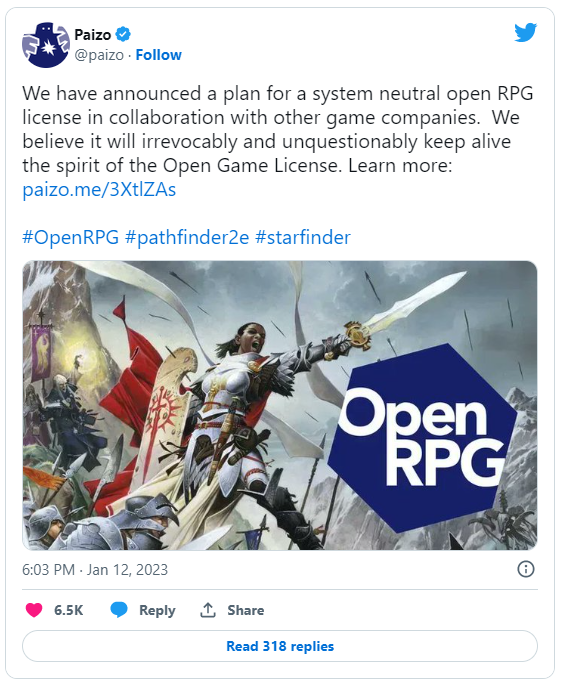
Yesterday, Paizo announced that they were developing a “system-neutral, open RPG license.” It’s overwhelmed with traffic, so you’ll have to be patient when trying to load it. They had a form for volunteering to review it and give feedback. After I signed up, I noticed some text that said it was for game designers only, so I doubt I’ll get an advanced copy for review. Maybe that’s a good idea considering my initial impression.
Same Old Song & Dance
As I’ve been running into the ground for well almost 15 years, the OGL isn’t a real license, and claiming it is has done a lot of damage that we’re finally seeing manifest in real harm, which I predicted. You can’t say I haven’t been warning you that this day would come. Talking about irrevocability or any other concept that applies to contracts shows that you’re missing that critical point, and that’s exactly what Paizo does in this announcement.
We believe that any interpretation that the OGL 1.0 or 1.0(a) were intended to be revocable or able to be deauthorized is incorrect, and with good reason.
Unless their position is that those interpretations are incorrect because they simply don’t apply to non-contracts, then they’re advancing the same false narrative that Wizards of the Coast (“WotC”) has since at least 2004. The fact that they intend to state their proposed consideration in a separate document suggests that we’ll be dealing with a “contract” with far too much uncertainty as to what it actually licenses. Maybe it’ll be an unmalleable appendix rather than a separate document — we don’t know — but everything I read in that press release leaves me pessimistic.
Remember, the OGL should have been an acknowledgement of the material WotC conceded they didn’t own. If they wanted it to be a real license, then it must be 1) specific about exactly what material the public now use, and 2) that material must be material the public otherwise wouldn’t have been able to use. That is, the consideration must be both obvious and real. Any other approach with Paizo’s license will mean that Paizo is continuing to feed the public that false and dangerous narrative. Granted, no one’s going to die because of this, but people’s livelihoods are on the line, so “dangerous” fits in that context. If you continue to buy into it this false narrative, you’ve learned nothing from the turmoil the OGL has caused, but you can’t blame WotC for it any longer. Like the danger from cigarettes, the information is out there, so it’s on you if you accept the risks.
And now we finally have WotC’s official statement, which demonstrates a victim complex. They 1) still intend to treat it as a legitimate license (of course); 2) act as if, on the week the final copy was to be distributed, that they were always just looking for feedback; and 3) overfocus on the non-discrimination provision to which no one objected, all to make themselves look like the good guy. Additionally, as Stephen Radney-MacFarland pointed out, you expect us to believe that they “didn’t see this coming”? Unbelievable, and yet paradoxically exactly what we expected.
But It’s Pazio!
You may believe Paizo’s promise of irrevocability even though it wouldn’t be legally enforceable. Some of the readers of this blog know Paizo management personally, so maybe you’re right for trusting them. But consider this: What if Hasbro’s chief rival, Mattel, decides to take advantage of Hasbro’s tarnished reputation and enter the RPG market? What would be their best way to jump start such an effort? If I were them, I’d buy Paizo, and if that happened, would you still trust Paizo to do the right thing? Do you know any Mattel executives? Would that even matter? Would a $7.18 billion business never change course because they’re a “nice bunch of guys”?
Still, everyone, including me, should give Paizo a chance. Maybe they’ll surprise me despite this reckless language.
Just a quick note today, as my next bit of legal analysis I’m preparing is going to take a while to write. Try not to shoot the messenger for today’s post. I’m just trying to help.
I see a lot of people online calling for a new open gaming license that’s done correctly. Sadly, that’s missing the point.
Our problems aren’t going to go away as long as you continue to buy into the fiction that the Open Gaming License (“OGL”) is a real license. It clearly isn’t, but if you treat it that way by giving lip service to its arguments that apply only to real contracts (“It’s irrevocable!” “It can’t be deauthorized!”), or make calls for bigger, better, open gaming licenses, you can still be duped. As I said yesterday, the OG”L” (which should no longer contain the misleading letter L in it) should be a statement of what the game designer acknowledges they don’t own, and thus have no power to stop you from sharing. With RPGs, that’s far more material than you probably realize.
To the extent that a publisher has copyrightable material and wants to dedicate it to the public domain, they should simply do that with an undeniably clear statement to that effect. (Copyright law won’t allow contract ambiguities to result in such a dedication.) Otherwise, you might as well draft a “closed gaming” license with proper means of acceptance (i.e., signatures) and clearly stated (and proper) consideration, and just make sure the terms aren’t unreasonable. What many of you are actually asking for is oxymoronic, and as a result, using SRD material that has even the tiniest chance of being copyrightable could still get you in trouble. It hasn’t been licensed to you because the OGL is not a license, and there’s no doctrine of laches in copyright, so the copyright remains enforceable even after 20 years.
I’m glad so many of you, especially attorneys, are finally catching up with my rants from the past 10-15 years and my posts from 3 years ago, but some of your hearing has thus far been selective. I’m making a call for awareness from game designers and honesty from and the attorneys they employ, but the public’s insistence on believing the lies surrounding the OGL is a serious hurdle to those goals. This is not me merely demanding legal precision. Figurative use of the word, license, has added to your misplaced faith, so it’s no longer acceptable for any so-called “open license” to use that word. We’re seeing the very real, tangible effects it’s having on the community and industry right now.
We don’t need another fake license; we need an honest legal statement or a real license. As long as you allow this fiction to rule the day, the community and industry will suffer regardless of how this whole OGL 1.1 thing shakes out.
Reality checks can sometimes be helpful, but you need to be open to the help.
So, the Open Gaming License 1.1 (“OGL”) was leaked. Let’s remember that 1) it could be fake; 2) it could be real but modified; and 3) it could have been an intentional leak designed to get feedback in dumbest way possible. We don’t strictly know which of the three it is, though the response of Wizard of the Coast (“WotC”) makes me believe that #1 is not an option. Here’s the response:
Oh, I’m sorry. Wrong media. Here it is.
We know you have questions about the OGL and we will be sharing more soon. Thank you for your patience.
I think it’s fair to be thinking about the issues this leak raises. I’d just prefer people not assume the sky is falling. Changes could be coming, however unlikely or meaningless they may be. Anyway, with all those caveats above . . . .
A Brief Review
When it comes to consideration, the OGL 1.1 falls into the same structural trap that the OGL 1.0 does. It licenses you “methods, procedures, processes and routines” as well as ” any additional content clearly identified as Open Game Content by the Contributor. . . .” The first part of that grant mirrors language in the Patent Act and patent law practice defining what can be patented. Likewise, these same words are used in the Copyright Act (specifically 17 U.S. Code § 102(b)) and copyright law practice to describe things not copyrightable. So, for a company like WotC that isn’t using the OGL to license patented subject matter (which is pretty much the case for all RPG producers), that first part clearly licenses nothing.
The second part of that grant is meant to reference the System Reference Document (“SRD”), but by its own terms could mean a press conference. A clear statement is a clear statement. However, in WotC’s case, they use the SRD. The content of the SRD is either mechanical (never copyrightable), an inseparable mix of mechanical and creative (and thus not copyrightable), or so simple and trite as to not represent even the “modicum of creativity” necessary to be copyrighted. So, my position has always been that, even with that second part, they’re still giving you nothing.
"Wizards, however, rarely releases Open Content that is not just mechanics." If the #SRD is the #OGL's consideration, and only a small part of it isn't mechanics, isn't #WotC conceding my arguments about stat blocks (a large part of the SRD) being just mechanics? #DnD#RPG#TTRPGpic.twitter.com/SWCkHklwsb
— Rob Bodine, gsllc@chirp.enworld.org or @dice.camp (@GSLLC) January 7, 2023
It’s apparently WotC’s position as well.
Now, with a new OGL on the horizon, maybe they’ll fix that. Maybe the SRD 5.1 (and OneD&D’s SRD) will contain licensable material. Assuming that material (or you’re assuming the material in the current OGL) is creative, does that mean the OGL won’t fail for lack of consideration?
Nope. It still fails, and here’s why.
An Analogy: Renting an Apartment
Recently, I started sharing this analogy on social media, and I think it makes it easier to understand the structural failure of the OGL. Let’s say you sign a lease to rent an apartment. It’s states that your rent is $800 (cheap nowadays), and that it runs from January 1 to December 31. Easy, right? Let’s say it also has a provision stating that you agree to abide by all the Rules & Regulations that appear in a second document. This is hardly rare. I’ve seen them more times than I can remember.
So, why put Rules & Regulations in a separate document? Is it to save space? Clearly not. If the lease is 3 pages long, and the Rules & Regulations are 10 pages long, then combined they’ll be 13 pages. Either way, it’s 13 pages of content, most of which you’re unlikely to read until there’s a dispute, so you’ll just skip ahead to the signature page and sign it. If the concern is organizational, then why not include them an exhibit or appendix? Again, why put them in separate documents that often aren’t even available when you sign the lease?
There’s only one reason: The Rules & Regulations are expected to change as circumstances change.
If the waste disposal company changes their pickup day from Tuesday to Monday, it makes no sense to say that trash can’t be put out until Monday evening after sunset. The Rules & Regulations must adapt. Use of common areas gives rise to the same need for flexibility. If anything in the Rules & Regulations were expected to go unchanged during the term of the lease, they could have been included in the lease.
Well, the OGL is your lease, and the SRD is your Rules & Regulations. The OGL sets the basic terms that can or cannot be revoked (separate discussion), but they reference a separate document where you get the current set of intellectual property that WotC (or any licensor) wants to license to you. There’s no legal or contractual reason to infer that any given licensor using the OGL is restricted from changing the contents of that document, and every reason to believe they can change it whenever they want.
You may think that, in this case, there is a reason to separate the two into different documents that has nothing to do with whether they can be changed. The OGL was intended to be used by other gaming companies with only their intellectual property within it. But that only solidifies that SRDs must be flexible. Also, it doesn’t get around the fact that the “clear statement” of the licensor could have been referenced as a required appendix or exhibit to the license itself rather than a separate document. It could have flat out stated that it was immutable, and absolutely should have said it is “incorporated by reference.” Again, there’s nothing (I’m aware of) in the contract, the law, or the history of interpreting consumer contracts that leads us to infer that the SRD can’t be changed. It’s a separate document (or oral statement!) that otherwise has no need to be separate. If I’m wrong, please point me to an example of a consumer contract with a separate, unsigned document (not merely an appendix, exhibit, schedule, etc.), not necessarily drafted at the time the contract is accepted, and not required to be in writing, that doesn’t expressly demand immutability in that separate document, yet is interpreted to require the separate document to be fixed. (That’s a mouthful, but it’s a lawyers job to interpret such sentences, so they know what I want.)
Aside: One thing that makes the OGL laughable is, carrying this analogy further, the OGL is like the lease and Rules & Regulations, but where the unit you live in, the amount of your rent, and the term of your rent all appear in the Rules & Regulations rather than the lease itself. I hope you see how batshit insane that is, but that’s what we’re dealing with.
This kind of uncertainty of consideration, especially where the licensor has no patents to license, calls the entire structure into question. I find it unlikely that this “contract” survives judicial scrutiny even if the licensee (non-drafter) of the OGL, wants consideration found so that you can enforce it. (Of course, what do you do with interpretation if the licensor is a game designer other than WotC? In that case, neither party drafted the contract, and by the OGL’s own terms, the licensor may not change it [the OGL].) Courts aren’t going to decide for the parties what they think should be included in the SRD with no guidance from the OGL to decide that. All it says is that there must be a “clear statement.” Statements change all the time.
Going back to the lease, your rent and term are set in stone. No matter what they do with the Rules & Regulations, your rent and term can’t be changed. The same is true here. The terms of the OGL aren’t changed by the SRD. You still can use their patents without any apparent restriction (isn’t that odd?), you still can’t use “environments” WotC mentions (that’s crazy), you can still accept the license merely by playing the game even if you’ve never heard of Dungeons & Dragons (“WTF?!”), etc. But again, there’s no reason to believe that the contents of the SRD are set in stone. They’re expected to change, and that also makes sense when considering that WotC has a federal right to control its copyrighted material. WotC hasn’t dedicated their work to the public, but a contrary interpretation could lead to exactly that without a clear statement of intent to do so. Federal copyright law will always override state-based interpretive principles. That is, state contract theories don’t overrule federal law (let alone the Arts & Sciences clause of the U.S. Constitution). I’ll have more to say on that in a future post, because the fact that copyright is involved adds even further strength to this argument.
On a side note, this is why the alleged irrevocability of the OGL is completely irrelevant. The OGL may be irrevocable, but the SRD isn’t (so to speak).
Could Things Have Been Different?
Someone asked me whether a license is even possible. Yes, it is, but not in the way the OGL was intended, and certainly not in the way you’ve all treated it all these years. The OGL 1.1 approaches a real license. It’s a shitty one, but it’s nearly a real license, and I don’t think it would have been received well even if the terms weren’t so onerous. I don’t think the OGL should have ever been (mis)characterized as license. Again, it’s point was to say, “We’re letting you use everything we put in the SRD,” even though most, if not all, of that material is not copyrightable.
What the SRD should have been was instead the exact opposite. It should have been a statement by WotC conceding what they didn’t own, and thus what you were free to use for all time because they had no right to stop you. They should also have said that, in the event they did own anything in the SRD, it’s dedicated to the public domain. If you think it through, that’s how you’re using it, and at least for the overwhelming majority (if not all) of that material, that’s what the SRD discloses. This would also alleviate every single concern I’ve ever stated on the OGL, because the OGL wouldn’t be needed.
Depending on WotC’s eventual statement, I may publish a post I have written that will be quite a serious statement on my part, but either way, I’ll be diving into some heavier copyright theory. Stay tuned.
Either way, can we all agree that WotC screwed up?
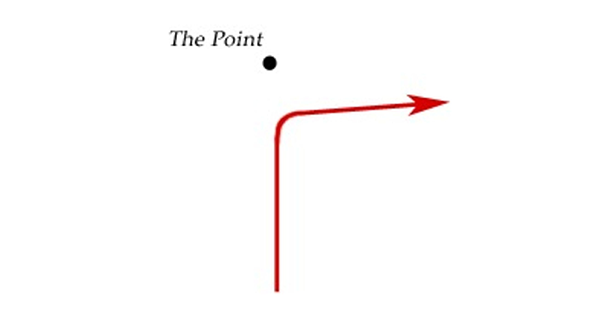
Isn’t Microsoft Paint the best?! Eat your heart out, Nowak!
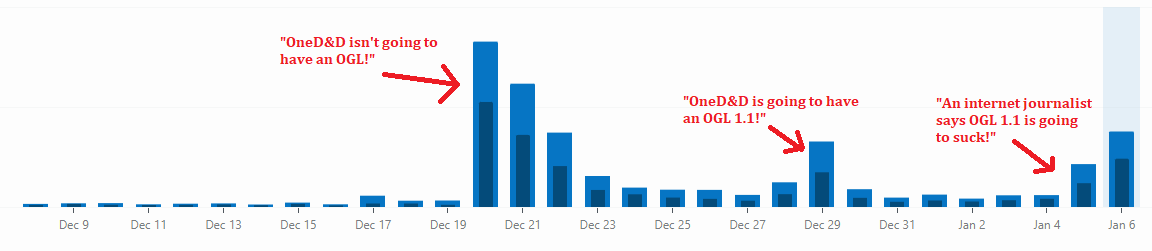
But wait! It gets … worse? Better? Throughout those posts, if I referenced a legal concept that wasn’t critical to the theme, rather than spell it out for you, I saved space by linking to a discussion of that legal concept on my far less popular legal blog. Here are the hits for that blog over the past few days.
Since writing this post, these numbers have gotten MUCH bigger. Today’s hits are now twice as large as December 29th’s and are approaching December 21st’s.
I don’t want to be famous, so I may have to shut down these blogs. 🙂
Also, I should have tagged John and Tales of Arcanayesterday, so I’m doing so today — with top billing — even though they have nothing to do with this post. So, there you go. If I’m going to be famous, I’m pulling those nerds into it with me.
Something Serious
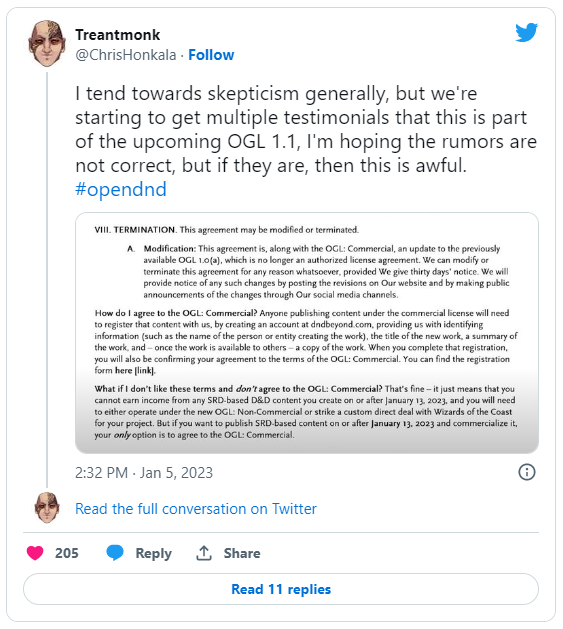
This is a supposed excerpt from the OGL 1.1. I have no idea if it’s real.
I tend towards skepticism generally, but we're starting to get multiple testimonials that this is part of the upcoming OGL 1.1, I'm hoping the rumors are not correct, but if they are, then this is awful.#opendndpic.twitter.com/VIAdnzIz4z
. . . you’re welcome. Sort of. It’s clear that my concerns about the OGL are being met, for better or worse, and I know WotC Legal read my posts. This means that there’s a good chance that the OGL 1.1 will be a real license because I pointed out why 1.0 wasn’t. The speculation is that 1.1 will be arduous, but the fake OGL is no less arduous. It simply appears open because WotC is lying to you about what they’ve actually licensed to you (reminder: NOTHING!). They could always have changed their mind and done this. Some people have said to me that WotC could never pull the rug from underneath the community because they’d revolt, but now that they’re telling you the truth, they’re saying (straining the metaphor a bit) that no rug is henceforth standard operating procedure. They’re expressly doing what I told you they always could, and the community is preparing a revolt. Voila!
So, now they’re going to tell you the real story, and it’s clear you don’t like it. Maybe you shouldn’t. Either way, this may not be good for business, and this may not change WotC Legal’s status as . . . well, you know my opinion, but at least you’re going to be protected from deceit (again, assuming this is real and representative of what they’re going to do throughout the OGL 1.1).
And then there’s this:
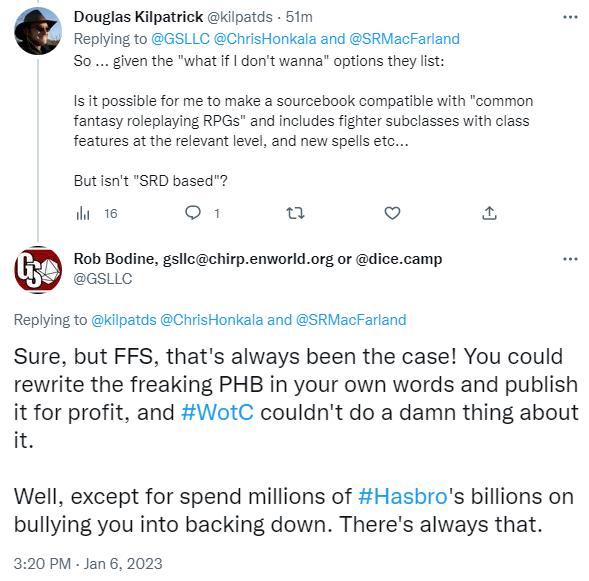
Sure, but FFS, that's always been the case! You could rewrite the freaking PHB in your own words and publish it for profit, and #WotC couldn't do a damn thing about it.
Well, except for spend millions of #Hasbro's billions on bullying you into backing down. There's always that.
— Rob Bodine, gsllc@chirp.enworld.org or @dice.camp (@GSLLC) January 6, 2023
Think about it, people, but not too hard, because . . .
As you all know, someone got a hold of a snippet of the new OGL 1.1 draft. A few people (publicly and privately) have asked me to weigh in based on my Tome of WotC Criticism. Sorry, but I’m not going to make the same mistake many people did jumping to conclusions about the OGL 1.1, so I’m certainly not going to comment on its text that I haven’t read. I’m also not relying on Gizmodo’s interpretation due to all of humanity’s experience with news media. I will remind you all that the current OGL isn’t a real license. No one has signed it, it’s terms for otherwise accepting it are laughable, and it doesn’t actually license you anything.
Beating a Dead Horse
WotC owns its expression of the game mechanics, but despite their implications, they never license that to you. The OGL (even assuming it’s real) uses terminology appearing in both the Patent Act and Copyright Act, saying “this stuff is what we’re licensing.” Those things are stated to be patentable subject matter in the Patent Act and are expressly excluded from copyrightable subject matter in the Copyright Act. And just to be on the safe side, the OGL says (in case it’s not already obvious, paraphrasing):
If any part of what we’re licensing falls under copyright or trademark [you know, such as the specific expression of game rules!], then we take that out of Open Gaming Content, stick it in Product Identity, and don’t license it to you.
No matter how seriously you take the OGL as a license, there’s simply no way to interpret, “processes, methods, routines, and procedures” as including anything copyrightable, which means nothing copyrightable is being licensed. So, despite the SRD containing WotC’s expression of game rules, and despite WotC’s claim to be allowing you to use that material, WotC is free to pull the rug out at any time and say, “You used out expression!” They never actually license it to you because the SRD is not in any way incorporated into the OGL.
Back on Point
It’s a bit hard to answer your questions or respond to your concerns when they’re all based on so weak a foundation, but here’s something on point. There’s a huge debate going around as to whether the OGL can be revoked. For those that say it can, you’re wrong because there’s nothing to revoke. It isn’t real. For those that say it can’t, you’re referencing language from the FAQ and OGL itself that suggests that. Why do you think that language makes it so clearly irrevocable? The FAQ itself states that “people will just ignore [a revocation] anyway.” How is it that a real license can simply be ignored? Because it’s not a real license. The answer to both groups is the same. You’re both right because you’re both wrong.
While the originally stated intentions were noble, this is, at least for at least the past decade or so, a big sham, and it’ll be very interesting to see whether the OGL 1.1 addresses these fatal shortcomings. Even worse for WotC, here’s an attorney taking the OGL seriously and threatening WotC with a lawsuit if they don’t clarify their position on revocation. To defend against any such lawsuit, or even to respond to the letter, may require WotC to take my OGL post and just read it. They’ll have to admit the OGL is a sham. Funny.
For now, though, I’m in the same holding pattern as you. Until we see the text, we don’t know. If, however, the OGL 1.1 corrects its errors as I’ve identified them, my arrogance level will rise so high that, well, I’d probably qualify for employment with WotC legal.
I had a brief interaction with Erik on Twitter (yes, him again) within the context of 5th Edition D&D (“5e”).
A twig or an owl's feather are one thing, but a bowl worth 1,000 gp is a material component that shouldn't be ignored.
— Rob Bodine, #Attorney by Day, #Nerd by Day & Night (@GSLLC) February 10, 2022
Material Components
I stand by my statement but want to clarify it. The spell, Fly, has a single material component: a feather. As Erik mentioned, Heroes’ Feast has a significant one: A bowl worth 1,000 gps. The reason there’s a distinction between the material components for these items is that Heroes’ Feast is far more powerful in the long run. It’s a 6th-level spell vs. a 3rd-level spell, so there needs to be something to balance that effect. This is obvious. What’s less obvious is that the bowl has to be encrusted with jewels, which requires a long process by a skilled craftsman. That’s a spell component with far more limited availability than “a wing feather from any bird.” Such scarcity puts a check on overpowered spells, or at least an overpowered application of such spells.
Lawyers and rules are not a fun party and apparently no food either.
This isn’t rules lawyering; it’s game mechanics. If you don’t want game mechanics, why are you playing a game?
If a DM tracks material components that have a high financial or logistical cost but largely ignores those with a low cost, game balance is maintained without turning the game into a spreadsheet. It also gives players another strategic dimension. A player must choose between having to collect 1,000 gp bowls to heal up and fortify defenses, or an offensive implement that prevents that damage in the first place. The decision isn’t merely mechanical; it also affects what kind of character a player wants to play.
Somatic and Verbal Components
Speaking of strategy, non-monetary components are also important. Ignoring components robs players of some of the fun. For example, Shatter has a verbal component. That makes sense. You shout to produce sound waves, then magically manipulate those waves to produce the damaging effect. If you remove that requirement, then the Silence spell is completely nerfed for combat, and with few remaining useful applications, the spell will largely be ignored by players. This means that everyone reverts to the same, short list of spells they choose. That’s boring (q.v., though it’s what’s happened for other reasons). This isn’t boring: Because NPCs may use Silence to prevent casting spells, PCs are given yet another strategy to consider during character design.
The same is true of somatic components. Most players ignore somatic components when their PCs have been placed in shackles or tied together. PCs should have to pay attention to the components required by the spells they’ve chosen and make sure they haven’t placed their eggs in too many baskets. That is, they must make sure that some spells have no material components, some have no somatic components, and some have no verbal components. Do enough such spells exist?
How This Impacts Game Design
If there’s a problem here, it’s probably that there are too many spells with verbal or somatic components, so there’s no effective strategy to be had.
Let’s test that hypothesis.
As you may recall, I have a database of all 5e spells that I created for my one stop stat blocks project. You can find details for my methodology buried within this post, but I’ll point out that there are a total of 457 spells in those sources (deleting duplicates between the Elemental Evil’s Player Companion and Xanathar’s Guide to Everything). A simple query gives me the following:
Number (Percentage)
V
52 (11.38%)
VS
149 (32.60%)
VM
11 (2.41%)
VSM
220 (48.14%)
S
17 (3.72%)
SM
8 (1.75%)
Number (Percentage) of Spells by Combination of Components Required
Material components are required by over 52% of spells, but never is there a spell that can be cast by a caster who’s bound and gagged but manages to pull a material component out of a hidden pocket. That is, there are no spells that require only a material component. 15% of spells can be cast with either a verbal or somatic component by itself, so those spells should be quite useful if material components are tracked. Almost 95% of spells require a verbal component, and over 84% require a somatic component. Clearly, the game designers didn’t intend for casters to be able to cast while bound and/or gagged.
Source
Level
Spell
Player’s Handbook
8
Demiplane
Guildmaster’s Guide to Ravinca
0
Encode Thoughts
Elemental Evil Player’s Guide
0
Control Flames
Elemental Evil Player’s Guide
0
Mold Earth
Elemental Evil Player’s Guide
0
Shape Water
Elemental Evil Player’s Guide
0
Thunderclap
Elemental Evil Player’s Guide
1
Absorb Elements
Elemental Evil Player’s Guide
1
Catapult
Elemental Evil Player’s Guide
1
Ice Knife
Xanathar’s Guide to Everything
0
Primal Savagery
Xanathar’s Guide to Everything
1
Snare
Xanathar’s Guide to Everything
2
Mind Spike
Xanathar’s Guide to Everything
3
Catnap
Xanathar’s Guide to Everything
5
Steel Wind Strike
Xanathar’s Guide to Everything
6
Mental Prison
Xanathar’s Guide to Everything
8
Illusory Dragon
Xanathar’s Guide to Everything
9
Psychic Scream
Spells requiring no verbal component.
I’d like to think that having a verbal component to, for example, a Power Word spell is more a question of flavor than mechanics. Even if that’s the normal approach, playtesters were probably forced to abide by the relevant rules when playtesting, and so the balance in the game was inevitably shaken out requiring components in most scenarios.
Consider that one of my criticisms of how D&D monsters are designed is that they all use the same spell selection. This list of spells is heavily weighted towards spells that are either overpowered or simple to remember without having to look up their details. For the first five levels, here are the top five spells by use by NPCs in the relevant sourcebooks (“preferred spells”). I skipped preferred spells higher than 5th level because there are far too few of those spells even used for a “top 5” list to make any sense, and besides, above 5th level none of those spells are used more than 8 times in all the sourcebooks combined.
Cantrips: Mage Hand, Prestidigitation, Light, Minor Illusion, Ray of Frost
5th: Scrying, Hold Monster, Cloudkill, Wall of Force, Cone of Cold
I’ve played with hundreds of different people through organized play, organized weekly game days across the Washington, DC area for a gaming club over about 250 members, and ran a convention for a couple of years. In my anecdotal experience, this is nearly identical to the list used by PCs, but I can’t technically prove that. Almost no one responds to my polls. 🙂
I'm adding an image to an attached tweet containing a list of 5th edition #DnD spells by level (cantrips to 5th). For any spellcasters you're current playing, what percentage (usually if not always) of those #spells are prepared when your #character starts a session? #RPG (1/2)
— Rob Bodine, #Attorney by Day, #Nerd by Day & Night (@GSLLC) February 11, 2022
So, just for shits and giggles, let’s look at what happens to the numbers above when we limit ourselves to preferred spells.
Number (Percentage)
V
2 (6.67%)
VS
11 (36.67%)
VM
1 (3.33%)
VSM
14 (46.67%)
S
1 (3.33%)
SM
1 (3.33%)
Number (Percentage) of Common Spells by Combination of Components Required
The numbers are too small to take too seriously, but they look about the same with the exception of spells requiring only verbal components (only Dimension Door and Misty Step). In case you’re curious, Counterspell is the only preferred spell requiring only a somatic component. So, preferred spells can be even more often nerfed if we enforce components. If we do so, perhaps we’ll see a more varied suite of spells at the table, but not by much in 5e. There don’t seem to be many alternatives that avoid the need for particular components.
What Have We Learned? Not Much.
I think this was a bit of work to say simply that the game was balanced during playtesting under a strong assumption that casters could be nerfed, especially by one another. Not enforcing components just further aggravates the existing problem of only a few spells ever being used. In the end, I’m sure people are having fun even if they don’t worry about components, but if a DM wants to remove spell components, I’d much rather see the DM remove them to urge players to choose spells other than the ones on the preferred (spell list, giving several spells the ability to be cast with only one type of component.
Food for thought for game designers of the future and those willing to do the work in changing 5e now.
I had a discussion during Winter Vantasy: The Return with Erik with respect to Wizards of the Coast’s (“WotC”) new stat block format. The new stat block has some rearranging of material, but that wasn’t the subject matter of the conversation. We were discussing the removal of spells and spell-like abilities from the new WotC stat block. Erik doesn’t like it and referenced my concerns about the complexity within the current stat block format. Erik referred to my position as “ridiculous,” but WotC’s switch proves that Erik’s view is the minority one. I didn’t have a large enough internet footprint to prove it on my own. More importantly, however, Erik understandably mischaracterized my position. I wasn’t saying that the Monster Manual got it wrong. In fact, quite the opposite. I’ve mentioned before that I think it’s the best RPG bestiary I’ve ever read. My concern is that WotC didn’t supplement it properly, then attempted to shut me down when I did.
Important Note: I’m not 100% certain that WotC’s stat blocks have been changed in the way we’re all assuming they were. I’ve seen a sample of the new format (below), but it was for a low level creature whose stat block would be simple anyway. Thus, this discussion comes from a place of partial ignorance, and I may get some things wrong. Take this all with a grain of salt.
When you look at a complex stat block (e.g., Mummy Lord), unless you have a truly eidetic or nearly eidetic memory, there’s no way you can effectively run that stat block as written, especially if the encounter is a combat encounter. There’s too much going on, and what we’ve all seen (and I actually got Erik to admit to an extent!) is that every DM just gives up and resorts to using the common spells they all know: Magic Missile, Hold Person, Fireball, Counterspell, etc., even for higher spell slots. Why? Well, first you must figure out which sourcebook contains the spell in order to look it up. If it isn’t a Player’s Handbook spell, you may not know, so you wind up searching through a couple of books before finding the correct one. Second, you must read the spell, which could take a while if it’s not one like Fly. If it were a spell like Fly, you may not have to look it up at all, which is why Fly is one of the spells to which DMs eventually resort. Something like Control Weather has far too much going on for most people to memorize. Erik is sometimes willing to do that, but there are very few players whose eyes don’t glaze over with boredom during that long process. Moreover, if you’re playing with a real-world time limit (e.g., convention play), that’s certainly not time you have to waste. At the table, the spell’s details should be right in front of your face. I don’t understand why anyone would disagree, and those with eidetic memories shouldn’t care one way or the other.
That said, in theory these stat blocks provide a framework for the culture of that creature. (In my second stat block/copyright post, I mathematically proved that WotC fails to do so, but that’s not relevant here.) So, the Monster Manual itself shouldn’t eliminate that complexity (I know; WotC can’t win with me), but rather use it as a framework for creating specific monsters within that cultural framework but suited to the encounter at hand. That last sentence is a tough read, so here’s an example. (I’m going from my memory, which is not eidetic.) The Couatl has both offensive and divination spells. If your encounter involved the Couatl using Detect Thoughts to aid in an interrogation, then you wouldn’t need the Couatl to have Shield. On the other hand, that position would be reversed if the Couatl were to engage in combat against the PCs (i.e., it would need Shield but I don’t think, from memory, Detect Thoughts would have value). The Monster Manual stat block provides you the spells a Couatl needs for all situations, but not every Couatl will appear in all situations. In fact, I doubt any will unless the Couatl is a PC, but a Couatl PC is clearly not what I’m talking about. For NPCs at the table, you need only the spells that that specific NPC will need in that specific encounter. Everything else muddies the water. However, it’s good that all situations are covered by the general stat block in the Monster Manual, because that’s what you use to build such table-based stat blocks.
So, in my ideal world, this is how WotC (or any game designer with sufficient resources) should approach their stat blocks. Make them as complex as WotC did in the Monster Manual, using only spell names as shorthand to make the stat block printable, but modify their online tools with check boxes allowing DMs to pick which spells and spell-like abilities appear on a final stat block at the table (whether in hard or soft copy). For that final stat block at the table, make sure that the spell descriptions are presented fully so that there’s no need to resort to multiple hardcopy resources to know details that are relevant to the combat, but at the same time make sure that the stat block isn’t cluttered with irrelevant details. If there are no online tools, provide one-stop stat blocks for all NPCs (as I did) as a PDF. They could also provide PDFs containing generic spell entries with coded placeholders such as, “Magic Missile, Atk: [L]+3+IntMod, . . . .” (or whatever it is), so that DMs could copy and paste them into their own stat blocks as needed. All my project did was the one part of that process that I could, which is something WotC didn’t do.
I fully appreciate that some (most?) game designers can’t do this. Online tools are a huge investment of time and resources they may not have, but some in the gaming community do. Game designers simply need to stay out of the way and allow the community to do that heavy lifting for them. On the other hand, WotC has both the time and resources to create this ideal that appeals to the most people, but they’re still getting it wrong, probably because there’s more profit in selling a new hardcopy (which I suspect will be very good nonetheless).
So yeah, WotC can’t win with me, but only because they’re choosing to lose. We’ll see how the final product shakes out.
It's about 3 am, and I can't sleep. My mind is racing through #DnD/#RPG discussions I had on Twitter that I couldn't resolve in 280-character snippets. My brain is fleshing out my stance even though no one is here to listen.
— Rob Bodine, #Attorney by Day, #Nerd by Day & Night (@GSLLC) June 13, 2021
All of those discussions were inspired by or involved NewbieDM, S Keldor lord of Castle Greyskull DMLSP (that’s a mouthful), Roving Band of Misfits, and Merric Blackman. I can say that NewbieDM and Merric are good at doing that; I’ve never interacted with S Keldor. Note that while I’ll be quoting them in these posts, much like my brain at 3 am acknowledged about me, I can’t do their arguments justice either. You’ll have to click through to see everything they’ve said. My only purpose here is to express my own opinions while providing context for their genesis and giving credit to those that inspired them. If you want to know what they think, click through and ask them to clarify.
To keep my posts short, each issue will be dealt with in its own post, all with this same introduction. | Part I | Part II | Part III | Part IV |Part V |
Part 1: This is Why the 5th Edition D&D Monster Manual is My Favorite RPG Bestiary
The 4e and 5e Monster Manuals took opposite approaches to how they loaded them with monsters. Very generally, and something you all already know, the Dungeons & Dragons 4th edition Monster Manual (let’s just say MM going forward) sacrificed variety for detail. The 4eMM1 (get it?) was the first bestiary we had for 4e, yet it didn’t include some iconic monsters such as metallic dragons and frost giants. No frost giants?!?! Even a 4e apologist like me (stay focused!) complained. The trade off was that there was more room to discuss the ecology and history of the monsters that were included, and there were more stat blocks for each of those creatures within that group. Plus, we got humans as monsters. 😐
5e took the opposite approach. With only a few exceptions, such as dragons, giants, and slaadi (I get a smug sense of satisfaction for knowing the proper plural form of slaad), we got no ecology or history and only one stat block per monster. This provided a lot of variety but considering how hard it is for new DMs to create monsters in 5e (compared to 4e), it was initially frustrating. On the bright side, they had room to give us the flumph. 😐
Ironically, it would seem that WotC should have taken opposite approaches in both situations, giving us only one, easily-leveled monster for 4e, but giving us multiple monsters for 5e so that we didn’t have to figure out how to create them. But didn’t they? Foreshadowing!
Enough complaining. Considering the title of this post, there must be a happy ending. As a result of my one-stop stat blocks project, I have in my possession something that I’ll never publish: a Word document containing my treatment of all of the 5eMM stat blocks, including ones that aren’t actually in the 5eMM (i.e., variant giant lizards, diseased giant rats, cave bear, and variant insect swarms). That is, I recreated by rote every single stat block in the 5eMM and then some. That gave me some perspective that I’m not sure one can have without at least intently reading the book cover to cover relatively rapidly.
Reskinning monsters is pretty easy in 5e. Here are two examples. First, let’s look at the giants. Before my stat block project, I was arguing with a friend (let’s call him Rob #247). He didn’t like the 5eMM, and I did. He complained that all the giants were the same: weapon attack, throw a rock, and multiattack. He found it boring and uncreative. I don’t think that’s fair. First, it’s actually important that the giants are very similar. It gives a sense that the giants were related evolutionarily speaking. Granted, You have to suspend quite a bit of disbelief in order to play D&D, but when logic is successfully applied, it triggers our instincts for familiarity and order. Second, when you visit the glacial rift of the frost giant Jarl, you don’t expect to see many, if any, fire giants, stone giants, etc. Maybe you’ll see one other giant type who’s an envoy from his leader (such as the cloud giant ambassador in Steading of the Hill Giant Chief), but that’s about it. That means that you can easily adapt the stat blocks for the other giants into the ones you need, even at different CRs , without appearing to use the same stat blocks over and over. There are plenty of other creatures with similar formats (e.g., cyclopes) that can be used as any form of giant.
Let’s now consider the kraken. Maybe you want to unleash it (yeah, I know) on your PCs, but that’s not an option for low level characters. What do you do? Well, have a giant octopus capsize their raft. Still too high a level? Then have a rock capsize the raft, and send a bunch of octopuses (octopi isn’t an English word) attack them. Maybe such a low level encounter isn’t that high a priority for your adventure, making ordinary octopi (octopodes also isn’t an English word) unimportant, but if your BBEG is a kraken, they become important as a means of foreshadowing or providing a theme. Need a lower-CR treant? Try the awakened tree.
The bottom line: The stat blocks are connected in such a way that you realistically have several stat blocks at different CRs that can be trivially adapted to represent the monsters you want. Because the 5eMM went almost 100% in the direction it did, the connections are far better than I’ve ever seen in a bestiary. You don’t just have to reskin some unrelated monster. You can reskin something that’s really close to it both mechanically and thematically, no matter which one you choose. That makes the game far more accessible for DMs than it otherwise would be.
Talk about foreshadowing! My thoughts on accessibility are the topic of the next post!
Follow me on Twitter @gsllc Follow Newbie DM @newbiedm Follow S Keldor lord of Castle Greyskull DMLSP @Dm_LSP Follow Merric Blackman @MerricB Follow Roving Band of Misfits @bandofmisfits
Dungeons & Dragons is a trademark of Wizards of the Coast, LLC, who neither contributed to nor endorsed the contents of this post. (Okay, jackasses?)
Here are the latest one-stop stat blocks for the 5th Edition Dungeons and Dragons Tales of the Yawning Portal. The file is in PDF format and contains bookmarks. If you find any errors, please let me know.








 Play What You Want