
4th Edition D&D: Still Much More to Do #DnD #RPG #TTRPG #4e #WotC

If you enjoy this post, please retweet it (Twitter/X), boost it (Mastodon), repost it (MeWe), or repost it (BlueSky).

A Little Context for This Post

I love 4th Edition Dungeons & Dragons (“4e“). If you don’t, that’s fine, but did, and I still do. During the 4e days, which I consider the best years for organized play, I was one of the primary organizers for Gamers Syndicate game days in the DC area. We organized Living Forgotten Realms games at as many as five sites a month on as many as every weekend each of those months. We also ran D&D Encounters on the weekdays. We got a little time off, but not much. As a result of my efforts, and the rather generous rewards program offered by Wizards of the Coast (“WotC“) that you’ll never see again, I received a lot of free product, so there were very few publications I don’t own. I own multiple copies for many, and some are still in the original wrapping to this day (e.g., the Dungeon Command Sting of Lolth package; several game day, D&D Encounters, and Ashes of Athas adventures). Needless to say, I’ve seen a lot of game play and, you’d think, I’d see it all. Well, nope.

A Little More Context for This Post

In September of 2023, I started hosting 4e games at my house (which I bought primarily so I could easily host games on my own terms). The other primary organizer of the game days I mentioned (Vic) and I created a game world and cosmology (largely based on his own game world), and are serving as alternating DMs for the campaign. Because of how seldom we meet, Vic is only now finishing up his first leg of the campaign, so I’m about to start my first leg at level 4. In preparation for the whole thing, I’ve been cleaning up, and adding to, the Masterplan campaign manager, which we use for running the games. (I know I just said I haven’t had my chance to DM yet, but I’ve had the chance to run my 4e delves based on classic 1st Edition adventures.) I’ve added several libraries for sourcebooks that aren’t part of the base Masterplan product because the author gave up on the project before those sourcebooks were released. At the moment, I’m adding the Dark Sun Creature Catalog library to it. By my count, there are 11 more publications I need to add to get the Masterplan files complete. That said, even when I do, I’ll still have to go back to the existing libraries to continue to clean them up. All my work is available here.

And Finally, My Point

When 5th Edition was announced, I had a conversation with a friend. We both agreed that 4e was ending too soon because there was too much we hadn’t yet done. As gamers plugged into organized play, we knew that we’d be moving on to the next system, and if we didn’t, we’d have no one with whom to play because we knew our gaming friends would be. As I mentioned, I’m currently entering creatures from the Dark Sun Creature Catalog into Masterplan. Despite having played in two 4e Dark Sun campaigns during the 4e days, I’m still running into monsters and other material that I’ve never even heard of, and it reminds me of the conversation. Note well that I never played 2nd Edition due to the Satanic Panic, so I imagine anyone that played it would at least have heard of those creatures, but a lot of this material is still new to me, and not just the Dark Sun material. There was just a ton of material that I never got to use. Some of my Shadowfell materials are among those still unopened.

If this sounds like I’m complaining, I’m really not. Despite WotC moving on from 4e relatively quickly, I still have a ton of material from which to draw. Guys like Rob Schwalb and Stephen Radney-McFarland had their dirty little hands all over that edition, so it’s no surprise that the things I’m discovering are really clever and interesting.

Follow me on Twitter/X @gsllc
Follow me on Mastadon chirp.enworld.org/@gsllc
Follow me on MeWe robertbodine.52
Follow me on Blue Sky @robbodine

The Golden Age of Living Campaigns (for Me Anyway) #DnD #4e #TTRPG #RPG #gaming #Pathfinder #Shadowrun #L5R #Rokugan #WotC @Luddite_Vic

If you enjoy this post, please retweet it (Twitter/X), boost it (Mastodon), repost it (MeWe), or repost it (BlueSky).

Still my favorite 4e image (PHB, page 177).

Last night, I hosted the 7th session of a 4th Edition D&D (“4e“) campaign that’s being run by my friend, Luddite Vic, but is based on a campaign setting that he and I created (still a work in progress). We’ll be alternating DMing duties, so I’ll get to run and play the game. As always, this led to reminiscing about the 4e days. For example, one of the players is almost finished converting Teos’s Ashes of Athas adventures to 5th Edition D&D. The conversations got me thinking (as always). I know that 4e is probably the most maligned edition of the game. It’s accused of not being “real D&D” by those who constantly complain when others say “you’re playing D&D wrong.” The hypocrisy keeps me from caring about that, but the reality is that it wasn’t nearly as popular as the other editions during each edition’s heyday. Nevertheless, for the Washington, DC area, the era of 4e was, as far as I can tell, the golden era of organized play and was the best the TTRPG community was ever organized.

Vic and I were two of the founders of the Gamers’ Syndicate gaming club that boasted about 250 members. With a lot of help from too many people to list here, we organized gamedays every single Saturday at, if I recall correctly, six different sites. We additionally organized and ran Wizard of the Coast‘s Encounters program at some of those sites one weekday a week. We (and Stephen and Cassandra) put on a convention, synDCon for two years. Nevertheless, I realize my experience is ultimately anecdotal, and I haven’t taken any polls to back up these claims, so take this with a grain of salt.

So, during the 4e era, we had two events regularly occurring every week in Chantilly, VA; Woodbridge, VA; Rockville, MD; Ashburn, VA; and some other spots occasionally. Every event had two to six tables of games being run, but we occasionally ran special events (i.e., battle interactives) that doubled the number of tables. (Somewhere out there is an embarrassing video of me being forced to LARP the introductory scene to a battle interactive. LARPs have never been my thing.) I can’t explain how, but we never turned away a single player. If someone showed up without registering, either Vic or I immediately organized another table and ran it ourselves if no one else could. We always organized with that possibility in mind.

What Edition Warriors Don’t Get

Our success came not only through organizing the 4e living campaign, Living Forgotten Realms (“LFR“), but also by including Pathfinder Society, Greyhawk Reborn, Shadowrun Missions, and Heroes of Rokugan living campaigns in our organizing. I even ran my own 4th Edition Gamma World adventure at one weekend gameday. Community interaction exploded even beyond what we experienced for Living Greyhawk, and everyone was happier for it. I don’t think anyone in the DC area brought TTRPG gamers together more than we did, but even after they formed home games from their new connections, these players still showed up to our events. They were just too much fun.

There were a couple other gaming groups nearby with whom we didn’t coordinate at all. We shared members with these groups, so it’s hard to really know who organized more people, but I’d bet good money we organized more events. We were at it literally every weekend for years.

Fast Forward to Today

This isn’t happening nearly as much today as far as I can tell, and if I’m right, there are at least a few reasons I can think of for the waning of these events. First, to a non-negligible extent, gaming is moving online. Face-to-face gaming, while still a majority of gaming, is slowly being chipped away by modern technology. Second, despite all its PR disasters, Wizards of the Coast (“WotC“) still dictates the industry (and by extension, the community) because they have the most valuable TTRPG trademark, Dungeons and Dragons. Because there are more people playing in general, the need for supporting game day organizers, or even game stores, has diminished. It simply makes less fiscal sense to worry about whether people like Vic and I are putting butts into public play seats. To the extent that’s still useful, WotC is going to rely on conventions, not game days, for organized play, and those are neither cheap nor as personal (but see Winter Fantasy hosted by Baldman Games). The Encounters program and the true DM rewards program no longer even exist, so what’s the point of game store gamedays? Third, this has led to a reduction of the number of game stores, at least in the DC area, so there aren’t a lot of affordable places for large crowds to organize. Fourth, and most importantly, I don’t think anyone was willing to work as hard as Vic and I at putting these events together. As I said above, we had a lot of help, and sometimes those people did an admirable amount of work without compensation, but every single one of them would tell you that they weren’t willing to do nearly as much work that Vic and I did. Today, neither of us has time for that, nor do we have the motivation considering WotC‘s approach, but if someone else did, I think the first three causes I mentioned would be rendered moot. Hard work cures almost all that ails us.

Change is Inevitable

It’s really not like this.

This is largely just an old guy rant, but not in the stereotypical way. I’m not angry. In fact, I’m doing great. I’m hosting a 1st Edition D&D game I run, and I’m hosting the 4e game I mentioned above. I’m getting exactly what I want. As for the newer gamers, if they don’t realize what type of an awesome community we had in those days and and are happy because they don’t know what they’re missing, that’s fine too. I do feel bad for my contemporaries from those days that no longer play because what I’m describing is no longer largely available, but ultimately that’s their choice, and if they’re weren’t happy, they’d make another choice. As long as everyone is happy, regardless of what they’re playing or whether they’re playing, all is well, but if they ever ask me, I’ll make it clear to them that it could be better.

One hell of a lot better.

Follow me on Mastadon chirp.enworld.org/@gsllc
Follow me on MeWe robertbodine.52
Follow me on Blue Sky @robbodine
Hit Point Charts for #DnD #Encounters: 2nd Edition #RPG

I’ve updated my hit point charts for the current season of D&D Encounters to include a “DCs by Level” table in the page footer. If you’re using the charts, you might want to replace them with this one.

Hit Point Charts

The link on the original page has also been updated.

Follow me on Twitter @GSLLC

D&D Next = Dungeon Crawl System, Second Edition: Validation!

I said this on Twitter, and I’ll say it again here. Based on what I’ve seen from the later D&D 4e products, the current season of D&D Encounters, and D&D Next, I feel like all the work I did on the dungeon crawl system was completely validated. (It’s a shame the Living Forgotten Realms living campaign writers didn’t follow suit, as it would have breathed new life into the campaign.) WotC basically took 4e in the direction I took it about a year ahead of time, and after processing the feedback from 4e players, D&D Next is looking like a “dungeon crawl system, second edition.”

Please note that I’m not suggesting they plagiarized my work (though I know they were aware of it), and even if they did, it’s not illegal. I’m simply pointing out that great minds think alike, and apparently I’m a great mind. 🙂

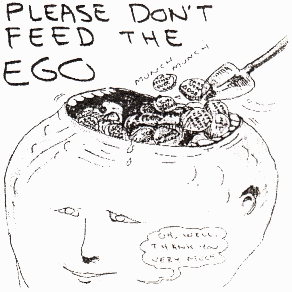
Follow my ego on Twitter @GSLLC

Hit Point Charts and Pregenerated Characters for War of Everlasting Darkness

More than a couple of you were appreciative of me sharing my hit point charts I use for running D&D Encounters (or D&D generally), so I’m sharing my next set for this season of Encounters: War of Everlasting Darkness. Please reference that past article for explanations as to read the document.

Hit Point Charts

This season, for lack of a better term, is weird. This isn’t a criticism, but it means that, among other things, I didn’t adjust the combats for parties of four or six players. Each encounter is actually better termed a “mini-adventure.” I suspect adjustments are a bad idea, even if you have seven or eight players, because you won’t have the time to finish the session if you increase the number of NPCs as well (unless you’re cheating and running this at home). Just run the encounters as written, adjusting on the fly as you see fit. If I see that adjustments are practical — I usually have 6 players at my table — then I’ll update the document.

As before, at the time I’m first posting this, I haven’t read the entire adventure. Please let me know if I need to perform edits for any reason. My schedule doesn’t allow me to make any edits during the week. Any changes will have to wait until the weekend.

Pregens

Because some of my players are kids without access to the character builder, and because the season takes the characters from levels 1 to 8 in eight sessions, I needed to create pregenerated characters as well, spanning those levels. I’m creating only two that are specifically designed for the players at my table. They use inherent bonuses, which is suggested by the adventure itself, and they’re designed to be very simple to run. Accordingly, if you like to optimize your characters, these will be disappointing (especially because I took so long to give Darthon Superior Will — I’m not redoing the work :)). However, I’m providing the character builder XML files as well, so if you sort of like what you see here, you can make some adjustments fairly easily.

The Links

Hit Point Charts

1st 2nd 3nd 4th 5th 6th 7th 8th
Slayer PDF  XML PDF  XML PDF  XML PDF  XML PDF  XML PDF  XML PDF  XML PDF  XML
Sorceror PDF  XML PDF  XML PDF  XML PDF  XML PDF  XML PDF  XML PDF  XML PDF  XML

Follow me on Twitter @GSLLC
Follow Wizards of the Coast on Twitter @Wizards_DnD

Hit Point Charts for Council of Spiders

For those of you running the Council of Spiders adventure for the latest season of D&D Encounters, I’d like to provide you with a game aid I like to use when DMing: D&D Encounters Council of Spiders HP Charts. These charts provide an easy-to-use format for tracking hit points and recording whether encounter powers have been used without requiring you to mark up your adventure book. If you’ve seen my 4th edition stat blocks for the gods of the Egyptian and Central American pantheons, this will be familiar to you.  Each creature has an entry that provides the creature name; the creature’s defenses; the mini being used to represent the creature; check boxes to record whether they’ve used their recharge, encounter, or daily powers; and their hit points, accompanied by columns to track damage.

First, I have some general comments for you. If the number of players varies at your table, you’ll  likely be adding or removing certain NPCs from the encounter. Those characters have their hit points provided in bold, italicized fonts to indicate they’re optional characters. Also, a recharge power is indicated by the American trademark symbol followed by a number (if applicable). Thus, the power Ricochet Shot, recharge  , appears as Ricochet Shot®5.

I generally use charts for minions only when the creatures have encounter or recharge powers; however, I’ve included them for all encounters in case you wanted them.

I’ve also included the DC charts that I stole from Sly Flourish. (Click that link. He has a lot to offer the D&D gamer.) I use them often enough that it’s useful to have them on hand on the same sheet of paper as the encounter charts. They’re in the footer of every page.

Finally, you’ll note the copyright notice at the bottom. I can’t help it. I’m an attorney focusing my practice on intellectual property law (and real estate law). I have to include it. Note that there’s also permission to use this for personal use. Basically, all that concerns me is the idea that someone might sell my work product. I doubt that’s a problem, and unless it’s your intent to do so, you won’t have any complaints from me. Don’t make money off of my work, and we have no issues between us.

As a final note, I’ll mention that, as I become more familiar with the adventure, I might add some notes to the pages that help remind me of key elements of the encounter that are easily forgotten or hard to reference quickly when buried in the adventure booklet’s write up. (For an example from last season, I had an italicized, underlined sentence that spelled out the schedule by which teams of skeletons animated as the combat progressed.) Feel free to come back here to see if I’ve updated the document or if you have any such suggestions.

In any case, I hope you find these useful. I’ve provided specific notes for each encounter. Mild spoilers follow.

Encounter 1

As mentioned above, the minion chart might not be useful here. If not, just ignore it.

Encounter 2

It seems strange to eliminate the Ambusher from this encounter if only 4 players are present, but technically he’s the appropriate one to eliminate. Again, the minion chart might not be useful here.

Encounters 3, 4, and 5

No notes.

Encounter 6

This is not likely to break out into combat, so stat blocks aren’t provided in the adventure package. I created stat blocks and placed them here so you wouldn’t have to bounce back and forth between encounters.

Encounter 7

The encounter is level 4, so but there’s only 1 level 4 character on the board: the Drow Acolyte. If you have 6 players, add another Drow Acolyte. Simple enough. Because of the importance of that character, though, removing her isn’t the best option if you have only 4 players. You’re obviously free to do so, but I chose to design the encounter blocks to eliminate 2 of the Drow Templars. YMMV.

Again, the minion chart might not be useful here.

Encounter 8

It makes absolutely no sense to eliminate Valan Jaelre from this encounter, though I guess it makes sense to add another character of his type. Nevertheless, to keep it simple, and to keep the spotlight on Valan as unique, I treated the Hex Knights as the NPCs that should be added or removed from the encounter to adjust for the number of players. They are also of level 4.

You’ll note that the recharge symbol for Valan’s Webbed Miasma power doesn’t have a number after it. That’s because it doesn’t recharge on a die roll. You’ll just have to reference the stat block or remember that it recharges when he’s first bloodied.

Again, the minion chart might not be useful here, especially considering there could easily be no Bone Spiders appearing during the encounter, and even if they do appear, there could easily be no more than one on the board at any one time.

Follow me on Twitter @GSLLC
Follow Mike “Sly Flourish” Shea on Twitter @SlyFlourish