Let's roll some dice, watch some movies, or generally just geek out. New posts at 6:30 pm ET but only if I have something to say. Menu at the top. gsllc@chirp.enworld.org on Mastodon and @gsllc on Twitter.
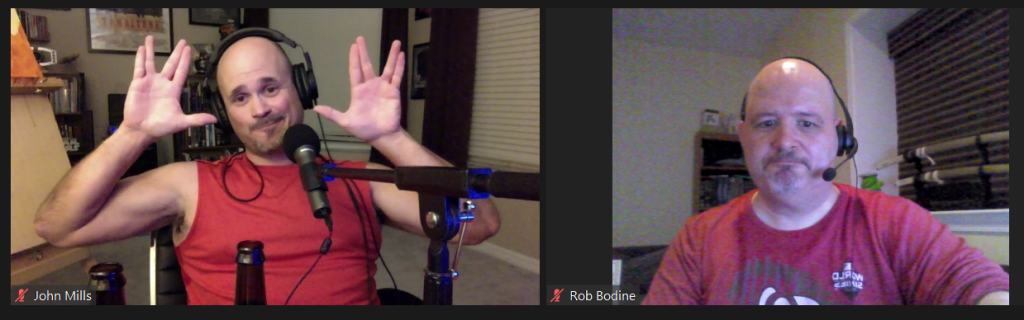
Back to Hulu I go, and this time I’m doing something really different. This is my first audio blog post, and I’m joined by my cousin, Kessel Junkie, who I give so much grief on this blog. This is our running commentary on a movie that’s certainly a guilty pleasure for both of us. No one else seems to like it, but we both love it.
Cue up the movie when instructed if you want to watch it with us. Kessel has clearly done his research on this movie, which is unsurprising considering 1) his love of the movie, and 2) the fact that he has a degree in theater. As a Star Trek nut that was raised on the theater (Arena Stage), I should be just as knowledgeable about this movie, but I’m lazy.
Just one note. There’s a point where Kessel Junkie changes the subject on me, and I don’t quite pick up on it, so we wind up talking past one another. I get his point. There’s an apparent canon violation between an episode of the Animated Series and this movie. Both have the Enterprise visiting a planet at or near the center of the galaxy. Fortunately, he’s wrong. The Enterprise was thrown into an alternate universe, so the fact that “God” wasn’t there isn’t a canon violation. Interestingly enough, “Lucien” was originally supposed to be God, but the network nixed that. Enough about that. Enjoy the listen.
No, we’re not related at all.
Click here for the audio file. Note: This is just over two hours long, and if you pause it, note where you paused. Pausing it often requires you to refresh the page before continuing.
To date, the films I’ve watched in this series were on Hulu. Now I must jump to CBS All-Access for the Voyage Home. They went all in on trying to make this comedic without losing the importance of what makes Star Trek Star Trek. Whether they succeeded is for each of us to decide. Don’t ask my opinion; I’m a Star Trek apologist.
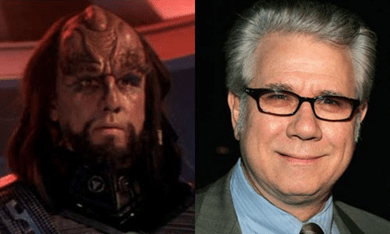
John Schuck played the Klingon ambassador. The first time I saw him was in a sitcom in the 70s, Holmes and Yoyo. He played a cop that was secretly an android. He occasionally malfunctioned, which was funny to a kid in elementary school but didn’t last long. If I recall correctly, it aired about a year after a show with the same premise started, only that show was a drama. Schuck has been a solid actor since 1969.
As I said before, I want to see V’Ger fight the whale probe. Both movies have the same basic premise. Human activity results in an alien probe coming to destroy the planet. Let’s see which of them
I always found it silly that cameras would make it appear as if a disabled ship was titling. Orientation is always relative to a reference point, and there’s no such point in deep space. But yeah, there are humans watching this movie, so I guess they must do that.
I think the pandemic has finally given me an understanding as to how Amanda Grayson must have felt living on Vulcan. I can’t hug, or even shake hands with, anyone. Neither could she.
I never liked time travel in movies. It always created stupid paradoxes. Avengers: Endgame did it right but raised the problem of multiple timelines that I also don’t like. It’s a burden to be me.
It took three seasons and four movies before we knew that Sulu was born in San Francisco. I’ve noted before that this is a good thing.
“It’s a miracle that these people got out of the 20th century.” Well, we did. Whether we can get out of the next century remains to be seen. I’m sure that’s a sentiment shared by every generation in every century.
“I’ll give you . . . $100.” “Is that a lot?”
To a high school kid in 1986, yes, but not now; not even to a kindergartner.
Just what is the future? / The things we’ve done and said? / Let’s just push the button / We’d be better off dead / ‘Cause I hate you / And I berate you / And I can’t wait to get to you / The sins of all the fathers / Being dumped on us, the sons / The only choice we’re given is / “How many megatons?” / And I eschew you / And I say screw you! / And I hope you’re blue too / We’re all bloody worthless. . .
I miss my boombox. Not really, though.
“Colorful metaphors.”
If he could mind meld with the Horta, he could mind meld with a humpback whale.
Spock’s the only one that can get the colorful metaphors right. Kirk’s so bad at it that he thinks Spock isn’t.
“I have a photographic memory. I see words.” This is probably the dumbest line in all of Star Trek, and that’s a high bar to clear.
I think there’s a script continuity error here. Spock agrees to Italian food but doesn’t go to dinner.
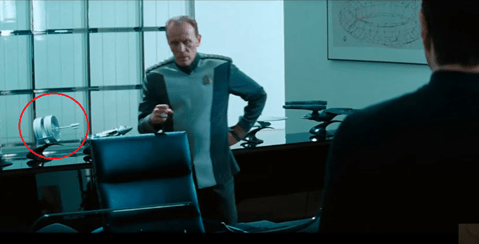
According to the novelization, Dr. Nichols, the one that’s given the formula for transparent aluminum by Scotty, is the one that supposedly discovered it in the Star Trek timeline. Temporal paradox resolved! “How do we know he didn’t invent the thing?” Paradox restored.
Poor Madeline. She did nothing wrong.
Now I want pizza.
Kirk seems confused. I guess they don’t have beer in the 23rd century. They have various forms of liquor, so maybe he simply doesn’t like it.
I don’t think two whales could repopulate the species.
My uncle, also an avid Star Trek fan, had recently served on the USS Saratoga when this movie came out. The Enterprise in the movie was the USS Forrestal, which is of the same type as the Saratoga. This gave my uncle a nerdgasm.
Kirk got the entire pizza that Gillian paid for. Smooth move, Captain.
“Of course, he’s a Ruskie, but he’s a retard or something.” Even a movie like this doesn’t age well. There’s always something that will send people into a frenzy.
There was a painted sign on the wall of the ship during Chekov’s escape. It said, “Escape route,” and had an arrow pointing the way. I shit you not.
Wouldn’t the cloak bleed over into anything nearby? It wouldn’t be a perfect cloak outlining the ship.
Finally, those lessons in miming paid off!
Wouldn’t it be funny if they just flew right into the sun? Everyone dies, Earth is destroyed, and we won’t have to deal with Star Trek: Insurrection. Everyone wins!
I know it’s not real, but I don’t see how the Klingon Bird of Prey could possibly be expected to float.
The scene where Kirk attempts to save the whales is the first scene where I started holding my breath while watching a movie. I wanted to see if I could do what they did. It’s an unfair test due to the scene jumps, but I try anyway. It’s safe to say that most of the time these scenes are bullshit, especially considering how much physical exertion is involved. The first time I was able to do it was recent: The second Kingsmen movie. For the first time, I came close on this one watching it this time. I still drowned though.
Again with the orientation thing. Why would the probe go vertical when speaking to the whales? There’s no vertical up there, and its communication can clearly reach anyplace in line-of-sight regardless of orientation.
Ironically, filming these scenes was probably tough on the whales.
So, now we’re left with a nagging question: What happens when George and Gracie die? That probe will do another U-Turn, and Picard’s going to have a bad day. They better figure out how to meaningfully duplicate the whale’s language.
Reading of the charges: Nichelle Nichols doesn’t seem to give a shit.
This alien looks like a toy.
Mark Lenard was as good at playing a Vulcan as Leonard Nimoy was.
I mentioned something similar in the Star Trek III post. How the hell did they not know exactly what ship they were getting? How would you even hide the creation of the 1701-A? I know; I know. Drama.
The score is nonstandard for Star Trek, but I liked it. Kessel Junkie? Not so much.
Tune in tomorrow when Kessel Junkie joins me for my first audio blog, which discusses Star Trek V: The Final Frontier.That’s where the real fun begins.
This is an important movie to me. As always, I’m going to be vague about why. There was a time when, for better or worse (worse, really, but necessary), I asserted my “independence.” This movie was part of that in a strange way. I will say that this is the first movie I saw in the theaters because I got on a bus, rode up to the (now closed) Aspen Hill movie theater, and bought a ticket with my own money. Twice. So, this movie is really important to me for reasons that don’t apply to any of you. Nevertheless, based on everything I’ve heard, I couldn’t believe how good its numbers are. Though I’m not sure how “scientific” Rotten Tomatoes is, I’m certain our personal experiences are even less so, so I shouldn’t be too surprised. Here are my viewing notes.
This movie starts with such high hopes, having us relive the most heartbreaking loss in Star Trek history.
That cadet that wanted a ceremony was a dingbat.
Christopher Lloyd was awesome as Kruge, and as with the Reliant, it was cool to see a new type of Klingon ship.
Are the Klingons still using 8-track tapes?
Why would anyone deal with the Klingons knowing they kill anyone working with them? Oh, wait I know why. Because the script says so.
The existence of Spacedock was also a no-brainer, but it was still cool to see it. The Excelsior was even better. As I said in yesterday’s Wrath of Khan post (and just above), it was neat to see other ship designs that we know must exist. The Excelsior represented the future as far as we knew; same-but-different. Who cares if Scotty liked it? The FASA Star Trek RPG really scratched that itch, but there’s nothing like seeing it on the big screen.
Scotty learning of his new assignment wasn’t the last time Starfleet told personnel their new assignments in casual conversation.
Hey, I know that Klingon!
Was Maltz once a prosecutor for the Klingon Empire?
And here’s another one: The USS Grissom. Another same-but-different design.
David’s hatred for Kirk was intense in the novelization, but in the movie, his brief interaction was polite. None of his thoughts on the matter were explored because there wasn’t any time to do so. The same can be said for David’s romantic relationship with Saavik, which wasn’t even hinted at in this movie. I remember a scene where they were criticized for taking the risky move of holding hands while being transported. Even more, Saavik’s Romulan side came out in the book. She was ferocious when provoked.
Hey, I know that Klingon!
As I mentioned yesterday, the novelization of Star Trek II: The Wrath of Khan didn’t have the “remember” scene in it.
Admiral Morrow was a dope. How can he not understand “Vulcan mysticism”? He must have witnessed neck pinches and, more importantly, mind melds. Plus, his mustache sucks, though it could be worse.
The highlight of Allan Miller’s career.
“How many fingers do I have up.” “It’s his revenge for all those arguments he lost.” “Up your shaft.”
🙂
I remember an interview with Nichelle Nichols. She was initially disappointed in the size of her role. She thought it was too small but eventually was happy with it considering how important it was. The novelization went into her role much more deeply.
I hoped we’d see James B. Sikking again. The reason we didn’t is because Sulu took over as captain of the Excelsior. In fact, in the novel, he was already assigned to do so. As they were stealing the Enterprise, Sulu reflected on how he was throwing away that opportunity. This also explains why This brings up an anecdote. George Takei lobbied heavily for Sulu to become captain of his own ship. I remember Howard Stern making fun of him for it, saying, “You realize that Sulu becoming captain of another ship means you’re out of a job, right?” Takei stood firm. I guess it worked out. By the time he got the Excelsior, it was this crew’s final movie.
So, they find a young Spock. That raises an issue for me. When Spock’s consciousness goes back into his body, what happens to the personality of the new Spock. However briefly he existed, he’s a separate person. Is the new Spock wiped out, or are the two personalities merged? What are the ethical ramifications either way?
That Klingon dog was ridiculous.
“Range, 5,000 killicams.” Why? Why are they speaking entirely in English but use a Klingon unit of measurement? They’re speaking Klingon, of course, and we’re hearing what we would assuming there was a universal translator present. Wouldn’t the universal translator also translate the range into units we’d understand?
The conversation between Kirk and his son, David, was the most cordial David was regarding Kirk in the novel. Then David dies, and Saavik says, “Admiral, David is dead.” After that, she goes nuts and attacks the Klingons. This is what I was referring to when I said she was ferocious.
I was hoping Kirk would say, “No tricks once on board.” That would have been a good call out to the Original Series episode, Day of the Dove. That reminds me: Kang is currently running around somewhere in the Klingon Empire.
Beaming down to a dying planet was a risky plan.
Klingons are like the Drow in D&D. Their society and psyche could never work in the real world, but we overlook that because they’re cool. That is, if Klingon captains are so eager to die, you won’t have many qualified captains running around. Deep Space Nine pulled back on that a little bit, but perhaps not enough. They are cool though.
You know, Kirk left the remaining Klingons on the planet knowing they’d die.
The refusion scene had me thinking about Star Trek: The Motion Picture. Boy did that drag even though it really wasn’t that long. They wanted to give you the feeling that it took hours, but the verisimilitude was broken because no one left to pee. The same could be said about Spock wandering around in a confused state (except the peeing part). Overall, though, a good ending.
Continuing my revisit of all the Star Trek movies brings me to the gold standard of sci-fi movies, liked by virtually everyone that saw it. This entry is a little shorter than the last, not so much because the movie is shorter, but because I kept getting distracted. I wanted to watch the movie itself.
In an early version of the script, the opening scene took place in the middle of the movie, so it wasn’t a surprise. I’m glad it didn’t stay there.
Everyone I’ve ever heard say the name of the Kobayashi Maru pronounces it ma-RU. I do so myself. It’s actually pronounced MA-ru. Aren’t we all stupid?
If one photon torpedo can take out your helmsman, your ship’s design sucks. Depending on whom you ask, ordinary cars of today make the driver’s seat the safest place in a car.
Saavik seems irritated. So illogical. Of course, in the novelization it’s revealed that she’s half Romulan.
Shatner is such a wonderfully shitty actor.
The Reliant was wonderful. Not only was it a cool design in general, but it was also the first starship design we saw that wasn’t a Constitution or Enterprise class. Sometimes all it takes is a single piece of data to inspire your imagination to run wild and fill in the gaps they don’t have time to provide. The FASA Star Trek RPG helped me in that regard.
The Reliant’s scanners suck. Weather notwithstanding, how did they think that a bunch of humanoids and cargo carriers were just a single “particle of pre-animate matter”? Their computers must also have sucked. How did they not know that there was a colony of genetic supermen living on the planet next door? When Terrell and Chekov saw the cargo carriers, they should have figured it out. *sigh* The things we tolerate for drama. And yes, I know Chekov never met Khan, but that doesn’t mean he wouldn’t know the story. He served on the Enterprise for years after that incident, which was a matter of Starfleet record. That part was not a continuity error.
Now that’s what I call an earwig.
When I was a kid watching this in 1983 (when it hit TV), I was confused by Spock referring to Saavik as “Mr. Saavik.” I thought, “Wait, is that a dude?” I should have figured it out. My favorite episode of any Star Trek series is Balance of Terror, and in it an officer refers to a female subordinate as “mister.” The subordinate happens to be his fiancee. The FASA Star Trek RPG taught me the generic use of that term. Never underestimate the educational value of RPGs.
Piloting a ship out of space dock? I never thought the buildup was worth the payoff. I’m sure I could do it. All Saavik did was say, “Hey, you guys, do your jobs,” and everyone else did all the work. Managers think way too much of themselves.
Khan’s followers know how to talk to him: Appeal to his inflated ego.
I never forgot an interview that Ricardo Montalban did on the character. A specific part always stayed with me: Basing his approach to the character on this overwhelming rage that built up over 15 years or so.
Go to 3:12 to hear what I’m referencing.
A jump scene (bloody arms) immediately after a fake jump scene (door opening to Kirk’s face)? Not scary.
“But he was late. He had to get back to Reliant in time to blow you to bits.”
Was that supposed to be a joke? It wasn’t funny. It didn’t even appear to be an attempt at funny. What an odd line.
The worm thing continued to scream even after it was liquified by Kirk’s phaser. Duh.
As I said, Shatner is such a wonderfully shitty actor.
I was annoyed about a scene in the 2009 Star Trek reboot. In Kirk’s talk about his cheat on the Kobayashi Maru (yeah, I just said that in my head as ma-RU), he mentions that he received a commendation for original thinking. The fact that the universe was rebooted doesn’t explain why Star Fleet would swing 180° and place him on suspension.
“Explain it to them.”
Yeah, okay, since you’re threatening to kill us, we’ll stop going into the nebula. We’ll stay out here so that you can kill us more easily. Not much of a threat, huh?
Kirk also knows how to talk to Khan: Appeal to his inflated ego.
The way Kirk beat Khan was perfect. Exploit the fact that he’s from the 21st century, and thus doesn’t think three-dimensionally. (We’re all assuming there are no aircraft pilots among Khan’s bridge crew.)
After seeing Star Trek III and reading the novelization, I went back to the novelization of this movie. It confirmed my recollection: The “remember” wasn’t in the book. How could a book not have something important that the movie did?
As a kid, I was disappointed that Khan didn’t see Kirk get away. Then I grew up and shed such prideful notions.
Spock’s death was heartbreaking, especially for a kid watching it.
On a final note, I think it’s appropriate to provide this visual.
It’s time to revisit all the Star Trek movies. It’s my favorite intellectual property, but don’t expect me to act the apologist. As my friends will attest, I’m happy to criticize the things I love, but there’s a lot to love here as well. The things we tolerate for drama. *sigh* This post doubles as an entry in my Guilty Pleasures; it wasn’t well received by anyone. It isn’t the first Star Trek movie to be in that category, and it won’t be the last. Here are my viewing notes.
Nice theme music. I remember getting into a mild argument with my uncle. I claimed that they reused it for the Star Trek: the Next Generation series. Guess who won that argument.
“I’m so offended they changed the Klingons! How can we explain this in canon?!” The FASA Star Trek RPG did so brilliantly (which they adapted from John M. Ford‘s work), and the canon explanation from Star Trek: Enterprise wasn’t bad either.
Trivia: Mark Lenard was the first actor to play three different species in the Star Trek universe. In my favorite Star Trek episode, Balance of Terror, he played a Romulan commander. In Journey to Babel, he played Sarek, Spock’s Vulcan father. In this movie, he was the Klingon commander. If I’m not mistaken, it wasn’t until Jeffrey Combs played Shran that someone else accomplished the feat. I’m not entirely sure about that though. It could have been Tony Todd or Joseph Ruskin. I’m too lazy to look it up.
I’m not even three minutes into the substantive content, and we’re already getting a scene with unnecessarily long exterior views of things that don’t matter. We get it. The space station is big. Really big.
Ooooo, a backwards-firing photon torpedo. We’ve never seen that before. Wait. Why not? How stupid were the designers of these ships?
I don’t think the movie ever explained that the voice calling out to Spock was Kirk’s, not V’Ger. I seem to remember from the novelization that it was Kirk. I read the novelizations of the first five Star Trek movies. Yeah, that includes the Final Frontier. That book was pretty good. Sybok could have been the best villain ever.
Poor Sonak. He didn’t realize what was in store for him, but he almost deserves it. You’re not Spock, Sonak. Don’t raise your eyebrow like that. It’s a Spock thing, not a Vulcan thing. (It became a Vulcan thing, but it shouldn’t have been.)
Why is the Enterprise the only ship in range to intercept? They’re on Earth, which is the center of government for the Federation. Shouldn’t there be at least a few ships nearby? This isn’t the only time this nonsense was used as a plot device.
And here’s the unnecessarily long exterior view that everyone talks about. I really should fast forward through this one, but writing these notes is distraction enough to make it bearable.
The engineer on the floating disk is probably violating OSHA regulations.
All these actors are amazing. I actually believe they’re happy to see William Shatner arrive.
The real reason Decker was relieved of his captaincy was that he was molesting children. (Too harsh?)
The other person in that transporter malfunction had a pretty decent treatment in the novel. Here, she wasn’t even named.
The crowd of crewmen included a lot of diversity. The rest of the movie? Not so much.
Chekov’s smile when Ilia enters is classic. Sulu tried and failed.
McCoy should have kept the beard for the entire movie.
I don’t think wormholes work that way, but I’ve never been in one. From a dramatic perspective, the scene wore out its welcome not even halfway through it. It had the same effect as any of those external shots.
Kirk needs a ready room.
I’m sorry. That you left Delta IV? Or that you didn’t say goodbye? If I had, would you have been able to say it?
Now picture me rolling my eyes so hard they fall out.
I made a simple ST:TMP game on my Commodore Vic-20. There wasn’t a lot of memory to do anything impressive, but it was a good way to connect with the movie.
More external shots. Yes, we know. This thing is even bigger.
Was V’ger related to the Borg in some way? There’s a non-canon story line that says so, but I want that resolved in canon. Hey, what about Control? Could V’ger close a temporal loop by being related to Control?
Oh, Ilia. ☹ She’s so scared.
“This is how I define unwarranted!” How did Decker make Captain? Space travel is risky business. If you can’t handle it, don’t do it. They’re trying to save Earth. There are billions of lives at stake. You must take risks.
Spock is a seer. He can see the future.
The computer’s assessment of what’s going on
Why is the Ilia probe wearing clothes? This isn’t wishful thinking. She was created in the shower without clothes, and then they were added before it exposed itself.
My memory of the novel tells me that it went into a ton of detail about the scan of the probe. It was . . . . fascinating.
Why didn’t the door open for the Ilia probe? She shouldn’t have had to break through it. They’re automatic. We already know it’s extremely strong.
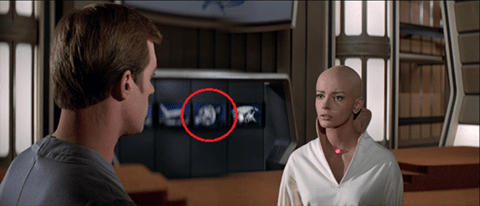
In one of his posts, Kessel Junkie claimed that this ship. . .
Spock getting emotional over a handshake. It’s as if millions of Vulcan voices cried out in terror.
I want to see V’Ger fight the whale probe.
Nimoy was wearing a lot of makeup.
“Mr. Chekov, when do those probes reach their final destination?” “Fifty-seven minutes.”
What? That means that there’s got to be 57 minutes left in this show for the ending to have a close call! Oh, there’s only 20 minutes left. Phew!
“Captain, I’d like to go along.”
Of course, you would, Commander Decker. Someone’s got to die.
In 1979, I was 11, so the big reveal (i.e., “VOYAGER”) surprised the hell out of me.
Couldn’t they just hit Voyager with a phaser? That’s the whole ship’s brain.
“Jim, I want this. As much as you wanted the Enterprise, I want this.”
Again, how did this idiot become Captain (of the flagship, no less)? It must have been nepotism.
In a sense, this was the perfect Star Trek movie. Lots of human drama, and a “villain” that represents the unknown of space, while representing a cautionary tale for humanity itself: Our actions will always have consequences. But that doesn’t resonate well with non-Star Trek nerds. It didn’t have the face-to-face villain that everyone craves. That’s because the first movie is always about the protagonists, with the sequel about the villain. Maybe the next movie will fare better with the masses. 😊
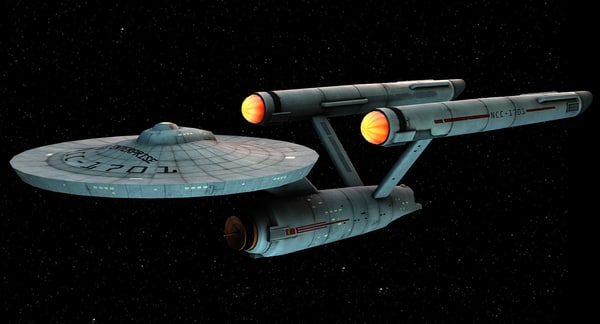
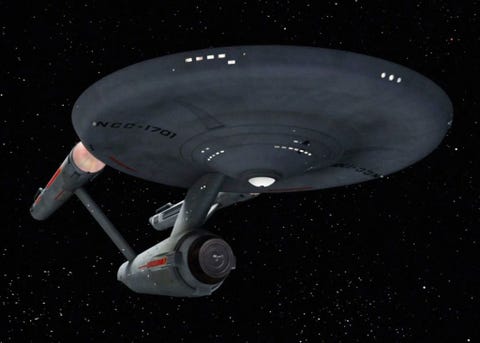
My cousin, Kessel Junkie, published a blog post that stole an idea from me. That he inspired. And that’s been done since the concept of a list was invented by cavemen. How he can look himself in the mirror is beyond me. Not to be outdone, I’m going to list my favorite StarTrek ships.
#5. NCC-1701: The Enterprise
#4. NCC-1701: The Enterprise
#3. NCC-1701: The Enterprise
#2. NCC-1701: The Enterprise
#1. NCC-1701: The Enterprise
I know what you’re thinking. Shut up. I’m feeling goofy, and that’s a large part of what Star Trek is about.
I swear this is my last list of favorites. Unless I have another idea for one.
If you enjoy this post, please retweet it. Other posts in this series can be found here: No Small Parts.
Great Shatner’s ghost! I can’t believe how long it’s been since I posted about Star Trek. It’s my favorite entertainment property, yet I’ve been so focused on the superhero stuff and random Netflix movies that I haven’t watched any Star Trek recently. Ironically, it was the Iron Man quarantine watch party on June 30, that inspired this post (as well as this one and this one).
— Rob Bodine #QuarantineWatchParty Fiend (@GSLLC) July 1, 2020
I haven’t seen a lot of Faran Tahir, but I’ve been impressed by everything in which I’ve seen him, including his role in Iron Man. That role wasn’t small, but this post is about Captain Robau from the 2009 reboot of Star Trek. George Kirk (Chris Hemsworth) gets the credit for his sacrifice, and that’s fair, but it’s clear that he was following the teachings of his captain, played by Mr. Tahir. Captain Robau set the tone for the scene, and the entire movie, by remaining completely calm during the brief negotiations and immediately complying with Nero’s demands despite the danger. He didn’t do this because he was without fear – his bio signs indicated an elevated heart rate, rapid breathing, and other signs of emotional distress – but because leaders don’t have the luxury of personal considerations. If you take responsibility for other people’s lives, you need to live up to that.
Captain Robau was a strong character, and his leadership set the tone for a movie that was as much about leadership as it was about friendship.
If you enjoy this post, please retweet it. Other posts in this series can be accessed by clicking here.
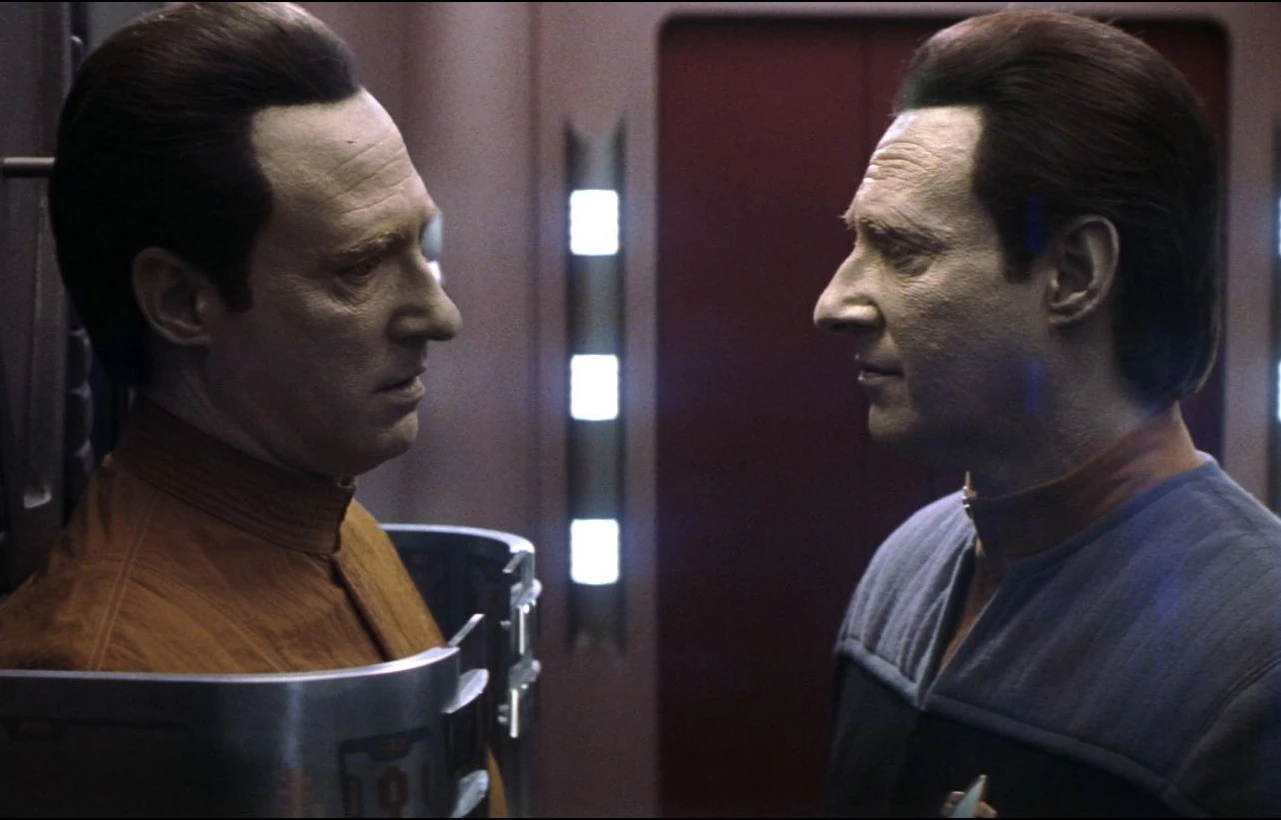
Star Trek X: The Search for Data
Rotten Tomatoes reports scores of 38 from the critics (who I don’t care about) and 49 from the audience, both of which are rotten scores. Nemesis is certainly a guilty pleasure, and I get that. Troi porn, a childish android, and the worst toast in the history of weddings are just a few of the examples of why this movie earned such low scores, but it had some good points. Moral philosophy is the foundation upon which Star Trek was built, and at its heart, it was an examination of the nature v. nurture debate. Nevertheless, it didn’t skimp on the action.
The goal of the movie was to recapture the magic of Star Trek II: The Wrath of Khan by giving Picard a fitting nemesis, just as Wrath of Khan gave Kirk his, and by having Picard suffer a loss as did Kirk. Nemesis is no Wrath of Khan, and Shinzon is no Khan, but SPOILER ALERT being Picard’s clone inherently made Shinzon a good match for Picard, and Shinzon’s lifetime of pain resulted in a rage mimicking that of Khan. Data’s death also mimicked Spock’s. I didn’t find this to be lazy plagiarism as it’s sometimes been labeled. There are only seven stories, and this story used the themes that have been proven to appeal to Star Trek fans (and non-fans).
The movie also set up the Picard series in a couple of ways. It set the foundation for Picard’s connection to the Romulans, and Picard resolved Data’s story without cheapening his death in Nemesis.
Sprinkle in the fact that I’m a Star Trek apologist, and I like this movie. You don’t have to.
I can’t tell you why, but I was reading a Cracked article that caught my eye. It was on the difficulties that Disney will have in creating Episode IX. Cracked has lost its step, but it triggered (pun intended) something in me that has inspired this post. I doubt that my argument is particularly novel, so just consider this me throwing my hat into the ring for a particular perspective.
There are a few points I should raise before diving in. You’re free to form your own opinions, and that won’t change mine, so I won’t justify any of these points. I provide them only for context which is necessary to my discussion.
Go to 2:28. Here’s an image of the relevant portion of the J.J. Abrams interview (also pasted at the bottom of this post).
2. The J.J. Abrams Movies.
I liked (not loved) Star Trek 2009 and Star Trek Beyond. Star Trek Into Darkness was insulting to every Star Trek: The Original Series (“TOS”) fan, whether or not they realize it. At every point in that script, J.J. was insulting us by mangling the characters and ridiculing our sacred cows. He then had the temerity to justify this by referring to these events as “homages” to the original. (Into Darkness was the only time in my life I genuinely felt nerd rage. Usually, I just roll with it because no one owes me anything, but that was too much.) As for the Force Awakens, I also like (not love) it but felt that the Last Jedi was a below average film. I’d watch the Force Awakens again but not the Last Jedi.
3. Star Wars EU.
I know extremely little about the Star Wars Expanded Universe. If any of my ideas are identical to something in the EU, I wouldn’t know it.
I’ve never seen it, so I have no opinion as to whether it’s good or bad.
Not all people are me.
What J.J. Is Likely Thinking
There have been countless memes, Facebook posts, and Tweets criticizing legacy Star Trek fans for being hypocrites. The argument goes something like this: “You say you wanted something new, but when J.J. gave it to you, you complained about it. He can’t win with you, so why should he care about you?” This was inspired by the flak J.J. caught from legacy Star Trek fans for the “Abramsverse” (i.e., his version of the Star Trek universe). In the first and third movies, he didn’t rehash any old Star Trek stories, but instead included an origin story and then a largely new story. I haven’t talked to J.J. nor have I seen him address this in any interviews, but I believe that he interpreted that hate as anger at telling a new story.
Why do I believe he holds this opinion? When creating The Force Awakens, he seemed to have decided at that point that the safe bet was to give fans the same story. The Force Awakens is essentially a retelling of a New Hope. As the Cracked article points out, J.J. Abrams is “nothing if not risk-averse.” I’m aware that J.J. received the same criticism from the fans (including me) for Into Darkness despite that being a retelling of one of the classic TOS stories, but based on his approach to the Force Awakens, I suspect that he saw that hate as riding on the coattails of the hate from Star Trek 2009.
Why J.J. Is Wrong
Based on his direction for the Force Awakens, J.J. probably is having a hard time reconciling the criticism with Star Trek 2009 and Star Trek Beyond with the criticism of Into Darkness. He apparently doesn’t see the connection that all three movies have, which is actually the source of legacy fan anger. The reason people reacted so poorly to Star Trek and the Force Awakens isn’t because he was telling a new story; it was that he completely wiped out everything that we loved so much from the past. In the case of Star Trek 2009, the entire timeline was erased, and not because he wanted to tell a time-travel story. J.J. wanted to wipe out this universe and its characters that he hated so much and rebrand them to his liking. It’s going to be tough, in general, to make legacy fans happy when you tell them that everything they loved so much never happened and doesn’t matter. Only the sycophants will enjoy it as much.
Flash forward to the Force Awakens. Everything the Ewoks (and I guess the rebels too) accomplished didn’t matter, because in the end the Empire survived, just with a different name. That happy ending from Return of the Jedi was an illusion, which means the next time you watch Return of the Jedi, you should do so with a heavy heart knowing that tyranny and global destruction is just a few years away. Hell, Rian Johnson even screwed this up going from the Force Awakens to the Last Jedi. The profoundness of Rey extending Luke’s lightsaber to him was completely undone when he tossed it away. That joke wasn’t worth what it (un)did to the new trilogy.
Now let’s go off on a slight tangent. The same thing happened with Ghostbusters. Sure, it’s easy to slap a label of “misogynist” on a critic of that movie (as many of you did with the Last Jedi). That way, one can simply dismiss the complainers as bad people and give themselves an excuse to ignore the complainers’ pesky logic. But notice that those same complainers are very excited about the new Ghostbusters movie that’s coming out in 2020. They’re excited even though they have no idea whether the main characters are going to be male or female; black or white; or Jew, gentile, or atheist. That’s because, as far as I can tell, only a statistically insignificant number of people care about that sort of thing. The internet, and the psychological need to look at train wrecks, gives those people more attention than they merit. Most people just want a good movie, but if the franchise is important to them, they want such stories to hold that franchise’s legacy intact. (That said, it’s always bothered my that Ghostbusters II basically undid the happy ending of Ghostbusters, so Rian Johnson was by no means the first filmmaker to make this mistake.)
J.J. Could Have Had It Both Ways
It didn’t have to be like this. I’m not a creative writer (as you can probably tell), so don’t hold me to the details, but let’s see if I can fix this.
Let’s start with Star Trek. Kirk’s origin story was never fully told in Star Trek canon prior to that movie, but there are some rough details we know. You didn’t need to change the timeline in order to provide such an origin story. If they had just told Kirk’s origin story within the prime universe, perhaps including stories that were mentioned in TOS (or better yet, dealing with their aftermath), they could have given 100% respect to canon while still telling a new story that everyone has been asking for. The movie could still end with the crew as we know it coming together. Star Trek Discovery, which I love, is doing something similar, so while it has its complainers, it’s quite popular. There’s no hypocrisy here. Star Trek fans really do want new stories, just not at the expense of old ones. For long-time readers of my blog (all two of you), you may know of an exception to this rule that I endorse. For the record, Star Trek Into Darkness shouldn’t have been about (spoiler alert!) Khan; it should have been about Sybok. There’s nothing wrong with retelling a story if you’re getting it right this time.
For Star Wars, I would have made the new trilogy about the rise of the new Sith Order. Imagine that there’s no “New Order,” which means the Empire was indeed defeated, leaving the catharsis of the original trilogy’s ending intact. In the years since Return of the Jedi, Luke Skywalker starts a new Jedi Order, and his nephew, Kylo, is one of the padawans. Kylo is approached by Darth Plagueis either as a Sith ghost or as a reincarnated Sith. (Both can be reconciled with the Tragedy of Darth Plagueis.) Plagueis corrupts Kylo and takes him on as an apprentice. Notice that so far, a lot of this story is exactly what we have without undoing the value of the original trilogy. Kylo kills Plagueis, who then creates a new Sith Order from among Luke’s other padawans, abandoning the Rule of Two (i.e., “Only two there are. No more; no less. A master and an apprentice.”) Kylo considers the Rule of Two misguided, blaming it for centuries of Jedi domination of the Sith. Kylo believes that he’s found a way to manage the selfishness inherent to the Sith, which could make a Sith Order work. Now you have a new story, which is absolutely a Star Wars story, but respects canon 100%. While I expect most fans would enjoy this, I can accept the possibility that this story may not appeal to the masses. My point, however, is that I just provided an outline for a potentially enjoyable Star Wars trilogy that’s both novel in its approach and consistent with canon. That’s what the complainers want, and the new fans would have enjoyed it just as much. Everyone wins.
For Ghostbusters, they should do exactly what they’re planning to do: Continue the original story. I’ll leave it at that.
Conclusion
I have a degree in physics. I’ve studied rocket science. This isn’t rocket science. This is about familiarity, but not story-based familiarity. The familiarity comes from the setting. Give us new characters, using the old characters to pass the torch if possible. Give us new stories, but within the same exact universe so that the old stories still matter. Unnecessarily wrecking our childhood is the crime. The new characters and stories should still make the kids happy without pissing off the ones that are telling them to get off their lawns.
What does this have to do with Sybok? I don’t care, and neither do you.
As opening night for Star Trek into Darkness (also my birthday) approaches, I wanted to make sure I reserve the opportunity to say, “I told you so,” even though there’s little chance that opportunity will actually present itself. My cousin, John (aka, @kesseljunkie) and I are big fans of the much-maligned Star Trek V: The Final Frontier (“TFF”). As a movie, it has its share of problems, but as most of you will agree with that statement, I won’t bother to justify it. Where I will take you to task, however, is with the character of Sybok.
Just a Little Misunderstood
As one of the six or so humans on the planet that actually read the novelization of TFF (John being one of the others), I have a deeper appreciation for the character of Sybok. Sybok was not just some lunatic. His reasons for accepting emotion spring from his mother’s views, which were seen as heretical by most of Vulcan. As geeks that are stereotypically considered outcasts for our interests, this is a character that we should have all embraced. Unfortunately, Sybok’s backstory was never fully developed by the film. This is understandable, as a book always has more room to do so than a movie, but it was a missed opportunity to say the least. While we didn’t necessarily have to agree with Sybok, we should have had a ton more sympathy for him, but unless you read the book (or are a completely delusional Star Trek apologist unable to criticize the franchise at all), you probably weren’t left with the same impression as I.
A Perfect Antagonist
I googled for an image of Sybok, and got this one … from kesseljunkie.com. I shit you not.
The destruction of Vulcan gave us the opportunity to revisit and reimagine Sybok. This is a Vulcan who embraces his emotion, and his people were all but wiped out because of Star Fleet’s failure to protect the planet. Sure, that’s an unfair criticism in light of the advanced technology of the attacking ship, but people who do bad things, especially when motivated by anger, generally don’t have the firmest grip on logic. In fact, that’s the whole point of Sybok’s character. He has all the advantages of being a superhuman Vulcan without the logic to restrain his selfish impulses. There’s a lot of potential for a good story if a cataclysmic event pushed him over the edge.
Could I Be Right?
The trailers and actors’ interviews have hinted at reasons Sybok could be the villain. Cumberbatch jumps from a great height and exhibits exceptional strength by throwing around a large piece of metal during a fight. (Vulcans are stronger than humans.) Cumberbatch has referred to his character as a terrorist, but one that thinks he’s doing the right thing by Star Fleet. (This is right in line with the way Sybok thinks and acts.) Sure, Sybok wasn’t a Star Fleet agent in the other timeline, but with the destruction of Vulcan, and with few friends among the survivors, perhaps Sybok was recruited for a task for which he was quite suited: Getting revenge on the Romulans. We know the Klingons interacted with Nero from the last movie, and we know they play a role here. Perhaps they’re siding with Sybok, who’s changed his mind about what he has to do.
Hey! That’s not Kirk’s shirt color!
John pointed out to me that the scene from the trailer where Kirk and Spock are performing the “live long and prosper” salute through a pane of glass (mimicking their last actions in Star Trek: The Wrath of Khan) in fact could be Spock and “JohnHarrison.” It’s clearly Spock, but the other sleeve is charcoal in color, which is the color shirt Cumberbatch is wearing while standing behind the pane of glass. The voice over then says, “Is there anything you wouldn’t do for your family?” Was that line spoken to Kirk, whose family hasn’t played a significant role in the reboot, or Spock, who is Sybok’s family?
Does all of this mean that John Harrison must actually be Sybok? Of course not. He could easily (probably?) be an augment, or perhaps even the Khan (which would be a tremendous shame). Gary Mitchell seems unlikely at this point, but still a possibility. All I’m saying is that Sybok would be a reasonable choice based on everything we’ve seen, and in this author’s humble opinion, would be the best choice. It would throw off everyone, and it would open the door to a proper telling of the character’s backstory.
But No
All that being said, I doubt it’s Sybok, but if it is, the IMAX Airbus theater in Chantilly, VA is going to have at least two geeks standing up during the big reveal, shouting, “Nailed it! We told you so!” (8:55pm showing on May 17 if you’re interested.)
But probably not, and that makes me a little sad.
Side Note: Why Not Khan?
For those not wanting to read the IO9 article to which I linked, let me explain quickly why Cumberbatch shouldn’t play Khan (besides the obvious concern of “been there, done that … twice already”). Back in the old days when Star Trek was less about bells and whistles and more about story and the big three, almost every episode was a kick in the gonads of racism. What could possibly be more ironic and insulting to the “superior race” crowd than a “master race” led by a “darkie.” An Hispanic actor playing an Indian superman? Perfect. The Nazi’s were turning in their graves. Casting a white guy to play that role misses a lot of the point Roddenberry was trying to make. By itself, it won’t ruin the film or the Khan character, but it would make the character a little less meaningful.










 Play What You Want