Let's roll some dice, watch some movies, or generally just geek out. New posts at 6:30 pm ET but only if I have something to say. Menu at the top. gsllc@chirp.enworld.org on Mastodon and @gsllc on Twitter.
On Friday (July 23, 2021), I mentioned that I was relearningAD&D 1st Edition (“1e“) with the intention of running it. As I read through the Player’s Handbook (“PHB“), certain mechanics or text will strike me as odd or surprising, but in either case worthy of discussion. In fact, the most surprising thing I’m experiencing is that I’m finding a lot more great ideas in 1e that we’ve since abandoned. I find myself asking, “Why?” As a result, I’ll be writing several posts over the next few weeks. I’m sure everything I’m thinking has been discussed before — sometimes be me — so perhaps my questions have been answered, and my concerns resolved, years ago. My experience with RPGs is relatively limited in scope, having played a small number of games, so I’m sure a lot of what I’m going to say has been incorporated into games I’ve never even heard of. (Some have certainly been addressed by future editions of D&D themselves.) Nevertheless, bringing this directed conversation to the public is new to me, so here it goes.
I’ve already discussed this but am going to repeat the argument here: You should never have a +X amulet, shield, suit of armor, weapon, etc. It’s boring, and the bonus is illusory anyway.
DMs balance encounters to suit the game they want to run. Maybe they want the encounters to be average, harder than average, or easier than average, but whatever the balance they want, that’s what they want. Let’s say a game is designed such that we can assume our characters will get a +1 weapon by 3rd level. If that happens, are all the encounters suddenly too easy for the party? Of course not. When I say that a “game is designed such that we can assume our characters will get a +1 weapon by 3rd level,” what I’m also effectively saying is that the monsters the characters will face at 3rd level also receive that same bump. That maintains the balance the DM seeks without having to mess with the level of the monsters. In other words, the bonus is illusory because it must be met, bonus for bonus, by the monsters. 1e makes things a bit more interesting using tables to determine randomly the precise magic item you find (as well as some other things like level drain and ability score drain being assumed), but even those items are balanced for a range of levels. I’m not satisfied by that, but at least there’s something interesting going on, so I can understand why someone else may be. But getting just a +2 weapon? C’mon, people.
Here’s a better solution, and one that all games use in part anyway: Be creative. Create interesting magic items, such as 1e‘s scimitar of speed, or 4e‘s frostbrand weapon. Sure, these weapons also give you an illusory combat power that must be balanced by increasing the threat of monsters, but the point is that they make things interesting. The 1escimitar of speed is fun because you can attack even while the rest of your side is surprised. With a frostbrand weapon, the Fighter can use tactics to line up the enemies in such a way as to hit multiple targets with a blast. Without stealing the Wizard’s thunder, for just a fleeting moment, the frostbrand weapon let’s the Fighter act as a Wizard using a blast power, and it feels like an accomplishment with respect to tactics. If the enemies are vulnerable to cold, that’s gravy. Even 3earmor of acid resistance, which is a passive effect, would give a character their chance to shine. The fighter wearing that could run headlong into a fight against a black dragon and nearly single-handedly save the day. Maybe. Dragons are tough. In any case, those are interesting magic items.
Well, not all dragons are tough.
On the other hand, who actually thinks it’s fun to add 6 to your attack rolls rather than adding 5? There’s nothing fun or interesting about that, and that’s the primary mechanical difference between a +X weapon and a nonmagical one. The only other one I can think of is that some creatures can’t be hit by nonmagical weapons, but not having magical weapons in those scenarios just means every encounter is a TPK. That means the boon of finding a +X magic item is, in all meaningful ways, illusory. It adds nothing to the mechanics or fun of the game. But here’s the other thing. Even if you think getting a +X weapon is fun (in which case you’re weird), would you miss it if it were gone? Wouldn’t you be just as happy with a scimitar of speed as you would a +X weapon? If so, then eliminating +X magic items from the game keeps everyone happy. Accordingly, 1e has a lot of cool magic items, and those are the only ones I’ll ever hand out.
You may be fooled by illusory bonuses, but I’m not.
On Friday (July 23, 2021), I mentioned that I was relearningAD&D 1st Edition (“1e“) with the intention of running it. As I read through the Player’s Handbook (“PHB“), certain mechanics or text will strike me as odd or surprising, but in either case worthy of discussion. In fact, the most surprising thing I’m experiencing is that I’m finding a lot more great ideas in 1e that we’ve since abandoned. I find myself asking, “Why?” As a result, I’ll be writing several posts over the next few weeks. I’m sure everything I’m thinking has been discussed before — sometimes be me — so perhaps my questions have been answered, and my concerns resolved, years ago. My experience with RPGs is relatively limited in scope, having played a small number of games, so I’m sure a lot of what I’m going to say has been incorporated into games I’ve never even heard of. (Some have certainly been addressed by future editions of D&D themselves.) Nevertheless, bringing this directed conversation to the public is new to me, so here it goes.
A friend and I have been designing our own RPG. We’re so busy with ordinary life that I doubt we’ll finish it, so don’t expect it to see the commercial light if day. Still, I enjoy the process so much that I love working on it when we can. One thing that was on my mind during design was my attempt to make a non-violent wizard (“NVW”). I wanted to create a pacifist that could still contribute to the combat but do so without ever directly causing damage. My attempt at a NVW was Ymitraa Warwager, a CG moon elf abjuration wizard under D&D 5th Edition (“5e“). To start, her combat-useful spells were Blade Ward, Minor Illusion, Shocking Grasp (only because I ran out of non-violent spells), Color Spray (considered non-violent because the blinding was only temporary), Shield, and Sleep. It didn’t work because the only aggressive but non-violent spell that I’d always have available (cantrip) was Minor Illusion, and that worked only because the DM (Sly Flourish) allowed me to cheat with it. As I progressed, I saw very few useful spells available, and I wasn’t interested in rewriting the game, let alone having Mike approve each rewrite.
NVW Don’t Work Because of a Lack of Flavor
My conclusion was that 5e failed in this regard, and when my review of 1e brought this memory back to the surface, I started writing a piece on how modern games have lost that focus on flavor. More to the point, prior editions (as well as other games) never made me feel that my enchanter was actually enchanting, or my illusionist was creating illusory things. They all felt like their magic was reskinned evocation, focusing on damage and just saying something like, “You cause this damage by scaring the guy, so even though the damage is the same in value, it’s toooootallly different from Fireball. Honest.” The loss of focus on flavor meant that the schools all resembled each other, and that always resulted in (largely) non-violent schools being reskinned evokers. This is why I rarely play wizards.
I believe that in order for certain schools of magic to work, the caster needs to play a different role than wizards from other schools. In 4th Edition D&D terms, a wizard was a “controller,” which was often interpreted to mean that damage dealing spells hit multiple targets, but there’s more than one way to interpret “control.” In fact, Another (better?) way to define it has nothing to do with doing damage. As a “leader” would move its allies into better positions, a controller would move its enemies into worse positions. Ergo, an illusionist should sacrifice damage done for a greater ability to trick enemies to go where they shouldn’t. An enchanter should likewise sacrifice damage done for greater ability to pacify or scare off enemies. Not every enemy has to die or even be captured in order for you to win.
1e was from a different time where flavor played a greater role. 1st level enchantments included Charm Person, Friends, and Sleep, none of which did damage but all of which provide a tactical advantage. At second level, you have Forget, Ray of Enfeeblement, Scare; at third level you have Hold Person and Suggestion; at fourth level Charm Monster, Confusion, Fire Charm, and Fumble; and so on, all of which do no damage but provide a tactical advantage (though Ray of Enfeeblement could use some slight flavor tweaks). They obviously did this correctly.
But we can’t even address that problem in modern games because the rules don’t give us the framework to do so. Going back to my stat block posts, I created a database containing all 457 spells contained in all the 5e spells. This proved quite convenient to make my point as long as I used 5e as the example of how to get it wrong. Well, that experiment failed. 5e gets it right just as well as 1e did.
Some Sour Before the Sweet
At first, a spell selected entirely at random and one I had never read before, confirmed my original thesis. I grabbed Mind Spike from Xanathar’s Guide to Everything.
Mind Spike does 3d8 psychic damage and allows the caster to know the target’s location until the spell ends (concentration up to an hour), preventing the target from hiding in any way from the caster (even through invisibility). At higher levels, the spell does and extra d6 of damage.
Does this feel like a diviner to you? A diviner is about gathering information, but how useful is the information gained beyond combat (which will end a bit quicker because it’s doing scaled damage)? Why is the spell’s higher-level benefit an increase in damage rather than information? To me, this seems to play out the way an evocation spell would, just not as well. It does damage, then gives you tactical information about the target so that the caster can kill it even faster (and certainly faster than the spell’s duration). How about instead doing less (or no) damage, but being able to translate that information to one or more party members so they can tear him apart (all of that scaling with spell level). If this turns people off to diviners, then those people really don’t want to play diviners.
Next, I randomly grabbed Power Word: Pain.
Power Word: Pain targets a single creature. If it has less than 100 hit points and isn’t immune to charm, its speed can’t be greater than 10′, it has disadvantage on attack, ability, an saving rolls (other than Con saves), and it has trouble casting spells (Con save to succeed).
Placing someone in crippling pain doesn’t seem like the kind of thing an “enchanter” would do. I want the target intimidated, convinced, or fooled into acting or not acting, or maybe just losing their marbles, but not doubling over in pain. It’s hard to ignore that flavor when the name of the spell screams it out. Nevertheless, in the end the net effect on the target is exactly what should be the result of an enchantment spell. Though it seemed that Wizards of the Coast (“WotC“) is snatching victory from the jaws of defeat on this one, after only two spells my thesis was falling apart.
My last random selection was Illusory Dragon.
Illusory Dragon creates a huge, illusory dragon that occupies a space and frightens enemies for 1 minute if they fail a Wisdom save. The save can be repeated if the enemy ends its turn without line of sight to the dragon, but the dragon can be moved. The dragon can use a breath weapon to do damage.
Although Illusory Dragon does a lot of damage even to someone that’s pierced the illusion, at 8th level, that makes sense. The phrase “scared to death” has some basis in truth; people can be scared into, for example, secreting fatal amounts of adrenaline, and 8th level is pretty damn high. But you all know how cognitive dissonance science works. I had data and needed to determine what it was trying to tell me. I assumed that Xanthanar’s was just WotC correcting an earlier mistake from the 5e PHB. All I needed was to tweak my thesis: Game designers, at least initially, build all their wizards towards blowing up things.
The 5e PHB
Focusing only on the 5e PHB, I came to the same conclusion. Again, I thought I found a couple of stinkers. For example, the point of Hex is clearly damage.
But even though it’s an enchantment, it’s a spell for warlocks. Everyone expects all warlock spells to blow up things. That’s actually the correct flavor for that enchantment spell. Oops. At this point, I had to really press hard to find a screw up in how 5e designed these spells, and despite that Herculean effort, I still failed. All of their divinations, enchantments, and illusions are written to play exactly as they should.
Even better, this puts Mind Spike in a completely different light. It’s not the rule, but rather an exception. Whenever a wizard uses a spell in the wizard’s chosen school of magic, there’s an added bonus of some sort. This allows an enchanter to enjoy that bonus at a relatively low level even in the event that odd circumstances dictate a different approach. That adaptation to circumstance doesn’t in any way take away from the player’s ability to play an enchanter the way the player wants.
Something good did come of this wasted effort. I found an error in my data entry. Prayer of Healing was designated an enchantment. Fixed!
My New Thesis
So now I’m forced to adopt a new thesis: WotC has completely failed in 5e to produce a balanced, tactically useful cantrip that doesn’t do damage. It’s very specific, and not exactly a “failure,” but that’s all I I’ve got. Should WotC get on this and make it happen? Maybe, but if they don’t, the only thing we lose is a NVW, which is a character quirk. On the much larger issue of having necromancers feel like necromancers, illusionists feel like illusionists, etc., they’ve already got that 100% right on the spells (as far as I’ve observed). If I had played wizards more often, or was a little more patient with this one, maybe I’d have seen that in the class abilities as well. In the meantime, here are my suggestions. Please keep in mind that I don’t have a good sense on how to balance 5e spells, so these may require some tweaking.
However, one point I’ve pondered recently is the scene on the Enterprise where Sybok divulges the inner trauma (so he thinks) of Spock and McCoy. Kirk, of course, refuses to play along but there are a couple of things wrapped up in this scene that seem especially…
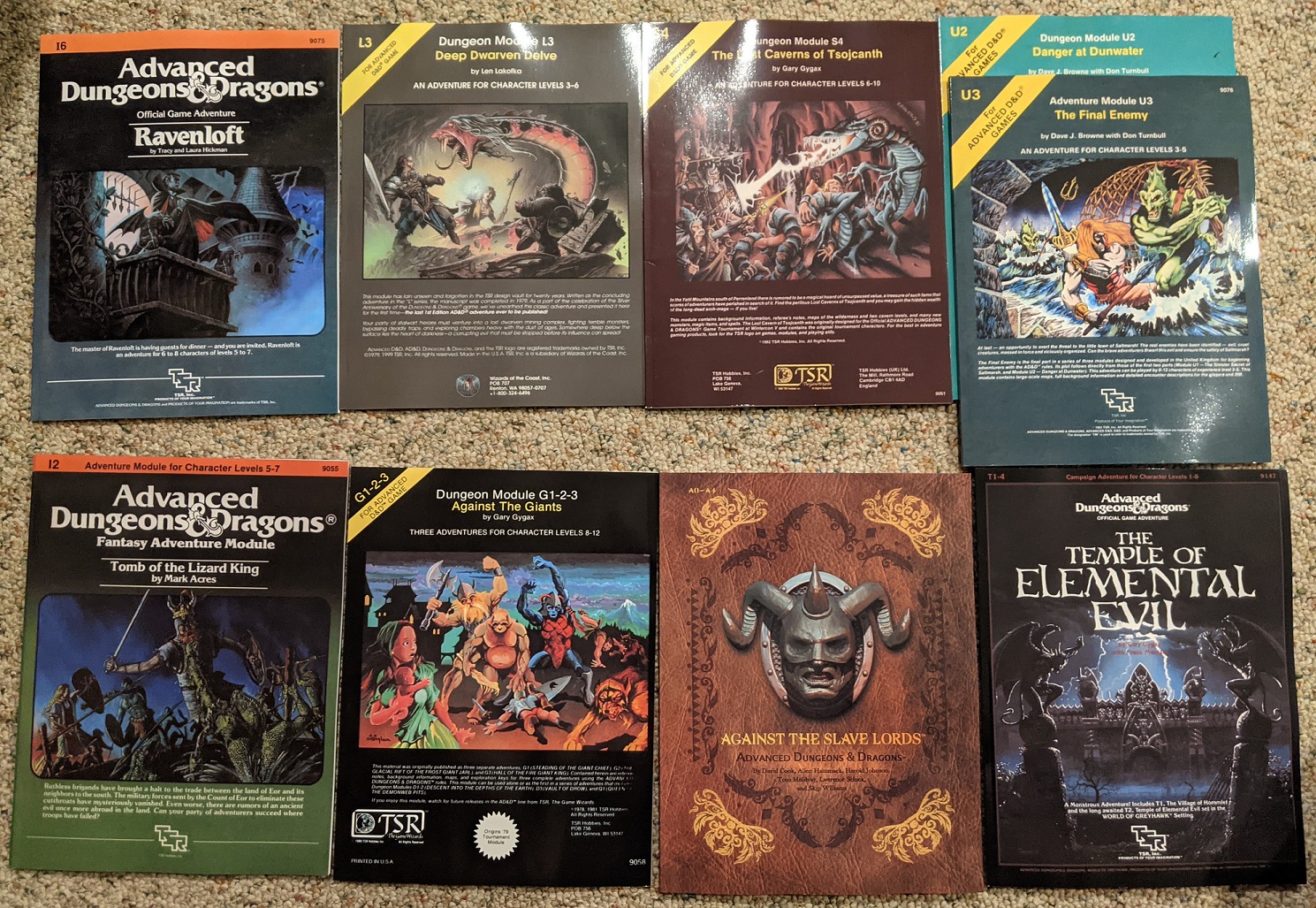
Sundays now are lazy days for me. I either post something silly or other people’s work. Usually both. Today, it’s about someone else’s work. If you follow this blog, it’s impossible not to know that I’m preparing for a return to 1st Edition AD&D. This week, I received the bulk of my new purchases.
I’m still awaiting three more titles: The Monster Manual II, the Dungeon Master’s Guide, and Unearthed Arcana. I don’t expect to make full use of this collection. A lot of this is to complete my collection, but even the stuff I don’t use will help me enhance the stuff I do use. As far as I’m concerned, none of this was a waste of money . . . except for I2: Tomb of the Lizard King, for which I accidentally bought two copies. That cost me only an extra $10. Fortunately, I’ve already sold and mailed it.
In case you’re wondering, I bought these via the DMs’ Guild, which is “direct” from Wizards of the Coast, but they run off the Drive Thru RPG engine. I’m not 100% sure of the relationship, but regardless of which site I’m on, I see the purchases I made from both. They were promised to be delivered within two weeks, but I got them within five days. Someone on MeWe pointed out one drawback of buying the reprinted adventures: The maps aren’t removeable. This is true, but it’s not a problem if, like me, you’ll actually run the game with the (bookmarked) PDFs. In all other ways, the adventures are the same as the original ones, but they’re reasonably priced. Getting a good price on any of these is possible, but it takes a lot of patience. Most of them cost literally 100s of dollars until you find that one offering that’s reasonable. I just bit the bullet and bought want I wanted for my collection without any danger of overpaying.
Because my recent posts are all D&D related, D&D is taking over Caturday this week. Here’s my top ten list of cat-related D&D creatures. WordPress won’t allow me to use descending numbers, so in this case, my favorite will be #10.
Sea Cats. Basically, they’re mentioned because there aren’t enough cat-like monsters to fill this list. Kind of funny, though, so they beat out the semi-feline dragonne for the bottom spot.
Tabaxi. I’m at least curious about playing a a Tabaxi. As a cat person, I could probably make a good run of it, but I never have. Curiosities don’t get to land high on a list.
Displacer Beast. These guys are probably lower on my list than they would be on the lists of most players. I never had the fanboy reaction to them that so many others did. I’m not sure why. They just didn’t do it for me.
Tressyms. Clearly, I’m a cat person. What cat person wouldn’t want a flying kitty cat? But I’ve never played one because I don’t play wizards, and the only context in which I’ve seen a player have a tressym is as a familiar. As with Tabaxis, theory doesn’t rank as high as practice.
Wemic. Leonine centaurs? How wonderfully majestic. In Sumerian mythology, they were called Urmahlullus, and they appear to be good guys. To my recollection, they’ve been considered neutral in D&D with respect to their alignment, but that certainly doesn’t mean they can’t be played as helpful to a party of PCs.
Manticores. Not only do manticores appear in a few of my favorite old-school adventures (ah, nostalgia), but they pose an interesting tactical challenge. Manticores can fly, but even if you nullify that ability, they’re equally dangerous in melee.
Tembos. I’m taking some license here and calling these denizens of Athas cats (from the Dark Sun campaign setting). I have doubts that they are; however, much like hyenas are feliforms (catlike) that appear to be canines (doglike) because of the space they occupy in their ecosystem, the Tembo appears roughly like a smilodon. When I first took a look at the stat block in 4e, I knew they were trouble, but when the DM threw one at our party, I realized how little I actually knew. It was hard not to immerse yourself in the gaming moment considering the unspeakable horrors it committed against you. (Unspeakable Horror was a fitting name for one of its 4e powers.) You may have well been fighting a creature three of four levels higher. Sometimes you just want a fight, and this thing delivered.
Sphinxes. This creature is right up my alley. My favorite aspect to D&D is solving puzzles, and a sphinx is loaded with them. Encountering sphinxes and being able to circumvent their threat using my real-world wits makes for a great and memorable encounter.
Leonines. What’s better than meeting a sphinx? Playing one. Duh. Grexes was my a leonine (anthropomorphic lion) from the Mystic Odyssey of Theros campaign setting, and I presented him as someone with an obsession admiration of sphinxes. He often spoke in riddles, for example asking a greeter at the inn for “that which has four legs but cannot run.” It took a second, but the DM quickly realized I was asking for a table. Maybe Grexes should have made my list of my favorite TTRPG characters.
Snuggles. Snuggles was a jaguar, but more to the point was the name I gave to my 4e beastmaster ranger’s animal companion. That was a fun class to play. Super mobile, varied attacks, high damage output, and always able to self-flank using Snuggles, which means he hit fairly often. Snuggles was the shit.
Dungeons & Dragons, Mystic Odyssey of Theros, and Dark Sun are trademarks of Wizards of the Coast, LLC, who neither contributed to nor endorsed the contents of this post. (Okay, jackasses?)
On Friday (July 23, 2021), I mentioned that I was relearningAD&D 1st Edition (“1e“) with the intention of running it. As I read through the Player’s Handbook (“PHB“), certain mechanics or text will strike me as odd or surprising, but in either case worthy of discussion. In fact, the most surprising thing I’m experiencing is that I’m finding a lot more great ideas in 1e that we’ve since abandoned. I find myself asking, “Why?” As a result, I’ll be writing several posts over the next few weeks. I’m sure everything I’m thinking has been discussed before — sometimes be me — so perhaps my questions have been answered, and my concerns resolved, years ago. My experience with RPGs is relatively limited in scope, having played a small number of games, so I’m sure a lot of what I’m going to say has been incorporated into games I’ve never even heard of. (Some have certainly been addressed by future editions of D&D themselves.) Nevertheless, bringing this directed conversation to the public is new to me, so here it goes.
Oh, shit. It’s on now. It’s a good thing my blog isn’t popular. I’d get hammered if this went viral.
What happens when a lawful good, mortal character picks up the Book of Vile Darkness? It burns, right? In 5e, she suffers disadvantage. In 4e, she grants combat advantage and has a penalty to attacks and saves. What happens when a neutral evil, mortal character holds it? Nothing, right? Well, that makes no sense. If the book is covered in acid, radiating electricity, or otherwise sending off harmful waves, it should hurt anyone who holds it that isn’t resistant to the damage. But it doesn’t. Why? Because what it’s radiating is evil, and in fantasy RPGs, law, chaos, good, and evil aren’t just philosophies. Philosophies can’t burn you.
Though philosophers can.
Instead, law, chaos, good, and evil are forces of nature, just like electromagnetism and the strong and weak nuclear forces. As Lord Gygax wrote, “it is very difficult for a character to voluntarily switch from one [alignment] to another. . .” (1e PHB, 34). This shouldn’t be hard for a D&D player to accept. We already accept the notion of the elements — air, earth, fire, and water — as fundamental aspects of nature, which is terrible science. Alignment can easily fit into that same approach. It’s an even stronger position to take considering that, in a fantasy setting, gods are fueled by prayers. These alignment forces provide a medium through which prayers and deeds fuel the power of the gods. Accordingly, you should expect the gods to engage in a divine arms race, infusing their mortal races with alignment energies, which results in an instinct to worship their respective creators. In other words, it makes perfect sense that Gruumsh would infuse orcs with both chaos and evil, and make them in his own image. Exceptions aside, who else would orcs worship?
Stories
Many wonderful stories that permeate not only RPGs, but our culture in general, are often a direct result of, and deeply intertwined with, this idealized approach to alignment. I understand that some of those stories have troubling themes (e.g., Sleeping Beauty was raped), but there’s no reason that such themes must exist as part of this approach. That’s a matter of story only. However, I will say that sometimes you need a story to be extreme in order for the audience to appreciate it.
A Few Problems Remain
If the point of keeping alignments is the stories, you have to make sure alignment doesn’t negatively impact the story. I see that happen when, for example, every player safely assumes that every monster they meet is evil.
Even if 99.99% of, e.g., hobgoblins are evil, the percentage of evil hobgoblins the characters actually meet should be much lower. Otherwise, every encounter with hobgoblins becomes as “kick the door down, kill everyone, and steal their shit” encounter. That’s too easy and boring.
So, even assuming you accept my position that alignments should remain, and you make sure a high percentage of exceptions exist among the humanoid NPCs the characters meet, there are two more problems that yet remain, and they have nothing to do with the social controversies surrounding it.
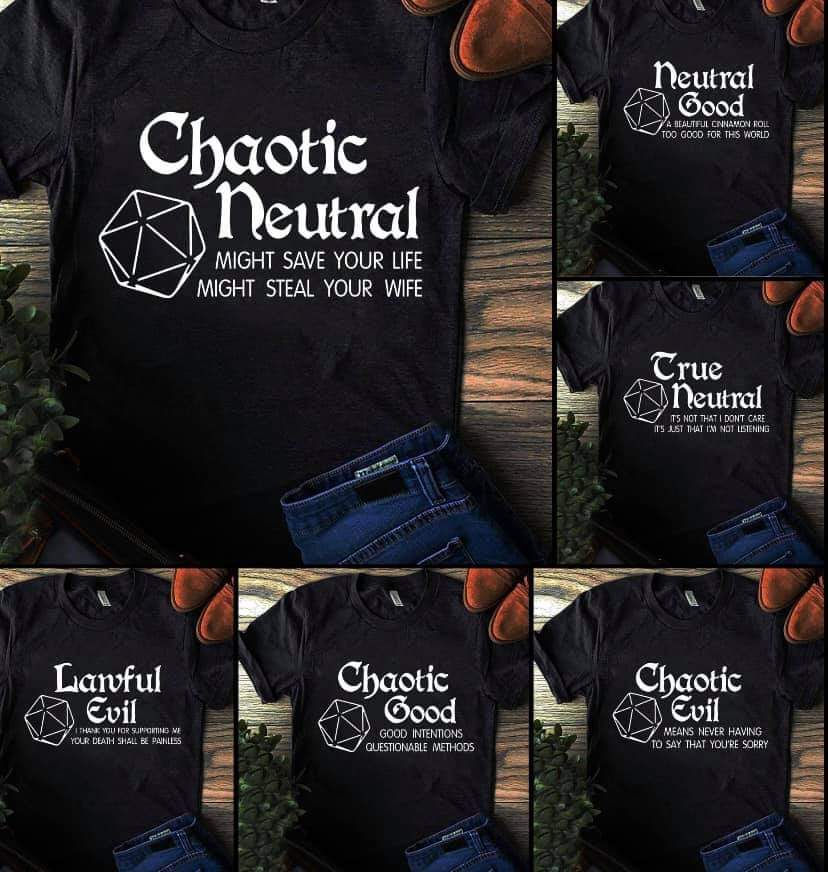
First, it sometimes seems that everyone has a different definition of each of the alignments. Over on Facebook, someone recently asked, “Just for fun, what alignment(s) suit Indiana Jones?” Here are the answers:
Unless “awesome” and “bitchen” are synonyms for evil, they all agree Indy isn’t neutral evil or chaotic evil. Well, that doesn’t exactly narrow it down. Without agreed-upon definitions for these terms, it’s hard to deal with them. Lord Gygax acknowledged this.
Naturally, there are all variations and shades of tendencies within each alignment. The descriptions are generalizations only.
PHB, 33.
This suggests, as do the explanations given in that Facebook post, that part of the problem is that everyone has their own opinion as to where the line is drawn between two alignments. Several of the 125 answers drew the boundaries around some alignments more narrowly than others. That is, they’d cite a single instance of Indy going off alignment as proof that he wasn’t of that alignment at all. For example, one person said chaotic good because Indy would occasionally break a law. Even a lawful good character would break a rule once in a blue moon, but “occasionally” breaking a rule sounds like neutral good to me. Chaotic good is a disrespect for all but the most important laws (e.g., murder), and even those were flexible. This poster apparently wouldn’t tolerate a single rule break before designating Indy chaotic good.
Maybe these will help.
I’m not sure this problem is solvable. Both 2e (IIRC) and 3e were reasonably thorough in their discussion of alignment, yet we still have this problem. However, we just need the problem solved on a per-table basis. That can be done at a session zero and as the campaign proceeds. So, for the sake of argument, let’s say everyone at a particular table fully agrees on how a character of a particular alignment should act under a particular set of circumstances. This leads us to the second problem: Some people don’t play alignment properly even where we all agree on what that alignment demands of the character. Some players choose an alignment for some mechanical benefit, but play the character as a different alignment simply because it’s more fun, or perhaps to take advantage of a different mechanical benefit. I can think of far worse things players have done, but you lose something from the gaming experience for yourself and others if you play that way.
The Solution to These Problems
These problems can be (have been?) mitigated in two ways: 1) lessening the mechanical benefit of alignment forces; and 2) having a robust reputation system. If a lawful good paladin holds the Book of Vile Darkness, then it should burn him and provide a mechanical penalty, because that’s a penalty that applies to only a small number of related encounters. The moment alignment has a larger impact on mechanics than these exceptional cases, players have an incentive to claim an alignment that they won’t actually play. Still, any incentive at all could be a problem, so we’re not out of the woods yet.
The overall behavior of the character (or creature) is delineated by alignment, or, in the case of player characters, behavior determines actual alignment.
1e DMG, 23
The other solution is a robust system of reputation. 4e’s D&D Encounters had such a system, but it wasn’t as strong as I’m suggesting. At any moment where the players are going to increase their reputation, a DM must disclose to a player that a given act will have appropriate consequences. They will be seen either as someone to rely on or someone not to be trusted depending on what choice they make. Some choices don’t carry any ethical weight to them but still add to a character’s reputation. Thus, characters accumulate good, bad, and neutral reputation points. The total number of points they accumulate determine their reputation (i.e., how well-known they are), but the difference between their good and bad points determines how certain institutions and organizations will view them. If you’re a thief with more bad points than good, the ruling noble won’t trust you, but the Thieves’ Guild will help you out. Alignment and reputation can work well together, and I see no pressing need to omit alignment from RPGs, but if you do omit alignment, you should certainly replace alignment with reputation.
Dwindling down to Nothing
As more elements are removed from the game, there won’t be anything else left to play. Alignment is yet another fine idea that’s about to be removed because people are connecting a fantasy world to the real world. The last time I dealt with this point of view, the Satanic Panic kicked my ass. The panicked saw the mythological elements of D&D as competition for their own religious views, which meant they were taking both mythology and games far too seriously. This campaign against alignment shares the same mentality, taking a game too seriously and treating it as you would the real world. The last time I checked, there are no goblins running around my neighborhood, and evil isn’t anything more than a state of mind, so there’s no need to eliminate many powerful stories from our arsenal. If this trend continues, future generations won’t be able to tell any stories at all. I’d rather not throw the baby out with the bathwater.
There. I’ve spoken my peace. I’ll never publicly discuss this alignment bullshit again.
On Friday (July 23, 2021), I mentioned that I was relearningAD&D 1st Edition (“1e“) with the intention of running it. As I read through the Player’s Handbook (“PHB“), certain mechanics or text will strike me as odd or surprising, but in either case worthy of discussion. In fact, the most surprising thing I’m experiencing is that I’m finding a lot more great ideas in 1e that we’ve since abandoned. I find myself asking, “Why?” As a result, I’ll be writing several posts over the next few weeks. I’m sure everything I’m thinking has been discussed before — sometimes be me — so perhaps my questions have been answered, and my concerns resolved, years ago. My experience with RPGs is relatively limited in scope, having played a small number of games, so I’m sure a lot of what I’m going to say has been incorporated into games I’ve never even heard of. (Some have certainly been addressed by future editions of D&D themselves.) Nevertheless, bringing this directed conversation to the public is new to me, so here it goes.
If there were a subtitle to this post, it would be, “1st Edition AD&D; where logic goes to die.” I think this post exists just so I can reinforce this crazy rule in my brain, but perhaps many of you reading this have never played 1e (or have forgotten it), so it’s still useful to illustrate a point.
The notion of Armor Class Ratings (“ACR“) adjustments is fascinating and logical.
The idea is that some weapons are better suited to attack specific types of armor than others. For example, the long sword is probably the best weapon a Fighter could carry for a number of reasons, but a morning star works better against a shield (+2 v. +1). Why? Perhaps because when the morning star is blocked, it’s bludgeoning force can transfer through the shield to damage the enemy’s arm. Similarly, a footman’s military pick (+2) can better find the gaps in plate mail than a battle axe (-2). These advantages are reflected in attack bonuses and penalties against ACRs. What do I mean by ACR? You’re going to be sorry I asked myself that.
Your ACR (a.k.a., base AC, AC type) is based on a chart provided below. It ranges from 2 to 10, though in Unearthed Arcana that range is extended down to 0. This is a number distinct from your actual Armor Class value (“AC“). So, if, for example, you’re wearing plate mail, your ACR is 3. Add a shield to that, and it becomes 2. The ACR is the AC the armor would grant on its own before any other adjustments are made; therefore these numbers are fixed as long as you’re using that armor. Your actual AC can be different due to a bonus or penalty granted to you by your Dexterity score, magical influence, or circumstances. So, the Fighter in plate mail has an ACR of 3, but could have an AC of -1. Your ACR, however, is the basis for the weapon-based attack bonuses and penalties for your enemies.
Type of Armor
ACR
None
10
Shield only
9
Leather armor // padded armor
8
Leather + shield // padded armor + shield // studded leather // ring mail
7
Studded leather + shield // ring mail + shield // scale mail
6
Scale mail + shield // chain mail
5
Chain mail + shield // splint mail // banded mail
4
Splint mail + shield // banded mail + shield // plate mail
3
Plate mail + shield // field plate armor
2
Field plate armor +shield // full plate armor
1
Full plate armor + shield
0
Data from PHB, page 36. Data in italics from Unearthed Arcana, page 26.
The Downsides
But here’s the thing. First, it’s crazy complicated, both on the DM end and the player end. It’s yet another layer of rules to apply to combat that, sadly, isn’t even included on the Dungeon Master’s Screen. Moreover, players playing fighters have yet another factor in picking what weapons to carry around, and they must be able to think on the fly as to what weapon to use in any given scenario. For example, as stated above, almost every fighter is going to have a longsword (-1 v. plate mail) or battle axe (-2 v. plate mail) as their primary weapon, but will also need a dagger (-3 v. plate mail) or short sword (-2 v. plate mail) for close-quarters combat, and some form of ranged weapon in case there’s a lot of distance between them and their enemies, the best against plate mail being the long bow and heavy crossbow (+0 v. plate mail). Because of ACR, the fighter will also want a footman’s flail, military pick, or two-handed sword (each +2 v. plate mail) strapped to their back in case they run into an enemy wearing plate mail, but they also want a spear in case they charge, or are charged by, an enemy. Did I mention that a Fighter is proficient in only 4 weapons until 4th level (PHB, 37)? Have we gone over encumbrance rules yet (PHB, 101)?
This won’t happen unless you hit him with the correct weapon.
Second, the basis of the rule is logic, but that logic quickly breaks down. As you can see from the chart, the base AC for splint mail and a shield is the same base AC for plate mail without a shield. So why would the morning star react to both the same way? Without the shield, the morning star shouldn’t get any sort of bonus, so as complicated as this rule is, it should be even more complicated, instead tying ACR bonuses and penalties to the specific armor used rather than on the numerical AC they inherently give. That is, instead of saying a morning star grants a +2 against any combination of armor that would, unadjusted, grant an AC of 2, the rules should say that a morning star grants +2 against any opponent relying on a shield regardless of what else they’re wearing. Maybe. If I really thought about it, an even more complicated rule could be appropriate. Fortunately/unfortunately, logic cedes ground to abstraction, because otherwise, well . . . .
Don’t forget to tune in next week for psionics! Maybe. I doubt it.
So Why Am I Going Use Them?
First, I want the full 1e experience, so I’m going to use this in my game at least to start. Second, I’m optimistic that this won’t be much of an issue because this applies only to enemies using armor. Monsters that don’t wear armor aren’t considered to have ACRs (DMG, page 28). Their AC is what’s needed to properly balance the system. At least that’s what the creators claimed.
Because of my 23-year hiatus from D&D, I completely missed 2nd Edition D&D. I’ve played three sessions of it since returning to the game, once for two hours, and then twice in successive weekends as part of a single adventure (probably about 5 hours each session IIRC). In the first of those latter two sessions, the DM (Erik) game my bard a wand of magic missiles. He randomly rolled the number of charges for me, and it was ridiculously high. There’s no way I was ever going to run out of magic missiles. So, every time I tried to use my rapier, cast a non-healing spell, or use any non-standard attack, the entire table said, “No! Use the wand!” Thereafter, the game bored me, and Erik actually apologized. He thought he was doing a nice thing but wasn’t thinking about how it would impact the way I like to play.
ACRs make things a slight bit more interesting. A party may insist that the Fighter always swing a longsword, but sometimes it won’t be the best option. As a player, swinging a morning star isn’t very different — roll a d20 to hit, and if you do, roll damage — but there are other useful things a character can do in combat. If the longsword isn’t as valuable as grappling, knocking a bookshelf over, or swinging from a chandelier to kick an enemy prone, then a Fighter will no longer be a one-trick pony. Combat modifications like ACR will leave a player looking for the right tool for the job. Assuming the system turns out to be workable, wouldn’t that be more fun?
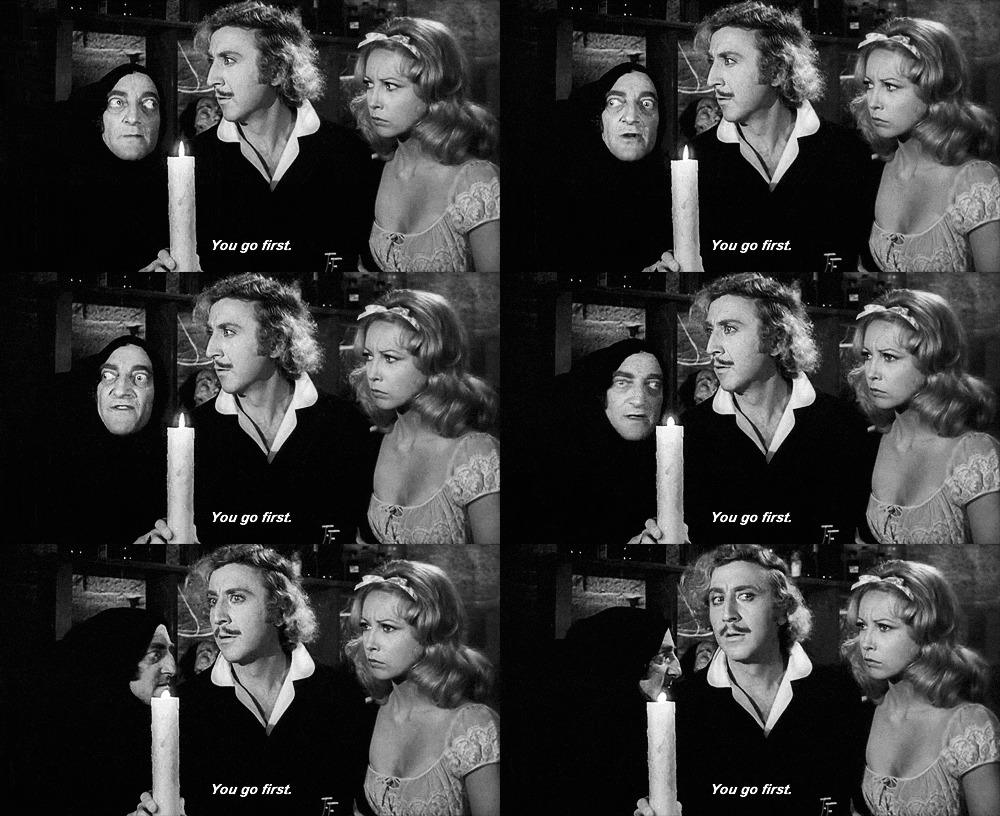
That brief shot of his left eyeball is solid gold.
On Friday (July 23, 2021), I mentioned that I was relearningAD&D 1st Edition (“1e“) with the intention of running it. As I read through the Player’s Handbook (“PHB“), certain mechanics or text will strike me as odd or surprising, but in either case worthy of discussion. In fact, the most surprising thing I’m experiencing is that I’m finding a lot more great ideas in 1e that we’ve since abandoned. I find myself asking, “Why?” As a result, I’ll be writing several posts over the next few weeks. I’m sure everything I’m thinking has been discussed before — sometimes be me — so perhaps my questions have been answered, and my concerns resolved, years ago. My experience with RPGs is relatively limited in scope, having played a small number of games, so I’m sure a lot of what I’m going to say has been incorporated into games I’ve never even heard of. (Some have certainly been addressed by future editions of D&D themselves.) Nevertheless, bringing this directed conversation to the public is new to me, so here it goes.
I don’t think this post will go over well with the professional game designers. Or the amateur ones. I’m being completely unreasonable, but professionals should always listen to their most demanding clients, right? Well, that’s me. I just want to play, and the quickest way to do that is to play a rules-light system. However, once I’ve got the hang of it, I want a rules-heavy system thorough enough not to leave itself open to conflicting interpretations.
I want my cake and to eat it too.
Why So Tense?
One of the tensions in game design is whether an RPG should be rules heavy or rules light. 1e is certainly rules heavy, at least when it comes to a combat system that micromanages so much. There’s a huge disadvantage to that: Learning such rules is a barrier to entry for new players. I get that point of view, especially when you have a system like 1e that requires you to jump from page to page, or even book to book, to get the complete rule (made easier by the hard work of David Prata mentioned in yesterday’s post on Initiative). Some game designers have tried to improve on this by simplifying processes, further abstracting how the system deals with the topic at hand. Well, I think it’s time for some reification.
Whiny Players
Here’s a grossly paraphrased conversation I’ve had since returning to D&D in 2005. In my experience, this is by no means an unusual conversation to have in this or other contexts.
Me (3-5 times while describing the scene): Are you sure you don’t want to do anything else? Table: Nope. Me (placing the minis on the table): Okay, you’re surprised. Table: How? We had a lookout. Me: I asked you several times if you had anything else to tell me, and you never mentioned it. Table: But we always have a lookout. We’re adventurers. We know to do that. Me: Well, they’re ambush predators. They know how to sneak. Table: Show me in the rules where we must be surprised in this instance. Me: The rules can’t possibly provide every example possible, so no such rule exists. Table: Then we can’t be surprised. Me: The very fact that surprise rules exist cuts against your argument. Table: You’re a terrible DM. You don’t know the rules.
Truthfully, I am a terrible DM, but this isn’t an example of that.
1e Combat
The 1e combat system is rules heavy. Yes, it’s spread out over different pages of the Players Handbook and the Dungeon Master’s Guide, but that’s a failure of execution, not concept. I’m discussing concept in this post, so let’s stay focused on that.
The system does two things that I absolutely love but haven’t appeared in D&D in some time. First, surprise is handled by a simple die roll in almost all combats. There are a few things that negate a poor roll, but in general, roll a 1 or 2 on a d6, and you’re surprised. Second, the distance between the parties at the precise moment of engagement is handled through a separate die roll. The rule takes into consideration practical matters such as line of sight, whether the encounter takes place in a 20’ x 20’ room or outdoors on a flat plane of low grass, etc., but no one can say that they were surprised because the DM didn’t properly set the scene or otherwise withheld important information, and they also can’t argue as to whether they were in striking distance at the moment they were surprised. The baseline is that these dice rolls govern, so the burden shifts to the players to point to something they expressly said they were doing, or circumstances of the scene, that justify ignoring or modifying those dice rolls.
So, should all RPGs be designed like this? Maybe not. A ruleset covering all the bases is going to be long and complicated, which can slow down the game even if you know the rules. Even worse, beginners will face a barrier to entry. They’ll take one look at David’s work and say, “Twenty pages? Nope. That’s too much to read just to get to sit down at the gaming table.” Is there some way to avoid that?
Beginning v. Advanced Systems
A possible solution to the problem of the barrier to entry is to go backwards. 1e published the Basic Set (followed by some others) that served this purpose, and it was reasonably compatible with the Advanced Dungeons & DragonsPHB and DMG (what I’ve been calling 1e). I never played this, but I seem to remember them having noticeable mechanical differences from 1e, which turned me off to it. This was probably arrogant because, believe it or not, when I first started playing “Blue Box” AD&D, we didn’t use ability scores at all. I don’t remember how that played out and can’t even guess how it worked, but I remember a conversation with a kid named Louis, who explained ability scores to me in 6th grade, which was two years after I started playing. The point is that you could abstract what you wanted, and once comfortable, drill down to a more complicated but well-defined system, but that was haphazard. Game designers should instead provide the roadmap by designing a combat system, then removing complexities from it in such a way that it maintains the balance between the two sides. What’s left is the “basic” system suitable for new players, existing players that prefer a rules-light system, or any player looking for an occasional quick and easy combat. Modern RPGs create alternate rules (e.g., methods for ability score generation), but that’s not the same thing.
A favorite RPG of mine, the FASA Star Trek RPG, did this quite well for starship combat. There was a basic subsystem and an advanced subsystem. The core mechanic was the same, with the base system dividing values by 3 (rounding down), but the advanced subsystem was more than just larger scalar values. It also introduced a more complicated means for bridge officers to affect combat. Not only did this eliminate a barrier to entry into the game, but I suspect that in order for this to work, the design methodology necessarily facilitated either subsystem being played as a board game. That opened the game to a lot of Star Trek fans who somehow thought RPGs were too nerdy. (I’m not kidding.) The rules were divided across five, short handbooks, all contained within the game’s box set.
There Are Still Concerns
Execution aside, publishing multiple subsystems, or even just one excessively complicated one, is not without its concerns. Players don’t want to purchase a nonnegligible amount of product just to move from one level of abstraction to the next. To allay this concern, the core rulebooks should disclose alternate subsystems even if an introductory box set exists. This leads to at least three other issues. The first issue is that game play could be slowed to a crawl if the rules get too complicated, even if you know exactly how they work. This could result in your advanced system almost never being used, making them a wasted effort. Ergo, there will still have to be trade-offs on that advanced system in order for it to have practical value. The second issue is that the core rulebooks could get too long if there are too many alternate subsystems across the entire game system. For both issues, game designers must pick their battles when deciding which rules to abstract/simplify. Perhaps that’s what’s raising my concerns here. Maybe they’ve picked their battles, and I just don’t like the ones they’ve picked, or maybe I don’t even perceive the battles they’ve won and therefore don’t appreciate them. I just know what gives me the most headaches as a DM and looking at all the PHBs and DMGs I’ve used, most have a little room to spare. Also, this is why I’m suggesting only two subsystems and only for combat, where one subsystem is just a compatible extension of the other.
For the record, the third issue, which for now I’ll call the Head of the Table writing method for now, will be discussed in a later post.
It’s All About Me
Let me know when I can stop apologizing.
Believe it or not, I know it’s a lot to ask of game designers to incorporate a second, simplified ruleset for combat, especially considering that my opinion may be a minority one. However, I suspect it would cut down on tension at the table, and designing in-game conflict resolution systems is the primary function of the game designer. Campaign settings are nice, but many people write their own. Not many write their own combat systems, and most can’t do that well. If any system is appropriate for division into a beginner and advanced system, it’s combat. So why not have your cake and eat it too? You could appeal to both the rules-light and rules-heavy crowds, broadening your customer base.
In general, I prefer a thorough system. Considering the conversation above, you can see why. Lightening the rules has led to a notion of DM empowerment in order to make the game playable, but it creates far more “us v. DM” tension than I enjoy at my table regardless of whether I’m behind the DM screen. The conversation above couldn’t occur often if we were playing 1e. I could point to the dice on the table, and that’d largely be the end of it. The biggest problem I’ve faced as a DM is the fact that many players don’t like to lose. By “lose,” I mean fail to solve a puzzle, miss a major piece of treasure, take a single hit point of damage, or get surprised. Just try to kill the average player’s character, and you’ll see how angry they can get. But the dice don’t lie. Thorough rules lead to predictable, and thus fair, results. Though it failed in clarity, 1e had the right idea. The FASA Star Trek RPG got it right. None of that would ever stop a DM from customizing those rules to suit their needs, especially if elements of the advanced subsystem were presented as attachable modules to the basic subsystem. I suspect multiple attachable modules would be harder to implement while maintaining balance, but 1e armor class adjustments, weapon speeds, and weapon lengths were effectively detachable rules that many people ignored, and the game was still playable. I’m looking for a well-defined subsystem that provides a clearer roadmap.
*sigh*
Hey, you chose game design as a career. You have no choice but to try to make me happy.
On Friday (July 23, 2021), I mentioned that I was relearningAD&D 1st Edition (“1e“) with the intention of running it. As I read through the Player’s Handbook (“PHB“), certain mechanics or text will strike me as odd or surprising, but in either case worthy of discussion. In fact, the most surprising thing I’m experiencing is that I’m finding a lot more great ideas in 1e that we’ve since abandoned. I find myself asking, “Why?” As a result, I’ll be writing several posts over the next few weeks. I’m sure everything I’m thinking has been discussed before — sometimes be me — so perhaps my questions have been answered, and my concerns resolved, years ago. My experience with RPGs is relatively limited in scope, having played a small number of games, so I’m sure a lot of what I’m going to say has been incorporated into games I’ve never even heard of. (Some have certainly been addressed by future editions of D&D themselves.) Nevertheless, bringing this directed conversation to the public is new to me, so here it goes.
Initiative in 1e starts off simply but doesn’t stay there. Each side gets a single roll, but each character deals with that roll differently. Characters may add bonuses or penalties based on their Dexterity scores and, if a character has multiple attacks per round, staggers those attacks. For example, if a character attacks twice per round, and its enemy attacks once per round, then then character attacks first and third in the round. Maybe. It depends in part on surprise. The net effect is that, unlike every other RPG I’ve ever played, initiative affects combat resolution but isn’t dispositive of it. Instead, other things largely determine combat order, and where there’s a tie, initiative breaks that tie. I was so confused by the writing that I posted to various social media outlets looking for clarification. Even worse, rules aren’t presented in a couple of paragraphs under an appropriate header. Instead, the rules for initiative are found in two different places in the Players Handbook, and elsewhere in the Dungeon Master’s Guide. This isn’t uncommon. Optional rules are in Unearthed Arcana. You really have to do a lot of research just to get the rule for initiative, and that’s just a small part of combat as a whole.
To get clarity, I often go to the Facebook and MeWe hiveminds. Unsurprisingly, there was only a sliver of consensus in the responses I received from my question on initiative, so other people’s interpretation of the initiative rules as written still left me confused. In the end, here was the best response I received from Pete on Facebook (referencing the entire ruleset):
The rules are crazy complex, have some bizarrely overpowered aspects, and tons of exceptions and unexplained aspects. I found it best to take what I liked, toss out what I didn’t, write up my initiative system on my game wiki so everyone understood it, and play like that.
This makes sense, except there are some real issues with rewriting initiative. Many spells have casting times given in segments, so you can’t ignore those divisions of a turn unless you want to rewrite a lot of 1e rules. No thanks. Fortunately, David Prata did a lot of research and work to clarify and summarize the entire combat system, complete with references in the footnotes. The linked document seems like the kind of thing I’d write — it’s a 20-page outline with footnotes — and it makes the system a lot easier to understand.
Why is this a big deal to me?
My predictive text just suggested "DM" after I typed "totalitarian." Funny thing is: the next word I was going to type was "DM." #DnD#rpg
— Rob Bodine, #Attorney by Day, #Nerd by Day & Night (@GSLLC) July 24, 2021
True story.
Among the many reasons I’ve stopped playingD&D, I don’t like DMs that treat the game like it’s their table, and not our table. I never intentionally DM like that, which means, in part, the rules should be open and understandable to everyone.
So, my current plan is to stick with initiative as is. Once I get the hang of it, it should be fine. However, tomorrow I’ll discuss some other aspects of the combat system, and the push and pull between strict and flexible systems. As with languages, 1e has some really good things to offer that modern game designers have left behind.













 Play What You Want