Let's roll some dice, watch some movies, or generally just geek out. New posts at 6:30 pm ET but only if I have something to say. Menu at the top. gsllc@chirp.enworld.org on Mastodon and @gsllc on Twitter.
In my focused post on consideration (or lack thereof) in the OGL, I analogized the Open Gaming License (“OGL”) 1.0(a) and System Reference Document (“SRD”) to a lease of an apartment and the rules and regulations document for that hypothetical apartment complex. That made it easier to understand the problem with consideration. I had another thought last night, which popped a memory into my head. Here’s a moderately-NSFW video from HBO’s movie, Don King: Only in America.
You Tube videos get deleted all the time, so let me give you the important (if not funny) part. Don King hands George Foreman a blank contract to sign. Foreman hesitates, but King assures him that he’ll fill in the details later. Do you need to be an attorney to realize that such a contract, once filled in, is not enforceable?
The OGL
So, let’s return again to the OGL’s language on consideration, copying what I wrote before almost verbatim. It licenses you “methods, procedures, processes and routines” as well as “any additional content clearly identified as Open Game Content by the” game designer. The first part of that grant mirrors language in the Patent Act and patent law practice defining what can be patented. Likewise, these same words are used in the Copyright Act (specifically 17 U.S. Code § 102(b)) and copyright law practice to describe things not copyrightable. So, for a company like WotC that isn’t using the OGL to license patented subject matter (which I believe is the case for all RPG producers), that first part clearly licenses nothing.
The second part of that grant is meant to reference the System Reference Document (“SRD”), but by its own terms could mean a press conference. A clear statement is a clear statement, it can be oral or written, and it can always be restated. However, more importantly for today, it doesn’t even have to exist at the time the OGL is deemed accepted by the licensee (i.e., you). We saw that with the OGL 1.1, which was sent out before the SRD 5.1 existed. So, even if the contents of what eventually is “clearly identified” are copyrightable, because they don’t exist at the time you accept the contract (by mere use of the game mechanic!), and assuming no patents on the game in question, you’re basically signing a blank contract. The game designer will just fill in the details later. This also means that, if you assume your acceptance of the contract is valid, it occurs not when you act or speak, but when the game designer does so. That is, the game designer makes the offer and then accepts on your behalf, all on terms you didn’t know at the time the contract became valid.
This is legal nonsense of course, and it’s why you can’t sign a blank contract and fill in the terms later. That’s not a “meeting of the minds” required for offer and acceptance. This will be the case for all of these so-called open gaming licenses. If you buy into any of them, you’re escaping from a crocodile’s jaws by running into the jaws of a leopard (viral video omitted).
Aw, how cute.
None of this works. It’s all (mis)perception, so it can all be taken away the second corporate philosophy changes, which eventually will happen.
Blog posts cannot substitute for legal advice. If the topics discussed in this post are relevant to a real case you have, please consult an attorney.
Two observations about this post. First, it was written shortly after the Open Gaming License 1.1 (“OGL 1.1”) leak, so a lot of this had to be rewritten to make sense. I may have missed a few things, so some of my points may be dated. Second, this could very well be the last post I make about the OGL specifically. I’ve addressed most things at issue, and I have a multitude of posts on this blog and my legal blog that address relevant topics generally. Besides, I know what I wantWizards of the Coast (“WotC”) and other game designers to do, so criticizing anything that doesn’t meet my needs is a meaningless effort. Expect more cat memes, mythology videos, and game design opinions going forward than legal analysis. If that’s not to your liking, that’s fine of course; just keep in mind what I’ve written here so you can reference it in the future.
The Open Gaming License, Version 2.0 (“OGL 2.0”), nee OGL 1.1, but now apparently 1.2, has stirred up quite a lot of controversy. WotC has continuously denied rumors that later turned out to be true, then shifted to declaring it a tie, and now has provided a mea culpa. The fact that they’re having so much trouble doing the right thing indicates that they don’t want to do the right thing. That’s annoying to say the least, but what’s most important is what they’re doing now. So far, what I’ve seen still fails to address my concerns about consideration and acceptance, but things are evolving rapidly, so we have to take things as they come, though I don’t trust them.
This man also rapes fish.
Many of you have called for boycotts of all things Hasbro, not just Dungeons and Dragons. Play-Doh is also in your sights, and #BoycottDNDMovie is trending on Twitter. As I’ve stated, I’m not on board with that hysteria here or elsewhere in the commercial world. There are too many good people that will suffer, and too much good material from them that will never see the light of day, if WotC has to lay them off. I feel like you’re throwing the baby out with the bath water, and at the expensive of people you don’t want to hurt. But that’s just me. You do you. I’m here to give you a dose of real hysteria.
I Swear This Section Will Be Quick
In short (like real short, so don’t sweat the missing details), game mechanics are not copyrightable, but your specific way in which you write those rules are. Accordingly, I can rewrite the entire Player’s Handbook in my own words, without any of their artwork, and not run afoul of WotC’s copyright. Would that be a cool thing to do? No, but there may come a time when it is both necessary and fitting.
My Proposed Response
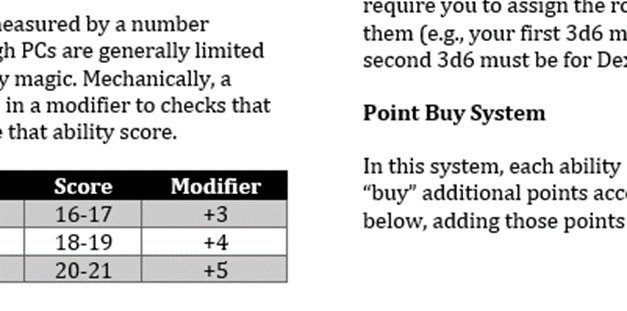
Here’s what I’m going to do if WotC doesn’t fix the problem to my satisfaction: I’m going to rewrite the entire 5th Edition Player’s Handbook in my own words, without any of their artwork, and publish it free on this site. Don’t believe me? I estimate that I’m at least 40% finished, and it’s all public domain material. Here’s an excerpt:
It includes race and class write ups from other sources as well, often pointing out very good reasons why WotC doesn’t own the material. Here’s another excerpt:
Centaurs predate the concept of copyright by at least 2,200 years. No one owns them
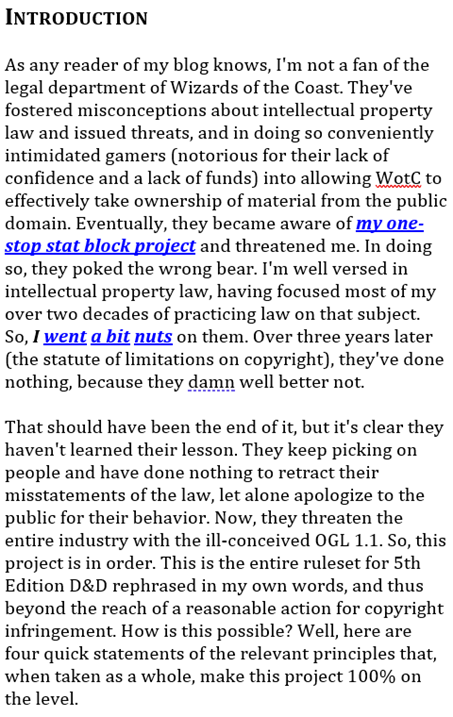
Do you think I’m afraid of a lawsuit? Here’s yet another excerpt.
Apparently “damn” is an obscene word according to Microsoft.
Oh, the OGL 1.1 is going to hate that introduction!
When OneD&D is released, I’ll do the same thing but with its version of the Dungeon Master’s Guide, which would be a much more serious concern for WotC considering that dungeon masters do the most purchasing. I was reluctant to do this. Not only would a court battle be a hassle, but I also don’t want the industry harmed. However, if WotC continues to push the false narrative of an “open gaming license” and doesn’t instead shift gears and go the route of dedicating to the public domain, then they’re the ones doing the harm. Massive harm. I’m simply publishing public domain material, and if anything appears to be creative, there’s always this. You may still not like this idea, but here’s something else to consider.
A Nefarious Plan
My post had subtext I wouldn’t expect anyone but an attorney well-versed in intellectual property to decipher. If the courts review table-top role-playing games (“TTRPGs”), we’ll learn that, given the nature of copyright law, TTRPGs can’t generate profits big businesses require. That is, while small publishers can expect to continue to make the relatively small amounts that they make on TTRPGs, TTRPGs will no longer be the cash cow that WotC has made of Dungeons & Dragons. WotC probably knows this, as evidenced by this provision of the draft OGL 2.0:
Gee, how kind of you to allow us to keep our own creations.
In case this isn’t clear, that draft gave WotC permanent access to your intellectual property, which they can do with as they please and have no obligation to pay you for that privilege. Now I know WotC has backtracked on that particular provision, but only because the feel they have no choice at this point. While I don’t trust them, I don’t care at this point whether they mean it. This was, at one point, their plan. If they think they should steal something you won, then it’s far for me to steal something from them that they do not own. At least I’m not really stealing.
But why would WotC even do something like this knowing that, once implemented, it would start to generate heat that could destroy the brand? Remember when WotC said that OneD&D would be the last version of D&D necessary? I suspect that’s because they see the writing on the wall. WotC sees my posts and others like them that necessarily lead to this legal conclusion and think, “Our well of money is about to dry up, so let’s do a last-minute cash- and intellectual property-grab. When it’s over, we’ll have made a ton of money and have a perpetual, irrevocable license to other people’s intellectual property that we can use to make books and other products that will survive the legal fallout.”
A friend of mine, who knows WotC culture far better than I, doesn’t think this is WotC’s plan, but I’m working with what I have, my own ignorance be damned.
Michael Hammock, an economics professor at Florida State University weighed in. A Facebook connection posted his quote in which he discussed how foolish the leaked OGL 2.0 would be if authentic. Could WotC be that stupid? Sure, but I wouldn’t make that assumption. They’ve been too successful for us to think they have so little business sense. They likely know the consequences and just don’t care. In summary, I suspect they know TTRPGs are no longer going to be profitable enough for them, and they wanted to secure new sources of revenue at your expense before that’s a done deal. So no, I won’t feel the slightest bit guilty of thwarting whatever remains of these plans, as my actions will be 100% legal and not in any way larcenous. You can’t steal what no one owns. Moreover, WotC may not even sue me, not because they realize that the suit would be frivolous, but because it would just make matters worse for them. They also may be facing lawsuits from other parties, and there are only so many fights they can handle at one time. The last one they need is one with a counterclaim for copyright misuse that will have serious consequences.
Copyright Law
Seriously.
Copyright law is in desperate need of reform, but it’s great stuff. I fully support the notion of (a reformed) copyright, but even in its current form it has consumer protections, such as copyright misuse, that prevent copyright holders from abusing their copyright. As far as I’m concerned, WotC has misused their copyright, at least with respect to their actions against me, and many creatives are going to be forced out of the market by an OGL anywhere near what we’ve seen so far. This hurts everyone, so I’m glad you’re finally seeing WotC for who they really are.
If you still think I’m the bad guy at this point, it’s because you’re the bad guy.
Follow me on Twitter @gsllc Follow Wizards of the Coast (D&D) @Wizards_DnD
Dungeons & Dragons is a trademark of Wizards of the Coast, LLC, who neither contributed to nor endorsed the contents of this post. (Okay, jackasses?)
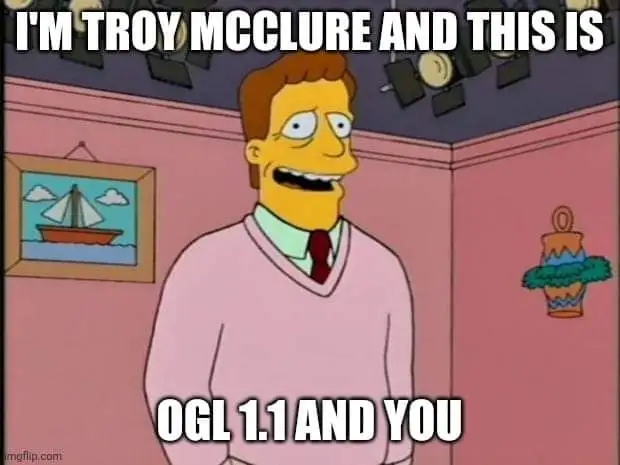
Sundays now are lazy days for me. I either post something silly or other people’s work. Usually both. Today, however, I mix another’s work with my own. First, the goofy stuff. Here’s a meme about the OGL conflict.
Think it through.
Now, for a strange point about WotC’s approach.
As you all should know by now, the specific expression of a game rule can (in theory) be protected through copyright. It still has to jump through the hoops of being creative enough for copyright and avoid the merger doctrine, but at least copyright could apply to that expression. So, simply adding “the specific expression of” to the beginning of “their sentence “the methods, processes, procedures, and routines” would avoid our arguments about copyrighting game mechanics and make this a tougher case. However, despite my 14-year insistence they do so, and now all these other attorneys (at long last) telling them the same thing, they still aren’t doing it. It’s a clear example of Bodine’s Law of the Internet, and in fact inspired me creating that rule in the first place. TL;DR: Without a clear indicator of the author’s intent, it’s often impossible to tell the difference between arrogant deceit and genuine ignorance/incompetence. Does WotC continue on this path because they’re idiots, or because they think we are. Either way, after all we’ve been through, that would make WotC a bunch of idiots.
Even more amazing, my rule hasn’t gained a lot of traction.
Okay, that sentence was a bonus “something stupid.”
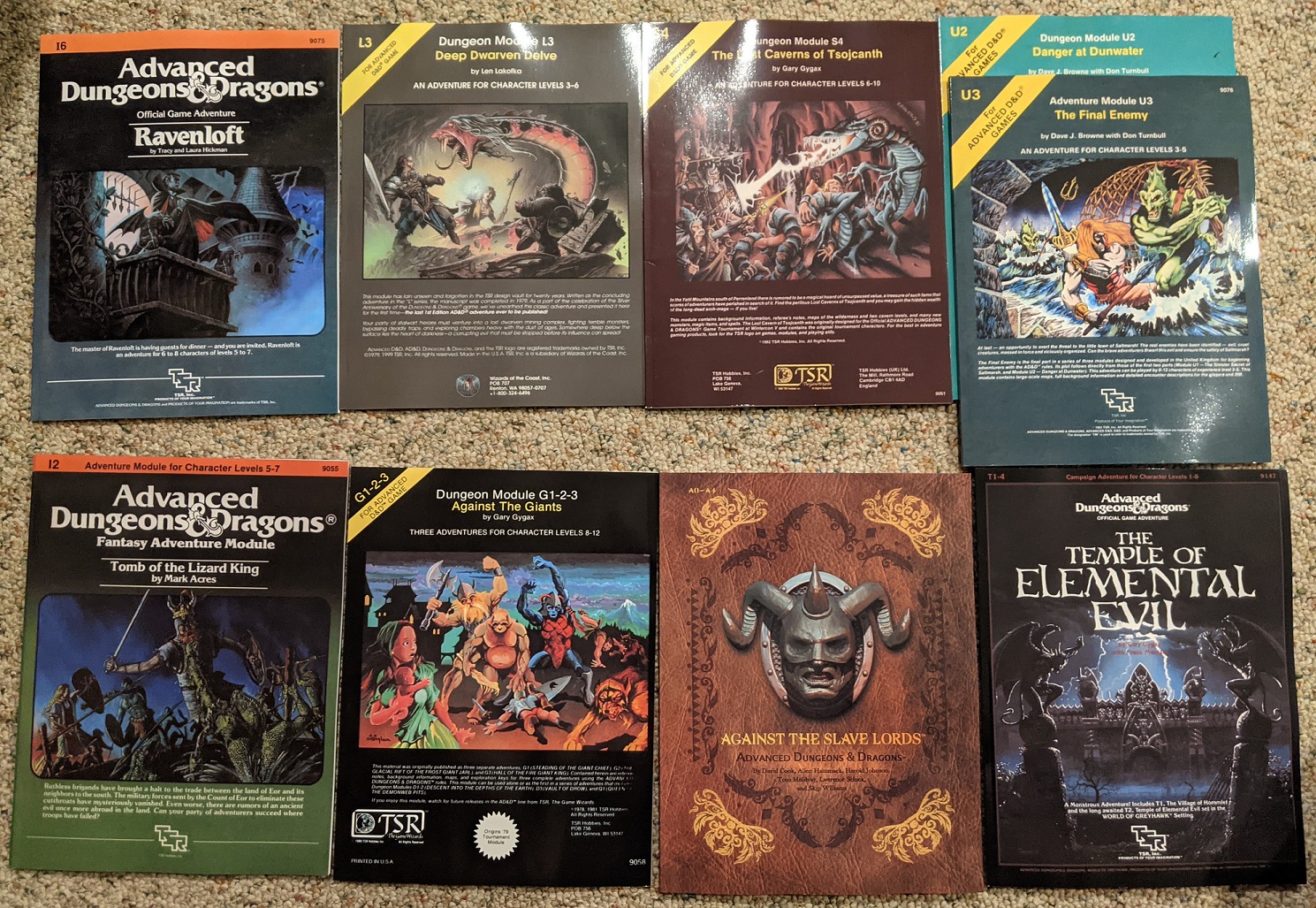
Sundays now are lazy days for me. I either post something silly or other people’s work. Usually both. Today, it’s about someone else’s work. If you follow this blog, it’s impossible not to know that I’m preparing for a return to 1st Edition AD&D. This week, I received the bulk of my new purchases.
I’m still awaiting three more titles: The Monster Manual II, the Dungeon Master’s Guide, and Unearthed Arcana. I don’t expect to make full use of this collection. A lot of this is to complete my collection, but even the stuff I don’t use will help me enhance the stuff I do use. As far as I’m concerned, none of this was a waste of money . . . except for I2: Tomb of the Lizard King, for which I accidentally bought two copies. That cost me only an extra $10. Fortunately, I’ve already sold and mailed it.
In case you’re wondering, I bought these via the DMs’ Guild, which is “direct” from Wizards of the Coast, but they run off the Drive Thru RPG engine. I’m not 100% sure of the relationship, but regardless of which site I’m on, I see the purchases I made from both. They were promised to be delivered within two weeks, but I got them within five days. Someone on MeWe pointed out one drawback of buying the reprinted adventures: The maps aren’t removeable. This is true, but it’s not a problem if, like me, you’ll actually run the game with the (bookmarked) PDFs. In all other ways, the adventures are the same as the original ones, but they’re reasonably priced. Getting a good price on any of these is possible, but it takes a lot of patience. Most of them cost literally 100s of dollars until you find that one offering that’s reasonable. I just bit the bullet and bought want I wanted for my collection without any danger of overpaying.
Note: I don’t understand the analysis of that attorney. I still see a huge distinction between the cases, but as I don’t work in employment law, I don’t appreciate all the subtleties that may apply. It does leave me scratching my head that I feel this is a slam-dunk for WotC, yet this attorney believes it’s a slam-dunk for the judges.
Follow me on Twitter @gsllc
Follow Magic the Gathering on Twitter @wizards_magic
Wizards of the Coast was just sued by several Magic: the Gathering judges. The complaint can be found here: https://www.scribd.com/doc/309867466/Shaw-Et-Al-v-Wizards-of-the-Coast-LLC. I’ve read the complaint, but I just found out about this, and I’ve spoken with no one about this. That being said….
This is crazy. Probably not enough to get sanctions against the plaintiffs, but crazy. They allege and employer-employer relationship, but I don’t see a logical basis for that claim, which would mean that the entire suit falls apart. (Note: They don’t need to prove that basis at this point. I’m simply stating that, in my mind, there’s no factual basis for that claim.) I don’t play Magic, but I’ve organized RP games for the DC area for over a decade, even running a convention for a couple of years. During the 3rd edition, Living Greyhawk days, I took two tests to earn some sort of certification as a judge. Nevertheless, we all know that this is volunteer work. We’re “working” for the community, not the company, and I know of no instance when WotC has ever claimed that judges were anything other than volunteers.
Most important to me is, if Shaw, et al. win, without exaggeration, I predict that it’s the end of organized play of any sort. If everyone who judges a game day for Magic, Dungeons & Dragons, or any other organized play event would need to be paid, reimbursed for expenses, etc., then these events have negative value to the companies that sanction them. There’s simply no reason even to allow them, let alone provide support for them.
In the long run, who does that help (other than the attorneys for the plaintiff)?
Please, if someone has a different view, let me know. If your argument is, “It’s really hard work,” then you’re missing my point. I’m one of the last people that needs to be lectured on how much work this sort of thing is. I’ve done it for a decade, suffering massive burnout from time to time, but it doesn’t justify me being paid.
Follow me on Twitter @gsllc
Follow Magic the Gathering on Twitter @wizards_magic









 Play What You Want