Let's roll some dice, watch some movies, or generally just geek out. New posts at 6:30 pm ET but only if I have something to say. Menu at the top. gsllc@chirp.enworld.org on Mastodon and @gsllc on Twitter.
If you enjoy this post, please retweet it. Other posts in this series can be accessed by clicking here.
Whether you’re an MCU nut like me, or a Pixar nut, there’s actually a lot more on Disney+ than what you subscribed for. For me, one of them is Brain Games care of National Geographic.
Hosted by Neil Patrick Harris in season one, Jason Silva in seasons 2 through 7, and Keegan-Michael Key since, this show dives into how our brains work. Many of you are certainly aware of a lot of the oddities of how the brain works, but even in episodes where I knew the tricks, I was still sometimes fooled, and in any event there was still a lot to learn. Brain Games goes into detail as to how and why the brain does what it does. Each episode so far has been just over 20 minutes, and none of them depend on the other, so it’s easy to fit into your schedule.
If you’re into science, or just like getting fooled, give Brain Games a shot.
I finished Penny Dreadful on Netflix last week. I wasn’t thrilled with seasons 2 and 3 in general, but that said, I didn’t like how it ended. I wonder if writers don’t know how to finish TV shows, or if we, as humans, are just impossible to please in that regard.
In the rare instance where I enjoy how a show ends, it’s almost always comedy. Hell, Parks and Recreation ended perfectly . . . twice! My sense is that comedies are more satisfying because the writers always go for a 100% feel-good ending where everything gets wrapped up happily. On the other hand, for a serious drama to work, it must often push some buttons throughout the series. When the wrong button is pushed in a finale, there’s no undoing it or making up for it. We’re all just left to feel unsatisfied. Even the Shield, which I felt ended well, still left me feeling at bit off only because there were a couple of things I didn’t like. They still stick in my craw a bit. For shows that don’t end so well, that effect is magnified.
For the record, Halt and Catch Fire is a drama that ended perfectly. The series produced its ups and downs by having the characters engage in destructive behavior that drove each other apart, yet somehow always brought them back together again. It ended with several of the characters having drifted apart, but because of that groundwork they laid over the course of the show, you come away feeling like they’re going to find their way back to one another again. This allowed them to “move on” and have a resolution very different than that of their friends while still facilitating a “feel good” ending.
So no, it’s not impossible, but it seems to be very difficult. I should probably take a screenwriting class so I can understand this process better, but this is how I interpret what I’ve heard from others and what I feel myself.
If you enjoy this post, please retweet it. Other posts in this series can be accessed by clicking here.
I recently watched the 6-speisode season of Ragnarok on Netflix. In contrast to most of my geek brethren, I’m not fond of shows where the protagonists are kids. I’m not into Harry Potter, Ender’s Game, the Hunger Games, Stranger Things, and all the rest of them, but if you are, the fact that high school kids are saving us all won’t bother you. I also don’t like subtitles, and these were quite annoying. They were greatly overdone. For example, many times that a song was played, it unnecessarily identified the song by name and artist. However, I’m quite fond of is mythology, so that drew me in regardless of the inherent strikes against it.
Ragnarok was a way to pull my favorite mythological characters, the Norse gods and giants, into the real world, so I’m inclined to like it even if it isn’t the best show on television. It wasn’t like Troy (a movie I love) that tried to explain how the legends could have arisen from real-world, realistic events. No, this was about the supernatural; these characters used magic and had superhuman abilities. The show also used anthropogenic climate change as the battle ground between humans and the Jotnar (i.e., giants). Of course, the best part is when the reincarnated Thor is wearing a Washington Redskins shirt. #HttR 🙂 The fact that it’s only six, 40-minute (or so) episodes makes it an easy watch.
If you enjoy this post, please retweet it. Other posts in this series can be accessed by clicking here.
Waco is another quarantine-inspired watch for me. For the young-uns, it’s the true and tragic story of the 1993 siege on the Branch Dravidians complex near Waco, Texas, a joint operation of the ATF and FBI. The end result was a fire that burnt the complex to the ground and killed most within. Who started the fire remains the subject of debate, with this dramatization placing the blame on the government. Whether or not that’s true, it’s clear that their documented actions during the siege certainly exaggerated the tragedy. There were huge mistakes made.
That said, the one thing I didn’t like about this series was that it made their leader, David Koresh, look very sympathetic. That’s an easy mistake to make. He was highly charismatic, and portraying that charisma accurately will inevitably have that effect on the audience. Make no mistake about it, though: David Koresh was a bad guy. He was a child molester, and many of the other adults were complicit in Koresh’s acts. I think the show could have played up these facts to keep the audience grounded in reality, but it was obviously more important to the creators to highlight the government’s mistakes than Koresh’s.
Still, this is an important and cautionary tale that I felt was well worth watching, with a cast that included some well-liked actors. With only 6, 1-hour (or so) episodes, it’s also a relatively easy watch.
Other posts in this series can be accessed by clicking here.
If you enjoy this post, please retweet it. Other posts in this series can be accessed by clicking here.
“I can’t take so much sunshine up my ass. It makes me itch.”
— John Bosworth
During the 80s, I was a physics student fascinated with the progress of the home computer. In the 90s, I was a software engineer working with computers professionally. Halt and Catch Fire is a dramatization of that culture and era starting in 1983. Perhaps this makes me prone towards liking this show more than others, but my guess is that most people likely to read my blog fall in that same category.
In season one, the story introduces Joe MacMillan (Lee Pace), a salesman who left IBM on less-than-ideal terms. He latches onto the fictional company, Cardiff Electric, based in Silicon Prairie, which in this case refers to Texas. He convinces (forces?) Cardiff Electric to include within their business plan the development of portable computers. Familiar (to me) terms such as “XT,” “286,” “386,” and “GUI” are thrown around as several companies vie to get their idea to the market first. By the end of the series, they progressed to the early 90s and the birth of the internet, and during more than a decade, the characters develop, sometimes for the better and sometimes for the worse. Their mistakes have them pushing each other apart, yet they always find themselves coming back together, which in turn leaves you hopeful at the end of the series even though there’s distance between some of them.
While I was never involved on the sales end of the industry, I was certainly the salesmen’s target, and I feel like the writing and acting capture the feel for that era quite well. Is it an exaggeration of the truth? At times, of course, but in this case that’s not done merely for the sake of drama. Many of us that are or were in the industry hold a romanticized memory of those times, and we’re just as guilty of exaggerating the events of them as the show’s writers did.
If, like me, you need an excuse to choose one show over another, here it is: If anything I said above sounds appealing to you, consider watching this one. It’s only four seasons, with only ten 50-minute episodes each. At the very least, if you’re as old as I, you’ll love the 80s and 90s music. It’s not as important to the show as it is to, for example, Guardians of the Galaxy, but it’ll remind you to give some songs another listen.
P.S. I hate Cameron and Gordon. I knew too many of them.
Other posts in this series can be accessed by clicking here.
If you enjoy this post, please retweet it. Other posts in this series can be accessed by clicking here.
I recently binged the entire series, Community, via Hulu. I started on Netflix and then was informed that the Netflix version was based on a syndication license, meaning it had a little bit cut out of each episode. If you’ve never seen the show, go with Hulu over Netflix.
Going into it, all I knew was that it took place at a community college, it starred Joel McHale and Chevy Chase, and there was a Dungeons & Dragons episode (the first one with “Fat Neil”). I didn’t realize that the Russo brothers were involved in it, and having finished the series, I now appreciate the relevant cameos in the MCU. The best part about the show was how it often parodied other shows. For example, there was an episode based on Law and Order, another animated as a GI Joe cartoon, and another mimicking a civil war documentary (brilliantly casting Keith David as the narrator).
The series followed along the same life-cycle as most good TV comedies. It started a little slow in order to establish the characters, was largely funny throughout, but by season five, the scripts got stale, some key actors moved on to other projects, and the replacement/rearranged characters felt forced and/or substandard to me.
Nellie and Francesca: Occupying the Same Space
The series finale showed that the writers were self-aware in this regard, but another paintball episode in season 6? That could work if you weren’t binging, but binging is the new normal. I wonder if the shift to binge-watching series will discourage creators from allowing their shows to recycle tropes and, in general, overstay their welcome. Time will tell.
Has this reference jumped the shark yet? c/o Gfycat
Verdict: If you’re not a completionist like me, then I wouldn’t bother with season six unless someone with your tastes strongly suggests a specific episode. (Episode 12: Wedding Videography had me laughing out loud, and the series finale was also very good.) Enough of the core group was there to keep it funny, but the magic was clearly gone by then. It was then just a decent show. However, while never as good as the Office or Parks and Recreation, Community seasons one through five were certainly worth my time.
Other posts in this series can be accessed by clicking here.
Disclaimer: Dungeons and Dragons is a registered trademark of Wizards of the Coast, LLC, whose attorneys are overzealous in their enforcement efforts and did not contribute, endorse, or request any of the content in this post or references to their work appearing herein.
Last night, my cousin, Kessel Junkie, and I had our monthly (or so) outing at Buffalo Wing Factory. As always, we talk about all things both political and nerdical. Of all the things we discussed, there was one point made that was wholly mine, rather than a consensus between our two views. It’s not that Kessel Junkie hadn’t heard the argument before and accepted it in the context of Star Trek, but I took it to a larger level.
For all it’s bells and whistles, all of the new iterations of Star Trek will never (apparently) have what the Original Series had: character development. At first, this seems like a ridiculous argument, but I’m serious. It’s not that TNG, DS9, and the rest don’t have character development; the problem is that they spread that development too thinly across too many characters.
The Triumverate of Nerd
TOS had three characters: Kirk, Spock, and McCoy. Everyone else was secondary. Can any of the newer series or movies say that? No, they can’t. They’ve all moved from being about “the main characters” to being about “the ensemble,” and the result is that none of the characters mean anywhere’s near as much as the original three. As I’ve pointed out before, we know the year that O’Brien’s mother-in-law was born. That’s a bit crazy. If you’re filling in that level of detail about the most minor of characters, you’re not spending time on who matters most. Granted, TOS lasted less years than any of the other series, so inevitably we would have known more about the minor characters as future seasons were released, but it still would have been about the big three.
It’s Not Just Star Trek
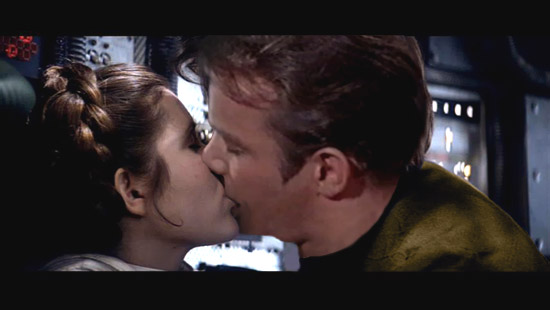
I pointed out to Kessel Junkie, a rabid Star Wars fan (seriously, check out his blog), that this isn’t just Star Trek. The original Star Wars trilogy was about Luke, Leia, and Han. Is Obi-Won Kenobi getting too important? Cut the bastard in half … or into thin air. Whatever. Same with Yoda. Bring them back as ghosts occasionally, but get them out of the action.
The Star Wars prequels became about the ensemble. While it should have been about Anakin, Obi-Won, and Padme, it wasn’t. Mace Windu, Yoda, and a freaking astromech droid were just as important. They got a ton of action independent of the main characters.
A Larger Trend
I haven’t done any serious math here, but this appears to be a larger trend, especially in light of the success of comic book movies. This isn’t necessarily a bad thing. It allows screenwriters to tell a different set of good stories. It’s also no longer “progressive” to just stick a minority on screen, make her a secretary, tell everyone she’s good at math, and rarely let her speak words other than, “I’m frightened.” I can understand a need to continue our social evolution, but it has its drawbacks with respect to the development of characters with whom the audience can relate. If we had the Avengers but didn’t have the benefit of two Iron Man movies, a Captain America movie, a Thor movie, and two Hulk movies, you wouldn’t care as much for those characters as you did (unless you had decades of development through reading their comics, which I do not have).
And this is why Picard will never have shit on original Kirk. Get over it and get off my lawn, you rotten kids.
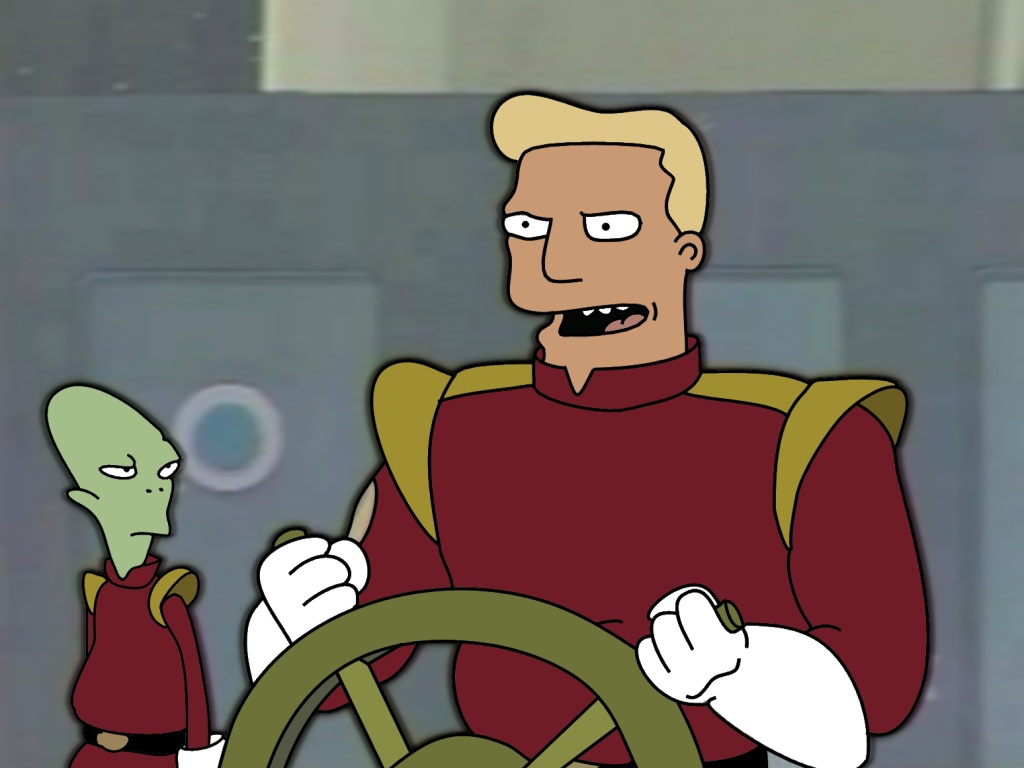
Of course, Zap’s better than both of those sissies put together.
P.S. Opening day for Star Trek into Darkness is my birthday. Great gift, though it would be better if Cumberbatch were playing Sybok.


 Play What You Want