Let's roll some dice, watch some movies, or generally just geek out. New posts at 6:30 pm ET but only if I have something to say. Menu at the top. gsllc@chirp.enworld.org on Mastodon and @gsllc on Twitter.
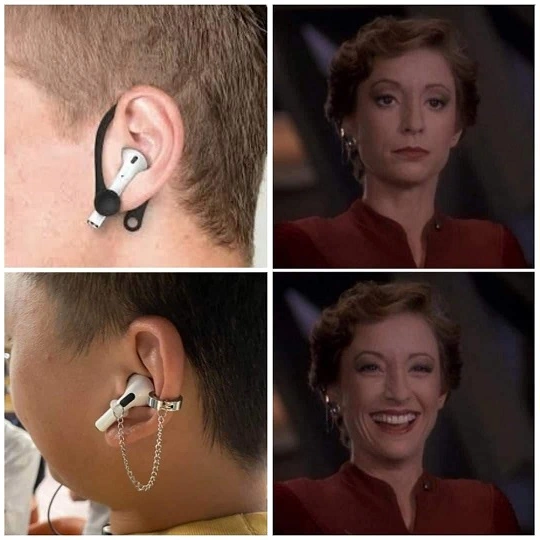
Once again, you kids have wandered onto my lawn, so I need to set you straight. Consider the following meme.
I get it!
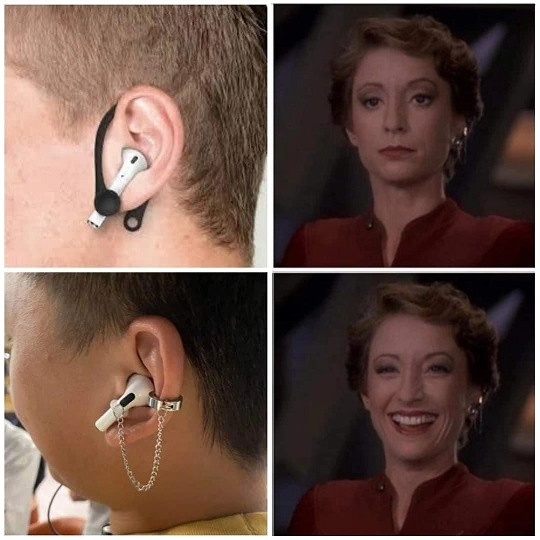
In this meme, Kira Nerys (in the first column) is reacting to what’s going on in the second column, yet her reactions are placed to the left of the Bluetooth devices. How does that make sense? While not all cultures read left to right, most do, and more to the point, ours does. Ergo, the meme shouldn’t be organized this way. Nevertheless, this is how they usually appear, and when they don’t, I’m assuming someone made a mistake. Try this, and see if a better mental picture forms in your head.
“But Rob! She’s subtly facing the wrong direction!” Not really, assuming the camera is panning from the ear to her (which makes the original image wrong for a different reason), but if it really bothers you, then flip the image, Picasso. I used MS Paint for all of this.
Doesn’t this work much better? Get it straight, dipshits.
I was searching the internet for something for Caturday and found this.
Here’s something old (2017) but new to me. Illustrator Jenny Parks created a book of illustrations of cats taking the roles of Star Trek characters from the original series. StarTrek.com published an article on it prior to its release. Its cost has dropped since the article. She did a sequel(?) based on the Next Generation and a wall calendar.
Despite the mash-up of two of my interests, these aren’t my thing, but maybe they’re yours.
Sundays now are lazy days for me. I either post something silly or other people’s work. Usually both. Today, it’s some neat Star Trek art from Young Rascal, a.k.a., Rich Kingston. I’d like to post a sample but, while I don’t know if he properly acquired the rights to publish the actors’ likenesses, I don’t want to trample on his or anyone else’s copyrights or publicity rights.
Sundays now are lazy days for me. I either post something silly or other people’s work. Usually both. Today, it’s work-related. Once per week, my office highlights an employee, sending his or her picture to the office with a short autobiography. This week, it was a 30-something who ended her bio with “Live long and prosper.” I was going to respond, but then I’d know I’d have looked like this.
Sundays now are lazy days for me. I either post something silly or other people’s work. Usually both. Today, it’s a video that hit my stream before I woke up this morning. It’s a mashup of my favorite Star Trek episode (any series), Balance of Terror, and Das Boot.
Here’s an interesting bit of trivia. When the Smithsonian Air & Space Museum in DC had a Star Trek exhibit (1992-1993), I read that Roddenberry stated the Romulans represented the Soviet Union (the current threat), and and the Klingons represented China (the growing future threat). Both my uncle and I found this odd. We both always assumed that the Romulans were the Germans, and the Klingons were the Soviet Union. Romulans with cloaking devices resemble German U-boats (the episode was basically The Enemy Below in space), and they were enemies from a prior war. Klingons, on the other hand, were participants in a cold war with the United Federation of Planets. They had never had an actual war with us, but there were several near misses.
Now, if you go on Facebook, MeWe, Twitter, or any social media site, you’ll get disagreement on what on-screen cultures represent what real-world cultures. Everyone has an angry opinion about that. This video, however, is just another piece of evidence as to which position makes the most sense. No analogy will be perfect; it’s just a matter of finding the one that fits better than the rest. Racist makeup aside, there’s simply nothing about the Klingons that screams “Chinese communism” at me.
But back to the episode. Why is Balance of Terror my favorite?
— Rob Bodine, #Attorney by Day, #Nerd by Day & Night (@GSLLC) August 26, 2021
Has a little of everything: Bells and whistles (cloaking device, aft torpedoes mentioned), morality play (racism), high tension fight (the Enemy Below), display of what's at stake (spoiler: Tomlinson's death). The perfect storm of all things #StarTrek.
— Rob Bodine, #Attorney by Day, #Nerd by Day & Night (@GSLLC) August 26, 2021
Star Trek was originally about the morality play first and the bells and whistles of advanced technology second, but both were important. This one gave us both wrapped up in a tense combat with both personal and political consequences. What’s not to love?
Yesterday I recorded my second-ever podcast. Again, it was with my cousin, Kessel Junkie, and again it was Star Trek related. In light of that, I bring up a related, recurring social phenomenon. Every now and then, a misconception enjoys new life on the internet despite having been thoroughly debunked just a few years prior. This one came up again recently. Many people still think that the Star Trek “arrowhead” logo denotes a specific ship, the Enterprise.
Well, no, it doesn’t. As this article on StarTrek.com explains, the arrowhead insignia is the insignia for Starfleet. All Starfleet crew are supposed to use it. The misconception arose from an error in production for the episode, Charlie X, in which a ship’s crew was given a different insignia. That ship, however, was not part of Starfleet. The crew “were the equivalent of merchant marine or freighter personnel,” and thus didn’t use the arrowhead insignia.
I’m not sure how this misconception stays alive after all these bouts with social media. The communication badges for every single person I can think of in Next Generation are based on the arrowhead insignia. That alone should have put this puppy to rest long ago.
Yeah, I know. It’s not the end of the world, but have you ever met a Star Trek fan? Despite unavoidable inconsistencies, producers and fans alike want consistency from episode to episode and series to series. Considering how extensive the Star Trek intellectual property is, it’s amazing that we’ve enjoyed that.
I’m probably going to have to re-blog this after another five years.
This coming week, this battle is going to boil over as Kessel and I engage (pun intended) in another joint effort. Among other things, I’ll ask why *I* must use the middle initial, but he doesn’t.
However, one point I’ve pondered recently is the scene on the Enterprise where Sybok divulges the inner trauma (so he thinks) of Spock and McCoy. Kirk, of course, refuses to play along but there are a couple of things wrapped up in this scene that seem especially…
On Friday (July 23, 2021), I mentioned that I was relearningAD&D 1st Edition (“1e“) with the intention of running it. As I read through the Player’s Handbook (“PHB“), certain mechanics or text will strike me as odd or surprising, but in either case worthy of discussion. In fact, the most surprising thing I’m experiencing is that I’m finding a lot more great ideas in 1e that we’ve since abandoned. I find myself asking, “Why?” As a result, I’ll be writing several posts over the next few weeks. I’m sure everything I’m thinking has been discussed before — sometimes be me — so perhaps my questions have been answered, and my concerns resolved, years ago. My experience with RPGs is relatively limited in scope, having played a small number of games, so I’m sure a lot of what I’m going to say has been incorporated into games I’ve never even heard of. (Some have certainly been addressed by future editions of D&D themselves.) Nevertheless, bringing this directed conversation to the public is new to me, so here it goes.
I don’t think this post will go over well with the professional game designers. Or the amateur ones. I’m being completely unreasonable, but professionals should always listen to their most demanding clients, right? Well, that’s me. I just want to play, and the quickest way to do that is to play a rules-light system. However, once I’ve got the hang of it, I want a rules-heavy system thorough enough not to leave itself open to conflicting interpretations.
I want my cake and to eat it too.
Why So Tense?
One of the tensions in game design is whether an RPG should be rules heavy or rules light. 1e is certainly rules heavy, at least when it comes to a combat system that micromanages so much. There’s a huge disadvantage to that: Learning such rules is a barrier to entry for new players. I get that point of view, especially when you have a system like 1e that requires you to jump from page to page, or even book to book, to get the complete rule (made easier by the hard work of David Prata mentioned in yesterday’s post on Initiative). Some game designers have tried to improve on this by simplifying processes, further abstracting how the system deals with the topic at hand. Well, I think it’s time for some reification.
Whiny Players
Here’s a grossly paraphrased conversation I’ve had since returning to D&D in 2005. In my experience, this is by no means an unusual conversation to have in this or other contexts.
Me (3-5 times while describing the scene): Are you sure you don’t want to do anything else? Table: Nope. Me (placing the minis on the table): Okay, you’re surprised. Table: How? We had a lookout. Me: I asked you several times if you had anything else to tell me, and you never mentioned it. Table: But we always have a lookout. We’re adventurers. We know to do that. Me: Well, they’re ambush predators. They know how to sneak. Table: Show me in the rules where we must be surprised in this instance. Me: The rules can’t possibly provide every example possible, so no such rule exists. Table: Then we can’t be surprised. Me: The very fact that surprise rules exist cuts against your argument. Table: You’re a terrible DM. You don’t know the rules.
Truthfully, I am a terrible DM, but this isn’t an example of that.
1e Combat
The 1e combat system is rules heavy. Yes, it’s spread out over different pages of the Players Handbook and the Dungeon Master’s Guide, but that’s a failure of execution, not concept. I’m discussing concept in this post, so let’s stay focused on that.
The system does two things that I absolutely love but haven’t appeared in D&D in some time. First, surprise is handled by a simple die roll in almost all combats. There are a few things that negate a poor roll, but in general, roll a 1 or 2 on a d6, and you’re surprised. Second, the distance between the parties at the precise moment of engagement is handled through a separate die roll. The rule takes into consideration practical matters such as line of sight, whether the encounter takes place in a 20’ x 20’ room or outdoors on a flat plane of low grass, etc., but no one can say that they were surprised because the DM didn’t properly set the scene or otherwise withheld important information, and they also can’t argue as to whether they were in striking distance at the moment they were surprised. The baseline is that these dice rolls govern, so the burden shifts to the players to point to something they expressly said they were doing, or circumstances of the scene, that justify ignoring or modifying those dice rolls.
So, should all RPGs be designed like this? Maybe not. A ruleset covering all the bases is going to be long and complicated, which can slow down the game even if you know the rules. Even worse, beginners will face a barrier to entry. They’ll take one look at David’s work and say, “Twenty pages? Nope. That’s too much to read just to get to sit down at the gaming table.” Is there some way to avoid that?
Beginning v. Advanced Systems
A possible solution to the problem of the barrier to entry is to go backwards. 1e published the Basic Set (followed by some others) that served this purpose, and it was reasonably compatible with the Advanced Dungeons & DragonsPHB and DMG (what I’ve been calling 1e). I never played this, but I seem to remember them having noticeable mechanical differences from 1e, which turned me off to it. This was probably arrogant because, believe it or not, when I first started playing “Blue Box” AD&D, we didn’t use ability scores at all. I don’t remember how that played out and can’t even guess how it worked, but I remember a conversation with a kid named Louis, who explained ability scores to me in 6th grade, which was two years after I started playing. The point is that you could abstract what you wanted, and once comfortable, drill down to a more complicated but well-defined system, but that was haphazard. Game designers should instead provide the roadmap by designing a combat system, then removing complexities from it in such a way that it maintains the balance between the two sides. What’s left is the “basic” system suitable for new players, existing players that prefer a rules-light system, or any player looking for an occasional quick and easy combat. Modern RPGs create alternate rules (e.g., methods for ability score generation), but that’s not the same thing.
A favorite RPG of mine, the FASA Star Trek RPG, did this quite well for starship combat. There was a basic subsystem and an advanced subsystem. The core mechanic was the same, with the base system dividing values by 3 (rounding down), but the advanced subsystem was more than just larger scalar values. It also introduced a more complicated means for bridge officers to affect combat. Not only did this eliminate a barrier to entry into the game, but I suspect that in order for this to work, the design methodology necessarily facilitated either subsystem being played as a board game. That opened the game to a lot of Star Trek fans who somehow thought RPGs were too nerdy. (I’m not kidding.) The rules were divided across five, short handbooks, all contained within the game’s box set.
There Are Still Concerns
Execution aside, publishing multiple subsystems, or even just one excessively complicated one, is not without its concerns. Players don’t want to purchase a nonnegligible amount of product just to move from one level of abstraction to the next. To allay this concern, the core rulebooks should disclose alternate subsystems even if an introductory box set exists. This leads to at least three other issues. The first issue is that game play could be slowed to a crawl if the rules get too complicated, even if you know exactly how they work. This could result in your advanced system almost never being used, making them a wasted effort. Ergo, there will still have to be trade-offs on that advanced system in order for it to have practical value. The second issue is that the core rulebooks could get too long if there are too many alternate subsystems across the entire game system. For both issues, game designers must pick their battles when deciding which rules to abstract/simplify. Perhaps that’s what’s raising my concerns here. Maybe they’ve picked their battles, and I just don’t like the ones they’ve picked, or maybe I don’t even perceive the battles they’ve won and therefore don’t appreciate them. I just know what gives me the most headaches as a DM and looking at all the PHBs and DMGs I’ve used, most have a little room to spare. Also, this is why I’m suggesting only two subsystems and only for combat, where one subsystem is just a compatible extension of the other.
For the record, the third issue, which for now I’ll call the Head of the Table writing method for now, will be discussed in a later post.
It’s All About Me
Let me know when I can stop apologizing.
Believe it or not, I know it’s a lot to ask of game designers to incorporate a second, simplified ruleset for combat, especially considering that my opinion may be a minority one. However, I suspect it would cut down on tension at the table, and designing in-game conflict resolution systems is the primary function of the game designer. Campaign settings are nice, but many people write their own. Not many write their own combat systems, and most can’t do that well. If any system is appropriate for division into a beginner and advanced system, it’s combat. So why not have your cake and eat it too? You could appeal to both the rules-light and rules-heavy crowds, broadening your customer base.
In general, I prefer a thorough system. Considering the conversation above, you can see why. Lightening the rules has led to a notion of DM empowerment in order to make the game playable, but it creates far more “us v. DM” tension than I enjoy at my table regardless of whether I’m behind the DM screen. The conversation above couldn’t occur often if we were playing 1e. I could point to the dice on the table, and that’d largely be the end of it. The biggest problem I’ve faced as a DM is the fact that many players don’t like to lose. By “lose,” I mean fail to solve a puzzle, miss a major piece of treasure, take a single hit point of damage, or get surprised. Just try to kill the average player’s character, and you’ll see how angry they can get. But the dice don’t lie. Thorough rules lead to predictable, and thus fair, results. Though it failed in clarity, 1e had the right idea. The FASA Star Trek RPG got it right. None of that would ever stop a DM from customizing those rules to suit their needs, especially if elements of the advanced subsystem were presented as attachable modules to the basic subsystem. I suspect multiple attachable modules would be harder to implement while maintaining balance, but 1e armor class adjustments, weapon speeds, and weapon lengths were effectively detachable rules that many people ignored, and the game was still playable. I’m looking for a well-defined subsystem that provides a clearer roadmap.
*sigh*
Hey, you chose game design as a career. You have no choice but to try to make me happy.











 Play What You Want