Let's roll some dice, watch some movies, or generally just geek out. New posts at 6:30 pm ET but only if I have something to say. Menu at the top. gsllc@chirp.enworld.org on Mastodon and @gsllc on Twitter.
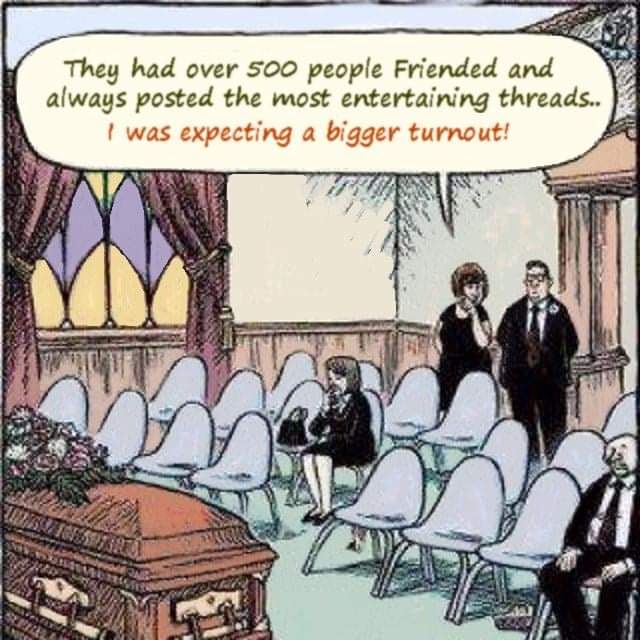
I’ve seen this and similar Facebook groups cited a lot recently: “This group is not an airport, no need to announce your departure.” I know it’s nothing new, but they’re cited even when people are very polite in their announcement.
Do you know what else you don’t need to announce?
What you had for dinner last night.
What you think of voter ID.
Why you bought the car you just bought (this one’s mine!).
Why you quit your job.
Whether you prefer hot or cold climates.
Where you’re going for vacation next month.
Storms: Scary or fun?
Whether you think you have too many keys on your keychain.
How great your new bed is (also mine!).
Why you don’t care that the person is leaving the group.
You don’t have to announce any of those things, but you do. Why? Because that’s probably the most important use of social media. Sure, except for Elvis, it would be awkward to announce your departure, whereas the rest of the list is common party fodder. That said, Facebook isn’t a party. It’s a social media platform. We’re communicating our thoughts, often to strangers and sometimes mundane, in a medium designed for that very purpose. Most of what you say means nothing to most of the people to whom you say it (even at a party of strangers), but the means to say it is a primary reason why these platforms are so popular.
I’ve only once had people do that to me, and surprisingly it wasn’t when I told everyone I was forming an exit strategy for Facebook (so far unsuccessfully). I left an XFL group and said I was giving up on the league because of a tremendous lack of integrity they showed. Officials at headquarters allowed a game to end when it shouldn’t have. The members laid into me. I laughed it off, but some take it more personally, and I thought we were all supposed to be nice to one another.
Instead of telling everyone, “Bye, Felicia,” or posting snarky animated GIFs (pronounced gif, not jif, obviously), how about you just be honest and say, “I don’t care about anyone else’s opinions but my own and those that agree with me.” Someone saying they’re leaving, and especially when they say why, can have value, but only to the open-minded. The rest may continue citing those groups. Which group are you in?
By all means, add a comment that you’re never going to read my blog again, but if you do, please tell me why.
I’ve seen a lot of (private) censorship going on by Facebook, and now it’s hit me right in the nuts. My “posting and replying privileges” were suspended for 24 hours because I made two jokes over the course of thirteen days that “violated community standards.”
RJS: “I have a long list of things I’d like to see improved with the coming administration, but one thing on that list, and I’m not going to say where it falls, is the decriminalization of a certain substance. Can’t. Wait.”
JD: “Okay now for sure if you and I ever both make the insane decision to attend a con in person, and it happens to be the same con at the same time…. Yeah, that.”
Me: “Hippies.”
Calling people hippies is something I’m known to do whenever someone disagrees with me (a la Eric Cartman), but it seemed particularly appropriate here. Continuing . . .
RJS: “Frog enthusiasts.”
This, of course, meant that RJS and JD licked toads. Unfortunately, I had a brain fart and thought he was referring to me as a frog enthusiast, and that I was missing some sort of reference. Mea culpa. So, not knowing what he was talking about, I responded, “Mais je deteste les Francais” (“But I hate the French.”). Get it? The French are frogs. Not my best work, I know, but it was just a goofy response to something I didn’t immediately understand.
That was deemed hate speech. Here’s some discussion on it from a subsequent post, again if you have access.
First concert – Billy Joel Last concert – 38 Special (with Erik Nowak) Best Concert – Iron Maiden Worst concert – Jimmy Buffett Loudest concert – Iron Maiden (I was on the floor) Seen the most – Billy Joel (twice) Most surprising – Cowboy Mouth (soooo good) Next concert – It’ll be a while. I’m not a huge concertgoer. Wish I could have seen – Fleetwood Mac, RUSH, Genesis, George Benson
Someone responded “’Last’ sounds so final. Perhaps ‘most recent’?” I replied, “I plan to kill everyone who responds.” I assume that was deemed terroristic threatening.
Basically, Facebook’s algorithm (and apparently the humans that perform the follow up review) can’t distinguish obvious humor from actual hate speech or terrorism. Of course, neither can many people nowadays, so I guess there’s always going to be a market for Facebook’s humorless bubble. However, if you’re in that group, you’re a tiny minority. Most people get it, and the only way Facebook will learn to stop catering to such a small minority is for people to either reduce their presence or leave altogether.
I think I’m going to do my part. I’ve been looking for an excuse to part ways with Facebook, and they just handed me one. My presence is going to be greatly reduced until I settle on another option. I’ll refocus my efforts towards Twitter and my blogs, so if you want to connect on Twitter, just send me a Facebook private message. I have several different handles that deal with different subject matter (geekdom, sports, politics, and law) in order to reduce the noise. As long as I’m still on Facebook, if I see something interesting there, I’ll respond via my Twitter feeds (quick responses) and blog sites (verbose responses). I’ll link to my posts via the Facebook news feed but won’t engage in discussions there, relying only on my posts’ comments sections. I don’t mind discussion on my Facebook wall; I’m just saying I won’t be part of that discussion or even follow it. Will you really miss me though?
No one seemed to miss me for the 24 hours.
This Isn’t the End of the World, but It’s No Small Matter
I’m an attorney. I’m well aware of the distinction between private and public censorship. Private censorship is almost always legal, and public censorship is almost always illegal. Facebook, Twitter, and other “microblogging platforms” are private entities largely permitted to suppress speech, but they’re clearly heading for (if not already there) an oligopoly (i.e., a monopoly, but where there are a tiny number of providers rather than just one), which means antitrust law applies.
While many of you hate the people who joined Parler, don’t you still find it troublesome that, the moment a competitor started to gain a serious foothold in the market, one of Twitter’s companions, Amazon Web Services, effectively bankrupted them by cutting off their access with a 30-hour notice? If MeWe gets too popular, they could be next. Facebook and Twitter could cut out all competition, leaving you no other options, and once that happens, who knows what rules they’ll impose? The fact that one’s access to the primary avenue to communicate with others (i.e., speech), in a pandemic no less, is the precise service being suppressed makes this even more troublesome regardless of whether the government is doing it.
Each of these cases turn on their facts, so I’m not going to condemn or complement the Court’s denial of an injunction in Parler’s suit. Also, this one incident isn’t the end of the world. I’m simply pointing out the immense market power these companies have and how they’re making sure they never lose it. Sooner or later, that will result in an antitrust violation, and the violation will be to everyone’s primary means to connect in the Internet Age. Everyone thinks they’re virtuous, but these giants could easily come for you next. Whether they’re destined to throw you out, or you’re destined to get sick of it and leave by own free will, maybe it’s time to form an exit plan just in case. While doing so, don’t be your own worst enemy by letting these guys off the hook.
My exit plan is under construction. The fact that one is even necessary is evidence advancing my argument.
Don’t worry. This isn’t as heavy-handed a moral lecture as the title makes it sound.
MeWe keeps coming up in my social media feeds. Everyone is asking whether it’s a good platform. Here’s my take on it. MeWe is an attempt to remove the privacy concerns of Facebook, and they absolutely succeed as far as I can tell. However, that’s actually the problem with MeWe. This is a tough pill to swallow, but the truth is that I, and probably many of you, don’t actually want the level of privacy that we demand from Facebook, at least not initially.
One of Facebook’s strengths was allowing us to reconnect with former friends and acquaintances. The privacy protections of MeWe prevent me from doing that. The last I checked, I couldn’t find my friends unless I already had their email addresses. That’s quite an impediment to connecting with lost friends, in which case, what’s the point of MeWe?
But that brings us back to the our own issues. We criticize Facebook’s lack of privacy, but the level of privacy we demand from Facebook would have prevented Facebook from generating its current value to us. I think we are again missing the big picture. The only reason we’re in a position to make such demands from Facebook is because we’ve already used their lack of protections for years to accomplish what we’ve wanted. That is, because we already have found our old friends on Facebook, now we want them to secure the platform. Though there are far greater sins, that’s a bit hypocritical, but the point is this: For new competitors without those existing connections, it’s nearly impossible form them to enter the market, so we’re stuck with Facebook unless we change.
As a result, I have a MeWe account but have no idea what to do with it.
If you enjoy this post, please retweet it even though you shouldn’t.
We all know how humans argue. We don’t listen; we just wait for our turn to speak so we can claim our opponent is wrong. As a result, we hear maybe a sentence or two of an argument, then fill in the missing pieces with our own assumptions and prejudgments about what we think our opponent is arguing. The result is that we hear only a portion of what they say, and even worse interpret their argument in the opposite way in which it was intended.
But it’s not completely our fault. Twitter gives us only 280 characters per tweet, and even if we chain them together, people will usually see only a single tweet in that chain. This reinforces our tendency to address only a portion of our opponent’s argument. As the conversation continues and others contribute, the effect snowballs into a real mess, and you don’t always remember to whom you’ve already clarified your points, meaning you make assumptions about what they understand.
A flowchart of a typical Twitter conversation.
I don’t think it’s a coincidence that Twitter is so popular and that it’s effect on dialogue mirrors the way we choose to discuss politics and religion. We choose to use Twitter because it’s how we argue. The cure to this social disease is to address only those topics that can be covered in 280 characters. If you want to blog, then blog. If you want to write a PhD dissertation, go back to school. Then it’s not your fault when people choose to miss the point. Otherwise, it is your fault.
I want to say that this was a waste of time, but I can’t. It’s too important not to be given an occasional reminder.
This 94-minute documentary (with occasional, annoying dramatizations) is about how social media is impacting our lives. Yeah, we all know it, but we can’t help but succumb to it. And that’s point #1. It resembles an addiction, but it’s really about preying on our very nature.
Point #2 is that it’s taken the internet and made it even more divisive. It’s not that we haven’t had serious disagreements with each other. Anyone that’s lived outside their bubble knows that. It’s that we’re now being exposed to those differing viewpoints seemingly continuously, and in a way that makes the speakers feel as if they’re anonymous, even when they clearly aren’t. In other words, we’re hearing a lot more about the way people really feel about issues, and we often disagree.
Kessel Junkie and I discussed this a little bit in the comments on his blog. Trigger warning: He hates the Goonies.


 Play What You Want