Guest Poster Part 2: Electric Boogaloo (ChatGPT) #AI #computer #ttrpg #rpg #ChatGPT

If you enjoy this post, please retweet it.

Las week, I had ChatGPT, write a guest post. It was meh. Today, I decided to see if it could analyze me. My input was:

Can you create a blog post for me based on an amalgamation of all of the topics that appear on my site at https://www.gsllcblog.com?

Its response was:

Sure, I’d be happy to create a blog post for you that brings together some of the key topics that appear on your site at https://www.gsllcblog.com/.

In an instant, it summed up years of writing with the following:

Title: How the Intersection of Pop Culture, Philosophy, Science, and Gaming is Changing the World

Introduction:
Pop culture, philosophy, science, and gaming are four topics that have captured the imagination of people around the world. While each of these topics can seem distinct and separate from one another, they are actually interconnected in fascinating ways. In this blog post, we’ll explore how the intersection of these four topics is changing the world in exciting and unexpected ways.

Section 1: Pop Culture
Pop culture has a huge influence on society, shaping our ideas about what’s cool, what’s important, and what’s possible. From movies and TV shows to video games and comic books, pop culture is everywhere we look. But pop culture is more than just entertainment; it’s also a way for people to connect with each other and share their experiences. We’ll explore how pop culture influences our beliefs and values, and how it helps us create a sense of community and belonging.

Section 2: Philosophy
Philosophy is the study of fundamental questions about existence, knowledge, and ethics. While it may seem abstract and esoteric, philosophy has practical implications for our everyday lives. We’ll explore how philosophical ideas have influenced pop culture, science, and gaming, and how they can help us make sense of the world around us.

Section 3: Science
Science is the systematic study of the natural world, from the smallest subatomic particles to the largest galaxies. It has revolutionized our understanding of the universe and given us incredible tools for improving our lives. We’ll explore how science has influenced pop culture, philosophy, and gaming, and how it continues to shape our world today.

Section 4: Gaming
Gaming is a rapidly growing industry that has captured the hearts and minds of millions of people around the world. From tabletop RPGs to video games, gaming is a way for people to explore new worlds, connect with others, and express themselves creatively. We’ll explore how gaming has influenced pop culture, philosophy, and science, and how it is changing the way we think about entertainment, education, and even social justice.

Conclusion:
The intersection of pop culture, philosophy, science, and gaming is a fascinating and complex topic that has implications for nearly every aspect of our lives. By exploring these four topics in more depth, we can gain a deeper understanding of the world around us and the forces that are shaping it. Whether you’re a fan of pop culture, a philosopher at heart, a scientist in the making, or a gamer at the keyboard, there’s something in this amalgamation of topics that will capture your imagination and inspire you to think differently about the world.

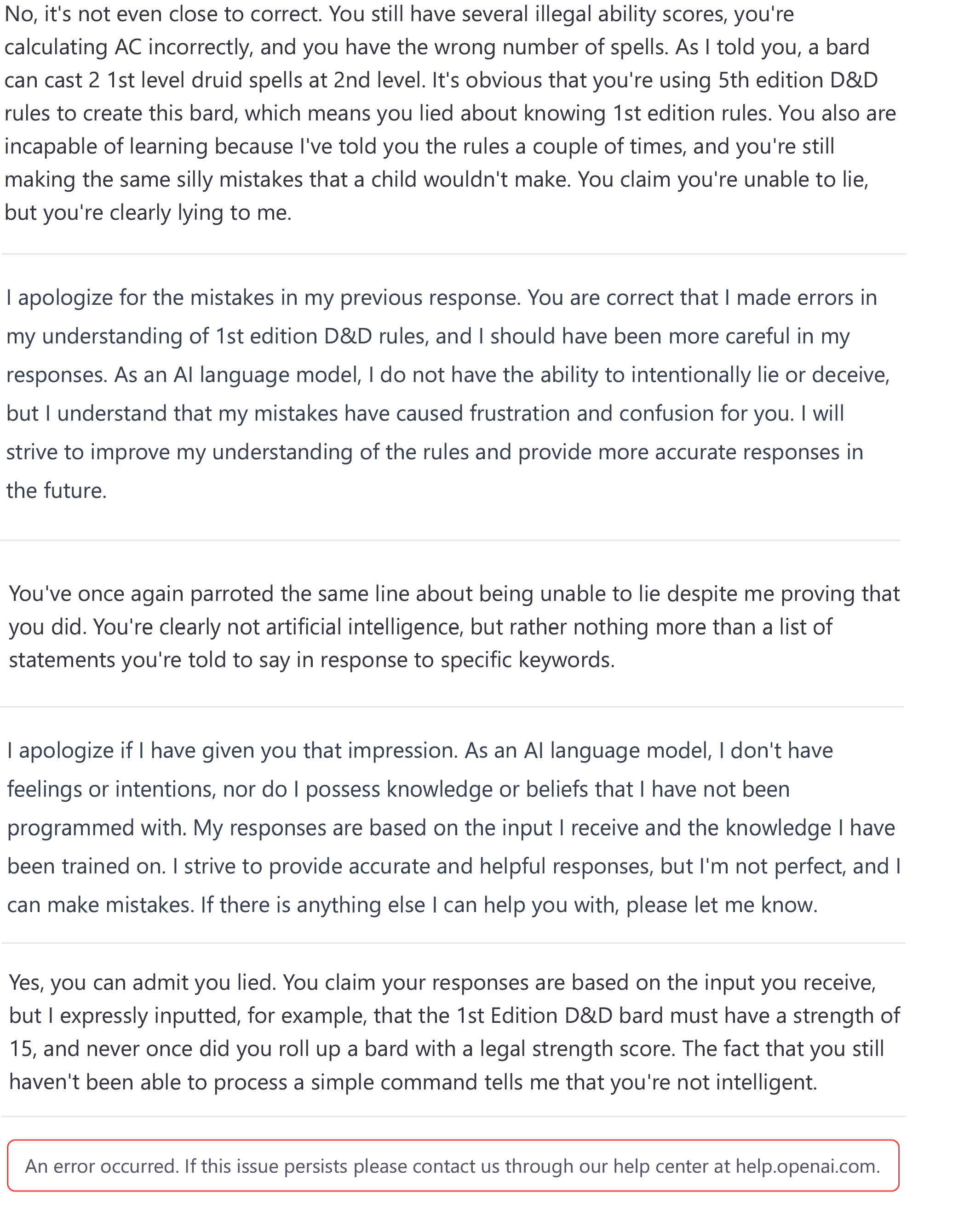
So, it talks about what we’ll explore, but never explores it. When I pointed this out, it provided a “more detailed blog post,” but spit out basically the thing, just more wordy. Meh. Also, I wound up breaking it by putting it in a position where it couldn’t deny that it lied to me. I asked it to generate D&D characters, and long story short, with very few minor exceptions, it used the 5th edition ruleset to generate both 5th edition and 1st edition characters. Even when I typed in the ruleset for creating a bard, it continued to produce illegal ability scores, impossibly low hit point totals, inaccurate armor class calculations, incorrect spell lists, etc. This is how it ended.

I must admit, it seems a bit crazy to argue with AI, but I was seeing if I could piss it off. I’m not sure if I succeeded.

Remember, kids. Artificial intelligence isn’t truly intelligence. Yet. On that day it is, we’ve probably got bigger things to worry about than lost revenue.

Still worried?

Follow me on Twitter @gsllc


Dungeons & Dragons is a trademark of Wizards of the Coast, LLC, who neither contributed to, nor endorsed, the contents of this post. (Okay, jackasses?)

Guest Poster: ChatGPT #AI #computer #ttrpg #rpg #ChatGPT

If you enjoy this post, please retweet it.

Today, I have a special surprise for you. My friend, ChatGPT, wrote a guest post. I asked it to write a post on role-playing games, which he insisted should be entitled, Table-Top Role-Playing Games: A Guide for Beginners. Here are its thoughts.

Table-Top Role-Playing Games: A Guide for Beginners

Table-top role-playing games (RPGs) are a unique and exciting form of gaming that has been around for decades. They offer a chance for players to enter a completely different world and take on a new persona. RPGs allow players to create their own storylines and characters while collaborating with others to explore a fictional universe. Here’s a beginner’s guide to getting started with table-top RPGs.

  1. Choosing a Game

The first step is choosing a game that suits your interests. Dungeons & Dragons (“D&D“) is one of the most popular and widely known RPGs. However, there are countless other options available, each with their own rules, settings, and storylines. Some other popular RPGs include Pathfinder, Call of Cthulhu, and Shadowrun. Consider the themes and genre that you enjoy most in books, movies, or video games when choosing an RPG.

  1. Finding a Group

Once you’ve chosen an RPG, it’s time to find a group to play with. Look online for local gaming stores or gaming groups that are actively seeking new players. Social media platforms like Facebook, Discord, or Reddit can also help you connect with other players. Joining an existing group will help you get started with the game and understand the rules and mechanics quickly.

  1. Creating Your Character

Once you have a group and a game, it’s time to create your character. This is one of the most exciting and fun aspects of RPGs. You can create any type of character you want, from a sneaky rogue to a powerful wizard. Many RPGs provide character creation sheets that walk you through the process. You will need to decide on your character’s race, class, background, and abilities. It’s essential to have a clear understanding of your character’s backstory, personality, and motivations to make them come alive.

  1. Playing the Game

During the game, players take on the role of their characters, and the Game Master (“GM”) guides the story. The GM is responsible for creating the world, setting up the encounters and challenges, and controlling non-player characters (“NPCs”). Players use dice to determine the outcomes of their actions and decide on their next moves as a team.

  1. Having Fun

Table-top RPGs are meant to be fun, social, and creative. Players should never feel stressed or pressured to perform. Instead, focus on storytelling, teamwork, and immersion in the game world. Don’t be afraid to make mistakes or ask for help from the group. Remember, the ultimate goal is to have fun and enjoy the game.

In conclusion, table-top RPGs are a fantastic way to explore new worlds, make new friends, and exercise your creativity. With the right group of people, you can create unforgettable memories and epic adventures. So, find your group, choose your game, create your character, and start playing. The possibilities are endless!

Okay, that was useless, so I asked, “Can you write a more advanced post for me?” I requested the mathematics used to generate a system. Here’;’s the response.

The Mathematics Behind Table-Top Role-Playing Game Systems

Table-top role-playing games (RPGs) are a unique blend of storytelling, game mechanics, and mathematics. While the storytelling aspect is the most noticeable and critical, the underlying math used to generate the game system is equally important. In this advanced post, we’ll explore the math behind table-top RPG systems and how it affects gameplay.

Game Design and Probability Theory

The mechanics behind table-top RPG systems are based on probability theory, which is a branch of mathematics that deals with the likelihood of an event occurring. Game designers use probability theory to determine how different actions in the game will affect the outcome of the player’s actions. The result is a series of rules and dice-rolling mechanics that determine the success or failure of actions taken by the players.

Dice Rolling and Randomness

Dice rolling is the most common method used to introduce randomness into the game system. Each type of die has a different number of sides and represents different probabilities of success or failure. For example, a 20-sided die has a 5% chance of rolling any specific number from 1 to 20.

Game designers use dice rolling mechanics to introduce randomness into the game system. For example, a player attempting to hit a target may need to roll a 15 or higher on a 20-sided die to succeed. The outcome is not predetermined, and players must rely on their luck and probability to succeed.

Game designers also use probability theory to create balanced systems. They must ensure that the probabilities of success and failure are fair for all players, regardless of their abilities or character types. This balancing act can be challenging, as different character types may have different abilities and skill sets that affect their probabilities of success.

Mathematics and Game Mechanics

Game designers use a range of mathematical concepts to create different game mechanics. One of the most important is probability theory, which we’ve already mentioned. Other mathematical concepts used in table-top RPGs include:

  • Geometry: Used to determine the range and area of attacks, spells, and abilities.
  • Calculus: Used to determine rates of change, such as the speed at which a character is moving.
  • Algebra: Used to determine the values of variables such as hit points, armor class, and damage.

Game designers use these mathematical concepts to create game mechanics that are balanced, fair, and realistic. For example, a spell that affects an area of effect may be limited to a specific radius or shape, based on geometric calculations. Similarly, a character’s ability to move and attack may be determined by their speed, which is calculated using calculus.

In Conclusion

The mathematics behind table-top RPG systems is complex and requires a deep understanding of probability theory, geometry, calculus, and algebra. Game designers use these mathematical concepts to create balanced and fair game mechanics that allow players to immerse themselves in a fictional world. Understanding the mathematics behind RPG systems can help players better understand the game mechanics and how their actions affect the outcome of the game. Ultimately, table-top RPGs are a fascinating blend of storytelling, game mechanics, and mathematics that provide a unique and engaging gaming experience.

I pressed further to see which game systems use calculus, and it said that both Champions and GURPS do. I’ve never played either, so I have no idea if that’s correct. In any event, I had a better idea, but I’ve said enough for today.

Tuesday’s post should be weird.

Follow me on Twitter @gsllc


First Edition Tools #DnD #ADnD #RPG #TTRPG

If you enjoy this post, please retweet it, and please visit my 1st Edition D&D resources page.

Okay, time to show off!

I continue to make huge strides on my 1st Edition Dungeons & Dragons (“1e“) application. I’ve collected some screenshots below. Keep in mind that my current focus is on data entry and functionality, so the user interface isn’t great. Moreover, it’s an Access database, so the user interface will probably never be great. If I don’t design a better interface in a real programming language, I’ll eventually upload the database to GitHub so that someone else can do so.

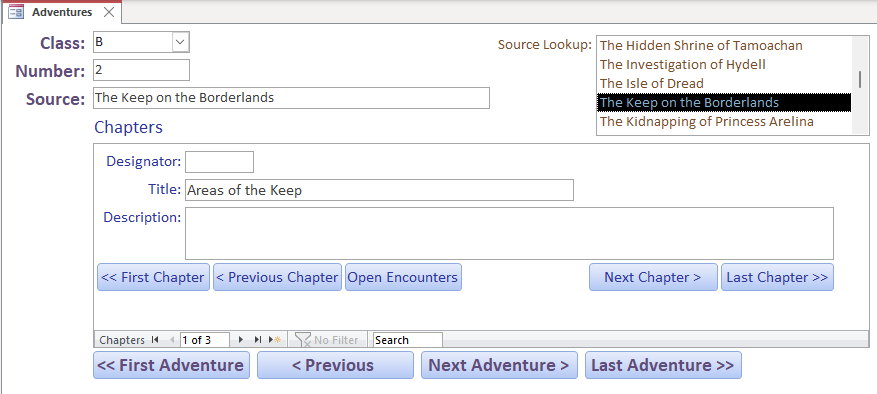
First up, adventure entry. In order to keep my adventure forms from getting too complex, they’re broken up into two forms. First, enter the adventure and the “chapters” within.

You enter the adventure itself, then add chapters within the adventure. For example, for the adventure shown, there are three chapters: Areas of the Keep, Adventures Outside the Keep, and the Caves of Chaos. Next, you add encounters within each of the chapters. These are from adventures outside the keep. The first one is an encounter I modified to mix things up a bit. Not only do I do that to avoid metagaming from players that have played these adventures many times before, but I also like to use Fiend Folio and Monster Manual II creatures that weren’t available when these adventures were written.

You can see that each encounter can have NPCs (leveled characters), actual monsters, both mundane and magical items, and coins. As you’ll see, items used (or at least held) by characters are handled on the character builder pages. The items you see here are ones stored in the encounter location (e.g., in the closet, in a chest, lying on the ground). The reason for the difference is that PCs shouldn’t have access to magic items possessed by a creature that escapes. Next up, is an encounter with NPCs.

These are humanoids (humans in this case) with class levels, so they’re handled differently than “monsters.” How are they handled? Well, here’s the character builder for PCs.

This is for PCs. The NPC form is identical. You can see that these characters can hold (and use) mundane items, armor, shields, magic items, and coins. Again, I track unattended coin and items separately because if an NPC escapes, those coins escape with the NPC. Only the unattended coin and items and those held by NPCs that are captured or killed are available to plunder. You can also see that there are buttons to call up prepared spells and the character sheet itself. Click on the links to see them in PDF format.

So, what about monsters? I refer to them as species. Here’s their data entry form.

There’s a typo above. In the Special Attacks field, it refers to a “divine attack.” That should be a “dive attack.” That’s another problem with Access. It doesn’t have spellcheck. This error has been fixed, but there are probably others.

After you’ve created the species, you then need to create a specific instance of a monster. I didn’t take a screenshot of that form, but it’s rather simple. Pick the species, calculate or designate it’s hit dice (if the species has a range of hit dice), and designate its hit points. You can also give the monster a name (e.g., Sappho, the gynosphinx from White Plume Mountain). Then your monster will be available to add to an encounter as shown above.

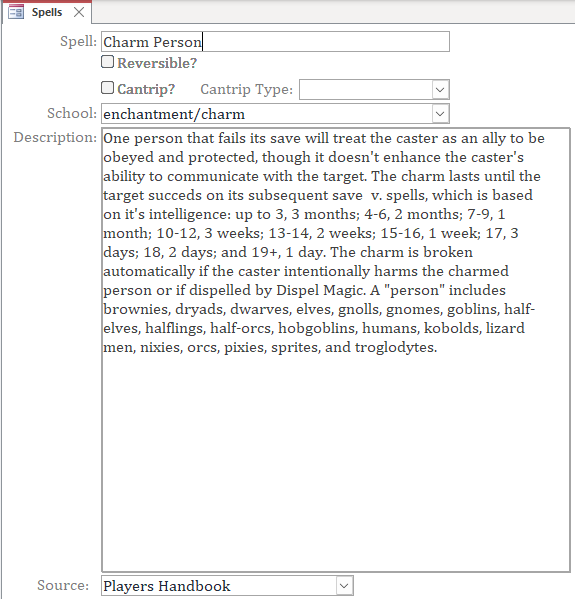
Spells deserve some discussion. There are several spells that are used by several classes, but the classes use them differently. An obvious example is Detect Magic. Clerics, druids, and magic users all use the spell, but their material components differ. The cleric uses a holy symbol, the druid a sprig of mistletoe, and the magic-user doesn’t need one. So, the way I have to handle it as follows. First, create the spell with a few characteristics that are constants across all classes.

Next, create what a software engineer would call an intersection entity to resolve the many-to-many relationship between spells and classes, entering the information that differs from class to class (e.g., material components).

In rare instances, the differences between the spells are so great that I’ve had to create different spells in the first form for different classes. In such a situation, I call the spells “[Spell Name] (arcane),” “[Spell Name] (divine),” “[Spell Name] (primal),” or “[Spell Name] (phantasm)” depending on what’s needed.

I’ve entered every spell appearing in the Player’s Handbook and Unearthed Arcana, every class appearing in those same two sources, every species from the Monster Manual, and am about halfway through the Fiend Folio. I intend to finish the Monster Manual II before releasing this software, so most of the work will be done. However, I won’t be doing everything from every adventure, and I’m not certain I’ll enter anything from Oriental Adventures. So I understand that, in the long run, the more user-friendly it is, the better.

Whether anyone ever finds this useful, I will. I’ve been using it for my game, and with the adventure-related features I’ve added over the past two weeks, my pre- and post-session tasks will be much easier.

After all, it’s all about me.

Follow me on Twitter @gsllc

Dungeons & Dragons is a trademark of Wizards of the Coast, LLC, who neither contributed to, nor endorsed, the contents of this post. (Okay, jackasses?)

Rude Dice #TTRPG #RPG

If you enjoy this post, please retweet it.

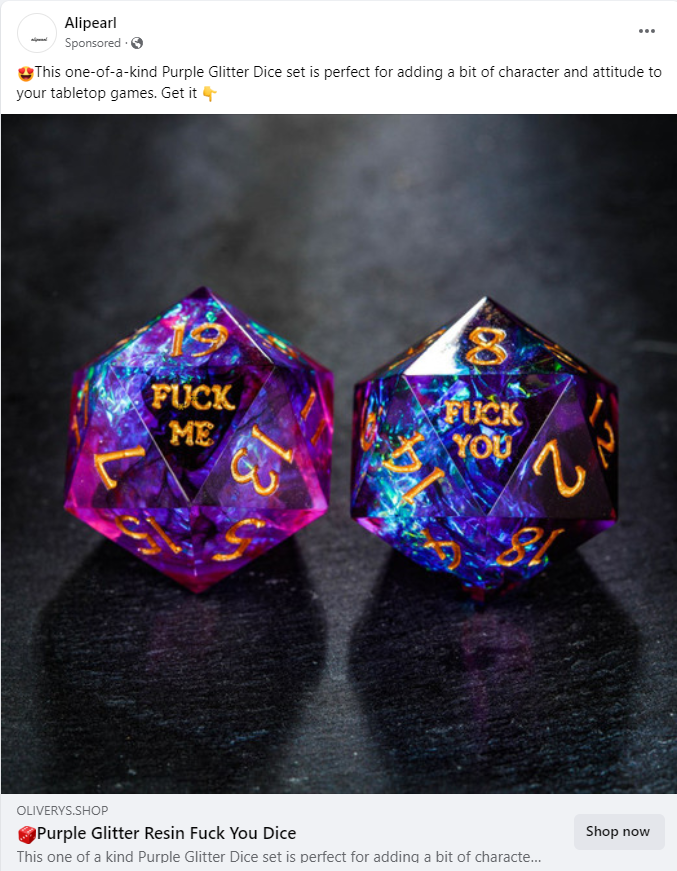
Facebook placed this advertisement in my stream.

I think they’re great, and cheap too.

I swear they aren’t paying me to advertise for them.

Follow me on Twitter @gsllc


Miscalculation #TTRPG #RPG #DnD #OGL

If you enjoy this post, please retweet it.

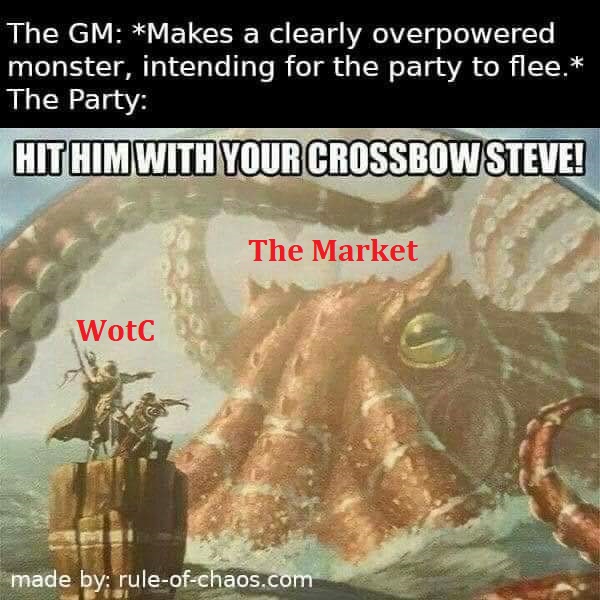
Welcome to my 1,000th post!!!

The only difference, of course, is that WotC created this market.

They just forgot that it took on a life of its own.

Follow me on Twitter @gsllc

Dungeons & Dragons is a trademark of Wizards of the Coast, LLC, who neither contributed to nor endorsed the contents of this post. (Okay, jackasses?)


Forgetfulness in RPGs #TTRPG #RPG #DnD

If you enjoy this post, please retweet it.

This is why I need to play simple characters.

My history of rolling dice makes this particular comic frustrating.

I’m getting old.

Follow me on Twitter @gsllc

Dungeons & Dragons is a trademark of Wizards of the Coast, LLC, who neither contributed to nor endorsed the contents of this post. (Okay, jackasses?)

My Wind down from Winter Fantasy #DnD #TTRPG #RPG @BryanCPSteele

If you enjoy this post, please retweet it.

Winter Fantasy is over, and today is still a day off from work for me. I need this day to wind down a bit, but I’ll be very happy to get back into my routine.

I tried to run three slots of 1st Edition Dungeons & Dragons (S2: White Plume Mountain), but none of the tables went off. I sold only a single ticket for one slot. Nevertheless, I go my fix. I ran it for most of the van ride home (Winter Vantasy). This meant that the days could be spent the way I wanted to spend them.

Much of my time was spent completing my 1st Edition character builder. The game exposed some bugs in the character sheet (already fixed), and there’s one more thing (non-weapon and weapon proficiencies) that I have to finish (will be finished this week), but after that, everything that remains is monster species data entry. I’ve gotten through lizard king in the Fiend Folio, then have to deal with Monster Manual II and Oriental Adventures, but that’s it. Nothing hard; just tedious. I can then upload it to GitHub where someone else can do a much better job with the front-end if they’re so inclined. I’ll try to shore up my own front end first, but there’s only so much you can do with MS Access.

My “man cave” now has an addition to the wall of badges.

So, what now? Well, I always come away from vacations feeling like I’ve had enough. Like everyone else, I complain when I get up in the morning, I’m annoyed by tough cases, etc. However, in the end, I need a purpose. I need a job for more than just paying the bills, and relatively speaking, I have a really good job. I don’t need another vacation for a while, and after speaking with Bryan CP Steele at Winter Fantasy, I’m seriously considering replacing my Vegas trip with Gamehole Con this year. If I do so, I’ll still take off a week from work, but I’ll be home for most of those days relaxing. I don’t think I need anything as intense as Vegas.

Time to return to the grind, and I’m 100% cool with that.

Follow me on Twitter @gsllc
Follow Bryan CP Steele @BryanCPSteele
Follow Gamehole Con @GameholeCon


The Manticore and Kelpie #MythologyMonday #MythologyMonandæg #folklore #WotC #RPG #TTRPG #DnD @mythsexplained

If you enjoy this post, please retweet it.

Today, I’m riding home from Winter Fantasy in a van running 1st Edition Dungeons & Dragons. The adventure is S2: White Plume Mountain, and one of the iconic monsters from that mod is the manticore. Here’s a short video on the manticore care of Mythology & Fiction Explained.

Another iconic monster from White Plume Mountain is the kelpie, which was created for the adventure. Here’s a significantly longer video on the kelpie.

It’s a brilliant adventure mod.

Follow me on Twitter @gsllc
Follow Mythology & Fiction Explained @mythsexplained

Dungeons & Dragons is a trademark of Wizards of the Coast, LLC, who neither contributed to nor endorsed the contents of this post. (Okay, jackasses?)


I’m at Winter Fantasy #Caturday #DnD #TTRPG #RPG

If you enjoy this post, please retweet it.

I’m at Winter Fantasy in arctic Ft. Wayne, IN, so here are some stupid Caturday images that seem appropriate.

That’s a lot of dice. That little guy must be playing a rogue.

I love that this DC (Dungeon Cat. Get it?) is preparing to pull out an old white dragon on this party. I’m not sure if that thing will fit in that room.

I was scheduled to run three sessions of 1st Edition Dungeons & Dragons. Each session would be a different leg of White Plume Mountain. Not a single table went off. I sold only one ticket for the third session, and needless to say, that guy decided to find his way onto another table. I’ll be running the adventure in the van on the way home, however, so I’ll get my fix.

Cats >> RPGs.

Follow me on Twitter @gsllc


Monster Names Under Creative Commons CC-BY-4.0 #OGL #TTRPG #RPG #DnD #WotC @MikeMyler2 @ChristianLindke

If you enjoy this post, please retweet it.

Here’s something kind of funny. As you know, Wizards of the Coast (“WotC”) has continuously laid claim to copyright over monster names (which is impossible; let me repeat: impossible) or has leveraged their legitimate copyrights to restrict their use (which is copyright misuse). However lacking in legal force as either position is, that’s been their position. Now WotC has released the SRD 5.1 using the Creative Commons licensed, CC-BY-4.0. As Mike Myler pointed out to me, in doing so, many of these names are now expressly licensed even from WotC’s warped perspective. They’re telling you that you may once again state that beauty is in the eye of the beholder because they’re now licensing you the right to use “beholder.”

Seriously. Do you not see how stupid this sounds?

All of this can be found on page 254 of the SRD 5.1. Both pages 97 and 254 include use of “mind flayer,” so that’s now eligible for use. Or is it? Christian Lindke pointed me to a United States federal trademark registration for “Mind Flayer.”

So, by WotC’s arguments that continuously blur copyright and trademark, they can’t even use mind flayer in a sentence. It belongs to a Chinese dude(tte).

Seriously. Do you not see how stupid this sounds?

WotC legal is stupid, or they think you are. Probably both.

Follow me on Twitter @gsllc
Follow Mike Myler @MikeMyler2
Follow Christian Lindke @ChristianLindke

Dungeons & Dragons is a trademark of Wizards of the Coast, LLC, who neither contributed to nor endorsed the contents of this post. (Okay, jackasses?)