Visiting an Old Friend, the 1st Edition Fiend Folio: Elemental Princes #DnD #RPG #ADnD

If you enjoy this post, please retweet it.

My review and discussions of 1st Edition Advanced Dungeons and Dragons (“1e“) has me visiting an old friend, the Fiend Folio (“FF“). My impression, which is anecdotal and thus suspect, is that the FF wasn’t very popular. Oddly enough, it was the only compendium of monsters I owned as a kid other than the small collection in the AD&D Blue Box and the monsters contained in the mods I ran. Plus, none of my friends owned it, so I had something on them. Needless to say, it holds a special place in my heart. I’m not making even more “dumbest monsters of D&D” posts. We’ve all had enough of those. These are about things I like.

| Kamadan | My Favorites | Elemental Princes | More Cats | Giants | Dragons |

As a 13-year-old, the elemental princes (FF, p. 31) blew me away. In the 1e Monster Manual, there were hints as to who ruled over the the elementals (p. 37). The FF gave us the details, stating out each of the suggested princes (and one princess). They’re all level X, but even the weakest among them, Olhydra, attacks as a 20 HD creature, so she’s still exceptionally dangerous. But wait! There’s more! In addition to the four elements, we got a fifth elemental prince of evil, Cryonax (cold). (My original user name on the WotC boards was Cryonax until they required us to create new accounts, and the people without jobs snatched up all the good ones while I toiled away.) 🙂 I don’t how he made tools with those octopus arms, but my characters weren’t about to ask. One thing that bugged me was the Ogremoch (earth) was only 10′ tall. This is hardly the “astounding size” we were promised, but hey, rumors aren’t always true, and he is probably the toughest of the elemental princes.

The last thing I’ll mention was a nice, artistic touch by Alan Hunter (R.I.P.): In addition to their stat block drawings, each of the princess has another drawing showing them commanding one or two elemental monsters, not all of whom are actual elementals. For example, Yan-C-Bin (air) is accompanied by a djinni and my favorite giant (foreshadowing!), a cloud giant. Imix (fire) was hanging with an efreeti, Crynoax with a white dragon (?!), Olhydra (water) with a sahuagin making easy work of a party of PCs, and Ogremoch with an earth elemental and what I think is supposed to be a purple worm. This gave you a sense of their power, and I loved that.

Elemental royalty was not meant to be taken lightly.

Follow me on Twitter @gsllc

Dungeons & Dragons is a trademark of Wizards of the Coast, LLC, who neither contributed to nor endorsed the contents of this post. (Okay, jackasses?)

Early v. Modern Gaming: Conversation Logistics #ADnD #DnD #RPG

If you enjoy this post, please retweet it.

Yeah, when I read the title of this post out loud, I hear it. Sounds weird.

I’ve talked quite a bit about immersion in the game world, and how the lack thereof has resulted in my loss of interest in RPGs. 1e AD&D has obviously rekindled that, but that’s not today’s point. While working on my 1e database, I came across a spell from 1e Unearthed Arcana called Withdraw. Here’s a summary.

So, the spell places the cleric in a temporal bubble such that time moves at 1/10th the speed experienced by the other characters. During that time, the cleric can cast only Augury, cure spells, and information-gathering spells, and those spells must be cast only on the caster. The caster can’t even move. You see, in 1e, sometimes decisions must be made in real time. That is, the player, not the character, must think on his or her feet. If the player takes too long, the NPCs will act instead. This spell slows down time for the player, giving the player time to ponder how the character should act. That can be quite useful at times, especially at high levels. However, the key point here is this: Because the other characters are not in the temporal bubble, their controlling players can’t help. Everyone needs to shut up and let the caster’s player think it through for themselves.

This led me to something related that’s been lost on the modern gamers with whom I’ve played. Because players don’t immerse themselves in the game world, you often have characters engaging in conversation, diplomacy, puzzle solving, etc. as if they’re sitting around the same table (as the players actually are). Then, the moment combat breaks out, the archers and spellcasters (a.k.a., the cowards of the party) claim that they were standing hundreds of feet away when initiative was rolled.

run away - GIF on Imgur

How is that possible? During that parley, were you shouting from 200-300 feet away? Why weren’t the other characters ignoring yours? Why aren’t the other players on my side?!?! As you can probably sense, this is very frustrating for me. Players want their cake and to eat it too, being able to address matters requiring close proximity, but then miraculously shifting their location (without an available teleport power) to where they want to be for combat. Players should have to pick one and accept the consequences of that, and they shouldn’t be arguing with me for enforcing those consequences. I stepped away from the game because I didn’t like that my frustration sometimes got the better of me in such situations. Games should be fun, not frustrating. Except puzzles and riddles. Those should be frustrating, but that kind of frustrating is fun. Watching players essentially cheat by breaking character and ignoring simple logistics is not fun frustration.

As always, play as you want, but I think you’re removing something fun about the game if you break the fourth wall like this, and just because there’s nothing in, for example, 5e as far as I know that pushes you in that direction, there’s absolutely no reason you can’t play other editions that way.

This is why, in large part, I’m looking forward to going backwards.

Follow me on Twitter @gsllc

Dungeons & Dragons is a trademark of Wizards of the Coast, LLC, who neither contributed to nor endorsed the contents of this post. (Okay, jackasses?)


Visiting an Old Friend, the 1st Edition Fiend Folio: My Favorites #DnD #RPG #ADnD

If you enjoy this post, please retweet it.

My review and discussions of 1st Edition Advanced Dungeons and Dragons (“1e“) has me visiting an old friend, the Fiend Folio (“FF“). My impression, which is anecdotal and thus suspect, is that the FF wasn’t very popular. Oddly enough, it was the only compendium of monsters I owned as a kid other than the small collection in the AD&D Blue Box and the monsters contained in the mods I ran. Plus, none of my friends owned it, so I had something on them. Needless to say, it holds a special place in my heart. I’m not making even more “dumbest monsters of D&D” posts. We’ve all had enough of those. These are about things I like.

| Kamadan | My Favorites | Elemental Princes | More Cats | Giants | Dragons |

I have four favorite creature types, which has remained unchanged since I initially stopped playing D&D in 1982: demons, devils, drow, and slaadi. Sure, I should have said dragons instead of slaadi just for the alliteration, but it wouldn’t be true, and I’m a horrible liar. (Never hire me to litigate. Or negotiate. Or practice law at all.)

Demons and Devils (FF p. 24-25)

As a victim of the Satanic Panic, I have plenty of reason to love demons and devils, but that love preceded all of that. They’re just a fascinating concept to me, representing two sides of the same evil coin. On the one hand, you had the ultimate lawyers, creatures that dealt in twisting words around to surprise parties to their contracts with unexpected loopholes. One the other side, you had ferocious brutes that followed no rules. There’s a place for both, but these were the extremes, and they made for great villains. The FF gave us only one of each, but the more I got, the better. Besides, Lolth scratched more than one itch, being the demon goddess of the drow, and I always loved seeing new additions to categories of monsters. Categories such as dragons and giants (foreshadowing!) can give you reasonable set of common characteristics among its members, while giving you enough of a difference to make them worthwhile. This also makes members of the group good for reskinning as other members of the group. (Side note: The 5e Monster Manual is my favorite RPG bestiary because the entire book reads that way.)

The only thing that bugged me about demons was that they had consistent forms per type. Truly chaotic creatures shouldn’t have any regularity in their design. Hordes of the Abyss addressed this fairly well. To the best of my recollection, it claimed that function influenced form, so demons with the same purposes, roles, functions, or whatever all had to be similar. That’s reasonable, but not quite good enough. There should still be lots of variation. Of course, how do you pull that off in a game played by real-world humans in need of regularity? It’s certainly forgivable.

Slaadi (FF p. 80)

Speaking of chaotic creatures, despite the concern above, I always loved the slaadi. I’m not a fan of frogs and toads, but I have an even greater, and irrational, hatred of bugs, so go Team Anura! Slaadi are the ultimate expression of chaos. (If I had ever read the Monster Manual II before the past couple of weeks, I may have had similar love of the modrons for the opposite reason.) That can be a lot of fun to run. The blindheim? Not so much. Then you’re given Ssendam and Ygorl, slaad lords of insanity and entropy. Each are level X monsters, which seems underpowered considering that the death slaad is also of the same level. Despite there being only four death slaads, I don’t think they should represent the same threat as their lords. I get that these levels aren’t hard and fast measures of powers, but they vaguely tell you what league a monster is in.

And yes, I get a smug satisfaction out of knowing the correct pluralization of “slaad.” That comes from my love of the FF.

Drow (FF p. 33)

Okay, okay, I get it; this is trite. But who doesn’t love Bill Willingham’s drawing of the drow? Certainly not 12-year-old Rob. Or 53-year-old Rob. Its anthropomorphism made it relatable, and it was accompanied by two full pages of background and culture. Great stuff. The only reason it’s fashionable to hate on Drow is because its popularity resulted in a saturation of the market. Give people too much of a good thing, and it can grow stale (c.f., tribbles), but it shouldn’t surprise you that an old man loves them. I still enjoy adventures with Drow.

Unlike my arrogance with “slaadi,” I’ve always had trouble deciding whether it was appropriate to capitalize, “Drow.” I mean, “drow.” Whatever.

Creatures Mentioned

Level and likelihood of encounter per FF:
Demon, Lolth, level X, resides in the Abyss.
Devil, Styx, level VII (1% chance of dungeon encounter)
Elf, Drow, level II+ (as III, 1% chance of dungeon encounter; as V, 1%)
Slaad, blue, level VII (1% chance of dungeon encounter)
Slaad, death, level X (2% chance of dungeon encounter)
Slaad, green, level VIII (1% chance of dungeon encounter)
Slaad, grey, level IX (2% chance of dungeon encounter)
Slaad, red, level VI (1% chance of dungeon encounter)
Slaad lord, level X (1% chance of dungeon encounter, randomly choosing either one)

Those are my favorites, but there are some other iconic monsters worth mentioning. I’ll do so all week.

Follow me on Twitter @gsllc

Dungeons & Dragons is a trademark of Wizards of the Coast, LLC, who neither contributed to nor endorsed the contents of this post. (Okay, jackasses?)
GIFs for Spells #ADnD #DnD #RPG

If you enjoy this post, please retweet it.

Sundays now are lazy days for me. I either post something silly or other people’s work. Usually both. Today, once again my current old-school kick has 1e taking over. I share a recent find: GIFs for Your Spells. To a large extent, the posts on this Tumblr … channel(?) are gifs representing D&D spells. I don’t think it’s limited to any single edition, but with so much overlap between editions, it should still be a fun resource for your game. After all, online gaming has become much more important, so this may be something to give it a boost.

Of course, it’s pronounced with a hard g.

Follow me on Twitter @gsllc

Dungeons & Dragons is a trademark of Wizards of the Coast, LLC, who neither contributed to nor endorsed the contents of this post. (Okay, jackasses?)


Visiting an Old Friend, the 1st Edition Fiend Folio: The Kamadan #DnD #RPG #ADnD #Caturday

If you enjoy this post, please retweet it.

My review and discussions of 1st Edition Advanced Dungeons and Dragons (“1e“) has me visiting an old friend, the Fiend Folio (“FF“). My impression, which is anecdotal and thus suspect, is that the FF wasn’t very popular. Oddly enough, it was the only compendium of monsters I owned as a kid other than the small collection in the AD&D Blue Box and the monsters contained in the mods I ran. Plus, none of my friends owned it, so I had something on them. Needless to say, it holds a special place in my heart. I’m not making even more “dumbest monsters of D&D” posts. We’ve all had enough of those. These are about things I like.

| Kamadan | My Favorites | Elemental Princes | More Cats | Giants | Dragons |

Except this one.

Today’s post is one of a few that will discuss specific monsters that are important to me, though this one is different because it focuses on only one: the Kamadan (FF p. 55). This feline monstrosity didn’t make my cut as one of my top ten D&D cats. Maybe it would have if I hadn’t cheated on my #1, but only because there aren’t many cat-like monstrosities to choose from. Entries on my were chosen because they were either iconic or silly. The Kamadan is the wrong combination of both. It’s “clearly a relative of the displacer beast,” which makes it feel more like a rip off than a homage to of that creature, but it’s not so off the wall as to be funny. Besides, if a creature is born of magic, do the rules of evolution actually apply? Some of us enjoy overthinking these things.

The Kamadan is an oversized leopard with non-venomous (?!) snakes coming out of its shoulders. Combination creatures like this are hardly unusual, and they can work, but the Kamadan is given a sleep breath weapon that seems out of place. It appears this creature was built to be a different challenge for its own sake. And of course, the write up is sparse, so there’s no interesting history attached to the Kamadan to rope you in.

The Kamadan appears on the Monster Level IV table (p. 104; 2% chance of encounter) and the temperate/subtropical, uninhabited wilderness table (p. 118; scrub, forest, rough, and hills, each a 1% chance of encounter).

Meh.

Follow me on Twitter @gsllc

Dungeons & Dragons is a trademark of Wizards of the Coast, LLC, who neither contributed to nor endorsed the contents of this post. (Okay, jackasses?)

What a Confusing Web He Wove; Also, Terminology (Again) #DnD #RPG #ADnD

If you enjoy this post, please retweet it.

During all my review and discussions of 1st Edition Advanced Dungeons and Dragons (“1e“), there have been two primary sources of headaches. The first is you guys. 🙂 Notice that I defined my abbreviation for 1e in the first sentence, as all good lawyers do (and apparently bad ones too). I do this because my use of my childhood terminology (shared by everyone with whom I played) has resulted in odd criticism. If you called little adventure packets “adventures” or “modules,” I’ll understand from context and will never going to give you grief about it. We called them “mods.” So be it. Similarly, “AD&D” apparently means different things to different people, and often isn’t the catch-all it’s intended to be. To me, there’s the Basic-Expert line of products (I rarely used them, and what I call Basic D&D), the PHBDMGMM hardcover line (my primary source, and what I call 1e), and then there’s Second Edition and its PHBDMG hardcovers and Monstrous Compendium binder inserts (I’ve played only a couple of times relatively recently, and what I call 2e). AD&D covers 1e and 2e, but if you use any of these terms in some other way, that’s fine. It isn’t worth a fight.

Organization

The second primary source of headaches is possibly the biggest barrier to entry to the game: The sourcebooks are as poorly organized as any writing I’ve ever seen. Let’s take invisibility as an example. The invisibility spell points out that the high level, high HD, and highly sensory creatures have a good chance of locating invisible creatures (1e PHB, p. 70). I went looking for that information. The PHB was useless, so I went to the combat section of the DMG. Nope, not there. I went to the index searching for “invisibility.” What index? Fortunately, the table of contents has a sub-sub-entry entitled “Invisibility” (DMG, p. 59) Trust me; that was a lucky break. Usually, you just have to thumb through a DMG with 240 pages, and in some cases only after not finding the information in the PHB.

Needless to say, this makes learning the rules far more difficult. What helps is the ADDICT and OSRIC PDFs. For reasons I discussed last Tuesday, I won’t read the spell descriptions in OSRIC, but the rest of it has been fantastic. They change the rules to suit their needs, but it’s still a great starting point. It’s clearly written, well-organized, and covers most of the rules. ADDICT is a comprehensive look at 1e combat, and [squeal!] includes footnotes with citations to each claim in the document. I suggest you give them a look.

How am I going to get through all of this? This isn’t even all of it.

Going back to my first point, which continues a rant from a prior post, the social media hivemind is still the best way to overcome the barriers of disorganized and vague writing. If you’re one of that small minority of smug pricks that insult those asking questions, you’re going discourage new and returning players. Is that in your interest? If you intentionally act as a gatekeeper, you can ignore that question. You’re beyond help.

Oh, to avoid further confusion, I should note: PHB is Players Handbook, DMG is Dungeon Masters Guide, and MM is Monster Manual. Bad lawyer! Bad!

I’d demand the ADDICT and OSRIC guys send me money for the advertisement, but they don’t charge for it. Dammit!

Follow me on Twitter @gsllc

Dungeons & Dragons is a trademark of Wizards of the Coast, LLC, who neither contributed to nor endorsed the contents of this post. (Okay, jackasses?)

More Thoughts on First Edition AD&D Spellcasting #DnD #RPG #ADnD

If you enjoy this post, please retweet it.

As I’m loading my 1e database with spell information, I realized two interesting and related things about 1e spellcasting. Having not played more than 6 hours worth of 1e since 1982, my memory contains mostly modern notions of RPGs. Accordingly, I went to the social media hivemind to see if I was correct. They confirmed I was.

Spells Increase Potency with Caster Level

As a caster gains levels, the power of the spells they already know become stronger. For example, even though it’s a first level spell, Magic Missile cast by a third level magic user hurls more magic missiles to a greater distance. Protection from Evil has an increased duration (+2 rounds per caster level). Neither of these improvements require any work on the part of the magic user. That is, the casters don’t have to prepare spells in a different way, or cast them using a higher spell slot. They’re simply stronger spells because the caster is higher level. We see this in 3e. On 3e PHB, p. 209, Chill Metal doesn’t scale by caster level, but Chill Touch does. However, I don’t recall it being the norm. It’s been a while, so I could be wrong. Spells in 4e didn’t scale like this, and 5e restricts it to cantrips. Either way, I’m sure D&D players know how this works, but in 1e, it’s certainly the rule, not the exception.

No Swapping of Spell Slots

Apparently, casters can’t use, for example, third level spell slots to cast extra Magic Missiles (a first level spell). This is also unsurprising in light of my first realization, and in fact fits in trivially. Casters don’t need to use third level spell slots to do more damage with Magic Missiles. They already do. This limits casters somewhat in that they can’t freely exchange memorized spells within slots. Each slot is assigned to one spell, and that spell must be used when activating that slot. Moreover, the caster can’t memorize extra Magic Missiles using higher slots. This seems like a fair trade, especially considering how powerful high-level casters can be.

I have to say that I really like the first realization. Too many spells feel worthless once you reach a certain level. Allowing them to scale reduces regrets with respect to your choices. The second one doesn’t matter. I see that as wholly a matter of balance. If the game is built around the restriction, then it’s fine. If not, then it isn’t. However, for 1e, they’re related, so it’d be hard to separate them.

Evolution isn’t always a good thing.

Follow me on Twitter @gsllc

Dungeons & Dragons is a trademark of Wizards of the Coast, LLC, who neither contributed to nor endorsed the contents of this post. (Okay, jackasses?)

My 1st Edition Dungeons & Dragons Database #DnD #RPG #ADnD

If you enjoy this post, please retweet it.

Before I was an attorney focusing his practice in part in intellectual property law (foreshadowing!), I was a database developer. Accordingly, I’m always looking for an excuse to relive my <sarcasm>glory days</sarcasm> and automate my life. RPGs give me an opportunity to do that. I’m always building databases or writing JavaScript behind PDFs in order to make playing or running games easier.

Now that I’m relearning 1e AD&D, I’ve decided to create a database and fill it with enough information to serve as a gaming resource. To start, I’m loading it with all the spells in the Players Handbook and Unearthed Arcana. Starting with the Players Handbook, I’ve loaded all of the spells for clerics and druids and halfway through level four for magic users. That took almost a week (I have a job). After that, I’ll add an initiative tracker, a time tracker, and maybe even a character builder. This is going to take a while, though I have Labor Day weekend and then a long vacation coming up, so I’ll make some significant progress in the near future.

Why do all this work? There are three reasons. First, it’ll make preparing and running games rather easy. Second, it’ll keep my database skills from declining further. Third, and most importantly, it’s going to force me to learn the rules thoroughly, which I want to do before attempting to run a game. That’s what makes it worth my while.

I haven’t decided yet whether I’ll publish it for others to use. I may because I think it could help people, but boy those ridiculous claims of “You can’t do that because it’s not OGL!” are annoying, especially coming from the Wizards of the Coast‘s legal department who know better. Ultimately, it depends on whether I do enough work to make it presentable for public consumption. It may be so clunky that only I can work with it. We’ll see, but I’m preparing it in such a way that it won’t infringe any valid copyrights. In fact, with the exception of Blink, I’ve never read a single spell from the OSRIC doc so that I can say that any exceptional similarities between my work and theirs is purely coincidental (i.e., independent creation). That doesn’t mean I won’t get threatened by Wizards of the Coast, but any such empty threats won’t rattle me, so that won’t factor into my decision.

Nothing’s nerdier than a gamer with a physics degree who knows how to code.

Follow me on Twitter @gsllc

Dungeons & Dragons is a trademark of Wizards of the Coast, LLC, who neither contributed to nor endorsed the contents of this post. (Okay, jackasses?)

Grading Customer Support at the DMs Guild @ChrisSSims @dms_guild @DriveThruRPG #ADnD #DnD #RPG

If you enjoy this post, please retweet it.

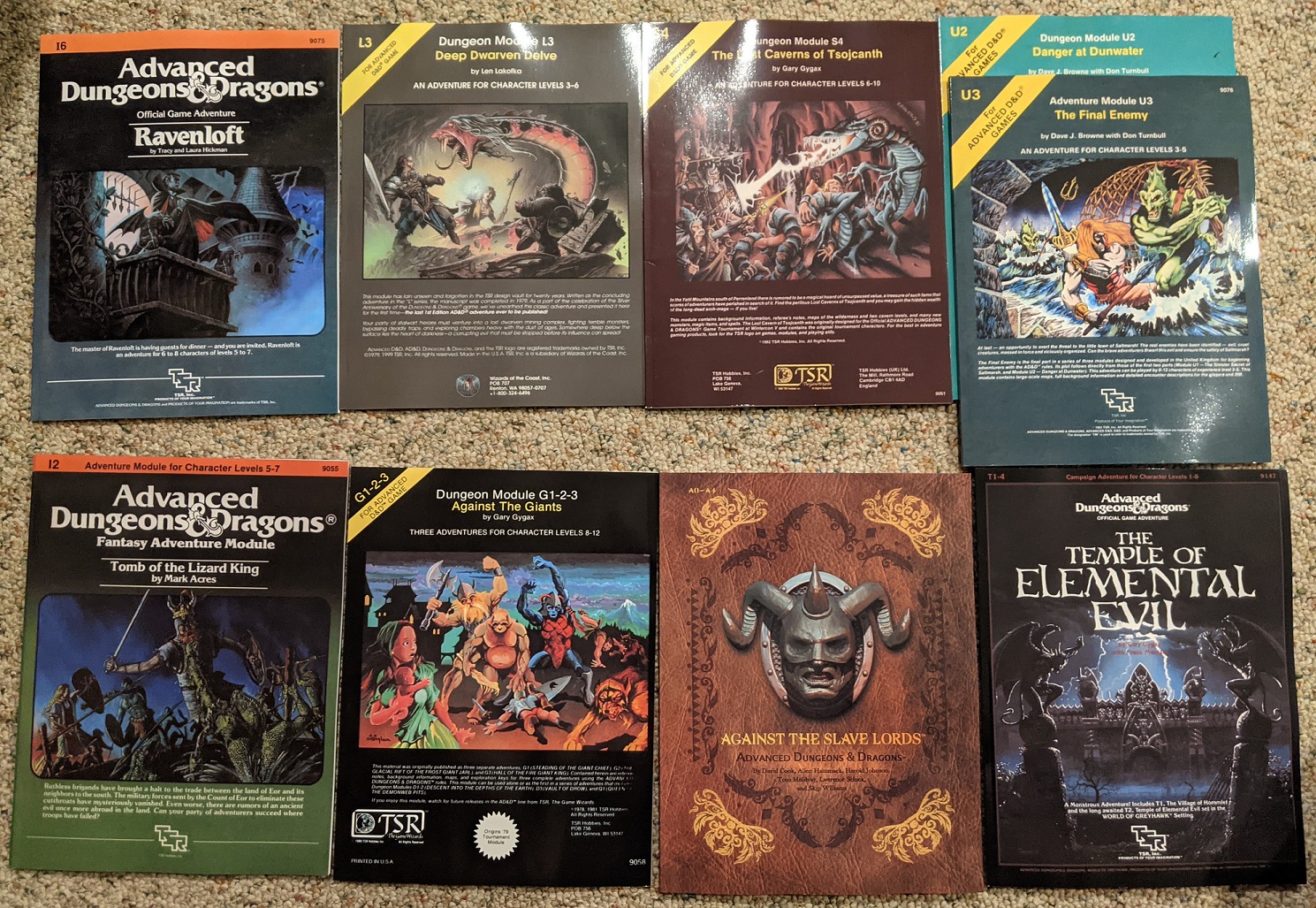
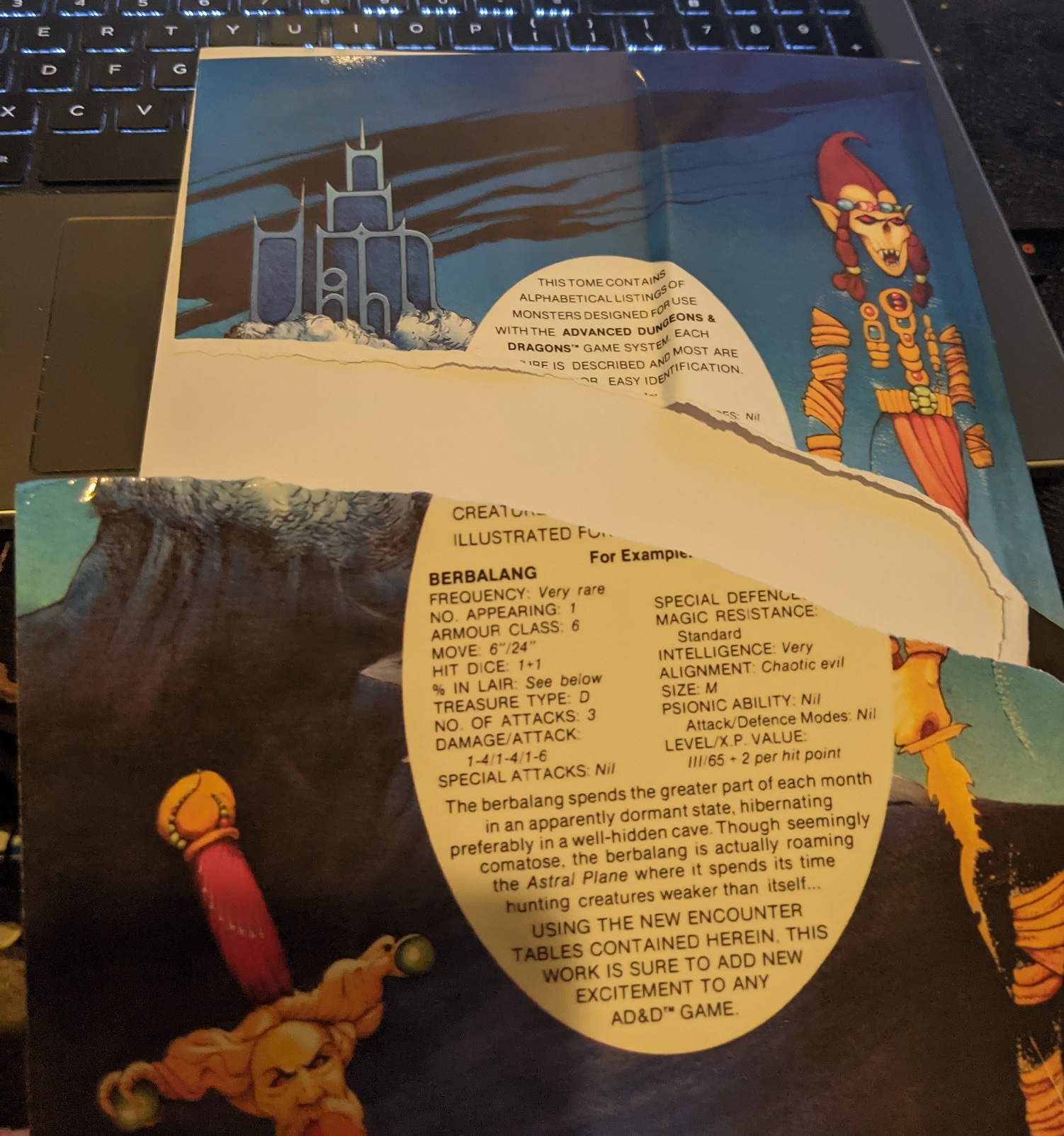
I’ve been prattling on for weeks as to how I’m relearning 1st Edition Advanced Dungeons & Dragons (“1e”) and posting images of my recent purchases from the DMs Guild. On Tuesday (8/24), I received my last shipment for the time being: The print-on-demand reprints of the 1e Players Handbook, 1e Monster Manual, and 1e Fiend Folio. This happened.

Because people have asked about the quality of the materials (addressed in this post), I think a longer story is in order. The reprinted Fiend Folio is available only in soft cover, and that apparently allowed the cover to get caught up in the glue that binds the packaging. Moreover, the ends of the packaging were open. I’m genuinely surprised that nothing fell out during shipping, but it’s clear that the books were able to move around far too much. That movement almost certainly contributed to the damage.

Here’s the thing: The product is technically usable. The only damage is to the back cover, so while that makes it “ugly,” all the substance is there. But I don’t want ugly. I’ve already arranged to purchase an original, hard copy of the Fiend Folio from a friend. As with all my 40+ year-old original copies, that will go on the shelf not taking any further abuse. Buying the reprint is about having a clean copy for my daily use, so the starting point needs to be new/mint condition. In other words, I’m being high maintenance, and perhaps unreasonably so. However, the DMs Guild is accommodating that. They sent three emails at various stages of analysis and shipped a replacement by the next morning.

I received a response from Chris Sims.

For the record, the DMs Guild uses the same engine as Drive Thru RPG. If I log into one, I can see my purchases with the other. Accordingly, Drive Thru RPG deserves the credit as well, so it’s important to mention that here. In fact, the response to my complaint was from them.

The only open question is this: Do I have to return the damaged copy? In my complaint form, I mentioned that I’d be happy to do so if they sent a return label from FedEx, UPS, or whomever. They didn’t mention that. I may be able to keep it, but I don’t want to abuse the system. If they don’t want it back, then I’ll probably give it away to someone who doesn’t mind the damage. Spread the wealth, and all that.

DMs Guild customer service is yet another reason to buy from them.

Follow me on Twitter @gsllc
Follow Chris S. Sims @ChrisSSims
Follow the DMs Guild @dms_guild
Follow the Drive Thru RPG @DriveThruRPG

Dungeons & Dragons is a trademark of Wizards of the Coast, LLC, who neither contributed to nor endorsed the contents of this post. (Okay, jackasses?)

Old-School v. Modern Approach #DnD #RPG #ADnD

If you enjoy this post, please retweet it.

Edition wars are an unfortunate reality of our community. They’re silly. Why should anyone care what someone else is playing or how? I haven’t been pondering that question, but my revisiting of 1e has made me think of the source of this tension. In other words, I’ve been contemplating how the play styles differ. Not everyone plays a particular edition the same way, but looking at my own anecdotal experiences and hearing people prattle on about how much better their way is than others, I have an answer to that question. The answer is important because I plan to run 1e as written. This is a rather silly notion considering how vaguely some rules are written and that some rules are so ridiculous that they won’t be used, but that’s the point. Any modern player playing at my 1e table deserves to know what to expect, and their instincts are likely based on modern notions of game play.

Time

As a general matter, I first want to revisit time in 1e, because it drives every consideration I’m going to discuss. Draconian timekeeping (q.v.) is designed to keep the game from slowing to a crawl.

You may ask why time is so important . . . . It is a necessary penalty imposed upon characters for certain activities. Beyond that, it also gives players yet another interesting set of choices and consequences. The latter tends to bring more true-to-life quality to the game, as some characters will use precious time to the utmost advantage, some will treat it lightly, and some will be constantly wasting it to their complete detriment. Time is yet another facet which helps to separate the superior player from the lesser ones.

1e DMG, p. 38

As arrogant as that last part sounds, Lord Gygax makes a good point. I’m all for immersion, and applying the right bits of logic to the calculus of consequences helps players immerse themselves in the game. If players want to check every square inch of a wall for a secret door, that’s fine, but it takes a lot of time, and they’re inviting multiple encounters with wandering monsters, just like they would if the situation were real. Given a choice between finding the door and almost assuredly being TPKd, I suggest players let the whole door thing go.

But let’s now look at the difference in playing style that are driven by the rules as written.

Being Too Thorough is Suicidal; Stay Focused on the Mission

In any given adventure, not every monster must be killed, not every secret door must be located, and not every magic item must be found. Modern players have the expectation that they’re not going to miss anything, which seems to come from an arrogant notion that their low-level characters can save the world. They shouldn’t expect to be capable of that. Even high-level characters don’t save the world by killing every last orc on the planet. They stop the world-ending ritual or diffuse the apocalyptic relic. Players of all levels should focus on their characters’ mission. If their job is to find the noble’s missing child, then they should be laser-focused on that. Once they find the child, or determine the child’s final fate (that got dark quickly), they should return back to home base, collect their reward, and rest up. Sure, there’ll be some leftover creatures, but that’s a fight for another day (and perhaps even for someone else).

This (as well as everything that follows) is enforced by way of the draconian tracking of time. 1e threatens players with wandering monsters, most of whom don’t hold any useful information, and even fewer carrying any treasure. With the limited resources 1e characters have, they’re unlikely to survive if they dawdle. Besides, the noble isn’t paying them to find every secret door. Sometimes that will be necessary, but in most cases it isn’t. 1e will still give focused players plenty of opportunity to decapitate bad guys. If the players bring unnecessary encounters upon themselves, their characters’ survival rates will quickly drop to 0%.

In the first column, fourth full paragraph of page 109 of the 1e PHB, there’s a great paragraph on this topic. It starts, “Avoid unnecessary encounters.”

Cats Aren’t the Only Ones Killed by Curiosity

If the characters find a magic item, they’ll not likely be able to use it until after the adventure. Sometimes wizards may be able to deduce the effects of a potion by sampling a small drop, but sometimes they won’t learn what they think they learned, especially if the potion has multiple effects. It’d be great if the sword the party just found were magical, but not if that magic is a curse. Sometimes it’s best to leave the testing for later when time isn’t a factor. That means that most items won’t be safe to use until after the adventure. But hey, feel free to tell me to shove it and grab that Sword -2, Cursed (1e DMG, page 166). Damn the consequences!

Not Everything is About Offense and Defense

Sometimes I wonder why anyone would play a wizard in 1e. The spell progression is terrible, and in 1e, utility spells are absolutely critical. I strongly suggest that every caster tries to gain the following spells if they’re on their spell list: Detect Magic, Dispel Magic, Identify, Neutralize Poison, Remove Curse, and Wizard Lock. During a trip through an adventuring site, players will inevitably need a means to stash safely what they’ve found along the way, hoping it isn’t stolen while the players continue their mission. Wizard Lock may prove invaluable in that regard. If a single character has been poisoned in an otherwise trivial encounter, that poison will continue to damage the character until dead. Identify allows using an important magic item during the adventure in which it was found. In other words, modern players need to consider seriously giving up Magic Missile, et al. to start their adventuring, or at least limit how often they choose to memorize it. It would seem that the more spellcasters, the better, but the same thing could be said about fighters and thieves for other reasons. There are always tough choices to make.

Some Things Are Abstracted

Even if I were a poet, I doubt I could express in words how much I like this. There have been too many arguments or unexpressed frustration (often lost on the socially-unaware DM) around too many tables. DMs insist that the players didn’t say what they needed to say to indicate they were looking for traps. Players insist that the DM’s description was unfairly vague or incomplete. Many complain that it’s the person on the other side of the screen that’s to blame. Some of that goes away in 1e through the use of dice in ways modern players don’t experience.

For example, to determine if a party is surprised in 1e, roll a d6 (1e DMG, pps. 102-03). Whether or not the character was dozing off at that particular moment, or whether the character’s sword was on hand, etc. are sometimes determined by a die roll, regardless of whether the DM explained it ahead of time. To determine the distance at which an encounter starts, roll an Xd6 depending on the environment (1e DMG, pp. 49, 62). To find a secret door, roll a d6 (1e DMG, p. 97). Sure, characters can, for example, increase their odds of surprising a group of goblins by walking at one inch per hour, but that takes time. Players should expect taps on the shoulders from trolls that’s snuck up from behind them.

Distance

A few weeks ago, I complained about 1e’s obsession with the inch. Everything is in inches, requiring players to translate inches into feet or yards depending on whether they’re outdoors. However, the more I’ve thought about it, the more I like it. Movement and attack ranges are measure in inches. Indoors, 1 inch equals 10 feet, but outdoors 1 inch equals 10 yards (30 feet). That seems unnecessary at first, but I can’t easily brush aside the distinction. Missile weapons and spells have ranges expressed in inches, which means they have different ranges indoors and outdoors, and that makes sense. When outdoors, the wide open areas should open lanes for casting and missile weapon attacks against enemies. Indoors, the walls, fixtures, and furniture can block attacks that are even a fraction of a degree off from their intended direction. Decreasing the size of an “inch” indoors accounts for that.

This takes away yet another opportunity for tension. If a player states that they should have a greater range outdoors because they’re in a desert, the DM can end the discussion with little resistance by pointing out the rules account for that, already having tripled the range for the player’s arrow attack. Of course, there’s always flexibility — a DM may treat a dense jungle as “indoors” for these purposes — but the less opportunity for tension, the better. Besides, I’m already accustomed to translating inches to the appropriate units, at least while reading (we’ll see about playing).

I’d be interested in any other aspects of the game you think would require an adjustment for modern players. Many of you have been thinking about this longer than I have.

Time is money. Don’t waste it.

Follow me on Twitter @gsllc

Dungeons & Dragons is a trademark of Wizards of the Coast, LLC, who neither contributed to nor endorsed the contents of this post. (Okay, jackasses?)