Let's roll some dice, watch some movies, or generally just geek out. New posts at 6:30 pm ET but only if I have something to say. Menu at the top. gsllc@chirp.enworld.org on Mastodon and @gsllc on Twitter.
Last week, I discussed some issues with the calculations for experience points (“XP”) in 1st Edition AD&D (“1e“). When I finally play 1e again, my intent is to play the game as written (as weird and impossible as that is), and every statement I make below will be in the context of the rules as written (unless expressly stated otherwise). I’m fully aware of the fact that a dungeon master can do what they want, but what I want to do is run the game as written. With that in mind, I intend to use XP, though I’m not a fan of it.
It makes far more sense to use a milestone method for leveling up. In 1e, you can’t level up within the course of an adventure because leveling up requires an expenditure of both time and money. You must spend between 1 to 4 weeks training, spending 1,500 gold pieces per level per week just to advance to the next level. (There may be even greater money and time spent on other matters, but those are outside the scope of this post.) In this regard, 1e is a perfect system for milestone leveling. There’ll never be a need for a calculation at the game table to see if it’s time to level up.
My reacquaintance with 1e does give me new appreciation for XP. The source of this appreciation is baked into why it would be difficult to run 1e without XP. (None of this will be new to any of you.) I like that you can earn XP based on treasure, which encourages playing characters intelligently (i.e., don’t have unnecessary fights). More importantly, level drain is some scary shit, and it gives you a sense of danger. That in turn immerses you in the game world. That said, I pointed out on Facebook that level drain more excessive than it needs to be, and someone suggested XP drain instead: each energy drain effect drains 500 XP per level. To that, I add the possibility that 1) in no event does XP drain take you below your current level; and 2) the XP (or level) drain is temporary. XP facilitates fine tuning energy drain to meet the DM’s specific needs, especially if you’re a modern gamer giving 1e a try.
I can live with XP, but I don’t look forward to tracking it. 🙂
Last Monday, I shared a bit of Chinese folklore. Today, I’m continuing with the eastern theme, moving northeast a bit. Here’s a video on the Japanese Oni. 1st Edition AD&D called them “Ogre Magi.” It’s no coincidence that the speaker points out how much they looked like ogres.
It isn’t all about Europe, or at least it shouldn’t be.
As I said yesterday, I’m not going to spend nearly as much effort on this blog for the time being, but I’m happy to say that I finished data entry for the 1st Edition AD&D Monster Manual yesterday and started entering Fiend Folio information. I think I may have written that I finished that entry a couple of days ago. I did but had to go back through the data and fix some issues. I’m not taking a particularly professional approach to this database — for software engineers, my requirements analysis phase has been shit — so after I reach a certain point, I realize I have to go back and change a few things. Getting to the very end of the Monster Manual lit yet another lightbulb, so I had to do a little more work.
Something important I learned in making those final changes: The XP calculations in Appendix E of the Dungeon Masters Guide sometimes make no sense at all. That not only includes some strange calculations that don’t seem to be supported by the stat block — green slimes don’t have as many special abilities (10) and exceptional ones (11) as Asmodeus — but it also includes impossible calculations not supported by the table, Experience Points Value of Monster (DMG, p. 85).
As to the former, I did what I was told. I assumed (probably naively) that the creatures were play-tested and played out more powerfully than the numbers otherwise dictated. I’m not going to rock that boat, though there were a couple of times I know I did, but don’t remember exactly which monsters those were. Sometimes the numbers were just so ridiculous that I changed them.
As to the latter, it forced me to make some calls that I really didn’t want to have to make. When you create a specific instance of a monster, you roll its hit points, which affects the final XP calculation. Because I want that calculation to be automated (less math for you!), for every given monster, I entered integers for the number of “special” and “exceptional” abilities. Therefore, the software will combine your die roll with certain data that calculate the XP for you. If that doesn’t make sense, just understand that you’ll push a button, and you’ll have a monster complete with an XP calculation. However, as I said, the calculations were impossible in a few cases, representing odd exceptions to the rules. I sometimes had to choose between a calculation that would give a creature an extra 10 XP or shortchange it by 5 XP. In such cases, I chose to give an extra 10 XP (larger numbers apply for higher level monsters, but the percentage of error is about the same). This doesn’t seem like much, and XP is often, being generous, an inexact science, so I won’t lose sleep over it. What bugs me about it is 1) it happened enough that it appears to be intentional; and 2) if these minor differences are nothing to lose sleep over, why have them? Why not have these monsters conform to the standard formula? If they did, that difference would also be nothing to lose sleep over. It just seems weird to make such specific, small exceptions to such an inexact equation, but knowing some of the AD&D crowd, I know I’m going to take some heat anyway for what I produce.
I’m so selfish for forgetting that I owe these people all my hard work.
In addition, there were times that no formulae were given, so I made them, and that also had me going my own way at times. For example, I broke out the dragons by those that cast spells and those that don’t, and considered 1st- and 2nd-level casting as “special” and higher level casting as “exceptional.” I also thought that the dragon’s fear aura was pretty damn powerful, so I called it “exceptional” even though it’s not in either list of abilities. Some will agree, and some won’t. Just try to keep in mind that all of these numbers will be subject to your own modifications within the database itself.
As someone who’s quite pretentious, I’m amazed how much competition some in the AD&D crowd give me in that regard. You realize it’s a game, right?
David Leonard has a blog, Greyhawk Musings. Last Friday, he added his own voice to the choir with a post about the 1st Edition AD&D (“1e“) adventure, L1: The Secret of Bone Hill. I previously gave my own review (Ha! I quickly made it about me!), but it was much briefer and wasn’t heavy on details. It’s a different sort of adventure, and has been soundly thrashed over the decades, but nevertheless isn’t an adventure you should ignore. I think it’s a type of adventure that needs to exist at various levels of difficulty. As always, YMMV.
This is the 187th day in a row with a post (note: not my longest streak). I’ll probably be ending that streak very soon. I’m going to focus my time on what you really want me to do: Complete my database. Or maybe you want me to shut up. Same net result. I’ll still post when something strikes me as blogworthy, and will probably continue to be consistent with my goofy nonsense on Saturday through Monday, but it won’t be my priority until I’ve got my database completed.
Like many (all?) of you that played it, 1st Edition AD&D (“1e”) taught me words I never knew. I started playing at age 9 in 1977, which was long before I studied Latin. 1e, not Fr. Wood, taught me id est, exempli gratia, and quod vide. In fact, during my 23 years away from the game, I still went out of my way to use q.v. in my writing, and continue to do so today. For whatever reason, that one stuck with me.
Another word I learned was “thrice” from the androsphinx, who could roar thrice per day. In 8th grade, I taught my mythology teacher the word, “pantheon,” which I had learned from the 1e Deities & Demigods three or four years earlier.
Mr. Joyce: You mean the Parthenon in Greece?
Me: No, Mr. Joyce. “Pantheon” refers to a culture’s collection of gods, as in the “Norse pantheon,” “Greek pantheon,” or “Indian pantheon.”
Mr. Joyce: Oh, I never knew that.
I clearly remember studying for the SATs when I was in 8th grade (my older brother was getting ready to take them, and I was in the room), and my mother asked us a practice question. I don’t remember the exact animal, but it was something like, “Elephant:herbivore::human:?” I knew the answer was omnivore before I was given the choices. My brother had never heard the word. I played D&D; he didn’t. Ironic in light of his and my mother’s participation in my Satanic Panic persecution.
All last month, Dictionary.com’s Word of the Day has been what I call, “D&D words.” For a brief instant, I thought that was odd, but I quickly realized this is because it’s Halloween, and everything scary has a place in D&D. But “empyrean”? An article on the difference between a catapult and a trebuchet? Hmmm. . . . Maybe Halloween was just an excuse for their editors to let their geek flags fly.
The Fiend Folio: A Tome of Creatures Malevolent and Benign.
Commenting on this on Facebook inspired many of you to share your own gains in vocabulary care of 1e: pseudo (from pseudo-dragon), homunculus, milieu, tableau, miscellaneous, simulacrum, clairaudience, glaive, carrion, alignment, satyriasis, melee, charisma, dexterity, projectile, theocracy, ethereal, omniscient, oubliette, hierophant, brazier (but pronounced as brassiere), and some alternative terms for prostitutes (1e DMG, page 192). It depends not only on your schooling, but also on how old you were when you started playing, so everyone has their own list. I know a lot of you learned math through 1e, or later editions for that matter, but I was always mathematically inclined, so 1e math was easy for me. But we all learned a lot. Spelling was my Achilles heel, and to this day D&D is teaching me how to spell. As of last week, I can write ixitxachitl without having to look it up. Of course, I’m not sure how that one’s going to enrich my life.
My friend (Vic) and I are (slowly) creating our own RPG, and I have a Word document called, “Big Words,” that contains a lot of obscure English words, and a few outside of English. The way we’re using them is as title for class and racial abilities. E.g., ataraia is “a state of freedom from emotional disturbance and anxiety; tranquility.” This could be the name of an ability or spell that calms emotions. The definition of ataraia is inherent in the (let’s say) spell description, so you can learn the word if you want. If you don’t want to learn the word, it doesn’t matter. It’s not going to cause confusion because it can be ignored in favor of the text you need to read anyway.
Other Subject Matter
But it was more than just words. I also learned some science. E.g., I memorized all the types of insanity (1e DMG, page 83). Looking at them now, I’m not sure this made me a qualified psychologist, but it did make me aware of them and raised my interest in science. I also flexed my future constitutional law chops by learning the definitions of several forms of government (1e DMG, page 89), and got some more science from the section on disease (1e DMG, page 89).
I’m also a bit grateful to that design when I was younger. It, along with similar traditions (philosophy in particular) taught me powerful cognitive lessons of attention and textual analysis. More than anyone at that point in my life, Gygax had me scrambling to the library and the Oxford English Dictionary just so I could understand what the fuck he was saying.
Moreover, as far as I can remember, 1e was my earliest experience with regularly thinking outside the box. I’ve always tried to see a bigger picture than my dopey, anti-intellectual siblings (who didn’t jump on that bandwagon until adulthood), but 1e was a near-constant exercise in that. Even when preparing an adventure, you had to think outside the box of the box outside of which your players were thinking.
What?
In other words, you had to anticipate that your players would find a way around the obstacles you wrote for them and put a larger obstacle around that. It was always a war of who could outthink whom. Whether playing or preparing, you were flexing your creative muscles, and it was so enjoyable that you had fun learning. That’s probably the best lesson of them all, and RPGs are perfect in this regard.
Dungeons & Dragons is a trademark of Wizards of the Coast, LLC, who neither contributed to, nor endorsed, the contents of this post. (Okay, jackasses?)
Last week, I published a post critical of Lord Gygax’s writing technique, to which I’ve added a lot of other examples since its publication. Today, I’m going to push back on that. One thing I’ll always appreciate as an old man being left behind by time is Lord Gygax’s writing style. Gary’s style was based on the time I grew up, so I love the directness.
It must be borne in mind that all of these [dinosaurs] are extremely stupid.
1e Monster Manual, page 23.
I know we’re learning more about birds every day, but it’ll take millennia of evolution before a raven will be enrolled in kindergarten. According to paleontologists, dinosaurs, despite their relationship to birds, were at best a little dumber than a raven, and even meat-eaters were mostly dumber than a chicken. They really are stupid by human standards, and until we meet some space aliens that blow us away with their intellect, Gary’s claim sticks.
Seriously, Jason? You’re going to die on this hill?
More on point, though, is the commentary from my friend, SRM. He commented (on Facebook),
There is absolutely no way that sentence would fly with current editors. “Gary, can we just say ‘remember’ instead of ‘It must be borne in mind.’ And can we use something not as judgmental as ‘stupid’? Then a conversation on how even “remember” or “keep in mind” are pointless and unnecessary. In the end, it would say, something like: “Dinosaurs are simpleminded animals.” And then, we would have conversations about the new theories of dinosaur intelligence and the fact that birds are not simple-minded animals. And then the sentence would be dropped.
I don’t doubt this, but neither Lord Gygax or I give a shit. We’re not going to spare the feelings of extinct animals too stupid to know we’re insulting them anyway. And I’m sure that, like me, Lord Gygax doesn’t tremble at critical words when used in the abstract.
Let’s move on.
Your players may want to know how far they can go in a day on a flying carpet (or other similar device). For the purposes of long-distance aerial travel, assume every 3” of speed equals one mile per hour. Thus, a broom of flying, with a speed of 30”, can fly long distances at an average speed of 10 m.p.h., and can cover about 100 miles in a day (assuming ten hours of semi-continuous travel during daylight). The above formula does not necessarily apply to short distance travel.
If your players are unimpressed by these kinds of distances, remind them that in a pre-technological civilization they are little short of miraculous. Some of your players may have walked as far as twenty miles in one day. Ask them to remember how far it was.
1e Dungeon Masters Guide, page 50.
Translation: If you don’t like how far you can fly in a day, suck it up, buttercup. Them’s the rules. We’re not here for a physics lecture but to create a reasonable game system. If you just want to “win D&D” by heavily slanting it in your favor, then I’ll just say, “Congratulations. You win. Now get out of my house. The rest of us actually want to play the game, challenges and all.”
Here’s another.
Wolverines inhabit only colder regions (which is fortunate for mankind, for these animals are horrible).
1e Monster Manual, page 102.
He’s not wrong. They’re adorable from a distance, but I wouldn’t be dumb enough to try to pet them. Even bears give them a wide berth. How can you criticize his choice of words when they’re 100% accurate? Stop fearing the truth. You must know, understand, and accept it before you can deal with it, and in this context, the truth helps with immersion in the game world. Don’t make me drop a wolverine in your backyard to accelerate your lesson. Still don’t like it? Fine. Screw you. They’re really neutral evil. Take that!
This is how Gary wrote because it’s a game. He expected you to roll with the jokes. It was funny, and I love it.
Dungeons & Dragons is a trademark of Wizards of the Coast, LLC, who neither contributed to, nor endorsed, the contents of this post. (Okay, jackasses?)
Yesterday, on Halloween of all days, I finished my data entry for the 1st Edition AD&D Monster Manual. I started the day with the vampire stat block and ended with the zombie stat block. How appropriate.
Not exactly what you were thinking, huh?
Here’s a video on a Chinese creature that’s a little bit of both. Other than the various editions of Deities & Demigods, D&D has primarily presented creatures from Europe folklore and mythology. Maybe this is one you’ve never seen.
Dungeons & Dragons is a trademark of Wizards of the Coast, LLC, who neither contributed to, nor endorsed, the contents of this post. (Okay, jackasses?)
A while back, I observed that, despite Lord Gygax’s writing being rightly criticized at times, he sometimes made some funny observations that I loved, and you really can’t have one without the other. Rather than accept the compliment for our beloved leader, some of you took me for task, stating there is no way (Seriously? No way?) Lord Gygax’s writing could be rightfully criticized. I have some questions for those people.
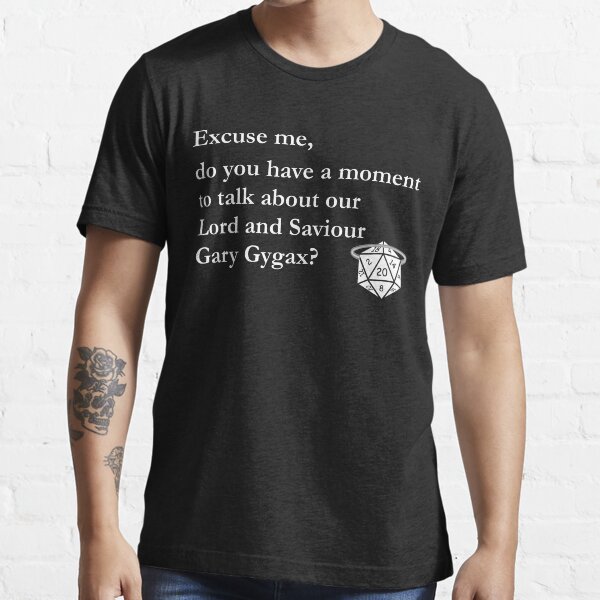
I need this shirt.
1/day, an ogre mage can cast “a ray of cold the same dimensions as that of a cold wand.” Putting aside the missing preposition, what’s a “cold wand”? A wand of cold? No, because that’s not a thing either.
Okay, that one’s not so bad. It’s probably a wand of frost. I don’t like having to go to another book to figure out what the book I’m reading is saying, especially without a page cite, but it didn’t take much work to deduce, so let’s keep going. Locathahs are “very intelligent” (intelligence of 11-12), yet they don’t speak a language. If that doesn’t seem right, it’s because it isn’t. They have their own language. How do I know this? I read the write up on the merman. Half of mermen speak locathah. That’s where I had to go to learn about the locathahs. You could also go to the triton stat block to learn that, which is my suggestion because the triton stat block is also where you have to go to learn that aquatic elves have their own language. Well, it actually says “sea elves,” which we’re all assuming are aquatic elves. Worgs may also have a language because winter wolves (that do) can converse with them, but it’s unclear whether that’s because Worgs can speak the language of winter wolves. If troglodytes speak a language, I haven’t found it yet.
Okay, that was a lecture. Back to questions. How many hit points does an ogre chieftain have? How much damage does a punch from Orcus do? Well, you better have an 11-sided die so that you can determine that (unless you like rerolling high numbers 8.3333% of the time). While you’re at it, make sure to bring your 7-sided die to the game. You may need to calculate how many hit points a goblin has. Fortunately, you need either a d5 or a d9, not both, to determine how many hit points of damage an umber hulk’s mandibles do.
Why doesn’t a giant pike have a swim speed? They seem to run pretty fast on land (36″). Eel? Eye of the deep? Giant gar? Hippocampus? Ixitxachitl? Lamprey (normal or giant)? Locathah? Masher? Morkoth? Portuguese Man-o-War? (From Portugal? Why not? Rakshasa are from India.) Rays of all sorts? Sea hag? Giant sea horse? Sea lion? Shark and megalodon? Sea snake? Triton? Water weird? Whale? That’s every single aquatic monster in the 1e Monster Manual that has only one speed, and it isn’t for swimming.
What spells do a rakshasas cast? What language(s) do they speak? I could ask the same questions for a number of creatures. I already did once (see above). How many rounds or turns does a slithering tracker’s paralysis last? If its siphoning of plasma is interrupted by an attack, will it have time to resume that process if the attacker breaks off the attack? How much damage does a giant slug’s acid do? It’s its preferred attack. Shouldn’t we be told without having to find it in the DMG (on page 64, by the way)? On a d6 roll of 2, what psionic attack will a Su-Monster use? Okay, that last one is just a typo. 🙂
Then there are the spells being referenced with variant names throughout the Monster Manual and even within the Players Handbook itself. One psionic attack is apparently misnamed. What does a mind flayer’s “mind blast” do? I’m not even going to address this disaster. I’ll leave that to this site, which isn’t just an indictment of incompleteness but also general disorganization.
Maybe I’m sensitive, but this is poor writing. My social media posts sometimes generate over 100 responses, and those responses often make opposite claims as to what the text clearly means. For example, no one could agree on the effect of a Iron Golem’s breath weapon or whether paladins and rangers cast at their class level or their class level minus 7 or 8 respectively. A whale at the surface of water is one of many examples of a monster that strikes a target for half the target’s hps. Is that half the target’s undamaged hp total or half the target’s current hp total? I think that last question applies to the effect a Haste spell has on a Wind Walker, but I’m just not sure. The only thing these people could agree on is that their own opinion was unambiguously supported by the text. I’m no logician, but I’m pretty sure that means that one of them is incorrect. I’m still waiting for those apologists to come to a consensus as to what that text clearly says. Instead, they claim that the others are ignoring what’s obvious, missing the irony completely.
At other times, the conversation devolves into, “Well, you’re the DM. Do what you want.” I assure you I will, but I shouldn’t have to design my own game system in the process. The rules should provide a clear baseline, and from there I can tweak it knowing I won’t likely break the game with my preferences. Saying “do what you want” in these contexts concedes, intentionally or not, that the rules are horribly vague. Sometimes when they are clear, they’re disorganized or require mathematically impossible “fair” dice.
This doesn’t mean you must hate the game. There are always clunky workarounds, and I can’t wait to play it again despite my concerns. Besides, these failures are certainly understandable. Lord Gygax was a pioneer. It’s impossible to get something right the first time, especially organization. As far as ambiguity is concerned, modern writers go to great pains to formulate unambiguous language. It’s an impossible goal, but you one can’t even come close if you don’t know to try. Lord Gygax was suffering from a variation of the false consensus effect, assuming that everyone would interpret his words exactly as he intended, in no small part because he was doing this before anyone else. He didn’t have the experience of dealing with min/maxers that squeeze any ambiguity they can find from the text. There’s also plenty to love about his writing, which I’ll discuss next week. However justified his approach, it’s foolish to deny the one and only thing that is clear: Lord Gygax’s writing is often rightly criticized. Denying that denies just how much he difficulty he faced as a pioneer. Getting angry at this notion is doubling down on that foolishness.
Yesterday, I published a post on how the wonderful 4th Edition D&D (“4e”) innovations, passive insight and passive perception, have 1st Edition AD&D (“1e”) to thank for their existence to some extent. They were so good that 5th Edition D&D (“5e”) kept them despite owing its quick existence to 4e hatred. PI & PP represent pulling back from the active checks of 3rd Edition D&D (“3e”). Some brief but extremely useful conversations took place on Facebook, so I hastily put together this post to take it a little further. I apologize for any typos or incomplete sentences. I’ll clean it up later tonight.
Note: The extent of my experience with other games is relatively limited.
All of this got me thinking. The problem with 3e skill rolls is metagaming. If the characters enter a room, and the DM tells the players to make Spot or Listen checks, and the players all roll 10s or less, they’re not going to believe the DM’s words, “You see nothing here.” Telling the players to roll those checks is basically giving away the secret, so I never saw a rogue try to pick a lock under analogous circumstances. That solution doesn’t work for me. Instead, I’m considering something I haven’t seen in D&D nor in any other role-playing game (see note above). My solution lies somewhere between 1e and 4e’s PI and PP. 1e has the monster’s stat block determine whether the PCs succeed or fail, which means that the DM rolls unannounced checks, and players aren’t aware that anything is up (i.e., reduces metagaming). That’s great, but it removes player agency over their own characters’ attributes and abilities. 4e PI and PP instead have the players’ character sheets factor in. The monster stat block sets the difficulty, but the PCs’ attributes and abilities modify their rolls appropriately (i.e., increases PC agency). At first, it seems like PI and PP are the best solution.
The Problem with Passives
But if they were, this post wouldn’t exist. When a game uses passives, the game designers build challenges around what the characters expected passives are going to be. In a situation where the game (or adventure) designer doesn’t want the characters to pierce an illusion or locate a trap, they can always set the difficulty (let’s call it a “TN” for “target number”) unreasonably high, but in most cases, you want the TN to be something nontrivial but obtainable, give or take based on whether it’s easy, moderate, or hard.
But the passive is a static number. There’s no wiggle room, so if, for example, a moderate challenge is desired, the designer picks a number that represents the average TN for the average character. However, every party is going to have at least one character that’s above average in the relevant check. And therein lies the rub. The above-average character’s passive score will always succeed against that average TN. Always. The nature of game design makes passives lean far too heavily towards successes even in a moderate or hard campaign. In hindsight, this is consistent with my experience throughout 4e and 5e.
Thus, while passives remain, in my humble opinion, an innovation, I’m now of the opinion that there’s something better we can use.
My Solution
As with virtually every issue I’ve raised in these posts, I’m probably not the first person to think of them. Screw it. I’m an asshole, so I’m still calling it “my” solution.
I prefer to keep the rolls behind the DM screen. Let the DM roll to determine success, which means there will always be at least some chance of a total failure and some chance of a total success. The high Wisdom character may still fail to hit an obtainable TN, but low Wisdom character may hit it instead. Everyone’s rolls matter, so everyone has their fun, but usually only the high Wisdom character’s roll will succeed, which means that character’s value will always be appreciated by the group. That character will get a chance to shine in the way in which the character was built to succeed. But that’s game balance, and that depends on the system’s math. I want a little more here because my primary concern is psychological.
Disclaimer: Not a shrink.
So, use the 1e system generally, but allow bonuses and penalties based in part on the character sheet. That is, have the DM roll the dice, but modify the roll based in part on each character’s relevant attributes or abilities, which the DM can keep handy behind the screen. This avoids both the problem with static numbers and the problem of metagaming (in this narrow regard), and the players retain their agency. While you’re at it, you can add bonuses if the characters have encountered a (very) similar challenge in the past.
The problem now is how to handle that math for existing systems. I really like the 1e mechanic of rolling 3d6, and if the roll is at or below a relevant attribute score, then the character succeeds. That won’t always work, though. With the gas spore, it’s a percentile roll. A +1 bonus on a d100 is completely different than a +1 bonus on a roll against an attribute score or a regular d20 save. You’ll need a reasonable formular for each, accounting for both the range of possible values and the bonus or penalty given to the relevant attribute score. You may even want/need to account for class and race abilities.
Metagaming?
But with the DM rolling, won’t characters know something’s up? Probably not. Once per round or once per encounter, the DM is expected to roll a surprise die, an initiative die, and a distance die in 1e, and occasionally will be expected to add in some extra dice rolls for equally mundane reasons. There are plenty of reasons to roll in most game systems, but if not, the DM can just make phantom rolls from time to time to throw them off the path. We always expect DM bullshit; it’s a problem only when we’re directed towards specific bullshit. In the end, no one should be the wiser.
Except for gas spores. Anyone who’s read my posts will probably be suspicious of any beholder I throw at them.
Simplicity
There’s one other thing to consider, though. What I’m describing is a small thing, but small things add up. Sure, this is an easy mechanic to grasp conceptually and implement practically, but it’s adding to the pile of other mechanics. PI and PP don’t add as much to the workload as what I’m suggesting, and every bit of complexity you can avoid makes for a faster game. Whether you’re considering what I’m proposing for your own game system or just to add to your existing RPG, keep that in mind.
If you’re modifying an existing system, good luck on the math.












 Play What You Want