
Good Watch: Ragnarok, Season 2 @jonasgravli @SunthDanu @netflix #MythologyMonday #Ragnarok #Jotunn #Thor #Loki #GoodWatch #tv

If you enjoy this post, please retweet it. For other entries in the Good Watch category, click here.

Last week, I watched season 2 of Ragnarok. I previously discussed season 1, which I think I liked more than I should have. I’m a sucker for mythology, so I sometimes give modern dramatizations a little more credit than they deserve (though this is not absolute). This certainly applies here. The acting was rather sour at times, and I’m not sure whether that’s because the English is dubbed. However, I haven’t seen a better representation of mythology on film than this show, and that’s despite the fact that it intentionally (and appropriately) takes the “gods” and “giants” in a different direction.

The premise is that the war between gods and giants never ends. Both groups are continuously reincarnated but in different ways. You learn in season 2 that the giants know who they are their entire lives, even as they take on new ones through reincarnation. However, because the gods represent the interests of humans, they possess or are reincarnated as (probably the former, but unclear) humans, taking time to remember/learn who they are. This creates a foot race. The giants are busy destroying the world (in the most modern of ways in this show), searching for evidence that the gods are returning. Once they learn that the gods are back, they race to complete their plans, or even kill the gods, before the gods gain their full strength. The complication for the giants are that they’re bound by the rules of the game, which doesn’t allow them to act directly at times.
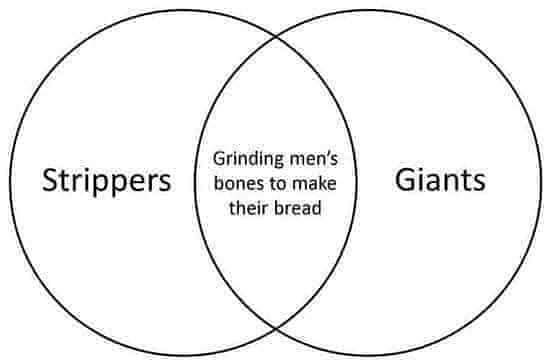
See? Giants aren’t all that bad.

Despite getting to the action this season, there’s still character development in play. For example, there’s an obscure character in Norse mythology, Járnsaxa (don’t click the link if you don’t want to be able to infer spoilers), whose role took me by surprise. Her character was in front of my face for two seasons, and I didn’t recognize her until the last episode of season 2. Based on the myths, her presence is important to how the series should wrap up. Some new characters were “born” in this season as well, including two extremely important ones, Loki and … something else.

The actor playing Loki is no Tom Hiddleston — who is? — but he does a good job, and the writing for his character is as good as any I’ve seen for any god from any mythology ever on television or in the movie theater. He’s exactly what Loki is supposed to be, which is hard to fit into modern storytelling. He’s not evil. He’s not even always selfish. He’s . . . Loki. Moreover, Thor’s reluctance to remove Loki as a threat makes a ton of sense, just as it does in Norse mythology, but not in exactly the same way, because this show takes place today.

Season 1 was very slow — all set up — but season 2 really got us into the mythology. Unfortunately, it’s only six, 50-minute (or so) episodes. I wanted a lot more.

I can’t guarantee you’ll like it if you’re not a mythology nut like me, so as always, YMMV.

Follow me on Twitter @gsllc
Follow Jonas Strand Gravli @jonasgravli
Follow Danu Sunth @SunthDanu
Follow Netflix @netflix

Good Watch: #Ragnarok on @Netflix #GoodWatch

If you enjoy this post, please retweet it. Other posts in this series can be accessed by clicking here.

I recently watched the 6-speisode season of Ragnarok on Netflix. In contrast to most of my geek brethren, I’m not fond of shows where the protagonists are kids. I’m not into Harry Potter, Ender’s Game, the Hunger Games, Stranger Things, and all the rest of them, but if you are, the fact that high school kids are saving us all won’t bother you. I also don’t like subtitles, and these were quite annoying. They were greatly overdone. For example, many times that a song was played, it unnecessarily identified the song by name and artist. However, I’m quite fond of is mythology, so that drew me in regardless of the inherent strikes against it.

Ragnarok was a way to pull my favorite mythological characters, the Norse gods and giants, into the real world, so I’m inclined to like it even if it isn’t the best show on television. It wasn’t like Troy (a movie I love) that tried to explain how the legends could have arisen from real-world, realistic events. No, this was about the supernatural; these characters used magic and had superhuman abilities. The show also used anthropogenic climate change as the battle ground between humans and the Jotnar (i.e., giants). Of course, the best part is when the reincarnated Thor is wearing a Washington Redskins shirt. #HttR 🙂 The fact that it’s only six, 40-minute (or so) episodes makes it an easy watch.

The series has been officially renewed for season 2.

For what it’s worth, I’ll be watching. I kind of have to. Season one didn’t really end.

Other posts in this series can be accessed by clicking here.

Follow me on Twitter @gsllc (please retweet!)
Follow Netflix on Twitter @Netflix

D&D Beyond and the Operatic Bard Class for #5e #DnD #RPG

An opera singer has created the Operatic Bard subclass for 5th Edition D&D, which she’s selling on the DM’s Guild for $1.99. This is interesting, but not necessarily in the way you think.

Journey To Ragnarok AvatarWhy would I pay one cent for this if I didn’t know whether or not it was useful to me?

On the other hand, if she published it without a paywall, then asked for money, she’d get next to nothing regardless of how good it is.

Unlike adventures, content like this will always be cursed by this paradox unless the content retains a value after being published as a PDF. Ergo, I believe the solution here is for WotC to facilitate incorporation of this material into their digital system, D&D Beyond. Beyond doesn’t allow us to create custom classes or builds because it requires more complicated coding behind the scenes. Therefore, the only way for it to be incorporated into Beyond is for WotC to do it themselves, which opens up the market for this kind of community-created content. She could sell the Operatic Bard for $1.99 and get the same cut that she currently gets for the PDF. Or more. Or less. The details don’t currently concern me.

The timing of this article is of particular interest to me because I just received the magnificent Journey to Ragnarok and have no way of incorporating the new class (Rune Master) into D&D Beyond, nor can I add the new builds for the barbarian, bard, cleric, druid, fighter, monk, paladin, ranger, rogue, sorcerer, warlock, or wizard (yeah, pretty much all of them). My gaming has dropped off dramatically as of late. Long story short, it’s not worth the time investment to play. Being able to run Journey to Ragnarok with access to D&D Beyond would be quite an incentive to get me back into the fold. If not, then my interest will continue to wane. I don’t know if I’m in any way representative of a large group of people, but there’s some anecdotal evidence as to why this is a good idea.

Again, I don’t think this applies to NPC stat blocks because they’re easily added to Beyond by the end user. I also don’t think this applies to adventures because players are willing to take chances on adventures based on the synopsis and based on the fact that even a “bad” adventure can still be fun. This applies only to classes, builds, or anything else that end users can’t add to D&D Beyond themselves.

What do you think? Is WotC dropping the ball to some extent by not incorporating community-created classes and builds into D&D Beyond? Would you be more inclined to create classes and builds if you knew they could sell.

Follow me on Twitter @GSLLC