Let's roll some dice, watch some movies, or generally just geek out. New posts at 6:30 pm ET but only if I have something to say. Menu at the top. gsllc@chirp.enworld.org on Mastodon and @gsllc on Twitter.
If you enjoy this post, please retweet it. Other posts in this series can be accessed by clicking here.
The DCEU is dark. In Man of Steel, Superman lost his mother and father before he knew them, and then lost his adoptive father just after reminding him he wasn’t his real father. Bruce Wayne famously lost both his parents, and that loss created the Batman. Wonder Woman couldn’t move forward without turning her back on her family, and by the end of the movie, she lost her one true love. The DCEU likes to kill heroes’ families.
The DCEU has taken some heat for how dark its tone is. The argument I’ve heard the most is that Marvel has always been upbeat, and Marvel is a success, so that must be the path to success. I think that’s a strange line of thought. First, there can be more than one path to success, and plenty of dark movies have enjoyed success. Second, the DCEU had to take its own path. If it had mimicked Marvel, it would have inspired just as many detractors who would have criticized a lack of originality. (My suspicion is that many of those detractors would have been the same people, but we’ll never know.) Whether you agree or disagree, my bottom line is that I’m glad it forged its own path, and I’ve enjoyed all the DCEU movies.
The Light in the Darkness
Moving to Aquaman, Jason Momoa played a brooding, reluctant hero who avoided connection at all costs due to his half-breed status and the loss of his mother. This is right in line with the darkness that I’ve enjoyed. That said, too much of even a good thing can be bad. We needed a break, and not just a scene or two. We needed hope, and not just an alien letter on a shirt. We needed to see Aquaman connect in a big way, and reuniting with his long, lost mother was just that. But that could have felt forced if not for the hints we had that deep down inside he sought that connection. Besides his scenes with his father, that started with the bar scene.
Go to 2:02 for the bar scene.
Granted, the build up within that scene was a bit overacted (which appears to be solely the script’s fault), but it redeemed itself by quickly shifting to comedy and lightheartedness. The actor portraying “Biker” is Luke Owen. Finding his information has proven difficult, so I can’t point to anything else he’s done or even copy him on this post. But as I’ve stated in my first and second “No Small Parts” posts, the scene and Mr. Owen’s part were important. They started the build up to the much-needed light in the darkness of the DCEU.
I leave you with a great song from the soundtrack.
Other posts in this series can be accessed by clicking here.
If you enjoy this post, please retweet it. Other posts in this series can be accessed by clicking here.
After participating in the Guardians of the Galaxy quarantine watch party, I published a post referencing the show business adage that there are no small parts. In doing so, I used Bereet as evidence supporting that adage. Today, I’m going to use the sympathetic physical therapist, played well by Kobna Holdbrook-Smith.
Character Growth
Like Tony Stark, Stephen Strange (slowly) grew from a self-absorbed jackhole to someone serving others, but unlike most others in the MCU did so by changing his methods. When the arms-dealing Tony Stark’s focus shifted from himself to others, his methods didn’t change. He still accomplished his tasks through weaponry. Thor still ran into battle headfirst relying on brawn more than strategy. Nebula’s plan for saving half the universe still involved murder, and her target was a family member. The Guardians in general were still scavengers looking for a payday to finance their universe-saving efforts. They worked with what they knew.
Strange was different. Off the top of my head, he was unique among the major MCU characters in that it wasn’t just his attitude that changed, but also his methods. Strange had to open his mind to other means to accomplish his goals. Strange’s circumstances largely removed his medical skills from his playbook, but he wasn’t being told to abandon them; in fact, he used them to help Dr. Palmer operate on him. The Ancient One’s point was that he had to add new skills. Experts “can often see in part but not the whole.” While I don’t believe in magic, as a general principle, this is certainly true. The more complex our base of knowledge becomes, the harder it is to understand everything necessary to solve large problems. But this is a superhero movie, so let’s stick with the magic. Strange needed to add magic to his repertoire, and while he could have used that magic to return to his old life, his new-founded altruism forced him to focus on a new skill set in favor of the old.
Bachelor’s Degree
In the prior post, I asked, “[H]ow can you appreciate that growth if you don’t experience its full progression?” That is, to appreciate the growth, you must first clearly establish the character’s starting point, which leads us to Holdbrook-Smith’s part.
Unfortunately, these videos get taken down from time to time. Here’s only the latter part of the scene with annoying 3D red and blue tint.
The physical therapist represents an important part of Strange’s own field, yet Strange responds to him with condescension (“Bachelor’s Degree”). Granted, Strange is emotionally compromised by his injuries, but Strange exhibited this same behavior earlier when discussing being a part of the emergency room team, and when criticizing the other surgeon, Dr. Nicodemus West (who could easily have been the subject of this post). The physical therapist was there to remind us of this specific character flaw at a time when we may have forgotten it. He also helped make it clear that even someone doing his job competently and exhibiting remarkable patience in the face of Strange’s insults, isn’t protected from them.
No doubt, this is a subtle point, but as I said before, actors with quick appearances, even if they have no lines and are relegated to the background, provide necessary color to scenes. Holdbrook-Smith did that for us, whether we were paying attention or not.
Other posts in this series can be accessed by clicking here.
If you like this post, please retweet it. Or comment. Seriously, more than any others, I’d like to know if anyone actually likes this post. That’d be weird.
Better late than never?
I wrote this in 2012 but never published it. I wanted to finish Part II before doing so, but I never really learned how to create artifacts in 4th Edition D&D, so that never happened. It’s been sitting in my Drafts folder for 8 years and 9 days. Just in case anyone is playing 4th edition and can make use of these high-paragon to epic level NPC stat blocks, and/or my take on their history, here they are. I’m not optimistic, but this “quarantine life” finds me posting a lot of material. Warning: I haven’t proofread this other than to delete a dead link. 🙂
In 2010, Wizards of the Coast published Dragon 178, and in it was an article that provided 4th Edition material for the creatures that appeared in the remake of Clash of the Titans. With the release of the sequel, Wrath of the Titans, it’s time for a sequel to the article. This article contains the stat blocks for the creatures that appeared in the movie. Part II will provide the artifacts that appeared in the movie: Zeus’s Thunderbolt, Hades’ Pitchfork, Poseidon’s Trident, and the Spear of Triam, as well as the stat block for Kronos himself.
These creatures are built based in large part on how they were portrayed in Wrath of the Titans. Obviously, the movie took (far too many) liberties with the legends, and at times the legends themselves contradict, so don’t expect a perfect congruence between the creatures as presented here and your personal understanding of their legendary counterparts. FYI, a third movie is planned. May Tharizdum have mercy on our souls.
The Chthonic Cyclopes of Hephaestus
My depth perception may be lacking, but that doesn’t matter when I swing for the fences.
Hephaestus guarded himself with three Cyclopes, a father and his two sons. These giants aren’t by any means evil, but as brutes, they tend to fire, ready, and aim in that order. They represent a good test of character for PCs that might take the same approach. Sometimes tact is the best weapon you have. If that fails, they’ll never attack someone wielding Poseidon’s Trident.
Lore
Arcana 37: Chthonic Cyclopes are master blacksmiths that aid Hephaestus in his work. Though not inherently evil, they’re territorial and fiercely protective of their master. They will attack first and ask questions later, but they will certainly
Encounters
The Chthonic Cyclops is the epitome of a brute, charging into battle against any sentient creature daring to intrude upon Hephaestus’s island sanctuary. It will use Hurl Foliage to toss tree trunks at its opponents until it has entered melee range, then switching to Sweeping Club to lay waste to its enemies. For lower-level characters, they represent an opportunity to negotiate a truce in the heat of battle by way of a skill challenge. For higher-level characters, they represent a good test of character for PCs that might be inclined to immediately attack. Sometimes tact is the best weapon you have. If that fails, they’ll never attack someone wielding Poseidon’s Trident.
Wolf-Chimeras
Look, people. Special effects difficulty goes up exponentially by the number of heads you put on these things. Three heads of different animal types is just too much to ask of the filmmaker.
Unlike their better-known, worldly cousins, these creatures have only two heads, both of which are that of wolves that can spew ignited venom. Additionally, their tails end in serpent’s head that packs a poisonous bite.
Lore
Religion 32: Residents of the underworld, these immortal beasts serve Hades as a reminder of the order of things. Their master, god of the Underworld, Hades, relies upon the fear of mortals to feed his divinity, and uses Wolf-Chimeras as a source of that fear. Hades occasionally sends these creatures to the World to random places at random times, leaving its residents in constant state of fear. The resultant carnage can weaken a city’s resources, or forever wipe remote villages from the World.
Encounters
Wolf-Chimeras are used by gods of the underworld to strike the occasional chord of fear. However, they occasionally serve as an initial wave of attack in a war against humanity, serving as a harbinger of much worse things to come.
Tactics
A Wolf-Chimera begins combat by closing the gap with Ferocious Leap. The Wolf-Chimera will use Flaming Venom whenever available, but will otherwise use double attack to do as much damage as possible.
The Tartaran Minotaur
The ancient Greeks had no concept of dentistry. Even the gods couldn’t fix my teeth.
The greatest of minotaurs guards the greatest of mazes. With a spirit-filled maze, Tarterus, as its domain, this already fearsome creature knows exactly how to strike fear into the hearts of its enemies, then tears them to pieces with his natural weapons.
Lore
Religion 35: When Zeus, Hades, and Poseidon commissioned Hephaestus to create the prison-maze of Tartarus, the architect knew that a guardian was needed. Knowing of the affinity minotaurs have for mazes, Hephaestus chose from among their greatest warriors the honor of immortality, all for the small price of eternal damnation. It took very little time for the guardian’s rage to cross into the realm of insanity, but his insanity didn’t stand in the way of complete mastery of his domain. He uses its effects to full advantage.
If we have to be miserable, we’re taking you down with us!
Encounters
The great maze of Tartarus houses the souls of those who lived treacherous lives. These souls find little solace in their eternal existence and savor the rare opportunity to feed off the fear of the living that pass through their prison. They accomplish this feat by uncovering the greatest fear from within the minds of their targets and enhancing it. The Tartaran Minotaur takes full advantage of the crippling effect this causes.
Tactics
The Tartaran Minotaur attacks with its bare hands and horns. It attempts to gain surprise — a feat made relatively easy by its surroundings and at-will invisibility — and attack an unsuspecting target with its Teleporting Slam. Once isolated with its prey, the Tartaran Minotaur stays hidden the shadows, slipping in and out of invisibility, and doing extra damage from the resulting combat advantage.
Soldier of Kronos
When not waging war, we make great Vegomatics(TM)
When Kronos formally launches his war against humanity, he will be preceded into battle by the damned souls of long-dead soldiers, some of whom are fused into a single being.
Lore
Religion 31: When a great soldier dies, he becomes a leader in Hades’ army. When a mediocre soldier dies, his life force is joined to another in the hopes that together they will serve competently as foot soldiers in that army. Accordingly, these dual-torso soldiers serve as the first line of attack in the war waged upon residents of the World by the god of the underworld.
Encounters
Soldiers of Kronos protect Kronos from harm while he remains imprisoned. As Kronos emerges from the underworld to begin his war against humanity, he hurls Soldiers of Kronos onto the battlefield before him, where they weaken his enemy’s forces by literally slicing through their ranks.
Tactics
The Soldier of Kronos is thrown onto the battlefield by Kronos. Upon landing, it uses Cinder Strike to burn all in its range, then immediately hurls itself into battle using Rain of Steel. It constantly moves across the battlefield, attacking a different target each round. It focuses on a single target only if no other targets remain.
Follow me on Twitter @gsllc Follow Wizards of the Coast @wizards
On April 3, 2020, I posted my observations made during the quarantine watch party of Shazam. During a resultant discussion on Facebook, I referenced haters of the film, to which my friend, Erik, responded, “I’m sure they’re out there, but I can’t think of anyone in my real life who saw it and didn’t like Shazam.” My impression is that people hated the film, but Rotten Tomatoes says otherwise: critics at 90%, and audience at 82%. This reminded me of a nearly identical conversation with Erik about District 9, and Rotten Tomatoes tells the exact same story: critics at 90%, and audience at 82%. (I’m going to try not to get distracted by how weird of a coincidence all of this is.)
Sometimes when I post about a movie, all I get are negative reactions. Sometimes all I get are positive reactions. In either case, I don’t really know whether I should view the movie in question as a guilty pleasure or myself as one of the sheeple. (Reign of Fire remains a guilty pleasure at 42%/49%.) Our Facebook and Twitter streams provide relatively small amounts of data and aren’t random sources. There’s too much commonality in our respective audiences, especially considering that, even if you feel you’re open-minded, you probably live in a bubble. I’m not just talking about political bubbles, but also social bubbles defined by hobbies and such.
Don’t let the squeaky wheel dictate your worldview. Take it for what it is: sometimes thought-provoking but rarely dispositive of anything important. You may make a mistake far greater than this one.
If you enjoy this post, please retweet it. Other posts in this series can be accessed by clicking here.
Tuesday night was the Guardians of the Galaxy quarantine watch party hosted again by Brandon Davis of ComicBook.com. We were joined by director James Gunn and actors Sean Gunn and Melia Kreiling. I love the GotG movies and have spoken about them many times, but with movies this good, there’s always something more to discuss after each viewing.
Melia Kreiling played Bereet in the 18-second clip below.
She had an additional one minute here.
This isn’t much screen time, but during my online interaction with Ms. Kreiling, I played the role of Captain Obvious and pointed out that there’s no such thing as a “small part.”
I agree. And not saying this to be a kiss ass, but James didn’t treat ANY part like it was small. He took me around the set to introduce me to everyone there, on my first day of camera tests. Amazing atmosphere.
Actors with quick appearances, even if they have no lines and are relegated to the background, provide necessary color to scenes. I’m sure most actors want lead roles in blockbuster films, but if that isn’t available, their contribution can still be important. Let’s consider the scenes in the videos. Like most of the primary and secondary MCU characters, Peter Quill (you might know him by another name, Star Lord) had a lot of growing to do. He started as an irreverent, silly, narcissistic, selfish criminal, but by the end of Endgame had become an . . . irreverent, silly, savior of the universe. Old habits die hard, and you can’t fix stupid, but it’s the thought that counts, and his intentions became noble.
Consider this: At this point, Quill suspects that grabbing the power stone will kill him. He doesn't care. It's more important to him that Ronin not grab the stone. He's grown as a person. #GotG#QuarantineWatchParty
— Rob, also gsllc@chirp.enworld.org (@GSLLC) April 8, 2020
But how can you appreciate that growth if you don’t experience its full progression? Bereet provided the necessary context. The first time we got a glimpse into what made Peter tick was his interaction with Bereet. She was, as Ms. Kreiling puts it,
Peter and Bereet had clearly spent a non-negligible amount of time together, most of which we assume was sexual, and he didn’t even remember her being there. How self-absorbed can one get? He then refuses to honor his word by betraying Yondu (admittedly, not the nicest guy either). Bereet provided the means to display that betrayal by unwittingly answering the “phone call,” something Peter would just have ignored without the audience knowing it had happened. This was good acting and good writing, and was as important as any other moment in that movie.
“Small parts” are often critical. Sometimes we just don’t think about the roles they play.
Other posts in this series can be accessed by clicking here.
Side note: As I was pulling up the YouTube videos, this gem auto-played. For your viewing and listening pleasure. Seriously, listen to that music.
On April Fool’s Day, I enjoyed yet another quarantine watch party. This one was for Shazam, which I love. We were joined by the director, David Sandberg, and the actors that played Billy’s foster parents, Marta Milans and Cooper Andrews. The party was hosted by Brandon Davis of Comicbook.com, and Russ Burlingame joined in as well. We may have been joined by some other people involved in the film, but I wouldn’t know. I was clearly confused. For a moment I though Russ was the producer or something. Awkward.
Anyway, comic book movies are well-loved, but it seems most people love them solely for their action and fantasy elements. I feel that they don’t get the respect they deserve for the acting and screenwriting, which at times is top notch. After all, the Marvel Cinematic Universe (“MCU”) and DC Extended Universe (“DCEU”) have a few former Oscar winners in them. There are several themes that came up in our collective commentary that I wanted to discuss, some of which are shared with the Guardians of the Galaxy. Shazam occupies the same space in the DCEU as GotG. When I initially made that observation, my thoughts were narrow. I was referring to the fact that both were expected to lighten the mood of their respective cinematic universes by focusing a lot more on comedy than the others. All these movies have some comedic one-liners, and both Shazam and GotG were still very much action-oriented, but we all can see that the balance between those two genres were tipped a little further comedy for Shazam and GotG. But there were other reasons to make this connection that I didn’t initially appreciate.
Everyone Was Pretty Selfish
As with most stories, the primary characters in these films were flawed; to-wit: their motivations selfish. In GotG, Peter was a thief, Gamora was an assassin, Rocket and Groot were mercenaries, and Drax was motivated solely by hatred and loss. Each of those attitudes led to risks not only to their own well-beings, but to the well-beings of the entire galaxy. The same selfishness was common among the main characters in Shazam, and not just the villain. These flaws were normal for children their ages, and thus the stakes were initially lower, but when these kids were forced to deal with fantastic circumstances that don’t exist in the real world, they had no choice but to grow up quickly. It didn’t go so well. Billy stole from Freddy, and when they worked together, they willingly took $73 from the mugging “victim” knowing full well that Shazam was scaring her into handing over the money. They stole far more money from an ATM.
Eventually, Billy started to play the role of a hero, but only because his reckless behavior created the danger in the first place. Though he saved the day … well …
"I caught a bus with my bare hands!" It's still about him rather than the goodness of the deed itself. He doesn't get it yet. #QuarantineWatchParty#Shazam
— Rob, also gsllc@chirp.enworld.org (@GSLLC) April 2, 2020
Billy’s still all about himself. Freddy had his own problems. He “understood this whole superhero thing” better than anyone, but he quickly broke his own rules.
— Rob, also gsllc@chirp.enworld.org (@GSLLC) April 2, 2020
Again, Freddy was wrong here. He really did break his own rule for selfish gain. Of course, both of them stole money earlier. They're kids suddenly in a position of power. Eventually they'll figure it out. #QuarantineWatchParty#Shazam
— Rob, also gsllc@chirp.enworld.org (@GSLLC) April 2, 2020
Family Takes Many Forms
"The blood of the covenant is thicker than the water of the womb." Something to consider considering the theme. Also, "I'm home." #QuarantineWatchParty#Shazam@russburlingame
— Rob, also gsllc@chirp.enworld.org (@GSLLC) April 2, 2020
Comic book movies don't always get the credit they deserve for their acting and writing. This film used the familiar theme of family, but did so in a way we haven't seen with comic book movies: an adoptive family. I thought it was well done. #QuarantineWatchParty#Shazam
— Rob, also gsllc@chirp.enworld.org (@GSLLC) April 2, 2020
That second tweet isn’t strictly correct. The Vasquez family wasn’t an “adoptive” family; they were a foster family. That’s a slightly different dynamic. I’m not familiar with the details of the process, but in an adoptive family, at least the parents get to choose the children they adopt. In a foster family, that choice is made by the foster care system. Foster familes are forced on one another, and in GotG, that’s true as well. The Guardians were forced on one another by circumstance. This isn’t to say that freewill didn’t play any part; the Vasquez family chose to be a foster family to someone, and the Guardians could have split up as soon as they escaped prison (or at any other time). I’m just saying that there were far more severe limits placed on their respective choices, and that makes their coming together as a family more impressive.
And those families worked. By working together, the characters in desperate need of personal growth became better. They focused on more than just themselves. On the extreme end of the spectrum, Nebula’s realized relationship with Gamora, and then the other Guardians, led to her rhetoric shifting from “I’m killing Thanos because I hate him” to “I’m killing Thanos because he’s going to kill half the universe.” In a similar way, despite all the superpowers he had, Billy was still just a dopey kid who’s sense of family was an unattainable ideal, and like Starlord, that caused him initially to miss the family that was right in front of his face. Billy didn’t really evolve until he accepted his new family, and then he learned not only their importance, but everyone’s importance. The sense of family led to a sense of community.
The Stakes Were Still High
This scene (boardroom) seemed a bit much considering the overall tone of the film, but I don't fault the filmmakers for doing it. It certainly raised the stakes. #QuarantineWatchParty#Shazam
— Rob, also gsllc@chirp.enworld.org (@GSLLC) April 2, 2020
These are still action movies. The Guardians saved a planet from a villain who would eventually become a threat to the entire galaxy. That threat needed to be extreme in order to keep the movie from getting too lighthearted. Shazam was written to be even far more family-friendly, yet the boardroom scene was so dark that it received quite a bit of criticism. I don’t think that’s fair. A movie so lighthearted can cause the viewer to lose sight of the stakes. Doctor Sivana murdered several people, including his brother and father. Sound familiar, Ego? What about you, Thanos?
The Acting Was Solid
I won’t beat the dead horse any more than I must, but here’s a quick summary of my feelings on the actors of GotG. The actors in GotG represented the best acting ensemble in the MCU, and Karen Gillan’s performance was so good in the MCU and elsewhere (for example, no spoilers and spoilers) that I’m convinced that there’s an Oscar in her future if she’s given the right script. Similarly, the cast of Shazam! is probably my favorite ensemble from the DCEU. All the themes above required solid acting to pull off.
Zachary Levi did a fantastic job playing a kid in a man’s body. He had the same insecurities as any kid and tried to hide them by acting as a kid would assume an adult would act. Billy’s lack of a father figure added to the awkwardness, which Levi captured well. A lot of that is scriptwriting, but someone must act it out.
— Rob, also gsllc@chirp.enworld.org (@GSLLC) April 2, 2020
One thing that stood out to me was that Billy never showed a fear of the dark as Tom Hanks’s character in Big did.
Billy turning old was better than the kid in Big. That kid still had reason to be afraid of the dark. Billy has nothing to fear. (Yet.) #QuarantineWatchParty#Shazam
— Rob, also gsllc@chirp.enworld.org (@GSLLC) April 2, 2020
This made sense because he had superpowers, but when he met Dr. Sivana, he had that moment of fear. Once he experienced Sivana’s superpowers and intimidating personality, that childish fear rose to the surface. He assumed (inaccurately) that his powers were no match for Sivana’s.
The script establishes that Shazam is more powerful, but he's losing anyway. It's all about confidence and experience that a kid just won't have. #QuarantineWatchParty#Shazam
— Rob, also gsllc@chirp.enworld.org (@GSLLC) April 2, 2020
Later in the movie, Meagan Good had a similar but funny moment.
Perhaps they showed a little too much patience for Billy’s antics than they should in the real world, but this is a movie, so the script did what it had to do. The point is that foster parents should be patient, and that’s something to which I can relate. When push came to shove, they mixed the right amount of good cop/bad cop in how they dealt with Billy. That gave Billy the push he needed, leading to his catchphrase, “If a superhero can’t save his family, he’s not much of a hero.”
That's really one hell of a catchphrase considering that finding a family is what pushed Billy's character forward to being a true hero (powers or not). #QuarantineWatchParty#Shazam@russburlingame
— Rob, also gsllc@chirp.enworld.org (@GSLLC) April 2, 2020
The child actors did a really good job as well. I don’t have much to say about them because they were kids playing kids, so nothing floored me there. However, having a script that takes advantage of a bunch of cute kids is always going to make some people happy.
Conclusion
I’ve never really read comics. I don’t know how faithful this movie was to the comics, and I understand that’s important to some of you, but I just don’t care. I’m taking this movie at face value, and I was impressed with both the acting and script. It was a lot of fun and may be my favorite DCEU film to date (though I really liked Wonder Woman too).
Postscript
There are some people included on my cc: that weren’t involved in the film and (to my knowledge) aren’t professional journalists. They were people that I “met” for the first time through this quarantine watch party, and they’re as important to it as the celebrities. It was a lot of fun. You may want to join us sometime.
You *all* made this fun. We're all in this together. 🙂
— Rob, also gsllc@chirp.enworld.org (@GSLLC) April 2, 2020
My favorite movie from the MCU is Captain America: The Winter Soldier because it deals with an issue — security v. liberty — that is both topical and important. In the end, it comes down on the correct side of that debate — liberty — without being naive. As I was watching it yesterday, it evoked a thought about Natasha Romanoff, a.k.a., Black Widow and why she had to be the one to sacrifice herself in Endgame.
Best Friends
Natasha and Clint's friendship is one of the *best* things about the #MCU, and it's an example of what makes the MCU fantastic. You couldn't build that relationship in a single film. The MCU is several independent films that collectively is greater than the sum of its parts.
As I’ve opined on Facebook and Twitter, I’m not sure if Natasha and Clint Barton’s friendship is the best thing about the MCU, but it’s really close. You couldn’t build that relationship in a single film. It was first introduced in Avengers, and continued in Age of Ultron, Civil War, and Endgame. However, as you know, that wasn’t the only relationship of Natasha’s that was developed throughout the movies. Almost all of the original Avengers had a one-on-one relationship with her developed by the writers.
Tony
In Iron Man 2, she was paired with Tony Stark. Being very shallow, Tony probably needed more time than most to let her in, so introducing them to each other very early in the MCU was necessary. Even though Tony was, for lack of a better description, very anti-spy, he eventually found himself on the same side as Natasha in the Avengers’ civil war. So, when I think about there relationship, I can’t help but think it’s strong, or at least as strong as Tony can have. That’s the impression I get.
… And the Rest
From there, the relationships get even stronger, both professional and personal. In Winter Soldier, Black Widow was critical in helping Steve Rogers discover and take down Hyrda, and she also established a relationship with Sam Wilson, who was part of the same mission. Topping it off, Natasha got Steve back into “the game” by insisting he start dating, so it wasn’t merely professional; they were genuine friends. Next, in Age of Ultron, Bruce Banner and she discussed their romantic feelings for one another, which Banner threw away. That would later come back to haunt him in Endgame, where he must have felt some regret over that decision. While not developed, you knew there must be some professional respect between Natasha and Rhodey, and perhaps with Vision and Wanda Maximoff as well, as she and Steve were responsible for training them. Even across so many films, there was only so much time to develop these kinds of relationships, so they appropriately focused on the original Avengers, but those seeds were planted elsewhere.
Endgame
When the Avengers were standing around mourning her loss, it felt real. Tony’s death affected the fans, but I don’t know that any other character could have evoked such a sense of genuine loss throughout the ensemble of characters. Each of those characters had a direct connection to her. The only one that was forced was her relationship with Thor because they never had a mission together, or even a significant moment. However, the other relationships within the group, as well as the fact that we’ve seen them work as part of the same team throughout those films, amplified the credulity of Thor’s grief, which Chris Hemsworth acted well. It’s a shame she didn’t have a funeral, but they had no place to put it.
Complaints
I’ve read plenty of resistance to her sacrifice online, but I thought it was perfect for her to be the one. Natasha was in a very real sense the emotional glue that held the team together, which also explains her role as leader of the Avengers at the beginning of Endgame. She (and similarly Clint) had no superpowers but certainly held a very important place on the team. Losing her was emotionally devastating for the others on a personal level, and perhaps because she’s gone, it makes sense that the team has now split (even though that’s really about actor contracts). Then there’s the fact that the character isn’t dead to us. We’ll all be watching her solo movie later this year, so she’s not really gone until the actor doesn’t want to play the character anymore. Maybe she’ll get a funeral in the credits.
Her death meant something internally to the script. It had to be her.
If you enjoy this post, please retweet it. Other posts in this series can be accessed by clicking here.
The ending of All Creatures Here Below really screwed me up, and it’s been festering in my brain for about a week now. (Technically, I’m already screwed up, and this just raised the issue. The coincidence that it was released on my birthday in 2019 is rather odd.) As I mentioned in a prior, spoiler-free post, I rented it, saw it, had to watch it a second time. This movie strikes the precise emotional chords for me. YMMV.
Spoiler Alert!
Before you read further, please note that this is one of those few movies that I’m glad I saw spoiler-free. If you’re at all spoiler-averse, you should stop reading now and watch the movie. If not, you’re robbing yourself of a process that made the movie even better for me. I watched it once, tolerating the typical humdrum character and story development necessary to start any film, was hit with the twist towards the end (which I won’t spoil here), and then was hit with the ending. At that point, I knew I had to watch it again, which completely changed how I saw the start of the movie. It was no longer humdrum; rather, almost every moment became disturbing and/or important.
The Characters
The two main characters, Gensan and Ruby, are bad people. They commit crimes, both minor and heinous, throughout the movie. I should be rooting for their downfall, but as I’ve pointed out, this movie demonstrates how complex issues can get. While I don’t waiver one bit on the position that they should both be in prison, the screenwriting (David Dastmalchian) and directing (Collin Schiffli), and acting (Dastmalchian and Karen Gillan) leave me conflicted. I feel bad for the characters, probably because I know that the emotions they feel are ones with which we all sympathize. They deserve to be in prison because of their actions, but how they emotionally respond to their own actions, as well as how tough their circumstances are, are relatable. Some of you may even share those circumstances.
5 Minutes
Most of us can appreciate the finality of death. Once a person dies, that’s it. Even if you’re religious, it feels like they’re gone forever. This inspires a very common sentiment: “What I wouldn’t give for just five more minutes with [person].” Depending on the relationship, you may want to spend that five minutes kissing, hugging, or just talking to that person, telling them how you feel about them or sitting back and enjoying their wisdom one more time. Regardless of what you need from that five minutes, you need that five minutes.
In the end scene, Gensan is living in what should have been those five minutes. In his twisted mind, he had to kill her but notat that precise moment. Even for a guy who was so emotionally stunted, I think he, like all of us, would appreciate just a few more minutes with her, but he’s the reason he doesn’t have those five minutes.
Moreover, despite Ruby’s mangled corpse being out of view, we all know what Gensan sees before him. However, the director (I think that’s where the credit lies) makes sure we connect emotionally with that scene. Ruby falls to the ground after the initial (brutal) strike. She gets hit again, and we see only her right hand clutching the grass. Then she’s hit a third time, and her hand is limp. On the fourth and final strike, it simply bounces a bit from the impact. We see her death occur without the blood and guts, but we can’t ignore the brutality of it. Gensan is looking directly at the product of his own handiwork knowing that he didn’t have to do it before spending five minutes saying a much-needed goodbye.
Ruby’s Letter
Ruby gets to have those five minutes in a sense, because through her letter to Gensan she tells him how she feels about him. She saw him as her “knight in shining armor,” but he failed her in that regard in the worst way imaginable. Gensan must now be overwhelmed by his own betrayal.
And all of this could have been delayed five minutes.
It May Be Even Worse
As if all of that isn’t bad enough, Gensan may have to relive this pain over again. Let’s say he gets exceptionally lucky and serves only twenty years in prison. Assuming he’s thirty years old, he’s out at fifty, with on average (statistically speaking) twenty-six years left to live. On the day he’s granted parole and knows he’s getting out, something’s going to hit him: If he could have gotten lucky, perhaps Ruby could have as well. She could have also been getting out of prison at some time, so they could have decades of those “five minutes” together if not for his short-sighted actions.
He’s going to have to relive that same pain again, knowing that he robbed himself and her of that time together, as well as everything else that goes along with life. How could you live with that?
Personal Matter
Everyone has their pain, and I’m no exception, but my greatest pain dwarves the rest of it, perhaps defining me. Several movies have occasionally tugged on that particular heart-string, but none struck that particular chord as hard as this movie did. Perhaps that makes me like this movie more than you will, but I still encourage people to watch it. Even if you’ve just spoiled it for yourself, there’s a twist I haven’t spoiled, and the ending should still be a powerful watch for you.
Grade
I give this movie an A+.
America’s Sugar Addiction
There was one other thing that was disturbing about the movie, but in a funny way. To avoid spoilers, I’ll just say this: Ruby, c’mon! You’re still watching TV and eating a Baby Ruth? 😊
Depending on how it’s presented, I sometimes don’t handle death in movies particularly well.
If you enjoy this post, please retweet it. Other posts in this series can be accessed by clicking here.
Based on my obsession with the MCU, I’ve become a fan of several of the actors that had never been on my radar scope before. I discovered All Creatures Here Below starring two of them: Karen Gillan and David Dastmalchian. I had never heard of Gillan before the MCU (I have a weird thing against Dr. Who), and had seen Dastmalchian in only a couple of small parts. This is nothing like an MCU movie, of course. It has that indie-movie feel to it. The two play a couple of non-loveable screw ups that can’t seem to make any good decisions and almost constantly piss me off. Gillan’s Ruby doesn’t seem to understand that her actions are evil or stupid (they’re often both), whereas Dastmalchian’s Gensan doesn’t seem to care about anyone else (other than Ruby), so he ignores the consequences to others. Ruby also doesn’t seem to understand the long-term consequences of her actions.
Jennifer Morrison and David Koechner are also in it, though their parts are small, so they aren’t given a chance to shine. That’s a shame because they’re both quite good.
It’s a depressing tale, but once it got started, I was eager to see how it turned out. Then I got hit with a twist in the diner scene, which really made me rethink the entire movie. The world is screwed up, and things can be more complicated than they appear (for better or worse). It’s frustrating, brutal, and the ending was downright painful (perhaps too painful for some), but it was well worth the 90 minutes and $3.99. I enjoyed both the acting and the writing, and I greatly appreciate the talent it takes to do either.
A- (but I’m a generous grader)
EDIT: I’m upgrading this movie to a solid A+ after thinking about it all day. I really didn’t expect a movie like this to make me think so hard, and I appreciate that.
Last night, my cousin, Kessel Junkie, and I had our monthly (or so) outing at Buffalo Wing Factory. As always, we talk about all things both political and nerdical. Of all the things we discussed, there was one point made that was wholly mine, rather than a consensus between our two views. It’s not that Kessel Junkie hadn’t heard the argument before and accepted it in the context of Star Trek, but I took it to a larger level.
For all it’s bells and whistles, all of the new iterations of Star Trek will never (apparently) have what the Original Series had: character development. At first, this seems like a ridiculous argument, but I’m serious. It’s not that TNG, DS9, and the rest don’t have character development; the problem is that they spread that development too thinly across too many characters.
The Triumverate of Nerd
TOS had three characters: Kirk, Spock, and McCoy. Everyone else was secondary. Can any of the newer series or movies say that? No, they can’t. They’ve all moved from being about “the main characters” to being about “the ensemble,” and the result is that none of the characters mean anywhere’s near as much as the original three. As I’ve pointed out before, we know the year that O’Brien’s mother-in-law was born. That’s a bit crazy. If you’re filling in that level of detail about the most minor of characters, you’re not spending time on who matters most. Granted, TOS lasted less years than any of the other series, so inevitably we would have known more about the minor characters as future seasons were released, but it still would have been about the big three.
It’s Not Just Star Trek
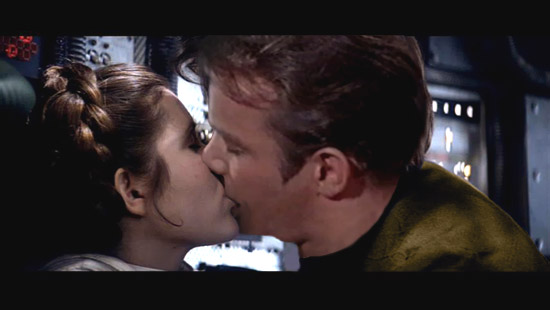
I pointed out to Kessel Junkie, a rabid Star Wars fan (seriously, check out his blog), that this isn’t just Star Trek. The original Star Wars trilogy was about Luke, Leia, and Han. Is Obi-Won Kenobi getting too important? Cut the bastard in half … or into thin air. Whatever. Same with Yoda. Bring them back as ghosts occasionally, but get them out of the action.
The Star Wars prequels became about the ensemble. While it should have been about Anakin, Obi-Won, and Padme, it wasn’t. Mace Windu, Yoda, and a freaking astromech droid were just as important. They got a ton of action independent of the main characters.
A Larger Trend
I haven’t done any serious math here, but this appears to be a larger trend, especially in light of the success of comic book movies. This isn’t necessarily a bad thing. It allows screenwriters to tell a different set of good stories. It’s also no longer “progressive” to just stick a minority on screen, make her a secretary, tell everyone she’s good at math, and rarely let her speak words other than, “I’m frightened.” I can understand a need to continue our social evolution, but it has its drawbacks with respect to the development of characters with whom the audience can relate. If we had the Avengers but didn’t have the benefit of two Iron Man movies, a Captain America movie, a Thor movie, and two Hulk movies, you wouldn’t care as much for those characters as you did (unless you had decades of development through reading their comics, which I do not have).
And this is why Picard will never have shit on original Kirk. Get over it and get off my lawn, you rotten kids.
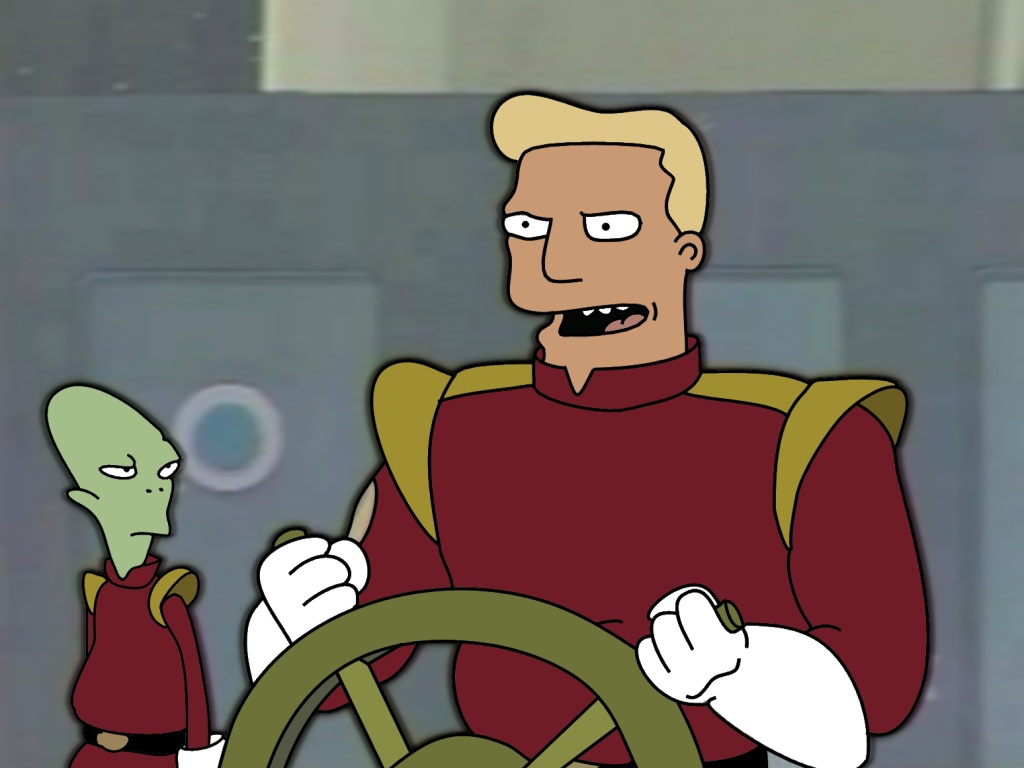
Of course, Zap’s better than both of those sissies put together.
P.S. Opening day for Star Trek into Darkness is my birthday. Great gift, though it would be better if Cumberbatch were playing Sybok.





 Play What You Want