Let's roll some dice, watch some movies, or generally just geek out. New posts at 6:30 pm ET but only if I have something to say. Menu at the top. gsllc@chirp.enworld.org on Mastodon and @gsllc on Twitter.
Sundays are now lazy days for me. Going forward, I’m just going to re-post other people’s work or just do something silly. Today, it’s the deleted scene from Avengers: Endgame the Russo Brothers don’t want you to see.
These are apparently a series of videos where “Bully McGuire” saves the day. Here’s a couple more.
He died on Jackie Robinson (#42) Day and Jack Kirby’s birthday. Here are three great scenes from his three biggest roles. (EDIT: one was taken down, so I deleted it)
Sundays are now lazy days for me. Going forward, I’m just going to re-post other people’s work or just do something silly.
I love the Guardians of the Galaxy movies and will always find excuses to mention them. Here’s a behind-the-scenes look you may enjoy.
Hmmmm. In light of the last four posts I published (movies, bands, songs, and albums), I should list my five favorite MCU films. I’ll do that quickly here because my rationale is spread out over my blog.
Sundays are now lazy days for me. Going forward, I’m just going to re-post other people’s work or just do something silly. This is both. This guy, “Nando,” initially annoyed me, but the more I listened, the more this made sense. What do you think?
Another thing that always bugged me about superhero movies (yes, I can pick at the things I love) are the comlinks that the heroes use to communicate. It’s some sort of Bluetooth thing going on; a earpiece with a built in microphone. I always thought, “Why aren’t they constantly talking over one another?”
It just seemed impractical. Of course, we all just let it go; there are far bigger things requiring the suspension of our disbelief. However, I recently started playing D&D again on Wednesday nights via Zoom, and that has brought this thought back to the surface. Even when there are only 5 of us, the cross-chatter makes it impossible for everyone to be heard. It drives me nuts. I’d think there was a lot more planning involved in the defense of New York City from an alien army then there is in deciding how to navigate a bar fight. And don’t tell me about military discipline. The Hulk, Tony Stark, and Thor don’t care about your silly, human, military procedures for communication.
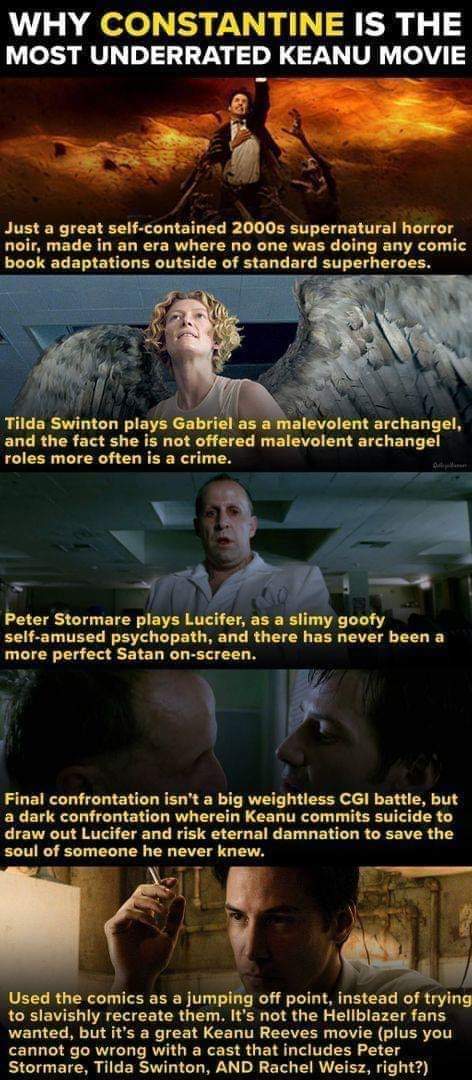
I ran into this meme on Facebook, and it triggered a long-held thought that I suspect is still relevant today.
Constantine (if you know the source of this meme, please let me know so I can give proper credit)
This refers to the movie Constantine, which I love. Its Rotten Tomatoes scores are typical of the divide between film credits and the audience. The last panel in the meme is what grabbed me. It references the fact that comics and movies are different media, and so they should play out differently. That appears to be something many (not necessarily most) comic book fans can’t grasp. Even when they accept, for example, the death of Thanos, they immediately start spreading theories as to how he could return in future movies. That attitude is still prevalent, and as much as I loved Thanos, I don’t get why.
This issue goes back a long way for me. I remember my cousin, and avid comic book collector, not liking that the Joker died in Michael Keaton’s first Batman movie (1989). In part, he saw it as a waste of a character that could be put to good use later. (His views may have changed, but others still make this argument.) The thing is, the Joker is not a character that they should have used again, precisely because it’s a movie.
It’s necessary for villains to survive in the comics. There are only so many ideas for villains, and with comic story lines having to last decades, killing off villains would create a shortage of adversaries for your stories. The only way to fix that would be to have another person take up that villain’s mantle. Sometimes that works, but doing that too often would leave the reader with the notion that they’re effectively dealing with the same character, so the writers are (cheaply) trying to have it both ways. Hence, you instead put them in prison or Arkham Asylum, they escape, and then you start the cycle again.
Movies are different. Most audience members require definitive closure, with death providing the most dramatic end to a story. Because the MCU‘s “blistering” pace still produces only three movies per year, there are actually far too many interesting villains that will go unused if you’re going to reuse the ones you’ve already shown. By the time you genuinely need to reuse a villain (if ever), you’re probably rebooting the cinematic universe for a different generation of viewers anyway. Ergo, for movies, you can have the closure your audience craves without painting yourself into a corner. If that pisses off a small percentage of your core fans that are still going to watch your movies anyway, you have an acceptable outcome.
It’s not the size of the dog in the fight, but the size of the fight in the dog.
— Mark Twain
Yesterday, I wrote about my re-watch of Batman v. Superman: Dawn of Justice. As soon as I finished, I re-watched Justice League because of course I did. My favorite scene from Justice League was the fight between Superman and the others, and within that scene, I loved where the Flash entered the speed force (his element), Superman was ready for it, Superman cast off the other members with ease, and then beat up the Flash before the other three even hit the ground. Once and for all, it established Superman as a badass. A badass with the exploitable weakness of his concern for others, but nevertheless a badass.
What struck me about that scene within the scene is that Superman won on Flash’s home turf. He shouldn’t have, but yet he did. Superman won because he was confident, and the Flash was an insecure kid who had never been in a fight before he teamed up with Batman, et al. (which didn’t go so well for him). This isn’t the first time we’ve seen a superhero movie address this theme.
The script establishes that Shazam is more powerful, but he's losing anyway. It's all about confidence and experience that a kid just won't have. #QuarantineWatchParty#Shazam
— Rob Bodine #QuarantineWatchParty Fiend (@GSLLC) April 2, 2020
Also, within Justice League, Victor Stone had to take control back from the machine that infected him, and he couldn’t do that while it still intimidated him. There are quite a few examples. On the flip side, Arthur Curry was far too arrogant when he agreed to face his half-brother, King Orm, in the Combat of the Kings (Aquaman). Arrogance can be just as damaging as meekness. You need to strike a balance between the two to realize your full potential, but the point is that attitude certainly matters and always will.
I hope Flash won the race from the mid-credit scene, but he probably spent too much time looking at Superman to see who was currently winning, which always slows you down. Meekness. 😦
Sundays are now lazy days for me. Going forward, I’m just going to re-post other people’s work or just do something silly. Today, it’s both: One of the cutest scenes in the MCU.
If you enjoy this post, please retweet it. Other posts in this series can be found here: No Small Parts.
Great Shatner’s ghost! I can’t believe how long it’s been since I posted about Star Trek. It’s my favorite entertainment property, yet I’ve been so focused on the superhero stuff and random Netflix movies that I haven’t watched any Star Trek recently. Ironically, it was the Iron Man quarantine watch party on June 30, that inspired this post (as well as this one and this one).
— Rob Bodine #QuarantineWatchParty Fiend (@GSLLC) July 1, 2020
I haven’t seen a lot of Faran Tahir, but I’ve been impressed by everything in which I’ve seen him, including his role in Iron Man. That role wasn’t small, but this post is about Captain Robau from the 2009 reboot of Star Trek. George Kirk (Chris Hemsworth) gets the credit for his sacrifice, and that’s fair, but it’s clear that he was following the teachings of his captain, played by Mr. Tahir. Captain Robau set the tone for the scene, and the entire movie, by remaining completely calm during the brief negotiations and immediately complying with Nero’s demands despite the danger. He didn’t do this because he was without fear – his bio signs indicated an elevated heart rate, rapid breathing, and other signs of emotional distress – but because leaders don’t have the luxury of personal considerations. If you take responsibility for other people’s lives, you need to live up to that.
Captain Robau was a strong character, and his leadership set the tone for a movie that was as much about leadership as it was about friendship.



 Play What You Want