Let's roll some dice, watch some movies, or generally just geek out. New posts at 6:30 pm ET but only if I have something to say. Menu at the top. gsllc@chirp.enworld.org on Mastodon and @gsllc on Twitter.
As some of you may know or remember, my grandparents’ home was taken in a tax sale. I didn’t care, but my cousin asked me to fight back. I said I’d try, but the deeper I dove into the issues, the more I realized the injustice occurring across the country. Long story short, 1) counties are auctioning off homes for a fraction of their value to recoup relatively small tax bills (in my case, at least a 94% theft of value), and 2) doing so to people who are particularly vulnerable and therefore cannot fight back (e.g., dementia, financial hardship, logistical issues). Despite SCOTUS unanimously forbidding the practice in Tyler v. Hennepin County, it continues because, well, the victims can’t fight back, so there are no consequences for continuing the practice. Thus, the legislature, counties, and even courts allow the unlawful scheme to continue.
Facing local, small-town bias, I lost in the trial court without any stated argument other than, “Those SCOTUS cases aren’t relevant.” Her honor also claimed I was fighting the battle in the wrong type of case, and to justify that, carefully parsed out the relevant part of the statute that says otherwise. I suspect that, as a trial court judge, she simply doesn’t want to overrule a decades-old statutory scheme based on Federal Constitutional grounds, but that’s reversible error. I don’t think either her Honor or opposing counsel expected the appeal. (I don’t think opposing counsel even expected my Answer to his Complaint.)
Now I’m working on my appeal. It’s been a grind. I’m learning litigation on the fly, and certainly screwing up, but so far it hasn’t bit me in the ass yet. The bad news is that it may. I might get my appeal thrown out on a technicality I didn’t anticipate. The good news is that, if it goes through, there’s a good chance that SCOTUS will decide Pung v. Isabella County (MI) by the time my reply brief is due. You see, the way the states have continued to justify this is by splitting hairs on the facts. That’s going to be exceptionally hard for Pennsylvania to do once Pung is decided. It’s even closer to the facts of my case, and I’d bet serious money that SCOTUS will not only rule unanimously in my favor, but also do so with a biting takedown of the unlawful practices of the counties and the dereliction of duty committed by the legislatures and judges. (Note: The Michigan Supreme Court took the taxpayers’ side, but the counties are still doing this because, again, no one fights back.)
Either way, this practice will be unquestionably forbidden going forward, so you won’t lose your potential future case even if I do on a technicality. Pung did the work to make sure of that.
And in case you’re wondering, none of the non-profits are willing to help. I asked all of them, but unless it’s a SCOTUS case, they aren’t interested. Only one even responded, asked for the Order I was appealing, then never replied again. The arguments I made were in part copied from their amicus brief in Tyler, so I know were on the same page. It’s just not yet worth their trouble.
I’ve also tried to get Pennsylvania media to interview me with no luck. If anyone has any media contacts up there, I’d appreciate you putting my case in their ear.
And now for something completely off topic for this blog.
The Supreme Court of the United States (“SCOTUS”) allowed the so-called ban on TikTok to go through. I refer to it as “so-called” because, as the holding states, it’s not a true ban; it’s a conditional ban. Political rhetoric always clouds the truth, so despite this being a unanimous decision of the Court, I still feel the need to preface this discussion with a brief discussion of the role of appellate courts.
Some Pontificating
The reason most of you are so angry at SCOTUS, or particular justices, is at least in part because you don’t understand (or care about) its role. Appellate courts, including SCOTUS, aren’t there to make policy decisions. They don’t make law. That would be a violation of the Separation of Powers principle, a violation of their individual oaths of office, and anti-democratic. In other words, SCOTUS doesn’t ask what the law should be; they ask what it actually is, for better or worse. What the law is, whether statutory or constitutional, is determined by Congress (and state legislatures). All the appellate courts do (that’s relevant to this conversation) is interpret that law, resolving ambiguities in the language or in how it might apply to a particular set of facts. So, you may absolutely be upset that TikTok is banned if you want, but the blame for that doesn’t lie on SCOTUS, and it would be horribly inappropriate if the justices sitting on that bench changed the law because they didn’t like it either. Stop shooting the messenger. That includes me. Much like SCOTUS just tells you what Congress says, I’m just telling you what SCOTUS said.
Enough of that. Let’s talk about what they said.
The Facts and the Law
In the interests of brevity and clarity, I’m just going to get right to the point, simplifying everything and leaving out a lot of fluff (and perhaps some important nuance).
TikTok, Inc. (“TikTok”) is an American company, but it’s owned by ByteDance, Ltd. (“ByteDance”), which means, like ByteDance, TikTok is subject to Chinese laws. This means that TikTok must “assist and cooperate” with the Chinese government, granting them “the power to access and control private data.” In other words, not a single piece of information you put on TikTok, even data indirectly coming from other connected social media platforms, is truly private. The Chinese government has access to all of it.
Important: This information includes age, phone number, precise location, internet address, device used, phone contacts, social network connections, the content of private messages, videos watched, and behavioral data (e.g., keystroke patterns and rhythms). Remember this list or come back to review it if necessary.
Trump tried to shut down TikTok, but the appellate courts stopped that, seeing that as outside the scope of executive power. Biden took office and tried to negotiate with ByteDance, but that went nowhere. In the meantime, Congress than passed the Protecting Americans from Foreign Adversary Controlled Applications Act (the “Act”). Under the Act, entities may not “distribute, maintain, or update a foreign adversary-controlled application” in the USA. There were some other details, including exceptions, but the point, of course, is that TikTok fit the definition.
I mentioned “conditional ban” above. TikTok could continue to operate under the Act if it underwent a “qualified divestiture.” That means that ByteDance would have to sever its control over TikTok, which would prevent ByteDance, and thus the Chinese government, from accessing your data on TikTok.
Applying the Law to the Facts
This gets complicated for the non-lawyer, so I’m going to leave it up to you to ask questions if you want a more detailed analysis. Here’s the short version. The first issue was whether the First Amendment applied to the Act, and SCOTUS said yes. The second issue was whether the Act’s constitutionality was subject to strict scrutiny or intermediate scrutiny. The Court said intermediate scrutiny, which is an easier test to pass, in part because the Act didn’t impose restrictions based on the content of any speech. In fact, the Act doesn’t care what was being said at all. In legalese, it was “content neutral” as opposed to “content based,” so it would be easier for the Court to find the Act constitutional (though not “easy”).
Applying intermediate scrutiny, the Court asked whether the Act 1) “advances important governmental interests”; that 2) don’t “burden substantially more speech than necessary”; 3) “to further those interests.” In other words, the goal must be important, and there must be a causal connection between the restriction and achieving the goal.
The Entire Point
I’ve been discussing this case with a coworker, and I know what she’s going to want to know. It isn’t going to be all the details on how all the conclusions above were reached. I imagine you want the same thing. Here it is. Congress passed the Act to prevent China from “track[ing] the locations of Federal employees and contractors, build[ing] dossiers of personal information for blackmail, and conduct[ing] corporate espionage.” This isn’t unreasonable. The Free Speech clause could certainly interfere with legislative acts that prevent such employees and contractors from using the TikTok app, so prohibiting the app’s availability is the only way to protect national security.
Or is it? Well, no, there are indeed other ways to do so, but under SCOTUS precedent, Congress is under no obligation to select those other ways. Congress made this choice after extensive hearings and other fact-finding processes and determined that all the evidence suggested that this is the best way, all while doing so in a way that satisfies intermediate scrutiny.
You may also want to know whether other platforms are next. It should be obvious that US companies are clearly outside the scope of this law, so Facebook, the platform formerly known as Twitter, and MeWe are safe. As for other foreign entities, SCOTUS points out that TikTok has “special characteristics” (i.e., foreign control over large amounts of private data) that have always justified a different analysis. This is why SCOTUS chose to “emphasize the inherent narrowness of [the] holding. . . . A law targeting another speaker would by necessity ential a distinct inquiry and separate considerations.” This case won’t immediately affect any other social media platform.
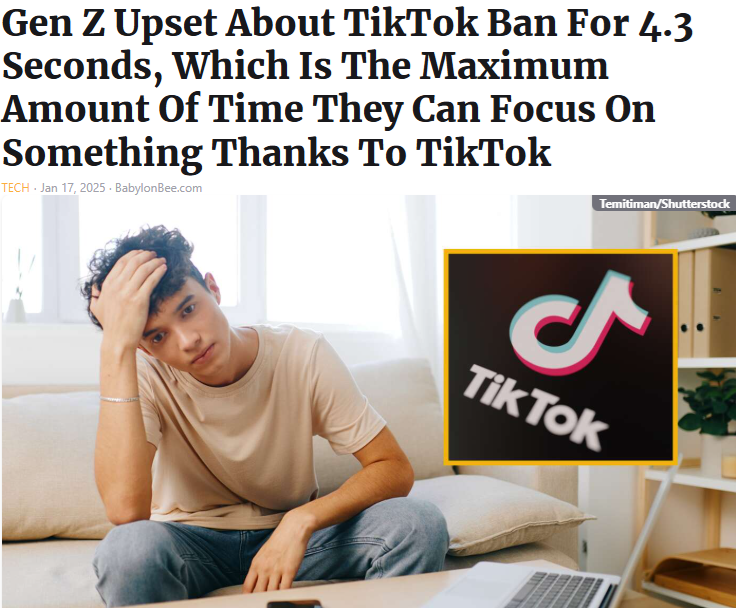
c/o The Babylon Bee
Is This a Good Idea?
As I said, SCOTUS doesn’t ask what the law should be, but we certainly can. I read somewhere (but didn’t verify) that a content creator can make 10 times on TikTok what they can make on Facebook, and YouTube is even less generous than that. This will certainly hurt content creators, but is your profit more important to you than your own privacy? What about the names and phone numbers of your friends that will also be exposed without realizing it? With everyone complaining about Facebook tracking confidential information, you’d think you’d be even more concerned with a foreign adversary doing so. All that considered, and putting aside matters of censorship, is this a good idea?
This is a decision you must make for yourself, and you can let your congressperson know how you feel about it. SCOTUS did not tell Congress it had to keep the Act; it just said it could. There is nothing stopping Congress from repealing or amending the law. That said, please keep in mind that Congress made its decision based on extensive research I’m sure you haven’t done, and arguments without specifics will fall on deaf ears. The nature of a republic is that you elect people you trust to do that research and make those decisions, because you don’t have time for a proper analysis. But they still must answer to you.
Final Note: I’ve left out a lot of details. However, I’ve uploaded a PDF of the decision with highlighted text and commentary from me. If you want to dive into the detail and have all your “Why?” questions answered, download it here. I’m happy to discuss the Court’s reasoning in greater detail. As long as you’re polite. 🙂
I recently came across an article about 10 songs that wouldn’t work in today’s social climate. Sure, I’m kind of old (56), so for the most part, those songs didn’t bother me, but culture revolves around the young, so my opinions don’t matter. However, I never understood the stupidity of the objections to one song in particular that appeared in the article: Suicide Solution by Ozzy Osbourne.
I post this with no fear any of you will kill yourselves after listening.
Ozzy was famously sued for causing the suicide of one of his fans by releasing the song. (That was the dumbest sentence I’ve ever written.) The article seemed apologetic to those from the 80s and today who objected to the release of the song. The idea is that Ozzy is trying to advertise suicide as the solution to your problems. Moreover, there’s a part of the song where Ozzy stutters over the word suicide, saying, “Su, su, su . . . .” I remember the attorney representing the plaintiffs saying that it sounded too close to “Shoot, shoot, shoot,” which, of course, is how the fan committed suicide. Ozzy fought back saying that the song was about the dangers of alcoholism, which is a sort of slow suicide by way of the chemical solution of alcohol. (I know there’s some disagreement on whether alcoholic beverages are “solutions” or “mixtures,” but that’s not a concern of this post.)
So, who’s right? (I am right.) Well, form your own opinion. (Your opinion will be stupid unless you admit I am right.) Here’s the opening lyric to the song.
Wine is fine, but whiskey’s quicker. Suicide is slow with liquor.
Do I really need to post the rest of the lyrics for you to understand what this song is about? Well, just in case . . . .
Take a bottle, drown your sorrows. Then it floods away tomorrows. . . . Now you live inside a bottle. The reaper’s traveling at full throttle.
Seriously, may I stop? While the other lyrics can be interpreted in a multitude of ways, they should be interpreted within the context of what you just read. Clearly, this song is about the dangers of alcohol excess. It’s actually a fucking public service announcement, but because a couple of parents couldn’t accept that the life they provided their child with a life he felt wasn’t worth living, they needed a scapegoat. That’s some serious cognitive dissonance, but their personal failings carried potential consequences for society at large, and ideas like this still swirl around in people’s insecure brains.
Of course, there could be even more to this argument. Suicide requires a complex combination of circumstances and emotions. No song could be causally linked to a suicide. Free fucking speech. But none of that should matter because the song itself is telling you not to commit suicide through irresponsible alcohol use. Ozzy knew something about this, as a fellow musician he knew had recently drank himself to death (so to speak). This song was absolutely the wrong target to attack.
I’m probably preaching to the choir among my few readers, but apparently there are still plenty of people who cling to this incredibly stupid position. Even my YouTube search warned me about what’s coming.
I don’t mind the phone number going viral, but I really don’t need the warning at the very bottom. Duh.
If you think being a lawyer is easy, which at this point you’re a dope if you do, I can assure you that it isn’t. Yesterday was an example of why it isn’t, and in a way that wasn’t obvious.
I’ve never played Mortal Kombat. Am I doing this right?
Here’s something to which many non-lawyers can relate. Is there any time period or specific event in your life that you never want to revisit? Yes? Okay, then imagine if someone started asking you about it, and really dug into the weeds, demanding details. Now imagine that you couldn’t respond to those questions with, “Fuck off. Mind you’re only business.” Instead, you had to answer those questions honestly and thoroughly, and if the questioner forgot to ask about a relevant topic, or if their phrasing allowed you to dodge it without lying, you’d have to volunteer the hidden information.
Yesterday, I had my character fitness interview. I’m joining the bar of an additional state, and that’s part of the application process. So, not only did I complete 185-page application (with attachments) detailing my entire life, but then I had to sit face-to-face with a complete stranger and discuss the ugly, deeply personal parts.
An Example
When I first got the call to schedule the appointment, I asked if I needed to bring anything, and my interviewer responded, “No, I have your bar application here, so I have your entire life in front of me.”
He wasn’t kidding, because bar applications are more detailed than any security clearance application I’ve ever completed. My response to that was a joke: “Well, you don’t have my medical records. Should I bring those?”
I admit, this isn’t a joke Bill Burr would tell, but it elicited a chuckle and an “of course not,” and that was that. However, my medical history came up in the interview. It was tangentially related to a topic we were discussing, and I must be honest and thorough in my responses. What should have remained a joke didn’t, and there’s nothing either of us could do about it. If it’s relevant, then he has an ethical responsibility to ask (even though he clearly didn’t want to), and I have an ethical responsibility to respond.
Believe it or not, that’s not the worst of it. That’s just the one example (from the single example of bar applications) that I’m willing to give you. The medical issue in question was a hernia, and I have no problem admitting to that publicly. But what if your medical issues were far more private? You wouldn’t be pleased discussing them with a stranger, would you? As I said, this is a brutal reality of practicing law. We’re under a constant microscope not only today, but yesterday, last year, and 1990. Everything is open to inspection. As the rise of the internet has shown us, no one is 100% clean. We’ve all got regrets, but those of attorneys are always on display even if capable of being hidden, and sometimes you can’t hide from the ensuing discussion despite the number of wounds it reopens.
On the bright side, I’m all but certain I’m going to be approved for membership. Mission accomplished.
This is the second of my two planned videos about Paizo’s ORC license. This one summarizes the issues I raised in the last video, follows up on one of those issues, then discusses an entirely different topic. I take a side trek towards shrink wrap licenses, but as long as this video is (41:00), I tried to keep it as brief as possible, so I didn’t mention the mild circuit split on shrink wrap licenses. Basically, sometimes the courts uphold them, and sometimes their skepticism has them strike them down. In other words, the concerns I expressed aren’t merely speculation, but rather based on actual disagreement between different courts. But hey; just watch the video. I wasn’t nearly as fired up in this one.
EDIT: After you watch the video, come back here for point of clarification. I say that shrink wrap licenses are being used in a weird way with respect to RPGs. Here’s another way to phrase it. With software, the licensor places a unilateral contract on their product and says, “This product is paired with this license. Use the product, and you accept the license.” With RPGs, the licensor (e.g., Paizo) isn’t putting their license on their own product, but even if they do, it’s not capable of being accepted at that point anyway, so it means nothing so far. Instead, the licensee (e.g., you) are putting Paizo’s unilateral contract on your own product, and in doing so effective saying, “Yeah, I accept this.” But you never actually say that to the licensor. Moreover, if Paizo accidentally figures out that you used the license on the product, they’re never going to contact you. Everyone is in a contractual relationship with everyone else, but most of us don’t actually know it. That’s weird.
Remember, shrink wrap licenses are unproven where it counts, and there are legitimate reasons not to trust them, not the least of which is that they’re unilateral. Now you’re using them in a way unique to an industry that’s rarely subject to litigation of this sort. That’s even more suspect.
This is the first of my two videos about Paizo’s ORC license. This one rehashes (far more than it should have) the idea v. expression dichotomy, and then discusses problems with consideration within the license. I did it off the top of my head, which is never a good idea (over 40 minutes of ums and ahs), so watch it at at least 1.25 speed and expect to take breaks.
This is just the tip of the iceberg as far as how animated I get.
My second video on acceptance was just recorded, so that will go up tomorrow. It summarizes the issues I raise in this video, follows up on one of those issues, then discusses an entirely different topic. If you have any other questions on either what I’ve discussed in these two videos or what I haven’t, please let me know. I know there are other issues people are contemplating.
I’ll be recording a video about Paizo’s ORC license soon. This serves as a prologue to that video. Here, I discuss the distinction between ideas and expressions in copyright law.
I recorded this while procrastinating; I didn’t want to go to the gym. Therefore, I didn’t do any research or write a script, so don’t expect any justification for my statements or structure to my words. I just want to make sure you understand a critical issue about copyright law, in layman’s terms, before dealing with the ORC.
Upper Deck (“UD”) sued a former employee, Ryan Miller (“Miller”) and a competitor, Ravensburger North America, Inc. (“Ravensburger”) over a “stolen game.” If you’ve ever read this blog, you know that game rules can’t be copyrighted. They can be patented, so UD’s claim that their game was “stolen” may prove correct. I’m going to try to answer the questions that people have addressed to me.
Facts
Briefly, UD employs Miller to design a trading card game (“TCG”). Miller sings an employment contract that contains a nondisclosure provision. Miller leaves UD, joins Ravensburger, and designs a similar game there. UD’s game hasn’t been released, but Ravensburger has publicly shared their ruleset for playtesting at conventions and has sold packs of cards for it (or so the complaint alleges).
I’m just going to deal with the intellectual property law issues because the question that everyone seems to be asking (me) is one related to IP: Is this a valid basis complaint in the first place? That’s a question I can answer without knowing both sides of the story. That is, I can’t say who’s right and wrong, but I can opine as to whether or not the philosophical basis of the suit is valid.
Trade Secrets: The Forgotten IP
Part of this case falls under trade secret law, which I address in this post covering all forms of IP. The defendant’s employment contract had a non-disclosure/secrecy provision, and that’s the basis of the suit. Game mechanics can be protected under trade secret law, which basically says, “Don’t tell anyone what we’re doing,” or “Don’t tell anyone how we do what we do.” This is very much unlike copyrights because copyrights often have little to no value unless they’re made publicly available. Trade secrets are valuable because they’re kept secret. One of the most valuable trade secrets in the world is the formula for Coca-Cola. If it were patented, it would be published, and thus have at most 17 years of protection. Instead, they keep it secret, so it has value for as long as it remains so. That’s an important point: Once a trade secret is made public, it can no longer be a trade secret. You can sue someone for publishing it, but you can’t put the genie back in the bottle. Once it’s out there, it’s no longer protectable. Ever.
So, the defendant in this case was (allegedly) bound by contract not to share the mechanics until after they were released by UD. It’s reasonable to infer that Miller must have shared those trade secrets when designing a game that was remarkably similar to what he did with UD. Miller and Ravensburger could argue that the similarities are ones shared by all card games, and so none of them are trade secrets. The complaint details the game mechanics, but I haven’t really read through them, so I can’t evaluate that defense.
Of course, even if those mechanics are identical to other games, this may not get the defendants off the hook. Games have several elements, so the difference between most games is essentially which specific combination of known elements you’ve chosen for your game. That combination may be unique. Even if not patentable, it may be marketable, and thus have value. If, for the reasons stated above, the sharing of that combination hurt UD’s market for the game, there’s still a lawsuit to be had.
You might ask, “How would it hurt the market?” Well, think about it. Games have limited shelf lives. Their first push in the market is often where they make their most money. If someone learns of your game system and publishes a quick-and-dirty version of it first, they’ll grab most, if not all, the market before your more well-designed version even gets there. Maybe you’ll enjoy a secondary push in a few years, but you’ll still have lost that first market. Also, the first game company to get their game to market can always accuse the other company of plagiarism. As for patent infringement, depending on the timing, a game company could actually lose their ability to patent a mechanic because the mechanic was published long before the application was filed. There are time limits on these things, so it’s best to keep your designs secret.
Patents
Of course, as I mentioned above, UD filed for a patent in April, 2023. I have no opinion as to whether that will be granted. Even after I eventually read through the game mechanics, there’s a lot of “prior art” (i.e., existing games) I’d have to analyze to form an opinion, and I’m not going to do that. I don’t play TCGs. Even if I did form an opinion, patent law is a tricky thing. There are very few obviously good or bad patents. My opinion wouldn’t mean squat; we’d have to wait for a judge’s decision, and then an appellate court’s opinion before we get a real answer. Either way, claiming that the game was stolen is at best premature. That’s not to say I don’t understand why UD is saying it. I’m simply acknowledging the basis for your confusion by that claim.
There’s far more to consider here than I could possibly address. I lack information and the desire to dig any deeper at the moment. The takeaway here, though, is that game mechanics can absolutely be protected by trade secret until they’re published. If the trade secrets are deemed valid, their publication by Miller and Ravensburger would constitute a legitimate cause of action for UD. We’ll just have to wait and see whether it sticks.
I’ll continue to go through the complaint and provide more information as I learn it (if it’s interesting). For now, back to work I go.
In the early 2000s, my paternal grandmother died. Because my father had predeceased her, his share of her property flowed down to his children, leaving me with a 1/12th interest in her home. I was an attorney at the time, but not yet working in real estate, and it simply wasn’t on my radar scope. It never appeared on my radar in part because my crazy uncle just continued to use the home as a storage facility and paid taxes.
Fast forward a bit. My uncle stopped paying taxes at some point, so in 2017, the house was sold in what Pennsylvania calls an “upset sale.” The sales price was ~$8,500 to pay off the tax bill. Of course, I didn’t know any of this was happening because the relevant Tax Claim Bureau didn’t notify any of us of the sale as required by statute. After the upset sale, the purchaser sold to a third party (remember, a house the upset sale purchaser didn’t really own), who then has to get that sale confirmed by the Court. That’s when we all found out about this. We were served papers earlier this month for that second case, but the plaintiff on that second case doesn’t really own the property. The original purchaser at the upset sale didn’t meet the requirements of the statute.
I work primarily in real estate at this point. I know what these plaintiffs are. They prey on unsophisticated and financially insecure families to make a six-figure windfall. I have no sympathy towards them and will happily take the house back if it comes to that.
To give you some perspective, I’ve been told second hand that the house is on the market for $171,000, but it’s worth (depending on who you ask) anywhere between that and $253,000. Let’s assume the plaintiff can provide an appraisal that state’s the house is worth $171,000. This jackass plaintiff stands to gain at least $125,000 from the sale of this home, and I’m sure he’s done that many times prior. My share of that $171,000 is 1/12th, which comes to $14,250***. On the other hand, my cousin’s share is 1/9th, so she’s entitled to $19,000***. She’s on disability and could use the payout, so she contacted me, the only lawyer in the bunch, to see what I could do. She had already mailed her own Answer, but to be blunt, it understandably sucks, and it wouldn’t intimidate the plaintiff into a settlement.
*** Of course, to sell the house, we’d have to first come up with the $8,500 to pay the tax bill, then pay closing costs, etc., so if we did that, we’d get somewhat less than these amounts. However, I think the value of the property is much higher, so let’s ignore that.
I mailed an Answer to the Complaint on Monday, informing the court that proper procedures weren’t followed with respect to notice. However, one of my other affirmative defenses was that, even if Pennsylvania law allowed for such procedures to be ignored for some strange reason, if Pennsylvania law allows discrimination against out-of-state litigants, it violates the Privileges & Immunities Clause of the Federal Constitution, and thus must fail.
Yeah, I cited the fucking United States Constitution on a simple tax sale, and if necessary, it’s going to stick.
I don’t technically represent my cousin because I can’t. I’m not barred in Pennsylvania. However, if I get a settlement for myself, require that I be permitted to share that settlement information with my cousin, and (of course) actually share that information with my cousin, then my cousin will know what to demand ($19,000). In other words, she and I will be getting our payout. I don’t want a dime of inheritance from my family, so I’ll probably donate my settlement amount to charity. Maybe I’ll buy something worth $100 or so just for my trouble. However, I’m getting to stick it to the bad guys and help a cousin. That’s worthwhile.










 Play What You Want