Let's roll some dice, watch some movies, or generally just geek out. New posts at 6:30 pm ET but only if I have something to say. Menu at the top. gsllc@chirp.enworld.org on Mastodon and @gsllc on Twitter.
Okay, I know I promised to get my FASA Star Trek RPG character builder up and running over the weekend, but I ran into a serious snafu, and it needed to be addressed. In any event, it’s up now. You can find it in this GitHub repository: https://github.com/Frylock1968/FASAStarTrekRPG. There’s a long-winded read me file that you really should read before you use it. Because none of you will, here’s a summary:
It’s written using Access 365, which is a limited programming tool.
It’s written using Access 365, which means Apple users are out of luck without some extra steps I don’t understand myself, and even PC users without an MS Office subscription won’t be able to run it. This software requires a preexisting installation of Access on your machine. The good news is that, to my knowledge, Access is included with even the most basic Office subscription.
It’s a beta version, which means I’m relying on your help in uncovering errors.
If something doesn’t work, I’m going to fix it, but if there’s a feature missing, it’s unlikely I’ll add it. I plan to make a web-based version of it, and that will include everything.
More features will be added, but only really simple ones. I’ll save all features for my intended web-based application.
A feature I said I’d like to add to this application is the ability to create Orion PCs. Yeah, that ain’t gonna happen. After reading through it, I learned that such a feature requires four different methods, and arguably five. Ruddies, greens, Green slave women, greys, and half-breeds among the bunch are all handled differently, and those differences are non-negligible. That’ll have to wait for the web application.
One issue I can’t seem to figure out is a data lock issue. When you load a previously saved character and edit it, and it results in Chinese characters saved to some of your fields, don’t save it. Something’s corrupted. Instead, reload the character from your hard drive and start again.
One clean up task on my list is to remove excess options from lists. For example, Klingon culture is Klingon culture. It shouldn’t be divided into separate cultures for Imperials, human-fusions, and romulan-fusions.
There’s no user manual. Instructions appear on the user interface itself in red, italicized text.
I’ve previously discussed my FASA Star Trek RPG character builder. I updated you by stating that I had made quite a bit of progress. Well, I was going to publish it after adding the component for creating Romulan player characters but decided to wait until I added the Klingon component. I can easily say that it should be uploaded to GitHub by the end of this weekend (let’s say, Sunday, 7/13).
I’ve already uploaded my first beta version of my Gamma World 7e character builder to GitHub (here). I’ll create a new repository for the Star Trek stuff and publish the link as soon as I do. I plan to add a component for creating Orion player characters and merge other components from my prior work into this character builder. That prior work has the means to instantly create solar systems, NPCs of all races, animals, and balanced starship battle groups. Eventually, I’ll replace all of these with web-based versions when I begin producing character builders for other games. Those other games will be contemporary ones still in print, so those will be subscription-based if I can work out a deal with the publishers.
FYI, the Gamma World and FASA Star Trek applications will always be free.
The application does not currently support creating Klingon or Romulan PCs for campaigns centered on those empires, and honestly, that’s not a priority. At this point, I have only three things I need to do immediately: Create the capacity to save the character to an external file; create the capacity to advance to the character as it competes adventures, and the customary clean up of bugs and such that are inevitably found during the use of the application. The first two will be relatively quick, and the third one is always an ongoing process.
I have to spend the next couple weeks focusing on a Response to a Motion for Summary Judgment. After that, I’ll finish this up and start my next project. Or so I hope. The next project will involve a modern game system still in print. I know the author of the game and need to discuss it with him before starting the project. If he gives me the thumbs up, that one will be a bear.
By the time I’m finished, I will be known as the “Character Builder Guy.”
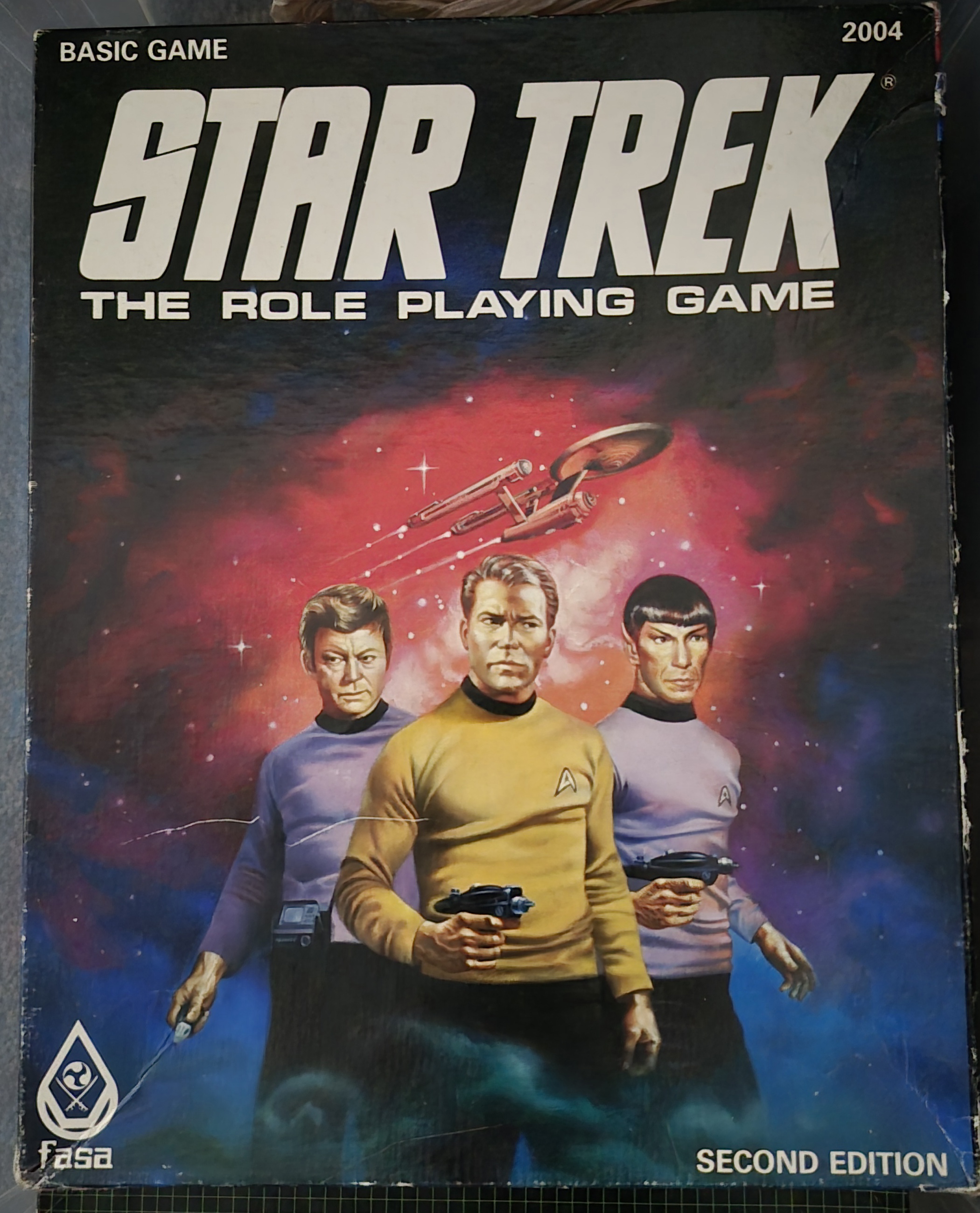
Last weekend, my 1st Edition Dungeons & Dragons (“1e“) gaming group discussed expanding our horizons. To some extent, 1e has run its course for us, so after the other Rob takes over as DM and runs us through the Village of Hommlet, we’ll probably be trying out new game systems. (Technically, we haven’t heard from Rob on the matter, so there’s more to discuss.) This discussion was prompted by a discussion I had with another member of the group a couple of weeks prior, and that prompted me to create my Gamma World 7e character builder (which is complete and should be on GitHub soon). This latest conversation with the group discussed different game systems we may run. One of my favorite is the FASA Star Trek Role-Playing Game (“FASA ST“) from the 1980s. When I was no longer allowed to play D&D, I shifted over to FASA ST for as long as I could. Surprisingly, I still have absolutely everything I bought related to that game except for the ship models that my older brother destroyed. (He’s an asshole.) I couldn’t possibly tell you how I managed to retain all of those items, but I have them.
Anyway, since Saturday, I was inspired to start another character builder, this time for FASA ST (2nd edition). I already created and published a Gamemaster’s application to manage various aspects of a FASA ST campaign, but I never got around to putting a character builder into it. Because I didn’t want to relearn my old code, I left that GM’s application be and started a new one. I imported a lot of the underlying data, then started building. In just four days, I’ve made an incredible amount of progress considering three of those days were workdays. 🙂
Like with the Gamma World character builder, I offer you some screenshots. For those of you with at least a vague recollection of the game system, I offer commentary to explain what’s going on. Most of you might want to ignore that commentary.
In the first screen, you choose your heritages (called “race” in the game). The red arrow points out a house rule I created. Each race has a specific set of bonuses and penalties to certain abilities. For characters of mixed heritage, those bonuses and penalties are averaged. My house rule is that, much like me, a typical American mutt of European ancestry, I allow characters to have as many as four distinct lines. My primary lineages are Scottish, Irish, German, and Italian, with a little Dutch sprinkled into the first three. Your character can be Vulcan, Romulan, Klingon, and Human. Star Trek canon seems to contemplate a mixing of the races, so my game does as well.
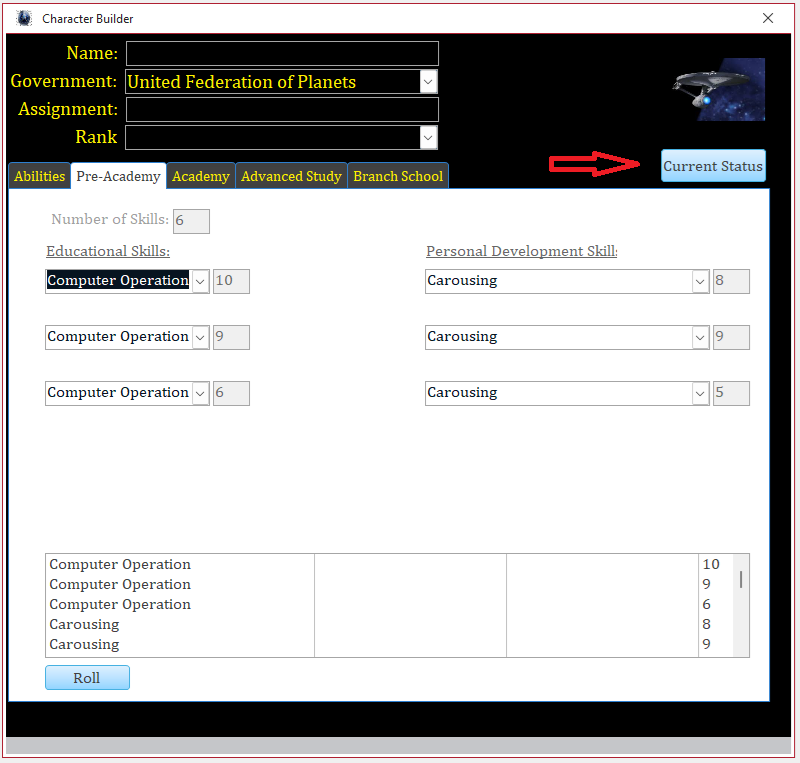
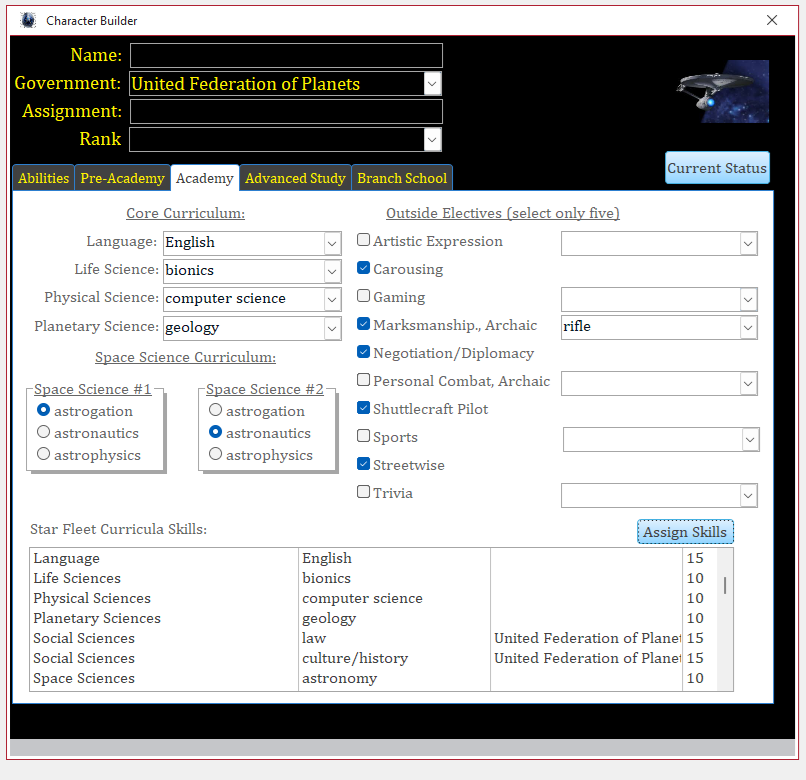
This next screen shows what you learned growing up. There are limited options, but they’re all useful for different types of characters. Another red arrow means something to point out. As you’re going through the character-building process, the same skills can be chosen multiple times to jack up a chosen specialty, but to make sure you can audit your work (and my software), I keep all the skill rolls separate. That creates a problem. In no event can a score exceed 99, but you might accidentally do so. In the end, I’ll force a cap of 99 on the final scores, but then you’re throwing away points you could have used elsewhere. Moreover, if you ever go backwards in the process, it erases everything that comes after it. It must because later steps are often dependent on the decisions you make in earlier steps. If your Computer Operation score gets too high, you may lose a lot of your work when you go back to fix it. The button at the top allows you to see your character’s current status (as far as points allocation) without taking the time to add up individual rolls. You’ll see a screen shot of this a little later in this post.
Nothing to discuss here. This is just the basic curriculum that all PCs learn at Star Fleet Academy.
This is also basic information you learn at Star Fleet Academy, but it couldn’t fit on the prior screen, so I gave it its own. Pay no attention to the fact that all the skills seem to be the same. I was running some testing.
Now you get to Branch School, which is where you start to really specialize. Navigators go to navigation school, medical professionals go to medical school, etc. Above, you see the helm Branch School, which is the simplest of all of them. There are no electives. You simply get what you see above.
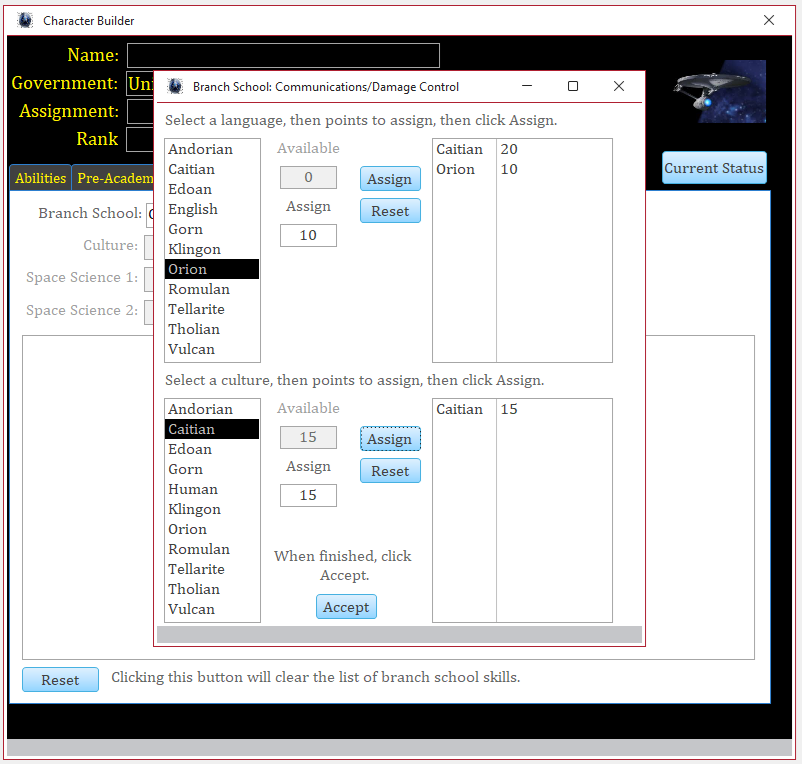
If, however, you choose any other school, you get a pop-up window that allows you make your elective choices. For communications, you get to spend 30 points in various languages any way you want, whether 30 points in one language or 3 points in ten languages. The rest of your skills are non-elective, so when you push the Accept button, it loads not only the choices you made here, but also the choices that are set by your choice of Branch School.
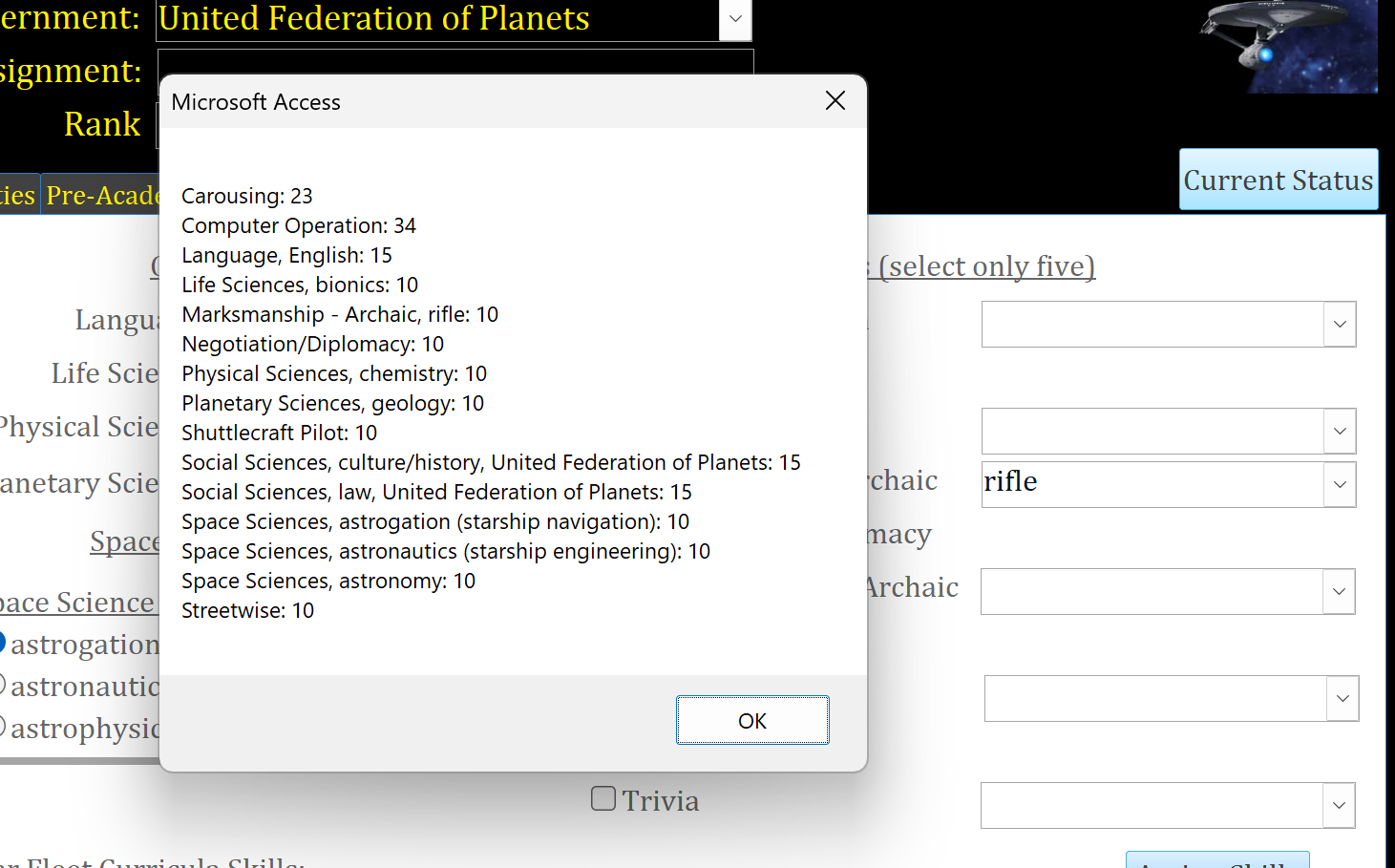
As promised, here’s what happens when you hit the Current Status button at the top right. You get an alphabetized and consolidated list of your skills so far. This image was taken for a different set of data than the others, so these numbers don’t correspond to what you saw in the images above. But this is, for example, all of your Carousing scores added together and listed just once. At this point, there’s no danger of wasting points by assigning scores above 99, but for the data in the prior images, I had a Carousing score of 115 just getting to this point. That’s why this exists.
That’s it for now. I’ve got only one more pop-up screen to create (Medical), and then it’s on to the characters’ past duty assignments on starships (or wherever they were assigned before the campaign begins).
Side Note: I’m Getting Better
The 1e character builder took years to create. I’m not relying on a technicality to say “years.” It’s more than just two. I think it’s been at least five years because I started it before I bought my current home in 2022. If you go through my posts, you might find and exact number, but I’m too lazy to figure it out. Even now, the damn thing has very little of a user interface, and I’m only part way through the Monster Manual II data entry. I haven’t even started Oriental Adventures or Deities and Demigods, and the latter would require some new data structure to implement. More importantly, because it was developed over years without any formal requirements analysis, it’s not put together very well. (Requirements analysis is important. Think about building a mutlistory building and halfway through the process being told it needed a basement.) Some of this can be explained by the fact that I included a campaign management tool, with the massive monster data entry that required. Moreover, I can blame this to some extent on the fact that it’s difficult to produce software for a game system that’s so convoluted.
Grognards are going to get angry with that statement, but it’s absolutely true. Every 1e rule is an exception to every other one. There’s no consistency at all. I’ve written extensively on how some of what’s in 1e should never have been abandoned by modern game designers. But be realistic. Taken as a whole, it’s exactly what you’d expect from a first-of-its-kind effort undertaken by a cobbler/insurance salesman. There was plenty of room for improvement. That doesn’t in any way condemn the efforts of the old gods of RPGs. We as a community owe them everything.
I was able to finish the Gamma World character builder in under three weeks. and it looks like I won’t even need that much time to finish this one (at least for the Federation PCs; Klingons and Romulans will take longer). I say all of this to make the point that I’m getting better as I relearn the skill of software development. In fact, I have an extra week of vacation time I’m taking in August, and I’ll be using that time to take a course towards C# certification. (C# is a programming language.) I may be able to launch these character builders via the web, opening them up to Mac users as well, though if that’s in my future, it’s a little ways off. There’s at least one more game for which I’d like to produce a character builder, and if the designer gives me his permission, a desktop application would be my next priority.
How Can I Get a Hold of This?
Gamma World should hit GitHub as soon as I figure that out. The FASA ST character builder will follow suit.
Maybe I’ll be known as the “Character Builder Guy.”
FYI, I’ve updated my (modest) 4e resources page. It includes support for the Masterplan campaign manager. For those that don’t know, some guy (a pro software engineer) built a campaign manager for 4e and left it on GitHub for all to use. It’s a great tool. The glaring problem it has is that some of the monster files cause the application to crash if you try to open them. (A good example are several of the hobgoblin files from the Monster Manual.) Well, I’ve fixed a lot of those. I can’t say whether I’ve fixed even half of the issues, but I’ve made a ton of progress. I’ve also updated a lot of the stat blocks to Monster Manual 3 format. My edited libraries are available on that page.
In addition, I ran convention in 2010 and 2011 (synDCon), and one of the events I created was a dungeon delve we called synDClash. These were common in cons. All combat. Just try to finish three combat encounters in 45 minutes. Rather than have only one adventure that people would have to play over and over again, I created six, each based on a classic 1e adventure. (In hindsight, I wish I had added “Revisiting the Mountain” or whatever as a homage to S2: White Plume Mountain.) Those files are up there too as separate Masterplan projects.
In other words, there are project files and libraries available for download. Moreover, the character sheets — both the ones used for synDClash and the offline Character Builder versions I created over the past couple days — are linked to there. (Please let me know if the link to my dropbox file works.)
All of this is a work in progress. I’ll continue to create whatever fixes are necessary and update sourcebook stat blocks to Monster Manual 3 format, but if you’re running an in-person 4e game and weren’t aware of Masterplan, you should consider it for tracking initiative, etc. We use it with a big screen TV as our battle map. This was my goofy way of letting everyone know that the set up was ready for what was the upcoming session: Reveal.
My thoughts on Gary Con will be brief. I doubt I’ll return. This isn’t a criticism of the con anymore than a non-football fan not liking a football game is a criticism of how good of a job the NFL is doing. It’s simply something that doesn’t appeal to me. I know a few industry insiders — two were my roommates — which means I’m within a degree of separation of almost all of the legacy ones. For me, the highlight of the trip was talking about the past, present, and future of the industry with Stephen Radney-MacFarland, James Lowder, and Dave Christ. The direct topic is interesting to me, but even more, this conversation inevitability leads to a back-and-forth on intellectual property law (usually copyrights). So, yeah; I’m in for that. Other highlights are conversations with Stephen and Jason Dandy (a non-industry friend) and with Jason and his friend, Mark, on sociopolitical issues. These guys think very differently than I do on most issues, but we engage in a form of constructive dialogue that’s very rare today. I even discussed abortion and Citizen’s United with no fear of generating anger from any of them.
But I can do all of that over Zoom. I don’t need to spend hundreds of dollars on airfare, lodging, a convention badge, and grossly overpriced convention food to have these conversations. One could say the same thing about Winter Fantasy, but that’s a different animal. Just eyeballing it, I’d say I know about 50% of the people that attend, and when I’m not hanging out with them, I’m relaxing. It’s a genuinely relaxing vacation. The food is good, and the whole trip is just an awesome ritual. While Gary Con could become the same thing for me, I don’t need two of them. Winter Fantasy is enough.
YMMV
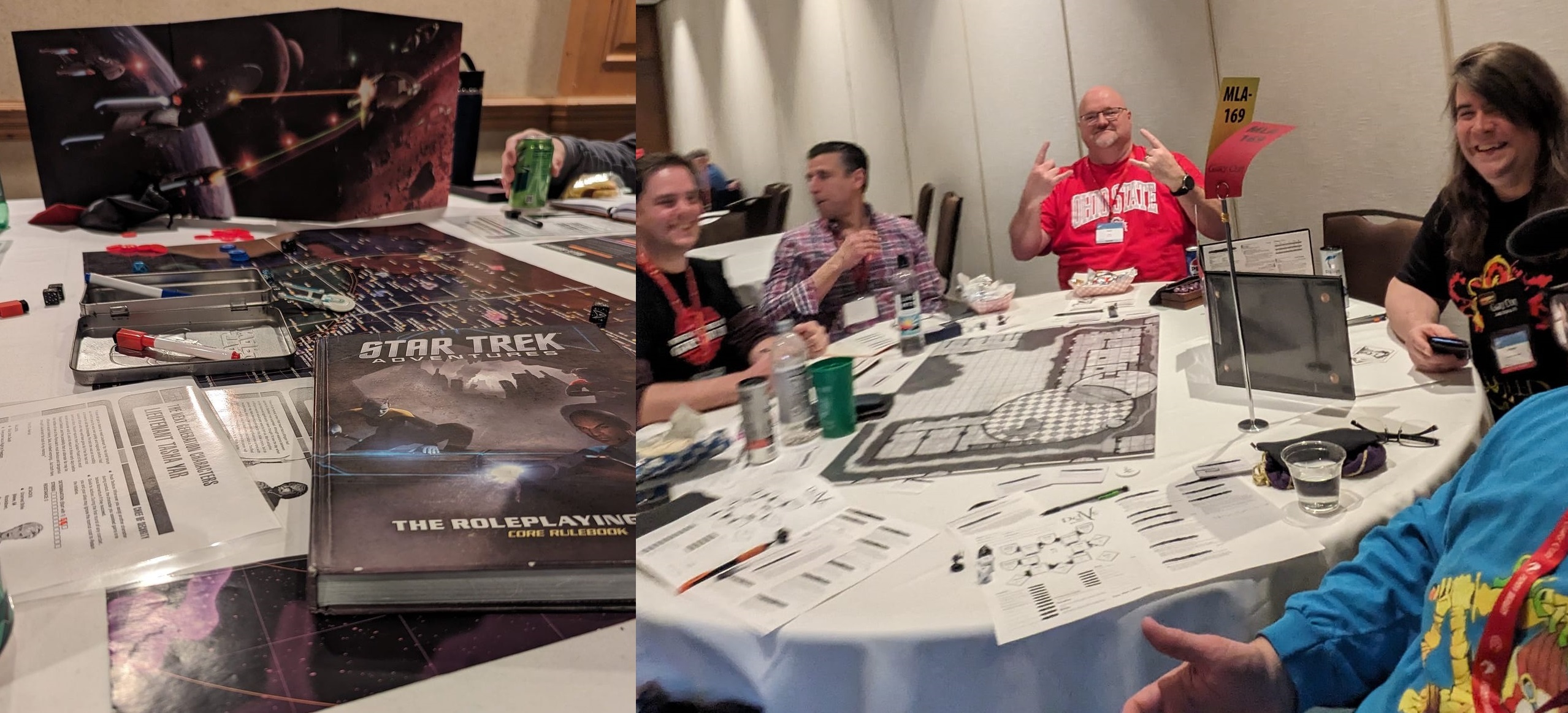
I hope it’s clear that I’m not saying I didn’t have a good time, and it’s certainly not to say that you wouldn’t. It’s a small-ish con, which is what I like about Winter Fantasy. I went with a mission to get to play (as opposed to DM) 1st Edition AD&D, and I played in three such games. I actually got to play the Dragon #56 bard in two of them. How many people can say they’ve done that? I got to play Stephen’s Delve game that uses a few mechanics that Vic and I added to our 4th Edition D&D game (e.g., “gang-up”), so I liked that. I got to finally make use of my Star Trek Adventures purchase by playing that game (granted, mere months before it’s rendered somewhat obsolete by its second edition). The only objective criticism I have is that there were too many tables in the rooms, which made it very difficult to hear your own DM/GM/judge, and I’m not alone in expressing that concern.
I saw only one celebrity (Pat Kilbane formerly of MadTV, with whom I spoke briefly), but I wasn’t looking for them. If that’s your thing, you may run into them for a selfie. The con was fairly easy to navigate, and I had no administrative difficulties at all.
All of this was good, but now that I’ve been there and done that, there’s no need to go back. I’m quite happy to have left Saturday so that I have all day Sunday to recover, and I return with added appreciation for both Winter Fantasy and my home gaming group. I don’t need this to be a regular thing, or even a sporadic thing, but if you’re a gamer, especially with an appreciation for its history, this is as good a con as any to attend.
Just expect to be inundated with some silliness. Every attendee got one of these.
This is the second of my two planned videos about Paizo’s ORC license. This one summarizes the issues I raised in the last video, follows up on one of those issues, then discusses an entirely different topic. I take a side trek towards shrink wrap licenses, but as long as this video is (41:00), I tried to keep it as brief as possible, so I didn’t mention the mild circuit split on shrink wrap licenses. Basically, sometimes the courts uphold them, and sometimes their skepticism has them strike them down. In other words, the concerns I expressed aren’t merely speculation, but rather based on actual disagreement between different courts. But hey; just watch the video. I wasn’t nearly as fired up in this one.
EDIT: After you watch the video, come back here for point of clarification. I say that shrink wrap licenses are being used in a weird way with respect to RPGs. Here’s another way to phrase it. With software, the licensor places a unilateral contract on their product and says, “This product is paired with this license. Use the product, and you accept the license.” With RPGs, the licensor (e.g., Paizo) isn’t putting their license on their own product, but even if they do, it’s not capable of being accepted at that point anyway, so it means nothing so far. Instead, the licensee (e.g., you) are putting Paizo’s unilateral contract on your own product, and in doing so effective saying, “Yeah, I accept this.” But you never actually say that to the licensor. Moreover, if Paizo accidentally figures out that you used the license on the product, they’re never going to contact you. Everyone is in a contractual relationship with everyone else, but most of us don’t actually know it. That’s weird.
Remember, shrink wrap licenses are unproven where it counts, and there are legitimate reasons not to trust them, not the least of which is that they’re unilateral. Now you’re using them in a way unique to an industry that’s rarely subject to litigation of this sort. That’s even more suspect.
This is the first of my two videos about Paizo’s ORC license. This one rehashes (far more than it should have) the idea v. expression dichotomy, and then discusses problems with consideration within the license. I did it off the top of my head, which is never a good idea (over 40 minutes of ums and ahs), so watch it at at least 1.25 speed and expect to take breaks.
This is just the tip of the iceberg as far as how animated I get.
My second video on acceptance was just recorded, so that will go up tomorrow. It summarizes the issues I raise in this video, follows up on one of those issues, then discusses an entirely different topic. If you have any other questions on either what I’ve discussed in these two videos or what I haven’t, please let me know. I know there are other issues people are contemplating.
I’ll be recording a video about Paizo’s ORC license soon. This serves as a prologue to that video. Here, I discuss the distinction between ideas and expressions in copyright law.
I recorded this while procrastinating; I didn’t want to go to the gym. Therefore, I didn’t do any research or write a script, so don’t expect any justification for my statements or structure to my words. I just want to make sure you understand a critical issue about copyright law, in layman’s terms, before dealing with the ORC.









 Play What You Want