Let's roll some dice, watch some movies, or generally just geek out. New posts at 6:30 pm ET but only if I have something to say. Menu at the top. gsllc@chirp.enworld.org on Mastodon and @gsllc on Twitter.
Okay, I know I promised to get my FASA Star Trek RPG character builder up and running over the weekend, but I ran into a serious snafu, and it needed to be addressed. In any event, it’s up now. You can find it in this GitHub repository: https://github.com/Frylock1968/FASAStarTrekRPG. There’s a long-winded read me file that you really should read before you use it. Because none of you will, here’s a summary:
It’s written using Access 365, which is a limited programming tool.
It’s written using Access 365, which means Apple users are out of luck without some extra steps I don’t understand myself, and even PC users without an MS Office subscription won’t be able to run it. This software requires a preexisting installation of Access on your machine. The good news is that, to my knowledge, Access is included with even the most basic Office subscription.
It’s a beta version, which means I’m relying on your help in uncovering errors.
If something doesn’t work, I’m going to fix it, but if there’s a feature missing, it’s unlikely I’ll add it. I plan to make a web-based version of it, and that will include everything.
More features will be added, but only really simple ones. I’ll save all features for my intended web-based application.
A feature I said I’d like to add to this application is the ability to create Orion PCs. Yeah, that ain’t gonna happen. After reading through it, I learned that such a feature requires four different methods, and arguably five. Ruddies, greens, Green slave women, greys, and half-breeds among the bunch are all handled differently, and those differences are non-negligible. That’ll have to wait for the web application.
One issue I can’t seem to figure out is a data lock issue. When you load a previously saved character and edit it, and it results in Chinese characters saved to some of your fields, don’t save it. Something’s corrupted. Instead, reload the character from your hard drive and start again.
One clean up task on my list is to remove excess options from lists. For example, Klingon culture is Klingon culture. It shouldn’t be divided into separate cultures for Imperials, human-fusions, and romulan-fusions.
There’s no user manual. Instructions appear on the user interface itself in red, italicized text.
I’ve previously discussed my FASA Star Trek RPG character builder. I updated you by stating that I had made quite a bit of progress. Well, I was going to publish it after adding the component for creating Romulan player characters but decided to wait until I added the Klingon component. I can easily say that it should be uploaded to GitHub by the end of this weekend (let’s say, Sunday, 7/13).
I’ve already uploaded my first beta version of my Gamma World 7e character builder to GitHub (here). I’ll create a new repository for the Star Trek stuff and publish the link as soon as I do. I plan to add a component for creating Orion player characters and merge other components from my prior work into this character builder. That prior work has the means to instantly create solar systems, NPCs of all races, animals, and balanced starship battle groups. Eventually, I’ll replace all of these with web-based versions when I begin producing character builders for other games. Those other games will be contemporary ones still in print, so those will be subscription-based if I can work out a deal with the publishers.
FYI, the Gamma World and FASA Star Trek applications will always be free.
The application does not currently support creating Klingon or Romulan PCs for campaigns centered on those empires, and honestly, that’s not a priority. At this point, I have only three things I need to do immediately: Create the capacity to save the character to an external file; create the capacity to advance to the character as it competes adventures, and the customary clean up of bugs and such that are inevitably found during the use of the application. The first two will be relatively quick, and the third one is always an ongoing process.
I have to spend the next couple weeks focusing on a Response to a Motion for Summary Judgment. After that, I’ll finish this up and start my next project. Or so I hope. The next project will involve a modern game system still in print. I know the author of the game and need to discuss it with him before starting the project. If he gives me the thumbs up, that one will be a bear.
By the time I’m finished, I will be known as the “Character Builder Guy.”
Last weekend, my 1st Edition Dungeons & Dragons (“1e“) gaming group discussed expanding our horizons. To some extent, 1e has run its course for us, so after the other Rob takes over as DM and runs us through the Village of Hommlet, we’ll probably be trying out new game systems. (Technically, we haven’t heard from Rob on the matter, so there’s more to discuss.) This discussion was prompted by a discussion I had with another member of the group a couple of weeks prior, and that prompted me to create my Gamma World 7e character builder (which is complete and should be on GitHub soon). This latest conversation with the group discussed different game systems we may run. One of my favorite is the FASA Star Trek Role-Playing Game (“FASA ST“) from the 1980s. When I was no longer allowed to play D&D, I shifted over to FASA ST for as long as I could. Surprisingly, I still have absolutely everything I bought related to that game except for the ship models that my older brother destroyed. (He’s an asshole.) I couldn’t possibly tell you how I managed to retain all of those items, but I have them.
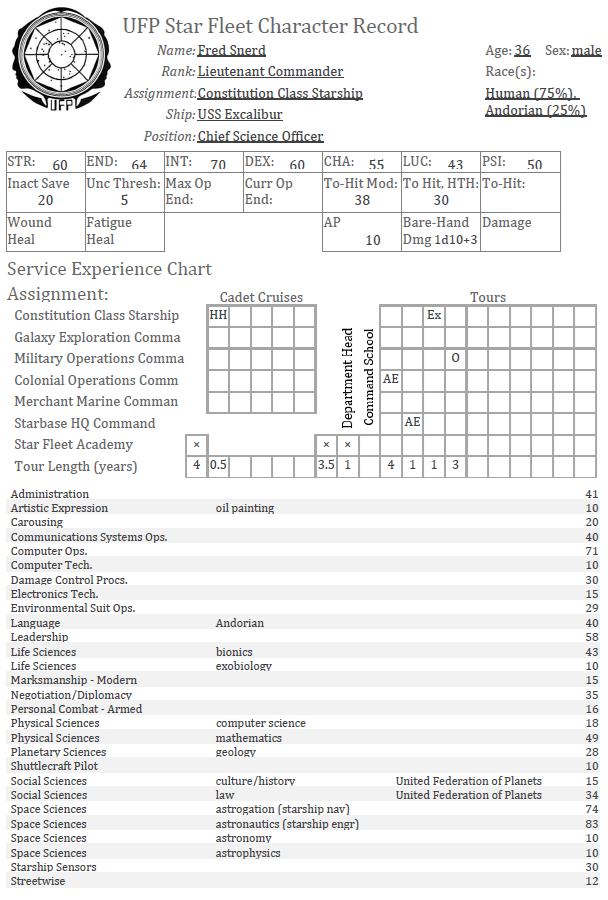
Anyway, since Saturday, I was inspired to start another character builder, this time for FASA ST (2nd edition). I already created and published a Gamemaster’s application to manage various aspects of a FASA ST campaign, but I never got around to putting a character builder into it. Because I didn’t want to relearn my old code, I left that GM’s application be and started a new one. I imported a lot of the underlying data, then started building. In just four days, I’ve made an incredible amount of progress considering three of those days were workdays. 🙂
Like with the Gamma World character builder, I offer you some screenshots. For those of you with at least a vague recollection of the game system, I offer commentary to explain what’s going on. Most of you might want to ignore that commentary.
In the first screen, you choose your heritages (called “race” in the game). The red arrow points out a house rule I created. Each race has a specific set of bonuses and penalties to certain abilities. For characters of mixed heritage, those bonuses and penalties are averaged. My house rule is that, much like me, a typical American mutt of European ancestry, I allow characters to have as many as four distinct lines. My primary lineages are Scottish, Irish, German, and Italian, with a little Dutch sprinkled into the first three. Your character can be Vulcan, Romulan, Klingon, and Human. Star Trek canon seems to contemplate a mixing of the races, so my game does as well.
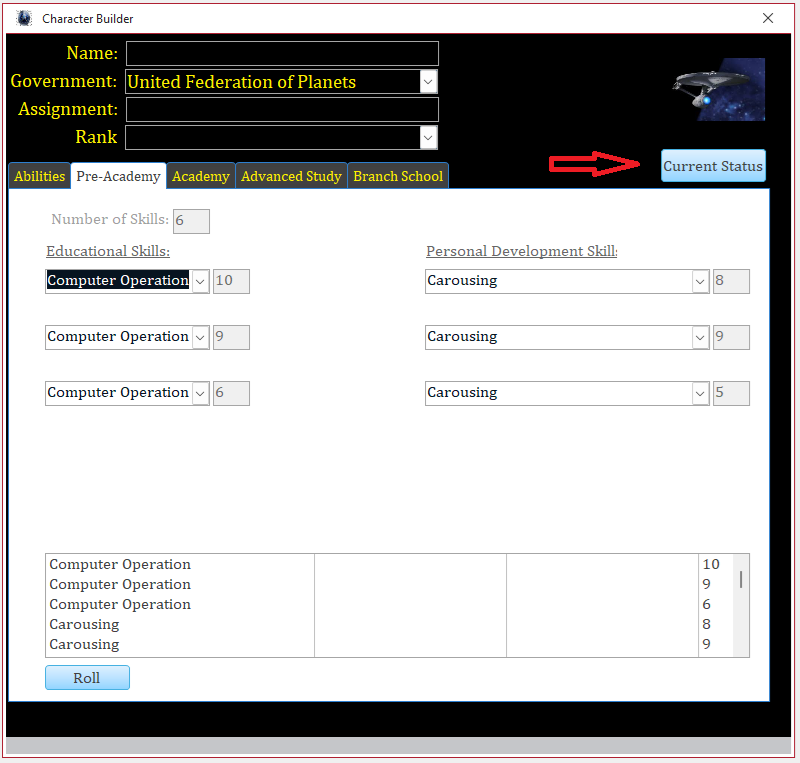
This next screen shows what you learned growing up. There are limited options, but they’re all useful for different types of characters. Another red arrow means something to point out. As you’re going through the character-building process, the same skills can be chosen multiple times to jack up a chosen specialty, but to make sure you can audit your work (and my software), I keep all the skill rolls separate. That creates a problem. In no event can a score exceed 99, but you might accidentally do so. In the end, I’ll force a cap of 99 on the final scores, but then you’re throwing away points you could have used elsewhere. Moreover, if you ever go backwards in the process, it erases everything that comes after it. It must because later steps are often dependent on the decisions you make in earlier steps. If your Computer Operation score gets too high, you may lose a lot of your work when you go back to fix it. The button at the top allows you to see your character’s current status (as far as points allocation) without taking the time to add up individual rolls. You’ll see a screen shot of this a little later in this post.
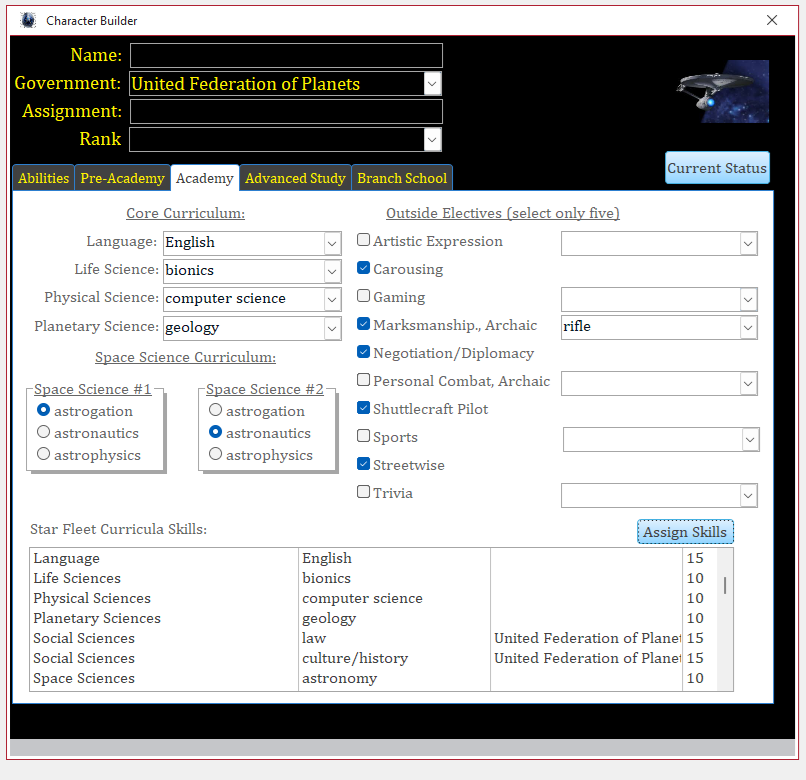
Nothing to discuss here. This is just the basic curriculum that all PCs learn at Star Fleet Academy.
This is also basic information you learn at Star Fleet Academy, but it couldn’t fit on the prior screen, so I gave it its own. Pay no attention to the fact that all the skills seem to be the same. I was running some testing.
Now you get to Branch School, which is where you start to really specialize. Navigators go to navigation school, medical professionals go to medical school, etc. Above, you see the helm Branch School, which is the simplest of all of them. There are no electives. You simply get what you see above.
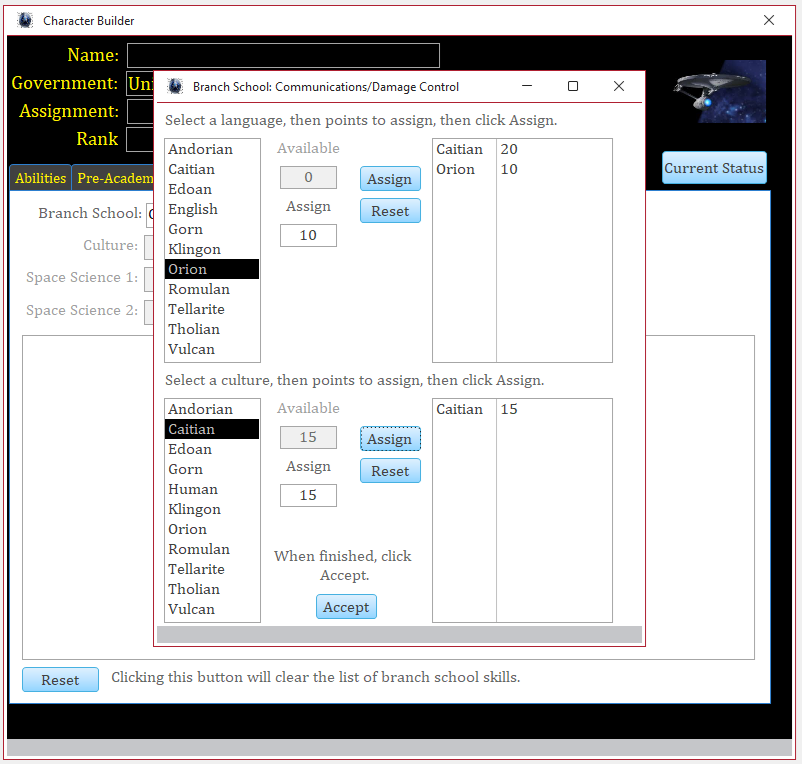
If, however, you choose any other school, you get a pop-up window that allows you make your elective choices. For communications, you get to spend 30 points in various languages any way you want, whether 30 points in one language or 3 points in ten languages. The rest of your skills are non-elective, so when you push the Accept button, it loads not only the choices you made here, but also the choices that are set by your choice of Branch School.
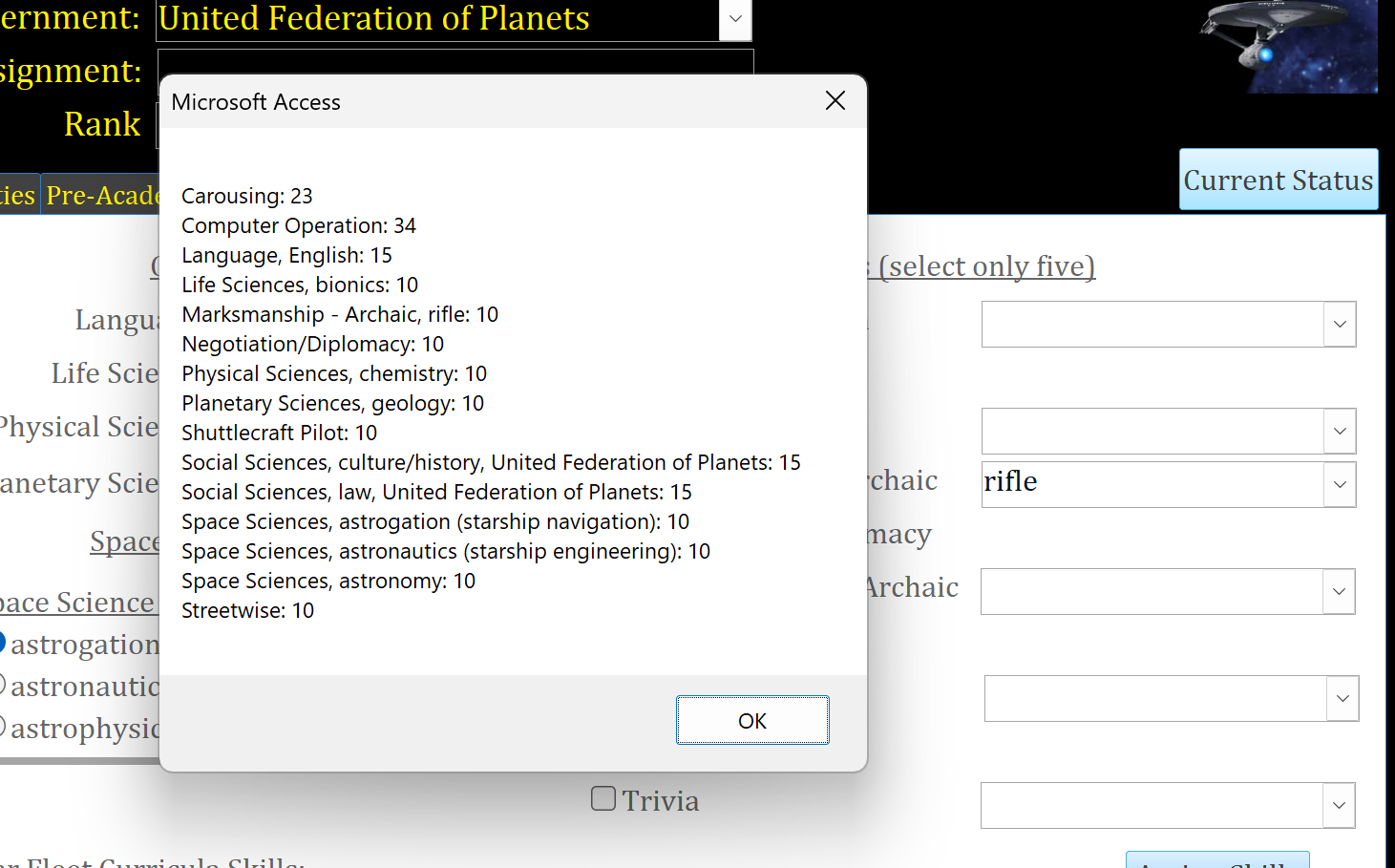
As promised, here’s what happens when you hit the Current Status button at the top right. You get an alphabetized and consolidated list of your skills so far. This image was taken for a different set of data than the others, so these numbers don’t correspond to what you saw in the images above. But this is, for example, all of your Carousing scores added together and listed just once. At this point, there’s no danger of wasting points by assigning scores above 99, but for the data in the prior images, I had a Carousing score of 115 just getting to this point. That’s why this exists.
That’s it for now. I’ve got only one more pop-up screen to create (Medical), and then it’s on to the characters’ past duty assignments on starships (or wherever they were assigned before the campaign begins).
Side Note: I’m Getting Better
The 1e character builder took years to create. I’m not relying on a technicality to say “years.” It’s more than just two. I think it’s been at least five years because I started it before I bought my current home in 2022. If you go through my posts, you might find and exact number, but I’m too lazy to figure it out. Even now, the damn thing has very little of a user interface, and I’m only part way through the Monster Manual II data entry. I haven’t even started Oriental Adventures or Deities and Demigods, and the latter would require some new data structure to implement. More importantly, because it was developed over years without any formal requirements analysis, it’s not put together very well. (Requirements analysis is important. Think about building a mutlistory building and halfway through the process being told it needed a basement.) Some of this can be explained by the fact that I included a campaign management tool, with the massive monster data entry that required. Moreover, I can blame this to some extent on the fact that it’s difficult to produce software for a game system that’s so convoluted.
Grognards are going to get angry with that statement, but it’s absolutely true. Every 1e rule is an exception to every other one. There’s no consistency at all. I’ve written extensively on how some of what’s in 1e should never have been abandoned by modern game designers. But be realistic. Taken as a whole, it’s exactly what you’d expect from a first-of-its-kind effort undertaken by a cobbler/insurance salesman. There was plenty of room for improvement. That doesn’t in any way condemn the efforts of the old gods of RPGs. We as a community owe them everything.
I was able to finish the Gamma World character builder in under three weeks. and it looks like I won’t even need that much time to finish this one (at least for the Federation PCs; Klingons and Romulans will take longer). I say all of this to make the point that I’m getting better as I relearn the skill of software development. In fact, I have an extra week of vacation time I’m taking in August, and I’ll be using that time to take a course towards C# certification. (C# is a programming language.) I may be able to launch these character builders via the web, opening them up to Mac users as well, though if that’s in my future, it’s a little ways off. There’s at least one more game for which I’d like to produce a character builder, and if the designer gives me his permission, a desktop application would be my next priority.
How Can I Get a Hold of This?
Gamma World should hit GitHub as soon as I figure that out. The FASA ST character builder will follow suit.
Maybe I’ll be known as the “Character Builder Guy.”
So, here’s a shitty memory. I had a rough childhood. I won’t go into detail except as relevant to this post, which is relatively tame, but still kind of sucks in a way that gaming nerds will relate.
As a victim of the Satanic Panic, I was forbidden from playing D&D in 1982. Two years later, as a high school sophomore, my cousin introduced me to Barbarian books store in Wheaton, MD (now Barbarian Comics). This is where he bought his comic books. That didn’t interest me at all, but the store also sold RPG material. I knew not to buy D&D materials, but as a high school student, I rebelled a bit and bought FASA Star Trek material. Needless to say, I kept it secret for as long as I could, because that’s still “the same thing” as far as my family was concerned.
I bought the 1st edition box set, the 2nd edition box set, numerous adventures, and a bunch accessories. The accessories included starship models that could be used with that game. Each cost $4.00 (plus tax), so if I bought fifteen of them, that was probably about two weeks pay. Considering I was forced to pay for private high school and college, that’s a fortune, but I can assure you I bought far more than 15 of them. I continued to buy material all the way until the first couple years of college. When my family eventually found my hidden materials, they were largely destroyed. I managed to hide most of my written material, but the starship models were a total loss, and a few accessories disappeared. For a high school/college student in the mid- to late-80s, these were expensive. They were all destroyed by my older brother, who enjoyed enforcing my mother’s prohibition against, well, virtually anything that made me happy, gaming or otherwise.
A couple of years ago, I replenished my entire catalogue of 1st Edition D&D (“1e“) material. There’s nothing I ever owned, or even ever wanted, that I don’t now own. I spent somewhere between $300 and $400, but that bought me more material than I could ever hope to run in the 21 years I statistically have left on this planet. I’m fortunate enough that I afford that. However, take a look at this bullshit. If you didn’t click through (or you’re reading this years after the eBay listing was removed), this is one of those $4.00 models that is selling for $40.00 plus $4.20 shipping. Here’s a screenshot for posterity.
This is an obscure, seldom used starship.
Imagine buying merely fifteen of these now. I’m not a math major, but that should be $633.00 just for materials that aren’t strictly necessary for the game. Buying them at these prices can’t be justified unless you’re truly wealthy.
I’m now running a 1e game for the first time in 40 years, so I’m in no position to complain. However, I’d really love to play FASA Star Trek again. Unfortunately, I know of only two local people that are interested in a in-person game, and one of them isn’t what I’d call “reliable.” (Note: I hate online gaming.) In short, there’s no chance of an in-person game, and certainly none in which I’m a player. That’s a tough pill to swallow, but I can live with that. I’m fortunate to be playing 1e. Moreover, I’m working on starting a 4th Edition D&D game, which also appeals to me. I have plenty going on, and will probably have more than I can handle soon enough.
But as an American, I’m spoiled and want more.
Follow me on Twitter @gsllc Follow me on Mastodon @gsllc
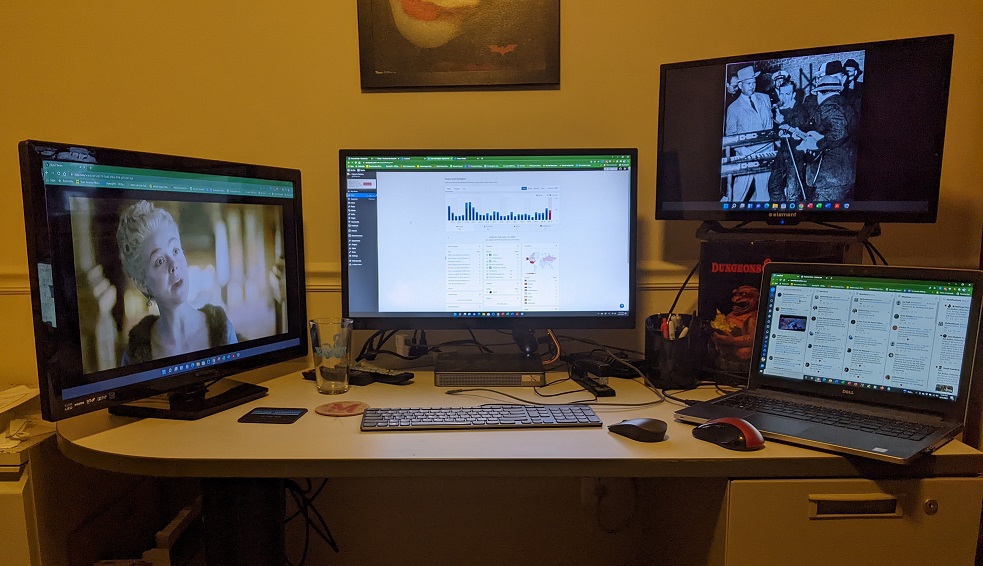
I told my coworkers that I was using one of the bedrooms in my new home into a den. They started calling it a mancave. Well, if this is a mancave, it’s the nerdiest one ever. I also can’t see it as a “cave” considering it’s on the second floor. It seems more like a man loft.
That doesn’t make any sense, does it?
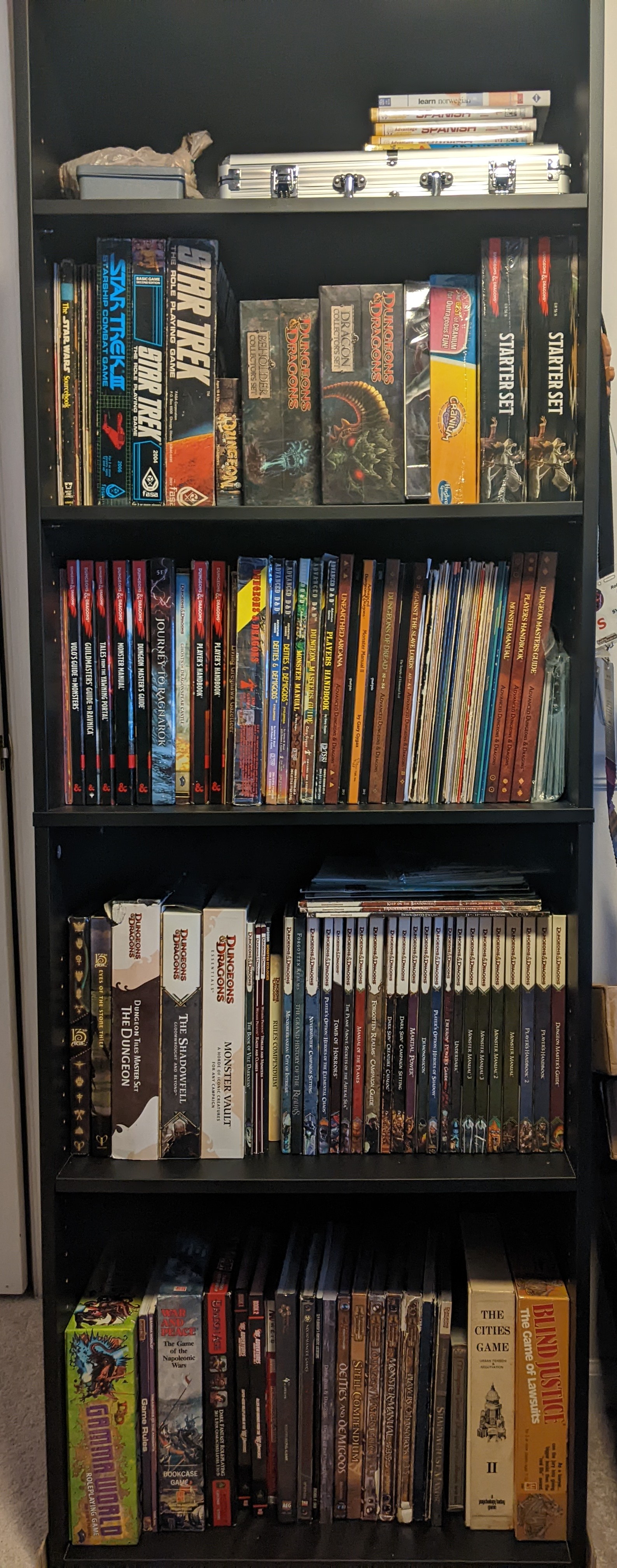
Last week, I bought a 6′ tall bookshelf that finally allowed me to unpack most of my gaming material. This weekend, I picked up a new desk, which again allows me to unpack office supplies and other things. The room is finally coming together, and I’m fairly well organized.
This den, mancave, or whatever you want to call it is oddly important to me. I’ve lived a rather simple lifestyle up to now. I’m used to a small place, and while this home isn’t what anyone would call large, it’s exceptionally large for me. In fact, it’s too large. It’s great that I have room for everything that I have and much of what I don’t have yet, but I spend 90% of my waking hours in this room. For lack of a better word, it feels cozy, and I’m jamming it with everything I want around me in my free time at home.
Do I have enough screens?
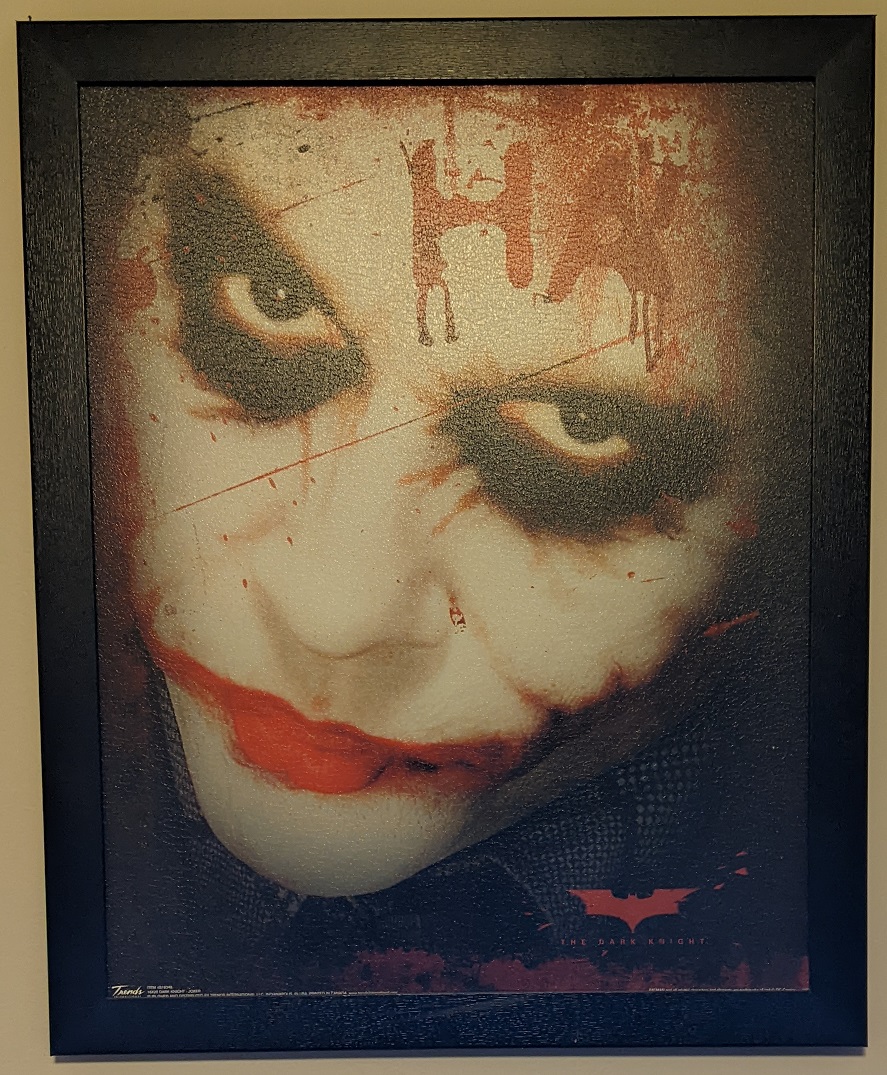
I have a lot of Jeff Dee originals to hang, but so far the only art on the walls is this guy over the desk.
Judging every one of my Google searches.
My cousin gave me a magazine rack. I asked, “What am I? 108 years old?” But I had just the use for it.
Though I may never read them again, I like having them.
Seriously. This is a mancave?
Almost one shelf per edition of D&D.
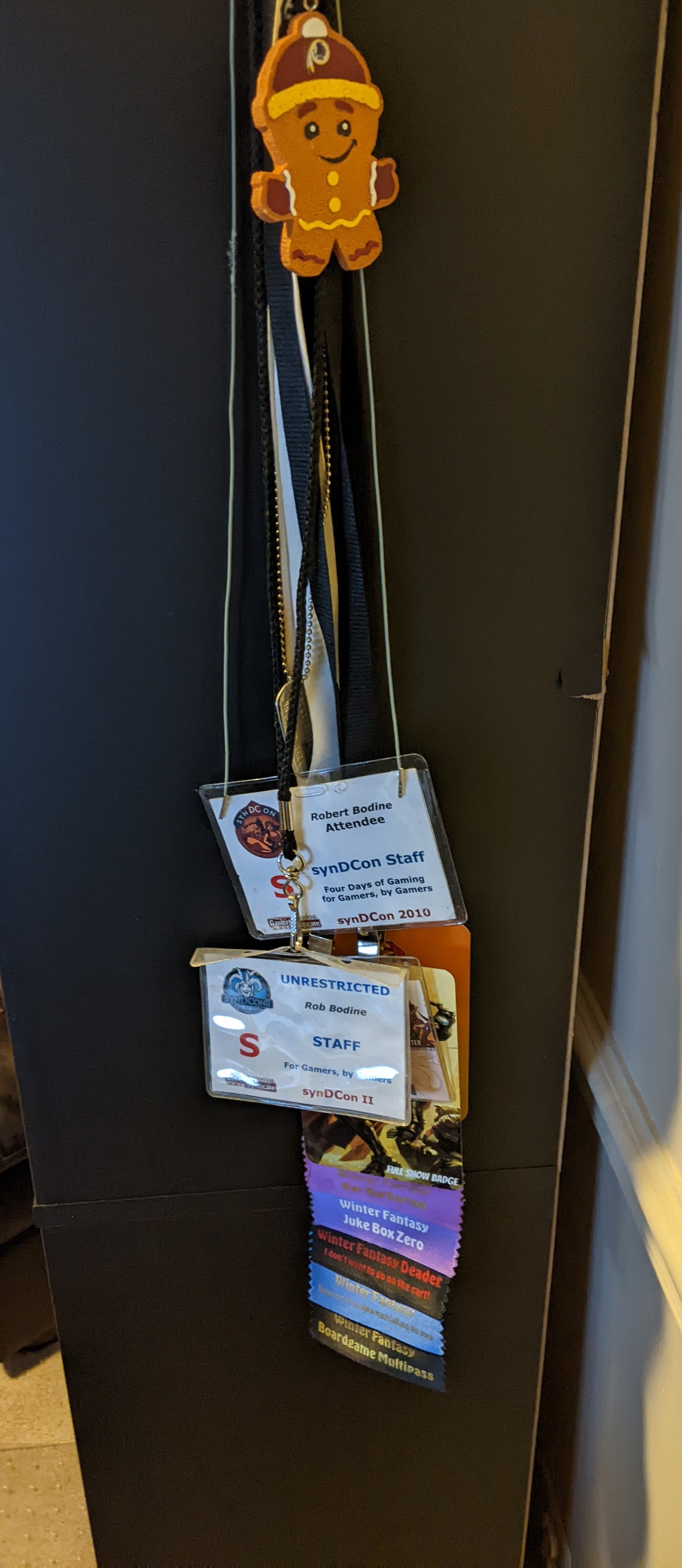
I have tons of other books not related to gaming, but the second bookshelf hasn’t even been put together. On the side of this bookshelf, I hung some memorabilia.
Okay, maybe it’s a mancave after all, but just barely.
The one thing that won’t fit are my musical instruments. I’m keeping them downstairs. That’s probably for the best. It’s a townhome, and the neighbors probably wouldn’t appreciate any noise being upstairs near their bedrooms.
Make no mistake about it: My keyboard playing is properly defined as “noise.”
Dungeons & Dragons is a trademark of Wizards of the Coast, LLC, who neither contributed to, nor endorsed, the contents of this post. (Okay, jackasses?)
On Friday (July 23, 2021), I mentioned that I was relearningAD&D 1st Edition (“1e“) with the intention of running it. As I read through the Player’s Handbook (“PHB“), certain mechanics or text will strike me as odd or surprising, but in either case worthy of discussion. In fact, the most surprising thing I’m experiencing is that I’m finding a lot more great ideas in 1e that we’ve since abandoned. I find myself asking, “Why?” As a result, I’ll be writing several posts over the next few weeks. I’m sure everything I’m thinking has been discussed before — sometimes be me — so perhaps my questions have been answered, and my concerns resolved, years ago. My experience with RPGs is relatively limited in scope, having played a small number of games, so I’m sure a lot of what I’m going to say has been incorporated into games I’ve never even heard of. (Some have certainly been addressed by future editions of D&D themselves.) Nevertheless, bringing this directed conversation to the public is new to me, so here it goes.
I don’t think this post will go over well with the professional game designers. Or the amateur ones. I’m being completely unreasonable, but professionals should always listen to their most demanding clients, right? Well, that’s me. I just want to play, and the quickest way to do that is to play a rules-light system. However, once I’ve got the hang of it, I want a rules-heavy system thorough enough not to leave itself open to conflicting interpretations.
I want my cake and to eat it too.
Why So Tense?
One of the tensions in game design is whether an RPG should be rules heavy or rules light. 1e is certainly rules heavy, at least when it comes to a combat system that micromanages so much. There’s a huge disadvantage to that: Learning such rules is a barrier to entry for new players. I get that point of view, especially when you have a system like 1e that requires you to jump from page to page, or even book to book, to get the complete rule (made easier by the hard work of David Prata mentioned in yesterday’s post on Initiative). Some game designers have tried to improve on this by simplifying processes, further abstracting how the system deals with the topic at hand. Well, I think it’s time for some reification.
Whiny Players
Here’s a grossly paraphrased conversation I’ve had since returning to D&D in 2005. In my experience, this is by no means an unusual conversation to have in this or other contexts.
Me (3-5 times while describing the scene): Are you sure you don’t want to do anything else? Table: Nope. Me (placing the minis on the table): Okay, you’re surprised. Table: How? We had a lookout. Me: I asked you several times if you had anything else to tell me, and you never mentioned it. Table: But we always have a lookout. We’re adventurers. We know to do that. Me: Well, they’re ambush predators. They know how to sneak. Table: Show me in the rules where we must be surprised in this instance. Me: The rules can’t possibly provide every example possible, so no such rule exists. Table: Then we can’t be surprised. Me: The very fact that surprise rules exist cuts against your argument. Table: You’re a terrible DM. You don’t know the rules.
Truthfully, I am a terrible DM, but this isn’t an example of that.
1e Combat
The 1e combat system is rules heavy. Yes, it’s spread out over different pages of the Players Handbook and the Dungeon Master’s Guide, but that’s a failure of execution, not concept. I’m discussing concept in this post, so let’s stay focused on that.
The system does two things that I absolutely love but haven’t appeared in D&D in some time. First, surprise is handled by a simple die roll in almost all combats. There are a few things that negate a poor roll, but in general, roll a 1 or 2 on a d6, and you’re surprised. Second, the distance between the parties at the precise moment of engagement is handled through a separate die roll. The rule takes into consideration practical matters such as line of sight, whether the encounter takes place in a 20’ x 20’ room or outdoors on a flat plane of low grass, etc., but no one can say that they were surprised because the DM didn’t properly set the scene or otherwise withheld important information, and they also can’t argue as to whether they were in striking distance at the moment they were surprised. The baseline is that these dice rolls govern, so the burden shifts to the players to point to something they expressly said they were doing, or circumstances of the scene, that justify ignoring or modifying those dice rolls.
So, should all RPGs be designed like this? Maybe not. A ruleset covering all the bases is going to be long and complicated, which can slow down the game even if you know the rules. Even worse, beginners will face a barrier to entry. They’ll take one look at David’s work and say, “Twenty pages? Nope. That’s too much to read just to get to sit down at the gaming table.” Is there some way to avoid that?
Beginning v. Advanced Systems
A possible solution to the problem of the barrier to entry is to go backwards. 1e published the Basic Set (followed by some others) that served this purpose, and it was reasonably compatible with the Advanced Dungeons & DragonsPHB and DMG (what I’ve been calling 1e). I never played this, but I seem to remember them having noticeable mechanical differences from 1e, which turned me off to it. This was probably arrogant because, believe it or not, when I first started playing “Blue Box” AD&D, we didn’t use ability scores at all. I don’t remember how that played out and can’t even guess how it worked, but I remember a conversation with a kid named Louis, who explained ability scores to me in 6th grade, which was two years after I started playing. The point is that you could abstract what you wanted, and once comfortable, drill down to a more complicated but well-defined system, but that was haphazard. Game designers should instead provide the roadmap by designing a combat system, then removing complexities from it in such a way that it maintains the balance between the two sides. What’s left is the “basic” system suitable for new players, existing players that prefer a rules-light system, or any player looking for an occasional quick and easy combat. Modern RPGs create alternate rules (e.g., methods for ability score generation), but that’s not the same thing.
A favorite RPG of mine, the FASA Star Trek RPG, did this quite well for starship combat. There was a basic subsystem and an advanced subsystem. The core mechanic was the same, with the base system dividing values by 3 (rounding down), but the advanced subsystem was more than just larger scalar values. It also introduced a more complicated means for bridge officers to affect combat. Not only did this eliminate a barrier to entry into the game, but I suspect that in order for this to work, the design methodology necessarily facilitated either subsystem being played as a board game. That opened the game to a lot of Star Trek fans who somehow thought RPGs were too nerdy. (I’m not kidding.) The rules were divided across five, short handbooks, all contained within the game’s box set.
There Are Still Concerns
Execution aside, publishing multiple subsystems, or even just one excessively complicated one, is not without its concerns. Players don’t want to purchase a nonnegligible amount of product just to move from one level of abstraction to the next. To allay this concern, the core rulebooks should disclose alternate subsystems even if an introductory box set exists. This leads to at least three other issues. The first issue is that game play could be slowed to a crawl if the rules get too complicated, even if you know exactly how they work. This could result in your advanced system almost never being used, making them a wasted effort. Ergo, there will still have to be trade-offs on that advanced system in order for it to have practical value. The second issue is that the core rulebooks could get too long if there are too many alternate subsystems across the entire game system. For both issues, game designers must pick their battles when deciding which rules to abstract/simplify. Perhaps that’s what’s raising my concerns here. Maybe they’ve picked their battles, and I just don’t like the ones they’ve picked, or maybe I don’t even perceive the battles they’ve won and therefore don’t appreciate them. I just know what gives me the most headaches as a DM and looking at all the PHBs and DMGs I’ve used, most have a little room to spare. Also, this is why I’m suggesting only two subsystems and only for combat, where one subsystem is just a compatible extension of the other.
For the record, the third issue, which for now I’ll call the Head of the Table writing method for now, will be discussed in a later post.
It’s All About Me
Let me know when I can stop apologizing.
Believe it or not, I know it’s a lot to ask of game designers to incorporate a second, simplified ruleset for combat, especially considering that my opinion may be a minority one. However, I suspect it would cut down on tension at the table, and designing in-game conflict resolution systems is the primary function of the game designer. Campaign settings are nice, but many people write their own. Not many write their own combat systems, and most can’t do that well. If any system is appropriate for division into a beginner and advanced system, it’s combat. So why not have your cake and eat it too? You could appeal to both the rules-light and rules-heavy crowds, broadening your customer base.
In general, I prefer a thorough system. Considering the conversation above, you can see why. Lightening the rules has led to a notion of DM empowerment in order to make the game playable, but it creates far more “us v. DM” tension than I enjoy at my table regardless of whether I’m behind the DM screen. The conversation above couldn’t occur often if we were playing 1e. I could point to the dice on the table, and that’d largely be the end of it. The biggest problem I’ve faced as a DM is the fact that many players don’t like to lose. By “lose,” I mean fail to solve a puzzle, miss a major piece of treasure, take a single hit point of damage, or get surprised. Just try to kill the average player’s character, and you’ll see how angry they can get. But the dice don’t lie. Thorough rules lead to predictable, and thus fair, results. Though it failed in clarity, 1e had the right idea. The FASA Star Trek RPG got it right. None of that would ever stop a DM from customizing those rules to suit their needs, especially if elements of the advanced subsystem were presented as attachable modules to the basic subsystem. I suspect multiple attachable modules would be harder to implement while maintaining balance, but 1e armor class adjustments, weapon speeds, and weapon lengths were effectively detachable rules that many people ignored, and the game was still playable. I’m looking for a well-defined subsystem that provides a clearer roadmap.
*sigh*
Hey, you chose game design as a career. You have no choice but to try to make me happy.
Yesterday I sent in my registration to TerpCon for my FASA Star Trek RPG adventure, “Intruders.” If you’re planning to be in the Washington, DC area on November 17, consider attending. It’s a free gaming convention held at my undergraduate alma mater, the University of Maryland at College Park. They’ll be a good array of RPG events there, but if you have any interest in an old-style, original series adventure, my event will certainly be of interest to you. The gaming schedule isn’t up yet, but you can already create a registration account and check out (or contribute to) the buzz over on their Facebook page.
I ran my other original adventure, Anything but Routine, at a past event, and Intruders involves the same ship and crew. Even if you can’t make TerpCon, you can find several other works published on my FASA Star Trek RPG Resources page and run your own adventures near where you live.
I’ve uploaded the first version of FASA Trek Digital, my Access 2007 database for the FASA Star Trek RPG. You can find it on my FASA Star Trek RPG Resources page (along with an explanation as to what exactly it is) by clicking here. I’ve never distributed an Access database, so if you’re having any problems opening it, let me know.
It’s an *.accde file (executable), so you might require the MS Access runtime application in order to run it. I haven’t packaged that with the program. I can do that if someone’s having trouble downloading the file, though you can also just download it yourself from the Access help database at http://www.microsoft.com/en-us/download/details.aspx?id=4438. It’s a quick download and installation, and once installed, it should work. (You should not need the Access Runtime Application if you already have Access 2007 installed on your PC.)
I’m happy with the functionality it provides, but remember that “you get what you pay for.” It could be a lot better, but unless I receive some support through (100% optional) PayPal donations, further development isn’t strictly guaranteed. Nevertheless, I’m planning to complete the player character generation component and am willing to entertain specific requests from all of you.
If you have any problems or uncover any bugs/defects, please contact me.
A friend had a birthday party yesterday, and although it was a board-game friendly event, I prepared a short, self-authored adventure for a game of FASA Star Trek RPG just in case anyone was interested in playing. The issue never even came up. Instead, I played 7 Wonders (came in a close 2nd my first time playing the game) and Circvs Maximus (my character was killed in a chariot race), but I digress . . . .
A Doomsday Like Any Other
By now any reader of this blog or my Loremaster blog should know that I’ve been revisiting the FASA Star Trek RPG recently, having run it once at TerpCon in College Park, MD. The adventure I ran, Anything but Routine, took place in the Outback area of the FASA Star Trek universe, which is where Federation space borders both Gorn and Romulan space. The Romulans were always my favorite Star Trek villain, and the Gorn were oddly underused. I remember once opining online that one of the later series or movies should revisit the Gorn as velociraptor-like enemies, perhaps representing a subspecies of Gorn. Again, I digress . . . .
For this adventure, I kept the same crew of the Chandley class Frigate, the USS Fife (lifted from the FASA adventure, A Doomsday Like Any Other). It was intended to be only two hours long in light of the fact that it was written for a board-game audience, but it can be fit rather nicely into the story I started with Anything but Routine, either before or after that adventure. In other words, I might have the start of an entire FASA Star Trek RPG campaign.
Now, if I can just find a table of players for it . . . .











 Play What You Want