Let's roll some dice, watch some movies, or generally just geek out. New posts at 6:30 pm ET but only if I have something to say. Menu at the top. gsllc@chirp.enworld.org on Mastodon and @gsllc on Twitter.
I returned to Dungeons and Dragons in 2005 after 23 years away due to the Satanic Panic, then starting a new career, then law school. When I came back, Living Greyhawk was my way in, and before you knew it, I was running gamedays all across the DC area, and even ran a convention, synDCon, for a couple of years. I went to my first Gen Con during those times, and like most of you went to plenty of smaller cons. As much as 3rd Edition Dungeons & Dragons (“3e“) turns me off now (which is a lot), I still enjoy thumbing through the books for nostalgia, and of course I’ve played it in somewhat recent history to connect with friends that remained with it. More importantly, whatever my criticism of the crunch, the flavor was as good as any edition.
Damn right.
Nothing demonstrated the disparity between crunch and flavor better than the Truenamer from Tome of Magic.
Prepare to vanish.
Because it’s primary abilities were based on skills (cool idea in theory, Rob Schwalb), the character’s power slowly diminished for three levels before it suddenly got a boost on the fourth that overcame that diminishment. Other players would be frustrated by the truenamer’s impotence. Eventually, that boost wouldn’t be enough, and the only way to keep pace was a single, specific, magic item, the Amulet of the Silver Tongue, that the DM had no choice but to give you (unless the DM hated you). No one else could make use of it. Unfortunately, there were only two versions of that item (i.e., lesser and greater), so after 12th(?) level, the character never could keep pace with the rest of the party’s power curve. Sure, a DM could just create a “superior” version of the Amulet of the Silver Tongue, but considering two more were were necessary to keep the character relevant through 20th level, they should have been included.
But I’ll be damned if that class didn’t have the greatest built-in flavor of any class I’ve played. The class used spooky words of power known as utterances to rearrange reality to suit its needs. At the highest level, there was an utterance, Unname, that could erase a creature from existence. It did so by warping reality and removing the creature’s truename from existence. Neither resurrection nor reincarnation could bring them back. It cost a ton more than that, which was a cost far more than anyone would ever want to pay. Bringing a class like this into other editions should have been a priority. It’s just too damn cool.
Rob Schwalb is one of the best writers in the industry. He had a really cool idea, but the system was convoluted that breaking away from the standard led to disaster. In this case, the disaster was an underpowered class. But enough with this digression.
In preparation for starting a new 1st Edition (“1e“) campaign a few years ago, I replenished my RPG stash, but not just 1e. There were quite a few books I wanted to get back from my 3e days, and with a little help from my friends, I did. These included the Book of Exalted Deeds, Deities & Demigods, the Fiendish Codex: Tyrant of the Nine Hells; and Drow of the Underdark:
Everything else I wanted I already had, but that was still a lot for a game I don’t play. Why? Flavor. I loved what the Fiendish Codexes did. I loved expanding on the Drow even though it has since been done to death. And I became a Dungeons & Dragons fan because I was a mythology nut, not the other way around. Without leaning in so heavily to mythology, I’d have never been interested in it.
Whatever its strengths and weaknesses, 3e will always hold a special place in my heart.
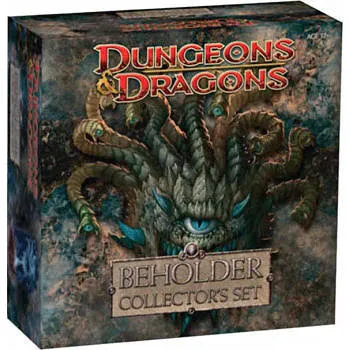
Last Saturday (February 1, 2025), to give myself some practice running 4th edition Dungeons & Dragons using the Masterplan software, I ran a couple of my synDClash delves. TL;DR: They were written for my convention, synDCon, as competitive, 4th edition delves. Five players playing one pre-generated character each goes through three combats, and whichever group of five players goes the farthest is the winner. My friend, Dusty, won, but I never got the prize to him (i.e., the set of five beholder mins). If I ever see him again, it’s his. But I digress . . . .
I think this is the one. I mention it only because my shame is my penance.
Each of the delves was based on classic 1st edition adventure module (what I always called a “mod,” which has strangely generated some grief on the internet). Why did I based them on 1e mods? Because I’m old. The mods were based on B2: The Keep on the Borderlands (easy), C2: The Ghost Tower of Inverness (moderate), G1-2-3: Against the Giants (moderate), D1-2-3: The Drow Series (difficult), S3: Expedition to the Barrier Peaks (difficult), and Q1: Queen of the Demonweb Pits (impossibly difficult). I converted those delves into Masterplan project files, which can be found on my D&D 4e Resources page along with the pre-generated characters.
How It Went
In short, it went tremendously well. Everyone had a blast, and the software was smooth almost all the time. There were only two downsides. First, 4e is inherently slow, and despite delves being relatively fast, this particular group really likes to have side conversations. This meant that we got through only two: Return to the Borderlands (based on B2) and The Great Metal Dungeon (based on S3). Second, there was a clear error in my math for skill checks during the second encounter of The Great Metal Dungeon, which resulted in an unfair TPK. (Revisions have already been made but not yet uploaded.) The delve is labeled as “difficult,” but I assure you that those numbers were still unfair.
You know what I’m talking about.
But what this means is that there are still four more (plus perhaps a retry of The Great Metal Dungeon) available for my group to play during weekends on which we can’t get a quorum for our regular gaming.
New Delves?
Over on BlueSky, someone posted an image of his four copies of the original versions of C2: The Hidden Shrine of Tomoachan. That triggered a thought inside my soft human brain. If we get through these delves, I’m going to write at least two more based on Tomoachan and S2: White Plume Mountain. I don’t think there are any other mods that, though iconic, have much special meaning to me. Even Keep on the Borderlands didn’t, but I needed an easy one, I knew it was special to a lot of people, and I knew what the three best encounters to use would be. Perhaps I’ll convert S1: Tomb of Horrors as well considering that Wizards of the Coast already converted it to 4e, though that one would be hard to run as a delve. If so, for obvious reasons, I’d have to make it as impossibly difficult as The Demonweb Pits was. If I convert them, I’ll post the to my D&D 4e Resources page as Masterplan files.
My thoughts on Gary Con will be brief. I doubt I’ll return. This isn’t a criticism of the con anymore than a non-football fan not liking a football game is a criticism of how good of a job the NFL is doing. It’s simply something that doesn’t appeal to me. I know a few industry insiders — two were my roommates — which means I’m within a degree of separation of almost all of the legacy ones. For me, the highlight of the trip was talking about the past, present, and future of the industry with Stephen Radney-MacFarland, James Lowder, and Dave Christ. The direct topic is interesting to me, but even more, this conversation inevitability leads to a back-and-forth on intellectual property law (usually copyrights). So, yeah; I’m in for that. Other highlights are conversations with Stephen and Jason Dandy (a non-industry friend) and with Jason and his friend, Mark, on sociopolitical issues. These guys think very differently than I do on most issues, but we engage in a form of constructive dialogue that’s very rare today. I even discussed abortion and Citizen’s United with no fear of generating anger from any of them.
But I can do all of that over Zoom. I don’t need to spend hundreds of dollars on airfare, lodging, a convention badge, and grossly overpriced convention food to have these conversations. One could say the same thing about Winter Fantasy, but that’s a different animal. Just eyeballing it, I’d say I know about 50% of the people that attend, and when I’m not hanging out with them, I’m relaxing. It’s a genuinely relaxing vacation. The food is good, and the whole trip is just an awesome ritual. While Gary Con could become the same thing for me, I don’t need two of them. Winter Fantasy is enough.
YMMV
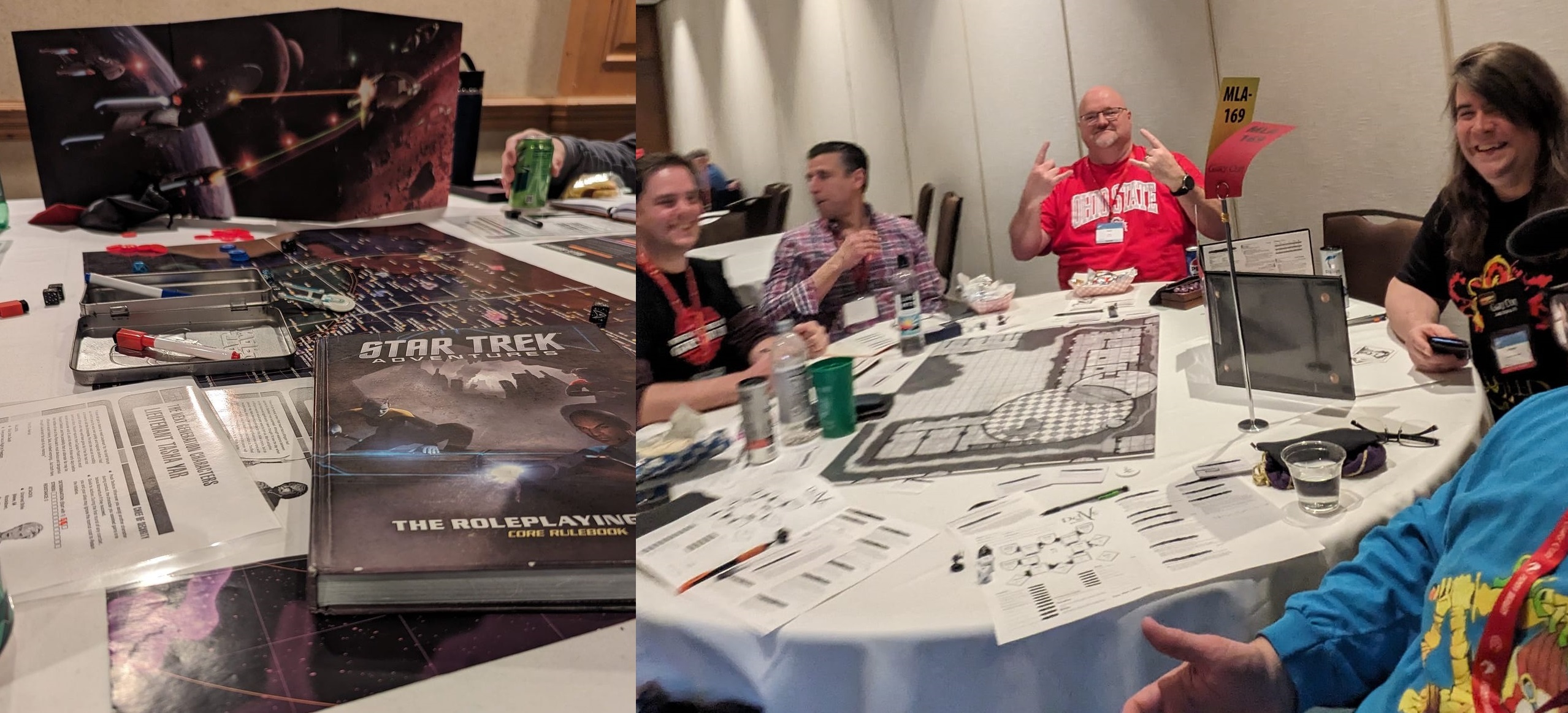
I hope it’s clear that I’m not saying I didn’t have a good time, and it’s certainly not to say that you wouldn’t. It’s a small-ish con, which is what I like about Winter Fantasy. I went with a mission to get to play (as opposed to DM) 1st Edition AD&D, and I played in three such games. I actually got to play the Dragon #56 bard in two of them. How many people can say they’ve done that? I got to play Stephen’s Delve game that uses a few mechanics that Vic and I added to our 4th Edition D&D game (e.g., “gang-up”), so I liked that. I got to finally make use of my Star Trek Adventures purchase by playing that game (granted, mere months before it’s rendered somewhat obsolete by its second edition). The only objective criticism I have is that there were too many tables in the rooms, which made it very difficult to hear your own DM/GM/judge, and I’m not alone in expressing that concern.
I saw only one celebrity (Pat Kilbane formerly of MadTV, with whom I spoke briefly), but I wasn’t looking for them. If that’s your thing, you may run into them for a selfie. The con was fairly easy to navigate, and I had no administrative difficulties at all.
All of this was good, but now that I’ve been there and done that, there’s no need to go back. I’m quite happy to have left Saturday so that I have all day Sunday to recover, and I return with added appreciation for both Winter Fantasy and my home gaming group. I don’t need this to be a regular thing, or even a sporadic thing, but if you’re a gamer, especially with an appreciation for its history, this is as good a con as any to attend.
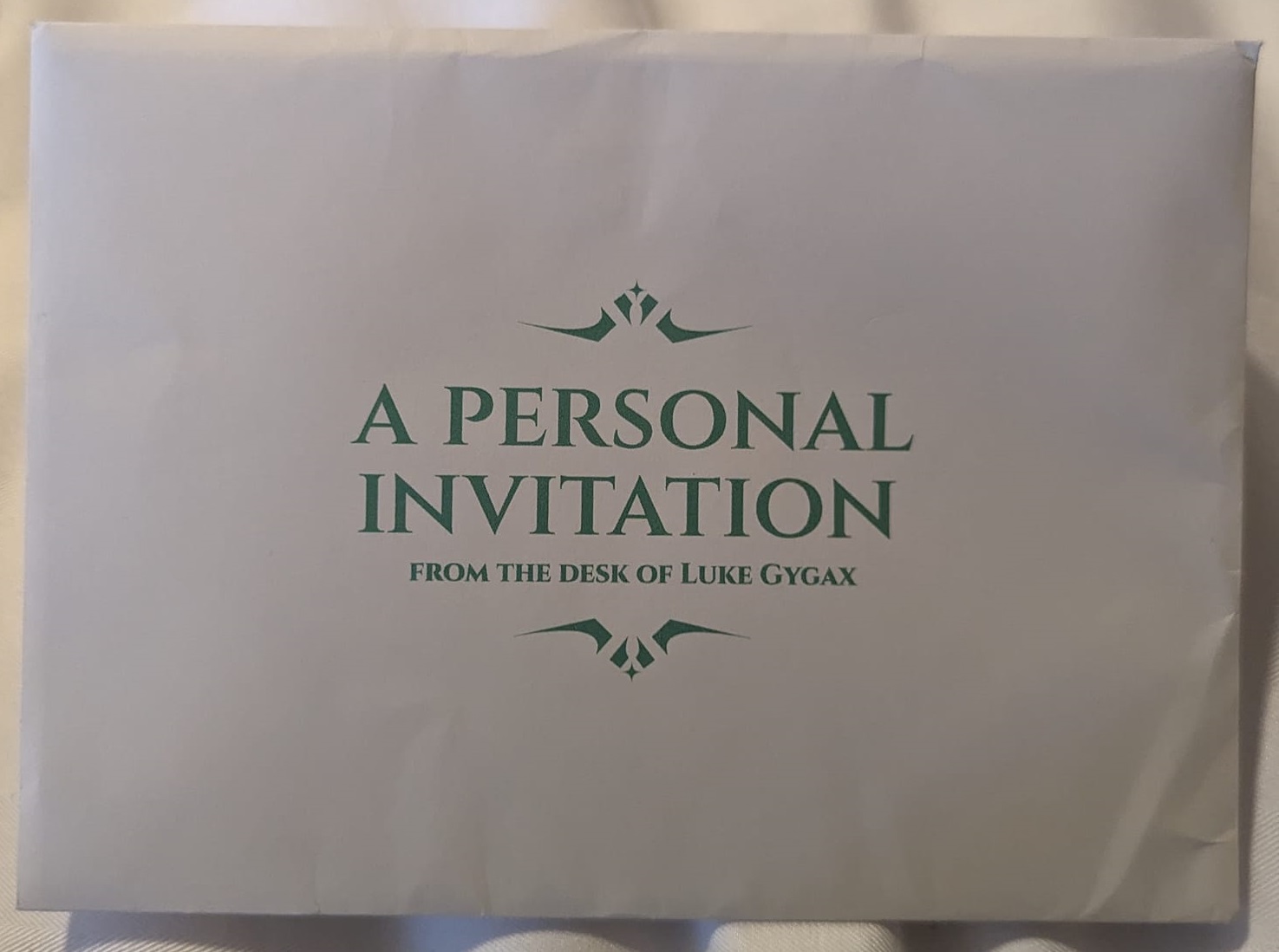
Just expect to be inundated with some silliness. Every attendee got one of these.
When I started running 1st Edition D&D again two years ago (first time in 40 years), I gathered and took an inventory of my 1st Edition material, and then went on a spending spree. Then I went on another. About a year ago, I somehow made a purchase that blew my mind. It’s a mint condition (you read that right) Wilderness Survival Guide by Kim Mohan but signed by James Ward. It was such an unbelievable haul that I had to contact James, before I even received it, to make sure the signature was legit. James verified his signature for me. (I’m sure many of you have even better stories of James, but that’s mine.)
Shortly thereafter, Kim died. Yesterday, the community lost James. I didn’t know James, but he shaped my childhood. Of note, I didn’t study mythology because I played 1st Edition; I played 1st Edition because I was already a mythology buff, and that drew me to the game. You can imagine how much I loved Deities & Demigods when I was a kid. When I returned to D&D after 23 years away, it was for the tail end of 3.5 Edition, and despite that edition’s Deities & Demigods being even less useful than the original, it was still my favorite book. He also wrote the “zeroth” edition D&D sourcebook Gods, Demi-Gods & Heroes (which I never used), and the TTRPG Metamorphosis Alpha (which I played once). That’s just to name a couple.
James is just the latest entry in a long list of TTRPG gaming legends we’ve lost, but as I didn’t know any of them personally, everything they’ve ever meant to me will exist for me as long as I do. No one can take that from me. But last month, I lost yet another family member in a long list of ones that meant a lot to me, so I get that I’m not the one grieving today. There’s a piece missing from each of their family members and friends, and I get the impression James had many. It’s hard to find a picture of the guy by himself. He seems always to be hanging out with someone, shaking hands, etc.
My condolences to all who’ve lost something so significant yesterday.
My return to 1st Edition AD&D (“1e“) is now two years strong, and now I’ve added a 4th Edition D&D (“4e“) game to my schedule. So, it was a nice surprise for my friend, Mike, to let me know that he was offloading his old school D&D material. Before you get too excited, he’s giving these materials only to people he knows well because we’re getting them on the honor system. The only cost is to make a (tax deductible) donation to a cat or dog charity that represents the approximate cost to buy them in the store or on eBay. Considering I’m going to get a cat in early April, that’s an easy ask of me.
So, what did I get? First up, the box sets and hard-covers.
Menzoberranzan box set, Star Frontiers Alpha Dawn box set, Greyhawk Adventures, Dragon Lance Adventures, the Scarlet Brotherhood, a reprint of the Second Edition Player’s Handbook, Oriental Adventures, and Dragon #56
In general, I never owned any of these in the day, and I bought the PDF of Oriental Adventures from the DMs Guild during my recent rebuy because the hard cover wasn’t on sale. I’m glad I now have a hard cover without paying through the nose for it. I’ve been intrigued by Star Frontiers based on the relatively recent chatter it’s generated — the less I say about that chatter, the better — so I picked it up out of curiosity. As for Dragon #56, I told Mike I wasn’t interested in any of the magazines except perhaps the one that has the 1e bard in it, redone as a character you can play at 1st level. Sure enough, he had that issue. Score!
Next up, some soft covers.
I was planning to buy the Book of Lairs and Book of Lairs II, so that makes this supplement all the sweeter. I never owned any of these materials either. Now for the minis.
Yeah, that’s quite the haul, ain’t it. Of particular interest . . .
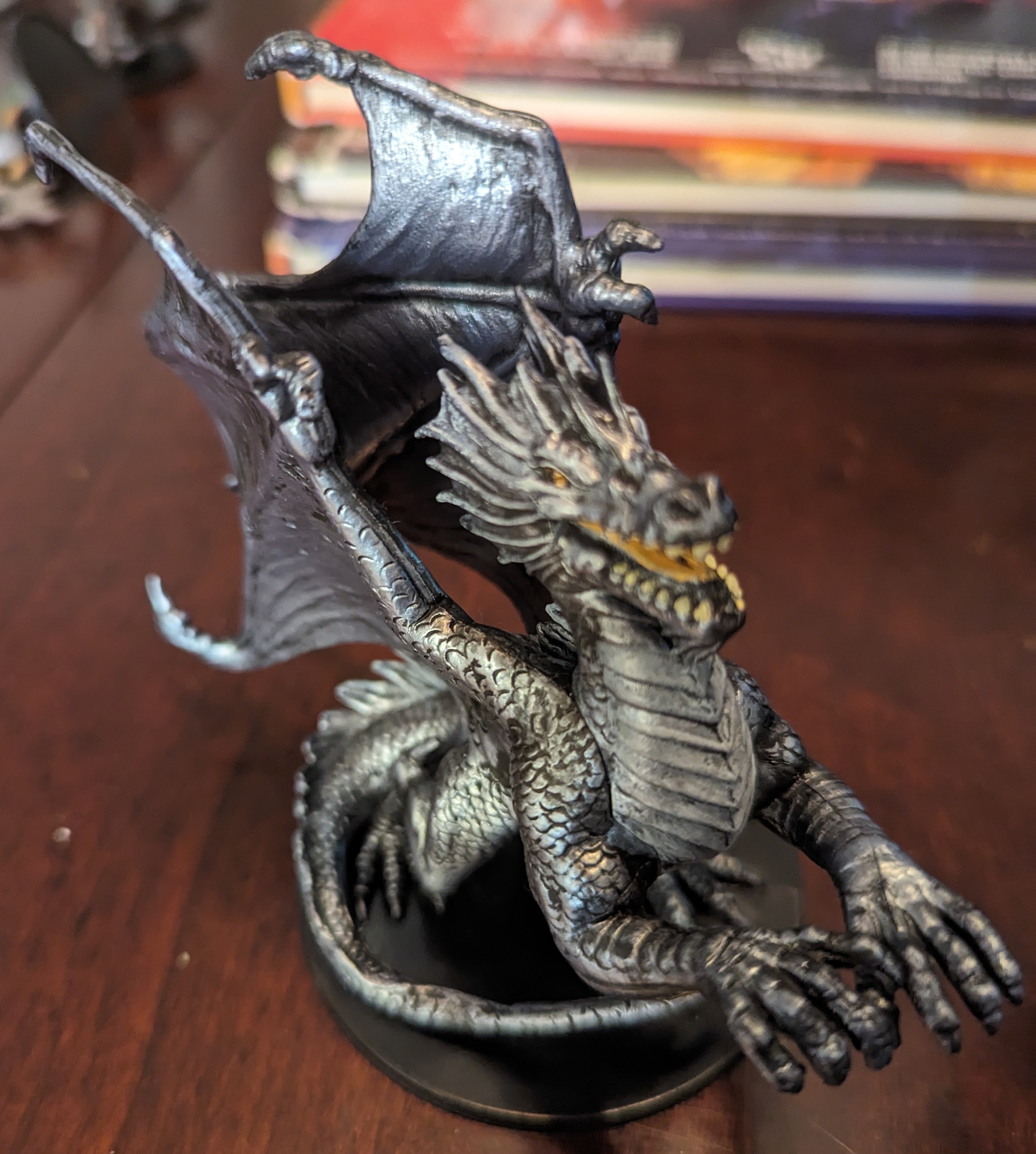
I never owned this guy. In fact, I never knew it existed, and I was quite the mini collector during the 3rd Edition D&D and 4e days. Somehow this one escaped me. Right now, the cheapest I see it on sale is $20 + about $6 shipping, so this one will set me back a bit.
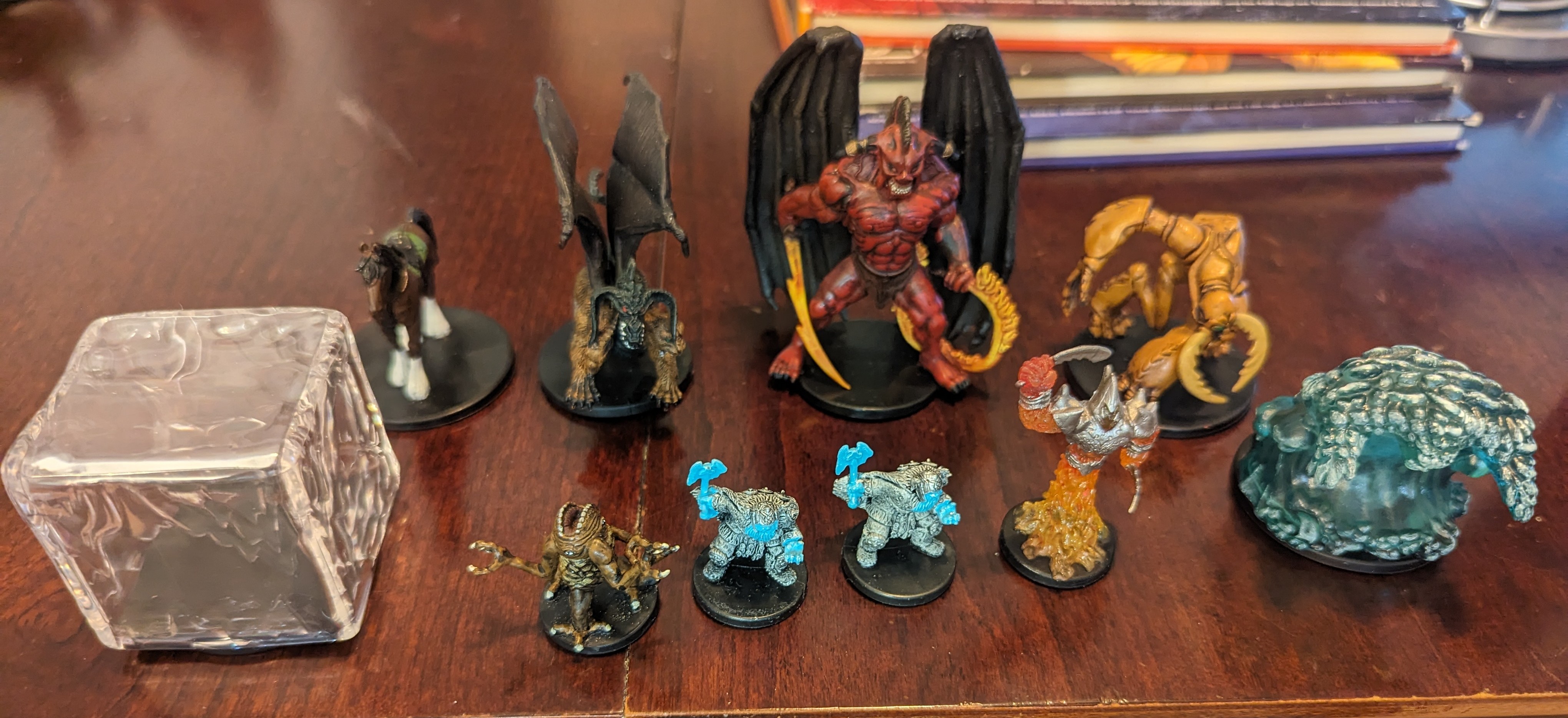
These are just a few of the minis that I’ve never owned.
These are a few of the minis that I own but could always use more of. My players may not appreciate multiple Balors on the field of battle, but them’s the breaks.
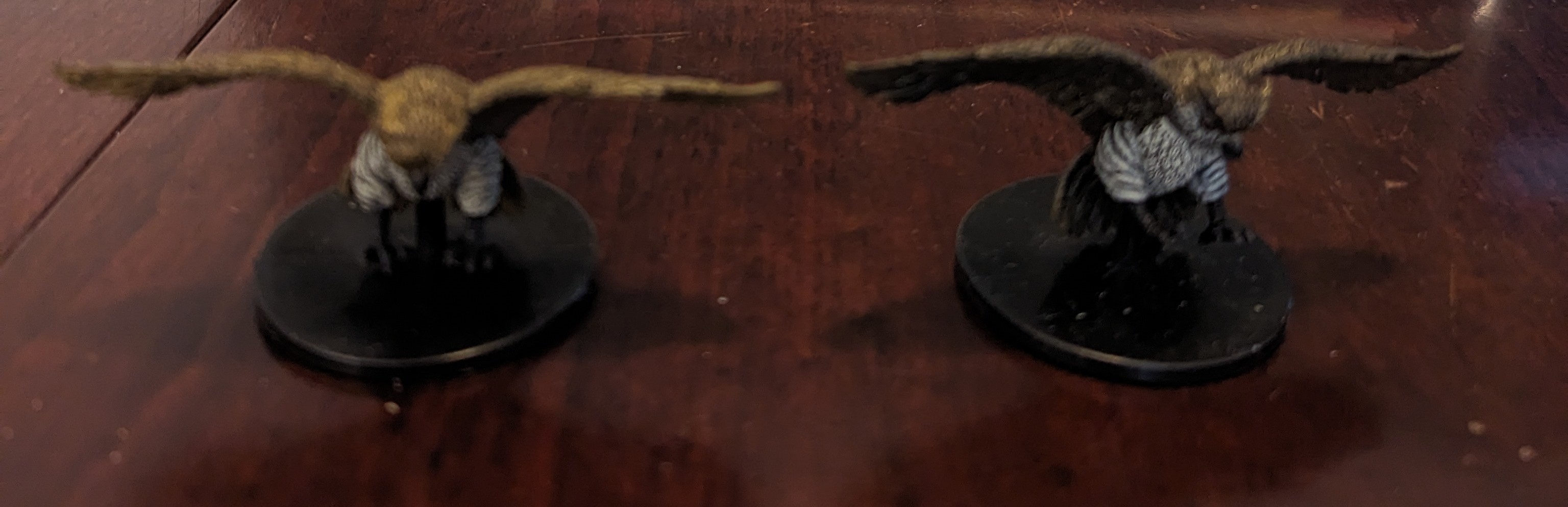
One of my Living Forgotten Realms characters had a giant owl, so I was a bit disturbed when the stand for that mini broke. No amount of crazy glue could fix it. Now, I’ve replaced it. I think I took the second one out of some sort of cosmic spite.
Importantly, I have every intention of using these goodies in my 1e and 4e games, so this is quite the haul.
Some animal shelter is going to be very happy very soon.
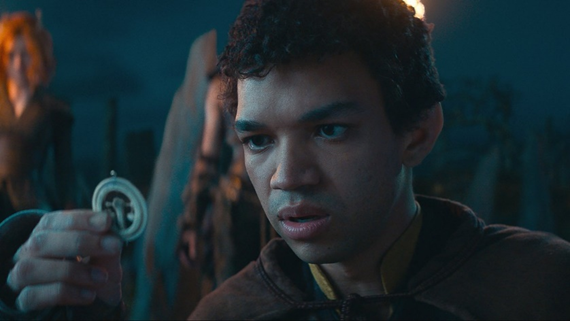
Timing is apparently not my strong suit. A few days ago, someone mentioned how much they loved the graveyard scene in the Dungeons & Dragons: Honor Among Thieves. Watch the scene here before it disappears.
I wasn’t as big a fan of the scene. Sure, it was funny, but it exemplifies the difference between legacy and modern gamers. Okay, I mean old people and young people. Whatever. As D&D players, we all want this movie to emulate the game, so our different approaches to the game affect our reactions to the movie or individual scenes. In the old days, failure was a thing in RPGs. If a magic user (that’s a wizard for the young’uns) wanted to learn a new spell, the player rolled percentile dice with a target number dependent on the character’s intelligence. If the roll failed, the wizard not only didn’t learn the spell, but could never learn it. Ever. That’s failure. The dice giveth, and the dice taketh away.
Nowadays, failure has fallen out of favor, granted to different degrees depending on the individual. Today, if a player were told that they could never learn the fireball spell, they’d be furious. If they couldn’t deduce a password from a riddle, it’s possible they’d quit your game. As I’ve discussed before (see the section, Another Example: The Puzzle Encounter), I once had players get angry at me because they couldn’t solve a puzzle trap, and as a result, the trap went off doing zero (0) points of damage to them.
Yeah, you read that right, but read it again if you don’t think you did.
Play whatever game you want — that’s the name of this blog — but I find this approach boring. I don’t try to solve easy sudoku puzzles; I go for the hard ones. I want the chance of failure because that’s how I improve. But even from a purely entertainment perspective, what’s the point of rolling the dice or even showing up to the game if you know the outcome? The players should instead tell the DM how they want the session to go, and the DM respond, “Sure, that’s what happened. Congratulations. You won D&D. Now get out of here and play some miniature golf or something.” Where’s the excitement in that? I really don’t get it, and it’s why I’m not involved in organized play anymore. Most tables just hand the players the victories.
This is not to say that I enjoy the notion of a character dying during character creation as in Traveler. There should be a chance of success, and the chances should tilt in favor of the players, but when the players don’t start enjoying my game until I remove all the challenge from it, I think the pendulum has swung too far in the other direction.
Nowadays, players don’t accept near enough failure in their games for them to be of interest to me, and the graveyard scene demonstrates this point. The point of the scene was to do something funny, and it succeeded, at least at first. I have no problem with that. However, after they failed, they simply tried again. And again. And again. The resource allowing them to speak with the dead was apparently unlimited, which means they couldn’t fail. Not only did that remove all consequences, and thus appear non-heroic, but it also detracted from the joke itself. Repeating a joke too many times is one way to ruin it. Why is the screw up funny if this is an unlimited trial-and-error.
The resource.
I would have written the scene in one of two alternative ways, and this is how my game would play out. First, they fail, so they have to be clever and come up with a different way to learn the information they need. Because this is a movie, that may not work. The movie could get really long, and no one really wants to watch a movie about people studying at a library. Second, they fail, but they get only one more bite at the apple. This time, they plan it out, come up with the five questions, assign one person to ask them, and everyone else shuts their annoying mouths (that’s another issue altogether).
That’s funny and heroic because the characters still had to rise to the occasion. But I really don’t think people want true heroes anymore, which is also demonstrated by this scene. They want to see idiots . . . .
. . . like him . . .
. . . win the day despite having none of the tools, including the personality and strength of character, to succeed. The only reason he succeeds is because the script says so. There’s nothing about him, even in a world of magic and monsters, that justifies his success logically. Even within that world, he’s a screw up, but he suddenly succeeds, because the screenwriters know that’s what the modern gamer wants to see, and they’re the foundation of the audience for this movie. After his success, he returns to being the same idiot that shouldn’t have succeeded in the first place. He didn’t improve; he was just handed success by the writers. This reminds me of another example.
None of us are perfect; some of us just can’t handle being reminded of that.
A while back, I told you I was preparing for a return to 1st Edition AD&D, and to do so, I had to update my stash of 1st Edition Dungeons & Dragons (“1e“) materials. Fast forward a couple of years. I’ve been running a 1e game for the first time in 40 years, and the only addition I had to make to my stash was the Egg of the Phoenix. Now, I’m less than 24 hours away from hosting a 4th Edition (“4e“) game (alternating DM duties with Luddite Vic), finally finishing my unfinished business, but I already have all the 4e stuff I could even need.
On a related note . . . .
Even though I can no longer stand 3rd Edition (“3e“), there were some books that were fantastic that I wish I had never sold. Serpentine Owl, who’ll be playing in the upcoming 4e game, gave me the reprint of Deities & Demigods (in perfect condition with the 3.5e conversion in the back); Erik (who left Twitter/X) gave me Hordes of the Abyss and Tyrants of the Nine Hells (both also in perfect condition); and then Jason (on Twitter/X but doesn’t appear to use it) gave me the Book of Vile Darkness (in pretty good condition). If I had gone through eBay, I would have paid almost as much for those four books as I did for all the 1e reprints I bought combined, but I got them all free.
If you click through the Book of Vile Darkness link, you won’t be able to view it without logging in and removing filters for adult content.
<gears turning>
So, after mulling it over, I realized, “The universe has provided so much in this regard, I think I can justify doing something stupid, especially something that isn’t too stupid.” I went to eBay and purchased the mediocre-at-best Book of Exalted Deeds just to have a match to the Book of Vile Darkness. I don’t know if I’ll ever use the material, but it’s nice to have that matched set, and I didn’t have to pay anywhere near USD$100 to get it. Now, I think my stash is complete, but who knows what I’ll be writing in a year?
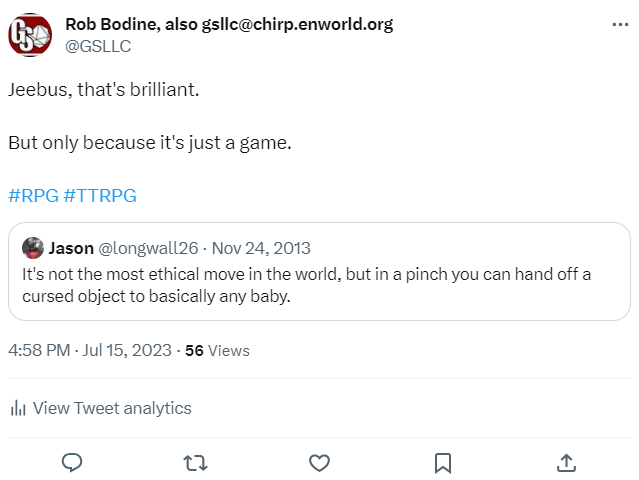
— Rob Bodine, also gsllc@chirp.enworld.org (@GSLLC) July 15, 2023
Screenshot below in case either tweet is ever deleted.
I shared a screenshot of Jason’s tweet to other social media, including Facebook, and most who responded agreed that it was funny, sometimes rolling with the joke and adding more. Sure enough, I found the one rotten apple in the bunch.
It went on further, but why burden you with that?
I guess “girls” need to avoid this guy, because he just refuses to have fun. The funny thing is, Mike was one of the people that reacted to the post with a laughter emoji. Go figure.
As promised yesterday, here’s a funny story from my only other Origins trip in 2009.
Something I didn’t mention in the video: I remember clearly that the swag I received for working the convention included the newly released Eberron Player’s Guide for 4th Edition Dungeons & Dragons. It wasn’t a complete stretch to think that Keith would have been there, but sitting down at a Living Forgotten Realms table to play an ordinary game was a bit of a stretch.
I saw Keith Baker hanging out with Luke Gygax at a bar at Origins last weekend, but I wasn’t going to interrupt them with this story about a guy he didn’t know (Steve) being told by another guy (me) he didn’t know for an incident in which he played no part.









 Play What You Want