
If you enjoy this post, please retweet it (Twitter/X), boost it (Mastodon), repost it (MeWe), or repost it (BlueSky).
I returned to Dungeons and Dragons in 2005 after 23 years away due to the Satanic Panic, then starting a new career, then law school. When I came back, Living Greyhawk was my way in, and before you knew it, I was running gamedays all across the DC area, and even ran a convention, synDCon, for a couple of years. I went to my first Gen Con during those times, and like most of you went to plenty of smaller cons. As much as 3rd Edition Dungeons & Dragons (“3e“) turns me off now (which is a lot), I still enjoy thumbing through the books for nostalgia, and of course I’ve played it in somewhat recent history to connect with friends that remained with it. More importantly, whatever my criticism of the crunch, the flavor was as good as any edition.

Nothing demonstrated the disparity between crunch and flavor better than the Truenamer from Tome of Magic.
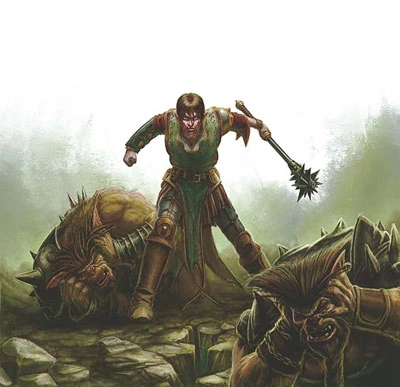
Because it’s primary abilities were based on skills (cool idea in theory, Rob Schwalb), the character’s power slowly diminished for three levels before it suddenly got a boost on the fourth that overcame that diminishment. Other players would be frustrated by the truenamer’s impotence. Eventually, that boost wouldn’t be enough, and the only way to keep pace was a single, specific, magic item, the Amulet of the Silver Tongue, that the DM had no choice but to give you (unless the DM hated you). No one else could make use of it. Unfortunately, there were only two versions of that item (i.e., lesser and greater), so after 12th(?) level, the character never could keep pace with the rest of the party’s power curve. Sure, a DM could just create a “superior” version of the Amulet of the Silver Tongue, but considering two more were were necessary to keep the character relevant through 20th level, they should have been included.
But I’ll be damned if that class didn’t have the greatest built-in flavor of any class I’ve played. The class used spooky words of power known as utterances to rearrange reality to suit its needs. At the highest level, there was an utterance, Unname, that could erase a creature from existence. It did so by warping reality and removing the creature’s truename from existence. Neither resurrection nor reincarnation could bring them back. It cost a ton more than that, which was a cost far more than anyone would ever want to pay. Bringing a class like this into other editions should have been a priority. It’s just too damn cool.
Rob Schwalb is one of the best writers in the industry. He had a really cool idea, but the system was convoluted that breaking away from the standard led to disaster. In this case, the disaster was an underpowered class. But enough with this digression.
In preparation for starting a new 1st Edition (“1e“) campaign a few years ago, I replenished my RPG stash, but not just 1e. There were quite a few books I wanted to get back from my 3e days, and with a little help from my friends, I did. These included the Book of Exalted Deeds, Deities & Demigods, the Fiendish Codex: Tyrant of the Nine Hells; and Drow of the Underdark:
Everything else I wanted I already had, but that was still a lot for a game I don’t play. Why? Flavor. I loved what the Fiendish Codexes did. I loved expanding on the Drow even though it has since been done to death. And I became a Dungeons & Dragons fan because I was a mythology nut, not the other way around. Without leaning in so heavily to mythology, I’d have never been interested in it.
Whatever its strengths and weaknesses, 3e will always hold a special place in my heart.
Follow me on Twitter/X @gsllc
Follow me on Mastadon chirp.enworld.org/@gsllc
Follow me on MeWe robertbodine.52
Follow me on Blue Sky @robbodine









 Play What You Want