Another Blast from the Past: Print Issues of Dragon and Dungeon Magazines #ADnD #DnD #3e #4e #RPG 

If you enjoy this post, please retweet it.

Last week, I mentioned that, during my move, I found the hard copies of my Dungeon Delves from synDCon. Well, I also found some print issues of Dragon and Dungeon magazines. Any mechanics or setting-based discussed in the magazines is for 3rd Edition D&D (“3e“), which I no longer enjoy playing, but much of the material is system agnostic. It’s still good stuff.

As I’ve said in many other contexts, I left D&D in 1982 due to the Satanic Panic, dabbled a bit in the Star Trek RPG in high school and college, then finally returned to D&D and a small amount of other RPGs in 2005. Because of my age, my awareness, my family’s restrictions, and logistics, I didn’t subscribe to Dragon and Dungeon until 2005 or 2006. It was fantastic. As someone still trying to get a feel for writing and running my own gaming material, I loved the advice and rules explanations that magazine offered. Unfortunately, shortly after I started subscribing, the rug was pulled out. They announced that they were moving the magazines online, and shortly thereafter, 4th Edition D&D (“4e“) was announced at GenCon 2007. The last issues of each were dated for September, 2007.

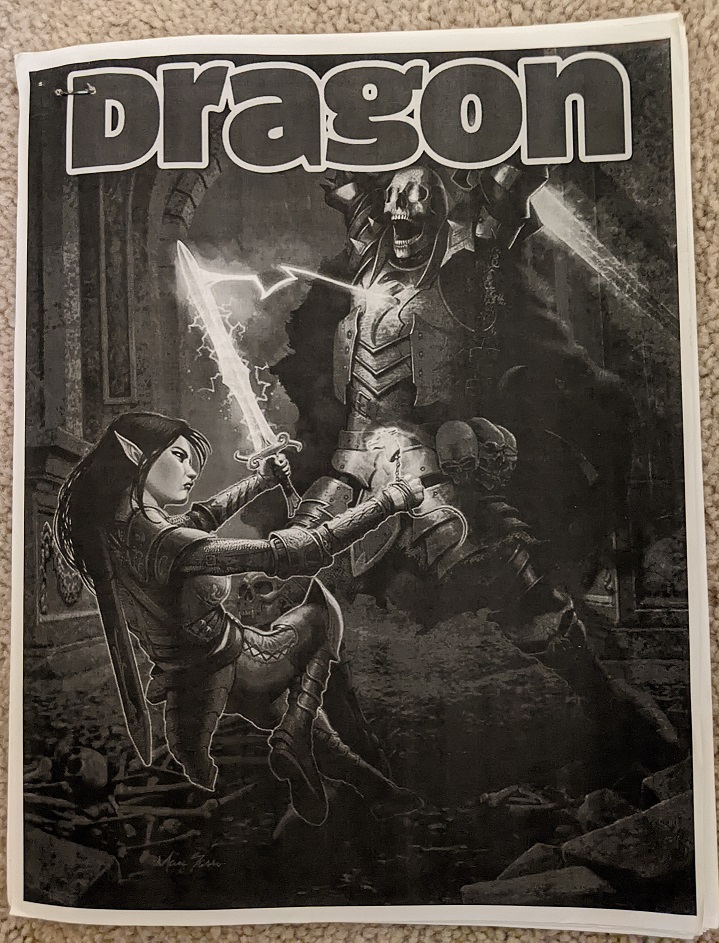
I wasn’t a fan of the online magazines. I wanted to find a color magazine in my Delaware post office box twice a month, but the reality of our world took over, and I eventually started receiving them online with my DDO subscription. How much did I prefer print? I printed out several of the PDFs, but in black and white. It wasn’t the same, and the ink costs were too high despite not being in color, so that practice didn’t last.

I think this was the first online issue.

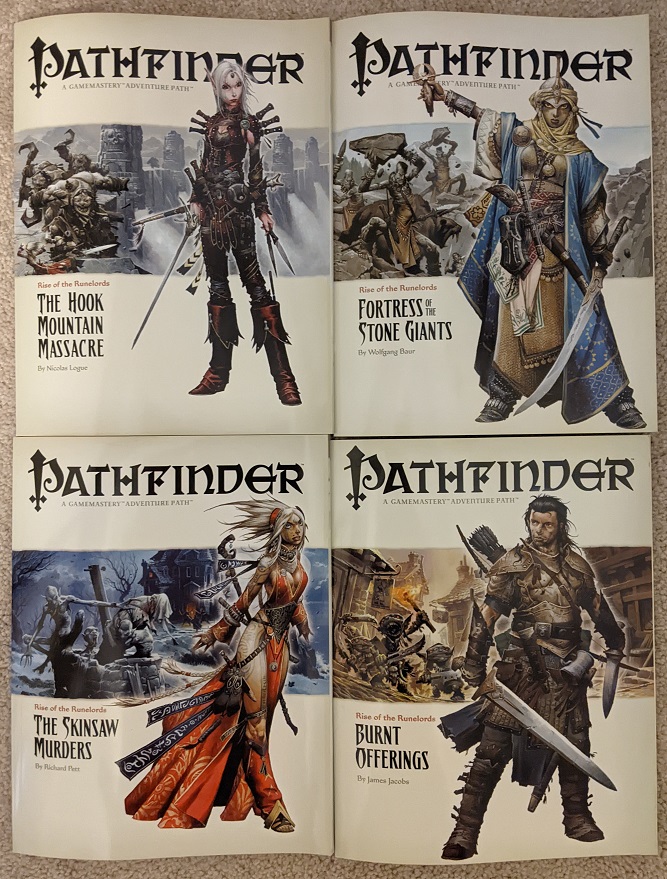
Because I appreciated Paizo for publishing them, I gave them a chance by continuing to subscribe to their Pathfinder adventure path books. I recall telling them that in response to their sales pitch they delivered via email.

You can buy these here, but they seem to have new covers.

Sadly (for Paizo), they weren’t for me, so I never used the material. Honestly, I always found their style of artwork better suited for children (especially the goblin), and, as I said above, I also knew that I wouldn’t be staying behind for 3e due to my participation in organized play. In hindsight, that wouldn’t have been a barrier due to the introduction of Pathfinder Society, but I would have abandoned Pathfinder anyway. I greatly prefer 4e, so I’m happy with my decision. Still, I’m happy Paizo enjoyed success, even though that success created a misconception as to how 4e fared, and that people were able to continuing playing an improved system they enjoyed.

My recent revisiting of 1st Edition D&D has me asking questions, and many people have pointed me to old editions of Polyhedron, Dragon, and Dungeon magazines. Apparently, these were a valuable resource long before I subscribed.

I’m old school, so I want those magazines, but I completely understand why I can’t have them.

Follow me on Twitter @gsllc

Dungeons & Dragons is a trademark of Wizards of the Coast, LLC, who neither contributed to nor endorsed the contents of this post. (Okay, jackasses?)

The Other D&D: Deities and Demigods @SerpentineOwl @Luddite_Vic #ADnD #DnD #RPG #MythologyMonday #MythologyMonandæg #folklore

If you enjoy this post, please retweet it.

Every now and then, someone posts to a D&D group asking how everyone used Deities & Demigods in your games. The question almost always refers to 1st Edition D&D (“1e”). I suspect the reason for that is 1) many people that used it as kids so (like me) their answers will depend on how long ago they played; and 2) later editions of D&D overtly incorporated combat with divine creatures, or their avatars, for epic level adventurers. I’ve also played 3rd Edition D&D (“3e”), 4th Edition D&D (“4e”), and 5th Edition D&D (“5e”), so I’m going to address all of them.

Yes, there’s a clear pattern in my abbreviations, but this is how lawyers write.

1e

As a kid, I loved reading mythology before I had even heard of D&D. Mythology is what drew me in, so of course I was going to use Deities and Demigods anyway I could. I remember during my earliest days (1977 or 1978), I created a list of 100 (or so) magic items from that sourcebook (e.g., Thor’s hammer, Enlil’s helm), and each PC was permitted to roll a d100 to determine their starting magic weapon. Yes, a 7th-level level character could wield Zeus’s Aegis. As an adult, this sounds stupid, but there’s no wrong way to play D&D, right? We had fun with it.

Hiatus

I stopped playing D&D in 1982 due to the Satanic Panic, so no 2nd Edition or 3rd Edition D&D for me.

3.5e

I returned to the game of D&D in 2005, and 3.5e was the current edition. I never played or ran epic level for 3.5e, so that edition’s Deities and Demigods was nothing more than reading material. I sold off almost all my 3e materials when 4e came out, but when I repurchased some for posterity, I made sure to grab that one (actually, it was gifted to me by James). I love that book, but what stood out the most to me about it was the transition to Horus as the supreme leader of the Egyptian pantheon. Like the real world, leadership switched. But I never used it in game.

Side Note: I really wish I’d never sold Hordes of the Abyss or Tyrants of the Nine Hells. They’re great resources valuable in any edition, but buying them now would be a horrible waste of money.

4e

There was no 4e Deities and Demigods. Divine creatures, or their avatars (DM’s choice as to which), appeared throughout various monster manuals, and they were designed as encounters for epic level creatures. Basically, Wizards of the Coast (“WotC”) surrendered to the notion that a lot of us wanted to face the divine, and it became part of the game. How the monster was interpreted – the actual creature or just an avatar – was a matter for the DM to decide, but they were there. Well, a few of them. I don’t recall WotC publishing gods beyond their own proprietary pantheons. I believe you had to go to third parties for that material, and sometimes it wasn’t right on point (e.g., Soldiers of Fortune had a Thor equivalent, but he wasn’t called “Thor”).

Going Backwards

Now that I’m going backwards, I must decide how to deal with divine creatures. They aren’t baked into the scheme like they are with 4e. In fact, as some have pointed out, it really should be impossible for PCs to compete against the divine on their home plane, which is the only place where they can finally be defeated. Once you leave the Prime Material Plane, many spells don’t work or are severely weakened. The environment itself works against the PCs but is home sweet home for divine creatures. There’s no upper limit to class levels for PCs, so eventually PCs should be able to fight the divine within the rules, but who’s going to level up to level 1,000? No one, and isn’t advancement through adventuring the real fun of the game? I’m not just going to say, “Okay, you’re all 1,000th level. Let’s go fight some gods.” I’m also not going to rewrite the rules in some odd way to make divine encounters more practical. It’s assumed that DMs will tweak the rules a bit, but eventually that reaches a point where we aren’t playing D&D anymore. That doesn’t interest me.

Of course, I don’t have to make my decision anytime soon. In fact, I may never have to make it. Once I sit down at the table, I may lose interest in 1e quickly. We’ll see.

Shameless Plug

This isn’t much of a plug, but here it goes. Luddite Vic and I are designing our own RPG. It’ll never see the commercial light of day because we don’t meet frequently enough to get it done. However, the system so far is, unsurprisingly, exactly what I want from an RPG. One of our design schemes relevant here is to make sure that PCs can emulate characters from mythology, folklore, or literature even at first level. I’ve never seen that in an RPG.

For example, how might one emulate Thor in 5e? One less-than-ideal option would be a hammer-wielding human tempest cleric, but that cleric would barely be distinguishable from any other cleric build until 3rd level, and even then, it’s going to take a while before it’s obvious to other players what you’re trying to do. You could just tell them, but if you need to do that, you’re not really playing Thor yet. What about Tarzan? How long would a half-naked, dagger-wielding barbarian last in a game of 5e?

In our system, everyone would know from the get-go exactly what you were doing with your lightning/thunder-based, hammer-wielding, human tempest, or a half-naked, dagger-wielding barbarian, even though those characters wouldn’t be any more or less powerful than any other 1st-level characters. That’s the real solution, but I know of no other game that does that. One game was mentioned to me where the PCs are the gods, but from what I understand, they don’t start as anything resembling 1st-level for other RPGs. That’s not bad, but it’s not the same thing. I want to start as first level with that character concept and earn divinity.

That’s how I’d prefer to “use Deities and Demigods.” I shouldn’t need to. I should be able to make the PCs and NPCs exactly what I need them to be. But in 1e, they’re just avatars.

Maybe someday Vic and I will finish our game.

Follow me on Twitter @gsllc
Follow James @SerpentineOwl
Follow Luddite Vic @Luddite_Vic

Dungeons & Dragons is a trademark of Wizards of the Coast, LLC, who neither contributed to nor endorsed the contents of this post. (Okay, jackasses?)


Musings on Game Design and Revisiting AD&D 1st Edition: Campaign Settings and Pantheons @Luddite_Vic #DnD #RPG #ADnD #MythologyMonday #MythologyMonandæg

If you enjoy this post, please retweet it.

Introduction to Each Post in This Series

On Friday (July 23, 2021), I mentioned that I was relearning AD&D 1st Edition (“1e“) with the intention of running it. As I read through the Player’s Handbook (“PHB“), certain mechanics or text will strike me as odd or surprising, but in either case worthy of discussion. In fact, the most surprising thing I’m experiencing is that I’m finding a lot more great ideas in 1e that we’ve since abandoned. I find myself asking, “Why?” As a result, I’ll be writing several posts over the next few weeks. I’m sure everything I’m thinking has been discussed before — sometimes be me — so perhaps my questions have been answered, and my concerns resolved, years ago. My experience with RPGs is relatively limited in scope, having played a small number of games, so I’m sure a lot of what I’m going to say has been incorporated into games I’ve never even heard of. (Some have certainly been addressed by future editions of D&D themselves.) Nevertheless, bringing this directed conversation to the public is new to me, so here it goes.

Posts in this series: | My Playlist | Campaign Settings and Pantheons | Languages | Level | “Dead Levels” | Division of Labor, Distance, and Time | Initiative | Combat Subsystems | Armor Class Ratings | Alignment and Reputation | The Feel of a School of Magic | Boring Magic Items | Ability Score Bonuses and Skill Rolls | The Problem with Democracies | Hitting More Frequently | Encounter Balance and Shooting Yourselves in the Feet |

As with my prior post, this post was written yesterday (7/25). That makes it the eighth post I’ve written in the series. It’s out of order because Mondays are for mythology, and writing something relevant to both topics is easy. So, here comes session 0.5.

A friend (Vic) and I are designing an RPG system. Our design sessions are months apart, so don’t expect this system to ever see the commercial light of day. It’s a fun exercise, so if nothing ever comes of it, I won’t feel I’ve wasted my time. As I was doing my homework on the campaign setting, a memory came to mind. In the original 1e Deities & Demigods, the chief god of the Egyptian pantheon was Ra. By 3rd Edition, it was Re-Horakhty (f/k/a, Horus). This switch mirrors the real-world switch of ancient Egypt. What we call the Egyptian empire lasted almost 3,000 years, and during those 30 centuries different dynasties held control. These dynasties were devoted to different temples, so as the dynasties rose and fell, so did the influence of the temples. Thus, the god seen as chief among the pantheon changed.

A Controversial Opinion?

As broad a view as that is, let’s go even broader and tie this to campaign setting design. First, I want to say that I believe campaign settings should be system agnostic, and game systems should be campaign setting agnostic. That is, if I want to run a campaign in the Forgotten Realms using Dragon Age RPG‘s AGE system, there’s no reason I can’t do it. Maybe I need to do a little tweaking to run Legend of the Five Rings using the Savage Worlds system, but if I can’t, the fault is on the system. Systems can and should be flexible enough to accommodate whatever story elements are needed. GMs, or at least the game designers themselves, could write a patch that addresses the needs of another setting. 1e is open-ended enough that you might think it was suited to this task, but I’m not certain that’s true. In any event, this opinion may or may not be well-received by game designers, but that’s not the point of this post; it’s just stated to give you context for my point.

A Long, Long Time Ago . . . .

Going back to my design efforts, I thought, “What if players wanted to play my game in a low-magic setting? That would certainly work in a more primitive campaign setting.” If we were inclined to create such a setting, why start from scratch? Why not just take the high-magic setting and make it more primitive? For example, the gods of the moon, sun, and sky would be the same god in a simplified pantheon. Not only would this save us a lot of work, but one setting would represent the natural evolution of the previous one, as that hypothetical god would be split into three different gods as mortals became more civilized and sophisticated. Oddly enough, that sounds like science, which branches out into an ever-increasing number of specialties the more we learn.

But wait! There’s more! A gold mine in a “wild west” setting could uncover archeological sites tied to the fantasy setting that came before it. The same could be said of a World War II setting where an occult-obsessed dictator could be looking for artifacts of great power. Depending on what type of game a DM wants to run, those artifacts could be nothing more than trinkets, or they could actually hold some form of supernatural or scientifically advanced power. Also consider that even in a high-fantasy setting, traveling the “astral plane” can take a character to space. The same setting could be adapted for the far future for a campaign resembling either Star Wars or Star Trek, and similar connections could be made.

What I’m saying is that all the campaign settings could exist as part of the same planet and universe in general. In a sense, it’s an ambitious plan, but in another sense, future efforts would be made easier by taking advantage of the ones that came before them. A large gaming company could easily do that, even one like WotC that’s already established. I suspect many people assume Theros, Faerun, and other planets all exist in the same universe, and the gods just have different names from planet to planet. In fact, I once read (can’t currently prove) that the Olman people from Greyhawk weren’t “like Aztecs,” but rather were Aztecs. Earth and Oerth were linked for some time by an interdimensional portal, so they were the same people. This might have been a fan theory, but clearly these connections are easy to make.

In an ideal world in which Vic or I win the lottery, maybe we’d commit to our efforts full time. If we did, this is definitely an idea I’d want to pursue.

Have any game designers connected campaign settings in this way?

Follow me on Twitter @gsllc
Follow Vic @Luddite_Vic

If you’re on Twitter, please consider voting in my two Twitter polls.


Dungeons & Dragons is a trademark of Wizards of the Coast, LLC, who neither contributed to nor endorsed the contents of this post. (Okay, jackasses?)
Musings on Game Design and Revisiting AD&D 1st Edition: My AD&D Playlist #DnD #RPG #ADnD #music

If you enjoy this post, please retweet it.

Introduction to Each Post in This Series

On Friday (July 23, 2021), I mentioned that I was relearning AD&D 1st Edition (“1e“) with the intention of running it. As I read through the Player’s Handbook (“PHB“), certain mechanics or text will strike me as odd or surprising, but in either case worthy of discussion. In fact, the most surprising thing I’m experiencing is that I’m finding a lot more great ideas in 1e that we’ve since abandoned. I find myself asking, “Why?” As a result, I’ll be writing several posts over the next few weeks. I’m sure everything I’m thinking has been discussed before — sometimes be me — so perhaps my questions have been answered, and my concerns resolved, years ago. My experience with RPGs is relatively limited in scope, having played a small number of games, so I’m sure a lot of what I’m going to say has been incorporated into games I’ve never even heard of. (Some have certainly been addressed by future editions of D&D themselves.) Nevertheless, bringing this directed conversation to the public is new to me, so here it goes.

Posts in this series: | My Playlist | Campaign Settings and Pantheons | Languages | Level | “Dead Levels” | Division of Labor, Distance, and Time | Initiative | Combat Subsystems | Armor Class Ratings | Alignment and Reputation | The Feel of a School of Magic | Boring Magic Items | Ability Score Bonuses and Skill Rolls | The Problem with Democracies | Hitting More Frequently | Encounter Balance and Shooting Yourselves in the Feet |

That was a big build up. I hope this doesn’t disappoint. This post was written today (7/25), which means it’s actually the seventh post I wrote in the series. Why am I front-loading it? Because Sundays are always reserved for posts that celebrate other people’s thoughts, deeds, or work; something silly; some of the above; or all of the above. That, and not game theory, is what this post is about. You should expect the same tomorrow, as Mondays are reserved for mythology. So, consider the next two days sessions 0 and 0.5 if you will.

Like all of you, when I hear a song, it takes me back to the time I first heard it and/or listened to it the most. As a result, there are a lot of songs that bring me back to 1e that wouldn’t necessarily put high fantasy into your brain. Nevertheless, if I’m at the gaming table, I don’t want to hear the 1812 Overture, the Anvil of Crom, or even Sisters of the Moon (a later-discovered song) by one of my two favorite bands, Fleetwood Mac. No, these specific versions of these songs are what I want to hear. While gaming. Seriously.

  1. Limelight, Spirit of the Radio, and Closer to the Heart by Rush;
  2. Sweet Dreams and The One That You Love by Air Supply;
  3. While You See a Chance by Stevie Winwood;
  4. Sara, Monday Morning, and Say You Love Me, Not That Funny, Rhiannon (one of the strongest vocal performances I’ve ever heard), and Landslide by Fleetwood Mac;
  5. Literally anything off of Fleetwood Mac’s Rumors album;
  6. Turn Your Love Around and Give Me the Night by George Benson;
  7. Goodbye Stranger, Take the Long Way Home, Fool’s Overture, and Babaji by Supertramp;
  8. Just Between You and Me and Sign of the Gypsy Queen by April Wine;
  9. Almost any song I can name by Triumph, but especially Magic Power and Fight the Good Fight;
  10. The Voice and Gemini Dream by the Moody Blues;
  11. Find Your Way Back and Jane by Jefferson Starship
  12. Ebony Eyes by Bob Welch;
  13. Don’t Fear the Reaper and Burning for You by Blue Oyster Cult;
  14. Babe and Best of Times by Styx;
  15. Lady by the Little River Band;
  16. Crazy Little Thing Called Love by Queen;
  17. Another Brick in the Wall Part 2 by Pink Floyd;
  18. Games People Play by the Alan Parsons Project;
  19. Refugee by Tom Petty & the Heartbreakers;
  20. Almost every song from Foreigner’s album, Four;
  21. Almost every song from the Police’s album, Ghost in the Machine;
  22. Almost every song from Asia’s debut album, Asia;
  23. Point of No Return by Kansas;
  24. Hold on Loosely and Caught up in You by .38 Special;
  25. I’m Winning by Santana;
  26. Don’t Let Him Know by Prism;
  27. Switching to Glide/This Beat Goes On by the Kings;
  28. No Time to Lose by the Tarney/Spencer Band;
  29. On the Loose by SAGA;
  30. A Life of Illusion by Joe Walsh;
  31. My Girl (Gone, Gone, Gone) by Chilliwack;
  32. Take It on the Run by REO Speedwagon;
  33. American Pie by Don McLean;
  34. Blinded by the Light and For You by Manfred Mann’s Earth Band; and
  35. Tragedy by the Bee Gees

I’m sure I’m forgetting a few big ones. I’ll add them as I think of them.

There’s a surprising number of songs on this list released in 1981/1982, which is the last year I played until 2005. I wonder what it says about me that I have the strongest association with songs that were there at the very end before the Satanic Panic kicked my ass. Probably that I’m a sociopath. That would check out.

Just order some pizza and put that shit on continuous loop, and I’ll keep playing the entire weekend nonstop.

Follow me on Twitter @gsllc

Dungeons & Dragons is a trademark of Wizards of the Coast, LLC, who neither contributed to nor endorsed the contents of this post. (Okay, jackasses?)