Let's roll some dice, watch some movies, or generally just geek out. New posts at 6:30 pm ET but only if I have something to say. Menu at the top. gsllc@chirp.enworld.org on Mastodon and @gsllc on Twitter.
Great Shatner’s ghost, I love mythology. Here’s a link to an article on Native American monsters care of Natasha Ishak. Because of this blog’s current focus on Dungeons & Dragons, I note that some of these monsters don’t appear in these precise forms in any RPGs I’ve played or read. There are similarities, of course, but some of these represent variations of what I’ve seen, so there’s some room for inspiration here. This is true despite how extensive the gaming library is.
Mythology is an eternal fountain of ideas. There’s always more you can grab from it.
Follow me on Twitter @gsllc Follow Natasha Ishak @npishak
Dungeons & Dragons is a trademark of Wizards of the Coast, LLC, who neither contributed to nor endorsed the contents of this post. (Okay, jackasses?)
Sundays now are lazy days for me. I either post something silly or other people’s work. Usually both. Today, it’s both in a diversion from my rants about my impending return to 1st Edition AD&D. I actually had Avengers: Infinity War running in the background yesterday while working, so a little MCU seems appropriate.
I have no idea who Krang is and am too lazy o Google it.
On Friday (July 23, 2021), I mentioned that I was relearningAD&D 1st Edition (“1e“) with the intention of running it. As I read through the Player’s Handbook (“PHB“), certain mechanics or text will strike me as odd or surprising, but in either case worthy of discussion. In fact, the most surprising thing I’m experiencing is that I’m finding a lot more great ideas in 1e that we’ve since abandoned. I find myself asking, “Why?” As a result, I’ll be writing several posts over the next few weeks. I’m sure everything I’m thinking has been discussed before — sometimes be me — so perhaps my questions have been answered, and my concerns resolved, years ago. My experience with RPGs is relatively limited in scope, having played a small number of games, so I’m sure a lot of what I’m going to say has been incorporated into games I’ve never even heard of. (Some have certainly been addressed by future editions of D&D themselves.) Nevertheless, bringing this directed conversation to the public is new to me, so here it goes.
My predictive text just suggested "DM" after I typed "totalitarian." Funny thing is: the next word I was going to type was "DM." #DnD#rpg
— Rob Bodine, #Attorney by Day, #Nerd by Day & Night (@GSLLC) July 24, 2021
Keep that in mind. I don’t like talking about serious matters on this blog. This is supposed to be goofy and fun. But bear with me. Every election cycle, there are lawsuits by candidates wanting to get their names at the top of the actual voting ballots. Why? Because people often pick the first candidate they see. This tendency to pick the first option has an affect on how RPGs are played. I don’t want to feed the ridiculous notion that good science is practiced via the internet — no, 100 YouTube videos of a thing found after a focused search does not mean it’s a trend among 325 million Americans, let alone 7.5 billion humans — but we work with what we’ve got, right? I asked my friend, Sly Flourish, to run a poll for me. He has a much larger footprint than I do, and so his poll didn’t disappoint. The results?
This is a poll for #dnd 5e players and DMs. What method do you use to generate ability scores for your D&D 5e characters?
These results show that over half of gamers chose the first option presented in the 5e PHB. I don’t think this is a coincidence, but let’s dig further.
Let’s consider another example: 4e skill challenges. I have a lot of thoughts on those but will refrain from going down that rabbit hole. Instead, I’ll just acknowledge that they could have been designed better, but with the caveat that they were far more maligned than they should have been. Their introduction in the Dungeon Master’s Guide was were presented in the The 4th EditionDungeon Master’s Guide 2 introduced us to progressive and branching skill challenges, but the one time I saw each in a Living Forgotten Realms adventure, they weren’t received well. “What is this? Just do a skill challenge!” You didn’t see them often. In fact, Wizards of the Coast themselves didn’t use these in their own published adventures. Even the ballot-maker voted for the first entry (so to speak).
Again, this isn’t great science. There’s limited data, some of which is based on my personal experience, but for what it’s worth, I ran a gaming club that almost 300 people considered themselves part of, I ran a gaming convention for two years and worked admin for several others for decades, and at one point I was organizing games every single weekend across as many as 6 different locations. My experience may count for something, and this example is consistent with what I’ve experienced in many other contexts. Also, this is consistent with a well-documented psychological phenomenon.
I want my table to be a constitutional democracy, but much like citizens often get in the way of democracy (freedom includes the freedom to be stupid), so do players often get in the way of gaming. My writing is at its best when I’m writing legal briefs, not blog posts, and certainly not gaming handbooks, so I don’t have an answer as to how you should present these materials. All I have is a thought that I hope game designers will take to heart. They’re usually better equipped to solve a problem like this. It just depends on whether they’re aware of the problem and willing to fix it. Right now, options are presented as a simple list, with the first option appearing at the “head of the table.” Somehow, readers need to view these options as equal. King Arthur had a round table so that no one would be seen as at the head of the table. I’m not sure how to do that with writing. Something has to be written first, but game designers have to find a way to to make sure each option is an equally valid choice so that when multiple options can be used in the same game, they will be. Or maybe we should keep reading after the first option.
Democracy is still the best form of government, so my table will always be a constitutional democracy.
On Friday (July 23, 2021), I mentioned that I was relearningAD&D 1st Edition (“1e“) with the intention of running it. As I read through the Player’s Handbook (“PHB“), certain mechanics or text will strike me as odd or surprising, but in either case worthy of discussion. In fact, the most surprising thing I’m experiencing is that I’m finding a lot more great ideas in 1e that we’ve since abandoned. I find myself asking, “Why?” As a result, I’ll be writing several posts over the next few weeks. I’m sure everything I’m thinking has been discussed before — sometimes be me — so perhaps my questions have been answered, and my concerns resolved, years ago. My experience with RPGs is relatively limited in scope, having played a small number of games, so I’m sure a lot of what I’m going to say has been incorporated into games I’ve never even heard of. (Some have certainly been addressed by future editions of D&D themselves.) Nevertheless, bringing this directed conversation to the public is new to me, so here it goes.
I’ve talked a little about this already, and foreshadowed the coming of this post. I’m not going to repeat what I wrote there, so you may need to read that post for context, but here’s my premise. At least at some point beyond character creation, if not immediately, the range of ability scores for player characters tends to be far too great, at least with respect to various editions of D&D. This occurs because of the use of boring magic items and ability score bumps. Needless to say, the Wizard isn’t going to boost his strength, while the Fighter absolutely will. Because they likely started 10 points apart (Wizard 8, Fighter 18), the already great spread gets even worse as they level up. This is a problem because of how it cascades through a game’s design to harm both skill rolls and the design itself.
Skill Checks
All games that I’ve played recently employ some form of “group skill check.” This is a check where all the characters are working together, so each player makes the same skill check representing their character’s contribution to the effort. 4e expanded this into the oft-maligned skill challenge. If, for example, all of the players are scaling a cliff, that check would be something like D&D‘s Athletics check. The problem is that in both 4e and 5e, neither of those characters are the slightest bit concerned as to what they roll. The Wizard is going to fail miserably, and the Fighter is going to succeed easily. That’s boring for both players. You need both skill rolls to matter, which means the target number for success must be attainable to both. That can’t happen if their scores are too far apart.
There’s another way to resolve this issue. During the group skill check, players can assist one another. The games I’ve played have done this, but with issues. Usually, the assist isn’t good enough, and the Wizard fails anyway far more often than makes sense to me. Sometimes the party should fail, but only when failure is based on a skill roll against a reasonable target number. I’ve seen this result avoided far too often via deus ex machina rather than by a fair game design. (By now, you should know how much I hate dei ex machina.) In other cases, this is handled reasonably, but only by adding an unnecessary layer of complexity to the process. The Fighter makes a second roll, and if she succeeds, she reaches down and pulls up the Wizard. Not only is that more time consuming, but it sometimes completely nullifies the Wizard’s roll. Instead, the Fighter should roll once, and that single roll should be measure not just for success, but for how much it succeeded. Did the roll succeed by 1? 3? 5? 10? The answer to each of those questions determines a bonus the Fighter can hand out to other characters that need it. That simulates the Fighter reaching down and pulling up the Wizard without a bulky second roll; it’s simply part of the process. However, keep in mind that the Wizard’s roll also has to matter. The Fighter’s shared bonus has to be small enough that the Wizard will still fail if the Wizard doesn’t come close on his roll.
Having both of these solutions working together is the best option. With the way I’ve mapped out, both skill rolls matter. The Fighter cares because her roll must uber-succeed, and the Wizard cares because his roll has to come within a reasonable distance of success. Other characters just have to worry about themselves. All of this requires an underlying mathematical foundation that supports it, and I often don’t see that.
Each of these problems can be solved with a slight tweak here and there, but one of my points is that they’re all connected. If you don’t have a fundamental design structure that fixes all the problems, you’ll continue to have these problems pop up here and there. The problems is I don’t think game designers actually want to solve this problem. Wizards of the Coast promised to do so with 5e but quickly abandoned that promise.
On Friday (July 23, 2021), I mentioned that I was relearningAD&D 1st Edition (“1e“) with the intention of running it. As I read through the Player’s Handbook (“PHB“), certain mechanics or text will strike me as odd or surprising, but in either case worthy of discussion. In fact, the most surprising thing I’m experiencing is that I’m finding a lot more great ideas in 1e that we’ve since abandoned. I find myself asking, “Why?” As a result, I’ll be writing several posts over the next few weeks. I’m sure everything I’m thinking has been discussed before — sometimes be me — so perhaps my questions have been answered, and my concerns resolved, years ago. My experience with RPGs is relatively limited in scope, having played a small number of games, so I’m sure a lot of what I’m going to say has been incorporated into games I’ve never even heard of. (Some have certainly been addressed by future editions of D&D themselves.) Nevertheless, bringing this directed conversation to the public is new to me, so here it goes.
I’ve already discussed this but am going to repeat the argument here: You should never have a +X amulet, shield, suit of armor, weapon, etc. It’s boring, and the bonus is illusory anyway.
DMs balance encounters to suit the game they want to run. Maybe they want the encounters to be average, harder than average, or easier than average, but whatever the balance they want, that’s what they want. Let’s say a game is designed such that we can assume our characters will get a +1 weapon by 3rd level. If that happens, are all the encounters suddenly too easy for the party? Of course not. When I say that a “game is designed such that we can assume our characters will get a +1 weapon by 3rd level,” what I’m also effectively saying is that the monsters the characters will face at 3rd level also receive that same bump. That maintains the balance the DM seeks without having to mess with the level of the monsters. In other words, the bonus is illusory because it must be met, bonus for bonus, by the monsters. 1e makes things a bit more interesting using tables to determine randomly the precise magic item you find (as well as some other things like level drain and ability score drain being assumed), but even those items are balanced for a range of levels. I’m not satisfied by that, but at least there’s something interesting going on, so I can understand why someone else may be. But getting just a +2 weapon? C’mon, people.
Here’s a better solution, and one that all games use in part anyway: Be creative. Create interesting magic items, such as 1e‘s scimitar of speed, or 4e‘s frostbrand weapon. Sure, these weapons also give you an illusory combat power that must be balanced by increasing the threat of monsters, but the point is that they make things interesting. The 1escimitar of speed is fun because you can attack even while the rest of your side is surprised. With a frostbrand weapon, the Fighter can use tactics to line up the enemies in such a way as to hit multiple targets with a blast. Without stealing the Wizard’s thunder, for just a fleeting moment, the frostbrand weapon let’s the Fighter act as a Wizard using a blast power, and it feels like an accomplishment with respect to tactics. If the enemies are vulnerable to cold, that’s gravy. Even 3earmor of acid resistance, which is a passive effect, would give a character their chance to shine. The fighter wearing that could run headlong into a fight against a black dragon and nearly single-handedly save the day. Maybe. Dragons are tough. In any case, those are interesting magic items.
Well, not all dragons are tough.
On the other hand, who actually thinks it’s fun to add 6 to your attack rolls rather than adding 5? There’s nothing fun or interesting about that, and that’s the primary mechanical difference between a +X weapon and a nonmagical one. The only other one I can think of is that some creatures can’t be hit by nonmagical weapons, but not having magical weapons in those scenarios just means every encounter is a TPK. That means the boon of finding a +X magic item is, in all meaningful ways, illusory. It adds nothing to the mechanics or fun of the game. But here’s the other thing. Even if you think getting a +X weapon is fun (in which case you’re weird), would you miss it if it were gone? Wouldn’t you be just as happy with a scimitar of speed as you would a +X weapon? If so, then eliminating +X magic items from the game keeps everyone happy. Accordingly, 1e has a lot of cool magic items, and those are the only ones I’ll ever hand out.
You may be fooled by illusory bonuses, but I’m not.
On Friday (July 23, 2021), I mentioned that I was relearningAD&D 1st Edition (“1e“) with the intention of running it. As I read through the Player’s Handbook (“PHB“), certain mechanics or text will strike me as odd or surprising, but in either case worthy of discussion. In fact, the most surprising thing I’m experiencing is that I’m finding a lot more great ideas in 1e that we’ve since abandoned. I find myself asking, “Why?” As a result, I’ll be writing several posts over the next few weeks. I’m sure everything I’m thinking has been discussed before — sometimes be me — so perhaps my questions have been answered, and my concerns resolved, years ago. My experience with RPGs is relatively limited in scope, having played a small number of games, so I’m sure a lot of what I’m going to say has been incorporated into games I’ve never even heard of. (Some have certainly been addressed by future editions of D&D themselves.) Nevertheless, bringing this directed conversation to the public is new to me, so here it goes.
A friend and I have been designing our own RPG. We’re so busy with ordinary life that I doubt we’ll finish it, so don’t expect it to see the commercial light if day. Still, I enjoy the process so much that I love working on it when we can. One thing that was on my mind during design was my attempt to make a non-violent wizard (“NVW”). I wanted to create a pacifist that could still contribute to the combat but do so without ever directly causing damage. My attempt at a NVW was Ymitraa Warwager, a CG moon elf abjuration wizard under D&D 5th Edition (“5e“). To start, her combat-useful spells were Blade Ward, Minor Illusion, Shocking Grasp (only because I ran out of non-violent spells), Color Spray (considered non-violent because the blinding was only temporary), Shield, and Sleep. It didn’t work because the only aggressive but non-violent spell that I’d always have available (cantrip) was Minor Illusion, and that worked only because the DM (Sly Flourish) allowed me to cheat with it. As I progressed, I saw very few useful spells available, and I wasn’t interested in rewriting the game, let alone having Mike approve each rewrite.
NVW Don’t Work Because of a Lack of Flavor
My conclusion was that 5e failed in this regard, and when my review of 1e brought this memory back to the surface, I started writing a piece on how modern games have lost that focus on flavor. More to the point, prior editions (as well as other games) never made me feel that my enchanter was actually enchanting, or my illusionist was creating illusory things. They all felt like their magic was reskinned evocation, focusing on damage and just saying something like, “You cause this damage by scaring the guy, so even though the damage is the same in value, it’s toooootallly different from Fireball. Honest.” The loss of focus on flavor meant that the schools all resembled each other, and that always resulted in (largely) non-violent schools being reskinned evokers. This is why I rarely play wizards.
I believe that in order for certain schools of magic to work, the caster needs to play a different role than wizards from other schools. In 4th Edition D&D terms, a wizard was a “controller,” which was often interpreted to mean that damage dealing spells hit multiple targets, but there’s more than one way to interpret “control.” In fact, Another (better?) way to define it has nothing to do with doing damage. As a “leader” would move its allies into better positions, a controller would move its enemies into worse positions. Ergo, an illusionist should sacrifice damage done for a greater ability to trick enemies to go where they shouldn’t. An enchanter should likewise sacrifice damage done for greater ability to pacify or scare off enemies. Not every enemy has to die or even be captured in order for you to win.
1e was from a different time where flavor played a greater role. 1st level enchantments included Charm Person, Friends, and Sleep, none of which did damage but all of which provide a tactical advantage. At second level, you have Forget, Ray of Enfeeblement, Scare; at third level you have Hold Person and Suggestion; at fourth level Charm Monster, Confusion, Fire Charm, and Fumble; and so on, all of which do no damage but provide a tactical advantage (though Ray of Enfeeblement could use some slight flavor tweaks). They obviously did this correctly.
But we can’t even address that problem in modern games because the rules don’t give us the framework to do so. Going back to my stat block posts, I created a database containing all 457 spells contained in all the 5e spells. This proved quite convenient to make my point as long as I used 5e as the example of how to get it wrong. Well, that experiment failed. 5e gets it right just as well as 1e did.
Some Sour Before the Sweet
At first, a spell selected entirely at random and one I had never read before, confirmed my original thesis. I grabbed Mind Spike from Xanathar’s Guide to Everything.
Mind Spike does 3d8 psychic damage and allows the caster to know the target’s location until the spell ends (concentration up to an hour), preventing the target from hiding in any way from the caster (even through invisibility). At higher levels, the spell does and extra d6 of damage.
Does this feel like a diviner to you? A diviner is about gathering information, but how useful is the information gained beyond combat (which will end a bit quicker because it’s doing scaled damage)? Why is the spell’s higher-level benefit an increase in damage rather than information? To me, this seems to play out the way an evocation spell would, just not as well. It does damage, then gives you tactical information about the target so that the caster can kill it even faster (and certainly faster than the spell’s duration). How about instead doing less (or no) damage, but being able to translate that information to one or more party members so they can tear him apart (all of that scaling with spell level). If this turns people off to diviners, then those people really don’t want to play diviners.
Next, I randomly grabbed Power Word: Pain.
Power Word: Pain targets a single creature. If it has less than 100 hit points and isn’t immune to charm, its speed can’t be greater than 10′, it has disadvantage on attack, ability, an saving rolls (other than Con saves), and it has trouble casting spells (Con save to succeed).
Placing someone in crippling pain doesn’t seem like the kind of thing an “enchanter” would do. I want the target intimidated, convinced, or fooled into acting or not acting, or maybe just losing their marbles, but not doubling over in pain. It’s hard to ignore that flavor when the name of the spell screams it out. Nevertheless, in the end the net effect on the target is exactly what should be the result of an enchantment spell. Though it seemed that Wizards of the Coast (“WotC“) is snatching victory from the jaws of defeat on this one, after only two spells my thesis was falling apart.
My last random selection was Illusory Dragon.
Illusory Dragon creates a huge, illusory dragon that occupies a space and frightens enemies for 1 minute if they fail a Wisdom save. The save can be repeated if the enemy ends its turn without line of sight to the dragon, but the dragon can be moved. The dragon can use a breath weapon to do damage.
Although Illusory Dragon does a lot of damage even to someone that’s pierced the illusion, at 8th level, that makes sense. The phrase “scared to death” has some basis in truth; people can be scared into, for example, secreting fatal amounts of adrenaline, and 8th level is pretty damn high. But you all know how cognitive dissonance science works. I had data and needed to determine what it was trying to tell me. I assumed that Xanthanar’s was just WotC correcting an earlier mistake from the 5e PHB. All I needed was to tweak my thesis: Game designers, at least initially, build all their wizards towards blowing up things.
The 5e PHB
Focusing only on the 5e PHB, I came to the same conclusion. Again, I thought I found a couple of stinkers. For example, the point of Hex is clearly damage.
But even though it’s an enchantment, it’s a spell for warlocks. Everyone expects all warlock spells to blow up things. That’s actually the correct flavor for that enchantment spell. Oops. At this point, I had to really press hard to find a screw up in how 5e designed these spells, and despite that Herculean effort, I still failed. All of their divinations, enchantments, and illusions are written to play exactly as they should.
Even better, this puts Mind Spike in a completely different light. It’s not the rule, but rather an exception. Whenever a wizard uses a spell in the wizard’s chosen school of magic, there’s an added bonus of some sort. This allows an enchanter to enjoy that bonus at a relatively low level even in the event that odd circumstances dictate a different approach. That adaptation to circumstance doesn’t in any way take away from the player’s ability to play an enchanter the way the player wants.
Something good did come of this wasted effort. I found an error in my data entry. Prayer of Healing was designated an enchantment. Fixed!
My New Thesis
So now I’m forced to adopt a new thesis: WotC has completely failed in 5e to produce a balanced, tactically useful cantrip that doesn’t do damage. It’s very specific, and not exactly a “failure,” but that’s all I I’ve got. Should WotC get on this and make it happen? Maybe, but if they don’t, the only thing we lose is a NVW, which is a character quirk. On the much larger issue of having necromancers feel like necromancers, illusionists feel like illusionists, etc., they’ve already got that 100% right on the spells (as far as I’ve observed). If I had played wizards more often, or was a little more patient with this one, maybe I’d have seen that in the class abilities as well. In the meantime, here are my suggestions. Please keep in mind that I don’t have a good sense on how to balance 5e spells, so these may require some tweaking.
However, one point I’ve pondered recently is the scene on the Enterprise where Sybok divulges the inner trauma (so he thinks) of Spock and McCoy. Kirk, of course, refuses to play along but there are a couple of things wrapped up in this scene that seem especially…
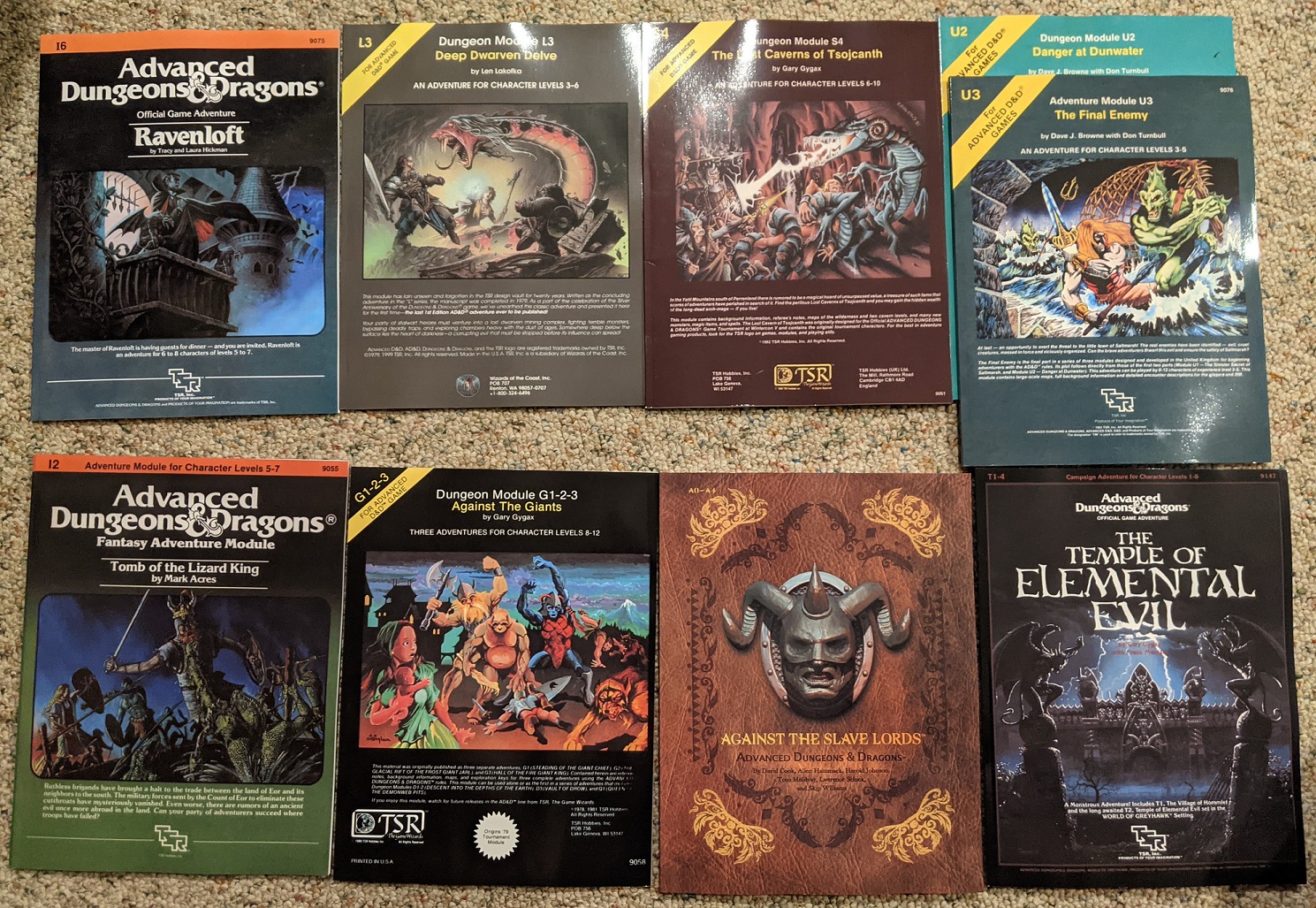
Sundays now are lazy days for me. I either post something silly or other people’s work. Usually both. Today, it’s about someone else’s work. If you follow this blog, it’s impossible not to know that I’m preparing for a return to 1st Edition AD&D. This week, I received the bulk of my new purchases.
I’m still awaiting three more titles: The Monster Manual II, the Dungeon Master’s Guide, and Unearthed Arcana. I don’t expect to make full use of this collection. A lot of this is to complete my collection, but even the stuff I don’t use will help me enhance the stuff I do use. As far as I’m concerned, none of this was a waste of money . . . except for I2: Tomb of the Lizard King, for which I accidentally bought two copies. That cost me only an extra $10. Fortunately, I’ve already sold and mailed it.
In case you’re wondering, I bought these via the DMs’ Guild, which is “direct” from Wizards of the Coast, but they run off the Drive Thru RPG engine. I’m not 100% sure of the relationship, but regardless of which site I’m on, I see the purchases I made from both. They were promised to be delivered within two weeks, but I got them within five days. Someone on MeWe pointed out one drawback of buying the reprinted adventures: The maps aren’t removeable. This is true, but it’s not a problem if, like me, you’ll actually run the game with the (bookmarked) PDFs. In all other ways, the adventures are the same as the original ones, but they’re reasonably priced. Getting a good price on any of these is possible, but it takes a lot of patience. Most of them cost literally 100s of dollars until you find that one offering that’s reasonable. I just bit the bullet and bought want I wanted for my collection without any danger of overpaying.









 Play What You Want